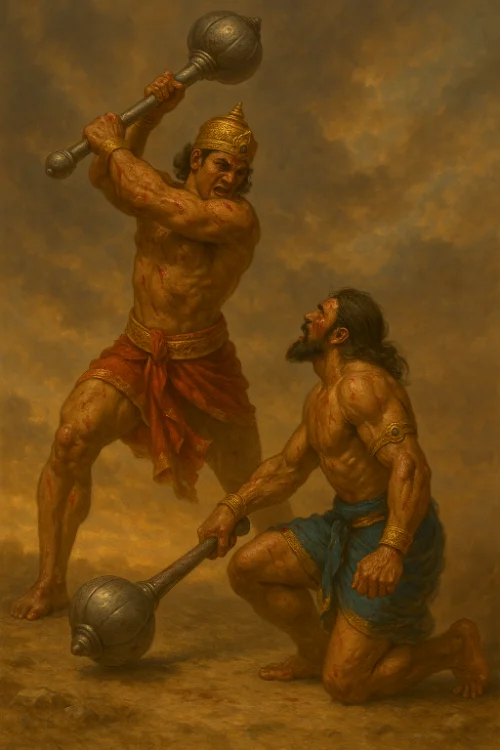
Mahābhārata - Shalya Parva
Chapter 57 - The Encounter Between Bhima and Duryodhana
संजय उवाच
ततो दुर्योधनो दृष्ट्वा भीमसेनं तथागतम् ।
प्रत्युद्ययावदीनात्मा वेगेन महता नदन् ॥ १ ॥
saṃjaya uvāca
tato duryodhano dṛṣṭvā bhīmasenaṃ tathāgatam |
pratyudyayāvadīnātmā vegena mahatā nadan || 1 ||
Sanjaya said Seeing Bhimasena in that state, Duryodhana rushed furiously against him, uttering a roar.
समापेततुरन्योन्यं शृङ्गिणौ वृषभाविव ।
महानिर्घातघोषश्चं प्रहाराणामजायत॥ २ ॥
samāpetaturanyonyaṃ śṛṅgiṇau vṛṣabhāviva |
mahānirghātaghoṣaścaṃ prahārāṇāmajāyata|| 2 ||
They met each other like two bulls encountering each other with their horns. The strokes of their maces produced loud sounds like those of thunderbolts.
अभवच तयोर्युद्धं तुमुलं लोमहर्षणम् ।
जिगीषतोर्यथान्योन्यमिन्द्रप्रह्लादयोरिव ॥ ३ ॥
abhavaca tayoryuddhaṃ tumulaṃ lomaharṣaṇam |
jigīṣatoryathānyonyamindraprahlādayoriva || 3 ||
Each sought victory, and their battle was terrible, making the hair stand erect like that between Indra and Pralada.
रुधिरोक्षितसर्वाङ्गौ गदाहस्तौ मनस्विनौ ।
ददृशाते महात्मानौ पुष्पिताविव किंशुकौ ॥ ४ ॥
rudhirokṣitasarvāṅgau gadāhastau manasvinau |
dadṛśāte mahātmānau puṣpitāviva kiṃśukau || 4 ||
With all their limbs covered with blood, the two great and energetic warriors, armed with maces, looked like two Kinshukas decked with flowers.
तथा तस्मिन् महायुद्धे वर्तमाने सुदारुणे ।
खद्योतसंघैरिव खं दर्शनीयं व्यरोचत ॥ ५ ॥
tathā tasmin mahāyuddhe vartamāne sudāruṇe |
khadyotasaṃghairiva khaṃ darśanīyaṃ vyarocata || 5 ||
During the onset of that tremendous and awful encounter, the sky looked beautiful, as if it swarmed with fireflies.
तथा तस्मिन् वर्तमाने संकुले तुमुले भृशम्।
उभावपि परिश्रान्तौ युध्यमानावरिंदमौ ॥ ६ ॥
tathā tasmin vartamāne saṃkule tumule bhṛśam|
ubhāvapi pariśrāntau yudhyamānāvariṃdamau || 6 ||
After that fierce and terrible battle had lasted for some time, both were exhausted.
तौ मुहूर्तं समाश्वस्य पुनरेव परंतप ।
अभ्यहारयतान्योन्यं सम्प्रगृह्य गदे शुभे ॥ ७ ॥
tau muhūrtaṃ samāśvasya punareva paraṃtapa |
abhyahārayatānyonyaṃ sampragṛhya gade śubhe || 7 ||
Having rested for some time, those two destroyers of foes, taking up their handsome maces, once again began to prevent each other's attacks.
तौ तु दृष्ट्वा महावीर्यौ समाश्वस्तौ नरर्षभौ ।
बलिनौ वारणौ यद्वद्वासितार्थे मदोत्कटौ ॥ ८ ॥
tau tu dṛṣṭvā mahāvīryau samāśvastau nararṣabhau |
balinau vāraṇau yadvadvāsitārthe madotkaṭau || 8 ||
Seeing those two mighty heroes, firm and unshaken, the best among men, they appeared like two strong elephants, maddened with the rut, ready to accomplish their purpose.
समानवीय सम्प्रेक्ष्य प्रगृहीतगदावुभौ ।
विस्मयं परमं जग्मुर्देवगन्धर्वमानवाः ॥ ९ ॥
samānavīya samprekṣya pragṛhītagadāvubhau |
vismayaṃ paramaṃ jagmurdevagandharvamānavāḥ || 9 ||
Seeing those two heroes, armed with maces and equaling each other in energy, the gods, Gandharvas, and men were filled with wonder.
प्रगृहीतगदौ दृष्ट्वा दुर्योधनवृकोदरौ।
संशयः सर्वभूतानां विजये समपद्यत ॥ १० ॥
pragṛhītagadau dṛṣṭvā duryodhanavṛkodarau|
saṃśayaḥ sarvabhūtānāṃ vijaye samapadyata || 10 ||
Beholding Duryodhana and Vrikodara, armed with mace, all creatures became doubtful about who would come off victorious amongst them.
समागम्य ततो भूयो भ्रातरो बलिनां वरौ ।
अन्योन्यस्यन्तरप्रेप्सू प्रचक्रातेऽन्तरं प्रति ॥ ११ ॥
samāgamya tato bhūyo bhrātaro balināṃ varau |
anyonyasyantaraprepsū pracakrāte’ntaraṃ prati || 11 ||
Rushing each other and desiring to take advantage of each other's weaknesses, those two great cousins waited, each watching the other.
यमदण्डोपमां गुर्वीमिन्द्राशनिमिवोद्यताम् ।
ददृशुः प्रेक्षका राजन् रौद्री विशसनीं गदाम् ॥१२॥
yamadaṇḍopamāṃ gurvīmindrāśanimivodyatām |
dadṛśuḥ prekṣakā rājan raudrī viśasanīṃ gadām ||12||
People, O king, saw each armed with his uplifted mace, which was heavy, dreadful, and killing, and that resembled the bludgeon of Yama or the thunderbolt of Indra.
आविद्ध्यतो गदां तस्य भीमसेनस्य संयुगे ।
शब्दः सुतुमुलो घोरो मुहूर्तं समपद्यत ॥ १३ ॥
āviddhyato gadāṃ tasya bhīmasenasya saṃyuge |
śabdaḥ sutumulo ghoro muhūrtaṃ samapadyata || 13 ||
While Bhimasena whirled his weapon, it produced a loud and dreadful sound.
आविद्ध्यन्तमरिं प्रेक्ष्य धार्तराष्ट्रोऽथ पाण्डवम् ।
गदामतुलवेगां तां विस्मितः सम्बभूवह ॥ १४ ॥
āviddhyantamariṃ prekṣya dhārtarāṣṭro’tha pāṇḍavam |
gadāmatulavegāṃ tāṃ vismitaḥ sambabhūvaha || 14 ||
Seeing his foe, the son of Pandu, thus whirling his mace, the impetuous Duryodhana was amazed.
चरंश्च विविधानं मार्गान् मण्डलानि च भारत ।
अशोभत तदा वीरो भूय एव वृकोदरः ॥ १५ ॥
caraṃśca vividhānaṃ mārgān maṇḍalāni ca bhārata |
aśobhata tadā vīro bhūya eva vṛkodaraḥ || 15 ||
Indeed, the heroic Vrikodara, O Bharata, as he moved about in various courses, shone highly beautiful.
तौ परस्परमासाद्य यत्तावन्योन्यरक्षणे ।
मार्जाराविव भक्षार्ये ततक्षाते मुहुर्मुहुः ॥ १६ ॥
tau parasparamāsādya yattāvanyonyarakṣaṇe |
mārjārāviva bhakṣārye tatakṣāte muhurmuhuḥ || 16 ||
Both bent upon carefully protecting themselves and as they approached, they repeatedly wounded each other like two cats fighting for a piece of meat.
अचरद् भीमसेनस्तु मार्गान् बहुविधांस्तथा ।
मण्डलानि विचित्राणि गतप्रत्यागतानि च ॥ १७ ॥
acarad bhīmasenastu mārgān bahuvidhāṃstathā |
maṇḍalāni vicitrāṇi gatapratyāgatāni ca || 17 ||
Bhimasena performed various kinds of evolutions. He moved about in beautiful circles, advanced, and receded.
अस्त्रयन्त्राणि चित्राणि स्थानानि विविधानि च।
परिमोक्षं प्रहाराणां वर्जनं परिधावनम् ॥ १८ ॥
astrayantrāṇi citrāṇi sthānāni vividhāni ca|
parimokṣaṃ prahārāṇāṃ varjanaṃ paridhāvanam || 18 ||
He dealt blows and warded off those of his opponent with extraordinary dexterity. He took up various kinds of offensive and defensive positions. He made attacks and warded off those of his opponent. He ran at his enemy, turning to the right and then to the left.
अभिद्रवणमाक्षेपमवस्थानं सविग्रहम् ।
परिवर्तनसंवर्तमवप्लुतमुपप्लुतम् ॥ १९ ॥
abhidravaṇamākṣepamavasthānaṃ savigraham |
parivartanasaṃvartamavaplutamupaplutam || 19 ||
He advanced straight against the foe. He made various tricks for drawing his foe. He stood immovable, bent upon attacking his enemy as soon as the latter would expose himself to attack. He went around his foe and prevented his foe from circumambulating him. He avoided his enemy's attacks by moving away in bent postures or jumping up.
उपन्यस्तमपन्यस्तं गदायुद्धविशारदौ ।
एवं तौ विचरन्तौ तु परस्परमविध्यताम् ॥ २० ॥
upanyastamapanyastaṃ gadāyuddhaviśāradau |
evaṃ tau vicarantau tu parasparamavidhyatām || 20 ||
Faced with his enemy, he struck or dealt backthrusts while moving away from him. Bhima and Duryodhana, experts in mace-fighting, thus moved about, fought, and hit each other.
वञ्जयानौ पुनश्चैव चेरतुः कुरुसत्तमौ ।
विक्रीडन्तौ सुबलिनौ मण्डलानि विचेरतुः ॥ २१॥
vañjayānau punaścaiva ceratuḥ kurusattamau |
vikrīḍantau subalinau maṇḍalāni viceratuḥ || 21||
Those two leading Kuru's heroes fared well. Thus, each avoided the other's attacks. Indeed, those two great warriors moved about in circles and seemed to play with each other.
तौ दर्शयन्तौ समरे युद्धक्रीडां समन्ततः ।
गदाभ्यां सहसान्योन्यमाजघ्नतुररिंदमौ ॥ २२ ॥
परस्परं समासाद्य दंष्ट्राभ्यां द्विरदौ यथा ।
अशोभेतां महाराज शोणितेन परिप्लुतौ ॥ २३ ॥
tau darśayantau samare yuddhakrīḍāṃ samantataḥ |
gadābhyāṃ sahasānyonyamājaghnaturariṃdamau || 22 ||
parasparaṃ samāsādya daṃṣṭrābhyāṃ dviradau yathā |
aśobhetāṃ mahārāja śoṇitena pariplutau || 23 ||
Displaying their skill in battle in that encounter, those two destroyers of foes sometimes suddenly attacked each other with their weapons, like two elephants attacked each other with their tusks. Bathed in blood, they looked stunning, O king, on the field.
एवं तदभवद्युद्धं घोररूपं परंतप ।
परिवृत्तेऽहनिं क्रूर वृत्रवासवयोरिव ॥ २४ ॥
गदाहस्तौ ततस्तौ तु मण्डलावस्थितौ बली ।
evaṃ tadabhavadyuddhaṃ ghorarūpaṃ paraṃtapa |
parivṛtte’haniṃ krūra vṛtravāsavayoriva || 24 ||
gadāhastau tatastau tu maṇḍalāvasthitau balī |
Thus, towards the close of the day, a dreadful battle took place before the very eyes of an immense multitude, like the battle between Vritra and Vasava. Armed with maces, both began to move about in circles.
दक्षिणं मण्डलं राजन् भीमसेनोऽभ्यवर्तत ॥ २५ ॥
सव्यं तु मण्डलं तत्र भीमसेनोऽभ्यवर्तत।
dakṣiṇaṃ maṇḍalaṃ rājan bhīmaseno’bhyavartata || 25 ||
savyaṃ tu maṇḍalaṃ tatra bhīmaseno’bhyavartata|
Duryodhana, O king, adopted the right Mandala, while Bhimasena adopted the left Mandala.
तथा तु चरतस्तस्य भीमस्य रणमूर्धनि ॥ २६ ॥
दुर्योधनो महाराज पार्श्वदेशेऽभ्यताडयत् ।
tathā tu caratastasya bhīmasya raṇamūrdhani || 26 ||
duryodhano mahārāja pārśvadeśe’bhyatāḍayat |
While Bhima was thus moving about in circles on the battlefield, Duryodhana, O king, suddenly struck him with a fierce blow on one of his flanks.
आहतस्तु ततो भीमः पुत्रेण तव भारत ।। २७॥
आविद्धयत गदां गुर्वी प्रहारं तमचिन्तयन् ।
āhatastu tato bhīmaḥ putreṇa tava bhārata || 27||
āviddhayata gadāṃ gurvī prahāraṃ tamacintayan |
Struck by your son, Bhima began to whirl his heavy mace for returning the same.
इन्द्राशनिसमा घोरां यमदण्डमिवोद्यताम् ॥ २८॥
ददृशुस्ते महाराज भीमसेनस्य तां गदाम् ।
indrāśanisamā ghorāṃ yamadaṇḍamivodyatām || 28||
dadṛśuste mahārāja bhīmasenasya tāṃ gadām |
People, O king, saw the mace of Bhimasena look as terrible as Indra's thunderbolt or Yama's rod.
आविध्यन्तं गदां दृष्ट्वा भीमसेनं तवात्मजः ॥ २९ ॥
समुद्यम्य गदां घोरां प्रत्यविध्यत् परंतपः ।
āvidhyantaṃ gadāṃ dṛṣṭvā bhīmasenaṃ tavātmajaḥ || 29 ||
samudyamya gadāṃ ghorāṃ pratyavidhyat paraṃtapaḥ |
Seeing Bhima whirl his mace, your son took up his terrible weapon and struck him again.
गदामारुतवेगेन तव पुत्रस्य भारत ॥ ३० ॥
शब्द आसीत् सुतुमुलस्तेजश्च समजायत ।
gadāmārutavegena tava putrasya bhārata || 30 ||
śabda āsīt sutumulastejaśca samajāyata |
A loud sound, O Bharata, was caused by the fall of your son's mace. The fall was so quick that it caused a flame of fire in the sky.
सचरन् विविधान् मार्गान् मण्डलानि च भागशः ॥ ३१॥
समशोभत तेजस्वी भूयो भीमात् सुयोधनः ।
sacaran vividhān mārgān maṇḍalāni ca bhāgaśaḥ || 31 ||
samaśobhata tejasvī bhūyo bhīmāt suyodhanaḥ |
Coursing in circles, adopting each motion at the proper time, the energetic Suyodhana once more seemed to prevail over Bhima.
आविद्धा सर्ववेगेन भीमेन महती गदा ॥ ३२ ॥
सधूमं सार्चिषं चाग्निं मुमोचोग्रमहास्वना ।
āviddhā sarvavegena bhīmena mahatī gadā || 32 ||
sadhūmaṃ sārciṣaṃ cāgniṃ mumocogramahāsvanā |
Meanwhile, Bhimasena's massive mace whirled with his entire force, producing a tremendous sound and valleys of smoke, sparks, and flames.
आधूतां भीमसेनेन गदां दृष्ट्वा सुयोधनः ॥ ३३ ॥
अद्रिसारमयीं गुर्वीमाविध्यन् बह्वशोभत ।
ādhūtāṃ bhīmasenena gadāṃ dṛṣṭvā suyodhanaḥ || 33 ||
adrisāramayīṃ gurvīmāvidhyan bahvaśobhata |
Seeing Bhimasena whirling his mace, Suyodhana also whirled his heavy and adamantine mace, which appeared highly beautiful.
गदामारुतवेगं हि दृष्ट्वा तस्य महात्मनः ॥ ३४॥
भयं विवेश पाण्डूंस्तु सर्वानेव ससोमकान् ।
gadāmārutavegaṃ hi dṛṣṭvā tasya mahātmanaḥ || 34||
bhayaṃ viveśa pāṇḍūṃstu sarvāneva sasomakān |
Marking the vehemence of the wind caused by the whirl of Duryodhana's mace, the Pandus, and the Somakas were stricken with great fear.
तौ दर्शयन्तौ समरे युद्धक्रीडां समन्ततः ॥ ३५ ॥
गदाभ्यां सहसान्योन्यमाजघ्नतुररिंदमौ ।
तौ परस्परमासाद्य दंष्ट्राभ्यां द्विरदौ यथा ॥ ३६ ॥
अशोभेतां महाराज शोणितेन परिप्लुतौ ।
tau darśayantau samare yuddhakrīḍāṃ samantataḥ || 35 ||
gadābhyāṃ sahasānyonyamājaghnaturariṃdamau |
tau parasparamāsādya daṃṣṭrābhyāṃ dviradau yathā || 36 ||
aśobhetāṃ mahārāja śoṇitena pariplutau |
Meanwhile, showing on every side their skill in battle, those two chastisers of foes continued to strike each other with their maces, like two elephants striking each other with their tusks. Both of them, O king, covered with blood, shone highly beautiful.
एवं तदभवद्युद्धं घोररूपमसंवृतम् ॥ ३७॥
परिवृत्तेऽहनि क्रूरं वृत्रवासवयोरिव ।
evaṃ tadabhavadyuddhaṃ ghorarūpamasaṃvṛtam || 37||
parivṛtte’hani krūraṃ vṛtravāsavayoriva |
Thus, that dreadful battle went on before the very eyes of thousands of spectators at the close of the day, like the fierce battle between Vritra and Vasava.
दृष्ट्वा व्यवस्थितं भीमं तव पुत्रो महाबलः ॥ ३८ ॥
चरंश्चित्रतरान् मार्गान् कौन्तेयमभिदुद्रुवे ।
dṛṣṭvā vyavasthitaṃ bhīmaṃ tava putro mahābalaḥ || 38 ||
caraṃścitratarān mārgān kaunteyamabhidudruve |
Seeing Bhima firmly stationed on the field, your powerful son, moving about, rushed towards that son of Kunti.
तस्य भीमो महावेगां जाम्बूनदपरिष्कृताम् ॥ ३९ ॥
अतिक्रुद्धस्य क्रुद्धस्तु ताडयामास तां गदाम् ।
tasya bhīmo mahāvegāṃ jāmbūnadapariṣkṛtām || 39 ||
atikruddhasya kruddhastu tāḍayāmāsa tāṃ gadām |
Worked up with wrath, Bhima struck the mace, endued with great impetuosity and adorned with gold, of the angry Duryodhana.
सविस्फुलिङ्गो निर्ह्रादस्तयोस्तत्राभिघातजः ॥ ४० ॥
प्रादुरासीन्महाराज सृष्टयोर्वज्रयोरिव ।
savisphuliṅgo nirhrādastayostatrābhighātajaḥ || 40 ||
prādurāsīnmahārāja sṛṣṭayorvajrayoriva |
The clash of the two maces produced a loud sound with sparks of fire, resembling the clash of two thunderbolts from opposite directions.
वेगवत्या तया तत्र भीमसेनप्रमुक्तया ॥ ४१ ॥
निपतन्त्या महाराज पृथिवी समकम्पत ।
vegavatyā tayā tatra bhīmasenapramuktayā || 41 ||
nipatantyā mahārāja pṛthivī samakampata |
Discharged by Bhimasena, his impetuous mace shook the Earth as it dropped.
तां नामृष्यत कौरव्यो गदां प्रतिहतां रणे ॥ ४२ ॥
मत्तो द्विप इव क्रुद्धः प्रतिकुञ्जरदर्शनात् ।
tāṃ nāmṛṣyata kauravyo gadāṃ pratihatāṃ raṇe || 42 ||
matto dvipa iva kruddhaḥ pratikuñjaradarśanāt |
The Kuru prince could not see his mace, so he was baffled by that attack. At the sight of a rival elephant, he was enraged like an infuriated elephant.
स सव्यं मण्डलं राजा उद्भ्राम्य कृतनिश्चयः ॥ ४३॥
आज मूर्ध्नि कौन्तेयं गदया भीमवेगया।
sa savyaṃ maṇḍalaṃ rājā udbhrāmya kṛtaniścayaḥ || 43||
āja mūrdhni kaunteyaṃ gadayā bhīmavegayā|
Adopting the left Mandala, O king, and whirling his mace, Suyodhana then struck the son of Kunti on the head with his terrible weapon.
तया त्वभिहतो भीमः पुत्रेण तव पाण्डवः ॥ ४४ ॥
नाकम्पत महाराज तदद्भुतमिवाभवत् ।
tayā tvabhihato bhīmaḥ putreṇa tava pāṇḍavaḥ || 44 ||
nākampata mahārāja tadadbhutamivābhavat |
Thus struck by your son, Bhima, the son of Pandu, did not even quake, O king, and the sight filled all present with wonder.
आश्चर्यं चापि तद् राजन् सर्वसैन्यान्यपूजयन् ॥ ४५ ॥
यद् गदाभिहतो भीमो नाकम्पत पदात् पदम्।
ततो गुरुतरां दीप्तां गदां हेमपरिष्कृताम् ॥ ४६ ॥
दुर्योधनाय व्यसृजद् भीमो भीमपराक्रमः ।
āścaryaṃ cāpi tad rājan sarvasainyānyapūjayan || 45 ||
yad gadābhihato bhīmo nākampata padāt padam|
tato gurutarāṃ dīptāṃ gadāṃ hemapariṣkṛtām || 46 ||
duryodhanāya vyasṛjad bhīmo bhīmaparākramaḥ |
That tremendous patience, O king of Bhimasena, who did not move an inch, though struck so violently, was praised by all the combatants there. Then Bhima hurled at Duryodhana his own heavy and shining mace adorned with gold.
तं प्रहारमसम्भ्रान्तो लाघवेन महाबलः ॥ ४७ ॥
मोघं दुर्योधनश्चक्रे तत्राभूद् विस्मयो महान् ।
taṃ prahāramasambhrānto lāghavena mahābalaḥ || 47 ||
moghaṃ duryodhanaścakre tatrābhūd vismayo mahān |
With incredible swiftness and composure, that mighty warrior rendered Duryodhana's attack futile. Great astonishment arose there among the onlookers.
सा तु मोघा गदा राजन् पतन्ती भीमचोदिता ॥ ४८ ॥
चालयामास पृथिवी महानिर्घातनिः स्वना ।
sā tu moghā gadā rājan patantī bhīmacoditā || 48 ||
cālayāmāsa pṛthivī mahānirghātaniḥ svanā |
That mace, hurled by Bhima, O king, Produced a loud sound like a thunderbolt and shook the very Earth.
आस्थाय कौशिकान् मार्गानुत्पतन् स पुनः पुनः ॥ ४९ ॥
गदानिपातं प्रज्ञाय भीमसेनं च वञ्चितम् ।
āsthāya kauśikān mārgānutpatan sa punaḥ punaḥ || 49 ||
gadānipātaṃ prajñāya bhīmasenaṃ ca vañcitam |
Adopting the maneuver called Kaushika and jumping up repeatedly, Duryodhana properly caused Bhima's mace to fall, rendering it useless.
वञ्चयित्वा तदा भीमं गदया कुरुसत्तमः ॥ ५० ॥
ताडयामास संक्रुद्धो वक्षोदेशे महाबलः ।
vañcayitvā tadā bhīmaṃ gadayā kurusattamaḥ || 50 ||
tāḍayāmāsa saṃkruddho vakṣodeśe mahābalaḥ |
Thus, the mighty Kuru king, baffling Bhimasena, finally struck the former in the chest in anger.
गया निहतो भीमो मुह्यमानो महारणे ॥ ५१ ॥
नाभ्यमन्यत कर्तव्यं पुत्रेणाभ्याहतस्तव ।
gayā nihato bhīmo muhyamāno mahāraṇe || 51 ||
nābhyamanyata kartavyaṃ putreṇābhyāhatastava |
Struck very forcibly by your son in that dreadful battle, Bhimasena was stupefied and, for a time, knew not what to do.
तस्मिंस्तथा वर्तमाने राजन् सोमकपाण्डवाः ॥ ५२ ॥
भृशोपहतसंकल्पा न हृष्टमनसोऽभवन् ।
tasmiṃstathā vartamāne rājan somakapāṇḍavāḥ || 52 ||
bhṛśopahatasaṃkalpā na hṛṣṭamanaso’bhavan |
At that time, O king, the Somakas, and the Pandavas were greatly disappointed and dispirited.
स तु तेन प्रहारेण मातङ्ग इव रोहितः ॥ ५३ ॥
हस्तिवद्धस्तिसंकाशमभिदुद्राव ते सुतम् ।
sa tu tena prahāreṇa mātaṅga iva rohitaḥ || 53 ||
hastivaddhastisaṃkāśamabhidudrāva te sutam |
Worked up with anger at that blow, Bhima then rushed at your son like an elephant rushing against an elephant.
ततस्तु तरसा भीमो गया तनयं तव ।। ५४ ।।
अभिदुद्राव वेगेन सिंहो वनगजं यथा ।
tatastu tarasā bhīmo gayā tanayaṃ tava || 54 ||
abhidudrāva vegena siṃho vanagajaṃ yathā |
With uplifted mace, Bhima rushed furiously at Duryodhana like a lion rushing against a wild elephant.
उपसृत्य तु राजानं गदामोक्षविशारदः ।। ५५ ।।
आविध्यत गदां राजन् समुद्दिश्य सुतं तव।
upasṛtya tu rājānaṃ gadāmokṣaviśāradaḥ || 55 ||
āvidhyata gadāṃ rājan samuddiśya sutaṃ tava|
Approaching the Kuru king, the son of Pandu, O king, an expert in the use of the mace, began to whirl his weapon, aiming at your son.
अताडयद् भीमसेनः पार्श्वे दुर्योधनं तदा ॥ ५६ ॥
स विह्वलः प्रहारेण जानुभ्यामगमन्महीम् ।
atāḍayad bhīmasenaḥ pārśve duryodhanaṃ tadā || 56 ||
sa vihvalaḥ prahāreṇa jānubhyāmagamanmahīm |
Bhimasena then struck Duryodhana on one of his sides. Stupefied at that blow, the latter dropped down on the Earth, supporting himself on his knees.
तस्मिन् कुरुकुलश्रेष्ठे जानुभ्यामवनीं गते ॥ ५७ ॥
उदतिष्ठत् ततो नादः सृजयानां जगत्पते ।
tasmin kurukulaśreṣṭhe jānubhyāmavanīṃ gate || 57 ||
udatiṣṭhat tato nādaḥ sṛjayānāṃ jagatpate |
When that Kuru's hero fell upon his knees, a loud cry arose among the Srinjayas, O king!
तेषां तु निनदं श्रुत्वा संजयानां नरर्षभः ॥ ५८ ॥
अमर्षाद् भरतश्रेष्ठ पुत्रस्ते समकुप्यत ।
teṣāṃ tu ninadaṃ śrutvā saṃjayānāṃ nararṣabhaḥ || 58 ||
amarṣād bharataśreṣṭha putraste samakupyata |
Upon hearing the roar of the victorious warriors, your son, O best of the Bharatas, the foremost among men, was filled with intense anger.
उत्थाय तु महाबाहुर्महानाग इव श्वसन् ॥ ५९ ॥
दिधक्षन्निव नेत्राभ्यां भीमसेनमवैक्षत ।
utthāya tu mahābāhurmahānāga iva śvasan || 59 ||
didhakṣanniva netrābhyāṃ bhīmasenamavaikṣata |
Rising, the mighty-armed hero began to breathe like a mighty snake and seemed to burn Bhimasena by looking at him.
ततः स भरतश्रेष्ठो गजापाणिरभिद्रवन् ॥ ६० ॥
प्रमथिष्यन्निव शिरो भीमसेनस्य संयुगे ।
tataḥ sa bharataśreṣṭho gajāpāṇirabhidravan || 60 ||
pramathiṣyanniva śiro bhīmasenasya saṃyuge |
That best of the line of Bharata then rushed at Bhimasena as if he would crush his opponent's head in that battle.
स महात्मा महात्मानं भीमं भीमपराक्रमः ॥ ६१ ॥
अताडयच्छङ्घदेशे न चचालाचलोपमः ।
sa mahātmā mahātmānaṃ bhīmaṃ bhīmaparākramaḥ || 61 ||
atāḍayacchaṅghadeśe na cacālācalopamaḥ |
The great and mighty Duryodhana then struck the high-souled Bhimasena on the forehead. The latter, however, stirred not an inch but stood fixed like a mountain.
भूयः शुशुभे पार्थस्ताडितो गदया रणे ।
उद्भिन्नरुधिरो राजन्प्रभिन्न इव कुञ्जरः ॥ ६२ ॥
bhūyaḥ śuśubhe pārthastāḍito gadayā raṇe |
udbhinnarudhiro rājanprabhinna iva kuñjaraḥ || 62 ||
Thus struck in that battle, the son of Pritha, O king, looked beautiful as he bled profusely, like an elephant with temporal juice trickling down its temples.
ततो गदां वीरहणीमयोमयां प्रगृह्य वज्राशनितुल्यानिः स्वनाम् ।
अताडयच्छत्रुममित्रकर्षणो ada विक्रम्य धनंजयाग्रजः ॥ ६३ ॥
tato gadāṃ vīrahaṇīmayomayāṃ pragṛhya vajrāśanitulyāniḥ svanām |
atāḍayacchatrumamitrakarṣaṇo ada vikramya dhanaṃjayāgrajaḥ || 63 ||
Then, taking up his hero-killing mace made of iron and producing a loud sound like the thunderbolt, the elder brother of Dhananjaya struck his opponent with great force.
स भीमसेनाभिहतस्तवात्मजः पपात संकम्पितदेहबन्धनः ।
सुपुष्पितो मारुतवेगताडितो वने यथा शाल इवाघूर्णितः ॥ ६४ ॥
sa bhīmasenābhihatastavātmajaḥ papāta saṃkampitadehabandhanaḥ |
supuṣpito mārutavegatāḍito vane yathā śāla ivāghūrṇitaḥ || 64 ||
Struck by Bhimasena, your son dropped down, his body trembling all over, like a gigantic Shala in the forest, decked with flowers, uprooted by a tempest.
ततः प्रणेदुर्जहृषुश्च पाण्डवाः समीक्ष्य पुत्रं पतितं क्षितौ तव ।
ततः सुतस्ते प्रतिलभ्य चेतनां समुत्पपात द्विरदो यथा ह्रदात् ॥ ६५ ॥
tataḥ praṇedurjahṛṣuśca pāṇḍavāḥ samīkṣya putraṃ patitaṃ kṣitau tava |
tataḥ sutaste pratilabhya cetanāṃ samutpapāta dvirado yathā hradāt || 65 ||
When your son lay on the Earth, the Pandavas became highly glad and uttered loud cries. Regaining consciousness, your son rose like an elephant from a lake.
स पार्थिवो नित्यममर्षितस्तदा महारथ: शिक्षितवत् परिभ्रमन् ।
अताडयत् पाण्डवमग्रतः स्थितं सविला जगतीमुपास्पृशत् ॥ ६६ ॥
sa pārthivo nityamamarṣitastadā mahāratha: śikṣitavat paribhraman |
atāḍayat pāṇḍavamagrataḥ sthitaṃ savilā jagatīmupāspṛśat || 66 ||
That angry king and great car-warrior, moving about with great skill, struck Bhimasena, who was before him. Thereat, the son of Pandu, with weakened limbs, dropped down on the Earth.
स सिंहनादं विननाद कौरवो निपात्य भूमौ युधि भीममोजसा ।
बिभेद चैवाशनितुल्यमोजसा गदानिपातेन शरीररक्षणम् ॥ ६७ ॥
sa siṃhanādaṃ vinanāda kauravo nipātya bhūmau yudhi bhīmamojasā |
bibheda caivāśanitulyamojasā gadānipātena śarīrarakṣaṇam || 67 ||
His power struck Bhimasena on the ground; the Kuru prince sent a leonine roar. By the fall of his mace, whose vehemence was like that of the thunder, he had broken Bhima's coat of mail.
ततोऽन्तरिक्षे निनदो महानभूद् दिवौकसामप्सरसां च नेदुषाम् ।
पपात चौच्चैरमरप्रवेरितं विचित्रपुष्पोत्करवर्षमुत्तमम्॥६८॥
tato’ntarikṣe ninado mahānabhūd divaukasāmapsarasāṃ ca neduṣām |
papāta cauccairamarapraveritaṃ vicitrapuṣpotkaravarṣamuttamam||68||
A loud uproar was then heard in the sky made by the celestials and the Apsaras. A shower of flowers of sweet fragrance, rained by the celestials, poured in.
ततः परानाविशदुत्तमं भयं समीक्ष्य भूमौ पतितं नरोत्तमम् ।
अहीयमानं च बलेन कौरवं निशाम्य भेदं सुदृढस्य वर्मणः ॥ ६९ ॥
tataḥ parānāviśaduttamaṃ bhayaṃ samīkṣya bhūmau patitaṃ narottamam |
ahīyamānaṃ ca balena kauravaṃ niśāmya bhedaṃ sudṛḍhasya varmaṇaḥ || 69 ||
Seeing Bhima prostrated on the Earth and his coat-of-mail out open, our foes felt great fear.
ततो मुहूर्तादुपलभ्य चेतनां प्रमृज्य वक्त्रं रुधिराक्तमात्मनः ।
धृतिं समालम्ब्य विवृत्य लोचने बलेन संस्तभ्य वृकोदरः स्थितः ॥ ७० ॥
tato muhūrtādupalabhya cetanāṃ pramṛjya vaktraṃ rudhirāktamātmanaḥ |
dhṛtiṃ samālambya vivṛtya locane balena saṃstabhya vṛkodaraḥ sthitaḥ || 70 ||
After regaining his senses in a moment, wiping his bloody face, and gathering patience, Vrikodara stood up, rolling his eyes.
Full Synopsis of The Encounter Between Bhima and Duryodhana
The passage recounts the fierce and climactic mace duel between Bhima and Duryodhana during the Kurukshetra war, a confrontation filled with raw power, skill, and intense emotions.
As the battle begins, Duryodhana, enraged and roaring with fury, charges at Bhima. The two warriors engage in brutal and skillful combat, resembling two ferocious bulls locked in a deadly fight. Their maces clash with thunderous sounds, filling the battlefield with awe and terror. Bloodied but undeterred, both combatants display extraordinary dexterity, executing advanced maneuvers and tactical strikes.
The fight draws admiration from spectators, including gods and mortals, who are captivated by its prowess and endurance. Both warriors adopt complex combat techniques, like the Mandala formations, evading and countering each other's blows with remarkable precision. Despite the injuries they inflict upon each other, they continue to fight with unrelenting determination.
Duryodhana strikes Bhima with great force at one point, causing him to falter and drop to the ground. This momentary triumph prompts a roar of celebration from Duryodhana and his supporters. However, Bhima quickly regains his composure, standing once more like an immovable mountain. Enraged by his opponent's resilience, Duryodhana presses on with greater ferocity.
The duel intensifies further, with each warrior delivering devastating blows. With tremendous force, Bhima finally strikes Duryodhana on his side, causing the Kuru prince to collapse to his knees. Though he quickly rises again, his rage and exhaustion are evident. The Pandavas and their allies cheer as Bhima, undeterred by his injuries, continues fighting unyieldingly.
The battle is marked by triumph and despair, as the outcome remains uncertain. The passage ends with Bhima standing again after being temporarily struck down, his bloodied form a testament to his endurance and determination. The duel, a microcosm of the larger war, showcases the intensity of the conflict and the personal vendettas driving these two warriors.