Agni Purana
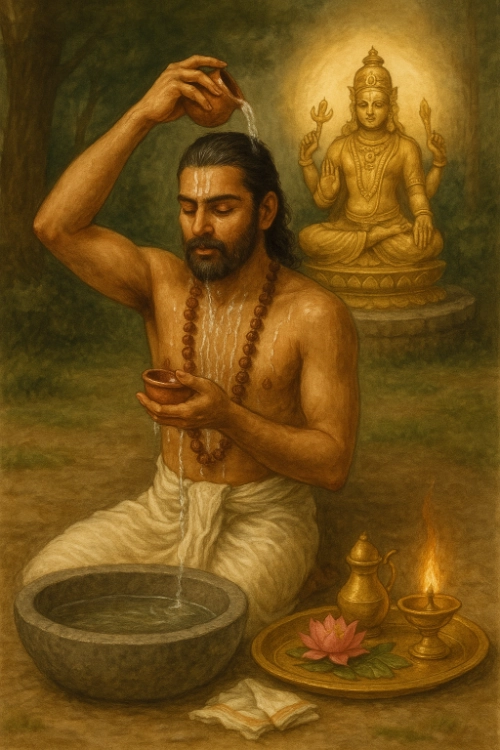
Chapter 22 - Description of the Bathing Rite
नारद उवाच
वक्ष्ये स्नानं क्रियाद्यर्थं नृसिंहेन तु मृत्तिकाम् ।
गृहीत्वा तां द्विधा कृत्वा मलस्नानमथैकया ॥१॥
nārada uvāca
vaksye snānaṁ kriyādy-arthaṁ nṛsiṁhena tu mṛttikām |
gṛhītvā tāṁ dvidhā kṛtvā mala-snānam athaikayā ||1||
Nārada said: I shall now describe the bathing rite for ritual purposes. Taking the sacred clay consecrated by Nṛsiṁha (nṛsiṁha-mṛttikā), the devotee should divide it into two portions; with one portion, he performs the purification bath that removes impurity.
निमज्याचम्य विन्यस्य सिंहेन कृतरक्षकः ।
विधिस्नानं ततः कुर्य्यात्प्राणायामपुरः सरम् ॥२॥
nimajyācamya vinyasya siṁhena kṛta-rakṣakaḥ
vidhi-snānaṁ tataḥ kuryyāt prāṇāyāma-puraḥsaram ||2||
After immersing himself, sipping water for purification, and establishing protective rites with the Nṛsiṁha-mantra, the devotee—thus safeguarded—should then perform the ritual bath according to rule, beginning with prāṇāyāma.
हृदि ध्यायन् हरिज्ञानं मन्त्रेणाष्टाक्षरेण हि ।
त्रिधा पाणितले मृत्स्नां दिग्बन्धं सिंहजप्ततः ॥३॥
hṛdi dhyāyan harijñānaṁ mantreṇāṣṭākṣareṇa hi |
tridhā pāṇitale mṛtsnāṁ digbandhaṁ siṁha-japtataḥ ||3||
Meditating in the heart upon the knowledge of Hari, and reciting the eight-syllabled mantra, he should take the sacred clay into his palm in three portions, establishing protection of the directions after chanting the Nṛsiṁha-mantra.
वासुदेवप्रजप्तेन तीर्थं सङ्कल्प्य चालभेत् ।
गात्रं वेदादिना मन्त्रैः सम्मार्ज्याराध्य मूर्त्तिना ॥४॥
vāsudeva-prajaptena tīrthaṁ saṅkalpya cālabhet |
gātraṁ vedādinā mantraiḥ sammārjya ārādhya mūrttinā ||4||
After consecrating the water as a sacred tīrtha by reciting the Vāsudeva-mantra, he should take it up. Then, using mantras from the Veda and similar hymns, he should purify his body by rubbing it, thus worshipping the divine form.
कृत्वाघमर्षणं वस्त्रं परिधाय समाचरेत् ।
विन्यस्य मन्त्रैर्द्विर्म्मार्ज्यं पाणिस्थं जलमेव च ॥५॥
kṛtvāghamarṣaṇaṁ vastraṁ paridhāya samācaret |
vinyasya mantrair dvir mārjyaṁ pāṇisthaṁ jalam eva ca ||5||
Having performed the Aghamarṣaṇa rite and putting on clean clothing, he should continue the procedure. Establishing the mantras through nyāsa, he should twice purify himself with the water held in his hand.
नारायणेन संयम्य वायुमाघ्राय चोत्सृजेत् ।
जलं ध्यायन् हरिं पश्चाद्दत्त्वार्घ्यं द्वादशाक्षरम् ॥६॥
nārāyaṇena saṁyamya vāyum āghrāya cotsṛjet |
jalaṁ dhyāyan hariṁ paścād dattvārghyaṁ dvādaśākṣaram ||6||
Restraining the breath with the Nārāyaṇa-mantra and inhaling it, he should then release it. Afterwards, meditating upon Hari in the water, he should offer the arghya while reciting the twelve-syllabled mantra.
जप्त्वान्याञ्छतशस्तस्य योगपीठादितः क्रमात् ।
मन्त्रान् दिक्पालपर्यन्तानृषीन् पितृगणानपि ॥७॥
japtvānyāñ śatashaḥ tasya yoga-pīṭhāditaḥ kramāt |
mantrān dikpāla-paryantān ṛṣīn pitṛ-gaṇān api ||7||
He should then recite, one hundred times, the other mantras connected with it, beginning from the Yoga-pīṭha and proceeding in due order, including the mantras for the guardians of the directions, the Ṛṣis, and also the hosts of the ancestors.
मनुष्यान् सर्वभूतानि स्थावरान्तान्यथावसेत् ।
न्यस्य चाङ्गानि संहृत्य मन्त्रान्यागगृहं व्रजेत्
manuṣyān sarva-bhūtāni sthāvarāntānyathāvaset |
nyasya cāṅgāni saṁhṛtya mantrāny āgagṛhaṁ vrajet
He should mentally place all humans, all beings—even up to immovable creatures—in their proper places. Then, having performed the nyāsa of his bodily limbs and withdrawing the mantras, he should return to the worship-house.
एवम अभ्यासु पूजासु मूलाद्यैः स्नानमाचरेत् ॥ε॥
इत्यादि महापुराणे अग्नये स्नानविधिकथनं नाम द्वाविंशोऽध्यायः ।
evam abhyāsu pūjāsu mūlādyaiḥ snānam ācaret ॥8॥
ityādi mahāpurāṇe agnaye snānavidhi-kathanaṁ nāma dvāviṁśo’dhyāyaḥ ||
In this way, during all acts of worship, one should perform the ritual bath beginning with the foundational procedures. Thus ends the twenty-second chapter, entitled ‘Description of the Bathing Rite’, in the Agni section of the great Purāṇa.
Full Synopsis of Bathing Rite
Nārada teaches the sacred bathing ritual required before worship. The devotee begins by taking the Nṛsiṁha-consecrated clay, dividing it into two portions, and using one to perform the mala-snāna, the bath that removes impurity. After immersing himself, sipping water for internal purification, and establishing protective rites through the Nṛsiṁha-mantra, he proceeds to the formal ritual bath, beginning with prāṇāyāma.
Meditating on Hari within the heart and reciting the eight-syllabled mantra, he takes the clay into his hand in three portions and performs the directional protections (dig-bandha). He then consecrates the water with the Vāsudeva-mantra, uses Vedic mantras to cleanse the body, and thereby worships the divine presence within himself.
After performing the Aghamarṣaṇa rite and putting on clean garments, he conducts further purification, placing mantras upon his limbs through nyāsa and twice sanctifying himself with water. Holding the breath with the Nārāyaṇa-mantra, he inhales, releases, and then meditates on Hari within the water, offering arghya with the twelve-syllabled mantra.
He recites the associated mantras a hundred times, beginning with those of the Yoga-pīṭha, followed by the guardians of the directions, the Ṛṣis, and the hosts of the ancestors. He mentally assigns all beings—from humans down to immovable creatures—to their proper places within the ritual cosmos. Finally, withdrawing the mantras and completing limb-nyāsa, he returns to the worship-house.
Nārada concludes: in all acts of worship, this foundational method of ritual bathing should always be performed first. Thus ends the twenty-second chapter, the “Description of the Bathing Rite,” in the Āgneya section of the Mahāpurāṇa.


Commentary
The verse instructs the devotee to begin the ritual bath by turning inward: meditating in the heart on the divine knowledge of Hari while reciting the sacred eight-syllabled mantra oṁ namo nārāyaṇāya. With the mind thus purified, he takes the consecrated clay and divides it into three portions, symbolizing the cleansing of body, speech, and mind. Finally, he performs digbandha, sealing and protecting all directions by chanting the Nṛsiṁha mantra. In this way, inner focus, mantra-purification, physical sanctity, and divine protection all come together before the formal bathing rite begins.