Visit the best and largest 108 and 1008 names collection


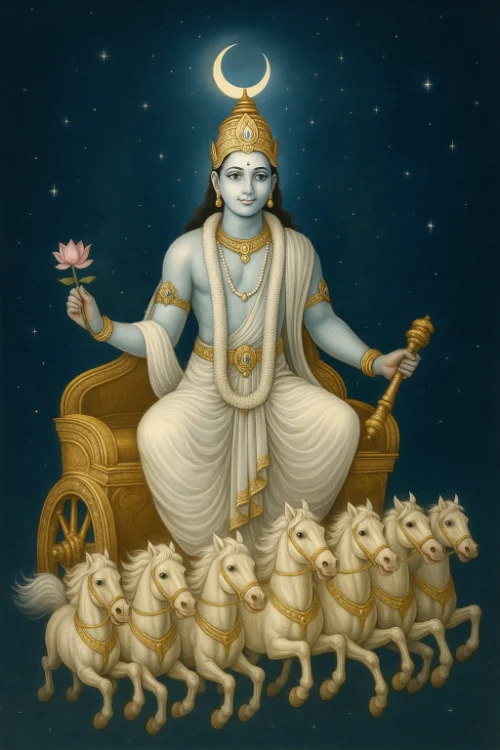
Chandra, the Moon God in Vedic tradition, governs the mind (manas), emotions, and intuition. His cooling, luminous presence is associated with soma, the nectar of immortality, and his mantras are used to cultivate mental clarity, emotional stability, and spiritual receptivity. As the fastest-moving graha, Chandra deeply influences our moods and thoughts. Mantras like "ॐ चन्द्राय नमः" or the powerful Gāyatrī variations offer remedies for astrological afflictions, strengthen calm reflection, and restore emotional balance.
This page presents authentic Vedic and Tantric Chandra mantras, including bīja mantras, Gāyatrīs, and poetic dhyāna verses such as “dadhi-śaṅkha-tuṣārābhaṁ…”. Each mantra is explained with transliteration, meaning, and the context of its spiritual and astrological use. Whether used in meditation, Jyotiṣa remedies, or lunar rituals like Pūrṇimā, Chandra mantras awaken the moon’s power within—the light of peace, intuition, and quiet brilliance.
ॐ श्रां श्रीं श्रौं चन्द्राय नमः।
oṁ śrāṁ śrīṁ śrauṁ candrāya namaḥ
Om — I bow to Chandra, the Moon God, who is evoked through the sacred syllables Shrāṁ, Shrīṁ, and Shrauṁ, and who bestows peace, emotional balance, and inner luminosity.
Spiritual & Practical Significance:
ॐ क्षीरपुत्राय विद्महे
अमृततत्त्वाय धीमहि
तन्नः चन्द्रः प्रचोदयात्॥
oṁ kṣīraputrāya vidmahe
amṛtatattvāya dhīmahi
tanno candraḥ pracodayāt
Om — Let us contemplate Kṣīraputra, the son of the Milky Ocean.
Let us meditate upon the essence of immortality.
May Chandra, the Moon God, inspire and illumine our intellect.
This Chandra Gāyatrī is recited to:
It's traditionally chanted during Mondays, Pūrṇimā (full moon days), or during moonrise meditations.
ॐ अत्रिनन्दनाय विद्महे
शशधराय धीमहि
तन्नः सोमः प्रचोदयात्॥
oṁ atrinandanāya vidmahe
śaśadharāya dhīmahi
tanno somaḥ pracodayāt
Let us meditate on Atri’s son, who bears the crescent moon.
May Soma, the Moon God, illuminate our intellect.
सप्ताश्वरथमारूढं प्रचण्डं कश्यपात्मजम्।
श्वेतपद्मधरं देवं तं सोमं प्रपद्यये॥
saptāśva-ratham-ārūḍhaṁ pracaṇḍaṁ kaśyapātmajam
śveta-padma-dharaṁ devaṁ taṁ somaṁ prapadyaye
I bow to Soma, the Moon God,
Who rides a chariot drawn by seven horses,
Who is intensely radiant,
the son of Sage Kaśyapa,
Who holds a white lotus,
and is revered as a divine being (deva).
The white lotus and chariot are not just imagery—they reflect the Moon's role as a carrier of consciousness, moving across time and inner moods like his chariot across the sky.
दधिशङ्खतुषाराभं क्षीरोदर्नवसम्भवम्।
नमामि शशिनं सोमं शम्भोर्मुकुटभूषणम्॥
dadhi-śaṅkha-tuṣārābhaṁ kṣīroda-arnava-sambhavam
namāmi śaśinaṁ somaṁ śambhoḥ mukuṭa-bhūṣaṇam
dadhi-śaṅkha-tuṣārābham
“One whose form is like curd (dadhi), a conch (śaṅkha), and snow (tuṣāra)”
→ Symbolizing Chandra's coolness, purity, and radiant whiteness.
kṣīroda-arnava-sambhavam
“Born from the ocean of milk”
→ Refers to Chandra’s mythical origin during the Samudra Manthana (Churning of the Milky Ocean).
namāmi śaśinaṁ somaṁ
“I bow to Śaśin (moon-bearer), to Soma (moon deity)”
→ Śaśin is a name of Chandra meaning "marked with a hare" (referring to the moon’s surface).
Soma is both the moon and the divine nectar.
śambhoḥ mukuṭa-bhūṣaṇam
“Who is the ornament of Śiva’s crown”
→ Refers to how Chandra is worn on Śiva’s head, symbolizing mastery of time and mind.
This śloka beautifully expresses the cooling, calming, sattvic nature of the moon:
RESULT
The planetary deity Chandra is pleased to increase mental health and peace of mind.