Agni Purana
Chapter 283 - The Teaching of Mantra-Form Medicines
Verse 1-3
धन्वन्तरिरुवाच
आयुरारोग्यकर्तारः ॐकाराद्याश्च नाकदाः ।
ॐकारः परमो मन्त्रस्तं जप्त्वा चामरो भवेत् ॥ १ ॥
गायत्री परमो मन्त्रस्तां जप्त्वा भुक्तिमुक्तिभाक् ।
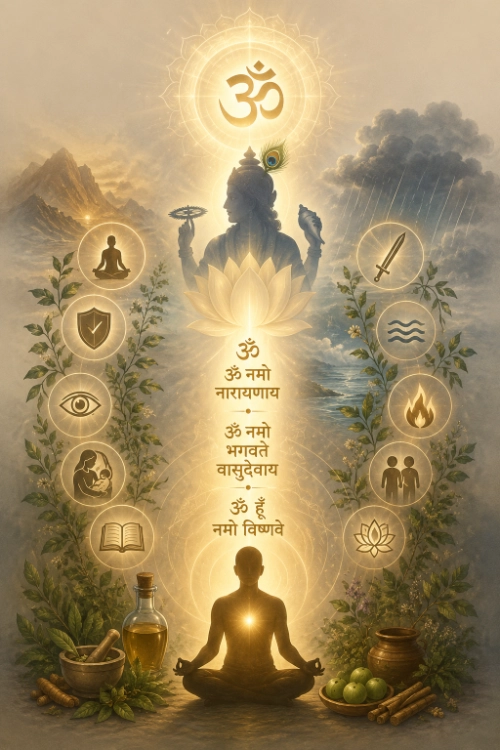
ॐ नमो नारायणाय मन्त्रः सर्वार्थसाधकः ॥ २ ॥
ॐ नमो भगवते वासुदेवाय सर्वदः ।
ॐ हूँ नमो विष्णवे मन्त्रोऽयं चौषधं परम् ॥ ३ ॥
Dhanvantarir uvāca
āyur-ārogya-kartāraḥ oṃkārādyāś ca nākadāḥ |
oṃkāraḥ paramo mantras taṃ japtvā cāmaro bhavet || 1 ||
gāyatrī paramo mantras tāṃ japtvā bhukti-mukti-bhāk |
oṃ namo nārāyaṇāya mantraḥ sarvārtha-sādhakaḥ || 2 ||
oṃ namo bhagavate vāsudevāya sarvadaḥ |
oṃ hūṃ namo viṣṇave mantro ’yaṃ cauṣadhaṃ param || 3 ||
Dhanvantari said: Mantras beginning with Oṃkāra are producers of long life and health, and bestowers of heaven. Oṃkāra is the supreme mantra; by reciting it, one becomes immortal.
The Gāyatrī is the supreme mantra; by reciting her, one becomes a recipient of both worldly enjoyment and liberation. The mantra “Oṃ namo Nārāyaṇāya” accomplishes every purpose.
The mantra “Oṃ namo Bhagavate Vāsudevāya” is always bestowing. This mantra, “Oṃ hūṃ namo Viṣṇave,” is also the supreme medicine.
Verse 4-6
अनेन देवा ह्यसुराः सश्रियः निरुजोऽभवन् ।
भूतानामुपकारश्च तथा धर्मो महौषधम् ॥ ४ ॥
धर्मः सद्धर्मकृद्धर्मी एतैर्धर्मैश्च निर्मलः ।
श्रीदः श्रीशः श्रीनिवासः श्रीधरः श्रीनिकेतनः ॥ ५ ॥
श्रियः पतिः श्रीपरमः एतैः श्रियमवाप्नुयात् ।
कामी कामप्रदः कामः कामपालस्तथा हरिः ॥ ६ ॥
anena devā hy asurāḥ saśriyaḥ nirujo ’bhavan |
bhūtānām upakāraś ca tathā dharmo mahauṣadham || 4 ||
dharmaḥ saddharma-kṛd dharmī etair dharmaiś ca nirmalaḥ |
śrīdaḥ śrīśaḥ śrīnivāsaḥ śrīdharaḥ śrīniketanaḥ || 5 ||
śriyaḥ patiḥ śrīparamaḥ etaiḥ śriyam avāpnuyāt |
kāmī kāmapradaḥ kāmaḥ kāmapālas tathā hariḥ || 6 ||
By this mantra, indeed, the gods and even the asuras became possessed of prosperity and free from disease. Benefiting living beings, and likewise dharma, is a great medicine.
He is Dharma, the performer of true dharma, the righteous one; and by these dharmic names one becomes purified. He is the giver of fortune, the Lord of Śrī, the abode of Śrī, the bearer of Śrī, and the dwelling-place of Śrī.
He is the Lord of Śrī and supreme in Śrī; by these names one obtains prosperity. He is desirous, the giver of desires, desire itself, the protector of desire, and likewise Hari.
Verse 7-9
आनन्दो माधवश्चैव नाम कामाय वै हरेः ।
रामः परशुरामश्च नृसिंहो विष्णुरेव च ॥ ७ ॥
त्रिविक्रमश्च नामानि जप्तव्यानि जिगीषुभिः ।
विद्यामभ्यस्यतां नित्यं जप्तव्यः पुरुषोत्तमः ॥ ८ ॥
दामोदरो बन्धहरः पुष्कराक्षोऽक्षिरोगनुत् ।
हृषीकेशो भयहरो जपेदौषधकर्मणि ॥ ९ ॥
ānando mādhavaś caiva nāma kāmāya vai hareḥ |
rāmaḥ paraśurāmaś ca nṛsiṃho viṣṇur eva ca || 7 ||
trivikramaś ca nāmāni japtavyāni jigīṣubhiḥ |
vidyām abhyasyatāṃ nityaṃ japtavyaḥ puruṣottamaḥ || 8 ||
dāmodaro bandha-haraḥ puṣkarākṣo ’kṣi-roga-nut |
hṛṣīkeśo bhaya-haro japed auṣadha-karmaṇi || 9 ||
For the fulfillment of desire, the names of Hari — Ānanda and Mādhava are indeed to be recited. Rāma, Paraśurāma, Nṛsiṃha, Viṣṇu himself, and Trivikrama — these names should be recited by those who wish to conquer. Those who are engaged in the study of knowledge should constantly recite Puruṣottama. Dāmodara removes bondage; Puṣkarākṣa removes diseases of the eyes; Hṛṣīkeśa removes fear. These should be recited in the performance of medicinal rites.
Verse 10-11
अच्युतं चामृतं मन्त्रं सङ्ग्रामे चापराजितम् ।
जलतारे नारसिंहं पूर्वादौ क्षेमकामवान् ॥ १० ॥
चक्रिणं गदिनं चैव शार्ङ्गिणं खड्गिनं स्मरेत् ।
नारायणं सर्वकाले नृसिंहोऽखिलभीतिनुत् ॥ ११ ॥
acyutaṃ cāmṛtaṃ mantraṃ saṅgrāme cāparājitam |
jala-tāre nārasiṃhaṃ pūrvādau kṣema-kāmavān || 10 ||
cakriṇaṃ gadinaṃ caiva śārṅgiṇaṃ khaḍginaṃ smaret |
nārāyaṇaṃ sarva-kāle nṛsiṃho ’khila-bhīti-nut || 11 ||
In battle, one should recite the mantra-name Acyuta, and also Amṛta and Aparājita. When crossing water, one who desires safety should remember Nārasiṃha, and beginning with the east, for protection in the quarters, one should remember him.
One should remember the Lord as Cakrin, bearer of the discus; Gadin, bearer of the mace; Śārṅgin, bearer of the Śārṅga bow; and Khaḍgin, bearer of the sword. At all times, one should remember Nārāyaṇa; Nṛsiṃha removes every fear.
Verse 12-13
गरुडध्वजश्च विषहृत् वासुदेवं सदा जपेत् ।
धान्यादिस्थापने स्वप्ने अनन्ताच्युतमीरयेत् ॥ १२ ॥
नारायणं च दुःस्वप्ने दाहादौ जलशायिनम् ।
हयग्रीवं च विद्यार्थी जगत्सूतिं सुताप्त्ये ।
बलभद्रं शौर्यकार्ये एकं नामार्थसाधकम् ॥ १३ ॥
garuḍa-dhvajaś ca viṣahṛt vāsudevaṃ sadā japet |
dhānyādi-sthāpane svapne anantācyutam īrayet || 12 ||
nārāyaṇaṃ ca duḥsvapne dāhādau jalaśāyinam |
hayagrīvaṃ ca vidyārthī jagatsūtiṃ sutāptye |
balabhadraṃ śaurya-kārye ekaṃ nāmārtha-sādhakam || 13 ||
Garuḍa-dhvaja, the Lord whose banner bears Garuḍa, removes poison; therefore, one should always recite Vāsudeva. At the storing of grain and such things, and in dreams, one should utter Ananta and Acyuta.
In a bad dream, one should recite Nārāyaṇa; in burning, feverish heat, fire, or similar affliction, one should remember Jalaśāyin, the Lord reclining upon the waters. A student should recite Hayagrīva; for obtaining a son, one should invoke Jagatsūti, the source of the world. For deeds requiring valor, one should recite Balabhadra. A single divine name accomplishes the intended purpose.
Synopsis of Chapter 283 — The Teaching of Mantra-Form Medicines
Mantra as Therapeutic Substance
This chapter presents mantra as a form of auṣadha [medicine], extending healing beyond herbs, diet, and bodily procedures. Dhanvantari identifies sacred sound — especially mantras beginning with Oṃkāra — as a force that produces longevity, health, prosperity, heavenly merit, and spiritual liberation. Medicine is therefore understood not only as material pharmacology, but also as vibrational, ritual, ethical, and devotional action.
Oṃkāra, Gāyatrī, and Vaiṣṇava Mantras
The hierarchy begins with Oṃkāra, described as the supreme mantra and the source of immortality through recitation. The Gāyatrī is then praised as a supreme mantra granting both bhukti [worldly enjoyment] and mukti [liberation]. The mantras of Nārāyaṇa, Vāsudeva, and Viṣṇu are presented as all-accomplishing and medicinal, showing that divine names function as precise instruments for protection, fulfillment, and healing.
Dharma as the Great Medicine
A key technical idea is that dharma itself is called a mahauṣadha [great medicine]. Benefiting living beings, acting righteously, and invoking dharmic names purify the practitioner and remove affliction at the moral and karmic level. This expands the medical field beyond the body to conduct: disease is treated not only by substances but also by purification, merit, compassion, and alignment with the cosmic order.
Names of Viṣṇu and Targeted Effects
The chapter maps specific divine names to specific aims. Ānanda and Mādhava are linked with desire and fulfillment; Rāma, Paraśurāma, Nṛsiṃha, Viṣṇu, and Trivikrama are prescribed for victory; Puruṣottama is recommended for students; Dāmodara removes bondage; Puṣkarākṣa removes eye diseases; and Hṛṣīkeśa removes fear. The logic is symbolic and functional: each name operates according to the divine quality it embodies.
Protective Mantras in Danger
Several names are prescribed for dangerous situations. Acyuta, Amṛta, and Aparājita are invoked in battle; Narasiṃha protects during water-crossing and removes fear; the armed forms of Viṣṇu — Cakrin, Gadin, Śārṅgin, and Khaḍgin — guard the quarters. Nārāyaṇa is prescribed for all times, making him the universal protective name, while Nṛsiṃha functions as the supreme remover of terror.
Specialized Applications: Poison, Dreams, Heat, Study, Progeny, Valor
The text then gives more specialized applications. Garuḍa-dhvaja removes poison, reflecting Garuḍa’s mythic power over serpents. Ananta and Acyuta are invoked in relation to stored grain and dreams, suggesting preservation and stability. Nārāyaṇa counters bad dreams, Jalaśāyin pacifies burning and heat, Hayagrīva supports learning, Jagatsūti is invoked for offspring, and Balabhadra is used for acts requiring strength and courage.
Sacred Sound as Complete Healing
The chapter’s central principle is that a single divine name, properly selected and recited with intention, can accomplish a specific purpose. Mantra here functions like a subtle medicine: it protects, heals, purifies, empowers, fulfills desire, and supports liberation. The medical worldview is therefore integrated and sacred — physical health, mental steadiness, ethical conduct, divine remembrance, and spiritual attainment are all treated as parts of one healing system.


Commentary
This chapter opens with a striking expansion of medicine beyond herbs, diet, and bodily regimen. Dhanvantari now teaches mantras as medicines. The logic is not merely symbolic: sacred sound is treated as a force that can protect life, restore health, grant heaven, and even lead to liberation. The sequence is meaningful. Oṃ is first praised as the supreme primordial sound; Gāyatrī then appears as the mantra of both worldly and spiritual fulfilment; and the Nārāyaṇa, Vāsudeva, and Viṣṇu mantras are presented as all-accomplishing and medicinal. The chapter thus joins Āyurveda with mantra-śāstra: healing is bodily, mental, karmic, and spiritual at once.