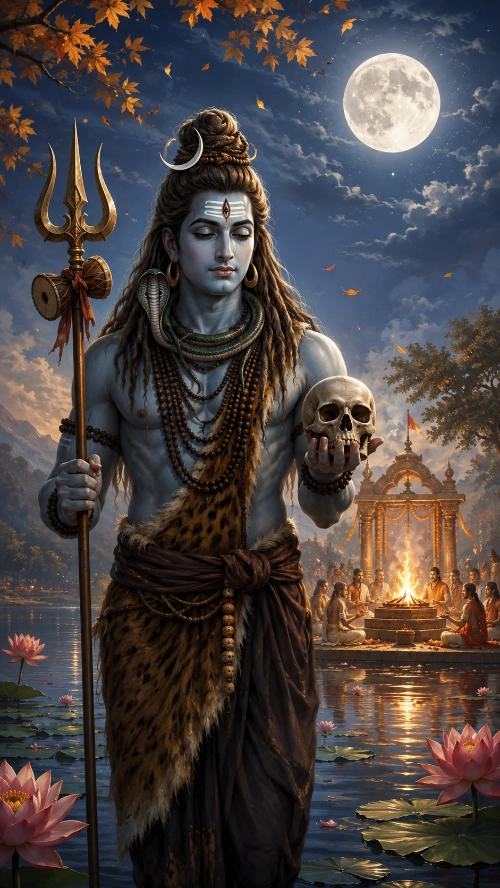
01
पुलस्त्य उवाच
ततस्त्रिनेत्रस्य गतः प्रावृट्कालो घनोपरि ।
लोकानन्दकरी रम्या शरत् समभवन्मुने ॥ १ ॥
Pulastya uvāca
tatas trinetrasya gataḥ prāvṛṭ-kālo ghanopari |
lokānandakārī ramyā śarat samabhavan mune || 1 ||
Pulastya said: Thereafter, O sage, when the rainy season of the Three-eyed Lord had passed, with the clouds now gone, the beautiful autumn arose — a season that brings delight to the worlds.
Commentary
- trinetrasya — “of the Three-eyed One,” a clear epithet of Śiva.
- prāvṛṭ-kālaḥ — the rainy season, especially the monsoon period.
- ghana-upari / ghanopari — literally connected with “clouds” (ghana). Here, the sense is that the period dominated by clouds has passed. The verse marks the clearing of the rainy atmosphere.
- lokānandakārī — “causing joy to the worlds.” Autumn is not merely meteorological; it is cosmically auspicious, bringing clarity, beauty, and relief after the rains.
- ramyā śarat — “the lovely autumn.” In Sanskrit kāvya and Purāṇic imagery, śarad often signifies clear skies, pure waters, blooming lotuses, bright moonlight, and spiritual serenity.
02
त्यजन्ति नीलाम्बुधरा नभस्तलं वृक्षांश्च कङ्काः सरितस्तटानि ।
पद्माः सुगन्धं निलयानि वायसा रुरुर्विषाणं कलुषं जलाशयः ॥ २ ॥
tyajanti nīlāmbudharā nabhastalaṃ vṛkṣāṃś ca kaṅkāḥ saritas taṭāni |
padmāḥ sugandhaṃ nilayāni vāyasā rurur viṣāṇaṃ kaluṣaṃ jalāśayaḥ || 2 ||
Dark rain-clouds abandon the expanse of the sky; the cranes leave the trees, and the rivers their banks. The lotuses release their fragrance; the crows leave their nests; the ruru deer sheds its horn, and the reservoirs cast off their muddiness.
Commentary
- nīlāmbudharāḥ — “dark water-bearers,” i.e. dark rain-clouds. Ambudhara literally means “water-holder” or “water-bearer,” a poetic word for cloud.
- nabhastalam — “the surface/expanse of the sky.” The phrase suggests the sky is becoming clear after the monsoon.
- kaṅkāḥ — water-birds, often identified as cranes or herons. In the rainy season, they may perch among trees, but in autumn, they return to open waters and riverbanks.
- saritaḥ taṭāni — “rivers [leave] their banks.” This means the flooded rivers recede from the banks after the rains.
- padmāḥ sugandham — the lotuses give forth/release fragrance.
- vāyasāḥ nilayāni — crows [leave] their dwellings/nests.
- ruruḥ viṣāṇam — the ruru, a kind of deer or antelope, sheds its horn. This is another sign of seasonal transition.
- jalāśayaḥ kaluṣam — “the water-reservoirs [abandon] their turbidity.” The ponds and lakes become clear after the mud and floodwater of the rains settle.
03
विकासमायन्ति च पङ्कजानि चन्द्रांशवो भान्ति लताः सुपुष्पाः ।
नन्दन्ति हृष्टान्यपि गोकुलानि सन्तश्च संतोषमनुव्रजन्ति ॥ ३ ॥
vikāsam āyanti ca paṅkajāni candrāṃśavo bhānti latāḥ supuṣpāḥ |
nandanti hṛṣṭāny api gokulāni santaś ca santoṣam anuvrajanti || 3 ||
The lotuses come into full bloom; the rays of the moon shine beautifully; the creepers are rich with blossoms. The herds of cattle rejoice in gladness, and the virtuous attain contentment.
Commentary
- vikāsam āyanti — “they come to expansion / blossoming.” This expresses the opening of flowers, especially lotuses, after the clarity of autumn has arrived.
- paṅkajāni — “mud-born ones,” a poetic word for lotuses. The term is especially fitting: from mud and water comes purity and beauty.
- candrāṃśavaḥ — “moon-rays.” In Sanskrit literature, autumn is strongly associated with clear moonlight, especially after the rains have ended and the sky is no longer obscured by clouds.
- latāḥ supuṣpāḥ — “creepers well-flowered,” or “creepers abundant with beautiful blossoms.” The vegetation now appears refined and ornamented.
- gokulāni — “cowherds, cattle-folds, herds of cows.” Here, it likely refers to cattle communities or herds, rejoicing after the season becomes pleasant and pastures are refreshed.
- santaḥ santoṣam anuvrajanti — “the good/virtuous follow after contentment,” meaning they enter, obtain, or dwell in satisfaction. The outer peace of autumn is mirrored inwardly in the hearts of the righteous.
04
सरस्सु पद्मा गगने च तारका जलाशयेष्वेव तथा पयांसि ।
सतां च चित्तं हि दिशां मुखैः समं वैमल्यमायान्ति शशाङ्ककान्तयः ॥ ४ ॥
sarassu padmā gagane ca tārakā jalāśayeṣv eva tathā payāṃsi |
satāṃ ca cittaṃ hi diśāṃ mukhaiḥ samaṃ vaimalyam āyānti śaśāṅka-kāntayaḥ || 4 ||
In the lakes, the lotuses; in the sky, the stars; and likewise the waters in the reservoirs — all attain purity and clarity. So too the minds of the virtuous become clear, together with the quarters of space, through the radiance of the moon.
Commentary
- sarassu — “in the lakes.” This is the locative plural of saras, “lake, pond, pool.”
- padmāḥ — “lotuses.” The verse continues the autumnal imagery: lotuses become especially prominent in clear waters.
- gagane ca tārakāḥ — “and in the sky, the stars.” With the clouds gone, the stars become visible and brilliant.
- jalāśayeṣu payāṃsi — “the waters in the reservoirs.”
- satāṃ cittaṃ — “the mind/heart of the good, the virtuous.” The purity of nature is paralleled by inner moral and spiritual clarity.
- diśāṃ mukhaiḥ samam — “together with the faces of the directions,” meaning the quarters of space themselves appear bright and clear.
- vaimalyam āyānti — “they attain stainlessness, clearness, purity.” Vaimalya suggests freedom from dirt, obscuration, or turbidity.
- śaśāṅka-kāntayaḥ — “the rays/radiances of the moon.” Literally, śaśāṅka means “hare-marked,” a poetic name for the moon.
05
एतादृशे हरः काले मघपृष्ठाधिवासिनीम् ।
सतीमादाय शैलेन्द्रं मन्दरं समुपाययौ ॥ ५ ॥
etādṛśe haraḥ kāle magha-pṛṣṭhādhivāsinīm |
satīm ādāya śailendraṃ mandaraṃ samupāyayau || 5 ||
At that season, Hara, taking Satī with him, went to Mandara, the foremost of mountains, Satī who had been dwelling upon the height called Magha.
Commentary
- etādṛśe kāle — “at such a time,” referring to the autumnal season just described: clear skies, pure waters, bright moonlight, blooming lotuses, and inward serenity.
- Haraḥ — Śiva, “the Remover,” one who takes away suffering, bondage, or worldly limitation.
- satīm ādāya — “taking Satī with him.” Satī is Dakṣa’s daughter and Śiva’s beloved wife.
- śailendraṃ mandaram — “Mandara, the lord/king of mountains.” Śailendra literally means “mountain-lord,” emphasizing Mandara’s majesty and sacred stature.
- magha-pṛṣṭhādhivāsinīm — “dwelling on the back/slope/height of Magha.” However, Magha-pṛṣṭha is neither very transparent nor common. It may refer to a particular elevated place, celestial region, or a textual/toponymic designation. The safest literal rendering is: “she who dwelt upon Magha-pṛṣṭha.”
06
ततो मन्दरपृष्ठेऽसौ स्थितः समशिलातले ।
रराम शंभुर्भगवान् सत्या सह महाद्युतिः ॥ ६ ॥
tato mandara-pṛṣṭhe ’sau sthitaḥ sama-śilātale |
rarāma śambhur bhagavān satyā saha mahā-dyutiḥ || 6 ||
Then, upon the slope of Mandara, that blessed Lord Śambhu, of great splendor, stayed upon a level slab of rock and delighted there together with Satī.
Commentary
- tataḥ — “then.”
- mandara-pṛṣṭhe — “on the back/slope/ridge of Mandara.” Pṛṣṭha literally means “back,” but in relation to a mountain, it means its upper surface, flank, ridge, or slope.
- asau — “that one,” referring to Śiva. The demonstrative gives a vivid narrative sense, as though the speaker were pointing toward the divine figure.
- sthitaḥ — “standing, staying, being situated.” Here, it means Śiva settled there or remained.
- sama-śilā-tale — “on a level surface of rock,” or “on a flat rocky slab.”
- rarāma — “he delighted, sported, took pleasure.” In Purāṇic contexts, it often denotes divine ease, joyful dwelling, or loving recreation.
- śambhuḥ bhagavān — “the blessed Lord Śambhu.” Śambhu means “the beneficent one,” “the source of auspiciousness.”
- satyā saha — “together with Satī.”
- mahā-dyutiḥ — “of great radiance/splendor.” The phrase emphasizes Śiva’s luminous divine presence against the purified autumnal setting.
07
ततो व्यतीते शरदि प्रतिबुद्धे च केशवे ।
दक्षः प्रजापतिश्रेष्ठो यष्टुमारभत क्रतुम् ॥ ७ ॥
tato vyatīte śaradi pratibuddhe ca keśave |
dakṣaḥ prajāpati-śreṣṭho yaṣṭum ārabhata kratum || 7 ||
Then, when autumn had passed, and Keśava had awakened, Dakṣa, the foremost of the Prajāpatis, began to perform a sacrifice.
Commentary
- tataḥ — “then,” marking the next stage in the narrative after Śiva and Satī’s stay on Mandara.
- vyatīte śaradi — “when autumn had passed.” The locative absolute construction indicates the time: after the season of śarad was over.
- pratibuddhe ca keśave — “and when Keśava had awakened.” This refers to Viṣṇu’s awakening from divine sleep, commonly associated with the Cāturmāsya period. Keśava is a name of Viṣṇu/Kṛṣṇa.
- Dakṣaḥ — Dakṣa Prajāpati, Satī’s father. His name implies skill, capability, ritual competence, or efficiency, but in this story, he is also marked by pride and hostility toward Śiva.
- prajāpati-śreṣṭhaḥ — “the foremost of the Prajāpatis,” the progenitor-lords responsible for creation and propagation of beings.
- yaṣṭum — “to sacrifice, worship ritually, perform a yajña.”
- ārabhata — “he began, undertook.”
- kratum — “sacrifice, solemn ritual act.” Kratu can mean both a sacrificial rite and the resolve/intention behind ritual action. Here it refers to Dakṣa’s great yajña.
08
द्वादशैव स चादित्याञ्शक्रादींश्च सुरोत्तमान् ।
सकश्यपान् समामन्त्र्य सदस्यान् समचीकरत् ॥ ८ ॥
dvādaśaiva sa cādityāñ śakrādīṃś ca surottamān |
sa-kaśyapān samāmantrya sadasyān samacīkarat || 8 ||
He then invited the twelve Ādityas, together with Śakra and the other foremost gods, along with Kaśyapa, and appointed them as members of the sacrificial assembly.
Commentary
- dvādaśa eva ādityān — “the twelve Ādityas.” These are the solar deities descended from Aditi and Kaśyapa, often associated with cosmic order, light, months, and divine guardianship.
- Śakra-ādīn — “Śakra and the others.” Śakra is Indra, king of the gods. The compound indicates Indra and other eminent devas.
- surottamān — “the best among the gods,” or “foremost celestials.” This reinforces the high status of those summoned.
- sa-kaśyapān — “together with Kaśyapa,” or “including Kaśyapa.” Kaśyapa is a major Prajāpati and father of many classes of beings, including devas, asuras, nāgas, birds, and others, through his various wives.
- samāmantrya — “having invited, having formally summoned.” The verb implies a ritual invitation, not merely a casual call.
- sadasyān — “members of the sadas,” the sacrificial assembly or council of officiants and dignitaries. In Vedic ritual language, sadas is both the assembly hall and the body of ritual participants.
- samacīkarat — “he made, appointed, constituted” them as participants in the rite.
Dakṣa’s sacrifice is presented as grand, orthodox, and cosmically prestigious. He does not assemble ordinary participants, but the highest gods — the twelve Ādityas, Indra, Kaśyapa, and other divine figures. This heightens the irony of the coming conflict: the yajña has external magnificence and impeccable divine attendance, yet its inner flaw will lie in exclusion and pride. The verse, therefore, builds ritual splendor while quietly preparing the moral rupture at the heart of the Dakṣa-yajña episode.
09
अरुन्धत्य च सहितं वसिष्ठं शंसितव्रतम् ।
सहानसूययाऽत्रिं च सह धृत्या च कौशिकम् ॥ ९ ॥
arundhatyā ca sahitaṃ vasiṣṭhaṃ śaṃsita-vratam |
sahānasūyayā ’triṃ ca saha dhṛtyā ca kauśikam || 9 ||
He also summoned Vasiṣṭha, of renowned vows, together with Arundhatī; Atri together with Anasūyā; and Kauśika together with Dhṛti.
Commentary
- arundhatyā ca sahitam — “together with Arundhatī.” Arundhatī is the celebrated wife of Vasiṣṭha, famed as a model of fidelity, austerity, and spiritual dignity.
- vasiṣṭham — Vasiṣṭha, one of the great sages and among the most revered Vedic ṛṣis.
- śaṃsita-vratam — “whose vow is praised,” “of celebrated observance.” The epithet presents Vasiṣṭha not merely as learned, but as ritually and morally disciplined.
- saha anasūyayā atrim ca — “and Atri together with Anasūyā.” Anasūyā is Atri’s famous wife, renowned for chastity, austerity, and freedom from envy — her name literally suggests “non-jealous” or “free from malice.”
- saha dhṛtyā ca kauśikam — “and Kauśika together with Dhṛti.” Kauśika most naturally refers here to Viśvāmitra, who is often called Kauśika from his lineage. Dhṛti means firmness, steadfastness, or fortitude, and here appears as the name of his wife.
This verse expands Dakṣa’s sacrificial assembly from gods to great ṛṣis and their wives. The inclusion of Arundhatī and Anasūyā is significant: Dakṣa’s yajña gathers not only ritual authority but also ideals of household sanctity, chastity, discipline, and ascetic power. The scene becomes more impressive outwardly — gods, Prajāpatis, sages, and exemplary women are present. Yet this grandeur also deepens the impending irony: a sacrifice surrounded by the highest symbols of dharma is still vulnerable if pride and exclusion corrupt its heart.
10
अहल्यया गौतमं च भरद्वाजममायया ।
चन्द्रया सहितं ब्रह्मन्नृषिमङ्गिरसं तथा ॥ १० ॥
ahalyayā gautamaṃ ca bharadvājam amāyayā |
candrayā sahitaṃ brahmann ṛṣim aṅgirasaṃ tathā || 10 ||
And, O Brahman, he invited Gautama together with Ahalyā; Bharadvāja together with Amāyā; and likewise the sage Aṅgiras, accompanied by Candrā.
Commentary
- ahalyayā gautamam ca — “Gautama together with Ahalyā.”
- Ahalyā is the famous wife of the sage Gautama.
- bharadvājam amāyayā — “Bharadvāja together with Amāyā.” Bharadvāja is one of the great Vedic sages. Amāyā means “free from deceit, guileless.” Amāyā is the wife of Bharadvāja.
- brahman — “O Brahman,” an address to Nārada or the listener within the narration. It marks Pulastya’s respectful speech to the sage.
- ṛṣim aṅgirasam tathā — “and likewise the sage Aṅgiras.” Aṅgiras is one of the ancient seers, strongly associated with Vedic revelation, sacred fire, hymns, and priestly wisdom.
- candrayā sahitam — “accompanied by Candrā.” Candrā is a feminine name meaning “bright, moon-like, lovely.” Here she is listed as Aṅgiras’s wife.
The catalog of invitees continues to present Dakṣa’s yajña as ritually magnificent and socially complete. Great sages do not arrive alone; they are accompanied by their wives, showing the sacred household dimension of Vedic ritual. A yajña is not merely a technical act performed by priests, but an ordered gathering of divine, ṛṣis, and domestic powers. Yet the repeated inclusion of revered couples also sharpens the dramatic contrast: Satī and Śiva, the most crucial divine pair for this episode, will stand outside Dakṣa’s honored circle.
11
आमन्त्र्य कृतवान्दक्षः सदस्यान् यज्ञसंसदि ।
विद्वान् गुणसंपन्नान् वेदवेदाङ्गपारगान् ॥ ११ ॥
āmantrya kṛtavān dakṣaḥ sadasyān yajña-saṃsadi |
vidvān guṇa-saṃpannān veda-vedāṅga-pāragān || 11 ||
Having invited them, the learned Dakṣa appointed them as members in the sacrificial assembly — men endowed with virtues, and thoroughly versed in the Vedas and the Vedāṅgas.
Commentary
- āmantrya — “having invited”.
- kṛtavān dakṣaḥ sadasyān — “Dakṣa made them sadasyas,” that is, members of the sacrificial assembly.
- yajña-saṃsadi — “in the sacrificial assembly.”
- vidvān — “learned, wise.” Refers to Dakṣa. Reflects his ritual competence and social authority.
- guṇa-saṃpannān — “endowed with qualities/virtues.” These participants are not presented merely as technically skilled but as possessing recognized excellence.
- veda-vedāṅga-pāragān — “those who had gone to the far shore of the Vedas and Vedāṅgas,” meaning masters of both the Vedas and their auxiliary disciplines. The Vedāṅgas are traditionally six: phonetics, ritual procedure, grammar, etymology, meter, and astronomy/ritual calendrics.
This verse summarizes and elevates the preceding catalog. Dakṣa’s assembly is outwardly flawless: learned, virtuous, ritually qualified, and grounded in Vedic authority. The phrase veda-vedāṅga-pāragān gives the scene great orthodox weight, suggesting that every technical and scriptural requirement of the yajña is in place. Yet this also prepares the central irony: perfect ritual learning does not guarantee inner dharma. The coming failure will not be due to ignorance of ritual, but to the deeper defect of pride and exclusion.
12
धर्मं च स समाहूय भार्ययाऽहिंसया सह ।
निमन्त्र्य यज्ञवाटस्य द्वारपालत्वमादिशत् ॥ १२ ॥
dharmaṃ ca sa samāhūya bhāryayā ’hiṃsayā saha |
nimantrya yajña-vāṭasya dvārapālatvam ādiśat || 12 ||
And having summoned Dharma, together with his wife Ahiṃsā, he invited him and assigned to him the guardianship of the entrance to the sacrificial enclosure.
Commentary
- dharmaṃ ca — “and Dharma.” Here, Dharma is personified as a divine being.
- samāhūya — “having called together, having summoned.” This suggests a formal summoning into the sacrificial arrangement.
- bhāryayā ’hiṃsayā saha — “together with his wife Ahiṃsā.” Ahiṃsā means “non-injury, non-violence, harmlessness.” As Dharma’s wife, she represents the ethical foundation of righteousness: true dharma cannot be separated from non-harm.
- nimantrya — “having invited.”
- yajña-vāṭasya — “of the sacrificial enclosure.” Vāṭa here means an enclosed area, precinct, or compound prepared for the yajña.
- dvārapālatvam ādiśat — “he assigned the office of gatekeeper.”
Dakṣa appoints Dharma, accompanied by Ahiṃsā, to guard the gate of the yajña. On the surface, this gives the sacrifice great moral legitimacy: righteousness and non-injury stand at its entrance. Yet the irony is sharp. A sacrifice guarded by Dharma will soon become a place of adharma because Śiva is excluded and Satī is dishonored. The verse, therefore, quietly contrasts ritual appearance with inner truth: Dharma may stand at the doorway, but the heart of the sacrifice is already vulnerable to pride.
13
अरिष्टनेमिनं चक्रे इध्माहरणकारिणम् ।
भृगुं च मन्त्रसंस्कारे सम्यग् दक्षः प्रयुक्तवान् ॥ १३ ॥
ariṣṭaneminaṃ cakre idhmāharaṇa-kāriṇam |
bhṛguṃ ca mantra-saṃskāre samyag dakṣaḥ prayuktavān || 13 ||
Dakṣa appointed Ariṣṭanemi to bring the sacrificial fuel, and he properly assigned Bhṛgu to the sanctification and preparation of the mantras.
Commentary
- ariṣṭaneminaṃ — the name of a sage, divine figure. Son of Kaśyapa and Vinatā (brother of Garuḍa).
- cakre — “he made, appointed.”
- idhmāharaṇa-kāriṇam — the bringer of sacrificial fuel.
- bhṛgum ca — “and Bhṛgu.” Bhṛgu is one of the great ancient sages and a powerful priestly figure in many Purāṇic narratives. His presence here is especially significant because Bhṛgu often represents Brahmanical ritual authority.
- mantra-saṃskāre — “in the consecration/refinement/sanctification of the mantras.” Saṃskāra here implies ritual preparation, purification, proper application, and being made fit for sacred use.
- samyak — “properly, correctly, duly.” The word emphasizes that Dakṣa made the appointment in accordance with ritual order.
- prayuktavān — “he employed, appointed, engaged.” Dakṣa put Bhṛgu to work in this specific sacrificial function.
This verse moves from the grand list of invited gods and sages to the practical architecture of the sacrifice. The yajña is being organized with precision: one figure brings the sacred fuel, another oversees the mantras. Idhma and mantra represent the two essential dimensions of Vedic ritual — material offering and sacred speech. Dakṣa appears fully competent in external ritual arrangement, yet the narrative continues to build the contrast between technical perfection and spiritual blindness. His sacrifice is correctly formed, but not yet purified in intention.
14
तथा चन्द्रमसं देवं रोहिण्या सहितं शुचिम् ।
धनानामाधिपत्ये च युक्तवान् हि प्रजापतिः ॥ १४ ॥
tathā candramasaṃ devaṃ rohiṇyā sahitaṃ śucim |
dhanānām ādhipatye ca yuktavān hi prajāpatiḥ || 14 ||
Likewise, Prajāpati appointed the pure god Candra, accompanied by Rohiṇī, to the lordship over the treasures and wealth of the sacrifice.
Commentary
- tathā — “likewise,” continuing the list of ritual appointments made by Dakṣa.
- candramasaṃ devam — “the god Candra,” the Moon-deity.
- rohiṇyā sahitam — “accompanied by Rohiṇī.” Rohiṇī is the most beloved of Candra’s wives among the lunar mansions or nakṣatras. Her presence here is auspicious, suggesting fertility, beauty, nourishment, and abundance.
- śucim — “pure, bright, radiant.” The word suits Candra both ritually and visually: he is luminous, cooling, and associated with purity and soma-like nourishment.
- dhanānām ādhipatye — “to the overlordship of wealth/treasures.” This means Candra was placed in charge of the riches, gifts, offerings, and other material resources associated with the yajña.
- yuktavān — “he appointed, engaged, assigned.” Dakṣa continues to allocate responsibilities in an orderly way.
- prajāpatiḥ — “the Prajāpati,” here Dakṣa, the lord of created beings and organizer of the sacrifice.
This verse gives Candra an administrative and auspicious role within Dakṣa’s yajña. His association with Rohiṇī deepens the imagery of prosperity: Candra is not only a heavenly luminary but also a symbol of nourishment, fertility, and refined abundance. By assigning him authority over wealth, Dakṣa’s sacrifice appears complete in yet another dimension — gods, sages, ethical guardians, fuel, mantra, and now treasure. Yet the deeper tension remains: the yajña is externally rich and beautifully arranged, but its moral center is still unstable because Śiva has not been honored.
15
जामातृदुहितृश्वैव दौहित्रांश्च प्रजापतिः ।
सशङ्करां सतीं मुक्त्वा मखे सर्वान् न्यमन्त्रयत् ॥ १५ ॥
jāmātṝn duhitṝś caiva dauhitrāṃś ca prajāpatiḥ |
sa-śaṅkarāṃ satīṃ muktvā makhe sarvān nyamantrayat || 15 ||
The Prajāpati invited all his sons-in-law, his daughters, and his daughters’ sons to the sacrifice — but he left out Satī together with Śaṅkara.
Commentary
- jāmātṛ / jāmātṝn — “sons-in-law.” Since Dakṣa’s daughters were married to various divine and sage-like beings, this refers to their husbands.
- duhitṛ / duhitṝḥ — “daughters.”
- dauhitrān — “daughter’s sons,” that is, grandsons through daughters.
- prajāpatiḥ — Dakṣa, the lord of progeny. The title is important here because he acts as the patriarch of a vast divine family.
- sa-śaṅkarāṃ satīm — “Satī together with Śaṅkara.” The phrase makes the exclusion very explicit: it is not merely Śiva who is omitted, nor Satī alone, but Satī as united with Śaṅkara.
- muktvā — “having left aside, having omitted, having excluded.”
- makhe — “at the sacrifice.” Makha is a Vedic-sacrificial term, often meaning a solemn yajña.
- sarvān nyamantrayat — “he invited all.” The irony lies in sarvān, “all”: he invited everyone — except the one pair whose exclusion will destroy the sacrifice.
This verse reveals the hidden wound in Dakṣa’s otherwise perfect ritual arrangement. Until now, the yajña has looked complete: gods, sages, wives, Dharma, Ahiṃsā, mantras, fuel, wealth, and formal order are all present. But here the decisive absence appears. Dakṣa invites the whole family circle — sons-in-law, daughters, and grandsons — yet deliberately excludes Satī and Śaṅkara. The word muktvā, “leaving aside,” carries the emotional force of the verse: this is not oversight, but rejection. The sacrifice is now outwardly universal but inwardly fractured, because it denies the very presence of Śiva, without whom no auspicious rite can remain whole.
16
नारद उवाच
किमर्थं लोकपतिना धनाध्यक्षो महेश्वरः ।
ज्येष्ठः श्रेष्ठो वरिष्ठोऽपि आद्योऽपि न निमन्त्रितः ॥ १६ ॥
Nārada uvāca
kimarthaṃ lokapatinā dhanādhyakṣo maheśvaraḥ |
jyeṣṭhaḥ śreṣṭho variṣṭho ’pi ādyo ’pi na nimantritaḥ || 16 ||
Nārada said: For what reason was Maheśvara not invited by the lord of the worlds — he who is the overseer of wealth, the eldest, the best, the most excellent, and indeed the primordial one?
Commentary
- kimartham — “for what reason?”, “why?” Nārada’s question directly exposes the theological and moral problem created by Dakṣa’s exclusion of Śiva.
- lokapatinā — “by the lord of the worlds.” This refers to Dakṣa as Prajāpati, a ruler and progenitor of beings. The instrumental form indicates the agent: “by the lord of the worlds.”
- dhanādhyakṣaḥ — “overseer of wealth,” “superintendent of treasures.”
- Maheśvaraḥ — “the Great Lord,” Śiva.
- jyeṣṭhaḥ — “the eldest,” senior in cosmic dignity.
- śreṣṭhaḥ — “the best,” foremost in excellence.
- variṣṭhaḥ — “the most eminent, most excellent, most venerable.”
- ādyaḥ api — “even the primordial one.” Ādya means first, original, beginningless in a theological sense. Nārada is not merely calling Śiva socially senior, but cosmically prior.
- na nimantritaḥ — “was not invited.”
Nārada’s question is not innocent curiosity; it is a theological challenge. Dakṣa has invited the entire ritual universe, yet excluded the one described as jyeṣṭha, śreṣṭha, variṣṭha, and ādya — eldest, best, most venerable, and primordial. The piling up of these epithets makes the omission appear not merely rude, but cosmically irrational. In Purāṇic logic, a sacrifice that excludes Maheśvara excludes the very principle of auspiciousness and transcendence. Nārada therefore asks what the narrative itself demands: how could such a yajña be considered complete without Śiva?
17
पुलस्त्य उवाच
ज्येष्ठः श्रेष्ठो वरिष्ठोऽपि द्योऽपि भगवाशिवः ।
कपालीति विदित्वेशो दक्षेण न निमन्त्रितः ॥ १७ ॥
Pulastya uvāca
jyeṣṭhaḥ śreṣṭho variṣṭho ’py ādyo ’pi bhagavān śivaḥ |
kapālīti viditvā īśo dakṣeṇa na nimantritaḥ || 17 ||
Pulastya said: Although Bhagavān Śiva is the eldest, the best, the most excellent, and even the primordial one, Dakṣa did not invite the Lord, knowing him as “Kapālī” — the skull-bearer. Though Śiva is supreme in seniority, excellence, and primordial divinity, Dakṣa refused to invite him because he regarded him as Kapālī, the skull-bearing ascetic.
Commentary
- jyeṣṭhaḥ, śreṣṭhaḥ, variṣṭhaḥ — “eldest, best, most eminent.” Pulastya deliberately repeats Nārada’s epithets from the previous verse, confirming that Nārada’s theological assessment is correct: Śiva truly is supreme.
- ādyaḥ api — “even the primordial one.”
- bhagavān śivaḥ — “the blessed Lord Śiva.”
- kapālī iti viditvā — “having known/regarded him as Kapālī.” Kapālī means “the skull-bearer,” from kapāla, “skull.”
- īśaḥ — “the Lord.” Even while Dakṣa judges Śiva by the outer sign of skull-bearing, Pulastya calls him Īśa, the sovereign Lord.
- dakṣeṇa na nimantritaḥ — “he was not invited by Dakṣa.”
Pulastya’s answer exposes Dakṣa’s error: Śiva’s supreme reality was hidden from him by Śiva’s unconventional appearance. Dakṣa saw Kapālī, the skull-bearing ascetic, but failed to recognize Īśa, the Lord. The verse, therefore, contrasts external social-ritual respectability with deeper spiritual vision. Dakṣa’s fault is not that he lacks ritual knowledge, but that he judges the divine by outward impurity and social discomfort. Śiva’s skull-bearing form, which terrifies the conventional mind, is precisely a sign of his transcendence over ordinary purity, death, and ego.
18
नारद उवाच
किमर्थं देवताश्रेष्ठः शूलपाणिस्त्रिलोचनः ।
कपाली भगवाञ्जातः कर्मणा केन शङ्करः ॥ १८ ॥
Nārada uvāca
kimarthaṃ devatā-śreṣṭhaḥ śūla-pāṇis trilocanaḥ |
kapālī bhagavāñ jātaḥ karmaṇā kena śaṅkaraḥ || 18 ||
Nārada said: For what reason did Bhagavān Śaṅkara — the best of the gods, the trident-bearing Three-eyed Lord — become Kapālī, the skull-bearer? By what deed did this come about?
Commentary
- kimartham — “for what reason?”
- devatā-śreṣṭhaḥ — “the best among the deities.”
- śūla-pāṇiḥ — “he whose hand bears the trident.” This is a standard epithet of Śiva, presenting him as the wielder of the triśūla, the weapon of sovereignty, destruction, and transcendence over the threefold world.
- trilocanaḥ — “the three-eyed one.” Śiva’s third eye signifies higher vision, fiery knowledge, and the power that burns through illusion.
- kapālī — “skull-bearer.” From kapāla, “skull.”
- bhagavān jātaḥ — “the Blessed Lord became.”
- karmaṇā kena — “by what action/deed?”
- Śaṅkaraḥ — “the beneficent one,” “the maker of auspiciousness.” The juxtaposition is important: how did the auspicious Lord come to be associated with a skull?
Nārada’s question opens a theological explanation behind Dakṣa’s prejudice. Śiva’s name Kapālī is not treated as a mere insult or social stigma; it has a sacred history. The verse frames the paradox sharply: the supreme god, three-eyed and trident-bearing, is also the skull-bearer. This prepares the narration of a deeper myth in which Śiva’s frightening form is revealed not as impurity, but as part of his cosmic and moral function — confronting pride, death, and false sanctity.
19
पुलस्त्य उवाच
शृणुष्वावहितो भूत्वा कथामेतां पुरातनीम् ।
प्रोक्तमादिपुराणे च ब्रह्मणाऽव्यक्तमूर्त्तिना ॥ १९ ॥
Pulastya uvāca
śṛṇuṣvāvahito bhūtvā kathām etāṃ purātanīm |
proktām ādi-purāṇe ca brahmaṇā ’vyakta-mūrtinā || 19 ||
Pulastya said: Listen attentively to this ancient account, which was declared in the Ādi-Purāṇa by Brahmā, whose form is the Unmanifest.
Commentary
- śṛṇuṣva — “listen!”
- avahitaḥ bhūtvā — “having become attentive,” “being composed and concentrated.”
- kathām etāṃ purātanīm — “this ancient story/account.”
- proktām — “declared, spoken, taught.”
- ādi-purāṇe — “the primordial Purāṇa” or “first Purāṇa.”
- avyakta-mūrtinā — “by him whose form is unmanifest.”
This verse marks a transition from the Dakṣa-yajña narrative into a deeper mythic explanation of Śiva’s skull-bearing form. Pulastya asks Nārada to listen avahitaḥ, with collected attention, because the story concerns a profound paradox: how the supreme auspicious Lord became known as Kapālī. By attributing the account to Brahmā in the Ādi-Purāṇa, the text frames it as primordial sacred memory, not mere sectarian polemic. The epithet avyakta-mūrti also hints that the story will concern realities beyond ordinary appearance — precisely the kind of deeper vision Dakṣa lacked.
20
पुरा त्वेकार्णवं सर्वं जगत्स्थावरजङ्गमम् ।
नष्टचन्द्रार्कनक्षत्रम् प्रणष्टपवनानलम् ॥ २० ॥
purā tv ekārṇavaṃ sarvaṃ jagat sthāvara-jaṅgamam |
naṣṭa-candrārka-nakṣatraṃ praṇaṣṭa-pavanānalam || 20 ||
Long ago, the entire universe — all that moves and does not move — had become one single ocean. The moon, the sun, and the stars had disappeared; wind and fire, too, had vanished.
Commentary
- purā tu — “in ancient times.”
- ekārṇavam — “one ocean.” Eka — one, arṇava — ocean, flood, vast expanse of waters. This is the standard Purāṇic image of cosmic dissolution, when differentiated creation collapses into undivided waters.
- sarvaṃ jagat — “the whole universe.”
- sthāvara-jaṅgamam — “the stationary and the moving.” naṣṭa-candra-arka-nakṣatram — “with moon, sun, and stars gone.”
- praṇaṣṭa-pavana-anilam — “wind and fire”, praṇaṣṭa means “completely lost, vanished, destroyed.”
Pulastya now takes Nārada back beyond Dakṣa’s sacrifice into the state of cosmic dissolution. The universe is no longer structured by earth, sky, beings, light, wind, or fire; it has become ekārṇava, a single undifferentiated ocean. The disappearance of the moon, sun, and stars is especially significant: without them, there is no ordinary time, no direction, no ritual calendar, and no visible order. This is the silent, pre-creational condition from which the deeper mystery of Śiva’s Kapālī form will be unfolded.
21
अप्रतर्क्यमविज्ञेयं भावाभावविवर्जितम् ।
निमग्नपर्वततरु तमोभूतं सुदुर्दशम् ॥ २१ ॥
apratarkyam avijñeyaṃ bhāvābhāva-vivarjitam |
nimagna-parvata-taru tamobhūtaṃ sudurdarśam || 21 ||
It was beyond reasoning, unknowable, devoid of both existence and non-existence; mountains and trees were submerged, and all had become darkness, exceedingly difficult to behold.
Commentary
- apratarkyam — “beyond logical inference.” The state described is prior to ordinary categories of thought.
- avijñeyam — “unknowable,” “not capable of being distinctly known.”
- bhāva-abhāva-vivarjitam — “devoid of existence and non-existence.” This is philosophically important. Bhāva means being, existence, manifestation; abhāva means non-being, absence. The dissolved cosmos is not simply “existent” in the normal sense, nor simply “non-existent.” It lies beyond the dual opposition of manifested being and absence.
- nimagna-parvata-taru — “with mountains and trees submerged.” The great vertical structures of the world — mountains and forests — are swallowed by the cosmic waters.
- tamobhūtam — “having the nature of darkness.”
- sudurdarśam — “extremely difficult to see.” The state is hidden from sight and comprehension.
This verse deepens the image of cosmic dissolution from physical destruction into metaphysical indeterminacy. The world is not merely flooded; it has passed beyond ordinary categories — beyond logic, knowledge, existence, and non-existence. This is close to the language of primordial avyakta, the unmanifest. The submerged mountains and trees show the collapse of visible order, while tamobhūtam indicates a darkness that is not only optical but ontological: manifestation itself has withdrawn.
22
तस्मिन् स शेते भगवान् निद्रां वर्षसहस्रिकीम् ।
रात्र्यन्ते सृजते लोकान् राजसं रूपमास्थितः ॥ २२ ॥
tasmin sa śete bhagavān nidrāṃ varṣa-sahasrikīm |
rātry-ante sṛjate lokān rājasaṃ rūpam āsthitaḥ || 22 ||
In that cosmic ocean, Bhagavān sleeps a sleep lasting a thousand years. At the end of the night, assuming a rajas-characterized form, he creates the worlds.
Commentary
- tasmin — “in that”.
- saḥ bhagavān śete — “that Bhagavān sleeps.” The verse speaks of the divine being reclining during the period of dissolution. In Purāṇic cosmology, this evokes the image of the Lord resting upon the causal waters before creation resumes.
- nidrāṃ varṣa-sahasrikīm — “a sleep of a thousand years.” Varṣa-sahasrikī means “lasting a thousand years.” This should be understood in cosmic, not ordinary human, time.
- rātry-ante — “at the end of the night.” The “night” here is the cosmic night of dissolution, when manifest creation has withdrawn.
- sṛjate lokān — “he creates the worlds.” The plural lokān refers to the various realms or planes of existence brought forth at the beginning of a new cycle.
- rājasaṃ rūpam āsthitaḥ — “having assumed a rajasic form.” Rajas is the guṇa of activity, projection, movement, passion, and creation. In Sāṃkhya and Purāṇic thought, creation requires activation; therefore, the Lord assumes the rājasa mode to bring the worlds into manifestation.
This verse moves from dissolution to the first stirrings of creation. The deity sleeps in the undifferentiated cosmic waters during the long night of non-manifestation, but when that night ends, he assumes rajas, the quality of creative activity. Theologically, this is important: the supreme being itself is beyond the guṇas, yet for the sake of cosmic function it takes on a guṇa-specific form. Here, rajas is not merely passion in a negative sense; it is the necessary dynamism by which the sleeping cosmos is awakened into worlds, beings, and ordered existence.
23
राजसः पञ्चवदनो वेदवेदाङ्गपारगः ।
स्रष्टा चराचरस्यास्य जगतोऽद्भुतदर्शनः ॥ २३ ॥
rājasaḥ pañca-vadano veda-vedāṅga-pāragaḥ |
sraṣṭā carācarasya asya jagato ’dbhuta-darśanaḥ || 23 ||
In his rajasic form, he is five-faced, fully versed in the Vedas and the Vedāṅgas, the creator of this world of moving and unmoving beings, wondrous to behold.
Commentary
- pañca-vadanaḥ — “five-faced.” This is a very important detail. Brahmā is commonly known as four-faced, but many Purāṇic accounts preserve the older or mythic motif of Brahmā having five faces before one was removed. Since the coming narrative explains Śiva as Kapālī, the skull-bearer, this five-faced form prepares the theological background for the severing of Brahmā’s fifth head.
- veda-vedāṅga-pāragaḥ — “one who has gone to the far shore of the Vedas and Vedāṅgas,” meaning a complete master of Vedic knowledge and its auxiliary sciences. The expression emphasizes total scriptural and ritual competence.
- sraṣṭā — “creator.” This identifies the rajasic manifestation with the creative function, most naturally Brahmā.
- cara-acarasya asya jagataḥ — “of this world consisting of the moving and unmoving.”
- adbhuta-darśanaḥ — “marvelous in appearance,” “wondrous to behold.”
This verse introduces the creator in his rajasic manifestation: five-faced, Veda-knowing, and wondrous. The five faces are especially significant because the present section is leading toward the origin of Śiva’s title Kapālī. Brahmā’s five-headed form becomes the necessary premise for that later act. The verse therefore does two things at once: it glorifies the creator as learned and majestic, while quietly placing before us the feature — the fifth head — that will become central to the mythic explanation of Śiva’s skull-bearing form.
24
तमोमयस्तथैवान्यः समुद्भूतस्त्रिलोचनः ।
शूलपाणिः कपर्दी च अक्षमालां च दर्शयन् ॥ २४ ॥
tamomayas tathaivānyaḥ samudbhūtas trilocanaḥ |
śūla-pāṇiḥ kapardī ca akṣamālāṃ ca darśayan || 24 ||
Then another arose, consisting of tamas — the Three-eyed One, bearing a trident in his hand, wearing matted locks, and displaying a rosary of beads.
Commentary
- tamomayaḥ — “composed of tamas,” “consisting of the quality of tamas.” tathā eva anyaḥ samudbhūtaḥ — “and likewise another arose.”
- trilocanaḥ — “the three-eyed one,” a defining epithet of Śiva. The third eye symbolizes transcendent perception and destructive spiritual fire.
- śūla-pāṇiḥ — “holding a trident in his hand.” The trident (triśūla) represents power over the three worlds, three guṇas, or threefold conditions of existence.
- kapardī — “the matted-haired one.” akṣamālāṃ ca darśayan — “displaying a rosary.”
After the rajasic creator appears, the text introduces the tamasic manifestation: Śiva as the Three-eyed ascetic. Yet “tamasic” here should not be misunderstood in a merely negative sense. In Purāṇic cosmology, tamas is the principle by which forms dissolve, egos collapse, and manifested existence returns to stillness. Śiva’s form reflects this paradoxical role: he bears the destructive trident, yet also the rosary of contemplation. He is both terrifying and profoundly ascetic — the dissolver of worlds and the master of inner stillness.
25
ततो महात्मा ह्यसृजदहङ्कारं सुदारुणम् ।
येनाक्रान्तावुभौ देवौ तावेव ब्रह्मशङ्करौ ॥ २५ ॥
tato mahātmā hy asṛjad ahaṅkāraṃ sudāruṇam |
yenākrāntāv ubhau devau tāv eva brahmaśaṅkarau || 25 ||
Then the Great One indeed created a very dreadful ego, by which those two gods themselves, Brahmā and Śaṅkara, were seized.
Commentary
- mahātmā — “the Great Soul.”
- asṛjat — “to emit, create, release.”
- ahaṅkāram — “ego-consciousness.”Ahaṅkāra is the principle by which undifferentiated consciousness becomes self-referential: “I am,” “I act,” “I am superior.”
- sudāruṇam — “very terrible, extremely fierce, dreadful.” This shows that the ego-principle produced here is dangerous and disruptive.
- yena ākrāntau — “by which the two were overcome/seized.” Ākrānta means invaded, possessed, overwhelmed, or overpowered.
- ubhau devau — “both gods.”
- tāv eva brahma-śaṅkarau — “those very two, Brahmā and Śaṅkara.”
This is a crucial psychological and theological turning point. The conflict to come does not arise from ordinary ignorance alone, but from ahaṅkāra, the cosmic principle of self-assertion. Even Brahmā and Śaṅkara, when appearing within guṇa-based cosmic roles, are shown as being touched by this fierce ego-force. The verse explains how rivalry can arise even among divine manifestations: once the “I-maker” appears, the question of supremacy emerges. This prepares the mythic background for the severing of Brahmā’s head and Śiva’s later identity as Kapālī.
26
अहङ्कारावृतो रुद्रः प्रत्युवाच पितामहम् ।
को भवानिह संप्राप्तः केन सृष्टोऽसि मां वद ॥ २६ ॥
ahaṅkārāvṛto rudraḥ pratyuvāca pitāmaham |
ko bhavān iha saṃprāptaḥ kena sṛṣṭo ’si māṃ vada || 26 ||
Covered over by ego, Rudra replied to Pitāmaha: “Who are you? Who has come here? By whom were you created? Tell me.”
Commentary
- ahaṅkāra-āvṛtaḥ — “covered by ego,” “enveloped by self-assertion.” Rudraḥ — Śiva in his fierce, cosmic form. The name suggests roaring, force, dissolution, and terrifying divine power.
- pratyuvāca — “replied, answered back.”
- pitāmaham — “the Grandfather,” a standard epithet of Brahmā, the progenitor of beings.
- ko bhavān — “Who are you, sir?” Bhavān is formally respectful.
- iha saṃprāptaḥ — “come here, arrived here.” Rudra treats Brahmā almost as an intruder into his presence.
- kena sṛṣṭo ’si — “by whom were you created?” This is the central egoic question. Rudra asks Brahmā to account for his origin, implying that Brahmā is not self-existent.
- māṃ vada — “tell me.” Direct and commanding.
This verse shows ahaṅkāra immediately turning divine manifestation into rivalry. Rudra, enveloped by ego, does not recognize Brahmā’s cosmic role but interrogates him: “Who are you? Who created you?” The irony is profound: both are divine forms arising within the same cosmic process, yet the ego makes each appear separate, self-standing, and superior. The dialogue begins not with mutual recognition but with a contest over origin and authority — the very question that will lead toward the Kapālī episode.
27
पितामहोऽप्यहङ्कारात् प्रत्युवाचाथ को भवान् ।
भवतो जनकः कोऽत्र जननी वा तदुच्यताम् ॥ २७ ॥
pitāmaho ’py ahaṅkārāt pratyuvācātha ko bhavān |
bhavato janakaḥ ko ’tra jananī vā tad ucyatām || 27 ||
Then Pitāmaha too, out of ego, replied: “And who are you? Who here is your father, and who is your mother? Let that be told.”
Commentary
- pitāmahaḥ api — “Pitāmaha too.”
- ahaṅkārāt — “from ego,” Brahmā’s reply arises out of egoic pride.
- pratyuvāca — “he replied.”
- atha ko bhavān — “then, who are you?”
- bhavataḥ janakaḥ kaḥ — “who is your father?” Janaka means begetter, father, originator.
- jananī vā — “or mother.” Jananī means mother, she who gives birth.
- tad ucyatām — “let that be said,” “tell that.”
This verse mirrors the previous one almost deliberately. Rudra asked Brahmā, “Who are you? By whom were you created?” Brahmā now responds with equal ego: “Who are you? Who are your parents?” Theologically, this is a dramatic illustration of ahaṅkāra as the force that makes divine manifestations forget their common source. Instead of recognizing one another as expressions of the same supreme reality, they demand genealogical proof of superiority. The question of “origin” becomes a weapon of pride.
28
इत्यन्योन्यं पुरा ताभ्यां ब्रह्मेशाभ्यां कलिप्रिय ।
परिवादोऽभवत् तत्र उत्पत्तिर्भवतोऽभवत् ॥ २८ ॥
ity anyonyaṃ purā tābhyāṃ brahmeśābhyāṃ kali-priya |
parivādo ’bhavat tatra utpattir bhavato ’bhavat || 28 ||
Thus, long ago, O lover of quarrel, there arose between those two — Brahmā and Īśa — a mutual dispute. And there, your own origin came about.
Commentary
- iti anyonyam — “thus, mutually.”
- purā — “long ago.”
- tābhyām brahma-īśābhyām — “by those two, Brahmā and Īśa.” kali-priya — “O lover of quarrel,” addressed to Nārada. This is a revealing epithet. Kali here does not primarily mean the Kali-yuga, but “strife, quarrel, discord.” Priya means “fond of, dear to.” Nārada is often portrayed as one who provokes questions, disputes, or events that ultimately reveal the hidden truth.
- parivādaḥ abhavat — “a dispute arose.” Parivāda can mean blame, reproach, accusation, quarrel, or hostile debate.
- tatra — “there,” at that very occasion of Brahmā and Rudra’s mutual confrontation.
- utpattiḥ bhavataḥ abhavat — “your origin came about.” Bhavataḥ means “of you,” addressed respectfully to Nārada. Pulastya says that Nārada’s birth or manifestation occurred in connection with this dispute.
This verse gives the quarrel a surprising consequence: from the egoic dispute between Brahmā and Īśa arises the origin of Nārada himself. Pulastya’s address kali-priya, “fond of strife,” is not merely humorous; it explains Nārada’s cosmic function. He is born of a moment of divine controversy and becomes the sage who stirs hidden tensions to the surface so that truth may be revealed. The verse, therefore, transforms quarrel into revelation: even conflict, when placed within divine myth, becomes a means by which cosmic roles and deeper knowledge emerge.
29
भवानप्यन्तरिक्षं हि जातमात्रस्तदोत्पतत् ।
धारयन्नतुलां वीणां कुर्वन् किलकिलाध्वनिम् ॥ २९ ॥
bhavān apy antarikṣaṃ hi jāta-mātras tadotpatat |
dhārayann atulāṃ vīṇāṃ kurvan kilakilā-dhvanim || 29 ||
You too, immediately upon being born, sprang up into the mid-region of the sky, holding an incomparable vīṇā and making a shrill, jubilant sound.
Commentary
- bhavān api — “you too.”
- antarikṣam — “the mid-space.”
- jāta-mātraḥ — “just born.”
- tadā utpatat — “then he flew up / sprang upward.” Fitting Nārada’s wandering celestial character.
- dhārayan atulāṃ vīṇām — “holding an incomparable vīṇā.” Atulā means “unequaled, incomparable.” The vīṇā is Nārada’s emblem: the instrument of divine song, sacred sound, and transmission of knowledge.
- kurvan kilakilā-dhvanim — “making a kilakilā sound.” Kilakilā-dhvani denotes a high, ringing, excited, or jubilant cry. It may suggest the playful, restless, animated sound of Nārada’s first appearance — already marked by voice, music, and movement.
Nārada’s birth is depicted as the immediate emergence of motion, sound, and music. He does not emerge passively; as soon as he is born, he rises into antarikṣa, bearing the vīṇā and producing a lively cry. This beautifully matches his later mythic role: Nārada is the roaming sage of the intermediate spaces, moving between worlds, carrying divine music, provoking dialogue, and awakening hidden truths. Born from the dispute between Brahmā and Īśa, he appears already as a being of sound — one who transforms conflict into revelation through speech, song, and inquiry.
30
ततो विनिर्जितः शंभुर्मानिना पद्मयोनिना ।
तस्थावधोमुखो दीनो ग्रहाक्रान्तो यथा शशी ॥ ३० ॥
tato vinirjitaḥ śambhur māninā padma-yoninā |
tasthāv adho-mukho dīno grahākrānto yathā śaśī || 30 ||
Then Śambhu, defeated by the proud Lotus-born one, stood with his face cast downward, dejected — like the moon seized by an eclipse.
Commentary
- tataḥ — “then.”
- vinirjitaḥ — “defeated, overcome, vanquished.”
- Śambhuḥ — Śiva as “the auspicious one,” “the beneficent one.”
- māninā — “by the proud one.” This refers to Brahmā.
- padma-yoninā — “by the Lotus-born one.”
- tasthau — “he stood, remained.”
- adho-mukhaḥ — “with face downward,” “downcast.” The expression conveys shame, defeat, or inner heaviness.
- dīnaḥ — “dejected, miserable, humbled, distressed.”
- graha-ākrāntaḥ yathā śaśī — “like the moon seized by a graha.” Here, graha means an eclipsing force, especially Rāhu, which seizes the moon during an eclipse. Śaśī, “the hare-marked one,” is the moon. The simile presents Śiva’s splendor as temporarily obscured, not destroyed.
This verse is dramatic because Śiva, normally the unconquerable Lord, is shown as humbled in the field of egoic dispute. Brahmā is called mānin, proud, while Śiva stands adho-mukha, downcast. Yet the simile is carefully chosen: like the moon in eclipse, Śiva’s radiance is only obscured, not extinguished. The verse captures the strange theological play of the Purāṇas: when divine forms enter the realm of ahaṅkāra, even the great gods appear subject to rivalry, shame, and temporary defeat. This sets the emotional tension for the fierce reversal that will follow.
31
पराजिते लोकपतौ देवेन परमेष्ठिना ।
क्रोधान्धकारितं रुद्रं पञ्चमोऽथ मुखोऽब्रवीत् ॥ ३१ ॥
parājite lokapatau devena parameṣṭhinā |
krodhāndhakāritaṃ rudraṃ pañcamo ’tha mukho ’bravīt || 31 ||
When the Lord of the worlds had been defeated by the god Parameṣṭhin, the fifth face then spoke to Rudra, who was darkened and blinded by anger.
Commentary
- parājite lokapatau — “when the Lord of the worlds had been defeated.” This refers to Śiva/Rudra, here called lokapati, “lord of the worlds.”
- devena parameṣṭhinā — “by the god Parameṣṭhin.” Parameṣṭhin is a title of Brahmā, “he who abides in the highest seat.” Here, it refers to Brahmā as the victorious party in the dispute.
- krodha-andhakāritam — “made dark/blind by anger.” Rudram — Rudra, the fierce form of Śiva.
- pañcamaḥ mukhaḥ — “the fifth face.” atha abravīt — “then spoke.”
This verse intensifies the mythic drama. Śiva, though lokapati, has been humiliated by Brahmā, the Parameṣṭhin, and anger now clouds his perception. The significant new actor is Brahmā’s fifth face. It is not simply Brahmā in general who speaks, but the fifth mouth specifically. This detail is essential: the coming offense or provocation from that face will lead to its severance, and thus to Śiva’s later identity as Kapālī, the bearer of the skull.
32
अहं ते प्रतिजानामि तमोमूर्ते त्रिलोचन ।
दिग्वासा वृषभारूढो लोकक्षयकरो भवान् ॥ ३२ ॥
ahaṃ te pratijānāmi tamo-mūrte trilocana |
digvāsā vṛṣabhārūḍho loka-kṣaya-karo bhavān || 32 ||
“I declare this to you, O Three-eyed one, embodiment of tamas: You are sky-clad, mounted upon a bull, and the bringer of the destruction of the worlds.”
Commentary
- ahaṃ te pratijānāmi — “I declare to you.”
- tamo-mūrte — “O embodiment of tamas.”
- trilocana — “O Three-eyed one.”
- digvāsāḥ — “clothed in the directions,” that is, naked or sky-clad.
- vṛṣabha-ārūḍhaḥ — “mounted upon a bull.”
- loka-kṣaya-karaḥ — “causer of cosmic dissolution.”
- bhavān — “you.”
The fifth face of Brahmā defines Rudra by signs that the conventional mind finds frightening: darkness, nakedness, the bull, and world-destruction. These are all true aspects of Śiva, but they are spoken here without reverence, as if they were defects. This is the same mistake Dakṣa later makes: he sees the outer, transgressive form and fails to perceive its sacred meaning. In reality, digvāsa, vṛṣabhārūḍha, and loka-kṣayakara mark Śiva’s freedom from social limitation, his lordship of dharma, and his cosmic function as dissolver. The insult lies not in the words themselves, but in the hostile vision behind them.
33
इत्युक्तः शङ्करः क्रुद्धो वदनं घोरचक्षुषा ।
निर्दग्धुकामस्त्वनिशं ददर्श भगवानजः ॥ ३३ ॥
ity uktaḥ śaṅkaraḥ kruddho vadanaṃ ghora-cakṣuṣā |
nirdagdhu-kāmas tv aniśaṃ dadarśa bhagavān ajaḥ || 33 ||
Thus addressed, Śaṅkara became enraged. The unborn Bhagavān fixed his terrible eye upon that face, desiring to burn it completely.
Commentary
- ity uktaḥ — “having been addressed in this way.”
- śaṅkaraḥ kruddhaḥ — “Śaṅkara, enraged.”
- vadanam — “the face.”
- ghora-cakṣuṣā — “with a fearsome gaze.”
- nirdagdhu-kāmaḥ — “desiring to burn completely.”
- aniśam — literally “unceasingly, continuously.”
- bhagavān ajaḥ — “the blessed unborn one.”
- Aja means “unborn.”
This verse shows the first eruption of Rudra’s destructive power in response to Brahmā’s proud fifth face. The insult is not merely personal; it is a failure to recognize the sacred meaning of Śiva’s frightening form. Śaṅkara’s gaze becomes a weapon. Yet the verse says he only desired to burn the face, preparing the moment before actual severance. The epithet aja, “unborn,” is important: even while Śiva appears caught in anger within the mythic drama, his deeper nature remains beyond ordinary birth, status, and egoic rivalry.
34
ततस्त्रिनेत्रस्य समुद्भवन्ति वक्त्राणि पञ्चाथ सुदर्शनानि ।
श्वेतं च रक्तं कनकावदातं नीलं तथा पिङ्गजटं च शुभ्रम् ॥ ३४ ॥
tatas trinetrasya samudbhavanti vaktrāṇi pañcātha sudarśanāni |
śvetaṃ ca raktaṃ kanakāvadātaṃ nīlaṃ tathā piṅgajaṭaṃ ca śubhram || 34 ||
Then five beautiful faces arose from the Three-eyed Lord: one white, one red, one bright like gold, one dark-blue, and another radiant, with tawny matted locks.
Commentary
- tataḥ — “then,” following Śaṅkara’s wrathful gaze toward Brahmā’s offending fifth face.
- trinetrasya — “of the Three-eyed One,” Śiva/Rudra.
- samudbhavanti — “arose, came forth, manifested.”
- vaktrāṇi pañca — “five faces.” This is a major Śaiva motif. Just as Brahmā had been described as five-faced, Śiva too now manifests five faces, but with distinct colors and forms.
- sudarśanāni — “beautiful to behold,” “auspicious in appearance.”
- śvetam — “white.” Often associated with purity, clarity, peace, and sattvic luminosity.
- raktam — “red.” Suggesting energy, power, passion, blood, fire, and creative potency.
- kanakāvadātam — “bright/pure like gold.” This face shines with golden splendor.
- kanaka — gold.
- avadāta — bright, pure, shining, clear. nīlam — “blue” or “dark-blue,” a color often associated with depth, infinity, poison, cosmic darkness, or transcendental power.
- piṅgajaṭam ca śubhram — “and bright, with tawny matted locks.” Piṅga means tawny, reddish-brown, yellow-brown; jaṭā means matted hair.
This verse is striking because Śiva responds to Brahmā’s five-faced pride by manifesting his own five faces. The colors are not random ornaments; they suggest a total divine spectrum — purity, energy, golden radiance, dark-blue depth, and ascetic brilliance. Śiva, who had just been mocked as tamomūrti, now reveals that he is not confined to tamas alone. His fivefold manifestation transcends any one guṇa or outer form. The insult that tried to reduce him becomes the occasion for a fuller revelation of his multiform divinity.
35
वक्त्राणि दृष्ट्वाऽर्कसमानि सद्यः पैतामहं वक्त्रमुवाच वाक्यम् ।
समाहतस्याथ जलस्य बुद्बुदा भवन्ति किं तेषु पराक्रमोऽस्ति ॥ ३५ ॥
vaktrāṇi dṛṣṭvā ’rka-samāni sadyaḥ paitāmahaṃ vaktram uvāca vākyam |
samāhatasyātha jalasya budbudā bhavanti kiṃ teṣu parākramo ’sti || 35 ||
Having seen these faces equal to the sun, [Brahmā] immediately spoke these words: “When water is struck, bubbles arise in it. What strength or heroic power is there in them?”
Commentary
- vaktrāṇi dṛṣṭvā — “having seen the faces.”
- arka-samāni — “equal to the sun,” “sun-like.” Arka means the sun.
- sadyaḥ — “immediately, at once.”
- paitāmahaṃ vaktram — “the face of Pitāmaha,” that is, Brahmā’s face. Paitāmaha means “belonging to Pitāmaha.” This is the same offending fifth face of Brahmā.
- uvāca vākyam — “he uttered these words.”
- samāhatasya jalasya — “of water that has been struck/agitated.” Samāhata means struck, beaten, disturbed, set in motion.
- budbudāḥ bhavanti — “bubbles arise.” Budbuda means bubble, foam-globule — something appearing suddenly on disturbed water and vanishing just as quickly.
- kiṃ teṣu parākramaḥ asti — “what power is there in them?” Parākrama means strength, prowess, heroic force, active might. The question is rhetorical: bubbles may appear many and shining, but they have no real power.
The face of Brahmā responds to Śiva’s fivefold radiance with contempt. Seeing Śiva’s sun-like faces, it compares them to bubbles on disturbed water — impressive in appearance but empty of real strength. This is a psychologically revealing moment: pride refuses to interpret divine manifestation as revelation; it reduces it to illusion or weakness. The metaphor is also dangerous, because it dismisses Śiva’s sudden fivefold expansion as a mere surface effect. Brahmā’s fifth face is thus not merely proud; it is spiritually blind, mistaking the blazing emergence of Rudra’s power for foam on water.
36
तच्छ्रुत्वा क्रोधयुक्तेन शङ्करेण महात्मना ।
नखाग्रेण शिरश्छिन्नं ब्राह्मं परुषवादिनम् ॥ ३६ ॥
tac chrutvā krodha-yuktena śaṅkareṇa mahātmanā |
nakhāgreṇa śiraś chinnaṃ brāhmaṃ paruṣa-vādinam ||
Hearing that, the great-souled Śaṅkara, filled with anger, cut off with the tip of his nail the Brahmā-head that had spoken harshly.
Commentary
- tac chrutvā — “having heard that.”
- krodha-yuktena — “filled with wrath.”
- śaṅkareṇa mahātmanā — “by the great-souled Śaṅkara.”
- nakhāgreṇa — “with the tip of the nail.” This detail is vivid and significant: Śiva does not require a weapon. Even the tip of his nail is sufficient to sever Brahmā’s head. It shows effortless divine power.
- śiraḥ chinnam — “the head was cut off.”
- brāhmam — “belonging to Brahmā.”
- paruṣa-vādinam — “harsh-speaking.”
- paruṣa — harsh, rough, cruel, offensive.
- vādin — speaker.
This verse gives the decisive act behind Śiva’s name Kapālī. The fifth head of Brahmā is severed not with the trident, but with the nakhāgra, the mere tip of Śiva’s nail, emphasizing both the ease and inevitability of the act. The reason is also precise: the head is paruṣa-vādin, the harsh speaker. In this myth, speech itself carries karmic weight. Proud, contemptuous speech against the divine becomes the cause of its own destruction. Theologically, the episode warns that Vedic authority and creative power, represented by Brahmā, become corrupted when joined with ahaṅkāra and abusive speech.
37
तच्छिन्नं शङ्करस्यैव सव्ये करतलेऽपतत् ।
पतते न कदाचिच्च तच्छङ्करकराच्छिरः ॥ ३७ ॥
tac chinnaṃ śaṅkarasyaiva savye karatale ’patat |
patate na kadācic ca tac chaṅkara-karāc chiraḥ || 37 ||
That severed head fell directly into Śaṅkara’s left palm, and that head would never again fall away from Śaṅkara’s hand.
Commentary
- tat chinnam — “that severed one.”
- śaṅkarasya eva — “precisely into Śaṅkara’s.”
- savye karatale — “in the left palm.”
- savya — left, left-side.
- karatala — palm of the hand, literally the surface of the hand.
- apatat — “fell.”
- patate na kadācit — “it never falls away.”
- śaṅkara-karāt śiraḥ — “the head from Śaṅkara’s hand.”
This verse explains the visible sign of Śiva’s Kapālī form. The severed head of Brahmā does not simply fall to the ground; it falls into Śiva’s own left palm and remains fixed there. The act of punishing arrogant speech becomes a burden that Śiva himself must carry. This is the profound paradox: even though Śiva is supreme and acts with irresistible power, the skull adheres to him as a mark of the deed. The kapāla thus becomes both a sign of divine victory over pride and a symbol of the grave karmic weight attached to severing Brahmā’s head.
38
अथ क्रोधावृतेनापि ब्रह्मणाऽद्भुतकर्मणा ।
सृष्टस्तु पुरुषो धीमान् कवची कुण्डली शरी ॥ ३८ ॥
atha krodhāvṛtenāpi brahmaṇā ’dbhuta-karmaṇā |
sṛṣṭas tu puruṣo dhīmān kavacī kuṇḍalī śarī || 38 ||
Then Brahmā, though enveloped by anger and possessed of wondrous power, created a wise and mighty being, armored, adorned with earrings, and bearing arrows.
Commentary
- atha — “then.”
- krodha-āvṛtena api brahmaṇā — “by Brahmā, even though covered by anger.”
- adbhuta-karmaṇā — “of wondrous deeds.”
- sṛṣṭaḥ tu puruṣaḥ — “then a man/person was created.”
- dhīmān — “intelligent, wise, resolute.” Meaning that this being is not merely a brute warrior; he has understanding and directed purpose.
- kavacī — “armored.”
- kuṇḍalī — “wearing earrings.” Heroic or divine ornament, marking splendor and status.
- śarī — “arrow-bearing,” equipped with arrows. A martial being, ready for combat.
After Śiva’s act of severing the fifth head, Brahmā’s anger takes creative form. Instead of merely lamenting or cursing, he generates an armed puruṣa — intelligent, ornamented, armored, and equipped for battle. The verse shows Brahmā’s creative function operating even through wrath: his response to humiliation is not dissolution, as with Rudra, but production. Yet what he produces is not a peaceful creation but a warrior-like being, indicating that egoic anger turns creative power into conflict.
39
धनुष्पाणिर्महाबाहुर्बाणशक्तिधरोऽव्ययः ।
चतुर्भुजो महातूणी आदित्यसमदर्शनः ॥ ३९ ॥
dhanuṣ-pāṇir mahā-bāhur bāṇa-śakti-dharo ’vyayaḥ |
catur-bhujo mahā-tūṇī āditya-sama-darśanaḥ || 39 ||
He had a bow in hand, mighty arms, and bore arrows and a spear. He was imperishable, four-armed, equipped with a great quiver, and his appearance was like the sun.
Commentary
- dhanuṣ-pāṇiḥ — “bow-handed,” that is, holding a bow in his hand.
- mahā-bāhuḥ — “mighty-armed.”
- bāṇa-śakti-dharaḥ — “bearing arrows and a spear.” Bāṇa — arrow, śakti — spear, lance, or dart-like weapon. Dhara — bearer, holder. avyayaḥ — “imperishable, undecaying, inexhaustible.”
- catur-bhujaḥ — “four-armed.”
- mahā-tūṇī — “possessing a great quiver.” mahā-tūṇī suggests an abundant or formidable supply of arrows.
- āditya-sama-darśanaḥ — “having a form equal to the Sun.” His brilliance is compared to Āditya, the solar deity.
This verse completes the martial portrait begun in the previous verse. Brahmā’s anger has produced not merely a servant, but a radiant warrior-being: four-armed, heavily armed, sun-like, and apparently inexhaustible. The imagery is deliberately intense. Against Śiva, who severed the head with only a nail-tip, Brahmā now creates a fully equipped combatant with bow, arrows, spear, and quiver. The contrast is revealing: Śiva’s power is effortless and concentrated, while Brahmā’s counter-response takes the form of elaborate martial creation.
40
स प्राह गच्छ दुर्बुद्धे मा त्वां शूलिन् निपातये ।
भवान् पापसमायुक्तः पापिष्ठं को जिघांसति ॥ ४० ॥
sa prāha gaccha durbuddhe mā tvāṃ śūlin nipātaye |
bhavān pāpa-samāyuktaḥ pāpiṣṭhaṃ ko jighāṃsati || 40 ||
He said: “Go away, O evil-minded one! Do not make me strike you down, O trident-bearer. You are joined with sin — but who would wish to slay one so utterly sinful?”
Commentary
- sa prāha — “he said.”
- gaccha — “go!” A direct imperative.
- durbuddhe — “O evil-minded one.”
- mā tvāṃ śūlin nipātaye — “let me not strike you down, O Śūlin.” bhavān pāpa-samāyuktaḥ — “you are associated with sin.” pāpiṣṭham — “most sinful.”
- jighāṃsati — “who would wish to kill?” The being says Śiva is already so sinful that killing him would be beneath consideration — or would bring no glory.
The newly created warrior immediately speaks with contempt toward Śiva. His words are bold, even arrogant: he calls the trident-bearing Lord durbuddhi and pāpa-samāyukta, treating the severing of Brahmā’s head as a sinful act rather than a punishment for arrogance. Theologically, the verse dramatizes the ambiguity of Śiva’s deed. From one angle, he has destroyed proud, abusive speech; from another, he now bears the mark of a terrible transgression. This tension is exactly what produces the Kapālī motif: Śiva’s act is divinely powerful, yet the severed skull becomes a burden and sign of karmic consequence.
41
इत्युक्तः शङ्करःस्तेन पुरुषेण महात्मना ।
त्रपायुक्तो जगामाथ रुद्रो बदरिकाश्रमम् ॥ ४१ ॥
ity uktaḥ śaṅkaras tena puruṣeṇa mahātmanā |
trapā-yukto jagāmātha rudro badarikāśramam || 41 ||
Thus addressed by that mighty being, Śaṅkara, filled with shame, then departed; Rudra went to Badarikāśrama.
Commentary
- ity uktaḥ — “thus spoken to.”
- tena puruṣeṇa mahātmanā — “by that great-souled man/being.”
- trapā-yuktaḥ — “filled with shame.” jagāma atha — “then he went.”
- Rudraḥ — the fierce form of Śiva.
- Badarikāśramam — Badarikāśrama, the sacred Himalayan hermitage associated especially with Nara-Nārāyaṇa and intense tapas. It is a place of purification, austerity, and divine refuge.
This verse is psychologically important. Śiva, who had just revealed five radiant faces and cut off Brahmā’s fifth head, is now shown trapā-yuktaḥ — filled with shame. The Purāṇic narrative does not flatten him into a simple victor. Because Brahmā’s head remains stuck to his palm, Śiva’s deed becomes a burden requiring purification. His journey to Badarikāśrama marks the beginning of a sacred expiation: the fierce Rudra turns from confrontation toward tapas and pilgrimage. This is central to the Kapālī story — the skull is not merely a trophy, but a sign that even divine wrath must be ritually and morally resolved.
42
नरनारायणस्थानं पर्वते हि हिमाश्रये ।
सरस्वती यत्र पुण्या स्यन्दते सरितां वरा ॥ ४२ ॥
nara-nārāyaṇa-sthānaṃ parvate hi himāśraye |
sarasvatī yatra puṇyā syandate saritāṃ varā || 42 ||
It was the abode of Nara and Nārāyaṇa, upon the mountain sheltered by snow, where the holy Sarasvatī, the foremost of rivers, flows.
Commentary
- nara-nārāyaṇa-sthānam — “the place/abode of Nara and Nārāyaṇa.” This identifies Badarikāśrama as the sacred seat of the twin sages Nara and Nārāyaṇa, who embody austerity, dharma, and divine tapas.
- parvate hi himāśraye — “on the snow-clad mountain.” parvata — mountain. hima — snow. āśraya — support, abode, resting-place.
- Sarasvatī — the sacred river Sarasvatī, revered both as a river and as a goddess of speech, learning, purity, and revelation.
- yatra — “where.”
- puṇyā — “holy, meritorious, purifying.” Sarasvatī is not merely a physical river; contact with her brings religious merit and purification.
- syandate — “flows, streams, moves onward.”
- saritāṃ varā — “the best/foremost of rivers.” saritām — “of rivers.” varā — best, excellent, chosen, noble.
The narrative now moves from conflict to purification. Badarikāśrama is not introduced merely as a geographical refuge, but as a sacred Himalayan field of tapas, associated with Nara-Nārāyaṇa and sanctified by the flowing Sarasvatī. This is an appropriate destination for Rudra after the severing of Brahmā’s head: the place combines austerity, divine presence, and purifying water. The mention of Sarasvatī is especially meaningful because the offense began with harsh and proud speech; now Śiva comes to the river-goddess of sacred speech and purification.
43
तत्र गत्वा च तं दृष्ट्वा नारायणमुवाच ह ।
भिक्षां प्रयच्छ भगवन् महाकापालिकोऽस्मि भोः ॥ ४३ ॥
tatra gatvā ca taṃ dṛṣṭvā nārāyaṇam uvāca ha |
bhikṣāṃ prayaccha bhagavan mahākāpāliko ’smi bhoḥ || 43 ||
Having gone there and seen Nārāyaṇa, he addressed him: “Grant me alms, O Bhagavān! For I am a great skull-bearing ascetic, O Lord.”
Commentary
- tatra gatvā — “having gone there.”
- taṃ dṛṣṭvā nārāyaṇam — “having seen that Nārāyaṇa.” Here Nārāyaṇa is the divine sage dwelling at Badarikāśrama, the ascetic form of Viṣṇu.
- uvāca ha — “he indeed said.”
- bhikṣāṃ prayaccha — “give alms,” “grant me a mendicant’s offering.” This is the language of a renunciant or expiatory wanderer seeking food or ritual relief.
- bhagavan — “O Blessed Lord,” a respectful address to Nārāyaṇa.
- mahākāpālikaḥ asmi — “I am a great Kāpālika,” or “I am a great skull-bearer.”
- bhoḥ — an address particle: “O sir!”, “O venerable one!”
This verse marks the full emergence of Śiva’s Kāpālika identity. He does not hide the skull-bearing condition; he names himself mahākāpālika, the great skull-bearer. The request for bhikṣā is deeply significant: the supreme Rudra now stands as a mendicant before Nārāyaṇa. This is not ordinary begging, but expiatory humility. After the fierce act of severing Brahmā’s head, Śiva enters the role of the wandering skull-bearing ascetic, seeking purification through sacred encounter, alms, and surrender of pride.
44
इत्युक्तो धर्मपुत्रस्तु रुद्रं वचनमब्रवीत् ।
सव्यं भुजं ताडयस्व त्रिशूलेन महेश्वर ॥ ४४ ॥
ity ukto dharma-putras tu rudraṃ vacanam abravīt |
savyaṃ bhujaṃ tāḍayasva triśūlena maheśvara || 44 ||
Thus addressed, the Son of Dharma then spoke these words to Rudra: “O Maheśvara, strike left arm with the trident.”
Commentary
- ity uktaḥ — “thus addressed.”
- a-putraḥ — “the Son of Dharma.” Here this refers to Nārāyaṇa, understood in this context as the son of Dharma. In Purāṇic tradition, Nara and Nārāyaṇa are often connected with Dharma as their father.
- rudram — “to Rudra.”
- vacanam abravīt — “he spoke a statement/word.”
- savyam bhujam — “the left arm.” Savya means “left,” and bhuja means arm. This is significant because the skull had fallen into Śaṅkara’s left palm.
- tāḍayasva — “strike!”
- triśūlena — “with the trident.”
- maheśvara — “O Great Lord.”
This verse presents a striking remedy for Śiva’s skull-bearing condition. Nārāyaṇa instructs Śiva to strike Nārāyaṇa’s own left arm. Thus, the remedy is an extraordinary act of divine compassion: Nārāyaṇa offers his own body as the source of purification. Since the skull is fixed in Śiva’s left hand, the ritual response still concerns the left side marked by the severing of Brahmā’s head. Symbolically, the violence born from anger is met not by further conquest, but by grace, sacrifice, and sacred expiation. Śiva’s weapon, capable of destroying worlds, becomes here an instrument through which divine compassion releases purifying streams.
45
नारायणवचः श्रुत्वा त्रिशूलेन त्रिलोचनः ।
सव्यं नारायणभुजं ताडयामास वेगवान् ॥ ४५ ॥
nārāyaṇa-vacaḥ śrutvā triśūlena trilocanaḥ |
savyaṃ nārāyaṇa-bhujaṃ tāḍayāmāsa vegavān || 45 ||
Hearing Nārāyaṇa’s words, the swift Three-eyed Lord struck Nārāyaṇa’s left arm with his trident.
Commentary
- nārāyaṇa-vacaḥ śrutvā — “having heard Nārāyaṇa’s words.”
- triśūlena — “with the trident.”
- trilocanaḥ — “the Three-eyed One.”
- savyam nārāyaṇa-bhujam — “Nārāyaṇa’s left arm.” tāḍayāmāsa — “he struck, smote.”
- vegavān — “swift, forceful, impetuous.”
This verse clarifies the instruction of the previous verse. Nārāyaṇa permits Śiva to strike Nārāyaṇa’s own left arm. This is a profound gesture of divine compassion: the Lord offers his own body as the means by which Śiva’s skull-bearing condition may be addressed. The scene is not a conflict between Śiva and Nārāyaṇa, but an act of sacred cooperation. Śiva’s trident, previously associated with wrath and destruction, now becomes an instrument in a ritual encounter of purification, humility, and divine grace.
46
त्रिशूलाभिहतान्मार्गांत् तिस्रो धारा विनिर्ययुः ।
एका गगनमाक्रम्य स्थिता ताराभिमण्डिता ॥ ४६ ॥
triśūlābhihatān mārgāt tisro dhārā viniryayuḥ |
ekā gaganam ākramya sthitā tārābhimaṇḍitā ||
From the wound struck by the trident, three streams flowed forth. One of them ascended into the sky and remained there, adorned with stars.
Commentary
- triśūla-abhihatāt mārgāt — “from the channel/path struck by the trident.”
- tisraḥ dhārāḥ — “three streams.”
- viniryayuḥ — “they issued forth, flowed out, emerged.” The prefix vi-nir- gives the sense of outward flowing or issuing from within.
- ekā — “one,” the first of the three streams.
- gaganam ākramya — “having entered/occupied the sky,” or “having ascended into the firmament.” Ākramya can mean stepping into, occupying, pervading, or taking possession of.
- sthitā — “stood, remained, was established.” The stream does not merely pass through the sky; it becomes fixed there.
- tārā-abhimaṇḍitā — “adorned with stars,” “encircled or ornamented by stars.” This strongly suggests that the stream becomes a celestial river or luminous heavenly current.
This verse transforms the wound in Nārāyaṇa’s arm into a cosmic source. Śiva’s trident produces not destruction here, but sacred outflow: three streams emerge from the divine body. The first rises to the sky and becomes star-adorned, suggesting a heavenly river or luminous celestial path. The image is powerful because the act of wounding is converted into purification and cosmic ordering. Nārāyaṇa’s compassion, Śiva’s trident, and the flowing streams together turn the burden of the skull into a sacred geography of grace.
47
द्वितीया न्यपतद् भूमौ तां जग्राह तपोधनः ।
अत्रिस्तस्मात् समुद्भूतो दुर्वासाः शङ्करांशतः ॥ ४७ ॥
dvitīyā nyapatad bhūmau tāṃ jagrāha tapodhanaḥ |
atris tasmāt samudbhūto durvāsāḥ śaṅkarāṃśataḥ || 47 ||
The second descended to earth and was received by the great sage Atrı. From it was born Durvasas from a portion of Śaṅkara.
Commentary
- dvitīyā — “the second.”
- nyapatat bhūmau — “fell upon the earth.” The first stream had ascended into the sky; this second one descends to the terrestrial realm.
- tām jagrāha — “he received/caught it.” tapodhanaḥ — “treasure of austerity,” a reverential epithet for Atri. The phrase means one whose true wealth is ascetic power.
- Atriḥ — the great sage Atri, one of the ancient ṛṣis. His role here is generative: he receives the divine stream from which Durvāsas manifests.
- tasmāt samudbhūtaḥ — “from that he arose.”
- Durvāsāḥ — Durvāsas, the famous fiery sage known for extreme ascetic power and quick wrath. His name is often interpreted as “difficult to dwell with” or “hard to live with,” reflecting his intense and unpredictable temperament.
- śaṅkara-aṃśataḥ — “from a portion of Śaṅkara,” or “as an emanation/share of Śiva.” This explains Durvāsas fierce temperament: he is not merely born from Atri’s reception of the stream, but from a Śaiva portion, an aspect of Rudra’s power.
This verse explains the sacred origin of Durvāsa. The second stream from Nārāyaṇa’s wounded arm descends to earth and is received by Atri, the sage rich in tapas. From that contact arises Durvāsas, explicitly said to be born from a portion of Śaṅkara. This beautifully accounts for his character in later Purāṇic and epic narratives: Durvāsas is a sage of immense ascetic holiness, but also of Rudra-like intensity and wrath. His birth joins three forces — Nārāyaṇa’s sacrificial grace, Atri’s tapas, and Śiva’s fierce aṃśa — producing a ṛṣi who embodies both sanctity and danger.
48
तृतीया न्यपतद् धारा कपाले रौद्रदर्शने ।
तस्माच्छिशुः समभवत् संनद्धकवचो युवा ॥ ४८ ॥
tṛtīyā nyapatad dhārā kapāle raudra-darśane |
tasmāc chiśuḥ samabhavat saṃnaddha-kavaco yuvā || 48 ||
The third stream fell into the skull, terrible to behold. From it there arose a child, yet a youth, fully clad in armor.
Commentary
- tṛtīyā dhārā — “the third stream.”
- nyapatat — “fell down, descended.”
- kapāle — “into the skull.”
- raudra-darśane — “terrible/fierce to behold.”
- tasmāt — “from that,” meaning from the stream entering the skull.
- śiśuḥ samabhavat — “a child came into being.” The word śiśu usually means infant or child, emphasizing sudden birth or new manifestation.
- saṃnaddha-kavacaḥ — “fully equipped with armor.”
- Saṃnaddha means bound on, girded, equipped; kavaca means armor.
- yuvā — “a youth.”
This verse yields the third stream’s most dramatic result. The first stream became celestial, the second produced Durvāsas through Atri, but the third enters the skull itself — the very emblem of Śiva’s Kapālī condition. From that skull arises a strange warrior-child, born as an infant yet immediately youthful and armored. The image suggests that the unresolved force of the severed head, when touched by Nārāyaṇa’s purifying stream, does not simply vanish; it is transformed into a living power. The skull, once a mark of guilt and fierce consequence, becomes a womb of new martial manifestation.
49
श्यामावदातः शरचापपाणिर्गर्जन्यथा प्रावृषि तोयदोऽसौ ।
इत्थं ब्रुवन् कस्य विशातयामि स्कन्धाच्छिरस्तालफलं यथैव ॥ ४९ ॥
śyāmāvadātaḥ śara-cāpa-pāṇir garjan yathā prāvṛṣi toyado ’sau |
itthaṃ bruvan kasya viśātayāmi skandhāc chiras tāla-phalaṃ yathaiva || 49 ||
Dark yet radiant in complexion, with arrows and bow in hand, he roared like a rain-cloud in the monsoon and spoke thus: “Whose head shall I strike off from his shoulders, like a palmyra fruit?”
Commentary
- śyāma-avadātaḥ — “dark and radiant.” Śyāma indicates a dark, blue-black, or dusky complexion; avadāta means bright, pure, shining, or clear. The compound gives the newly born warrior a powerful, luminous darkness.
- śara-cāpa-pāṇiḥ — “holding arrows and a bow in his hand.” śara — arrow. cāpa — bow. pāṇi — hand. garjan yathā prāvṛṣi toyadaḥ — “roaring like a rain-cloud in the rainy season.” Toyada, literally “water-giver,” means a cloud. The comparison suggests deep, thunderous force. He is not merely speaking; his voice shakes the scene like monsoon thunder.
- asau — “that one,” referring to the warrior-youth who arose from the skull.
- itthaṃ bruvan — “speaking thus.”
- kasya viśātayāmi — “whose [head] shall I cut/split off?” The verb viśātayāmi suggests cutting, shattering, splitting, or striking apart. The sense here is decapitation.
- skandhāt śiraḥ — “the head from the shoulder.” Skandha means shoulder, trunk, or upper body; śiras means head.
- tāla-phalaṃ yathā eva — “just like a palmyra fruit.” The palmyra fruit is heavy and round; the image suggests a head being knocked or cut cleanly from the body and falling like a fruit from its stalk.
The being born from the skull is immediately martial, thunderous, and violent in speech. His first impulse is not inquiry, devotion, or humility, but decapitation: “Whose head shall I cut off?” This is deeply appropriate to his origin. He arises from the skull produced by the severing of Brahmā’s head, and therefore his very nature carries the momentum of that act. Yet he is also born from Nārāyaṇa’s stream, so his violence is not merely chaotic; it is a transformed and weaponized force emerging from the unresolved karma of the Kapālī episode. The comparison with a tāla-phala, a palmyra fruit, makes the imagery stark and physical: the skull has become a womb of a head-severing warrior.
50
तं शंकरोऽभ्येत्य वचो बभाषे नरं हि नारायणबाहुजातम् ।
निपातयैनं नर दुष्टवाक्यं ब्रह्मात्मजं सूर्यशतप्रकाशम् ॥ ५० ॥
taṃ śaṅkaro ’bhyetya vaco babhāṣe naraṃ hi nārāyaṇa-bāhu-jātam |
nipātayainaṃ nara duṣṭa-vākyaṃ brahmātmajaṃ sūrya-śata-prakāśam || 50 ||
Śaṅkara approached that man, indeed born from Nārāyaṇa’s arm, and spoke these words: “Strike down this evil-speaking son of Brahmā, who shines with the brilliance of a hundred suns.”
Commentary
- taṃ śaṅkaraḥ abhyetya — “Śaṅkara, having approached him.”
- vaco babhāṣe — “he spoke words.”
- Naram hi nārāyaṇa-bāhu-jātam — “that Nara, indeed born from Nārāyaṇa’s arm.”
- Nipātaya enam — “strike him down,” “cast him down,” “slay him.”
- nara — “O Nara.”
- Duṣṭa-vākyam — “evil-speaking,” “one whose speech is wicked.”
- Brahmātmajam — “son of Brahmā,” “born from Brahmā.”
- sūrya-śata-prakāśam — “shining with the splendor of a hundred suns.”
This verse confirms that the skull-born, Nārāyaṇa-arm-born warrior is acting as Śiva’s champion. His taking up of the Ājagava, the famous bow associated with Śiva, is crucial: although his material emergence comes through Nārāyaṇa’s stream, his martial commission and weapon are Śaiva. The inexhaustible quivers intensify his supernatural status. He is not merely a spontaneous child of the skull, but a fully empowered divine warrior, born from a convergence of Nārāyaṇa’s grace, Śiva’s burden, and the unresolved violence of Brahmā’s severed head.
51
इत्येवमुक्तः स तु शङ्करेण प्राद्यं धनुस्त्वाजगवं प्रसिद्धम् ।
जग्राह तूणानि तथाक्षयाणि युद्धाय वीरः स मतिं चकार ॥ ५१ ॥
ity evam uktaḥ sa tu śaṅkareṇa prādyam dhanus tv ājagavaṃ prasiddham |
jagrāha tūṇāni tathākṣayāṇi yuddhāya vīraḥ sa matiṃ cakāra ||
Thus addressed by Śaṅkara, that hero took up the famous primordial bow called Ājagava, together with inexhaustible quivers, and resolved upon battle.
Commentary
- ity evam uktaḥ — “thus addressed in this way.”
- sa tu śaṅkareṇa — “he, by Śaṅkara.”
- prādyam dhanus — “the primordial/original bow.”
- ājagavam prasiddham — “the famous Ājagava.” Ājagava is traditionally known as Śiva’s bow.
- jagrāha — “he took, grasped, seized.”
- tūṇāni tathā akṣayāṇi — “and likewise inexhaustible quivers.” akṣaya — imperishable, inexhaustible, not diminishing. The warrior’s supply of arrows cannot be exhausted.
- yuddhāya matiṃ cakāra — “he made up his mind for battle.”
- vīraḥ — “the hero.”
Nārāyaṇa-arm-born warrior is taking up of the Ājagava, the famous bow associated with Śiva. Although his material emergence comes through Nārāyaṇa’s stream, his martial commission and weapon are Śaiva. The inexhaustible quivers intensify his supernatural status. He is not merely a spontaneous child of the skull, but a fully empowered divine warrior, born from a convergence of Nārāyaṇa’s grace, Śiva’s burden, and the unresolved violence of Brahmā’s severed head.
52
ततः प्रयुद्धौ सुभृशं महाबलौ ब्रह्मात्मजो बाहुभवश्च शार्वः ।
दिव्यं सहस्रं परिवत्सराणां ततो हरोऽभ्येत्य विरञ्चिमूचे ॥ ५२ ॥
tataḥ prayuddhau subhṛśaṃ mahā-balau brahmātmajo bāhu-bhavaś ca śārvaḥ |
divyaṃ sahasraṃ parivatsarāṇāṃ tato haro ’bhyetya virañcim ūce || 52 ||
Then the two mighty warriors fought fiercely: the son of Brahmā and the arm-born one belonging to Śarva. For a thousand divine years, they battled. Thereafter, Hara approached Virañci and spoke to him.
Commentary
- prayuddhau — “the two fought.”
- subhṛśam — “very fiercely, exceedingly intensely.”
- mahā-balau — “the two of great strength.”
- brahmātmajaḥ — “the son of Brahmā.”
- bāhu-bhavaḥ ca śārvaḥ — “and the arm-born one belonging to Śarva.”
- Bāhu-bhavaḥ means “born from the arm,” referring to the stream from Nārāyaṇa’s arm. Śārvaḥ means “belonging to Śarva,” that is, connected with Śiva. Thus, this warrior is arm-born in source, but Śaiva in allegiance and function.
- divyaṃ sahasraṃ parivatsarāṇām — “a thousand divine years.”
- Divya means “divine” or “celestial,” so the timescale is cosmic rather than ordinary human time.
- Haraḥ — Śiva, “the remover.” Hara intervenes after the long, unresolved battle.
- abhyetya — “having approached.”
- Virañcim ūce — “he spoke to Virañci.”
- Virañci is Brahmā, the creator. The name is often used in Purāṇic and later Sanskrit literature to refer to Brahmā.
This verse confirms the exact opposition: brahmātmajaḥ versus bāhu-bhavaḥ śārvaḥ — Brahmā’s son against the arm-born champion of Śarva. The battle lasts for a thousand divine years, showing that neither side is ordinary and that the conflict between Brahmā’s anger and Śiva’s expiatory power cannot be quickly resolved. Only after this vast struggle does Hara approach Brahmā directly, suggesting that the myth is moving from delegated violence toward negotiated recognition.
53
जितस्त्वदीयः पुरुषः पितामह नरेण दिव्याद्भुतकर्मणा बली ।
महापृषत्कैरभिपत्य ताडितस्तदद्भुतं चेह दिशो दशैव ॥ ५३ ॥
jitas tvadīyaḥ puruṣaḥ pitāmaha nareṇa divyādbhuta-karmaṇā balī |
mahā-pṛṣat-kair abhipatya tāḍitas tad adbhutaṃ ceha diśo daśaiva || 53 ||
“O Pitāmaha, your powerful warrior has been defeated by Nara, whose deeds are divine and wondrous. Assailed and struck by great arrows, he has been driven through all ten directions — and this indeed is astonishing.”
Commentary
- jitaḥ tvadīyaḥ puruṣaḥ — “your man/warrior has been conquered.” Śiva speaks to Brahmā and refers to Brahmā’s created combatant as tvadīyaḥ puruṣaḥ, “your man,” making the opposition explicit.
- pitāmaha — “O Grandfather.”
- nareṇa — “by Nara.”Here Nara is the arm-born warrior associated with Śiva, not simply the already-established ascetic sage Nara.
- divya-adbhuta-karmaṇā — “by one whose deeds are divine and marvelous.” This describes Nara. His actions in battle are not ordinary martial acts but supernatural and astonishing.
- balī — “powerful, mighty.”
- mahā-pṛṣatkaiḥ — “with great arrows.”
- Pṛṣatka means an arrow, shaft, or missile. Heavy, powerful arrows.
- abhipatya tāḍitaḥ — “having been attacked/assailed, he was struck.”
- diśaḥ daśa eva — “the ten directions.”
- tad adbhutam ca iha — “and that here is wondrous.” Śiva himself marks the event as extraordinary.
This verse is important because it confirms the identity and allegiance of the two warriors. Brahmā’s combatant is called tvadīyaḥ puruṣaḥ, “your man,” while Śiva’s champion is Nara, the extraordinary warrior born from the stream issuing from Nārāyaṇa’s arm and functioning on Śiva’s side. The victory is not presented as easy: Brahmā’s warrior is balī, powerful, yet Nara’s divine and wondrous action overwhelms him with great arrows across the ten directions. The mythic conflict has expanded from a personal insult into a cosmic battle, and Śiva now reports the outcome to Brahmā as something astonishing even among divine events.
54
ब्रह्मा तमीशं वचनं बभाषे नेहास्य जन्मान्यजितस्य शंभो ।
पराजितश्चेष्यतेऽसौ त्वदीयो नरो मदीयः पुरुषो महात्मा ॥ ५४ ॥
brahmā tam īśaṃ vacanaṃ babhāṣe |
na iha asya janma anyajitasya, śambho |
parājitaḥ ca iṣyate asau tvadīyaḥ naraḥ |
madīyaḥ puruṣaḥ mahātmā ||
Brahmā said to Īśa: “O Śambhu, this one of mine is unborn and unconquered, defeated by no other. It is your Nara who should be regarded as defeated; my Puruṣa is a great-souled being.”
Commentary
- brahmā tam īśam — “Brahmā [addressed] that Īśa/Lord.”
- vacanaṃ babhāṣe — “spoke a statement.”
- na iha asya janma —“his birth is not [ordinary] here,” “This one is not born in such a way that he can be defeated.”
- anyajitasya — “conquered by another,” Brahmā denies that his own warrior has truly been defeated.
- śambho — “O Śambhu.” Addressing Śiva.
- parājitaḥ ca iṣyate asau tvadīyaḥ naraḥ — “rather, that Nara of yours is considered defeated.” Brahmā explicitly calls the arm-born warrior “your Nara,” meaning Śiva’s champion. This confirms that Nara here functions on Śiva’s side.
- madīyaḥ puruṣaḥ mahātmā — “my Puruṣa is great-souled.”
This verse continues the contest through speech after the thousand-year battle. Śiva has claimed that Brahmā’s warrior was defeated by Nara, but Brahmā refuses the verdict. He counters: “No — your Nara is the defeated one; my Puruṣa remains great and unconquered.” The language tvadīyo naraḥ and madīyaḥ puruṣaḥ is especially revealing: the conflict is now explicitly framed as a rivalry between two divine champions, Śiva’s Nara and Brahmā’s Puruṣa. Even after an immense battle, ahaṅkāra persists. Neither side readily accepts defeat, showing that the deeper issue is not merely physical combat but prideful attachment to one’s own emanation and power.
Brahmā is asserting the classical Vedāntic distinction: the individual human (nara) operates in Śiva’s world of manifestation and destruction, but the transcendent puruṣa within that human — the eternal witnessing Self — belongs to the domain of Brahman/consciousness itself.
Brahmā is asserting that what Śiva claims as his — the individual Nara — is the lesser, defeatable principle; while what Brahmā claims — the transcendent Puruṣa — is the mahātmā, the great Self that cannot be defeated because it transcends the field in which defeat is possible.
In the Vāmana Purāṇa, this debate almost certainly precedes or accompanies the narrative of Nara-Nārāyaṇa — the twin avatāras who embody precisely this Nara-Puruṣa duality — thereby making the verse a cosmological prologue to their manifestation.
55
इत्येवमुक्तो वचनं त्रिनेत्रश्चिक्षेप सूर्ये पुरुषं विरिञ्चेः ।
नरं नरस्यैव तदा स विग्रहे चिक्षेप धर्मप्रभवस्य देवः ॥ ५५ ॥
ity evam ukto vacanaṃ trinetras cikṣepa sūrye puruṣaṃ viriñceḥ |
naraṃ narasyaiva tadā sa vigrahe cikṣepa dharma-prabhavasya devaḥ || 55 ||
Thus addressed, the Three-eyed Lord cast the Puruṣa of Viriñci into the Sun. Then that god cast Nara into the very body of Nara, the son of Dharma.
Commentary
- ity evam uktaḥ — “thus addressed.”
- trinetrāḥ / trinetraḥ — “the Three-eyed One,” Śiva.
- cikṣepa — “he cast, threw, projected, placed.”
- sūrye puruṣaṃ viriñceḥ — “the Puruṣa of Viriñci into the Sun.” Viriñci is Brahmā. Thus puruṣaṃ viriñceḥ means “Brahmā’s Puruṣa,” the warrior created by Brahmā out of anger. Śiva casts him into Sūrya, the Sun.
- naram — “Nara,” the warrior born from the stream issuing from Nārāyaṇa’s arm and associated with Śiva in the preceding battle.
- narasya eva vigrahe — “into the very body/form of Nara.” This is the delicate phrase. It suggests that the newly manifested warrior, Nara, is merged with, or identified as, the already existing Nara, the divine sage associated with Nārāyaṇa.
- dharma-prabhavasya — “born from Dharma,” “originating from Dharma.” This refers to the ascetic sage Nara, son of Dharma, the companion of Nārāyaṇa at Badarikāśrama.
- devaḥ — “the god,” here Śiva, who performs both acts of casting/placing.
- Corrected Sense of the Identity
- Śiva takes the Nara principle and inserts it into the body of Nara — the son of Dharma — meaning the cosmic Nara (the universal human principle) is embodied, incarnated, made flesh within the specific Nara who is dharmaprabhava (born of Dharma). This is a cosmogonic act of incarnation — the universal descending into the particular, the principle becoming a person.
Paired with the first act — Puruṣa cast into the Sun (the transcendent ascending to its natural cosmic seat) — the verse stages a complete cosmological movement:
- Puruṣa ascends → into the Sun → the transcendent domain
- Nara descends → into the body of Nara → the incarnate domain
Two simultaneous and opposite cosmic acts: transcendence and incarnation, performed by the Three-eyed one in direct response to Brahmā’s claim of hierarchical distinction — Śiva’s answer being not argument but cosmic enactment of the very duality Brahmā proposed, now made real in the universe.
Finis
इति श्रीवामनपुराणे द्वितीयोऽध्यायः ॥ २ ॥
iti śrī-vāmana-purāṇe dvitīyo ’dhyāyaḥ || 2 ||
Thus ends the second chapter in the revered Vāmana Purāṇa.
Full synopsis
Śiva as Kapālī
Chapter 2
Autumnal Purification and Śiva on Mandara
The chapter opens with a refined description of śarad [autumn] after the rainy season. Clouds withdraw, rivers recede, waters become clear, lotuses bloom, moonlight brightens the quarters, and the minds of the virtuous attain serenity. This purified natural setting frames Śiva and Satī’s movement to Mount Mandara, where Śambhu dwells with Satī upon a level rock, surrounded by the calm and clarity of the post-monsoon world.
Dakṣa’s Sacrificial Assembly
When autumn has passed and Keśava has awakened, Dakṣa Prajāpati begins a grand yajña. The sacrifice is externally magnificent: the twelve Ādityas, Indra, Kaśyapa, great sages, their wives, Dharma with Ahiṃsā, Ariṣṭanemi, Bhṛgu, Candra, and Rohiṇī are all assigned ritual roles. The scene emphasizes technical ritual order: proper officiants, sacred fuel, mantra preparation, wealth, and moral guardianship are all in place.
The Ritual Flaw: Exclusion of Satī and Śiva
The central defect of the yajña appears when Dakṣa invites his sons-in-law, daughters, and grandsons, yet deliberately excludes Satī together with Śaṅkara. This omission is not accidental but a theological and emotional rejection. The text contrasts external ritual perfection with inner adharma: a sacrifice may be formally complete, but if it excludes Śiva — the primordial Lord and source of auspiciousness — its spiritual foundation is already fractured.
Nārada’s Question and the Problem of Kapālī
Nārada challenges the exclusion by asking why Maheśvara, though eldest, best, most venerable, and primordial, was not invited. Pulastya answers that Dakṣa rejected Śiva because he knew him as Kapālī, the skull-bearer. The title becomes the pivot of the chapter: Dakṣa sees only the transgressive outer form of Śiva, while the narrative will reveal that this form conceals a profound cosmic history.
Cosmic Dissolution and the Emergence of Brahmā and Rudra
Pulastya then narrates an ancient account that begins with cosmic dissolution, when the universe had become a single ocean, beyond reason, knowledge, existence, and non-existence. From this state, the divine assumes a rajasic form as the five-faced creator Brahmā, master of the Vedas and Vedāṅgas. Another form arises as Rudra, tamasic, three-eyed, trident-bearing, matted-haired, and ascetic. These two divine functions — creation and dissolution — are then seized by the fierce principle of ahaṅkāra [ego].
Ego, Rivalry, and the Severing of Brahmā’s Fifth Head
Under the influence of ahaṅkāra, Brahmā and Rudra dispute each other’s origin and superiority. Brahmā’s fifth face insults Rudra as sky-clad, bull-mounted, tamasic, and world-destroying, failing to recognize these as sacred signs of Śiva’s cosmic function. In anger, Śiva manifests five radiant faces and then cuts off Brahmā’s harsh-speaking fifth head with the tip of his nail. The severed skull falls into Śiva’s left palm and remains there, explaining the origin of his form as Kapālī.
Nārāyaṇa, Nara, and the Resolution of Divine Conflict
The later episode moves to Badarikāśrama, where Śiva approaches Nārāyaṇa as a skull-bearing ascetic seeking alms. Nārāyaṇa instructs him to strike his left arm with the trident, from which three streams emerge: one becomes celestial, one reaches Atri and gives rise to Durvāsas, and one fills the skull, producing a warrior born from Nārāyaṇa’s arm. This warrior battles Brahmā’s being for a thousand divine years. The chapter closes by resolving the conflict through divine reintegration: Brahmā’s being is cast into the Sun, while Nara is returned into the body of Nara, the son of Dharma. The myth thus reveals Śiva’s skull-bearing form as a sign of cosmic justice, ego destruction, and transcendence of conventional purity.