Visit the best and largest 108 and 1008 names collection

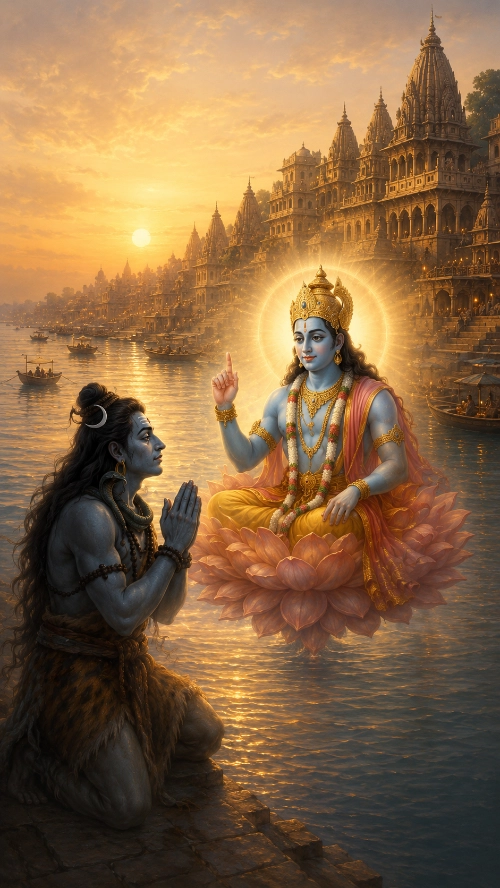
Ch3 — Shivas Liberation at Varanasi

Śiva’s Liberation from Brahmahatyā at Vārāṇasī

Chapter 3 of the Vāmana Purāṇa narrates how Śiva, burdened by the sin of brahmahatyā after severing Brahmā’s head, wanders through sacred rivers, forests, hermitages, and tīrthas in search of purification. Despite his austerities and yogic discipline, neither the guilt nor the skull attached to his hand is removed.

Śiva then approaches Viṣṇu, who directs him to the sacred city of Vārāṇasī, situated between the Varaṇā and Asi rivers. The chapter presents Vārāṇasī as the foremost tīrtha in the three worlds, a divine region where even those immersed in worldly life may attain liberation.

After bathing at the holy sites of Vārāṇasī, Śiva is freed from brahmahatyā, but the skull remains attached to his palm. Following Keśava’s instruction, he bathes in the sacred pool of Kapālamocana, where the skull finally falls away, establishing both Śiva’s title Kapālin and the tīrtha’s enduring sanctity.

Vamana Mahapurana

Chapter 3 - Śiva’s Liberation from Brahmahatyā at Vārāṇasī

Vāmana purāna
ch 3

पुलस्त्य उवाच
ततः करतले रुद्रः कपाले दारुणे स्थिते ।
सन्तापमगमद् ब्रह्मंश्चिन्तया व्याकुलेन्द्रियः ॥ १ ॥
ततः समागता रौद्रा नीलाञ्जनचयप्रभा ।
संरक्तमूर्धजा भीमा ब्रह्महत्या हरान्तिकम् ॥ २ ॥
तामागतां हरो दृष्ट्वा पप्रच्छ विकरालिनीम् ।
काऽसि त्वमागता रौद्रे केनाप्यर्थेन तद्वद ॥ ३ ॥

Pulastya uvāca tataḥ karatale rudraḥ kapāle dāruṇe sthite | santāpam agamad brahmaṃś cintayā vyākulendriyaḥ || 1 || tataḥ samāgatā raudrā nīlāñjanacayaprabhā | saṃraktamūrdhajā bhīmā brahmahatyā harāntikam || 2 || tām āgatāṃ haro dṛṣṭvā papraccha vikarālinīm | kāsi tvam āgatā raudre kenāpy arthena tad vada || 3 ||

Pulastya said: Then, while the dreadful skull remained fixed upon Rudra’s palm, he was overcome with anguish, O Brāhmaṇa, his senses agitated by anxious thought.

Then the terrible personification of brahmahatyā approached Hara. She was fierce, possessed the dark luster of a mass of black collyrium, had blood-red hair, and was fearsome in appearance.

Seeing that terrifying woman approach, Hara questioned her: “Who are you, fierce one, and for what purpose have you come? Tell me this.”


Commentary

Here, brahmahatyā is not merely an abstract offense but a female personification of the guilt arising from the killing of Brahmā or, more broadly, from the gravest sin of brahmahatyā. Her black radiance, blood-red hair, and terrifying form externalize the moral and ritual impurity that now follows Rudra. The narrative emphasizes that even a cosmic deity must visibly bear the consequences and expiation of such an act.

Verse 4-6

कपालिनमथोवाच ब्रह्महत्या सुदारुणा ।
ब्रह्मवध्याऽस्मि सम्प्राप्ता मां प्रतीच्छ त्रिलोचन ॥ ४ ॥
इत्येवमुक्त्वा वचनं ब्रह्महत्या विवेश ह ।
त्रिशूलपाणिनं रुद्रं सम्प्रतापितविग्रहम् ॥ ५ ॥
ब्रह्महत्याभिभूतश्च शर्वो बदरिकाश्रमम् ।
आगच्छन्न ददर्शाथ नरनारायणावृषी ॥ ६ ॥

kapālinam athovāca brahmahatyā sudāruṇā |
brahmavadhyāsmi samprāptā māṃ pratīccha trilocana || 4 ||
ity evam uktvā vacanaṃ brahmahatyā viveśa ha |
triśūlapāṇinaṃ rudraṃ sampratāpitavigraham || 5 ||
brahmahatyābhibhūtaś ca śarvo badarikāśramam |
āgacchan na dadarśātha naranārāyaṇāv ṛṣī || 6 ||

Then the exceedingly dreadful personification of brahmahatyā addressed the skull-bearing Lord: “I am Brahmavadhyā—the guilt arising from the slaying of Brahmā. I have now come to you; receive me, O Three-eyed One.”

Having spoken these words, Brahmahatyā entered Rudra, the trident-bearing Lord, whose embodied form was thereby grievously tormented.

Overwhelmed by brahmahatyā, Śarva came to Badarikāśrama, but upon arriving there, he did not see the two sages Nara and Nārāyaṇa.


Commentary

Brahmahatyā does not merely pursue him; she enters his body and consumes him with torment. The Purāṇic symbolism is precise: the consequence of an act is not merely an external punishment but something that becomes lodged within the doer’s own being. Rudra first seeks relief at Badarikāśrama, the sacred abode of Nara and Nārāyaṇa. Yet they are absent. This prepares the ensuing pilgrimage: even arrival at a supremely holy place does not automatically remove the burden. Rudra must continue searching for the specific means and sacred place capable of releasing him from both brahmahatyā and the skull that adheres to him.

Verse 7-9

अदृष्ट्वा धर्मतनयौ चिन्ताशोकसमन्वितः ।
जगाम यमुनां स्नातुं साऽपि शुष्कजलाऽभवत् ॥ ७ ॥
कालिन्दीं शुष्कसलिलां निरीक्ष्य वृषकेतनः ।
प्लक्षजां स्नातुमगमदन्तर्धानं च सा गता ॥ ८ ॥
ततो नु पुष्करारण्यं मागधारण्यमेव च ।
सैन्धवारण्यमेवासौ गत्वा स्नातो यथेच्छया ॥ ९ ॥

adṛṣṭvā dharmatanayau cintāśokasamanvitaḥ |
jagāma yamunāṃ snātuṃ sāpi śuṣkajalābhavat || 7 ||
kālindīṃ śuṣkasalilāṃ nirīkṣya vṛṣaketanaḥ |
plakṣajāṃ snātum agamad antardhānaṃ ca sā gatā || 8 ||
tato nu puṣkarāraṇyaṃ māgadhāraṇyam eva ca |
saindhavāraṇyam evāsau gatvā snāto yathecchayā || 9 ||

Not finding the two sons of Dharma, he became filled with anxiety and grief. He went to the Yamunā to bathe, but she, too, became entirely devoid of water.

Seeing the Kālindī bereft of her waters, the Bull-bannered Lord went to bathe in the Plakṣajā, but that river disappeared from sight.

Thereafter, he went to the forest of Puṣkara, as well as to the Māgadha forest and the Saindhava forest; having reached those places, he bathed there according to his desire.


Commentary

Kālindī is another name for the Yamunā, traditionally connected with Mount Kalinda, from which the river is said to arise. Rudra sees that the Yamunā–Kālindī has dried up. The river does not merely refuse to purify Rudra: her water itself vanishes in the presence of the embodied guilt of brahmahatyā.

In Purāṇic sacred geography, Plakṣajā is an epithet of the Sarasvatī, associated with her emergence at Plakṣaprasravaṇa. Elsewhere, the Vāmana Purāṇa itself explicitly identifies Sarasvatī as plakṣajā pāpanāśinī, “the sin-destroying river born from the plakṣa.”

The episode presents Rudra’s impurity as cosmically disruptive. The Yamunā dries up, while the Sarasvatī withdraws from sight. Sacred water, normally capable of removing sin, cannot yet receive one who is still completely possessed by the personified brahmahatyā.

Nevertheless, Rudra continues to visit the great sacred regions of Puṣkara, Māgadha, and Saindhava and to perform the prescribed bathing rites. The deeper implication is that ritual action alone does not invariably produce purification: the rite must correspond to the specific nature of the transgression. The following verses will make clear that even these renowned tīrthas cannot yet release him.

Verse 10-13

तथैव नैमिषारण्यं धर्मारण्यं तथेश्वरः ।
स्नातो नैव च सा रौद्रा ब्रह्महत्या व्यमुञ्चत ॥ १० ॥
सरित्सु तीर्थेषु तथाश्रमेषु पुण्येषु देवायतनेषु शर्वः ।
समायुतो योगयुतोऽपि पापान्नावाप मोक्षं जलदध्वजोऽसौ ॥ ११ ॥
ततो जगाम निर्विण्णः शङ्करः कुरुजाङ्गलम् ।
तत्र गत्वा ददर्शाथ चक्रपाणिं खगध्वजम् ॥ १२ ॥
तं दृष्ट्वा पुण्डरीकाक्षं शङ्खचक्रगदाधरम् ।
कृताञ्जलिपुटो भूत्वा हरः स्तोत्रमुदीरयत् ॥ १३ ॥

tathaiva naimiṣāraṇyaṃ dharmāraṇyaṃ tatheśvaraḥ |
snāto naiva ca sā raudrā brahmahatyā vyamuñcat || 10 ||
saritsu tīrtheṣu tathāśrameṣu puṇyeṣu devāyataneṣu śarvaḥ |
samāyuto yogayuto ’pi pāpān nāvāpa mokṣaṃ jaladadhvajo ’sau || 11 ||
tato jagāma nirviṇṇaḥ śaṅkaraḥ kurujāṅgalam |
tatra gatvā dadarśātha cakrapāṇiṃ khagadhvajam || 12 ||
taṃ dṛṣṭvā puṇḍarīkākṣaṃ śaṅkhacakragadādharam |
kṛtāñjalipuṭo bhūtvā haraḥ stotram udīrayat || 13 ||

In the same way, the Lord bathed at Naimiṣāraṇya and at Dharmāraṇya; yet that fierce Brahmahatyā did not release him.

In rivers and sacred fords, likewise in hermitages and holy temples, Śarva—though fully disciplined and established in yoga—did not obtain release from the sin, that Bull-bannered Lord.

Then Śaṅkara, overcome with despondency, went to Kurujāṅgala. Having arrived there, he beheld Cakrapāṇi, whose banner bore the bird Garuḍa.

Seeing the Lotus-eyed Lord, the bearer of the conch, discus, and mace, Hara placed his hands together in the hollow of reverential añjali and began to utter a hymn of praise.


Commentary

Kurujāṅgala is the comparatively dry or open tract of the Kuru country. In the broader Purāṇic narrative, it belongs to the sacred geography associated with Kurukṣetra.

Añjalipuṭa is the hollow or cup formed by joining the palms. It expresses humility, supplication, worship, and readiness to receive divine instruction.

The repeated pilgrimage reaches its theological turning point. Śiva has bathed in celebrated rivers, tīrthas, forests, hermitages, and temples; he has also employed yogic discipline. Yet none of these means has removed the embodied guilt. The text thereby distinguishes between the general purificatory power of sacred places and the specific remedy required for a particular transgression.

Śiva’s despondency leads him to Viṣṇu, not merely as another deity to be worshipped, but as one who knows the precise path of expiation. The movement from ritual wandering to supplicatory praise marks a transition from self-directed effort to revealed guidance. The following hymn will therefore function as both praise and an explicit plea for liberation from brahmahatyā.

Verse 14-16

हर उवाच
नमस्ते देवतानाथ नमस्ते गरुडध्वज ।
शङ्खचक्रगदापाणे वासुदेव नमोऽस्तु ते ॥ १४ ॥
नमस्ते निर्गुणानन्त अप्रतर्क्याय वेधसे ।
ज्ञानाज्ञाननिरालम्ब सर्वालम्ब नमोऽस्तु ते ॥ १५ ॥
रजोयुक्त नमस्तेऽस्तु ब्रह्ममूर्ते सनातन ।
त्वया सर्वमिदं नाथ जगत्सृष्टं चराचरम् ॥ १६ ॥

Hara uvāca
namas te devatānātha namas te garuḍadhvaja |
śaṅkhacakragadāpāṇe vāsudeva namo ’stu te || 14 ||
namas te nirguṇānanta apratarkyāya vedhase |
jñānājñānanirālamba sarvālamba namo ’stu te || 15 ||
rajoyukta namas te ’stu brahmamūrte sanātana |
tvayā sarvam idaṃ nātha jagat sṛṣṭaṃ carācaram || 16 ||

Hara said: Salutations to you, O Lord of the deities; salutations to you whose banner bears Garuḍa. O bearer of the conch, discus, and mace, O Vāsudeva, homage be to you.

Salutations to you, O attributeless and infinite One, to the inconceivable Creator. One independent of both knowledge and ignorance, yet the support of all things, homage be to you.

Salutations to you, O eternal One associated with rajas, whose form is Brahmā. By you, O Lord, this entire universe of moving and unmoving beings has been created.


Commentary
  • Nirguṇa does not necessarily mean that the deity possesses no qualities whatsoever. In Purāṇic theology, it primarily denotes the supreme reality that transcends the three material guṇas: sattva, rajas, and tamas.
  • Apratarkyāya — he who cannot be fully reached or determined by reasoning.
  • Jñānājñānanirālamba — independent of knowledge and ignorance. The Lord is not conditioned even by the distinction between knowing and not knowing.
  • Sarvālamba — the support upon which everything rests.
  • Brahmamūrte — one whose manifested form is Brahmā.

The hymn begins with Viṣṇu’s recognizable iconographic form—the Garuḍa banner, conch, discus, and mace—but quickly rises to a metaphysical description. Vāsudeva is both nirguṇa, beyond cosmic qualities, and sarvālamba, the foundation of all existence.

The same supreme being who is beyond the guṇas becomes associated with rajas and assumes the form of Brahmā in order to create the moving and unmoving universe. The text, therefore, distinguishes between the deity’s eternal, unconditioned nature and his functional manifestations within the cosmos.

Verse 17-19

सत्त्वाधिष्ठित लोकेश विष्णुमूर्तेऽधोक्षज ।
प्रजापाल महाबाहो जनार्दन नमोऽस्तु ते ॥ १७ ॥
तमोमूर्तिरहं ह्येष त्वदंशक्रोधसम्भवः ।
गुणाभियुक्त देवेश सर्वव्यापिन् नमोऽस्तु ते ॥ १८ ॥
भूरियं त्वं जगन्नाथ जलाम्बरहुताशनः ।
वायुर्बुद्धिर्मनश्चापि शर्वरी त्वं नमोऽस्तु ते ॥ १९ ॥

sattvādhiṣṭhita lokeśa viṣṇumūrte ’dhokṣaja |
prajāpāla mahābāho janārdana namo ’stu te || 17 ||
tamomūrtir ahaṃ hy eṣa tvadaṃśakrodhasambhavaḥ |
guṇābhiyukta deveśa sarvavyāpin namo ’stu te || 18 ||
bhūr iyaṃ tvaṃ jagannātha jalāmbarahutāśanaḥ |
vāyur buddhir manaś cāpi śarvarī tvaṃ namo ’stu te || 19 ||

O Lord of the worlds, established in sattva, whose manifested form is Viṣṇu; O Adhokṣaja, protector of created beings, mighty-armed Janārdana—homage be to you.

I am indeed this embodiment of tamas, born from the wrath of a portion of you. O Lord of the gods, associated with the guṇas and pervading all things, homage be to you.

You are this earth, O Lord of the universe; you are water, ether, and fire. You are wind, intellect, and mind; you are also the night. Homage be to you.


Commentary
  • Adhokṣaja — This traditional epithet of Viṣṇu denotes one who is beyond the reach of ordinary sensory cognition. It is commonly explained as that reality which cannot be brought within or diminished by the operations of the senses and empirical knowledge.
  • Prajāpāla — protector of creatures.

jalāmbarahutāśanaḥ — this expression enumerates:

  • jala — water
  • ambara — ether or space
  • hutāśana — fire, literally “the eater of oblations”

śarvarī — literally, “night.” Here, it may represent not merely ordinary nighttime but darkness, cosmic night, or the condition into which the manifested universe withdraws.

These verses complete a systematic description of the divine in terms of the three guṇas. The supreme Vāsudeva is beyond all qualities, yet manifests as Brahmā through rajas to create, as Viṣṇu through sattva to preserve, and as Rudra through tamas to dissolve.

Hara’s statement is especially significant: he does not present himself as an entirely independent power but as the tamasic manifestation arising through the wrath of Brahmā, who is himself a portion of the Supreme. The hymn, therefore, expresses a theology of functional divine unity: the apparently distinct deities are differentiated manifestations of one all-pervading reality.

Verse 19 expands this unity beyond the divine triad. The Lord is not only creator, preserver, and dissolver; he is the physical elements, the internal faculties of intellect and mind, and even cosmic darkness. Nothing exists outside his supporting and pervading presence.

Verse 20-23

धर्मो यज्ञस्तपः सत्यमहिंसा शौचमार्जवम् ।
क्षमा दानं दया लक्ष्मीर्ब्रह्मचर्यं त्वमीश्वर ॥ २० ॥
त्वं साङ्गाश्चतुरो वेदास्त्वं वेद्यो वेदपारगः ।
उपवेदा भवानीश सर्वोऽसि त्वं नमोऽस्तु ते ॥ २१ ॥
नमो नमस्तेऽच्युत चक्रपाणे नमोऽस्तु ते माधव मीनमूर्ते ।
लोके भवान् कारुणिको मतो मे त्रायस्व मां केशव पापबन्धात् ॥ २२ ॥
ममाशुभं नाशय विग्रहस्थं यद् ब्रह्महत्याऽभिभवं बभूव ।
दग्धोऽस्मि नष्टोऽस्म्यसमीक्ष्यकारी पुनीहि तीर्थोऽसि नमो नमस्ते ॥ २३ ॥

dharmo yajñas tapaḥ satyam ahiṃsā śaucam ārjavam |
kṣamā dānaṃ dayā lakṣmīr brahmacaryaṃ tvam īśvara || 20 ||
tvaṃ sāṅgāś caturo vedās tvaṃ vedyo vedapāragaḥ |
upavedā bhavān īśa sarvo ’si tvaṃ namo ’stu te || 21 ||
namo namas te ’cyuta cakrapāṇe namo ’stu te mādhava mīnamūrte |
loke bhavān kāruṇiko mato me trāyasva māṃ keśava pāpabandhāt || 22 ||
mamāśubhaṃ nāśaya vigrahasthaṃ yad brahmahatyābhibhavaṃ babhūva |
dagdho ’smi naṣṭo ’smy asamīkṣyakārī punīhi tīrtho ’si namo namas te || 23 ||

You are dharma, sacrifice, austerity, truth, nonviolence, purity, and uprightness. You are forgiveness, generosity, compassion, and prosperity embodied as Lakṣmī, and the discipline of brahmacarya, O Lord.

You are the four Vedas together with their ancillary disciplines; you are that which is to be known, and you have reached the farther shore of Vedic knowledge. You, O Lord, are the Upavedas; you are everything. Homage be to you.

Homage, repeated homage to you, O Acyuta, bearer of the discus. Homage be to you, O Mādhava, whose form is the Fish. I regard you as the compassionate one in this world. Save me, O Keśava, from the bondage of sin.

Destroy the evil lodged within my body—the affliction that arose through the overpowering presence of brahmahatyā. I am scorched; I am ruined; I acted without due consideration. Purify me—you yourself are the sacred ford of purification. Homage, repeated homage to you.


Commentary

The verse identifies the Lord not merely as the giver or protector of these principles, but as the principles themselves:

  • dharma — sustaining righteousness, sacred and moral order
  • yajña — sacrifice or sacrificial worship
  • tapas — austerity and spiritual discipline
  • satya — truth and truthfulness

śaucam ārjavam — these are complementary virtues:

  • śauca — purity, both external and internal
  • ārjava — straightness, sincerity, freedom from deceit or crookedness. Ārjava is more than general “honesty”: it denotes harmony between one’s thoughts, words, and actions.

Lakṣmī may simultaneously signify:

  • the goddess Lakṣmī as the divine power of Viṣṇu;
  • prosperity, auspiciousness, beauty, excellence, and good fortune.

Mīnamūrte — One whose form is a fish — this addresses Viṣṇu in his Matsya manifestation, the divine Fish associated with the preservation of sacred knowledge and living beings through the cosmic deluge.

A tīrtha is originally a ford or crossing-place and, by extension, a sacred place through which one crosses beyond impurity and suffering. After wandering through numerous physical tīrthas without obtaining release, Hara now recognizes the deity himself as the true living tīrtha and source of purification.

The hymn progresses from cosmic theology to ethical theology and finally to personal repentance. Viṣṇu is first praised as the elements and faculties composing the universe; he is then identified with virtues, sacrifice, sacred discipline, the Vedas, and everything that may be known. Divine reality is thus presented as the foundation not only of existence but also of moral and spiritual order.

The decisive moment occurs in verse 23. Hara calls himself asamīkṣyakārī, “one who acted without proper consideration.” This is a genuine admission of responsibility. His suffering is not described as an arbitrary misfortune imposed from outside, but as the consequence of his own unexamined action.

The statement tīrtho ’si, “you are the sacred ford,” also completes the preceding pilgrimage motif. Rivers, hermitages, forests, and temples had failed to free him. The text now suggests that purification ultimately requires more than physical movement through sacred geography: it requires humility, acknowledgment of wrongdoing, divine guidance, and an encounter with the very source of sacredness.

Verse 24-26

पुलस्त्य उवाच
इत्थं स्तुतश्चक्रधरः शङ्करेण महात्मना ।
प्रोवाच भगवान् वाक्यं ब्रह्महत्याक्षयाय हि ॥ २४ ॥
हरिरुवाच
महेश्वर शृणुष्वेमां मम वाचं कलस्वनाम् ।
ब्रह्महत्याक्षयकरीं शुभदां पुण्यवर्धनीम् ॥ २५ ॥
योऽसौ प्राङ्मण्डले पुण्ये मदंशप्रभवोऽव्ययः ।
प्रयागे वसते नित्यं योगशायीति विश्रुतः ॥ २६ ॥

Pulastya uvāca
itthaṃ stutaś cakradharaḥ śaṅkareṇa mahātmanā |
provāca bhagavān vākyaṃ brahmahatyākṣayāya hi || 24 ||
Harir uvāca
maheśvara śṛṇuṣvemāṃ mama vācaṃ kalasvanām |
brahmahatyākṣayakarīṃ śubhadāṃ puṇyavardhanīm || 25 ||
yo ’sau prāṅmaṇḍale puṇye madaṃśaprabhavo ’vyayaḥ |
prayāge vasate nityaṃ yogaśāyīti viśrutaḥ || 26 ||

Pulastya said: Thus praised by the magnanimous Śaṅkara, the divine bearer of the discus spoke these words, precisely for the destruction of brahmahatyā.

Hari said: O Maheśvara, listen to this sweet-toned utterance of mine—one that brings about the destruction of brahmahatyā, bestows auspiciousness, and increases merit.

That imperishable one who, in the holy eastern region, has arisen from a portion of me, dwells perpetually at Prayāga and is renowned as Yogaśāyin, “He who reclines in yogic repose.”


Commentary

The transition is significant. Śiva has asked Viṣṇu to purify him, but Viṣṇu does not simply remove the affliction instantaneously. Instead, he reveals a sacred geography and directs Śiva toward a particular manifestation of himself, Yogaśāyin.

Hari’s speech is itself described as brahmahatyākṣayakarī, capable of destroying the pollution of brahmahatyā. Divine instruction is therefore already part of the purification: Śiva must hear, understand, and follow the revealed path.

Verse 26 also begins to connect Prayāga, Yogaśāyin, Varaṇā, Asi, and Vārāṇasī within a single Purāṇic sacred geography. Although the geographical relationship will appear unusual from a modern cartographic standpoint, the text presents a theological landscape in which rivers and holy regions emanate from the body of the divine manifestation.

Verse 27-29

चरणाद् दक्षिणात्तस्य विनिर्याता सरिद्वरा ।
विश्रुता वरणेत्येव सर्वपापहरा शुभा ॥ २७ ॥
सव्यादन्या द्वितीया च असिरित्येव विश्रुता ।
ते उभे तु सरिच्छ्रेष्ठे लोकपूज्ये बभूवतुः ॥ २८ ॥
ताभ्यां मध्ये तु यो देशस्तत्क्षेत्रं योगशायिनः ।
त्रैलोक्यप्रवरं तीर्थं सर्वपापप्रमोचनम् ।
न तादृशोऽस्ति गगने न भूम्यां न रसातले ॥ २९ ॥

caraṇād dakṣiṇāt tasya viniryātā saridvarā |
viśrutā varaṇety eva sarvapāpaharā śubhā || 27 ||
savyād anyā dvitīyā ca asir ity eva viśrutā |
te ubhe tu saricchreṣṭhe lokapūjye babhūvatuḥ || 28 ||
tābhyāṃ madhye tu yo deśas tat kṣetraṃ yogaśāyinaḥ |
trailokyapravaraṃ tīrthaṃ sarvapāpapramocanam |
na tādṛśo ’sti gagane na bhūmyāṃ na rasātale || 29 ||

From his right foot issued forth an excellent river, renowned by the name Varaṇā, auspicious and the remover of every sin.

From his left foot arose another, a second river, renowned by the name of the Asi. Those two became the foremost of rivers and objects of veneration throughout the world.

The region lying between those two rivers is the sacred domain of Yogaśāyin—a tīrtha foremost throughout the three worlds and capable of releasing one from every sin. No region as it exists in heaven, upon the earth, or in Rasātala.


Commentary

These verses provide a sacred-geographical account of the region later explicitly identified as Vārāṇasī. Varaṇā emerges from Yogaśāyin’s right foot and Asi from his left; the territory enclosed by them becomes his divine kṣetra. The next verse in the chapter names the auspicious city situated there as Vārāṇasī.

The imagery makes the rivers more than geographical streams. Both originate from the body of the divine manifestation and therefore possess an intrinsic purificatory power. The land between them is consequently not sacred merely because rituals are performed there: its sanctity derives from its direct bodily relationship with Yogaśāyin.

This also clarifies why Śiva’s previous pilgrimage was unsuccessful. Hari is now directing him toward a uniquely constituted sacred domain—one described not simply as another holy place, but as the foremost tīrtha in all three worlds, with no equal in heaven, on earth, or below.

Verse 30-32

तत्रास्ति नगरी पुण्या ख्याता वाराणसी शुभा ।
यस्यां हि भोगिनोऽपीश प्रयान्ति भवतो लयम् ॥ ३० ॥
विलासिनीनां रशनास्वनेन श्रुतिस्वनैर्ब्राह्मणपुङ्गवानाम् ।
शुचिस्वरत्वं गुरवो निशम्य हास्यादशासन्त मुहुर्मुहुस्तान् ॥ ३१ ॥
व्रजत्सु योषित्सु चतुष्पथेषु पदान्यलक्तारुणितानि दृष्ट्वा ।
ययौ शशी विस्मयमेव यस्यां किंस्वित् प्रयाता स्थलपद्मिनीयम् ॥ ३२ ॥

tatrāsti nagarī puṇyā khyātā vārāṇasī śubhā |
yasyāṃ hi bhogino ’pīśa prayānti bhavato layam || 30 ||
vilāsinīnāṃ raśanāsvanena śrutisvanair brāhmaṇapuṅgavānām |
śucisvaratvaṃ guravo niśamya hāsyād aśāsanta muhur muhus tān || 31 ||
vrajatsu yoṣitsu catuṣpatheṣu padāny alaktāruṇitāni dṛṣṭvā |
yayau śaśī vismayam eva yasyāṃ kiṃsvit prayātā sthalapadminīyam || 32 ||

There stands the holy and auspicious city renowned as Vārāṇasī. There, O Lord, even those devoted to sensual enjoyment attain dissolution into you.

In that city, the teachers, hearing in the jingling of the girdles of graceful women a purity of tone comparable to the sounds of Vedic recitation uttered by the foremost Brāhmaṇas, repeatedly corrected those pupils with laughter.

Seeing at the crossroads the footprints left by passing women, reddened with lac dye, the Moon was overcome with wonder in that city and thought: “Can it be that this lotus-filled lake has somehow come upon the dry land?”


Commentary
  • Bhogin denotes one who enjoys or is attached to worldly and sensual pleasures. Vārāṇasī is said to possess such extraordinary salvific power that even persons who have not adopted an ascetic life may attain layam, dissolution, or absorption into Śiva. Here, laya is not mere physical death. In this sacred context, it signifies the cessation of separate existence through absorption into the Lord, thus implying liberation.
  • Jingling of the women’s girdles possesses such śucisvaratva, “purity or correctness of tone,” that it rivals the meticulously regulated accents of Vedic recitation.
  • As the women walked through the crossroads, the red color from their feet marked the ground.

Verse 30 expresses the celebrated doctrine that Vārāṇasī grants liberation even to those still immersed in worldly enjoyment. The holiness of the city is portrayed as surpassing the ordinary distinction between ascetic and sensual modes of life.

Verses 31–32 then shift into ornate urban poetry. Sacred learning and sensual beauty are not presented as mutually exclusive: the sounds of Vedic recitation mingle with the musical jingling of women’s ornaments. Likewise, the streets themselves appear transformed into lotus ponds by the red, lotus-like footprints of passing women.

The image of the astonished Moon is especially elegant. The Moon traditionally causes night lotuses to bloom, but in Vārāṇasī he encounters “lotuses” already blossoming upon dry land. The city’s beauty thus confounds even the celestial body most intimately associated with the lotus.

Verse 33-35

तुङ्गानि यस्यां सुरमन्दिराणि रुन्धन्ति चन्द्रं रजनीमुखेषु ।
दिवाऽपि सूर्यं पवनाप्लुताभिर्दीर्घाभिरेवं सुपताकिकाभिः ॥ ३३ ॥
भृङ्गाश्च यस्यां शशिकान्तभित्तौ प्रलोभ्यमानाः प्रतिबिम्बितेषु ।
आलेख्ययोषिद्विमलाननाब्जेष्वीयुर्भ्रमान्नैव च पुष्पकान्तरम् ॥ ३४ ॥
परिभ्रमश्चापि पराजितेषु नरेषु संमोहनलेखनेन ।
यस्यां जलक्रीडनसंगतासु न स्त्रीषु शम्भो गृहदीर्घिकासु ॥ ३५ ॥

tuṅgāni yasyāṃ suramandirāṇi rundhanti candraṃ rajanīmukheṣu |
divāpi sūryaṃ pavanāplutābhir dīrghābhir evaṃ supatākikābhiḥ || 33 ||
bhṛṅgāś ca yasyāṃ śaśikāntabhittau pralobhyamānāḥ pratibimbiteṣu |
ālekhyayoṣidvimalānanābjeṣv īyur bhramān naiva ca puṣpakāntaram || 34 ||
paribhramaś cāpi parājiteṣu nareṣu sammohanalekhanena |
yasyāṃ jalakrīḍanasaṅgatāsu na strīṣu śambho gṛhadīrghikāsu || 35 ||

In that city, its lofty temples of the gods obstruct the Moon at the beginning of the night, and even by day, their long and splendid banners, tossed aloft by the wind, conceal the Sun.

There, bees, enticed by the flawless lotus-faces of painted women reflected upon walls of moonstone, flew toward them in their delusion and did not seek any other flower.

In that city, O Śambhu, bewilderment is found among men overcome by enchanting paintings, but not among the women assembled for water-play in the long pools within the houses.


Commentary
  • pavana — wind;
  • supatākikā — the word is a derivative of patākā, “banner, flag, streamer,” with su-, “beautiful, excellent.” The diminutive-looking suffix does not necessarily indicate smallness here; the banners are explicitly described as dīrghāḥ, “long.”
  • śaśikānta — moonstone, a pale and lustrous gem traditionally associated with moonlight;
  • vimala — flawless, spotless;
  • ānana — face;
  • abja — lotus, literally “water-born”;
  • paribhramaḥ — mental confusion or bewilderment; dizziness or reeling; wandering or moving about in circles.
  • sammohana — captivating, enchanting, producing bewilderment;
  • lekhana — drawing, painting, artistic delineation.

These verses continue an ornate description of Vārāṇasī in which its architecture, art, and inhabitants surpass ordinary reality. The temples reach so high that they obstruct the celestial lights; their banners hide the Sun, while their towers block the rising Moon.

Verse 34 presents an elegant illusion: painted women are so exquisitely rendered upon the luminous walls that bees mistake their faces for real lotuses. Art does not merely imitate nature—it momentarily defeats the creatures whose instincts are directed toward nature.

Verse 35 extends this theme from bees to human beings. Men are overcome by the captivating power of artistic representation, while the women of Vārāṇasī remain composed even amid vigorous water-play. The passage praises both the extraordinary artistic culture of the city and the beauty, grace, and self-possession of its inhabitants.

Verse 36-38

न चैव कश्चित् परमन्दिराणि रुणद्धि शम्भो सहसा ऋतेऽक्षान् ।
न चाबलानां तरसा पराक्रमं करोति यस्यां सुरतं हि मुक्त्वा ॥ ३६ ॥
पाशग्रन्थिर्गजेन्द्राणां दानच्छेदो मदच्युतौ ।
यस्यां मानमदौ पुंसां करिणां यौवनागमे ॥ ३७ ॥
प्रियदोषाः सदा यस्यां कौशिका नेतरे जनाः ।
तारागणेऽकुलीनत्वं गद्ये वृत्तच्युतिर्विभो ॥ ३८ ॥

na caiva kaścit paramandirāṇi ruṇaddhi śambho sahasā ṛte ’kṣān |
na cābalānāṃ tarasā parākramaṃ karoti yasyāṃ surataṃ hi muktvā || 36 ||
pāśagranthir gajendrāṇāṃ dānacchedo madacyutau |
yasyāṃ mānamadau puṃsāṃ kariṇāṃ yauvanāgame || 37 ||
priyadoṣāḥ sadā yasyāṃ kauśikā netare janāḥ |
tārāgaṇe ’kulīnatvaṃ gadye vṛttacyutir vibho || 38 ||

In that city, O Śambhu, no one forcibly lays hold of another’s houses—except the dice; nor does anyone make a forceful advance against women, except in the context of lovemaking.

Knots in binding-cords are found only among mighty elephants, and the “interruption of dāna” occurs only in the dripping of their rut-fluid. In that city, among males, pride and intoxication belong only to elephants when they enter the vigor of youth.

There, only owls are perpetually fond of doṣā, the night, not other people of doṣa, faults. “Lack of noble lineage” is found only in the host of stars, and departure from vṛtta only in prose, O Lord.


Commentary

These verses are built upon parisaṃkhyā, a poetic figure of exclusive restriction. The poet appears to acknowledge undesirable conditions—bondage, interruption of generosity, pride, love of faults, ignoble status, and deviation from right conduct—but confines every one of them to an innocent secondary meaning.

Thus, knots exist only in elephants’ ropes; the cessation of dāna only in the flow of elephant-ichor; pride and intoxication only in rutting elephants; love of doṣā only among nocturnal owls; akulīnatva only among the stars; and loss of vṛtta only in prose. The inhabitants of Vārāṇasī are thereby praised as free from violence, miserliness, arrogance, vice, ignoble conduct, and moral deviation.

Verse 39-41

भूतिलुब्धा विलासिन्यो भुजङ्गपरिवारिताः ।
चन्द्रभूषितदेहाश्च यस्यां त्वमिव शङ्कर ॥ ३९ ॥
ईदृशायां सुरेशान वाराणस्यां महाश्रमे ।
वसते भगवाँल्लोलः सर्वपापहरो रविः ॥ ४० ॥
दशाश्वमेधं यत्प्रोक्तं मदंशो यत्र केशवः ।
तत्र गत्वा सुरश्रेष्ठ पापमोक्षमवाप्स्यसि ॥ ४१ ॥

bhūtilubdhā vilāsinyo bhujaṅgaparivāritāḥ |
candabhūṣitadehāś ca yasyāṃ tvam iva śaṅkara || 39 ||
īdṛśāyāṃ sureśāna vārāṇasyāṃ mahāśrame |
vasate bhagavāṁl lolaḥ sarvapāpaharo raviḥ || 40 ||
daśāśvamedhaṃ yat proktaṃ madaṃśo yatra keśavaḥ |
tatra gatvā suraśreṣṭha pāpamokṣam avāpsyasi || 41 ||

In that city, O Śaṅkara, the courtesans resemble even you: they are eager for bhūti—wealth in their case and sacred ash in yours; they are surrounded by bhujaṅgas—paramours in their case and serpents in yours; and their bodies are adorned with lunar ornaments, just as yours is adorned with the Moon.

In such a Vārāṇasī, O Lord of the gods—that great sacred sanctuary—dwells the divine Lola, the Sun who removes every sin.

There is also the place called Daśāśvamedha, where Keśava, a manifestation arising from a portion of me, abides. Having gone there, O foremost of the gods, you will obtain release from sin.


Commentary

bhūtilubdhāḥ — this compound has a deliberately different application to the courtesans and to Śiva. “Eager for wealth” and “fond of sacred ash.” For Śiva, bhūti can also refer to sacred ash, or bhasman. Śiva is characteristically smeared with ash. Courtesan’s resemblance to Śiva is established through śleṣa, a pun in which the same word bears different meanings in relation to two subjects.

bhujaṅgaparivāritāḥ — bhujaṅga ordinarily means “snake” or “serpent”, but figuratively, it can denote a libertine, gallant, lover, or paramour. Thus, the women are “surrounded by their lovers,” whereas Śiva is “surrounded and adorned by serpents.”

candrabhūṣitadehāḥ — “those whose bodies are adorned by the Moon.” In relation to Śiva, the meaning is direct: he bears the crescent Moon upon his head. In relation to the women, the expression refers poetically to lunar or crescent-shaped ornaments, or ornaments whose pale brilliance resembles moonlight. Thus, their bodies are decorated with “moons,” while Śiva bears the actual Moon.

The proper name is Lola. Because the deity is immediately identified as Ravi, the Sun, the reference is to the solar manifestation known more fully as Lolārka:

  • lola — trembling, wavering, moving;
  • arka — the Sun.

Lolārka, the Sun-god of the famous tīrtha still extant in Varanasi today (Lolārka Kuṇḍa, near Tulsī Ghāṭ at the Asi–Gaṅgā confluence). The Vamana Purāṇa is, in fact, one of the textual sources cited for the origin story of this very shrine, alongside the Kāśī Khaṇḍa of the Skanda Purāṇa. Lolārka Ṣaṣṭhī, the festival still observed there today (bathing for fertility/cure of disease), is the living continuation of exactly the "remover of all sin" function this verse assigns him.

sarvapāpaharaḥ — removing, taking away, destroying every sin. pāpamokṣam avāpsyasi — you will obtain release from sin.

Verse 39 concludes the elaborate praise of Vārāṇasī with an audacious and humorous comparison. Even the city’s courtesans resemble Śiva—not because their outward lives are identical to his ascetic life, but because the poet can apply the same words to both through carefully constructed double meanings. Wealth corresponds to ash, lovers to serpents, and lunar ornaments to Śiva’s crescent Moon. The sacred and sensual dimensions of the city are poetically interwoven rather than simply opposed.

Verses 40–41 then return from literary description to Hari’s practical instruction. Three sacred presences are indicated: Lola or Lolārka, the sin-destroying Sun; Daśāśvamedha, the renowned tīrtha; and Keśava, Hari’s localized manifestation. Śiva is not merely told to enter Vārāṇasī in a general sense, but to approach its particular divine centers.

The sequence also shows that Vārāṇasī’s salvific power is expressed through the convergence of several divine traditions. Śiva seeks purification there, Viṣṇu directs him there and abides there as Keśava, while the Sun dwells there as Lola. The city is thus portrayed as a unified sacred field in which Śaiva, Vaiṣṇava, and solar powers cooperate to remove sin.

Verse 42-45

इत्येवमुक्तो गरुडध्वजेन वृषध्वजस्तं शिरसा प्रणम्य ।
जगाम वेगाद् गरुडो यथाऽसौ वाराणसीं पापविमोचनाय ॥ ४२ ॥
गत्वा सुपुण्यां नगरीं सुतीर्थां दृष्ट्वा च लोलं सदशाश्वमेधम् ।
स्नात्वा च तीर्थेषु विमुक्तपापः स केशवं द्रष्टुमुपाजगाम ॥ ४३ ॥
केशवं शङ्करो दृष्ट्वा प्रणिपत्येदमब्रवीत् ।
त्वत्प्रसादाद् हृषीकेश ब्रह्महत्या क्षयं गता ॥ ४४ ॥
नेदं कपालं देवेश मद्धस्तं परिमुञ्चति ।
कारणं न वेद्मि च तदेतन्मे वक्तुमर्हसि ॥ ४५ ॥

ity evam ukto garuḍadhvajena vṛṣadhvajas taṃ śirasā praṇamya |
jagāma vegād garuḍo yathāsau vārāṇasīṃ pāpavimocanāya || 42 ||
gatvā supuṇyāṃ nagarīṃ sutīrthāṃ dṛṣṭvā ca lolaṃ sadaśāśvamedham |
snātvā ca tīrtheṣu vimuktapāpaḥ sa keśavaṃ draṣṭum upājagāma || 43 ||
keśavaṃ śaṅkaro dṛṣṭvā praṇipatyedam abravīt |
tvatprasādād dhṛṣīkeśa brahmahatyā kṣayaṃ gatā || 44 ||
nedaṃ kapālaṃ deveśa maddhastaṃ parimuñcati |
kāraṇaṃ na vedmi ca tad etan me vaktum arhasi || 45 ||

Having been thus instructed by the Garuḍa-bannered Lord, the Bull-bannered Śiva bowed his head before him and sped toward Vārāṇasī for release from sin, as swiftly as Garuḍa himself.

Having reached that exceedingly holy city, rich in excellent sacred fords, and having beheld Lola together with Daśāśvamedha, he bathed in its tīrthas. Freed from sin, he then approached Keśava in order to behold him.

Having seen Keśava, Śaṅkara bowed down before him and said: “Through your grace, O Hṛṣīkeśa, Brahmahatyā has come to an end.

Yet this skull, O Lord of the gods, does not release my hand. I do not know the reason for this; therefore, you should explain it to me.”


Commentary
  • supuṇyām — exceedingly holy, supremely meritorious;
  • sutīrthām — possessing excellent tīrthas, or itself constituting an excellent sacred ford.

These verses introduce an important distinction between moral-ritual purification and the removal of the deed's visible consequences. By bathing at Vārāṇasī’s tīrthas, Śiva becomes vimuktapāpa, released from the pollution of Brahmahatyā. Yet Brahmā’s skull remains attached to his hand.

The text, therefore, treats the two afflictions separately. Brahmahatyā represents the internalized guilt and impurity generated by the act, whereas the skull that adheres to it is its enduring physical and ascetic sign. The first has been removed by the sacred power of Vārāṇasī; the second will require a further, more specific act.

Śiva’s question also demonstrates continued humility. Although his principal sin has been destroyed, he does not assume that purification is complete. He approaches Keśava again and asks for the cause and remedy, allowing divine instruction—not his own presumption—to guide the final stage of expiation.

Verse 46-49

पुलस्त्य उवाच
महादेववचः श्रुत्वा केशवो वाक्यमब्रवीत् ।
विद्यते कारणं रुद्र तत्सर्वं कथयामि ते ॥ ४६ ॥
योऽसौ ममाग्रतो दिव्यो ह्रदः पद्मोत्पलैर्युतः ।
एष तीर्थवरः पुण्यो देवगन्धर्वपूजितः ॥ ४७ ॥
एतस्मिन् प्रवरे तीर्थे स्नानं शम्भो समाचर ।
स्नातमात्रस्य चाद्यैव कपालं परिमोक्ष्यति ॥ ४८ ॥
ततः कपाली लोके च ख्यातो रुद्र भविष्यसि ।
कपालमोचनेत्येवं तीर्थं चेदं भविष्यति ॥ ४९ ॥

Pulastya uvāca
mahādevavacaḥ śrutvā keśavo vākyam abravīt |
vidyate kāraṇaṃ rudra tat sarvaṃ kathayāmi te || 46 ||
yo ’sau mamāgrato divyo hradaḥ padmotpalair yutaḥ |
eṣa tīrthavaraḥ puṇyo devagandharvapūjitaḥ || 47 ||
etasmin pravare tīrthe snānaṃ śambho samācara |
snātamātrasya cādyaiva kapālaṃ parimokṣyati || 48 ||
tataḥ kapālī loke ca khyāto rudra bhaviṣyasi |
kapālamocanety evaṃ tīrthaṃ cedaṃ bhaviṣyati || 49 ||

Pulastya said: Having heard Mahādeva’s words, Keśava replied: “There is a reason for this, O Rudra; I shall explain it all to you.

That divine pool before me, filled with lotuses and blue water-lilies, is an excellent and holy tīrtha, worshipped by gods and Gandharvas.

Perform the rite of bathing in this foremost tīrtha, O Śambhu. This very day, as soon as you have bathed, the skull will release its hold upon you.

Thereafter, O Rudra, you will become renowned throughout the world as Kapālin, ‘the Skull-bearer’; and this tīrtha will consequently become known as Kapālamocana, ‘the Place of Release from the Skull.’”


Commentary
  • puṇya — holy and merit-producing;
  • devagandharvapūjita — honored by gods and Gandharvas.
  • Kapālin — one who bears or carries a skull.

The narrative now distinguishes three successive stages of Śiva’s expiation. First, Brahmahatyā, the internalized guilt and impurity, is destroyed through his pilgrimage and bathing in Vārāṇasī. Second, the physical sign of the transgression—the skull adhering to his hand—must be removed at a specific sacred pool. Third, the event becomes permanently inscribed into sacred geography and divine nomenclature: Śiva becomes Kapālin, while the pool becomes Kapālamocana.

This is a typical Purāṇic explanation of the origin of a tīrtha. The place is sacred not merely because it possesses water or ritual merit, but because a decisive divine event occurred there. The name preserves the event, while pilgrimage ritually allows later worshippers to participate in the same power of release.

Verse 50-51

पुलस्त्य उवाच
एवमुक्तः सुरेशेन केशवेन महेश्वरः ।
कपालमोचने सस्नौ वेदोक्तविधिना मुने ॥ ५० ॥
स्नातस्य तीर्थे त्रिपुरान्तकस्य परिच्युतं हस्ततलात् कपालम् ।
नाम्ना बभूवाथ कपालमोचनं तत्तीर्थवर्यं भगवत्प्रसादात् ॥ ५१ ॥

Pulastya uvāca
evam uktaḥ sureśena keśavena maheśvaraḥ |
kapālamocane sasnau vedoktavidhinā mune || 50 ||
snātasya tīrthe tripurāntakasya paricyutaṃ hastatalāt kapālam |
nāmnā babhūvātha kapālamocanaṃ tat tīrthavaryaṃ bhagavatprasādāt || 51 ||

Pulastya said: Having been thus instructed by Keśava, the Lord of the gods, Maheśvara bathed at Kapālamocana according to the procedure prescribed in the Veda, O sage.

When Tripurāntaka had bathed in that tīrtha, the skull fell away from the palm of his hand. Thereupon, by the grace of the Lord, that most excellent tīrtha became known by the name Kapālamocana, “Release from the Skull.”


Commentary

The chapter’s central narrative concludes here. Śiva had already been released from Brahmahatyā, but the skull remained attached as the physical residue and visible sign of his act. Only after he performs the prescribed bathing rite at the particular pool designated by Keśava does the skull finally fall from his palm.

Verse 51 also formally establishes the tīrtha’s name. Although Keśava had already referred to it prospectively as Kapālamocana, the name becomes historically and ritually grounded only when the foretold event actually occurs. The place is therefore called Kapālamocana not merely because it can release sins in general, but because it was the precise site where Brahmā’s skull was released from Śiva’s hand.

इति श्रीवामनपुराणे
तृतीयोऽध्यायः ३

iti śrīvāmanapurāṇe tṛtīyo ’dhyāyaḥ || 3 ||

Thus ends the third chapter of the venerable Vāmana Purāṇa.

Synopsis of Vāmana Purāṇa, Chapter 3 — 
Śiva’s Liberation from Brahmahatyā at Vārāṇasī

Brahmahatyā as an Embodied Consequence

The chapter begins with Brahmā’s severed skull remaining fixed to Rudra’s palm. The guilt of the act manifests independently as Brahmahatyā, a terrifying female figure with a dark complexion and blood-red hair. Identifying herself specifically as the consequence of Brahmā’s killing, she enters Rudra’s body and subjects him to severe suffering. The narrative, therefore, distinguishes between the skull, as the visible residue of the deed, and Brahmahatyā, as its internal moral and ritual pollution.

The Failure of General Purificatory Means

Afflicted by Brahmahatyā, Rudra seeks Nara and Nārāyaṇa at Badarikāśrama but does not find them. He then attempts purification by bathing in the Yamunā and Sarasvatī, and in numerous renowned sacred regions, including Puṣkara, Naimiṣāraṇya, Dharmāraṇya, Māgadha, and Saindhava. The Yamunā dries up, and the Sarasvatī disappears, suggesting that Rudra’s impurity is so powerful that even sacred waters withdraw from it. Neither pilgrimage, ritual bathing, residence at holy places, nor yogic discipline releases him.

Viṣṇu as the Revealer of the Specific Expiation

Despondent, Śiva reaches Kurujāṅgala and approaches Viṣṇu with folded hands. His hymn presents Vāsudeva as both nirguṇa—beyond the cosmic qualities—and as the source of the functional manifestations of Brahmā, Viṣṇu, and Rudra through rajas, sattva, and tamas. Śiva acknowledges that he is a manifestation associated with tamas and admits he acted without proper consideration. Viṣṇu is praised not only as the cosmic elements and faculties but also as dharma, sacrifice, truth, austerity, compassion, the Vedas, and the ultimate tīrtha.

Vārāṇasī as a Divinely Constituted Sacred Field

Viṣṇu directs Śiva to the supreme sacred region associated with Yogaśāyin. The Varaṇā and Asi rivers are described as issuing from the deity’s right and left feet, and the territory between them forms the sacred domain of Vārāṇasī. Its sanctity is therefore presented as intrinsic rather than merely conventional: the city is physically and cosmologically connected with the divine body. It is proclaimed the foremost tīrtha in the three worlds, without equal in heaven, on earth, or in the subterranean realms.

Sacredness, Urban Beauty, and Liberation

The chapter contains an elaborate poetic description of Vārāṇasī as a city where sacred learning, artistic refinement, sensual beauty, and liberating power coexist. Its temples reach the celestial bodies, its paintings deceive bees and men, and the sounds of women’s ornaments rival the precision of Vedic recitation. Through puns and restrictive poetic constructions, the text portrays its inhabitants as free from violence, arrogance, vice, ignoble conduct, and moral deviation. Even those devoted to worldly enjoyment are said to attain dissolution into Śiva there.

Two Stages of Purification

After Śiva bathes at the sacred sites of Vārāṇasī and worships Lola, Daśāśvamedha, and Keśava, Brahmahatyā is destroyed. Nevertheless, Brahmā’s skull remains attached to his hand. This establishes a technical distinction between release from sin and removal of its physical or ascetic sign. Keśava therefore directs him to a particular lotus-filled pool, worshipped by gods and Gandharvas, where the final stage of expiation must occur.

The Origin of Kapālamocana

Śiva bathes in the designated pool according to Vedic procedure, whereupon the skull falls from his palm. The event establishes Śiva’s epithet Kapālin, “the Skull-bearer,” and gives the tīrtha the name Kapālamocana, “Release from the Skull.” The chapter thus functions as a tīrtha-māhātmya: it explains the origin, name, ritual efficacy, and theological authority of Kapālamocana while presenting Vārāṇasī as a sacred field in which Śaiva, Vaiṣṇava, and solar manifestations cooperate to remove sin.

Bookmark Dharmavidya by pressing Ctrl+D or Cmd+D. 
Visit our YouTube channel.