1-3
पुलस्त्य उवाच
एवं कपाली सञ्जातो देवर्षे भगवान् हरः ।
अनेन कारणेनासौ दक्षेण न निमन्त्रितः ॥ १ ॥
कपालिजायेति सतीं विज्ञायाथ प्रजापतिः ।
यज्ञे चार्हापि दुहिता दक्षेण न निमन्त्रिता ॥ २ ॥
एतस्मिन्नन्तरे देवीं द्रष्टुं गौतमनन्दिनी ।
जया जगाम शैलेन्द्रं मन्दरं चारुकन्दरम् ॥ ३ ॥
Pulastya uvāca
evaṃ kapālī sañjāto devarṣe bhagavān haraḥ |
anena kāraṇenāsau dakṣeṇa na nimantritaḥ || 1 ||
kapālijāyeti satīṃ vijñāyātha prajāpatiḥ |
yajñe cārhāpi duhitā dakṣeṇa na nimantritā || 2 ||
etasminn antare devīṃ draṣṭuṃ gautamanandinī |
jayā jagāma śailendraṃ mandaraṃ cārukandaram || 3 ||
Pulastya said: Thus, O divine sage, the blessed Hara came to be known as Kapālin, the Skull-bearer. For this reason, Dakṣa did not invite him.
Then Prajāpati Dakṣa, regarding Satī as the wife of Kapālin, did not invite even his own daughter to the sacrifice, although she was certainly worthy of invitation.
Meanwhile, Jaya, the daughter of Gautama, went to Mount Mandara, the lord of mountains with its beautiful caves, in order to see the Goddess.
Commentary
The new chapter returns to the question raised earlier: why Śiva and Satī were excluded from Dakṣa’s sacrifice. The explanation is now made explicit. Dakṣa despised Śiva’s identity as Kapālin, interpreting the skull-bearing ascetic form as unfit for participation in a solemn sacrifice.
Satī’s exclusion is presented as especially unjust. She was Dakṣa’s own daughter and inherently worthy of honor, yet he rejected her because of her marriage to Śiva. The passage, therefore, establishes the personal insult and familial rupture that will lead to the catastrophe at Dakṣa’s sacrifice.
4-6
तामागतां सती दृष्ट्वा जयामेकामुवाच ह ।
किमर्थं विजया नागाज्जयन्ती चापराजिता ॥ ४ ॥
सा देव्या वचनं श्रुत्वोवाच परमेश्वरीम् ।
गताः निमन्त्रिताः सर्वाः मखे मातामहस्य ताः ॥ ५ ॥
समं पित्रा गौतमेन मात्रा चैवाप्यहल्यया ।
अहं समागता द्रष्टुं त्वां तत्र गमनोत्सुका ॥ ६ ॥
tām āgatāṃ satī dṛṣṭvā jayām ekām uvāca ha |
kimarthaṃ vijayā nāgāj jayantī cāparājitā || 4 ||
sā devyā vacanaṃ śrutvovāca parameśvarīm |
gatā nimantritāḥ sarvā makhe mātāmahasya tāḥ || 5 ||
samaṃ pitrā gautamena mātrā caivāpy ahalyayā |
ahaṃ samāgatā draṣṭuṃ tvāṃ tatra gamanotsukā || 6 ||
Seeing that Jaya alone had arrived, Satī said to her: “Why have Vijayā, Jayantī, and Aparājitā not come?”
Hearing the Goddess’s words, she replied to the Supreme Lady: “All of them were invited and have gone to our maternal grandfather’s sacrifice.
Together with my father Gautama and my mother Ahalyā, I have come to see you, being eager to go there.”
Commentary
The maternal grandfather here is Dakṣa, since the girls are descended through Satī’s sister and are therefore his granddaughters.
Jaya has come first to see Satī, but she also expects to proceed to the sacrifice.
The dialogue reveals the exclusion indirectly. Satī initially assumes that her companions’ absence is accidental, but Jaya explains that they have all been formally invited to Dakṣa’s sacrifice. This makes Satī’s own exclusion more conspicuous and painful: the wider family has been summoned, while Dakṣa’s own daughter has deliberately been left uninformed.
Jaya’s innocent remark, therefore, becomes the immediate cause of Satī’s discovery. The contrast between the formal invitation and Satī’s omission prepares the emotional crisis that follows.
7-9
किं त्वं न व्रजसे तत्र तथा देवो महेश्वरः ।
नामन्त्रिताऽसि तातेन उताहोस्विद् व्रजिष्यसि ॥ ७ ॥
गतास्तु ऋषयः सर्वे ऋषिपत्न्यः सुरास्तथा ।
मातृष्वसः शशाङ्कश्च सपत्नीको गतः क्रतुम् ॥ ८ ॥
चतुर्दशसु लोकेषु जन्तवो ये चराचराः ।
निमन्त्रिताः क्रतौ सर्वे किं नासि त्वं निमन्त्रिता ॥ ९ ॥
kiṃ tvaṃ na vrajase tatra tathā devo maheśvaraḥ |
nāmantritāsi tātena utāhosvid vrajiṣyasi || 7 ||
gatās tu ṛṣayaḥ sarve ṛṣipatnyaḥ surās tathā |
mātṛṣvasaḥ śaśāṅkaś ca sapatnīko gataḥ kratum || 8 ||
caturdaśasu lokeṣu jantavo ye carācarāḥ |
nimantritāḥ kratau sarve kiṃ nāsi tvaṃ nimantritā || 9 ||
“Why are you not going there—and likewise the divine Maheśvara? Were you not invited by your father, or will you perhaps go later?
All the sages have gone, as have the sages’ wives and the gods. Your maternal aunts have gone as well, and the Moon has gone to the sacrifice together with his wives.
All the moving and unmoving beings that exist throughout the fourteen worlds have been invited to the sacrifice. How is it that you alone have not been invited?”
Commentary
- śaśāṅkaḥ — “the hare-marked one,” a conventional name for the Moon.
- caturdaśasu lokeṣu — “throughout the fourteen worlds” — the expression embraces the complete Purāṇic cosmos, including the upper and lower worlds.
The compound carācara conventionally denotes the whole created world: animate beings that move and forms of life or existence that remain stationary.
- jantavaḥ — living beings, creatures;
- cara — moving;
- acara — unmoving.
Jaya’s words become increasingly emphatic. She first asks casually whether Satī and Śiva intend to attend; she then lists the sages, their wives, the gods, Satī’s sisters, and the Moon with his consorts. Finally, she declares that every moving and unmoving being in all fourteen worlds has been invited.
The closing question—“How is it that you have not been invited?”—reveals the full extent of Dakṣa’s deliberate insult. Satī has not been overlooked accidentally. The universality of the invitation makes her exclusion, and therefore Śiva’s exclusion, uniquely conspicuous.
10-12
पुलस्त्य उवाच
जयायास्तद्वचः श्रुत्वा वज्रपातसमं सती ।
मन्युनाऽभिप्लुता ब्रह्मन् पञ्चत्वमगमत् ततः ॥ १० ॥
जया मृतां सतीं दृष्ट्वा क्रोधशोकपरिप्लुता ।
मुञ्चन्ती वारि नेत्राभ्यां सस्वरं विललाप ह ॥ ११ ॥
आक्रन्दितध्वनिं श्रुत्वा शूलपाणिस्त्रिलोचनः ।
आः किमेतदितीत्युक्त्वा जयाभ्याशमुपागतः ॥ १२ ॥
Pulastya uvāca
jayāyās tad vacaḥ śrutvā vajrapātasamaṃ satī |
manyunābhiplutā brahman pañcatvam agamat tataḥ || 10 ||
jayā mṛtāṃ satīṃ dṛṣṭvā krodhaśokapariplutā |
muñcantī vāri netrābhyāṃ sasvaraṃ vilalāpa ha || 11 ||
ākranditadhvaniṃ śrutvā śūlapāṇis trilocanaḥ |
āḥ kim etad itīty uktvā jayābhyāśam upāgataḥ || 12 ||
Pulastya said: Having heard those words of Jaya, which struck like the fall of a thunderbolt, Satī was overwhelmed by anguish and indignation, O Brāhmaṇa, and thereupon passed into the five elements.
Seeing Satī dead, Jaya was overcome by anger and grief. Shedding streams of water from her eyes, she lamented aloud.
Hearing the sound of her wailing, the three-eyed, trident-bearing Lord exclaimed, “Ah! What is this?” and approached the place where Jaya was.
Commentary
pañcatvam agamat — “she went to the state of five” — this is a conventional Sanskrit expression for death. The body is understood to dissolve into the five great elements:
- earth,
- water,
- fire,
- air,
- ether.
This recension presents Satī’s death differently from the better-known narrative in which she attends Dakṣa’s sacrifice and enters the sacrificial fire. Here, she does not go to the sacrifice at all. The mere discovery that Dakṣa has invited virtually the whole cosmos while deliberately rejecting her and Śiva strikes her like a thunderbolt, and she dies immediately upon Mount Mandara.
Her death is described not as a deliberate ritual act but as the direct result of unbearable inner anguish—manyunābhiplutā, “overwhelmed by wounded emotion.” Jaya’s loud lament then draws Śiva to the scene, initiating the violent consequences of Dakṣa’s insult.
13-16
आगतो ददृशे देवीं लतामिव वनस्पतेः ।
कृत्तां परशुना भूमौ श्लथाङ्गीं पतितां सतीम् ॥ १३ ॥
देवीं निपतितां दृष्ट्वा जयां पप्रच्छ शङ्करः ।
किमियं पतिता भूमौ निकृत्तेव लता सती ॥ १४ ॥
सा शङ्करवचः श्रुत्वा जया वचनमब्रवीत् ।
श्रुत्वा मखस्था दक्षस्य भगिन्यः पतिभिः सह ॥ १५ ॥
आदित्याद्यास्त्रिलोकेश समं शक्रादिभिः सुरैः ।
मातृष्वसा विपन्नेयमन्तर्दुःखेन दह्यती ॥ १६ ॥
āgato dadṛśe devīṃ latām iva vanaspateḥ |
kṛttāṃ paraśunā bhūmau ślathāṅgīṃ patitāṃ satīm || 13 ||
devīṃ nipatitāṃ dṛṣṭvā jayāṃ papraccha śaṅkaraḥ |
kim iyaṃ patitā bhūmau nikṛtteva latā satī || 14 ||
sā śaṅkaravacaḥ śrutvā jayā vacanam abravīt |
śrutvā makhasthā dakṣasya bhaginyaḥ patibhiḥ saha || 15 ||
ādityādyās trilokeśa samaṃ śakrādibhiḥ suraiḥ |
mātṛṣvasā vipanneyam antarduḥkhena dahyatī || 16 ||
On arriving, he saw the Goddess Satī lying upon the ground, her limbs slack, like a creeper severed from its supporting tree by an axe.
Seeing the Goddess fallen, Śaṅkara asked Jaya: “Why has this Satī fallen upon the ground like a creeper that has been cut down?”
Hearing Śaṅkara’s words, Jaya replied: “O Lord of the three worlds, having heard that Dakṣa’s sisters were present at the sacrifice together with their husbands, and that the Ādityas and the other gods were there together with Śakra and the deities who accompany him, this maternal aunt of mine, consumed by inward grief, has perished.”
Commentary
The repeated image of the creeper is especially poignant. A creeper depends upon a tree for support; once severed, it immediately collapses. Satī is portrayed in the same way—her body fallen and powerless after the emotional bond joining her to her family has been violently cut by Dakṣa’s rejection.
Jaya’s explanation makes the cause precise. Satī heard that her sisters, their husbands, the Ādityas, Indra, and the other gods were all present at the sacrifice. Her death, therefore, results not simply from receiving no invitation but from realizing that her exclusion alone was deliberate and comprehensive. The phrase antarduḥkha, “inward grief,” presents the insult as a consuming inner fire.
17-19
पुलस्त्य उवाच
एतच्छ्रुत्वा वचो रौद्रं रुद्रः क्रोधाप्लुतो बभौ ।
क्रुद्धस्य सर्वगात्रेभ्यो निश्चेरुः सहसार्चिषः ॥ १७ ॥
ततः क्रोधात् त्रिनेत्रस्य गात्ररोमोद्भवाः मुने ।
गणाः सिंहमुखा जाता वीरभद्रपुरोगमाः ॥ १८ ॥
गणैः परिवृतस्तस्मान्मन्दराद्धिमसाह्वयम् ।
गतः कनखलं तस्माद् यत्र दक्षोऽयजत् क्रतुम् ॥ १९ ॥
Pulastya uvāca
etac chrutvā vaco raudraṃ rudraḥ krodhāpluto babhau |
kruddhasya sarvagātrebhyo niśceruḥ sahasārciṣaḥ || 17 ||
tataḥ krodhāt trinettrasya gātraromodbhavā mune |
gaṇāḥ siṃhamukhā jātā vīrabhadrapurogamāḥ || 18 ||
gaṇaiḥ parivṛtas tasmān mandarād dhimasāhvayam |
gataḥ kanakhalaṃ tasmād yatra dakṣo ’yajat kratum || 19 ||
Pulastya said: Hearing this dreadful account, Rudra became overwhelmed with anger and blazed forth terribly. From every limb of the enraged Lord, flames suddenly burst forth.
Then, from the wrath of the Three-eyed One, hosts arose from the hairs of his body, O sage. They had lion-like faces and were led by Vīrabhadra.
Surrounded by those hosts, he departed from Mount Mandara and went to the region called Hima. From there, he proceeded to Kanakhala, where Dakṣa was performing the sacrifice.
Commentary
Kanakhalam — the sacred locality traditionally associated with Dakṣa’s sacrifice, near present-day Haridwar. In the narrative, it is the destination toward which Śiva and his newly arisen hosts advance.
The emotional shock of Satī’s death immediately becomes cosmic violence. Rudra’s grief is transformed into fire, and that fire generates living forces of destruction. The gaṇas arise not from an external army but from Śiva’s own body, showing that they are direct embodiments of his wrath.
Vīrabhadra appears as the foremost of these beings. His leadership signals that Śiva’s response will no longer remain personal mourning: it will become a deliberate assault upon Dakṣa’s sacrificial order.
The movement from Mandara through the Himalayan region to Kanakhala also marks the transition from grief to action. Śiva does not remain beside Satī’s fallen body; surrounded by the powers born from his anger, he advances toward the place where the insult originated.
20-22
ततो गणानामधिपो वीरभद्रो महाबलः ।
दिशि प्रतीच्युत्तरायां तस्थौ शूलधरो मुने ॥ २० ॥
जया क्रोधाद् गदां गृह्य पूर्वदक्षिणतः स्थिता ।
मध्ये त्रिशूलधृक् शर्वस्तस्थौ क्रोधान्महामुने ॥ २१ ॥
मृगारिवदनं दृष्ट्वा देवाः शक्रपुरोगमाः ।
ऋषयो यक्षगन्धर्वाः किमिदं त्वित्यचिन्तयन् ॥ २२ ॥
tato gaṇānām adhipo vīrabhadro mahābalaḥ |
diśi pratīcyuttarāyāṃ tasthau śūladharo mune || 20 ||
jayā krodhād gadāṃ gṛhya pūrvadakṣiṇataḥ sthitā |
madhye triśūladhṛk śarvas tasthau krodhān mahāmune || 21 ||
mṛgārivadanaṃ dṛṣṭvā devāḥ śakrapurogamāḥ |
ṛṣayo yakṣagandharvāḥ kim idaṃ tv ity acintayan || 22 ||
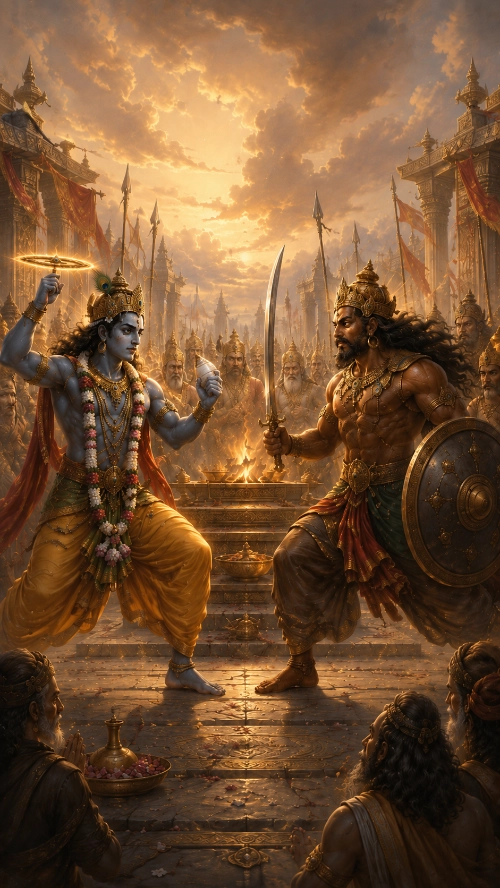
Then the immensely powerful Vīrabhadra, commander of the divine hosts, stood in the northwestern quarter, bearing his trident, O sage.
Jaya, having seized a mace in her wrath, took her position on the southeastern side. In the center stood Śarva himself, bearing his trident and filled with fury, O great sage.
Seeing the lion-faced one, the gods headed by Śakra, together with the sages, Yakṣas, and Gandharvas, wondered: “What indeed is this?”
Commentary
- Here, gaṇa denotes Śiva’s supernatural hosts, generated from the hairs of his body in the preceding verse. Vīrabhadra stands at their head as their military commander.
- Northwestern quarter — in traditional directional terminology, this is the vāyavya direction, the quarter associated with Vāyu.
- The southeast is diagonally opposite the northwest. Thus, Vīrabhadra and Jaya take positions on opposing corners, while Śiva occupies the center.
- Jaya, who had first conveyed the news of Satī’s death, now becomes an armed participant in the punitive expedition. Her grief has likewise been transformed into martial anger.
- The central position establishes Śiva as the controlling source of the entire formation. Vīrabhadra and Jaya occupy the surrounding directional points, but the divine force from which their anger proceeds remains at the center.
- Having the face of a lion — this adjective refers to Vīrabhadra.
The arrangement is not incidental. Vīrabhadra occupies the northwest, Jaya the southeast, and Śiva the center. The two armed attendants stand on diagonally opposed sides, while Śiva remains the central source and commander of the wrathful forces. The scene resembles a deliberate martial or ritual enclosure of Dakṣa’s sacrificial ground.
The reaction of the assembled beings emphasizes Vīrabhadra’s unprecedented character. Gods, sages, Yakṣas, and Gandharvas do not immediately recognize him; they merely stare at the lion-faced warrior and ask, “What indeed is this?” Vīrabhadra is not introduced as an ordinary combatant but as a new and terrifying manifestation of Śiva’s grief and fury, created specifically to confront the sacrificial order that rejected Satī and her Lord.
23-25
ततस्तु धनुरादाय शरांश्चाशीविषोपमान् ।
द्वारपालस्तदा धर्मो वीरभद्रमुपाद्रवत् ॥ २३ ॥
तमापतन्तं सहसा धर्मं दृष्ट्वा गणेश्वरः ।
करेणैकेन जग्राह त्रिशूलं वह्निसन्निभम् ॥ २४ ॥
कार्मुकं च द्वितीयेन तृतीयेनाथ मार्गणान् ।
चतुर्थेन गदां गृह्य धर्ममभ्यद्रवद् गणः ॥ २५ ॥
tatas tu dhanur ādāya śarāṃś cāśīviṣopamān |
dvārapālas tadā dharmo vīrabhadram upādravat || 23 ||
tam āpatantaṃ sahasā dharmaṃ dṛṣṭvā gaṇeśvaraḥ |
kareṇaikena jagrāha triśūlaṃ vahnisannibham || 24 ||
kārmukaṃ ca dvitīyena tṛtīyenātha mārgaṇān |
caturthena gadāṃ gṛhya dharmam abhyadravad gaṇaḥ || 25 ||
Then Dharma, who was serving as the guardian of the gate, took up his bow and arrows resembling deadly serpents and rushed against Vīrabhadra.
Seeing Dharma suddenly advancing upon him, the lord of the gaṇas grasped in one hand a trident blazing like fire.
With his second hand, he held a bow, with the third his arrows, and with the fourth, he seized a mace; thus armed, that mighty gaṇa charged against Dharma.
Commentary
The conflict begins with Dharma himself defending the entrance to Dakṣa’s sacrifice. This is symbolically significant: Vīrabhadra is not initially opposed by an ordinary warrior, but by the personification of cosmic and ritual order.
Yet the narrative creates a profound tension. Dharma guards a sacrifice that has violated genuine dharma by excluding and humiliating Śiva and Satī. Thus, the outward guardian of righteousness now defends a ritual whose moral foundation has become corrupted. Vīrabhadra’s four weapons also establish him as more than a mere attendant. Four-armed and armed with trident, bow, arrows, and mace, he appears as a fully divine martial manifestation of Śiva’s wrath, prepared to overcome every form of resistance surrounding Dakṣa’s sacrifice.
26-28
ततश्चतुर्भुजं दृष्ट्वा धर्मराजो गणेश्वरम् ।
तस्थावष्टभुजो भूत्वा नानायुधधरोऽव्ययः ॥ २६ ॥
खड्गचर्मगदाप्रासपरश्वधवराङ्कुशैः ।
चापमार्गणभृत्तस्थौ हन्तुकामो गणेश्वरम् ॥ २७ ॥
गणेश्वरोऽपि सङ्क्रुद्धो हन्तुं धर्मं सनातनम् ।
ववर्ष मार्गणांस्तीक्ष्णान् यथा प्रावृषि तोयदः ॥ २८ ॥
tataś caturbhujaṃ dṛṣṭvā dharmarājo gaṇeśvaram |
tasthāv aṣṭabhujo bhūtvā nānāyudhadharo ’vyayaḥ || 26 ||
khaḍgacarmagadāprāsaparaśvadhavarāṅkuśaiḥ |
cāpamārgaṇabhṛt tasthau hantukāmo gaṇeśvaram || 27 ||
gaṇeśvaro ’pi saṅkruddho hantuṃ dharmaṃ sanātanam |
vavarṣa mārgaṇāṃs tīkṣṇān yathā prāvṛṣi toyadaḥ || 28 ||
Then, seeing the lord of the gaṇas standing four-armed, Dharmarāja, the imperishable one, assumed eight arms and stood bearing many kinds of weapons.
Armed with a sword, shield, mace, spear, battle-axe, and excellent elephant-goad, and bearing a bow and arrows, he stood intent upon killing the lord of the gaṇas.
The lord of the gaṇas, likewise greatly enraged and intent upon killing eternal Dharma, showered sharp arrows upon him, just as a rain-cloud pours down water during the rainy season.
Commentary
Dharmarāja refers to the personified deity Dharma, who is encountered in the preceding verses and guarded the entrance to Dakṣa’s sacrifice. Dharma assumes this eight-armed martial form in response to seeing Vīrabhadra’s four-armed manifestation.
The contest now escalates through reciprocal divine transformation. When Dharma sees Vīrabhadra’s four-armed form, he responds by assuming eight arms and equipping each with a distinct weapon. His embodiment as eternal moral order is transformed into an imposing martial manifestation.
The confrontation is deliberately paradoxical. Vīrabhadra, born from Śiva’s righteous fury, seeks to destroy sanātana Dharma, yet Dharma is defending Dakṣa’s sacrifice—a ritual whose exclusion of Śiva and Satī has itself violated deeper righteousness. The episode, therefore, exposes a conflict between outward ritual order and the more fundamental justice that the ritual has betrayed.
The image of arrows falling like monsoon rain emphasizes the overwhelming intensity of Vīrabhadra’s assault. The battle is no longer a dispute at the sacrificial gate; it has become a clash between cosmic powers embodied in many-armed divine forms.
29-31
तावन्योन्यं महात्मानौ शरचापधरौ मुने ।
रुधिरारुणसिक्ताङ्गौ किंशुकाविव रेजतुः ॥ २९ ॥
ततो वरास्त्रैर्गणनायकेन जितः स धर्मस्तरसा प्रसह्य ।
पराङ्मुखोऽभूद्विमना मुनीन्द्र स वीरभद्रः प्रविवेश यज्ञम् ॥ ३० ॥
यज्ञवाटं प्रविष्टं तं वीरभद्रं गणेश्वरम् ।
दृष्ट्वा तु सहसा देवा उत्तस्थुः सायुधा मुने ॥ ३१ ॥
tāv anyonyaṃ mahātmānau śaracāpadharau mune |
rudhirāruṇasiktāṅgau kiṃśukāv iva rejatuḥ || 29 ||
tato varāstrair gaṇanāyakena jitaḥ sa dharmas tarasā prasahya |
parāṅmukho ’bhūd vimanā munīndra sa vīrabhadraḥ praviveśa yajñam || 30 ||
yajñavāṭaṃ praviṣṭaṃ taṃ vīrabhadraṃ gaṇeśvaram |
dṛṣṭvā tu sahasā devā uttasthuḥ sāyudhā mune || 31 ||
Those two mighty beings, bearing bows and arrows and fighting one another, had their limbs drenched and reddened with blood; they shone like two blossoming kiṃśuka trees, O sage.
Then Dharma, forcibly overcome by the leader of the gaṇas with his excellent divine weapons, turned away, dispirited. Thereupon, Vīrabhadra entered the sacrificial enclosure, O foremost of sages.
Seeing Vīrabhadra, the lord of the gaṇas, enter the sacrificial ground, the gods suddenly rose to their feet with weapons in hand, O sage.
Commentary
- The image is simultaneously beautiful and violent: wounds transform the warriors into flowering trees.
- An astra is not merely an ordinary handheld weapon; it often denotes a weapon discharged through a bow and empowered by a mantra.
The comparison with two flowering kiṃśuka trees is characteristic of Sanskrit martial poetry. The warriors’ blood-covered bodies are transformed into an image of brilliant natural beauty. Violence and splendor coexist: their wounds appear like masses of scarlet blossoms.
Dharma’s defeat allows Vīrabhadra to cross the threshold of the sacrificial enclosure. This is the decisive transition in the battle. Until now, Dharma had functioned as the guardian of the gate; once he turns away, the boundary protecting Dakṣa’s rite is broken.
The gods now rise armed because Vīrabhadra has entered the ritual space itself. The conflict is no longer fought outside the sacrifice between a guardian and an attacker; the entire divine assembly must now confront Śiva’s wrath within the heart of Dakṣa’s sacrificial order.
32-34
वसवोऽष्टौ महाभागा ग्रहा नव सुदारुणाः ।
इन्द्राद्या द्वादशादित्या रुद्रास्त्वेकादशैव हि ॥ ३२ ॥
विश्वेदेवाश्च साध्याश्च सिद्धगन्धर्वपन्नगाः ।
यक्षाः किंपुरुषाश्चैव खगाश्चक्रधरास्तथा ॥ ३३ ॥
राजा वैवस्वताद् वंशाद् धर्मकीर्तिस्तु विश्रुतः ।
सोमवंशोद्भवश्चोग्रो भोजकीर्तिर्महाभुजः ॥ ३४ ॥
vasavo ’ṣṭau mahābhāgā grahā nava sudāruṇāḥ |
indrādyā dvādaśādityā rudrās tv ekādaśaiva hi || 32 ||
viśvedevāś ca sādhyāś ca siddhagandharvapannagāḥ |
yakṣāḥ kiṃpuruṣāś caiva khagāś cakradharās tathā || 33 ||
rājā vaivasvatād vaṃśād dharmakīrtis tu viśrutaḥ |
somavaṃśodbhavaś cogro bhojakīrtir mahābhujaḥ || 34 ||
The eight illustrious Vasus, the nine exceedingly formidable planetary deities, the twelve Ādityas headed by Indra, and indeed the eleven Rudras—
the Viśvedevas and the Sādhyas, the Siddhas, Gandharvas, and serpentine beings; the Yakṣas, Kiṃpuruṣas, birds, and discus-bearing warriors as well—
together with the renowned king Dharmakīrti of the lineage of Vaivasvata and the fierce, mighty-armed Bhojakīrti, born of the Lunar Dynasty—all rose to confront Vīrabhadra.
Commentary
- The Vasus constitute a traditional class of eight deities associated with fundamental cosmic powers and natural phenomena.
- Viśvedevas are a collective class of deities frequently invoked together in Vedic and later sacred literature.
- The Sādhyas form a celestial class whose name suggests beings associated with accomplishment, perfection, or the powers to be propitiated.
- Siddhas — perfected celestial beings;
- Gandharvas — celestial musicians and divine beings;
- Pannagas — serpents or Nāga-like beings, literally “those who move by crawling.”
- Kiṃpuruṣas — the name literally suggests beings concerning whom one might ask: “Is this a man?” They are traditionally portrayed as extraordinary, semi-divine, or partly animal-formed inhabitants of mythic regions.
- Khaga means “sky-goer,” normally “bird.” In this divine assembly, it may particularly include powerful celestial birds such as Garuḍa-like beings.
- Cakradharāḥ — a group of armed divine or heroic beings bearing discus-like weapons.
- Vaivasvatād vaṃśāt — from the lineage of Vaivasvata.
- Dharmakīrti — one whose fame rests upon righteousness.
- Somavaṃśodbhavaḥ — born in the Lunar Dynasty.
The list greatly expands the scale of the confrontation. Vīrabhadra is no longer opposed only by Dharma or by a few individual gods. The principal numerical classes of divinity—the eight Vasus, nine Grahas, twelve Ādityas, and eleven Rudras—rise alongside celestial races, serpent beings, armed warriors, and renowned human kings.
Verses 32–34 form a single syntactic catalog dependent upon the previous verse’s “the gods rose armed.” The accumulated enumeration creates the impression that virtually the entire cosmic and royal order has gathered against Vīrabhadra. This prepares the next stage of the narrative, in which all these forces rush upon him simultaneously, only to encounter the concentrated, destructive power generated by Śiva’s wrath.
35-37
दितिजा दानवाश्चान्ये येऽन्ये तत्र समागताः ।
ते सर्वेऽभ्यद्रवन् रौद्रं वीरभद्रमुदायुधाः ॥ ३५ ॥
तानापतत एवाशु चापबाणधरो गणः ।
अभिदुद्राव वेगेन सर्वानेव शरोत्करैः ॥ ३६ ॥
ते शस्त्रवर्षमतुलं गणेशाय समुत्सृजन् ।
गणेशोऽपि वरास्त्रैस्तान् प्रचिच्छेद बिभेद च ॥ ३७ ॥
ditijā dānavāś cānye ye ’nye tatra samāgatāḥ |
te sarve ’bhyadravan raudraṃ vīrabhadram udāyudhāḥ || 35 ||
tān āpatat evāśu cāpabāṇadharo gaṇaḥ |
abhidudrāva vegena sarvān eva śarotkaraiḥ || 36 ||
te śastravarṣam atulaṃ gaṇeśāya samutsṛjan |
gaṇeśo ’pi varāstrais tān praciccheda bibheda ca || 37 ||
The sons of Diti, the Dānavas, and all the others who had assembled there rushed against the terrible Vīrabhadra with their weapons raised.
The gaṇa, bearing his bow and arrows, immediately advanced against them and charged swiftly upon them all with dense volleys of arrows.
They discharged an unequalled shower of weapons against the lord of the gaṇas; but he, with his excellent divine missiles, cut those weapons apart and struck down their wielders.
Commentary
Ditijāḥ — those born from Diti. This denotes the Daityas, the powerful descendants of Diti and Kaśyapa. The following Dānavas are descendants of Danu. Although the two groups are often collectively called Asuras, the verse distinguishes their genealogical classes.
An astra may be invoked through a mantra and is more potent than an ordinary physical weapon.
The confrontation now becomes universal. Daityas and Dānavas join the gods, celestial races, and human kings already assembled against Vīrabhadra. Former cosmic enemies temporarily stand on the same side in defense of Dakṣa’s sacrifice.
Yet their combined assault is ineffective. The verse carefully distinguishes two stages of Vīrabhadra’s response: he cuts apart the incoming weapons and then pierces the attackers themselves. His superiority is therefore not merely defensive; after neutralizing the immense weapon-storm, he immediately turns his divine missiles against those who launched it.
The contrast between the multitude and the single warrior is central. An entire cosmic assembly produces an “unequaled rain of weapons,” yet Vīrabhadra alone breaks the storm and advances through it as the concentrated embodiment of Rudra’s wrath.
38-40
शरैः शस्त्रैश्च सततं वध्यमाना महात्मना ।
वीरभद्रेण देवाद्या अपहारमकुर्वत ॥ ३८ ॥
ततो विवेश गणपो यज्ञमध्यं सुविस्तृतम् ।
जुह्वाना ऋषयो यत्र हवींषि प्रवितन्वते ॥ ३९ ॥
ततो महर्षयो दृष्ट्वा मृगेन्द्रवदनं गणम् ।
भीता होत्रं परित्यज्य जग्मुः शरणमच्युतम् ॥ ४० ॥
śaraiḥ śastraiś ca satataṃ vadhyamānā mahātmanā |
vīrabhadreṇa devādyā apahāram akurvata || 38 ||
tato viveśa gaṇapo yajñamadhyaṃ suvistṛtam |
juhvānā ṛṣayo yatra havīṃṣi pravitanvate || 39 ||
tato maharṣayo dṛṣṭvā mṛgendravadanaṃ gaṇam |
bhītā hotraṃ parityajya jagmuḥ śaraṇam acyutam || 40 ||
Continuously struck with arrows and other weapons by the mighty Vīrabhadra, the gods and the other assembled beings withdrew from the battle.
Then the lord of the gaṇas entered the center of the vast sacrificial enclosure, where the sages were offering and distributing the sacrificial oblations.
Thereupon, seeing that lion-faced attendant, the great sages became terrified; abandoning the sacrificial rite, they sought refuge in Acyuta.
Commentary
The combined cosmic army has now been driven back, allowing Vīrabhadra to penetrate the innermost sacrificial ground. This crossing is crucial: the protective forces surrounding Dakṣa’s sacrifice have failed, and Śiva’s embodied wrath has entered the very center of the rite.
The sages’ response reveals the collapse of ritual confidence. Although they had been sustaining the sacrifice through correctly offered oblations, the sight of the lion-faced Vīrabhadra causes them to abandon the rite and seek Viṣṇu’s protection. The ritual can no longer defend itself through its own procedures.
The passage thus prepares the direct confrontation between Vīrabhadra and Acyuta. Dharma, the gods, celestial hosts, demons, and kings have all failed to restrain him; only Viṣṇu now remains as the final protector of Dakṣa’s sacrificial assembly.
41-43
तानार्तांश्चक्रभृद् दृष्ट्वा महर्षींस्त्रस्तमानसान् ।
न भेतव्यमितीत्युक्त्वा समुत्तस्थौ वरायुधः ॥ ४१ ॥
समानम्य ततः शार्ङ्गं शरानग्निशिखोपमान् ।
मुमोच वीरभद्राय कायावरणदारणान् ॥ ४२ ॥
ते तस्य कायमासाद्य अमोघा वै हरेः शराः ।
निपेतुर्भुवि भग्नाशा नास्तिकादिव याचकाः ॥ ४३ ॥
tān ārtāṃś cakrabhṛd dṛṣṭvā maharṣīṃs trastamānasān |
na bhetavyam itīty uktvā samuttasthau varāyudhaḥ || 41 ||
samānamya tataḥ śārṅgaṃ śarān agniśikhopamān |
mumoca vīrabhadrāya kāyāvaraṇadāraṇān || 42 ||
te tasya kāyam āsādya amoghā vai hareḥ śarāḥ |
nipetur bhuvi bhagnāśā nāstikād iva yācakāḥ || 43 ||
Seeing those great sages afflicted and terrified in mind, the bearer of the discus said, “You must not be afraid,” and rose, armed with his excellent weapons.
Then, bending his bow Śārṅga, he discharged against Vīrabhadra arrows resembling tongues of fire and capable of tearing through bodily armor.
Yet those arrows of Hari—ordinarily unfailing—reached Vīrabhadra’s body and fell broken upon the ground, their purpose frustrated, like petitioners returning disappointed from an impious and ungenerous man.
Commentary
- Śārṅgam — Śārṅga is Viṣṇu’s celebrated divine bow.
- nāstika — an impious person, one who rejects sacred obligation; in this poetic context, also someone lacking generosity or faith in the merit of giving. The comparison implies that beggars approach expecting a gift but leave empty-handed and disappointed. Likewise, the arrows approach Vīrabhadra, expecting to fulfill their destructive purpose, but fall uselessly to the ground.
The narrative now reaches a major escalation: Viṣṇu himself intervenes. He reassures the terrified sages, draws Śārṅga, and releases his famously unfailing arrows. Yet even these cannot pierce Vīrabhadra.
Verse 43 uses deliberate paradox. The arrows are called amogha, “unfailing,” precisely at the moment when they fail. Their defeat, therefore, magnifies Vīrabhadra’s supernatural power: he is not merely resistant to ordinary weapons but invulnerable even to Viṣṇu’s divine missiles.
The simile of disappointed petitioners is both humorous and sharp. Just as supplicants leave an ungenerous man without receiving what they sought, Hari’s arrows leave Vīrabhadra’s body without obtaining their intended result. The martial grandeur is thus momentarily expressed through an image drawn from everyday social life.
44-46
शरांस्त्वमोघान्मोघत्वमापन्नान्वीक्ष्य केशवः ।
दिव्यैरस्त्रैर्वीरभद्रं प्रच्छादयितुमुद्यतः ॥ ४४ ॥
तानस्त्रान्वासुदेवेन प्रक्षिप्तान्गणनायकः ।
वारयामास शूलेन गदया मार्गणैस्तथा ॥ ४५ ॥
दृष्ट्वा विपन्नान्यस्त्राणि गदां चिक्षेप माधवः ।
त्रिशूलेन समाहत्य पातयामास भूतले ॥ ४६ ॥
śarāṃs tv amoghān moghatvam āpannān vīkṣya keśavaḥ |
divyair astrair vīrabhadraṃ pracchādayitum udyataḥ || 44 ||
tān astrān vāsudevena prakṣiptān gaṇanāyakaḥ |
vārayāmāsa śūlena gadayā mārgaṇais tathā || 45 ||
dṛṣṭvā vipannāny astrāṇi gadāṃ cikṣepa mādhavaḥ |
triśūlena samāhatya pātayāmāsa bhūtale || 46 ||
Seeing that his unfailing arrows had become fruitless, Keśava prepared to overwhelm Vīrabhadra with divine missiles.
But the leader of the gaṇas warded off those missiles discharged by Vāsudeva—with his spear, his mace, and his arrows.
Seeing his missiles rendered ineffective, Mādhava hurled his mace. Vīrabhadra struck it with his trident, bringing it crashing down to the ground.
Commentary
The battle escalates through successive levels of divine weaponry. Hari’s ordinary arrows fail first; he then resorts to celestial astras, but Vīrabhadra counters them with his own physical and missile weapons. When these too prove ineffective, Mādhava hurls his mace directly.
The central poetic feature is the contrast between amogha and moghatva: weapons celebrated as incapable of failure are forced into failure upon touching Vīrabhadra. This does not necessarily diminish Hari’s inherent power; rather, the passage magnifies the inviolability of the being generated from Śiva’s concentrated wrath.
Verse 46 also emphasizes Vīrabhadra’s active superiority. He does not merely withstand the mace—he intercepts it in flight with his trident and violently knocks it to earth.
47-49
मुशलं वीरभद्राय प्रचिक्षेप हलायुधः ।
लाङ्गलं च गणेशोऽपि गदया प्रत्यवारयत् ॥ ४७ ॥
मुशलं सगदं दृष्ट्वा लाङ्गलं च निवारितम् ।
वीरभद्राय चिक्षेप चक्रं क्रोधात् खगध्वजः ॥ ४८ ॥
तमापतन्तं शतसूर्यकल्पं सुदर्शनं वीक्ष्य गणेश्वरस्तु ।
शूलं परित्यज्य जगार चक्रं यथा मधुं मीनवपुः सुरेन्द्रः ॥ ४९ ॥
muśalaṃ vīrabhadrāya pracikṣepa halāyudhaḥ |
lāṅgalaṃ ca gaṇeśo ’pi gadayā pratyavārayat || 47 ||
muśalaṃ sagadaṃ dṛṣṭvā lāṅgalaṃ ca nivāritam |
vīrabhadrāya cikṣepa cakraṃ krodhāt khagadhvajaḥ || 48 ||
tam āpatantaṃ śatasūryakalpaṃ sudarśanaṃ vīkṣya gaṇeśvaras tu |
śūlaṃ parityajya jagāra cakraṃ yathā madhuṃ mīnavapuḥ surendraḥ || 49 ||
Then Halāyudha, the bearer of the plow, hurled his pestle at Vīrabhadra, but the lord of the gaṇas warded off the plow as well with his mace.
Seeing that the pestle—together with the mace—and the plow had all been repelled, the Garuḍa-bannered Lord, enraged, hurled his discus at Vīrabhadra.
Seeing Sudarśana rushing toward him, blazing like a hundred suns, the lord of the gaṇas cast aside his trident and swallowed the discus, just as the Lord of the gods in fish-form swallowed Madhu.
Commentary
Thus Halāyudha means “he whose weapon is the plough,” the customary epithet of Balarāma. The verse depicts him employing both of his characteristic weapons:
- muśala — pestle or heavy club;
- lāṅgala — plough.
The escalation is carefully structured. Mādhava’s mace is defeated, followed by Halāyudha’s pestle and plow. Viṣṇu then releases Sudarśana, a weapon shining like a hundred suns and normally irresistible.
Vīrabhadra’s response surpasses ordinary defense. He does not strike the discus aside but swallows it, temporarily containing Viṣṇu’s supreme weapon within his own body. The following verses, however, will show that Viṣṇu responds by physically overpowering Vīrabhadra, causing the swallowed discus to emerge again.
50-52
चक्रे निगीर्णे गणनायकेन क्रोधातिरक्तोऽसितचारुनेत्रः ।
मुरारिरभ्येत्य गणाधिपेन्द्रमुत्क्षिप्य वेगाद् भुवि निष्पिपेष ॥ ५० ॥
हरिबाहूरुवेगेन विनिष्पिष्टस्य भूतले ।
सहितं रुधिरोद्गारैर्मुखाच्चक्रं विनिर्गतम् ॥ ५१ ॥
ततो निःसृतमालोक्य चक्रं कैटभनाशनः ।
समादाय हृषीकेशो वीरभद्रं मुमोच ह ॥ ५२ ॥
cakre nigīrṇe gaṇanāyakena krodhātirakto ’sitacārunetraḥ |
murārir abhyetya gaṇādhipendram utkṣipya vegād bhuvi niṣpipeṣa || 50 ||
haribāhūruvegena viniṣpiṣṭasya bhūtale |
sahitaṃ rudhirodgārair mukhāc cakraṃ vinirgatam || 51 ||
tato niḥsṛtam ālokya cakraṃ kaiṭabhanāśanaḥ |
samādāya hṛṣīkeśo vīrabhadraṃ mumoca ha || 52 ||
When the discus had been swallowed by the leader of the gaṇas, Murāri—his lovely dark eyes intensely reddened with anger—rushed upon the foremost commander of the gaṇas, lifted him up, and violently crushed him against the ground.
As Vīrabhadra lay thoroughly crushed upon the earth by the tremendous force of Hari’s arms, the discus came forth from his mouth together with gushes of blood.
Seeing the discus emerge, the destroyer of Kaiṭabha picked it up; Hṛṣīkeśa then released Vīrabhadra.
Commentary
The encounter now reaches its decisive reversal. Vīrabhadra had neutralized Hari’s arrows, divine missiles, mace, and even Sudarśana by swallowing it. Yet Viṣṇu abandons ranged weaponry and overpowers him through direct physical force.
The contrast is striking: Vīrabhadra can contain the divine discus, but he cannot withstand the immense strength of Hari’s arms. When Viṣṇu crushes him against the earth, the swallowed weapon is expelled together with blood.
Nevertheless, Hari does not destroy Vīrabhadra. After recovering Sudarśana, he releases him. The narrative, therefore, presents Vīrabhadra’s defeat without annihilating Śiva’s emissary; he remains alive to return to Śiva and report that he has been overcome by Vāsudeva.
53-55
हृषीकेशेन मुक्तस्तु वीरभद्रो जटाधरम् ।
गत्वा निवेदयामास वासुदेवात् पराजयम् ॥ ५३ ॥
ततो जटाधरो दृष्ट्वा गणेशं शोणिताप्लुतम् ।
निश्वसन्तं यथा नागं क्रोधं चक्रे तदाऽव्ययः ॥ ५४ ॥
ततः क्रोधाभिभूतेन वीरभद्रोऽथ शम्भुना ।
पूर्वोद्दिष्टे तदा स्थाने सायुधस्तु निवेशितः ॥ ५५ ॥
hṛṣīkeśena muktas tu vīrabhadro jaṭādharam |
gatvā nivedayāmāsa vāsudevāt parājayam || 53 ||
tato jaṭādharo dṛṣṭvā gaṇeśaṃ śoṇitāplutam |
niśvasantaṃ yathā nāgaṃ krodhaṃ cakre tadāvyayaḥ || 54 ||
tataḥ krodhābhibhūtena vīrabhadro ’tha śambhunā |
pūrvoddiṣṭe tadā sthāne sāyudhas tu niveśitaḥ || 55 ||
Having been released by Hṛṣīkeśa, Vīrabhadra went to the matted-haired Lord and reported his defeat at the hands of Vāsudeva.
Then the matted-haired, imperishable Lord saw the commander of the gaṇas drenched in blood and breathing heavily like a serpent; at that moment, he became filled with anger.
Thereupon, Śambhu, overwhelmed by wrath, stationed the armed Vīrabhadra in the place previously assigned to him.
Commentary
jaṭādharam — “the bearer of matted locks” — This is Śiva.
Vīrabhadra’s return marks the first major setback suffered by Śiva’s forces. He reports his defeat by Vāsudeva. His blood-covered body and heavy breathing make the consequences of the encounter visible to Śiva.
Śiva’s response is not an immediate, reckless attack. Although filled with wrath, he first places the armed Vīrabhadra back in his previously assigned position. This suggests deliberate reorganization of the battle formation before Śiva himself enters the conflict more directly.
56-57
वीरभद्रमथादिश्य भद्रकालीं च शङ्करः ।
विवेश क्रोधताम्राक्षो यज्ञवाटं त्रिशूलभृत् ॥ ५६ ॥
ततस्तु देवप्रवरे जटाधरे त्रिशूलपाणौ त्रिपुरान्तकारिणि ।
दक्षस्य यज्ञं विशति क्षयङ्करे जातो ऋषीणां प्रवरो हि साध्वसः ॥ ५७ ॥
vīrabhadram athādiśya bhadrakālīṃ ca śaṅkaraḥ |
viveśa krodhatāmrākṣo yajñavāṭaṃ triśūlabhṛt || 56 ||
tatas tu devapravare jaṭādhare triśūlapāṇau tripurāntakāriṇi |
dakṣasya yajñaṃ viśati kṣayaṅkare jāto ṛṣīṇāṃ pravaro hi sādhvasaḥ || 57 ||
Then Śaṅkara, having given his commands to Vīrabhadra and Bhadrakālī, entered the sacrificial enclosure. His eyes were copper-red with anger, and he bore his trident.
Then, as the foremost of gods—the matted-haired, trident-bearing destroyer of Tripura and bringer of devastation—entered Dakṣa’s sacrifice, an overwhelming terror arose among the sages.
Commentary
Bhadrakālī is the fierce goddess associated with Śiva’s wrath and the destruction of Dakṣa’s sacrifice.
Śiva now enters the conflict personally. Vīrabhadra and Bhadrakālī remain under his command, but the appearance of the copper-eyed, trident-bearing destroyer of Tripura signals that the battle has entered a more devastating phase.
The sages’ terror is immediate because they recognize that Śiva is no longer acting only through his attendants. The one who annihilated the three cities has himself entered the sacrificial enclosure as kṣayaṅkara, “the bringer of destruction.” Dakṣa’s sacrifice, already morally compromised and militarily breached, now stands directly before the full force of Rudra’s wrath.
इति श्रीवामनपुराणे
चतुर्थोऽध्यायः
iti śrīvāmanapurāṇe caturtho ’dhyāyaḥ
Thus ends the fourth chapter of the venerable Vāmana Purāṇa.
Full synopsis
Vīrabhadra’s Assault
Chapter 4
Dakṣa’s Rejection of Śiva and Satī
The chapter directly connects Dakṣa’s exclusion of Śiva from the sacrifice with Śiva’s identity as Kapālin, the Skull-bearer. Dakṣa regards this ascetic and transgressive form as incompatible with sacrificial respectability and consequently refuses to invite not only Śiva but also Satī, despite her status as his own daughter. The offense is therefore both ritual and familial: Dakṣa attempts to preserve an external sacrificial order while violating the obligations of honor, kinship, and genuine dharma.
Satī’s Death through Inward Grief
Satī learns of the sacrifice from Jaya, who explains that sages, gods, relatives, and beings throughout the fourteen worlds have been invited. The universality of the invitation makes Satī’s exclusion unmistakably deliberate. In this recension, Satī does not travel to the sacrifice or enter the sacrificial fire; instead, she is overwhelmed by indignation and internal sorrow and immediately “passes into the five elements.” Her death is thus presented as the bodily consequence of unbearable emotional and moral injury.
The Generation of Vīrabhadra and the Gaṇas
When Śiva sees Satī’s lifeless body and hears the cause of her death, grief is transformed into cosmic wrath. Flames burst from his limbs, and lion-faced gaṇas arise from the hairs of his body, led by Vīrabhadra. These beings are not ordinary attendants but embodied extensions of Rudra’s anger. Śiva then advances toward Kanakhala, where Dakṣa’s sacrifice is being performed, arranging Vīrabhadra, Jaya, and himself in a deliberate directional battle formation.
Dharma and the Collapse of Sacrificial Protection
The first defender of the sacrificial enclosure is Dharma himself, stationed as guardian of the gate. He assumes an eight-armed martial form, while Vīrabhadra manifests with four arms and multiple weapons. The confrontation exposes the chapter’s central paradox: the personified Dharma protects a sacrifice that has already violated deeper righteousness by rejecting Śiva and Satī. Vīrabhadra defeats Dharma, breaches the ritual boundary, and thereby demonstrates that correct sacrificial form cannot preserve a rite whose ethical foundation has been corrupted.
Vīrabhadra against the Cosmic Assembly
After entering the enclosure, Vīrabhadra is opposed by the Vasus, Grahas, Ādityas, Rudras, Viśvedevas, Sādhyas, Siddhas, Gandharvas, Yakṣas, serpentine beings, Daityas, Dānavas, kings, and other armed forces. He withstands their combined assault, destroys their weapons with divine missiles, and drives them from the field. The scale of the enumeration presents the conflict as more than an attack on one sacrifice: Śiva’s concentrated wrath confronts the assembled cosmic, royal, and ritual order.
The Confrontation with Viṣṇu
The terrified sages abandon the sacrifice and seek protection from Viṣṇu. Hari’s arrows, though ordinarily unfailing, break against Vīrabhadra, and his divine missiles and mace are likewise neutralized. Vīrabhadra even swallows the Sudarśana discus, demonstrating extraordinary resistance to Viṣṇu’s weaponry. Viṣṇu ultimately defeats him through direct physical force, crushing him against the ground until the discus emerges with blood. Yet Hari does not kill him; after recovering Sudarśana, he releases Vīrabhadra, preserving the balance between Vaiṣṇava power and Śiva’s wrathful manifestation.
Śiva’s Personal Entry into the Sacrifice
Bloodied and defeated, Vīrabhadra returns to Śiva and reports what occurred. The sight of his wounded commander intensifies Śiva’s anger, but Śiva first restores the battle formation and gives commands to Vīrabhadra and Bhadrakālī. He then personally enters Dakṣa’s sacrificial enclosure with copper-red eyes and trident in hand. The chapter closes at the moment when delegated wrath gives way to Rudra’s direct intervention, and the assembled sages recognize that the destroyer of Tripura has entered the rite as the bringer of its devastation.