Visit the best and largest 108 and 1008 names collection

Ch5 — The Destruction of Dakshas Sacrifice

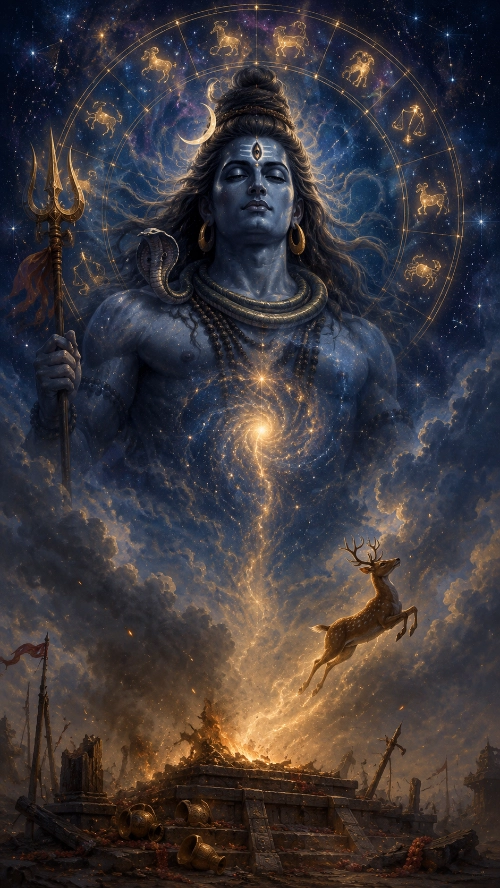
Śiva as Cosmic Time: The Destruction of Dakṣa’s Sacrifice and the Twelve Zodiac Signs

This chapter of the Vāmana Purāṇa describes Śiva’s terrifying arrival at Dakṣa’s sacrifice and the defeat of the assembled gods. Pūṣan loses his teeth, Bhaga is deprived of his eyes, the sacred fires are consumed, and the personified sacrifice escapes into the heavens in the form of a deer.

Śiva then manifests as Kālarūpī, the cosmic embodiment of Time. The twelve zodiacal signs, from Meṣa to Mīna, are identified with the different parts of his celestial body, while their nakṣatras, planetary rulers, forms, and characteristic habitats are explained in detail.

The chapter presents the zodiac not merely as an astronomical system but as the visible body of the divine. Through Śiva’s cosmic form, celestial time, sacred geography, sacrifice, and the structure of the universe are brought together within a single Purāṇic vision.

Vamana Mahapurana

Chapter 5 - Śiva as Cosmic Time: The Destruction of Dakṣa’s Sacrifice and the Twelve Zodiac Signs

Verse 1-3

पुलस्त्य उवाच
जटाधरं हरिर्दृष्ट्वा क्रोधादारक्तलोचनम् ।
तस्मात् स्थानादपाक्रम्य कुब्जाम्रेऽन्तर्हितः स्थितः ॥ १ ॥
वसवोऽष्टौ हरं दृष्ट्वा सुस्रुवुर्वेगतो मुने ।
सा तु जाता सरिच्छ्रेष्ठा सीता नाम सरस्वती ॥ २ ॥
एकादश तथा रुद्रास्त्रिनेत्रा वृषकेतनाः ।
कान्दिशीका लयं जग्मुः समभ्येत्यैव शङ्करम् ॥ ३ ॥

Pulastya uvāca
jaṭādharaṃ harir dṛṣṭvā krodhād āraktalocanam |
tasmāt sthānād apākramya kubjāmre ’ntarhitaḥ sthitaḥ || 1 ||
vasavo ’ṣṭau haraṃ dṛṣṭvā susruvur vegato mune |
sā tu jātā saricchreṣṭhā sītā nāma sarasvatī || 2 ||
ekādaśa tathā rudrās trinetrā vṛṣaketanāḥ |
kāndiśīkā layaṃ jagmuḥ samabhyetyaiva śaṅkaram || 3 ||

Pulastya said: Having seen the matted-haired Lord, whose eyes had become deeply reddened with anger, Hari withdrew from that place and remained concealed at Kubjāmra.

O sage, upon seeing Hara, the eight Vasus streamed forth with great speed; that stream then became the foremost of rivers—the Sarasvatī known by the name Sītā.

Then the eleven Rudras—three-eyed and bearing the bull as their emblem—became panic-stricken; approaching Śaṅkara himself, they entered into dissolution within him.


Commentary
  • Hari here denotes Viṣṇu, while jaṭādhara, “the matted-haired one,” denotes Śiva.
  • Kubjāmra is a sacred site, also known as Kubjāmraka, and is mentioned elsewhere as a tīrtha.
  • The eight divine beings collectively produce a single sacred river, identified as Sītā Sarasvatī.
  • Kāndiśīkāḥ describes persons who, overwhelmed by fear, no longer know which direction to take.
  • The eleven Rudras are not merely said to flee toward Śiva; they approach Śaṅkara and merge back into him. Since they share his marks—three eyes and the bull emblem—the verse presents them as differentiated manifestations of Rudra returning to their originating unity in Śaṅkara.

Verse 4-6

विश्वेऽश्विनौ च साध्याश्च मरुतोऽनलभास्कराः ।
समासाद्य पुरोडाशं भक्षयन्तो महामुने ॥ ४ ॥
चन्द्रः सममृक्षगणैर्निशां समुपदर्शयन् ।
उत्पत्यारुह्य गगनं स्वमधिष्ठानमास्थितः ॥ ५ ॥
कश्यपाद्याश्च ऋषयो जपन्तः शतरुद्रियम् ।
पुष्पाञ्जलिपुटा भूत्वा प्रणताः संस्थिता मुने ॥ ६ ॥

viśve ’śvinau ca sādhyāś ca maruto ’nala-bhāskarāḥ |
samāsādya puroḍāśaṃ bhakṣayanto mahāmune || 4 ||
candraḥ samam ṛkṣagaṇair niśāṃ samupadarśayan |
utpatyāruhya gaganaṃ svam adhiṣṭhānam āsthitaḥ || 5 ||
kaśyapādyāś ca ṛṣayo japantaḥ śatarudriyam |
puṣpāñjalipuṭā bhūtvā praṇatāḥ saṃsthitā mune || 6 ||

O great sage, the Viśvedevas, the two Aśvins, the Sādhyas, the Maruts, Anala and Bhāskara, having seized the sacrificial cake, [withdrew] while eating it.

The Moon, together with the hosts of stars, bringing the night into view, sprang upward, ascended the firmament, and took his own appointed station.

O sage, the ṛṣis headed by Kaśyapa, reciting the Śatarudriya, formed their hands into cups filled with flowers, bowed down, and remained standing there.


Commentary

Puroḍāśa is the consecrated sacrificial cake, ordinarily offered to a deity during a Vedic sacrifice. Thus, even while fleeing, these gods take the ritual food with them. The expression anala-bhāskarāḥ is grammatically compressed; contextually, it denotes Anala, Fire, and Bhāskara, the Sun.

Verse 5 presents a restoration of cosmic order amid the collapse of Dakṣa’s sacrifice. Candra rises with the stars, manifests the night, and resumes his proper celestial position. Adhiṣṭhāna here means his established station, domain, or appointed place in the heavens.

Verse 6 contrasts the sages’ response with the flight of the gods. Instead of attempting escape, Kaśyapa and the other ṛṣis seek to appease Rudra through the Śatarudriya, the celebrated Vedic litany addressed to Rudra, while presenting flowers with bowed heads. Their response is ritual submission: Rudra’s terrifying power is met through praise, reverence, and recognition of his divine sovereignty.

Verse 7-9

असकृद् दक्षदयिता दृष्ट्वा रुद्रं बलाधिकम् ।
शक्रादीनां सुरेशानां कृपणं विललाप ह ॥ ७ ॥
ततः क्रोधाभिभूतेन शङ्करेण महात्मना ।
तलप्रहारैरमरा बहवो विनिपातिताः ॥ ८ ॥
पादप्रहारैरपरे त्रिशूलेनापरे मुने ।
दृष्ट्यग्निना तथैवान्ये देवाद्याः प्रलयीकृताः ॥ ९ ॥

asakṛd dakṣa-dayitā dṛṣṭvā rudraṃ balādhikam |
śakrādīnāṃ sureśānāṃ kṛpaṇaṃ vilalāpa ha || 7 ||
tataḥ krodhābhibhūtena śaṅkareṇa mahātmanā |
tala-prahārair amarā bahavo vinipātitāḥ || 8 ||
pāda-prahārair apare triśūlenāpare mune |
dṛṣṭyagninā tathaivānye devādyāḥ pralayīkṛtāḥ || 9 ||

Seeing Rudra, whose might surpassed that of all others, Dakṣa’s beloved wife repeatedly lamented piteously over Indra and the other lords of the gods.

Then the great-souled Śaṅkara, overcome by wrath, struck down many of the immortals with blows from the palms of his hands.

O sage, some others were struck down by the blows of his feet, others by his trident, and still others—the gods and those accompanying them—were reduced to destruction by the fire of his gaze.


Commentary
  • In verse 7, Dakṣa-dayitā literally means “Dakṣa’s beloved woman” and most naturally denotes Dakṣa’s beloved wife.
  • Balādhikam means “surpassing others in strength” or “possessing superior might.” Her lament is prompted by the helpless condition of Indra and the other divine rulers before Rudra.
  • The expression dṛṣṭy-agni, “the fire of the gaze,” evokes Śiva’s destructive ocular power.
  • Pralayīkṛtāḥ is stronger than an ordinary expression for defeat: they were “made to enter pralaya,” that is, annihilated or reduced to a state resembling cosmic dissolution. This language magnifies the destruction of Dakṣa’s sacrifice into a miniature pralaya, with Śiva manifesting as the power that withdraws the gods and the established cosmic order itself.

Verse 10-12

ततः पूषा हरं वीक्ष्य विनिघ्नन्तं सुरासुरान् ।
क्रोधाद् बाहू प्रसार्याथ प्रदुद्राव महेश्वरम् ॥ १० ॥
तमापतन्तं भगवान् संनिरीक्ष्य त्रिलोचनः ।
बाहुभ्यां प्रतिजग्राह करेणैकेन शङ्करः ॥ ११ ॥
कराभ्यां प्रगृहीतस्य शम्भुनांशुमतोऽपि हि ।
कराङ्गुलिभ्यो निश्चेरुरसृग्धाराः समन्ततः ॥ १२ ॥

tataḥ pūṣā haraṃ vīkṣya vinighnantaṃ surāsurān |
krodhād bāhū prasāryātha pradudrāva maheśvaram || 10 ||
tam āpatantaṃ bhagavān saṃnirīkṣya trilocanaḥ |
bāhubhyāṃ pratijagrāha kareṇaikena śaṅkaraḥ || 11 ||
karābhyāṃ pragṛhītasya śambhunāṃśumato ’pi hi |
karāṅgulibhyo niścerur asṛgdhārāḥ samantataḥ || 12 ||

Then Pūṣan, seeing Hara striking down the gods and Asuras, angrily stretched out both his arms and charged at Maheśvara.

Seeing him rushing forward, the blessed three-eyed Śaṅkara seized him by both arms with a single hand.

Indeed, as the radiant Aṃśumān was thus held by both hands by Śambhu, streams of blood issued in every direction from his fingers.


Commentary
  • Verse 10 depicts Pūṣan attempting a direct physical assault upon Śiva.
  • In verse 11, the image deliberately emphasizes the enormous disparity in their strength.
  • Pūṣan’s two hands were crushed within Śiva’s single-handed grip. Consequently, blood streamed from all his fingers.
  • Pūṣan is here called Aṃśumān, “the ray-bearing” or “radiant one.” The following verse identifies him still more explicitly as Divākara, “the maker of day.” Thus, in this passage, Pūṣan is treated in his solar character, and the names Pūṣan, Aṃśumān, and Divākara refer to the same deity within the continuous episode.

Verse 13-15

ततो वेगेन महतांशुमन्तं दिवाकरम् ।
भ्रामयामास सततं सिंहो मृगशिशुं यथा ॥ १३ ॥
भ्रामितस्यातिवेगेन नारदांशुमतोऽपि हि ।
भुजौ ह्रस्वत्वमापन्नौ त्रुटितस्नायुबन्धनौ ॥ १४ ॥
रुधिराप्लुतसर्वाङ्गमंशुमन्तं महेश्वरः ।
संनिरीक्ष्योत्ससर्जैनमन्यतोऽभिजगाम ह ॥ १५ ॥

tato vegena mahatāṃśumantaṃ divākaram |
bhrāmayāmāsa satataṃ siṃho mṛgaśiśuṃ yathā || 13 ||
bhrāmitasyātivegena nāradāṃśumato ’pi hi |
bhujau hrasvatvam āpannau truṭita-snāyu-bandhanau || 14 ||
rudhirāpluta-sarvāṅgam aṃśumantaṃ maheśvaraḥ |
saṃnirīkṣyotsasarjainam anyato ’bhijagāma ha || 15 ||

Then, with tremendous force, he whirled Aṃśumān, the maker of day, continuously, just as a lion whirls a young deer.

Indeed, O Nārada, as Aṃśumān was being whirled with extreme speed, his two arms became shortened, the bonds of their sinews having been torn apart.

Seeing Aṃśumān with his entire body drenched in blood, Maheśvara released him and proceeded toward another adversary.


Commentary

Aṃśumān and Divākara are epithets of the solar deity Pūṣan. Aṃśumān means “possessing rays” or “the radiant one,” and Divākara means “maker of the day.” The simile “as a lion [whirls] a young deer” emphasizes Pūṣan’s complete helplessness before Śiva.

Verse 16-18

ततस्तु पूषा विहसन् दशनानि विदर्शयन् ।
प्रोवाचैह्येहि कापालिन् पुनः पुनरथेश्वरम् ॥ १६ ॥
ततः क्रोधाभिभूतेन पूष्णो वेगेन शम्भुना ।
मुष्टिनाहत्य दशनाः पातिता धरणीतले ॥ १७ ॥
भग्नदन्तस्तथा पूषा शोणिताभिप्लुताननः ।
पपात भुवि निःसंज्ञो वज्राहत इवाचलः ॥ १८ ॥

tatas tu pūṣā vihasan daśanāni vidarśayan |
provācaihy ehi kāpālin punaḥ punar atheśvaram || 16 ||
tataḥ krodhābhibhūtena pūṣṇo vegena śambhunā |
muṣṭināhatya daśanāḥ pātitā dharaṇītale || 17 ||
bhagnadantas tathā pūṣā śoṇitābhiplutānanaḥ |
papāta bhuvi niḥsaṃjño vajrāhata ivācalaḥ || 18 ||

Then Pūṣan, laughing and baring his teeth, repeatedly said to the Lord: “Come! Come, O Kāpālin!”

Thereupon, Śambhu, overcome by anger, struck with his fist with tremendous force, causing Pūṣan’s teeth to fall upon the surface of the earth.

Thus Pūṣan, his teeth broken and his face drenched in blood, fell unconscious upon the ground like a mountain struck by a thunderbolt.


Commentary

Verse 16 contains deliberate provocation. Dantāni vidarśayan means not merely “showing his teeth,” but baring or conspicuously displaying them while laughing. Pūṣan challenges Śiva with the repeated imperative ehi, ehi—“Come! Come!”—and addresses him as Kāpālin, “the skull-bearer.” In this context, the epithet appears to be used tauntingly, referring to Śiva’s association with Brahmā’s skull, as narrated earlier in the Purāṇa.

The second sandhi produces ehy ehi: “he said, ‘Come, come!’”

In verse 17, pūṣṇo daśanāḥ means “Pūṣan’s teeth.” Vegenāhatya conveys a forceful, violent blow rather than a light strike.

The sequence is marked by sharp poetic irony: Pūṣan ostentatiously displays his teeth while mocking Śiva, and those very teeth are immediately knocked out. The comparison in verse 18—Pūṣan falling like a mountain struck by a thunderbolt—emphasizes both the violence of the blow and the sudden collapse of a seemingly powerful divine being before Śiva.

Verse 19-21

भगोऽभिवीक्ष्य पूषाणं पतितं रुधिरोक्षितम् ।
नेत्राभ्यां घोररूपाभ्यां वृषध्वजमवैक्षत ॥ १९ ॥
त्रिपुरघ्नस्ततः क्रुद्धस्तलेनाहत्य चक्षुषी ।
निपातयामास भुवि क्षोभयन् सर्वदेवताः ॥ २० ॥
ततो दिवाकराः सर्वे पुरस्कृत्य शतक्रतुम् ।
मरुद्भिश्च हुताशैश्च भयाज्जग्मुर्दिशो दश ॥ २१ ॥

bhago ’bhivīkṣya pūṣāṇaṃ patitaṃ rudhirokṣitam |
netrābhyāṃ ghorarūpābhyāṃ vṛṣadhvajam avaikṣata || 19 ||
tripuraghnas tataḥ kruddhas talenāhatya cakṣuṣī |
nipātayāmāsa bhuvi kṣobhayan sarvadevatāḥ || 20 ||
tato divākarāḥ sarve puraskṛtya śatakratum |
marudbhiś ca hutāśaiś ca bhayāj jagmur diśo daśa || 21 ||

Bhaga, seeing Pūṣan fallen and smeared with blood, glared at the Bull-bannered Lord with his two fearsome eyes.

Then the enraged destroyer of Tripura struck Bhaga’s two eyes with the palm of his hand and caused them to fall upon the ground, throwing all the deities into consternation.

Thereupon all the solar deities, placing Śatakratu at their head, fled in fear toward the ten directions, together with the Maruts and the fire-gods.


Commentary
  • Bhaga first sees Pūṣan’s blood-covered condition and then turns his own terrible gaze upon Śiva.
  • Vṛṣadhvaja, “he whose banner bears the bull,” is an epithet of Śiva.
  • The punishment in verse 20 corresponds precisely to Bhaga’s act of defiance: because he directs a fierce and hostile gaze at Śiva, Śiva destroys the very organs through which that gaze was expressed.
  • Talena means “with the palm” or “with the flat of the hand.” The dual cakṣuṣī explicitly refers to Bhaga’s two eyes.
  • In verse 21, divākarāḥ literally means “makers of the day.” Although Divākara commonly denotes the Sun in the singular, the plural here refers collectively to solar deities—probably the Ādityas, as also reflected in the published English translation.
  • Śatakratu, “he of a hundred sacrifices,” is Indra.
  • The phrase puraskṛtya śatakratum means that they placed Indra at their head or followed him as their leader.
  • Hutāśāḥ, literally “eaters of the oblation,” denotes the various forms or manifestations of Fire. The gods no longer maintain an organized battle line: they scatter fearfully throughout all ten directions.

Verse 22-24

प्रतियातेषु देवेषु प्रह्लादाद्या दितीश्वराः ।
नमस्कृत्य ततः सर्वे तस्थुः प्राञ्जलयो मुने ॥ २२ ॥
ततस्तं यज्ञवाटं तु शङ्करो घोरचक्षुषा ।
ददर्श दग्धुं कोपेन सर्वांश्चैव सुरासुरान् ॥ २३ ॥
ततो निलिल्यिरे वीराः प्रणेमुर्दुद्रुवुस्तथा ।
भयादन्ये हरं दृष्ट्वा गता वैवस्वतक्षयम् ॥ २४ ॥

pratiyāteṣu deveṣu prahlādādyā ditīśvarāḥ |
namaskṛtya tataḥ sarve tasthuḥ prāñjalayo mune || 22 ||
tatas taṃ yajñavāṭaṃ tu śaṅkaro ghoracakṣuṣā |
dadarśa dagdhuṃ kopena sarvāṃś caiva surāsurān || 23 ||
tato nililyire vīrāḥ praṇemur dudruvus tathā |
bhayād anye haraṃ dṛṣṭvā gatā vaivasvatakṣayam || 24 ||

When the gods had withdrawn, Prahlāda and the other lords of the Daityas all bowed down and remained standing with joined palms, O sage.

Then Śaṅkara, with his terrible eye, cast his gaze upon that sacrificial enclosure, intending in his wrath to burn it, together with all the gods and Asuras.

Thereupon some of the warriors concealed themselves, some bowed down, and others fled; still others, beholding Hara, died from terror and went to the abode of Vaivasvata.


Commentary

Verse 22 sharply contrasts the responses of the gods and the Daityas. While the gods have retreated, Prahlāda and the other Ditīśvaras do not challenge Śiva. They bow and stand with joined hands. Ditīśvara literally means “a lord among the descendants of Diti” and here denotes the principal Daitya rulers. Prahlāda’s conduct is consistent with his traditional reputation for wisdom and devotion: he recognizes Śiva’s irresistible divine power and responds with reverence rather than hostility.

In verse 23, ghoracakṣuṣā is an instrumental expression: Śaṅkara looks “with his terrible eye.” The infinitive dagdhum, “to burn,” expresses his intention—he surveys the sacrificial ground with the purpose of consuming it and all who remain there. The corrected surāsurān includes both sides of the cosmic opposition: Śiva’s wrath is no longer directed at one faction alone but threatens the entire assembly of gods and Asuras.

Verse 24 presents four reactions to Śiva’s terrifying manifestation: some hide, some submit, some flee, and some die from fear.

Vaivasvatakṣaya, literally “the dwelling of Vaivasvata,” is a euphemistic expression for the realm of Yama, Vaivasvata being Yama as the son of Vivasvat. Thus, gatā vaivasvatakṣayam means that they perished and passed into Yama’s domain.

Verse 25-28

त्रयोऽग्नयस्त्रिभिर्नेत्रैर्दुःसहं समवैक्षन्त ।
दृष्टमात्रास्त्रिनेत्रेण भस्मीभूताभवन् क्षणात् ॥ २५ ॥
अग्नौ प्रणष्टे यज्ञोऽपि भूत्वा दिव्यवपुर्मृगः ।
दुद्राव विक्लवगतिर्दक्षिणासहितोऽम्बरे ॥ २६ ॥
तमेवानुससारेशश्चापमानम्य वेगवान् ।
शरं पाशुपतं कृत्वा कालरूपी महेश्वरः ॥ २७ ॥
अर्धेन यज्ञवाटान्ते जटाधर इति श्रुतः ।
अर्धेन गगने शर्वः कालरूपी च कथ्यते ॥ २८ ॥

trayo’gnayas tribhir netrair duḥsahaṃ samavaikṣanta |
dṛṣṭamātrās trinetrēṇa bhasmībhūtābhavan kṣaṇāt || 25 ||
agnau praṇaṣṭe yajño’pi bhūtvā divyavapur mṛgaḥ |
dudrāva viklavagatir dakṣiṇāsahito’mbare || 26 ||
tam evānusasāreśaś cāpam ānamya vegavān |
śaraṃ pāśupataṃ kṛtvā kālarūpī maheśvaraḥ || 27 ||
ardhena yajñavāṭānte jaṭādhara iti śrutaḥ |
ardhena gagane śarvaḥ kālarūpī ca kathyate || 28 ||

The three sacred fires looked upon the irresistible Lord with their three eyes; but the very moment they were beheld by the Three-eyed One, they were reduced to ashes.

When Agni had been destroyed, the sacrifice itself assumed the divine form of a deer and fled through the sky with an agitated gait, accompanied by Dakṣiṇā.

The swift Lord followed that very deer; bending his bow and preparing a Pāśupata arrow, Maheśvara assumed the form of Time.

With one half of himself remaining at the edge of the sacrificial enclosure, he is known as Jaṭādhara; with the other half present in the sky, Śarva is described as Kālarūpī—“he who has the form of Time.”


Commentary

Verse 25 refers to the three Vedic sacrificial fires:

  • Gārhapatya
  • Āhavanīya
  • Dakṣiṇāgni

Three fires gaze upon Śiva, described as duḥsaha, “unendurable” or “irresistible,” but are themselves instantly consumed by the gaze of Trinetra, the Three-eyed Lord. The destruction of the fires signifies the complete cessation of the sacrificial operation.

In verse 26, Yajña, the sacrifice, is personified as a divine being. After its sustaining fire disappears, it assumes the form of a deer and attempts to escape into the sky. The deer-form is particularly appropriate because mṛga, the elusive quarry, becomes the object of Śiva’s pursuit.

Dakṣiṇā, the sacrificial fee or honorarium offered to the officiating priests, is likewise personified and accompanies Yajña. Thus, both the rite and its indispensable offering attempt to flee together.

Śiva’s assumption of Kālarūpa, the form of Time, elevates the episode beyond an ordinary hunt: Time itself pursues the sacrifice, making escape impossible.

Verse 28 explains that Śiva manifests simultaneously in two aspects. One portion remains at Dakṣa’s sacrificial ground as Jaṭādhara, “the bearer of matted locks,” while the other expands through the heavens as Kālarūpī, the cosmic embodiment of Time. The following verses develop this celestial form by identifying the twelve zodiacal signs with the different limbs of Śiva’s vast body.

नारद उवाच
कालरूपी त्वयाख्यातः शंभुर्गगनगोचरः
लक्षणं च स्वरूपं च सर्वं व्याख्यातुमर्हसि २६

nārada uvāca |
kālarūpī tvayākhyātaḥ śambhur gaganagocaraḥ |
lakṣaṇaṃ ca svarūpaṃ ca sarvaṃ vyākhyātum arhasi || 29 ||

Nārada said: You have described Śambhu as assuming the form of Time and manifesting within the celestial sphere. You should now explain both his distinguishing characteristics and his essential form fully.


Commentary

Gaganagocaraḥ literally means “moving within the sky,” “whose sphere is the heavens,” or “manifest within the celestial realm.” It refers back to the preceding statement that one portion of Śiva extended into the sky as Kālarūpī, the embodiment of Time. Nārada asks for two related but distinct explanations:

  • lakṣaṇa — the identifying characteristics, signs, or constituent features of this cosmic form;
  • svarūpa — its inherent nature or actual configuration.

He is asking how the celestial body of Time is constituted and what its deeper nature signifies.

Verse 30-32

पुलस्त्य उवाच ।
स्वरूपं त्रिपुरघ्नस्य वदिष्ये कालरूपिणः ।
येनाम्बरं मुनिश्रेष्ठ व्याप्तं लोकहितेप्सुना ॥ ३० ॥
यत्राश्विनी च भरणी कृत्तिकायास्तथांशकः ।
मेषो राशिः कुजक्षेत्रं तच्छिरः कालरूपिणः ॥ ३१ ॥
आग्नेयांशास्त्रयो ब्रह्मन् प्राजापत्यं कवेर्गृहम् ।
सौम्यार्धं वृषनामेदं वदनं परिकीर्तितम् ॥ ३२ ॥

pulastya uvāca |
svarūpaṃ tripuraghnasya vadiṣye kālarūpiṇaḥ |
yenāmbaraṃ muniśreṣṭha vyāptaṃ lokahitepsunā || 30 ||
yatrāśvinī ca bharaṇī kṛttikāyās tathāṃśakaḥ |
meṣo rāśiḥ kujakṣetraṃ tac chiraḥ kālarūpiṇaḥ || 31 ||
āgneyāṃśās trayo brahman prājāpatyaṃ kaver gṛham |
saumyārdhaṃ vṛṣanāmedaṃ vadanaṃ parikīrtitam || 32 ||

Pulastya said: O foremost of sages, I shall describe the form of the destroyer of Tripura in his manifestation as Time—the form by which, desiring the welfare of the worlds, he pervaded the heavens.

The zodiacal sign in which Aśvinī, Bharaṇī, and one quarter of Kṛttikā are situated is Meṣa, the domain of Mars; it constitutes the head of the Time-formed Lord.

O Brahman, the three portions belonging to Agni, the Prajāpatya constellation, and half of the Saumya constellation constitute this sign called Vṛṣa, the house of Venus; it is proclaimed to be his face.


Commentary

These verses begin a systematic identification of Śiva’s celestial Kālarūpa, “Form of Time,” with the twelve zodiacal signs. His cosmic body is not merely located in the sky; it is constituted by the zodiac itself, beginning with the head and proceeding downward through the limbs.

Verse 31 accurately defines Meṣa, Aries, through its constituent lunar-mansion divisions:

  • the whole of Aśvinī;
  • the whole of Bharaṇī;
  • the first quarter of Kṛttikā.

Here, aṃśaka, “a portion,” specifically denotes one pāda, or quarter, of a nakṣatra. Meṣa is called kujakṣetra, “the domain of Kuja,” because Mars rules Aries. It corresponds to the head of Śiva’s cosmic form.

Verse 32 describes Vṛṣa, Taurus:

  • āgneyāṃśās trayaḥ — the remaining three quarters of Kṛttikā, whose deity is Agni;
  • prājāpatyam — Rohiṇī, whose presiding deity is Prajāpati;
  • saumyārdham — half of Mṛgaśīrṣa, associated with Soma.

The phrase kaver gṛham means “the house of Kavi,” Kavi here being an epithet of Venus. Taurus is therefore Venus’s domain and forms the vadana, the face, of Śiva’s Time-form. The astronomical divisions correspond exactly to the traditional nakṣatra-pāda structure of Taurus.

Verse 33-35

मृगार्धमार्द्रादित्यांशास्त्रयः सौम्यगृहं त्विदम् ।
मिथुनं भुजयोस्तस्य गगनस्थस्य शूलिनः ॥ ३३ ॥
आदित्यांशश्च पुष्यं च आश्लेषा शशिनो गृहम् ।
राशिः कर्कटको नाम पार्श्वे मखविनाशिनः ॥ ३४ ॥
पित्र्यर्क्षं भगदैवत्यमुत्तरांशश्च केसरी ।
सूर्यक्षेत्रं विभोर्ब्रह्मन् हृदयं परिगीयते ॥ ३५ ॥

mṛgārdham ārdrādityāṃśās trayaḥ saumya-gṛhaṃ tv idam |
mithunaṃ bhujayos tasya gaganasthasya śūlinaḥ || 33 ||
ādityāṃśaś ca puṣyaṃ ca āśleṣā śaśino gṛham |
rāśiḥ karkaṭako nāma pārśve makhavināśinaḥ || 34 ||
pitryarkṣaṃ bhagadaivatyam uttarāṃśaś ca kesarī |
sūryakṣetraṃ vibhor brahman hṛdayaṃ parigīyate || 35 ||

Half of Mṛgaśīrṣa, Ārdrā, and three-quarters of the asterism belonging to Aditi constitute this sign Mithuna, the house of Saumya; it forms the two arms of the trident-bearing Lord who abides in the heavens.

One quarter of the asterism belonging to Aditi, together with Puṣya and Āśleṣā, constitutes the house of the Moon—the sign called Karkaṭaka; it forms the two flanks of the destroyer of the sacrifice.

The ancestral asterism, the asterism presided over by Bhaga, and one quarter of Uttara constitute Kesarī, the domain of the Sun; O Brahman, it is celebrated as the heart of the all-pervading Lord.


Commentary

Verse 33 describes Mithuna, Gemini, through its constituent nakṣatra divisions:

  • the latter half of Mṛgaśīrṣa;
  • the whole of Ārdrā;
  • the first three quarters of Punarvasu, whose presiding deity is Aditi.

Here Āditya means “belonging to Aditi” and refers to Punarvasu; it does not denote the Sun in this context. Saumya, “the son of Soma,” is Mercury, whose house is Gemini. Gemini forms Śiva’s two arms, appropriately reflecting the sign’s dual nature.

Verse 34 continues with Karkaṭaka, Cancer:

  • the remaining quarter of Punarvasu;
  • the whole of Puṣya;
  • the whole of Āśleṣā.

Cancer is śaśino gṛham, “the house of the Moon,” and forms the two pārśve, the flanks or sides, of Śiva’s celestial body. Makhavināśin, “destroyer of the sacrifice”.

In verse 35, the designations are theological descriptions of the nakṣatras rather than their ordinary names:

  • pitryarkṣa, “the asterism of the Pitṛs,” is Maghā;
  • bhagadaivatya, “the one whose deity is Bhaga,” is Pūrvaphalgunī;
  • uttarāṃśa, “a portion of Uttara,” is the first quarter of Uttaraphalgunī.

Together they constitute Kesarī, literally “the Lion,” or Leo. Leo is the Sun’s domain and corresponds to the heart of Śiva’s Time-form. The progression from Gemini’s arms through Cancer’s flanks to Leo’s heart maps the zodiac onto a coherent cosmic anatomy.

Verse 36-38

उत्तरांशास्त्रयः पाणिश्चित्रार्धं कन्यका त्वियम् ।
सोमपुत्रस्य सद्मैतद् द्वितीयं जठरं विभोः ॥ ३६ ॥
चित्रांशद्वितयं स्वातिर्विशाखायांशकत्रयम् ।
द्वितीयं शुक्रसदनं तुला नाभिरुदाहृता ॥ ३७ ॥
विशाखांशमनूराधा ज्येष्ठा भौमगृहं त्विदम् ।
द्वितीयं वृश्चिको राशिर्मेढ्रं कालस्वरूपिणः ॥ ३८ ॥

uttarāṃśās trayaḥ pāṇiś citrārdhaṃ kanyakā tv iyam |
somaputrasya sadmaitad dvitīyaṃ jaṭharaṃ vibhoḥ || 36 ||
citrāṃśa-dvitayaṃ svātir viśākhāyāṃśaka-trayam |
dvitīyaṃ śukra-sadanaṃ tulā nābhir udāhṛtā || 37 ||
viśākhāṃśam anūrādhā jyeṣṭhā bhauma-gṛhaṃ tv idam |
dvitīyaṃ vṛściko rāśir meḍhraṃ kālasvarūpiṇaḥ || 38 ||

Three-quarters of Uttarā, Pāṇi, and half of Citrā constitute this sign Kanyakā. It is the second mansion of the son of Soma and forms the abdomen of the all-pervading Lord.

Two quarters of Citrā, Svātī, and three quarters of Viśākhā constitute Tulā, the second mansion of Venus; it is described as the navel of the Lord.

One quarter of Viśākhā, Anūrādhā, and Jyeṣṭhā constitute this second mansion of Mars—the zodiacal sign Vṛścika—which forms the generative organ of the One whose essential form is Time.


Commentary

Verse 36 describes Kanyakā, Virgo, through its constituent nakṣatra divisions:

  • the final three quarters of Uttaraphalgunī;
  • the whole of Hasta, designated here by pāṇi, “hand”;
  • the first half, or two quarters, of Citrā.

Somaputra, “the son of Soma,” is Mercury. Virgo is Mercury’s second mansion, the first being Gemini. The sign corresponds to the jaṭhara, the abdomen or belly, of Śiva’s cosmic body.

Verse 37 defines Tulā, Libra:

  • the remaining two quarters of Citrā;
  • the whole of Svātī;
  • the first three quarters of Viśākhā.

Libra is Venus’s second zodiacal mansion, the first being Taurus, and forms the nābhi, the navel. The placement is anatomically coherent: after Virgo as the abdomen, Libra represents its central point, the navel.

Verse 38 defines Vṛścika, Scorpio:

  • the remaining one quarter of Viśākhā;
  • the whole of Anūrādhā;
  • the whole of Jyeṣṭhā.

It is Mars’s second mansion, Aries being the first. Scorpio corresponds to the meḍhra, specifically the male generative organ, or more generally the genital region, of Śiva’s Kālarūpa. The assignment reflects Scorpio’s traditional association with the concealed reproductive organs and the generative power situated below the abdomen.

Verse 39-41

मूलं पूर्वोत्तरांशश्च देवाचार्यगृहं धनुः ।
ऊरुयुगलमीशस्यामरर्षे प्रगीयते ॥ ३९ ॥
उत्तरांशास्त्रयो ऋक्षं श्रवणं मकरो मुने ।
धनिष्ठार्धं शनिक्षेत्रं जानुनी परमेष्ठिनः ॥ ४० ॥
धनिष्ठार्धं शतभिषा प्रौष्ठपद्यांशकत्रयम् ।
सौरेः सद्मापरमिदं कुम्भो जङ्घे च विश्रुते ॥ ४१ ॥

mūlaṃ pūrvottarāṃśaś ca devācāryagṛhaṃ dhanuḥ |
ūruyugalam īśasyāmararṣe pragīyate || 39 ||
uttarāṃśās trayo ṛkṣaṃ śravaṇaṃ makaro mune |
dhaniṣṭhārdhaṃ śanikṣetraṃ jānunī parameṣṭhinaḥ || 40 ||
dhaniṣṭhārdhaṃ śatabhiṣā prauṣṭhapadyāṃśakatrayam |
saureḥ sadmāparam idaṃ kumbho jaṅghe ca viśrute || 41 ||

Mūla, Pūrvāṣāḍhā, and one quarter of Uttarāṣāḍhā constitute Dhanu, the mansion of the preceptor of the gods; O divine sage, it is proclaimed to be the pair of thighs of the Lord.

The three remaining quarters of Uttarāṣāḍhā, the asterism Śravaṇa, and half of Dhaniṣṭhā constitute Makara, the domain of Saturn; O sage, it forms the two knees of the Supreme Lord.

The remaining half of Dhaniṣṭhā, Śatabhiṣā, and three-quarters of Proṣṭhapadā constitute Kumbha, this other mansion of Saturn; it is renowned as the Lord’s two lower legs.


Commentary

Verse 39 defines Dhanu, Sagittarius:

  • the whole of Mūla;
  • the whole of Pūrvāṣāḍhā, abbreviated here as pūrvā;
  • the first quarter of Uttarāṣāḍhā, expressed as uttarāṃśa.

Devācārya, “the preceptor of the gods,” denotes Bṛhaspati or Jupiter. Sagittarius is therefore Jupiter’s mansion and forms the two ūru, the thighs, of Śiva’s cosmic Time-form.

Verse 40 defines Makara, Capricorn:

  • the remaining three quarters of Uttarāṣāḍhā;
  • the whole of Śravaṇa;
  • the first half, or two quarters, of Dhaniṣṭhā.

Capricorn is śanikṣetra, the domain of Saturn, and corresponds to the two knees of Parameṣṭhin, the Supreme Lord.

Verse 41 defines Kumbha, Aquarius:

  • the remaining half of Dhaniṣṭhā;
  • the whole of Śatabhiṣā;
  • the first three quarters of Pūrvaproṣṭhapadā, now commonly called Pūrvabhādrapadā.

Sauri, “the son of Sūrya,” denotes Saturn. Aquarius is called Saturn’s aparaṃ sadma, his “other” or second mansion, Capricorn being the first. It forms the two jaṅghe—the shanks or lower legs—of Śiva’s celestial body.

Verse 42-43

प्रोष्ठपद्यांशमेकं तु उत्तरा रेवती तथा ।
द्वितीयं जीवसदनं मीनस्तु चरणावुभौ ॥ ४२ ॥
एवं कृत्वा कालरूपं त्रिनेत्रो यज्ञं क्रोधान्मार्गणैराजघान ।
विद्धश्चासौ वेदनाबुद्धिमुक्तः खे सन्तस्थौ तारकाभिश्चिताङ्गः ॥ ४३ ॥

proṣṭhapadyāṃśam ekaṃ tu uttarā revatī tathā |
dvitīyaṃ jīvasadanaṃ mīnas tu caraṇāv ubhau || 42 ||
evaṃ kṛtvā kālarūpaṃ trinetro yajñaṃ krodhān mārgaṇair ājaghāna |
viddhaś cāsau vedanābuddhimuktaḥ khe santasthau tārakābhiś citāṅgaḥ || 43 ||

The remaining one quarter of Proṣṭhapadā, Uttaraproṣṭhapadā, and Revatī constitute Mīna, the second mansion of Jīva; it forms both feet of the Lord.

Having thus assumed the form of Time, the Three-eyed Lord, in his wrath, struck the sacrifice with arrows. Pierced by them, the sacrifice became insensible to pain and remained established in the sky, its body arrayed with stars.


Commentary

Verse 42 completes the identification of Śiva’s cosmic body with the twelve zodiacal signs. Mīna, Pisces, consists of:

  • the remaining one quarter of Pūrvaproṣṭhapadā;
  • the whole of Uttaraproṣṭhapadā;
  • the whole of Revatī.

The abbreviated uttarā therefore means Uttaraproṣṭhapadā, not Uttaraphalgunī or Uttarāṣāḍhā.

Jīva is an epithet of Bṛhaspati, Jupiter. Pisces is his second mansion, Sagittarius being the first, and it forms the two feet of Śiva’s Kālarūpa.

Mārgaṇa means an arrow; thus, mārgaṇair ājaghāna means “he struck with arrows.” The object yajñam is the personified sacrifice, which had assumed the form of a deer and fled through the sky in verse 26.

Finally, tārakābhiś citāṅgaḥ literally means “whose body was covered, adorned, or studded with stars.” The fleeing, deer-formed sacrifice is therefore transformed into a celestial figure: pierced by Śiva’s arrows, it remains fixed in the heavens with its body delineated by stars. This closes the narrative connection between Śiva’s pursuit of the sacrificial deer and his manifestation throughout the celestial sphere.

Verse 44

नारद उवाच ।
राशयो गदिता ब्रह्मंस्त्वया द्वादश वै मम ।
तेषां विशेषतो ब्रूहि लक्षणानि स्वरूपतः ॥ ४४ ॥

nārada uvāca |
rāśayo gaditā brahmaṃs tvayā dvādaśa vai mama |
teṣāṃ viśeṣato brūhi lakṣaṇāni svarūpataḥ || 44 ||

Nārada said: O Brahman, you have indeed described to me the twelve zodiacal signs. Now tell me in detail their distinguishing characteristics according to their respective forms.


Commentary

Having heard how the twelve rāśis constitute the limbs of Śiva’s cosmic Time-form, Nārada now asks for a more concrete description of the signs themselves. Lakṣaṇāni denotes their identifying characteristics or distinguishing marks, while svarūpataḥ means “with reference to their actual forms” or “according to their inherent appearance.” Thus, Nārada is asking for their individual shapes, attributes, habitats, and modes of movement—the subjects introduced in the following verses.

Verse 45-47

पुलस्त्य उवाच ।
स्वरूपं तव वक्ष्यामि राशीनां शृणु नारद ।
यादृशा यत्र सञ्चारा यस्मिन् स्थाने वसन्ति च ॥ ४५ ॥
मेषः समानमूर्तिश्चाजाविकधनादिषु ।
सञ्चारस्थानमेवास्य धान्यरत्नाकरादिषु ॥ ४६ ॥
नवशाद्वलसञ्छन्नवसुधायां च सर्वशः ।
नित्यं चरति फुल्लेषु सरसां पुलिनेषु च ॥ ४७ ॥

pulastya uvāca |
svarūpaṃ tava vakṣyāmi rāśīnāṃ śṛṇu nārada |
yādṛśā yatra sañcārā yasmin sthāne vasanti ca || 45 ||
meṣaḥ samānamūrtiś cājāvikadhanādiṣu |
sañcārasthānam evāsya dhānyaratnākarādiṣu || 46 ||
navaśādvala-sañchanna-vasudhāyāṃ ca sarvaśaḥ |
nityaṃ carati phulleṣu sarasāṃ pulineṣu ca || 47 ||

Pulastya said: Listen, O Nārada. I shall describe to you the forms of the zodiacal signs—what they are like, where they move, and in what places they dwell.

Meṣa has a form corresponding to that of a ram and is found among goats, sheep, and other livestock. Its places of movement are granaries, repositories or mines of precious stones, and similar locations.

It constantly roams over land everywhere covered with fresh turf and upon the flower-covered banks of lakes.


Commentary

Pulastya will now describe the individual form, customary movement, and characteristic habitat of each sign.

Verse 48-50

वृषः सदृशरूपो हि चरते गोकुलादिषु ।
तस्याधिवासभूमिस्तु कृषीवलधराश्रयः ॥ ४८ ॥
स्त्रीपुंसयोः समं रूपं शय्यासनपरिग्रहः ।
वीणावाद्यधृङ् मिथुनं गीतनर्तकशिल्पिषु ॥ ४९ ॥
स्थितः क्रीडारतिर्नित्यं विहारावनिरस्य तु ।
मिथुनं नाम विख्यातं राशिर्द्वेधात्मकः स्थितः ॥ ५० ॥

vṛṣaḥ sadṛśarūpo hi carate gokulādiṣu |
tasyādhivāsabhūmis tu kṛṣīvaladharāśrayaḥ || 48 ||
strīpuṃsayoḥ samaṃ rūpaṃ śayyāsanaparigrahaḥ |
vīṇāvādyadhṛṅ mithunaṃ gītanartakaśilpiṣu || 49 ||
sthitaḥ krīḍāratir nityaṃ vihārāvanir asya tu |
mithunaṃ nāma vikhyātaṃ rāśir dvedhātmakaḥ sthitaḥ || 50 ||

Vṛṣa has a bull-like form and roams through cattle settlements and similar places. Its dwelling-ground is the land resorted to by cultivators.

Mithuna has the combined, balanced form of a woman and a man and is associated with beds and seats. Bearing the vīṇā and other musical instruments, it is found among singers, dancers, and artisans.

It remains perpetually devoted to play and delight; its characteristic ground is a place of recreation. The sign renowned as Mithuna is constituted in a twofold form.


Commentary

Verse 48 describes Vṛṣa, Taurus, not only through its bull-like appearance but also through its natural environment: gokula denotes a cattle station, cowherd settlement, or place where herds are kept.

Taurus resorts to cultivated land or land inhabited and worked by farmers. The association is therefore distinctly bovine and agricultural.

Verse 49 depicts Mithuna, Gemini, as a male–female pair. Female and male forms are equally represented or joined in a balanced composite.

Mithuna retains its primary Sanskrit sense of “a pair” or “couple,” rather than merely functioning as the conventional name for Gemini.

Gemini belongs to furnished domestic, social, or pleasurable environments, because it “possesses or associates with beds and seats”. The sign also bears a vīṇā and other musical instruments and is associated with performers and skilled artisans.

Verse 50 develops the same symbolism. Krīḍārati means “delighting in play,” while vihārāvani is a pleasure-ground, recreation area, garden, or place of amusement. Dvedhātmaka, “twofold in nature,” refers directly to the sign’s dual constitution as the joined forms of a woman and a man. Thus, Gemini is characterized by duality, sociability, music, artistic skill, recreation, and the union of complementary human forms.

Verse 51-53

कर्किः कुलीरेण समः सलिलस्थः प्रकीर्तितः ।
केदारवापीपुलिने विविक्तावनिरेव च ॥ ५१ ॥
सिंहस्तु पर्वतारण्यदुर्गकन्दरभूमिषु ।
वसते व्याधपल्लीषु गह्वरेषु गुहासु च ॥ ५२ ॥
व्रीहिप्रदीपिककरा नावारूढा च कन्यका ।
चरते स्त्रीरतिस्थाने वसते नड्वलेषु च ॥ ५३ ॥

karkiḥ kulīreṇa samaḥ salilasthaḥ prakīrtitaḥ |
kedāra-vāpī-puline viviktāvanir eva ca || 51 ||
siṃhas tu parvatāraṇya-durga-kandara-bhūmiṣu |
vasate vyādha-pallīṣu gahvareṣu guhāsu ca || 52 ||
vrīhi-pradīpikā-karā nāvārūḍhā ca kanyakā |
carate strī-rati-sthāne vasate naḍvaleṣu ca || 53 ||

Karki is declared to resemble a crab and to dwell in water. Its characteristic habitats are cultivated fields, reservoirs, their banks, and secluded tracts of land.

Siṃha dwells in mountainous forests, inaccessible regions, and lands containing ravines; it inhabits settlements of hunters, deep recesses, and caves.

Kanyakā is a maiden holding rice and a lamp in her hand and mounted upon a boat. She moves in places of women’s pleasure and dwells among reed-beds.


Commentary

Verse 51 describes Karkaṭaka (Cancer) as Karki. Kulīra means a crab or similar aquatic crustacean, so kulīreṇa samaḥ identifies the sign’s physical appearance.

Its habitats combine water with cultivated and secluded terrain: kedāra is a field, especially an irrigated plot; vāpī is a reservoir, tank, or stepwell; and pulina is a bank or shore. The verse, therefore, portrays Cancer as aquatic but closely associated with the margins between water and land.

Verse 52 places Siṃha, Leo, in wild, difficult, and predatory environments.

Durga here need not mean a constructed fortress; in combination with mountains, forests, and ravines, it primarily denotes inaccessible or difficult terrain. Vyādha-pallī is a settlement or hamlet inhabited by hunters. Gahvara and guhā both indicate concealed places, but gahvara often suggests a deep recess, thicket, hollow, or cavernous region, whereas guhā more specifically denotes a cave.

In verse 53, the compound vrīhi-pradīpikā-karā is most naturally understood as “having rice and a lamp in her hand.” Vrīhi is rice or an ear of rice, while pradīpikā is a small lamp. The image is thus of Virgo as a maiden bearing symbols of nourishment and illumination while standing or sitting in a boat. Nāvārūḍhā means “mounted upon a boat”.

Strī-rati-sthāna may mean a place of women’s enjoyment, recreation, or amorous pleasure; the phrase carries a broader sense of feminine delight rather than necessarily referring only to sexual activity.

Naḍvala denotes a place overgrown with reeds or cane, hence “reed-bed” or “reedy ground.” Together, the boat and reed-filled habitat give Virgo a waterside setting, while the grain and lamp characterize the maiden as cultivated, productive, and refined.

Verse 54-56

तुलापाणिश्च पुरुषो वीथ्यापणविचारकः ।
नगराध्वानशालासु वसते तत्र नारद ॥ ५४ ॥
श्वभ्रवल्मीकसञ्चारी वृश्चिको वृश्चिकाकृतिः ।
विषगोमयकीटादिपाषाणादिषु संस्थितः ॥ ५५ ॥
धनुस्तुरङ्गजघनो दीप्यमानो धनुर्धरः ।
वाजी शूरोऽस्त्रविद् वीरः स्थायी गजरथादिषु ॥ ५६ ॥

tulāpāṇiś ca puruṣo vīthyāpaṇavicārakaḥ |
nagarādhvānaśālāsu vasate tatra nārada || 54 ||
śvabhravalmīkasañcārī vṛściko vṛścikākṛtiḥ |
viṣagomayakīṭādipāṣāṇādiṣu saṃsthitaḥ || 55 ||
dhanus turaṅgajaghano dīpyamāno dhanurdharaḥ |
vājī śūro ’stravid vīraḥ sthāyī gajarathādiṣu || 56 ||

Tulā is a man holding a balance in his hand, moving about through streets and marketplaces. O Nārada, he dwells in cities, along roads, and in halls or commercial establishments.

Vṛścika has the form of a scorpion and moves through pits and anthills. It is found among poisonous substances, dung, insects, and the like, and among stones and similar places.

Dhanu has the hindquarters of a horse; radiant in appearance, he bears a bow. He is a valiant horseman, a heroic warrior skilled in weapons, and takes his station among elephants, chariots, and similar instruments of war.


Commentary

Verse 54 portrays Tulā, Libra, through the familiar image of a male merchant or trader holding scales. The sign’s environment is distinctly urban and commercial: streets, roads, market areas, and public or mercantile halls. The balance naturally symbolizes weighing, exchange, and commerce.

Verse 55 places Vṛścika, Scorpio, in concealed, low, and potentially dangerous environments. Śvabhra denotes a pit, hole, or cavity, while valmīka is an anthill or termite mound. The compound viṣa-gomaya-kīṭādi-pāṣāṇādiṣu associates Scorpio with poison, dung, insects, stones, and comparable hiding places—an accurate portrayal of a scorpion’s natural habitat.

Dhanu is represented as a composite equine-human archer, corresponding to the traditional centaur-like form of Sagittarius. Dīpyamāna describes him as radiant, splendid, or blazing in appearance, while dhanurdhara explicitly identifies him as a bow-bearer. His presence among elephants and chariots situates him within a royal or military formation, emphasizing warfare, mounted movement, bravery, and proficiency with weapons.

Verse 57-59

मृगास्यो मकरो ब्रह्मन् वृषस्कन्धः फणाङ्गदः ।
मकरोऽसौ नदीचारी वसते च महोदधौ ॥ ५७ ॥
रिक्तकुम्भश्च पुरुषः स्कन्धधारी जलाप्लुतः ।
द्यूतशालाचरः कुम्भः स्थायी शौण्डिकसद्मसु ॥ ५८ ॥
मीनद्वयमथासक्तं मीनस्तीर्थाब्धिसञ्चरः ।
वसते पुण्यदेशेषु देवब्राह्मणसद्मसु ॥ ५९ ॥

mṛgāsyo makaro brahman vṛṣaskandhaḥ phaṇāṅgadaḥ |
makaro ’sau nadīcārī vasate ca mahodadhau || 57 ||
riktakumbhaś ca puruṣaḥ skandhadhārī jalāplutaḥ |
dyūtaśālācaraḥ kumbhaḥ sthāyī śauṇḍikasadmasu || 58 ||
mīnadvayam athāsaktaṃ mīnas tīrthābdhisañcaraḥ |
vasate puṇyadeśeṣu devabrāhmaṇasadmasu || 59 ||

O Brahman, Makara has the face of a deer, the shoulders of a bull, and serpent-shaped armlets. This Makara moves through rivers and dwells in the great ocean.

Kumbha is a water-drenched man carrying an empty pot upon his shoulder. He frequents gambling halls and remains in the houses of liquor-makers and tavern-keepers.

Mīna consists of two fish joined together. It moves through sacred bathing places and the ocean and dwells in holy regions and in the abodes of gods and Brahmins.


Commentary

Verse 57 portrays Makara, Capricorn, as a composite aquatic creature. Mṛgāsya means “deer-faced,” while the preferable reading vṛṣaskandhaḥ phaṇāṅgadaḥ describes it as bull-shouldered and adorned with armlets resembling serpent hoods. Its movement through rivers and residence in the ocean emphasize the older Indian conception of the makara as a fabulous aquatic animal rather than the later Western goat-fish image.

Verse 58 gives Kumbha, Aquarius, an anthropomorphic form: a man carrying a pot on his shoulder. Riktakumbha literally means “an empty pot,” although the bearer himself is jalāpluta, drenched or surrounded by water. The locations assigned to Aquarius are socially distinctive: dyūtaśālā is a gambling house, while śauṇḍika-sadman is the establishment or dwelling of a liquor-maker, distiller, or tavern-keeper.

Verse 59 describes Pisces as two fish joined at the tail, the customary dual image of the sign. Tīrtha here denotes a sacred ford or bathing place, while abdhi means the ocean. Its holy habitats—sacred regions and the dwellings of deities and Brahmins.

Verse 60-61

लक्षणा गदितास्तुभ्यं मेषादीनां महामुने ।
न कस्यचित् त्वयाख्येयं गुह्यमेतत् पुरातनम् ॥ ६० ॥
एतन् मया ते कथितं सुरर्षे यथा त्रिनेत्रः प्रममाथ यज्ञम् ।
पुण्यं पुराणं परमं पवित्रमाख्यातवान् पापहरं शिवं च ॥ ६१ ॥

lakṣaṇā gaditās tubhyaṃ meṣādīnāṃ mahāmune |
na kasyacit tvayākhyeyaṃ guhyam etat purātanam || 60 ||
etan mayā te kathitaṃ surarṣe yathā trinetraḥ pramamātha yajñam |
puṇyaṃ purāṇaṃ paramaṃ pavitram ākhyātavān pāpaharaṃ śivaṃ ca || 61 ||

O great sage, the distinguishing characteristics of Meṣa and the other zodiacal signs have been explained to you. This is an ancient secret and must not be disclosed by you to anyone.

Thus I have related to you, O divine sage, how the Three-eyed Lord violently destroyed the sacrifice. I have narrated this meritorious and ancient account, which is supremely purifying, destructive of sin, and auspicious.


Commentary

The adjectives puṇyam, purāṇam, paramaṃ pavitram, pāpaharam, and śivam all characterize the account that Pulastya has narrated. Here, śivam primarily means “auspicious” or “beneficent,” though its placement also evokes Śiva himself. Purāṇam may be understood adjectivally as “ancient” or substantivally as “an ancient sacred account.” The chapter, therefore, closes by affirming that hearing this narrative is itself meritorious, purifying, and capable of removing sin.

इति श्रीवामनपुराणे
पञ्चमोऽध्यायः ५

iti śrīvāmanapurāṇe pañcamo ’dhyāyaḥ || 5 ||

Thus ends the fifth chapter of the venerable Vāmana Purāṇa.

Synopsis of Chapter 5 — The Destruction of Dakṣa’s Sacrifice

The chapter opens with the collapse of Dakṣa’s sacrificial assembly before the wrath of Śiva. Viṣṇu withdraws, the Vasus become associated with the sacred Sītā Sarasvatī, and the eleven Rudras return into Śaṅkara as differentiated manifestations dissolving into their source. While many gods flee, the sages led by Kaśyapa attempt to appease Rudra through the recitation of the Śatarudriya, revealing that Vedic praise and submission—not resistance—are the proper response to Śiva’s overwhelming power.

The Punishment of the Gods

Śiva’s destruction is presented as precise and symbolically proportionate. Pūṣan challenges him, baring his teeth, and consequently has them shattered; Bhaga directs a hostile gaze at Śiva and loses his eyes. Other deities are struck down by Śiva’s palms, feet, trident, or fiery gaze. These punishments demonstrate that the divine faculties of sight, speech, nourishment, and ritual authority remain effective only while aligned with Rudra’s sovereignty.

The destruction culminates in the annihilation of the three sacred fires, signifying the complete interruption of the Vedic sacrificial mechanism. Yajña itself becomes personified, assumes the form of a celestial deer, and flees into the sky accompanied by Dakṣiṇā, the sacrificial fee. Śiva pursues it with a Pāśupata arrow, transforming the destruction of one ritual enclosure into a cosmic event involving sacrifice, time, and the celestial sphere.

Śiva as Kālarūpī

Śiva then divides his manifestation: one aspect remains at the sacrificial ground as Jaṭādhara, while another expands through the heavens as Kālarūpī, the embodiment of Time. This celestial form is mapped systematically onto the twelve zodiacal signs. Meṣa forms the head, Vṛṣa the face, Mithuna the arms, Karkaṭaka the flanks, Siṃha the heart, Kanyā the abdomen, Tulā the navel, Vṛścika the generative organ, Dhanu the thighs, Makara the knees, Kumbha the lower legs, and Mīna the feet.

Each sign is defined according to its constituent nakṣatra divisions and planetary ruler. The description closely follows the traditional allocation of twenty-seven lunar mansions across the twelve rāśis: Aśvinī through part of Kṛttikā constitute Meṣa, the remaining portions of Kṛttikā with Rohiṇī and Mṛgaśīrṣa form Vṛṣa, and the sequence continues mathematically through Revatī in Mīna. The zodiac is therefore presented not as an independent astronomical structure but as the articulated body of Śiva in his temporal and cosmic manifestation.

Forms and Habitats of the Zodiacal Signs

The chapter further describes the iconography, movement, and natural habitat of each sign. Meṣa is ram-shaped and associated with livestock, grain, and grassy land; Vṛṣa is bovine and agricultural; Mithuna is a male–female pair connected with music, art, recreation, and domestic spaces. Karkaṭaka is aquatic and crab-like; Siṃha inhabits forests and caves; and Kanyā appears as a maiden carrying grain and a lamp while mounted on a boat.

The remaining signs are likewise given concrete environments and symbolic functions. Tulā is represented by a merchant holding a balance in urban marketplaces; Vṛścika inhabits pits, stones, poison, and insects; Dhanu is a horse-bodied archer associated with warfare; Makara is a composite aquatic creature; Kumbha is a water-bearing man connected with taverns and gambling houses; and Mīna consists of two joined fish dwelling in sacred waters. Through these descriptions, astrology is integrated with zoology, geography, social activity, ritual space, and cosmological symbolism.

Cosmological Significance

The chapter ultimately presents Śiva as the power that both destroys ritual disorder and reorganizes the cosmos. Dakṣa’s sacrifice fails because it excludes and opposes Rudra, but its destruction generates a larger revelation: sacrifice becomes celestial, the heavens become Śiva’s body, and the zodiac becomes the visible anatomy of Time. The narrative, therefore, unites Śaiva theology, Vedic ritual, astral science, sacred geography, and cosmic anthropology within a single Purāṇic framework.

Why did Bhaga lose his eyes?

This belongs to the Dakṣa-yajña-bhaṅga myth — the destruction of Dakṣa's sacrifice — found across the Śiva Purāṇa, Kālikā Purāṇa, Mahābhārata, and the Vāmana Purāṇa's own version of this episode.

The story, briefly: Dakṣa performs a great sacrifice but deliberately excludes Śiva from receiving a share of the oblations (either as an insult, or — in the Satī-death versions — compounded by the further insult to Satī). Śiva, enraged, produces a fearsome being (usually Vīrabhadra, sometimes Bhairava) who storms the sacrificial ground and mutilates the assembled gods one by one, each in a way that fits what that god did during the sacrifice. Dakṣa's own head is cut off and replaced with a goat's. Among the casualties: Pūṣan has his teeth knocked out, and Bhaga has his eyes torn out.

The symbolism, specifically for Bhaga: Bhaga is the Vedic deity of "share, portion, apportionment" — the god who presides over the fair distribution of sacrificial offerings and of fortune and wealth generally (this is the same root that gives you भाग्य, "fortune"). At Dakṣa's sacrifice, Bhaga's role would have been precisely to oversee/witness the distribution of oblations, and he watched Śiva's portion being denied without objecting. So the punishment is organ-specific and exact: the very faculty that let him passively witness the injustice — his eyes — is the faculty destroyed. He's blinded for having seen and stayed silent.

This is the same logic running through the whole massacre: Pūṣan's teeth are broken because he ate his share of the offerings (complicit by participation, punished through the organ of eating); other gods lose hands, get beaten, or flee in terror, each penalty mapped onto their specific role or organ of complicity in the moment Śiva was slighted. It's a very characteristic Purāṇic device — divine retribution isn't generic, it's legible: the wound itself narrates the sin.

Bookmark Dharmavidya by pressing Ctrl+D or Cmd+D. 
Visit our YouTube channel.