

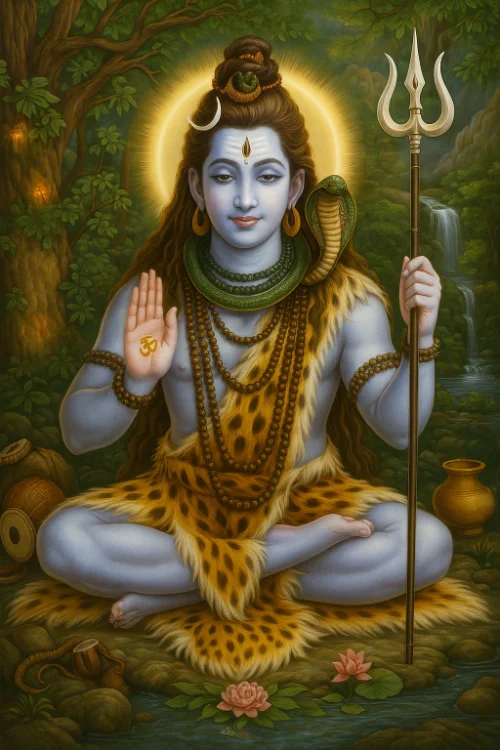
These potent Sanskrit mantras call upon aspects of Shiva such as Mahādeva, Rudra, Sadāśiva, Naṭarāja, Tryambaka, and Nīlakaṇṭha, guiding the devotee toward spiritual awakening, inner peace, and higher consciousness.
Whether you are seeking mantras for meditation, daily chanting, healing, or transformation, the Shiva Gāyatrī offers profound connection to the Supreme Being. Each mantra follows the revered Gāyatrī meter, invoking Shiva’s blessings to illuminate the intellect and purify the soul.
On this page, you’ll find a curated collection of authentic Shiva Gāyatrī mantras, complete with Devanāgarī script, IAST transliteration, translations, and interpretations — perfect for spiritual practice, learning, or ritual use.
ॐ तत्पुरुषाय विद्महे
महादेवाय धीमहि
तन्नो रुद्रः प्रचोदयात्॥
Oṁ Tatpuruṣāya Vidmahe
Mahādevāya Dhīmahi
Tanno Rudraḥ Prachodayāt
Om. We contemplate (vidmahe) that Supreme Being (Tatpuruṣa),
We meditate upon (dhīmahi) the Great God (Mahādeva).
May that Rudra (tanno Rudraḥ) inspire and guide us (prachodayāt).
By chanting this mantra, the seeker aligns themselves with Śiva’s divine energy, seeking guidance, illumination, and spiritual awakening.
ॐ सदाशिवाय विद्महे
सहस्राक्षाय धीमहि
तन्नो शम्भो प्रचोदयात्॥
Om Sadāśivāya Vidmahe
Sahasrākṣāya Dhīmahi
Tanno Śambho Prachodayāt
Om. We contemplate Sadāśiva.
We meditate upon the thousand-eyed One.
May that Śambhu inspire and illumine our intellect.
Chanting this mantra invites divine wisdom, inner clarity, and the awakening of higher consciousness through Śiva’s grace.
ॐ नीलकण्ठाय विद्महे
विशदङ्गाय धीमहि
तन्नः शिवः प्रचोदयात्॥
Om Nīlakaṇṭhāya Vidmahe
Viśadaṅgāya Dhīmahi
Tanno Śivaḥ Prachodayāt
We meditate upon Nīlakaṇṭha, the blue-throated one.
We contemplate the radiant-limbed Lord.
May Śiva illuminate our intellect.
ॐ शम्भवे विद्महे
महादेवाय धीमहि
तन्नः शिवः प्रचोदयात्॥
Om Śambhave Vidmahe
Mahādevāya Dhīmahi
Tanno Śivaḥ Prachodayāt
We contemplate Śambhu,
We meditate upon the Great Lord (Mahādeva);
May Śiva illuminate our mind.
ॐ नटराजाय विद्महे
महादेवाय धीमहि
तन्नः शिवः प्रचोदयात्॥
Om Naṭarājāya Vidmahe
Mahādevāya Dhīmahi
Tanno Śivaḥ Prachodayāt
We contemplate Naṭarāja, the cosmic dancer.
We meditate upon the Great God.
May Śiva inspire our consciousness.
This mantra is for creative flow, embracing change, harmony, artistic energy, alignment with the cosmic rhythm.
ॐ त्र्यम्बकाय विद्महे
महादेवाय धीमहि
तन्नो रुद्रः प्रचोदयात्॥
Om Tryambakāya Vidmahe
Mahādevāya Dhīmahi
Tanno Rudraḥ Prachodayāt
We contemplate the three-eyed one (Tryambaka),
Meditate upon the Great God;
May Rudra inspire us.
This mantra is for awakening insight, transcending illusion, inner fire for transformation, clarity.
अङ्गिकं भुवनं यस्य
वाचिकं सर्ववाङ्मयम्।
आहार्यं चन्द्रतारादि
तं वन्दे सात्त्विकं शिवम्॥
Aṅgikaṁ bhuvanaṁ yasya
Vācikaṁ sarva-vāṅmayam
Āhāryaṁ candra-tārādi
Taṁ vande sāttvikaṁ Śivam
Whose body is the whole universe,
Whose speech is all language and expression,
Whose ornaments are the moon and stars —
To that pure and auspicious Śiva, I bow down.
This verse is a salutation to Śiva as Nāṭarāja, the Lord of Dance and Cosmic Expression:
This verse is often recited: