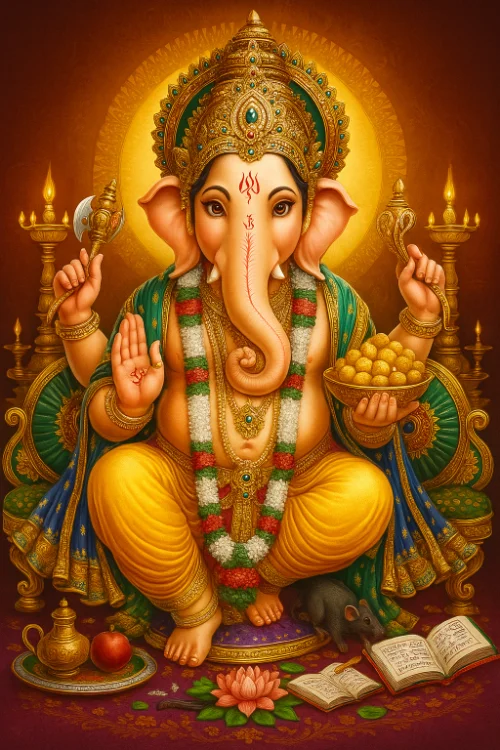
The four Gaṇeśa incarnations during the Yuga
According to the Gaṇeśa Purāṇa, four Gaṇeśa incarnations came on earth during different time periods (yugas) in order to defeat demonic forces. They are as follows:
-
ॐ महोत्कटाय नमः
Om Mahotkaṭāya Namah
To Mahotkaṭa, the Mighty One
Mahotkaṭa, a ten-armed form of Gaṇeśa seated on a lion and radiant like the sun, appeared in the Kṛta Yuga to defeat the demons Narāntaka and Devāntaka.
-
ॐ मयूरेश्वराय नमः
Om Mayūreśvarāya Namah
To Mayūreśvara, the Peacock-Rider
Mayūreśvara, white-colored with six arms and riding a peacock, appeared in the Tretā Yuga to battle the demon Sindhu.
-
ॐ गजाननाय नमः
Om Gajānānāya Namah
To Gajānana, the Elephant-Faced One
Gajānana, red in color and mounted on his rat, manifested in the Dvāpara Yuga and destroyed the demon Sindūra.
-
ॐ धूम्रकेतवे नमः
Om Dhūmraketave Namah
To Dhūmraketu, the Smoke-Bannered One
Dhūmraketu, a smoke-colored form of Gaṇeśa with two arms, will appear in the future during the Kali Yuga. He will ride a blue horse and battle the forces of evil to restore cosmic order.
The eight incarnations of Gaṇeśa
The Mudgala Purāṇa tells the story of eight unique incarnations of Gaṇeśa. Each one arose to conquer a specific inner demon or negative force. Their stories are described briefly below:
-
ॐ वक्रतुण्डाय नमः
Om Vakratuṇḍāya Namah
To Vakratuṇḍa, the Curved-Trunked Lord
Vakratuṇḍa, seated on a lion, emerged to battle Matsara—the demon of jealousy—symbolizing the need to overcome envy and crookedness.
-
ॐ एकदन्ताय नमः
Om Ekadantāya Namah
To Ekadanta, the One-Tusked Lord
Ekadanta conquered Mada, the demon of arrogance and intoxication. He is symbolized with a single tusk, reflecting restraint and sacrifice.
-
ॐ महोदराय नमः
Om Mahodaráya Namah
To Mahodara, the Big-Bellied One
Mahodara fought Moha, the demon of delusion. His great belly symbolizes the ability to contain and digest both knowledge and illusion.
-
ॐ गजाननाय नमः
Om Gajānānāya Namah
To Gajānana, the Elephant-Faced One
This form of Gaṇeśa vanquished Lobha, the demon of greed, teaching detachment and contentment.
-
ॐ लम्बोदराय नमः
Om Lambodarāya Namah
To Lambodara, the Lord with the Hanging Belly
Lambodara subdued Krodha, the demon of anger, symbolizing self-control and emotional mastery.
-
ॐ विकटाय नमः
Om Vikaṭāya Namah
To Vikata, the Misshapen One
Vikata conquered Kāma, the demon of desire. His strange form reflects the rejection of worldly beauty in favor of spiritual truth.
-
ॐ विघ्नराजाय नमः
Om Vighnarājāya Namah
To Vighnarāja, the King of Obstacles
In this form, Gaṇeśa reclines upon Śeṣa, the serpent of eternity, and defeats Mama, the demon of egoism.
-
ॐ धूम्रवर्णाय नमः
Om Dhūmravarṇāya Namah
To Dhūmravarṇa, the Tawny-Colored One
Dhūmravarṇa, riding a mouse, overcomes Ahaṅkāra—the demon of self-infatuation—restoring humility and self-awareness.
These mythic forms demonstrate that Gaṇeśa has the capacity to reduce all the human weaknesses, such as jealousy, drunkenness, illusion, greed, anger, desire, egotism, and self-infatuation (arrogance), which divert the devotee from the path to God. It must be noted that the battle against these enemies of the human being forms the very basis of sādhana for the spiritual seeker. However, these demons are not definitively destroyed — they are only brought under control. The spiritual path offers discipline and mastery, not total annihilation of the ego.
The Twelve Main Names of Gaṇeśa
The Gaṇeśa Purāṇa, an important scripture of the Gāṇapatya tradition, provides a list of twelve principal names of the elephant-headed deity. These sacred names are traditionally recited at the beginning of any ritual or devotional practice dedicated to Gaṇeśa. They are as follows:
-
ॐ सुमुखाय नमः
Om Sumukhāya Namah
To Sumukha, the Very Graceful Lord
Sumukha means "beautiful-faced" — symbolizing Gaṇeśa's auspicious and benevolent nature.
-
ॐ एकदन्ताय नमः
Om Ekadantāya Namah
To Ekadanta, the One-Tusked Lord
He who has a single tusk, representing the power of sacrifice and focused wisdom.
-
ॐ कपिलाय नमः
Om Kapilāya Namah
To Kapila, the Tawny-Colored Lord
Kapila signifies a reddish or tawny hue, often associated with asceticism and radiant energy.
-
ॐ गजकर्णाय नमः
Om Gajakarṇāya Namah
To Gajakarṇa, the Lord with Elephant Ears
This name highlights his elephant-like ears, symbolic of deep listening and sensitivity to devotees’ prayers.
-
ॐ लम्बोदराय नमः
Om Lambodarāya Namah
To Lambodara, the One with a Prominent Belly
His round belly signifies abundance, the universe itself, and the ability to assimilate all experiences.
-
ॐ विकटाय नमः
Om Vikaṭāya Namah
To Vikata, the Misshapen One
A reminder that divinity is not limited to outer form — Vikata is a fierce protector and remover of desire.
-
ॐ विघ्ननाशकाय नमः
Om Vighnanāśakāya Namah
To Vighnanāśaka, the Destroyer of Obstacles
This central aspect of Gaṇeśa affirms his power to remove spiritual, mental, and material obstructions.
-
ॐ गणाधिपाय नमः
Om Gaṇādhipāya Namah
To Gaṇādhipa, the Protector of the Gaṇa
He is the lord and guardian of divine attendants (gaṇas), symbolizing his role as spiritual commander.
-
ॐ धूम्रकेतवे नमः
Om Dhūmraketave Namah
To Dhūmraketu, the Smoke-Colored Warrior
This form, with two arms and riding a blue horse, will appear in the Kali Yuga to defeat demonic forces and restore harmony.
-
ॐ गणाध्यक्षाय नमः
Om Gaṇādhyakṣāya Namah
To Gaṇādhyakṣa, the Minister of the Gaṇa
He governs the collective energies of the cosmos and manages divine order among celestial beings.
-
ॐ भालचन्द्राय नमः
Om Bhālacandrāya Namah
To Bhālacandra, the Moon-Crested Lord
Bhālacandra is he who bears the crescent moon on his forehead, linking him with time, cycles, and cosmic rhythm.
-
ॐ गजाननाय नमः
Om Gajānānāya Namah
To Gajānana, the Elephant-Faced Lord
The most iconic form of Gaṇeśa, symbolizing strength, wisdom, and auspicious power.
It is noteworthy that several incarnations of Gaṇeśa — specifically Ekadanta, Gajānana, Lambodara, and Vikata — are also found in this list of twelve principal names. This overlap illustrates the deep connection between Gaṇeśa’s cosmic forms and his devotional invocations.
Of course, the Gaṇeśa Purāṇa contains many more sacred names of Gaṇeśa, including the renowned litany of one thousand names — the Gaṇeśa Sahasranāma.
The Twenty-One Names of Gaṇeśa
This set of twenty-one sacred names of Lord Gaṇeśa encompasses many of his forms, epithets, and attributes. Chanting these names is believed to bestow wisdom, protection, and spiritual clarity.
-
ॐ विघ्नराजाय नमः
Om Vighnarājāya Namah
To Vighnarāja, the King of Obstacles
As Vighnarāja, Gaṇeśa governs the realm of obstacles, both creating and removing them for the benefit of the devotee.
-
ॐ गजाननाय नमः
Om Gajānānāya Namah
To Gajānana, the Elephant-Faced Lord
His elephant face signifies strength, intelligence, and boundless wisdom.
-
ॐ लम्बोदराय नमः
Om Lambodarāya Namah
To Lambodara, the One with a Prominent Belly
His round belly symbolizes his capacity to contain the universe and all its experiences.
-
ॐ शिवात्मजाय नमः
Om Śivātmajāya Namah
To Śivātmaja, the Son of Śiva
Gaṇeśa, born from the essence of Lord Śiva, embodies divine energy and auspicious power.
-
ॐ वक्रतुण्डाय नमः
Om Vakratuṇḍāya Namah
To Vakratuṇḍa, the Lord with a Curved Trunk
The curved trunk symbolizes adaptability and the ability to overcome challenges in creative ways.
-
ॐ सुपकर्णाय नमः
Om Supakarṇāya Namah
To Supakarṇa, the One with Excellent Ears
He listens attentively to the prayers of all beings, offering guidance and support.
-
ॐ गणेश्वराय नमः
Om Gaṇeśvarāya Namah
To Gaṇeśvara, the Lord of the Gaṇas
As Gaṇeśvara, he rules over the celestial hosts and maintains divine order.
-
ॐ विघ्ननाशिने नमः
Om Vighnanāśine Namah
To Vighnanāśin, the Destroyer of Obstacles
He removes hindrances on the path of truth and righteousness.
-
ॐ विकटाय नमः
Om Vikaṭāya Namah
To Vikata, the Misshapen One
His unusual form reminds us to look beyond appearances and seek deeper meaning.
-
ॐ वामनाय नमः
Om Vāmanāya Namah
To Vāmana, the Dwarf
This form represents humility and divine presence in small, unassuming forms.
-
ॐ सर्वदेवाय नमः
Om Sarvadevāya Namah
To Sarvadeva, the Essence of All Gods
Gaṇeśa contains within himself the energies of all divine beings.
-
ॐ सर्वदुःखविनाशिने नमः
Om Sarvaduḥkhavināśine Namah
To the One Who Removes All Suffering
He dispels pain and sorrow from the hearts of his devotees.
-
ॐ विघ्नर्हर्त्रे नमः
Om Vighnarhartre Namah
To the One Who Cancels Obstacles
As Vighnarhartṛ, he clears unseen obstacles from the devotee’s path.
-
ॐ धूमराजाय नमः
Om Dhūmarājāya Namah
To Dhūmarāja, the King of Smoke
A mystical form of Gaṇeśa associated with transformation and subtle power.
-
ॐ सर्वदेवाधिदेवाय नमः
Om Sarvadevādhidevāya Namah
To the God Above All Gods
He stands as the Supreme Deity, honored by all other deities.
-
ॐ एकदन्ताय नमः
Om Ekadantāya Namah
To Ekadanta, the One-Tusked Lord
A symbol of sacrifice and the singular focus required on the spiritual path.
-
ॐ कृष्णपिङ्गलाय नमः
Om Kṛṣṇapiṅgalāya Namah
To Kṛṣṇapiṅgala, the Blue and Tawny-Hued One
This color duality reflects balance between action and stillness, knowledge and mystery.
-
ॐ भालचन्द्राय नमः
Om Bhālacandrāya Namah
To Bhālacandra, the Crescent-Moon Adorned
The moon on his brow represents time, cycles, and the cool light of wisdom.
-
ॐ गणनाथाय नमः
Om Gaṇanāthāya Namah
To Gaṇanātha, the Supreme Leader of the Gaṇas
He is honored as the commander and guide of divine beings and energies.
-
ॐ शङ्करसूनवे नमः
Om Śaṅkarasūnave Namah
To Śaṅkarasūnu, the Son of Śaṅkara
Another name for Gaṇeśa as the divine child of Śiva (Śaṅkara).
-
ॐ अनङ्गपूजिताय नमः
Om Anaṅgapūjitāya Namah
To Anaṅgapūjita, the Formless One Worshipped Even by Desire
Anaṅga ("formless") refers to pure consciousness — Gaṇeśa is worshipped as that which transcends all form.
The Thirty-Two Forms of Gaṇeśa
These thirty-two iconic forms of Lord Gaṇeśa, described in various Purāṇic texts and iconographic traditions, embody his diverse qualities and functions—from his childhood innocence to his divine mastery. Each form represents a distinct aspect of Gaṇeśa’s role in guiding, protecting, and blessing devotees.
-
ॐ बालगणपतये नमः
Om Bāla Gaṇapataye Namah
To Bāla Gaṇapati, the Child Gaṇeśa
Depicted with four arms, Bāla Gaṇapati holds a mango, a mango shoot, a sugarcane stalk, and a sweet cake, symbolizing nourishment and vitality.
-
ॐ तरुणगणपतये नमः
Om Taruṇa Gaṇapataye Namah
To Taruṇa Gaṇapati, the Youthful Gaṇeśa
With eight arms, he holds a single tusk, elephant goad, kapittha fruit, sugarcane, noose, paddy ear, and apūpa cake, radiating youthful strength and charm.
-
ॐ भक्तगणपतये नमः
Om Bhakta Gaṇapataye Namah
To Bhakta Gaṇapati, the Devoted Lord
A form embodying devotion, he holds a banana, mango branch, and a bowl of sweetened rice (payāsapātra), reflecting simplicity and surrender.
-
ॐ वीरगणपतये नमः
Om Vīra Gaṇapataye Namah
To Vīra Gaṇapati, the Heroic Gaṇeśa
Vīra Gaṇapati, with sixteen arms, holds a formidable array of weapons including trident, axe, club, bow, sword, spear, disc, and more—signifying power and protection.
-
ॐ शक्तिगणपतये नमः
Om Śakti Gaṇapataye Namah
To Śakti Gaṇapati, the Embracer of Energy
Embracing the goddess Puṣṭi, Śakti Gaṇapati holds an elephant goad, noose, and lemon, while showing abhaya mudrā. His trunk lifts a sweet cake as an offering of blessing.
-
ॐ उच्छिष्टगणपतये नमः
Om Ucchiṣṭa Gaṇapataye Namah
To Ucchiṣṭa Gaṇapati, the Enjoyer of Remnants
This form with six arms and a goddess by his side holds a rosary, pomegranate, paddy ear, nocturnal lotus, and vīṇā. His trunk touches the goddess’s thigh, signifying intimacy and tantric symbolism.
-
ॐ सिद्धिगणपतये नमः
Om Siddhi Gaṇapataye Namah
To Siddhi Gaṇapati, the Bestower of Success
Siddhi Gaṇapati favors sesame cakes. He holds an axe, noose, sugarcane stalk, and mango, blessing devotees with worldly and spiritual accomplishments.
-
ॐ द्विजगणपतये नमः
Om Dvija Gaṇapataye Namah
To Dvija Gaṇapati, the Twice-Born
With four heads and four arms, he holds a rosary, water pot, ascetic staff or ritual spoon, and palm-leaf manuscript, representing knowledge and spiritual discipline.
-
ॐ विघ्नगणपतये नमः
Om Vighna Gaṇapataye Namah
To Vighna Gaṇapati, the Remover of Obstacles
Holding a tusk, disc, arrow, hatchet, conch, sugarcane, noose, and goad, he also lifts a flower cluster with his trunk — dispelling obstacles with grace.
-
ॐ क्षिप्रगणपतये नमः
Om Kṣipra Gaṇapataye Namah
To Kṣipra Gaṇapati, the Swift One
With four arms and carrying a precious gem-filled pot with his trunk, Kṣipra Gaṇapati grants blessings quickly and compassionately to sincere seekers.
-
ॐ हेरम्बगणपतये नमः
Om Heramba Gaṇapataye Namah
To Heramba Gaṇapati, the Five-Headed Rider of the Lion
With ten arms and five heads, Heramba Gaṇapati is a powerful protector. He holds rosary, citron, club, goad, noose, axe, kadabu cake, and a tusk, while bestowing fearlessness and blessings.
-
ॐ लक्ष्मीगणपतये नमः
Om Lakṣmī Gaṇapataye Namah
To Lakṣmī Gaṇapati, the Fortunate One
Embracing his consorts Siddhi and Buddhi, he holds a pomegranate, sword, wish-fulfilling creeper, goad, parrot, noose, gem pot, and blesses devotees with abundance and success.
-
ॐ महागणपतये नमः
Om Mahāgaṇapataye Namah
To Mahāgaṇapati, the Great Lord
Accompanied by the goddess Puṣṭi (Wealth), Mahāgaṇapati holds tusk, pomegranate, club, sugarcane bow, disc, conch, noose, lotus, paddy ear, and gem pot, representing total mastery over creation.
-
ॐ विजयगणपतये नमः
Om Vijaya Gaṇapataye Namah
To Vijaya Gaṇapati, the Victorious One
Riding a swift mouse, Vijaya Gaṇapati holds a tusk, goad, noose, and mango, embodying triumph, courage, and sweetness in action.
-
ॐ नृत्यगणपतये नमः
Om Nṛtya Gaṇapataye Namah
To Nṛtya Gaṇapati, the Dancing Lord
Dancing under the wish-fulfilling tree, he holds tusk, goad, noose, and axe or hatchet, sometimes also a sweet cake — signifying bliss and joy in divine rhythm.
-
ॐ ऊर्ध्वगणपतये नमः
Om Ūrdhva Gaṇapataye Namah
To Ūrdhva Gaṇapati, the Elevated One
Seated with his consort on his left thigh, he has eight arms holding tusk, arrow-flower, lotus, blue lily, sugarcane bow, paddy ear, club, and embraces the goddess, symbolizing upward spiritual ascent.
-
ॐ वरगणपतये नमः
Om Vara Gaṇapataye Namah
To Vara Gaṇapati, the Boon-Giving Lord
Seated with goddess Puṣṭi on his thigh, he holds goad, skull cup, noose, and his fourth hand touches the goddess. He represents abundance, intimacy, and divine grace.
-
ॐ एकाक्षरगणपतये नमः
Om Ekākṣara Gaṇapataye Namah
To Ekākṣara Gaṇapati, the Lord of the Sacred Syllable
Identified with the single sound OM, he holds tusk, goad, noose, and modaka. Sometimes his trunk holds the seed-pot, representing primal sound and essence.
-
ॐ त्र्यक्षरगणपतये नमः
Om Tryakṣara Gaṇapataye Namah
To Tryakṣara Gaṇapati, the A+U+M Lord
Representing the three sacred syllables A-U-M, he carries tusk, goad, noose, and mango, holding a modaka in his trunk — symbolizing fullness of divine sound and bliss.
-
ॐ क्षिप्रप्रसादगणपतये नमः
Om Kṣipraprasāda Gaṇapataye Namah
To Kṣipraprasāda Gaṇapati, the Swiftly Merciful One
This compassionate form with six arms blesses swiftly. He holds tusk, goad, lotus, wish-fulfilling creeper, noose, and lemon — instantly responding to sincere prayers.
-
ॐ हरिद्रागणपतये नमः
Om Haridrā Gaṇapataye Namah
To Haridrā Gaṇapati, the Turmeric-Colored One
Golden in hue like turmeric, he holds a single tusk, elephant goad, noose, and modaka, embodying auspicious energy and healing warmth.
-
ॐ एकदन्तगणपतये नमः
Om Ekadanta Gaṇapataye Namah
To Ekadanta Gaṇapati, the One-Tusked Lord
He holds a large tusk, rosary, hatchet, and laddu, signifying strength, spiritual focus, discipline, and sweetness of devotion.
-
ॐ सृष्टिगणपतये नमः
Om Sṛṣṭi Gaṇapataye Namah
To Sṛṣṭi Gaṇapati, the Creator
Riding a large rat, this form symbolizes creative force. He holds a tusk, elephant goad, noose, and mango, representing generative energy and abundance.
-
ॐ उद्दण्डगणपतये नमः
Om Uddaṇḍa Gaṇapataye Namah
To Uddaṇḍa Gaṇapati, the Unrestrained
With twelve arms and consort on his thigh, he wields tusk, club, lotus, noose, sugarcane bow, disc, conch, pomegranate, and more, signifying wild and cosmic might.
-
ॐ संकटहरगणपतये नमः
Om Saṅkaṭahara Gaṇapataye Namah
To Saṅkaṭahara Gaṇapati, the Remover of Calamities
Seated on a lotus with his consort, he holds an elephant goad, noose, sugared rice bowl, and gestures boon-bestowal, protecting devotees from danger.
-
ॐ दुन्धिगणपतये नमः
Om Dundhi Gaṇapataye Namah
To Dundhi Gaṇapati, the One Who Must Be Sought
A mysterious form who must be discovered through spiritual search. He carries a tusk, rosary, hatchet, and jewel pot (ratnapātra), revealing hidden blessings.
-
ॐ त्रिमुखगणपतये नमः
Om Trimukha Gaṇapataye Namah
To Trimukha Gaṇapati, the Three-Headed Lord
With three heads and six arms, he grants boons, holds goad, rudrākṣa bead, noose, nectar pot, and shows abhaya — embodying triple divinity and fearlessness.
-
ॐ सिंहगणपतये नमः
Om Siṃha Gaṇapataye Namah
To Siṃha Gaṇapati, the Lion-Faced One
Fierce and majestic, this eight-armed form displays disc, flowers, vīṇā, lotus, wish-fulfilling creeper, gem pot, and shows protection and grace.
-
ॐ योगगणपतये नमः
Om Yoga Gaṇapataye Namah
To Yoga Gaṇapati, the Ascetic
A meditative form with a yogapaṭṭa girdle, he holds rosary, staff or elbow-rest, noose, and sugarcane, symbolizing spiritual discipline and inner focus.
-
ॐ दुर्गागणपतये नमः
Om Durgā Gaṇapataye Namah
To Durgā Gaṇapati, the Warrior-Like One
Similar in spirit to Goddess Durgā, this eight-armed Gaṇapati wields bow, arrow, creeper, tusk, noose, goad, rosary, and rose-apple, protecting the righteous.
-
ॐ ऋणमोचकगणपतये नमः
Om Ṛṇamocaka Gaṇapataye Namah
To Ṛṇamocaka Gaṇapati, the Liberator from Debts
This merciful form removes karmic debts and worldly burdens. He carries tusk, goad, noose, and rose-apple fruit — a symbol of fulfilled wishes.
-
ॐ धूम्रवर्णगणपतये नमः
Om Dhūmravarṇa Gaṇapataye Namah
To Dhūmravarṇa Gaṇapati, the Smoke-Colored One
This subtle and mystical form of Gaṇeśa, gray as sacred ash, symbolizes transcendence and the quiet power of meditation. He holds a tusk, rosary, modaka, and blesses devotees with silent wisdom.