Visit the best and largest 108 and 1008 names collection


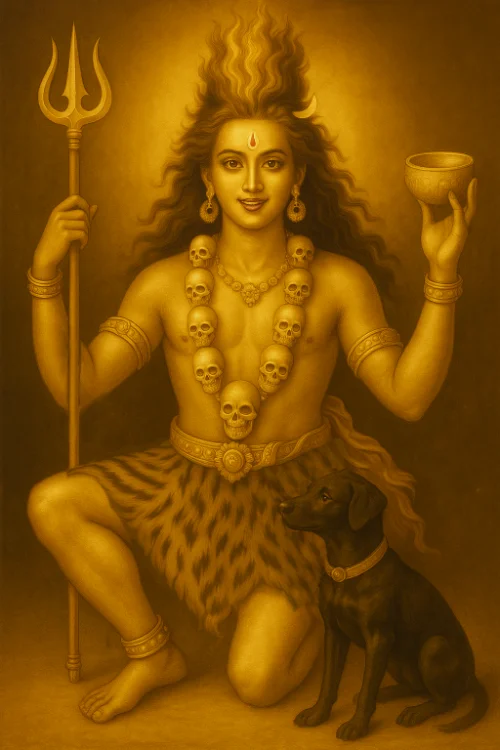
The Kaal Bhairava Ashtakam, composed by the great sage Adi Shankaracharya, is a sacred eight-verse hymn dedicated to Kaal Bhairava, the fierce form of Lord Shiva and the guardian of time (kāla). Each verse glorifies Bhairava’s power to cut through illusion, destroy ego, and grant inner courage and spiritual protection. Reciting this stotra is believed to remove fear, overcome negative energies, and lead the seeker toward ultimate truth and liberation (mokṣa).
This powerful hymn is especially potent when chanted during Bhairava Ashtami, midnight meditations, or in times of transition and uncertainty. The Kaal Bhairava Ashtakam praises the Lord as the protector of dharma, the giver of wisdom, and the fierce yet compassionate guide beyond death and time. Regular recitation brings clarity, discipline, and divine grace, making it an essential chant for devotees seeking both inner strength and spiritual depth.
Kalabhairava is an incarnation of Lord Shiva and the Devatha of Lord Rahu (Navagraha Planet). Kalabhairava is also regarded as the guardian of Lord Shiva Temples. Sri Kalabhairava Ashtakam is a very musical prayer of Lord Kalabhairava. Kalabhairava Astakam is recited by the priests of the Kalabhairava Temples.
Kaal Bhairav is the Rudra Avatar of Shiva, who is the omnipresent time or Kaal. Kaal or time is the fearsome face of Shiva, as time stops for none. Each and every living being is afraid of time as it spares none. Hence, Kaal is feared by one and all.
The Kaal Bhairav Ashtakam was composed by the great philosopher saint of the 8th century AD Adi Shankara.
The Kaal Bhairav Ashtakam is recited to make your journey through time or life free from troubles and dangers.
1.
Devarāja-sevyamāna-pāvana-aṅghri-paṅkajam
Vyālayajña-sūtramiṇḍu-śekharaṁ kṛpākaram |
Nāradādi-yogi-vṛnda-vanditaṁ digambaraṁ
Kāśikā-purādhinātha-kālabhairavaṁ bhaje || 1 ||
2.
Bhānu-koṭi-bhāsvaraṁ bhavābdhi-tāraṇaṁ param
Nīlakaṇṭham-ipsitārtha-dāyakaṁ trilocanam |
Kālakālam-ambujākṣam-akṣa-sūla-makṣaram
Kāśikā-purādhinātha-kālabhairavaṁ bhaje || 2 ||
3.
Śūla-ṭaṅka-pāśa-daṇḍapāṇim-ādi-bhūmikam
Syāma-kāyam-ādi-devam-akṣaraṁ niramayam |
Bhīma-vikramam prabhuṁ vicitra-tāṇḍava-priyam
Kāśikā-purādhinātha-kālabhairavaṁ bhaje || 3 ||
4.
Bhukti-mukti-dāyakaṁ praśasta-cāru-vigraham
Bhakta-vatsalaṁ sthitaṁ samasta-loka-vigraham |
Viṇikvayann-manoharaṁ hema-kiṅkiṇī-lasat-kaṭīm
Kāśikā-purādhinātha-kālabhairavaṁ bhaje || 4 ||
5.
Dharma-setu-pālakam tva-dharma-mārga-nāśakam
Karma-pāśa-mocakaṁ suśarma-dāyakaṁ vibhum |
Svarṇa-varṇa-śeṣa-pāśa-śobhita-aṅga-maṇḍalam
Kāśikā-purādhinātha-kālabhairavaṁ bhaje || 5 ||
6.
Ratna-pādukā-prabhābhirāma-pāda-yugmakam
Nityam-advitīyam-iṣṭa-daivatam nirañjanam |
Mṛtyu-darpa-nāśanaṁ karāla-daṁṣṭra-mokṣaṇam
Kāśikā-purādhinātha-kālabhairavaṁ bhaje || 6 ||
7.
Attahāsa-bhinna-padma-jaṇḍa-kośa-saṁhatim
Dṛṣṭi-pāta-naṣṭa-pāpa-jāla-mugra-śāsanam |
Aṣṭa-siddhi-dāyakaṁ kapāla-mālikā-dharam
Kāśikā-purādhinātha-kālabhairavaṁ bhaje || 7 ||
8.
Bhūta-saṅga-nāyakaṁ viśāla-kīrti-dāyakam
Kāśi-vāsa-loka-puṇya-pāpa-śodhakaṁ vibhum |
Nīti-mārga-kovidam purātanaṁ jagat-patiṁ
Kāśikā-purādhinātha-kālabhairavaṁ bhaje || 8 ||
Phalaśruti (9):
Kālabhairavāṣṭakaṁ paṭhanti ye manoharam
Jñāna-mukti-sādhanam vicitra-puṇya-vardhanam |
Śoka-moha-daīna-lopa-kopa-tāpa-nāśanaṁ
Te prayānti kālabhairavāṅghri-sannidhiṁ dhruvam || 9 ||
I sing praise of Kalabhairav, Who is the ruler of the city Kashi, Who is adorned by lotus-feet which is reverred and served by Indra (Devaraj), Who has a Yagya-thread made up of snake, Who has the moon on His forehead, Who is the abode of mercy, Who has been sung by Narad and other celestial singers, and Whose clothes are the directions.||1||
I sing praise of Kalabhairav, Who is the ruler of the city Kashi, Who is resplendent like millions of sun, Who absolves the ocean of cycle of rebirth, Who is supreme, Who has a blue neck, Who bestows us with our desires, Who has three-eyes, Who is the end of Kaal, Who has lotus-like eyes, Who has immortal monodent weapon, and Who is immortal.||2||
I sing praise of Kalabhairav, Who is the ruler of the city Kashi, Who has monodent, spade, a cord and punishment in His hands, Who is the cause behind the beginning, Who has a grey (smeared) body, Who is the first Deva, Who is imperishable, Who is free from illness and health, Who is immensely mighty, Who is the Lord, and Who loves the special Tandava dance.||3||
I sing praise of Kalabhairav, Who is the ruler of the city Kashi, Who is the bestower of desires and salvation, Who has an enticing appearance form, Who is endears His devotees, Who is static, Who takes various manifestations and forms the world, and Who has a beautiful golden waist-thread with small melodious bells.||4||
I sing praise of Kalabhairav, Who is the ruler of the city Kashi, Who is the maintainer of righteousness, Who is the destroyer of unrighteous paths, Who liberates us from the ties of Karma or deeds, Who bestows us with shyness, Who is splendid, and Whose organ-groups are decorated with a beautiful cord of golden color.||5||
I sing praise of Kalabhairav, Who is the ruler of the city Kashi, Who has feet adorned by two sandals made of gold which is possessing a resplendent shine, Who is eternal, Who is induplicable, Who bestows our desires to us, Who is without desires, Who destroys the pride of death (as in is supreme to death), and Who liberates soul by His teeth.||6||
I sing praise of Kalabhairav, Who is the ruler of the city Kashi, Whose loud roar is enough to destroy all the manifestations created by the lotus-born Brahma, Whose (merciful) glance is enough to destroy all the sins, Who is the powerful ruler, Who gives the eight-powers¹, and Who wears a garland of skull-caps.||7||
I sing praise of Kalabhairav, Who is the ruler of the city Kashi, Who is the leader of the ghosts and spirits, Who showers immense glory, Who absolves people dwelling in Kashi from their sins and righteous deeds, Who is splendor, Who has explained the path of righteousness, Who is eternally old, and Who is the controller of the universe.||8||
Those who study these eight verses on Kalabhairav — which is enticing, which is a source of knowledge and liberation, which increases righteousness of a person, and which destroys grief, attachment, depression, greed, anger an heat — move towards the proximity of the feet of Shiv (Kalabhairav), necessarily.||9||