Agni Purana
Chapter 26 - The Explanation of the Characteristics of Mudrās.
Verse 1
नारद उवाच
मुद्राणां लक्षणं वक्ष्ये सान्निध्यादिप्रकारकम्
अञ्चलिः प्रथमा मुद्रा वन्दनी हृदयानुगा ॥१॥
nārada uvāca
mudrāṇāṃ lakṣaṇaṃ vakṣye sānnidhyādi-prakārakam
añjaliḥ prathamā mudrā vandanī hṛdayānugā || 1 ||
Nārada said: Nārada said: I shall explain the characteristics of the mudrās, which bring about divine presence and related effects. Añjali is the first mudrā. The mudrā called Vandanī, performed near the heart, is (the second).
Verse 2
ऊर्ध्वाङ्गुष्ठो वाममुष्टिर्दक्षिणाङ्गुष्ठबन्धनम्
सव्यस्य तस्य चाङ्गुष्ठो यस्य चोर्ध्वे प्रकीर्तितः ॥२॥
ūrdhvāṅguṣṭho vāma-muṣṭir dakṣiṇāṅguṣṭha-bandhanam
savyasya tasya cāṅguṣṭho yasya cordhve prakīrtitaḥ || 2 ||
With the left hand clenched into a fist and its thumb held erect, and with the right thumb interwoven with that upright left thumb — that is said to be the third (mudrā).
Verse 3
तिस्रः साधारणा व्यूहे अथासाधारणा इमाः
कनिष्ठादिविमोकेन अष्टौ मुद्रा यथाक्रमम् ॥३॥
tisraḥ sādhāraṇā vyūhe athāsādhāraṇā imāḥ
kaniṣṭhādi-vimokena aṣṭau mudrā yathā-kramam || 3 ||
In vyūha-worship there are three common (mudrās). Next, these are the specific ones: eight mudrās produced by releasing the fingers beginning with the little finger, in proper sequence.
Verse 4
अष्टानां पूर्व्वबीजानां क्रमशस्त्ववधारयेत्
अङ्गुष्ठेन कनिष्ठान्तं नामयित्वाङ्गुलित्रयम् ॥४॥
aṣṭānāṃ pūrva-bījānāṃ kramaśas tv avadhārayet
aṅguṣṭhena kaniṣṭhāntaṃ nāmayitvāṅguli-trayam || 4 ||
One should clearly fix in mind the eight preceding seed mantras in their proper sequence. Then, using the thumb, one should bend the three middle fingers in order up to the little finger.
Verse 5
ऊर्ध्वं कृत्वा सम्मुखं च बीजाय नवमाय वै
वामहस्तमथ उत्तानं कृत्वोर्ध्वं नामयेच्छनैः ॥५॥
ūrdhvaṃ kṛtvā sammukhaṃ ca bījāya navamāya vai
vāma-hastam atha uttānaṃ kṛtvordhvaṃ nāmaye cchanaiḥ || 5 ||
Having raised it upward and oriented it forward, for the ninth seed-mantra indeed, then one should make the left hand open, with palm upward, and gently incline it upward.
Verse 6
वराहस्य स्मृता मुद्रा अङ्गानाञ्च क्रमादिमाः
एकैकां मोचयेद्बद्ध्वा वाममुष्टौ तथाङ्गुलीम् ॥६॥
varāhasya smṛtā mudrā aṅgānāṃ ca kramād imāḥ
ekaikāṃ mocayedd baddhvā vāma-muṣṭau tathāṅgulīm || 6 ||
These mudrās associated with Varāha are traditionally known and are to be applied sequentially to the fingers. Binding each finger in the left fist, one should release them one by one.
Verse 7
आकुञ्चयेत्पूर्वमुद्रां दक्षिणेऽप्येवमेव च
ऊर्ध्वाङ्गुष्ठो वाममुष्टिर्मुद्रासिद्धिस्ततो भवेत् ॥७॥
ākuñcayet pūrva-mudrāṃ dakṣiṇe’py evam eva ca
ūrdhvāṅguṣṭho vāma-muṣṭir mudrā-siddhis tato bhavet || 7 ||
One should now contract the previous mudrā likewise in the right hand, exactly as before. With the left fist maintained and the thumb held upright, the accomplishment of the mudrā then arises.
इत्यादिमहापुराणे आग्नेये मुद्रालक्षणं नाम षड्विंशोऽध्यायः
ity ādi–mahāpurāṇe āgney e mudrā–lakṣaṇaṃ nāma ṣaḍviṃśo’dhyāyaḥ
Thus ends the twenty-sixth chapter, entitled ‘The Characteristics of Mudrās,’ in the Agneya (Agni) section of the great primordial Purāṇa.
Synopsis of Chapter 26 — Mudrā–lakṣaṇa–kathanam (Characteristics of Mudrās)
Chapter 26 provides a concise but technical exposition of ritual mudrās—sacred hand gestures employed in vyūha-oriented Vaiṣṇava worship. Mudrās are presented not as devotional ornamentation but as operative ritual mechanisms whose correct execution establishes divine presence (sānnīdhya) and empowers mantra practice.
The chapter opens by classifying mudrās into two groups: three common (sādhāraṇa) and eight specific (asādhāraṇa). The three common mudrās include:
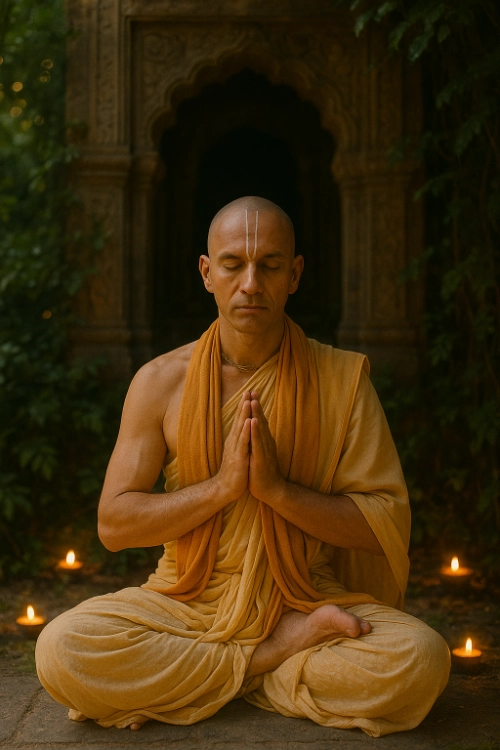
- Añjali – the joining of palms in reverence,
- Vandanī – a heart-centered gesture of salutation, and
- a third technical mudrā formed through a fist-and-thumb configuration.
The eight specialized mudrās are then introduced through a precise finger-release system beginning with the little finger. Each mudrā corresponds to a distinct seed-mantra (bīja) and is generated through controlled manipulation of the fingers rather than through symbolic expression. The thumb governs the system, acting as the activating digit.
Special attention is given to a class of mudrās associated with Varāha, Viṣṇu’s boar incarnation, which symbolize grounding and earth stabilization. These mudrās employ binding and releasing of fingers within the left fist, followed by symmetrical execution in the right hand. Completion (mudrā-siddhi) depends not on intention alone but on precise anatomical conformity.
Overall, the chapter demonstrates that mudrās function as codified ritual devices—mechanical, structural, and intrinsic to the correct activation of mantra and deity-presence. The body itself becomes a ritual instrument, and correct form, sequence, and symmetry replace emotionalism as the criteria of efficacy. This chapter thus integrates hands, mantra, and embodiment into a single operational ritual technology within worship.


Commentary
This opening verse introduces the ritual doctrine that mudrās are operative instruments, not symbolic gestures alone: they establish divine proximity (sānnīdhya) and activate ritual efficacy. Nārada announces a technical exposition, not a devotional sermon. The verse actually names two distinct mudrās: Añjali as the first and Vandanī as the second. Añjali is the traditional gesture of joined palms expressing reverence. Vandanī, however, is a separate mudrā, performed at the heart region (hṛdayānugā), indicating its interiorized and contemplative function. The qualities “vandanī” and “hṛdayānugā” therefore do not describe Añjali but introduce a second mudrā with a different ritual placement. The verse thus establishes a sequence structure: Añjali (first), Vandanī (second), with further mudrās to follow. It frames mudrās as functional techniques within worship, involving precise bodily placement rather than emotional symbolism.