Agni Purana
Chapter 27 - The Explanation of the Initiation Procedure.
Verse 1
नारद उवाच
वक्ष्ये दीक्षां सर्वदाञ्च मण्डलेऽब्जे हरिं यजेत्
दशम्यामुपसंहृत्य यागद्रव्यं समस्तकम् ॥१॥
nārada uvāca
vakṣye dīkṣāṃ sarvadā ca maṇḍale’bje hariṃ yajet
daśamyām upasaṃhṛtya yāga-dravyaṃ samastakam || 1 ||
Nārada said: I shall explain the initiation. At all times, one should worship Hari in the lotus within the maṇḍala. On the tenth lunar day, having gathered all sacrificial materials in full, the rite should be performed.
Verse 2
विन्यस्य नरसिंहेन सम्मन्त्र्य शतवारकम् ।
सर्षपांस्तु फडन्तेन रक्षोघ्नान् सर्वतः क्षिपेत् ॥२॥
vinyasya narasiṃhena sammantrya śatavārakam
sarṣapāṃs tu phaḍ-antena rakṣo-ghnān sarvataḥ kṣipet || 2 ||
Having installed (the deity) through Narasiṃha and having empowered it with mantra a hundred times, one should then cast mustard seeds, infused with the ‘phaṭ’ termination, in all directions as destroyers of harmful forces.
Verse 3
शक्तिं सर्वात्मिकां तत्र न्यसेत् प्रासादरूपिणीम् ।
सर्वौषधीः समाहृत्य विकिरान् अभिमन्त्रयेत् ॥३॥
śaktiṃ sarvātmikāṃ tatra nyaset prāsāda-rūpiṇīm
sarvauṣadhīḥ samāhṛtya vikirān abhimantrayet || 3 ||
There one should install the all-pervading Śakti, imagined in the form of a palace. Then, having gathered all sacred herbs, one should empower and scatter them by mantra.
Verse 4
शतवारं शुभे पात्रे वासुदेवेन साधकः ।
संसाध्य पञ्च गव्यं तु पञ्चभिर्मूलमूर्तिभिः ॥४॥
śata-vāraṃ śubhe pātre vāsudevena sādhakaḥ
saṃsādhya pañca gavyaṃ tu pañcabhir mūla-mūrtibhiḥ || 4 ||
In a pure vessel, the practitioner should empower (it) a hundred times with the Vāsudeva-mantra, and then prepare the pañcagavya using the five root-forms (of the deity).
Verse 5
नारायणान्तैः सम्प्रोक्ष्य कुशाग्रैस्तेन तां भुवम्
विकिरान्वासुदेवेन क्षिपेदुत्तानपाणिना ॥५॥
nārāyaṇāntaiḥ samprokṣya kuśāgrais tena tāṃ bhuvam
vikirān vāsudevena kṣiped uttāna-pāṇinā || 5 ||
Having thoroughly sprinkled that ground with kuśa-tips using mantras ending in ‘Nārāyaṇa,’ one should then scatter the empowered substances with the Vāsudeva-mantra, using the open upward-facing hand.
Verse 6
त्रिधा पूर्वमुखस्तिष्ठन् ध्यायेद्विष्णुं तथा हृदि
वर्द्धन्या सहिते कुम्भे साङ्गं विष्णुं प्रपूजयेत् ॥६॥
tridhā pūrva-mukhas tiṣṭhan dhyāyed viṣṇuṃ tathā hṛdi
varddhanyā sahite kumbhe sāṅgaṃ viṣṇuṃ prapūjayet || 6 ||
Standing facing the East, one should meditate threefold on Viṣṇu, and likewise upon Him in the heart. In the ritual pot, together with the prosperity-invoking adjunct, one should duly worship Viṣṇu with all His aṅgas.
Verse 7
शतवारं मन्त्रयित्वा अस्त्रेणैव च वर्द्धनीम् ।
अच्छिन्नधारया सिञ्चन् ईशानान्तं नयेच्च तम् ॥७॥
śata-vāraṃ mantrayitvā astreṇaiva ca varddhanīm
acchinna-dhārayā siñcann īśānāntaṃ nayec ca tam || 7 ||
Having empowered the vardhanī a hundred times with mantra, and also with the Astra-mantra itself, one should pour it in an unbroken stream and direct it toward the Īśāna (northeast) direction.
Verse 8
कलशं पृष्ठतो नीत्वा स्थापयेद् विकिरोपरी
संहृत्य विकिरान् दर्भैः कुम्भेशं कर्वरीं यजेत् ॥८॥
kalaśaṃ pṛṣṭhato nītvā sthāpayet vikir opari
saṃhṛtya vikirān darbhaiḥ kumbheśaṃ karvarīm yajet || 8 ||
Having moved the ritual vessel from behind, one should place it upon the scattered (consecrated substances). Then, drawing together the scattered materials with darbha grass, one should worship the Lord of the Kumbha together with Kārvarī.
Verse 9
सवस्त्रं पञ्चरत्नाढ्यं स्थण्डिले पूजयेद्धरिम् ।
अग्नावपि समभ्यर्च्य मन्त्रान् संजप्य पूर्ववत् ॥९॥
savastraṃ pañca-ratnāḍhyaṃ sthaṇḍile pūjayed dharim
agnāv api samabhyarcya mantrān saṃjapya pūrvavat || 9 ||
Clothing Him and adorning Him with the five gems, one should worship Hari upon the ritual ground. Then, worshiping also within the fire, one should recite the mantras as previously prescribed.
Verse 10
प्रक्षाल्य पुण्डरीकेण विलिप्य अन्तः सुगन्धिना ।
उखामाज्येन सम्पूर्य गोक्षीरेण तु साधकः ॥१०॥
prakṣālya puṇḍarīkeṇa vilipya antaḥ sugandhinā
ukhām ājyena sampūrya go-kṣīreṇa tu sādhakaḥ || 10 ||
The practitioner, having cleansed it with lotus-water and anointed its interior with fragrance, then fills the ukhā with ghee and with cow’s milk.
Verse 11
आलोक्य वासुदेवेन ततः सङ्कर्षणेन च ।
तण्डुलान् आज्य–संसृष्टान् क्षिपेत् क्षीरे सुसंस्कृते ॥११॥
ālokya vāsudevena tataḥ saṅkarṣaṇena ca
taṇḍulān ājya-saṃsṛṣṭān kṣipet kṣīre su-saṃskṛte || 11 ||
Having empowered (it) through Vāsudeva and then through Saṅkarṣaṇa as well, one should cast the rice grains mixed with ghee into the properly prepared milk.
Verse 12
प्रद्युम्नेन समालोड्य दर्व्या सङ्घट्टयेच्छनैः ।
पक्वम् उत्तारयेत् पश्चात् अनिरुद्धेन देशिकः ॥१२॥
pradyumnena samāloḍya darvyā saṅghaṭṭayec chanaiḥ
pakvam uttārayet paścāt aniruddhena deśikaḥ || 12 ||
Having thoroughly stirred (the mixture) with Pradyumna, using a ladle, one should churn it gently. When it is cooked, the officiating teacher should then remove it while invoking Aniruddha.
Verse 13
प्रक्षाल्यालिप्य तत् कुर्याद् ऊर्ध्वपुण्ड्रं तु भस्मना ।
नारायणेन पार्श्वेषु चरुमेवं सुसंस्कृतम् ॥१३॥
prakṣālyālipya tat kuryād ūrdhva-puṇḍraṃ tu bhasmanā
nārāyaṇena pārśveṣu carum evaṃ su-saṃskṛtam || 13 ||
After cleansing and anointing, one should then make the vertical sacred mark with ash. Using the Nārāyaṇa-mantra, one should apply it upon the sides, and thus the cooked offering is fully consecrated.
Verse 14
भागमेकं तु देवाय कलशाय द्वितीयकम्
तृतीयेन तु भागेन प्रदद्यादाहुतित्रयम् ॥१४॥
bhāgam ekaṃ tu devāya kalaśāya dvitīyakam
tṛtīyena tu bhāgena pradadyād āhuti-trayam || 14 ||
One portion should be given to the deity, the second to the kumbha, and with the third portion one should offer three oblations.
Verse 15
शिष्यैः सह चतुर्थं तु गुरुरद्याद् विशुद्धये ।
नारायणेन सम्मन्त्र्य सप्तधा क्षीरवृक्षजम् ॥१५॥
śiṣyaiḥ saha caturthaṃ tu gurur adyād viśuddhaye
nārāyaṇena sammantrya saptadhā kṣīra-vṛkṣajam || 15 ||
The teacher, together with the disciples, should then consume the fourth portion for purification, after empowering the milk-tree substance sevenfold with the Nārāyaṇa-mantra.
Verse 16
दन्तकाष्ठं भक्षयित्वा त्यक्त्वा ज्ञात्वा स्वपातकम्
ऐन्द्राग्न्युत्तरकेशानीमुखं पतितमुत्तमम् ॥१६॥
danta-kāṣṭhaṃ bhakṣayitvā tyaktvā jñātvā sva-pātakam
aindrāgny-uttara-keśānī-mukhaṃ patitam uttamam || 16 ||
Having cleansed the teeth with a tooth-stick and discarded it, and having recognized one’s own impurity, the candidate—formerly fallen—should be oriented facing the quarters of Indra, Agni, the North, and Īśāna, toward the Supreme.
Verse 17
शुभं सिंहशतं हुत्वा प्राचम्याथ प्रविश्य च
पूजागारं न्यसेन्मन्त्री प्राच्यां विष्णुं प्रदक्षिणम् ॥१७॥
śubhaṃ siṃha-śataṃ hutvā prācamyātha praviśya ca
pūjā-gāraṃ nyasen mantrī prācyāṃ viṣṇuṃ pradakṣiṇam || 17 ||
Having auspiciously performed one hundred oblations to Narasiṃha, and after sipping water and entering (the sanctuary), the officiant should install Viṣṇu in the eastern quarter, in the proper circumpolar (clockwise) orientation.
Verse 18
संसारार्णवमग्नानां पशूनां पाशमुक्तये
त्वमेव शरणं देव सदा त्वं भक्तवत्सल ॥१८॥
saṃsārārṇava-magnānāṃ paśūnāṃ pāśa-muktaye
tvam eva śaraṇaṃ deva sadā tvaṃ bhakta-vatsala ||18||
For beings drowned in the ocean of saṃsāra and bound like cattle, seeking release from the noose—You alone are our refuge, O Lord; always You are the lover of Your devotees.
Verse 19
देवदेवानुजानीहि प्राकृतैः पाशबन्धनैः
पाशितान्मोचयिष्यामि त्वत्प्रसादात्पशूनिमान् ॥१९॥
deva-devānujānīhi prākṛtaiḥ pāśa-bandhanaiḥ
pāśitān mocayiṣyāmi tvat-prasādāt paśūn imān ||19||
O God of gods, grant permission! Bound by worldly bonds, I shall release these beings, by Your grace.
Verse 20
इति विज्ञाप्य देवेशं सम्प्रविश्य पशूंस्ततः
धारणाभिस्तु संशोध्य पूर्व्ववज्ज्वलनादिना ॥२०॥
iti vijñāpya deveśaṃ saṃpraviśya paśūṃs tataḥ
dhāraṇābhis tu saṃśodhya pūrvavat jvalanādinā || 20 ||
Thus having supplicated the Lord of gods, and then approaching the candidates, he should purify them by acts of concentration, and again, as before, by fire and related rites.
Verse 21
संस्कृत्य मूर्त्त्या संयोज्य नेत्रे बद्ध्वा प्रदर्शयेत्
पुष्पपूर्णाञ्जलींस्तत्र क्षिपेत्तन्नाम योजयेत् ॥२१॥
saṃskṛtya mūrtyā saṃyojya netre baddhvā pradarśayet
puṣpa-pūrṇāñjalīṃs tatra kṣipet tat-nāma yojayet || 21 ||
Having purified (the candidate) and united him with the divine form, and having bound the eyes, one should then reveal (the deity). There, he should place flower-filled joined palms (before the Lord), and bestow that sacred Name.
Verse 22
अमन्त्रम् अर्चनं तत्र पूर्ववत् कारयेत् क्रमात् ।
यस्यां मूर्तौ पतेत् पुष्पं तस्य तन्नाम निर्दिशेत् ॥२२॥
amantram arcanaṃ tatra pūrvavat kārayet kramāt
yasyāṃ mūrtau patet puṣpaṃ tasya tat-nāma nirdiśet || 22 ||
There, one should conduct the worship without a mantra, in the proper order as before. Upon whichever form the flower falls, that very Name should be assigned (to the disciple).
Verse 23
शिखान्तसम्मितं सूत्रं पादाङ्गुष्ठादि षड्गुणम् ।
कन्यासु कर्तितं रक्तं पुनस् त्रिगुणीकृतम् ॥२३॥
śikhānta-samitaṃ sūtraṃ pādāṅguṣṭhādi ṣaḍ-guṇam
kanyāsu kartitaṃ raktaṃ punas tri-guṇī-kṛtam || 23 ||
A thread measured from the crown to the big toe, made sixfold, cut by pure maidens, tinged red, and then twisted into three strands.
Verse 24
यस्यां संलीयते विश्वं यतो विश्वं प्रसूयते
प्रकृतिं प्रक्रियाभेदैः संस्थितां तत्र चिन्तयेत् ॥२४॥
yasyāṃ saṃlīyate viśvaṃ yato viśvaṃ prasūyate
prakṛtiṃ prakriyā-bhedaiḥ saṃsthitāṃ tatra cintayet || 24 ||
One should contemplate Prakṛti there (in it), in whom the universe dissolves and from whom the universe is born, existing in differentiated modes of operation.
Verse 25
तेन प्राकृतिकान् पाशान् ग्रथित्वा तत्त्वसंख्यया
कृत्वा शरावे तत्सूत्रं कुण्डपार्श्वे निधाय तु ॥२५॥
tena prākṛtikān pāśān grathitvā tattva-saṃkhyayā
kṛtvā śarāve tat-sūtraṃ kuṇḍa-pārśve nidhāya tu || 25 ||
With that cord, having knotted the material bonds according to the number of tattvas, and placing that thread in a dish, one should then set it beside the fire-pit.
Verse 26
ततस्तत्त्वानि सर्वाणि ध्यात्वा शिष्यतनौ न्यसेत्
सृष्टिक्रमात्प्रकृत्यादिपृथिव्यन्तानि देशिकः ॥२६॥
tatas tattvāni sarvāṇi dhyātvā śiṣya-tanau nyaset
sṛṣṭi-kramāt prakṛty-ādi-pṛthivy-antāni deśikaḥ || 26 ||
Then, having meditated upon all the tattvas, the teacher should install them upon the body of the disciple, in the order of creation, from Prakṛti down to Earth.
Verse 27
तत्रैकधा पञ्चधा स्याद्दशद्वाद्दशधापि वा
ज्ञातव्यः सर्व्वभेदेन ग्रथितस्तत्त्वचिन्तकैः ॥२७॥
tatraikadhā pañcadhā syād daśa-dvādaśadhāpi vā
jñātavyaḥ sarva-bhedena grathitas tattva-cintakaiḥ || 27 ||
There it may be understood as single, fivefold, tenfold, or twelvefold; It is to be known, in all its distinctions, as a woven system by the contemplators of reality.
Verse 28
अङ्गैः पञ्चभिरध्वानं निखिलं विकृतिक्रमात्
तन्मात्रात्मनि संहृत्य मायासूत्रे पशोस्तनौ ॥२८॥
aṅgaiḥ pañcabhir adhvānaṃ nikhilaṃ vikṛti-kramāt
tanmātrātmani saṃhṛtya māyā-sūtre paśos tanau || 28 ||
By the five ritual limbs, the entire course of manifestation, in the order of creation, is reabsorbed into the essence of the subtle elements, and into the thread of māyā within the body of the bound soul.
Verse 29
प्रकृतिर् लिङ्ग-शक्तिश् च कर्ता बुद्धिस् तथा मनः ।
पञ्च-तन्मात्र-बुद्ध्याख्यं कर्माख्यं भूत-पञ्चकम् ॥२९॥
prakṛtir liṅga-śaktiś ca kartā buddhiś tathā manaḥ
pañca-tanmātra-buddhy-ākhyaṃ karmākhyaṃ bhūta-pañcakam ||29||
Prakṛti, the subtle marking power, the agent, the intellect, and the mind; the five subtle essences classed as cognition, the category of action, and the five elements—(all these).
Verse 30
ध्यायेत् च द्वादशात्मानं सूत्रे देहे तथा इच्छया ।
हुत्वा सम्पातविधिना सृष्टेः सृष्टिक्रमेण तु ॥३०॥
dhyāyet ca dvādaśātmānaṃ sūtre dehe tathā icchayā
hutvā saṃpāta-vidhinā sṛṣṭeḥ sṛṣṭi-krameṇa tu || 30 ||
One should meditate upon the Twelvefold Lord within the cord and within the body as intended, and then perform offerings in the fire by the method of convergence, in the order of creation.
Verse 31
एकैकं शतहोमेन दत्त्वा पूर्णाहुतिं ततः
शरावे सम्पुटीकृत्य कुम्भेशाय निवेदयेत् ॥३१॥
ekaikaṃ śata-homena dattvā pūrṇāhutiṃ tataḥ
śarāve saṃpuṭī-kṛtya kumbheśāya nivedayet || 31 ||
After giving a hundred oblations to each (form), and then offering the final oblation, one should enclose (the remnants) in a dish and present them to the Lord in the sacred vessel.
Verse 32
अधिवास्य यथान्यायं भक्तं शिष्यं तु दीक्षयेत् ।
करणीं कर्तरीं वापि रजांसि खटिकाम् अपि ॥३२॥
adhivāsya yathā-nyāyaṃ bhaktaṃ śiṣyaṃ tu dīkṣayet
karaṇīṃ kartarīṃ vāpi rajāṃsi khaṭikām api || 32 ||
Having duly performed the preliminary consecration, one should initiate the devoted disciple (using) a ritual stylus, a cutter, pigments, or even chalk.
Verse 33
अन्यदपि उपयोगि स्यात् सर्वं तद् वायु-गोचरे ।
संस्थाप्य मूल-मन्त्रेण परामृष्य अधिवासयेत् ॥३३॥
anyad api upayogi syāt sarvaṃ tad vāyu-gocare
saṃsthāpya mūla-mantreṇa parāmṛśya adhi-vāsayet || 33 ||
Anything else that is useful may also be employed; all of it should be placed within the vital field, installed by the root mantra, ritually touched, and subjected to consecration.
Verse 34
नमो भूतेभ्यः च बलिः कुशे देयः स्मरन् हरिम् ।
मण्डपं भूषयित्वा अथ वितान-घट-लड्डुकैः ॥३४॥
namo bhūtebhyaś ca baliḥ kuśe deyaḥ smaran harim
maṇḍapaṃ bhūṣayitvā atha vitāna-ghaṭa-laḍḍukaiḥ || 34 ||
Salutation to the beings; an offering should be placed upon kuśa grass while remembering Hari. Then, having adorned the pavilion with hangings, vessels, and sweet offerings…
Verse 35
मण्डलेऽथ यजेद्विष्णुं ततः सन्तर्प्य पावकम्
आहूय दीक्षयेच्छिष्यान् बद्धपद्मासनस्थितान् ॥३५॥
maṇḍale ’tha yajed viṣṇuṃ tataḥ santarpya pāvakam
āhūya dīkṣayet śiṣyān baddha-pad māsana-sthitān || 35 ||
Then one should worship Viṣṇu in the mandala, thereafter satisfy Agni; then, having summoned the disciples seated in a bound lotus posture, one should initiate them.
Verse 36
सम्प्रोक्ष्य विष्णुं हस्तेन मूर्धानं स्पृश्य वै क्रमात् ।
प्रकृत्यादि-विकृत्यन्तां साधि-भूताधि-दैवताम् ॥३६॥
samprokṣya viṣṇuṃ hastena mūrdhānaṃ spṛśya vai kramāt
prakṛty-ādi-vikṛty-antāṃ sādhi-bhūtādhi-daivatām || 36 ||
Having consecrated with Viṣṇu by the hand and touching the crown of the head in due order, (from there he installs) the entire series from Prakṛti to the final modification, together with the adhibhūta and adhidaivata principles.
Verse 37
सृष्टिम् आध्यात्मिकीं कृत्वा हृदि तां संहरेत् क्रमात् ।
तन्मात्र–भूतां सकलां जीवेन समेताम् गताम् ॥३७॥
sṛṣṭim ādhyātmikīṃ kṛtvā hṛdi tāṃ saṃharet kramāt
tanmātra-bhūtāṃ sakalāṃ jīvena sametāṃ gatām || 37 ||
Having established the cosmos inwardly, one should withdraw it into the heart in due order, until the whole becomes subtle essence and merges into the living self.
Verse 38
ततः सम्प्रार्थ्य कुम्भेशं सूत्रं संहृत्य देशिकः
अग्नेः समीपमागत्य पार्श्वे तं सन्निवेश्य तु ॥३८॥
tataḥ samprārthya kumbheśaṃ sūtraṃ saṃhṛtya deśikaḥ
agneḥ samīpam āgatya pārśve taṃ sanniveśya tu || 38 ||
Then, having prayed to the Lord in the vessel and gathered up the cord, the teacher goes near the fire and places it beside it.
Verse 39
मूल-मन्त्रेण सृष्टि-ईशम् आहुतीनां शतेन तम् ।
उदासीनम् अथ आसाद्य पूर्णाहुत्या च देशिकः ॥३९॥
mūla-mantreṇa sṛṣṭīśam āhutīnāṃ śatena tam
udāsīnam atha āsādya pūrṇāhutyā ca deśikaḥ || 39 ||
With the root mantra and by a hundred oblations to the Lord of Creation, having then approached Him in transcendence, the teacher seals it with the final offering.
Verse 40
शुक्लं रजः समादाय मूलेन शतमन्त्रितम्
सन्ताड्य हृदयन्तेन हुंफट्कारान्तसंयुतैः ॥४०॥
śuklaṃ rajaḥ samādāya mūlena śata-mantritam
santāḍya hṛdayāntena huṃ-phaṭkārānta-saṃyutaiḥ || 40 ||
Taking white ritual powder consecrated a hundred times by the root mantra, he applies it forcefully using the heart-mantra, accompanied by the utterance of HUṂ and PHAṬ.
Verse 41
वियोगपदसंयुक्तैर्बीजैः पादादिभिः क्रमात्
पृथिव्यादीनि तत्त्वानि विश्लष्य जुहुयात्ततः ॥४१॥
viyoga-pada-saṃyuktair bījaiḥ pādādibhiḥ kramāt
pṛthivy-ādīni tattvāni viślaṣya juhuyāt tataḥ || 41 ||
Then, employing seed syllables united with dissociative formulas, beginning from the feet upward, in due order, one should detach the principles starting with Earth and offer them into the fire.
Verse 42
वह्नावखिलतत्त्वानामालये व्याहते हरौ
नीयमानं क्रमात्सर्वं तत्राध्वानं स्मरेद्बुधः ॥४२॥
vahnāv akhila-tattvānām ālaye vyāhate harau
nīyamānaṃ kramāt sarvaṃ tatrādhvānaṃ smared budhaḥ || 42 ||
In the fire, the abode of all principles, being absorbed into Hari, the wise should contemplate the entire path as it is led back, step by step.
Verse 43
ताडनेन वियोज्य एवम् आदाय आपाद्य शाम्यताम् ।
प्रकृत्याहृत्य जुहुयात् यथोक्ते जातवेदसि ॥४३॥
tāḍanena viyojya evam ādāya āpādya śāmyatām
prakṛtyāhṛtya juhuyāt yathokte jātavedasi || 43 ||
Thus, having severed by ritual striking, having taken and drawn it inward until it is extinguished, having withdrawn it back into Prakṛti, one should offer it into Jātavedas as prescribed.
Verse 44
गर्भाधानं जातकर्म भोगं चैव लयं तथा ।
हुत्वा अष्टौ तत्र तत्र एव ततः शुद्धिं तु होमयेत् ॥४४॥
garbhādhānaṃ jāta-karma bhogaṃ ca eva layaṃ tathā
hutvā aṣṭau tatra tatra eva tataḥ śuddhiṃ tu homayet || 44 ||
Having offered eight oblations corresponding to conception, birth, experience, and dissolution—at each point—one should then perform an oblation specifically for purification.
Verse 45
शुद्धं तत्त्वं समुद्धृत्य पूर्णाहुत्या तु देशिकः
सन्धयेद्धि परे तत्त्वे यावदव्याकृतं क्रमात् ॥४५॥
śuddhaṃ tattvaṃ samuddhṛtya pūrṇāhutyā tu deśikaḥ
sandhayedd hi pare tattve yāvad avyakṛtaṃ kramāt || 45 ||
Having extracted the purified principle, the teacher—by the final offering— should indeed unite it into the supreme reality, ascending in order up to the unmanifest.
Verse 46
तत्परं ज्ञानयोगेन विलाप्य परमात्मनि
विमुक्तबन्धनं जीवं परस्मिन्नव्यये पदे ॥४६॥
tat-paraṃ jñāna-yogena vilāpya paramātmani
vimukta-bandhanaṃ jīvaṃ parasminn avyaye pade || 46 ||
Then, by the yoga of knowledge, fixing the mind upon That and dissolving (it) into the Supreme Self, the individual soul—freed from bondage—rests in the imperishable Supreme state.
Verse 47
निर्वृत्तं परमानन्दे शुद्धे बुद्धे स्मरेद् बुधः ।
दद्यात् पूर्णाहुतिं पश्चात् एवं दीक्षा समाप्यते ॥४७॥
nirvṛttaṃ paramānande śuddhe buddhe smared budhaḥ
dadyāt pūrṇāhutiṃ paścād evaṃ dīkṣā samāpyate || 47 ||
The wise one should contemplate the self as withdrawn into supreme bliss, pure and luminous awareness; thereafter, he should offer the final oblation—thus initiation is completed.
Verse 48
प्रयोगमन्त्रान् वक्ष्यामि यैर् दक्षः होमसंलयः ।
ॐ यं भूतानि विशुद्धं हुं फट् ।
अनेन ताडनं कुर्यात् वियोजनं इह द्वयम् ॥४८॥
prayoga-mantrān vakṣyāmi yair dakṣaḥ homa-saṃlayaḥ
oṃ yaṃ bhūtāni viśuddhaṃ huṃ phaṭ
anena tāḍanaṃ kuryāt viyojanaṃ iha dvayam || 48 ||
I shall declare the applied mantras by which one becomes competent in dissolution through fire. ‘OṂ YAṂ — may the beings/elements be completely purified — HUṂ PHAṬ.’ With this, one should perform ritual striking; here, separation is effected in a twofold manner.
Verse 49
ॐ यं भूतानि आपादयामि
आदानं कृत्वा चानेन प्रकृत्या योजनं शृणु
ॐ यं भूतानि पुं च आहो
होममन्त्रं प्रवक्ष्यामि ततः पूर्णाहुतेर्मनुम् ॥४९॥
oṃ yaṃ bhūtāni āpādayāmi
ādānaṃ kṛtvā cānena prakṛtyā yojanaṃ śṛṇu
oṃ yaṃ bhūtāni puṃ ca āho
homa-mantraṃ pravakṣyāmi tataḥ pūrṇāhuter manum || 49 ||
OM — I draw all elements into reintegration. Having withdrawn them by this, hear the method of uniting them back into Prakṛti. OM YAṂ — (mantric discharge). Now I declare the fire-mantra, and after it the formula of the final oblation.
Verse 50
ॐ भूतानि संहर स्वाहा ।
ॐ अं ॐ नमो भगवते वासुदेवाय वौषट् ।
पूर्णाहुत्यनन्तरे तु शिष्यम् वै साधयेत् ।
एवं तत्त्वानि सर्वाणि क्रमात् संशोधयेत् बुधः ॥५०॥
oṃ bhūtāni saṃhara svāhā
oṃ aṃ oṃ namo bhagavate vāsudevāya vauṣaṭ
pūrṇāhuty-anantare tu śiṣyam vai sādhayet
evaṃ tattvāni sarvāṇi kramāt saṃśodhayet budhaḥ || 50 ||
‘Om — withdraw all the elements — svāhā. Om Aṃ; Om, homage to the Blessed Lord Vāsudeva — vauṣaṭ.’ After the final oblation, one should indeed establish the disciple; Thus, the wise purifies all principles in due order.
Verse 51
नमोऽन्तेन ख–बीजेन ताडनादि–पुरःसरम् ।
ॐ वां कर्मेन्द्रियाणि ।
ॐ दें बुद्धीन्द्रियाणि ।
यं बीजेन समानन्तु ताडनादि–प्रयोगकम् ॥५१॥
namo’ntena kha-bījena tāḍanādi-puraḥsaram
oṃ vāṃ karmendriyāṇi
oṃ deṃ buddhīndriyāṇi
yaṃ bījena samānantu tāḍanādi-prayogakam || 51 ||
Using the kha-seed joined with a ‘namaḥ’-ending, and preceded by the rites of striking and the like: ‘Om Vāṃ — the organs of action,’ ‘Om Deṃ — the organs of perception.’ Likewise, with the Yaṃ seed, one should perform all the acts of striking and separation.”
Verse 52
ॐ सुं गन्ध-तन्मात्रे वियुङ्क्ष्व हुं फट् ॐ सम्पाहि हा ।
ॐ स्वं स्वं युङ्क्ष्व प्रकृत्या ।
ॐ सुं हुं गन्ध-तन्मात्रे संहर स्वाहा ।
ततः पूर्णाहुतिश्चैवम् उत्तरेषु प्रयुज्यते ।
ॐ रां रस-तन्मात्रे ।
ॐ भें रूप-तन्मात्रे ।
ॐ रं स्पर्श-तन्मात्रे ।
ॐ एं शब्द-तन्मात्रे ।
ॐ भं नमः ।
ॐ सों अहङ्कारः ।
ॐ नं बुद्धे ।
ॐ ॐ प्रकृते ।
एक-मूर्तौ अयं प्रोक्तो दीक्षा-योगः समासतः ।
एवमेव प्रयोगस् तु नव-व्यूह-आदिके स्मृतः ॥५२॥
oṃ suṃ gandha-tanmātre viyuṅkṣva huṃ phaṭ oṃ saṃpāhi hā
oṃ svaṃ svaṃ yuṅkṣva prakṛtyā
oṃ suṃ huṃ gandha-tanmātre saṃhara svāhā
tataḥ pūrṇāhutiś caivam uttareṣu prayujyate
oṃ rāṃ rasa-tanmātre
oṃ bheṃ rūpa-tanmātre
oṃ raṃ sparśa-tanmātre
oṃ eṃ śabda-tanmātre
oṃ bhaṃ namaḥ
oṃ soṃ ahaṅkāraḥ
oṃ naṃ buddhe
oṃ oṃ prakṛte
eka-mūrtau ayam prokto dīkṣā-yogaḥ samāsataḥ
evam eva prayogas tu nava-vyūha-ādike smṛtaḥ || 52 ||
OM — Suṃ, sever the principle of smell; HUṂ PHAṬ — guard and drive it out. OM — join each back into Prakṛti. OM — Suṃ HUṂ — withdraw the principle of smell into fire — svāhā.
Thereafter, the final oblation is performed in the same way for the others:
Rāṃ for taste,
Bheṃ for form,
Raṃ for touch,
Eṃ for sound,
Bhaṃ as the sealing syllable,
Soṃ for ego,
Naṃ for intellect,
OṂ for Prakṛti itself.
Thus, the method of initiation is defined as a single form. The same application applies to the multi-form and nine-emanation systems.
Verse 53
दग्धा परस्मिन् सन्दध्यात् निर्वाणे प्रकृतिं नरः ।
अविकारे समादध्यात् ईश्वरे प्रकृतिं नरः ॥५३॥
dagdhā parasmin sandadhyāt nirvāṇe prakṛtiṃ naraḥ
avikāre samādadhyāt īśvare prakṛtiṃ naraḥ || 53 ||
When Prakṛti has been burned, the practitioner should merge her into the Supreme, in nirvāṇa; in the immutable Lord, he should establish Prakṛti again.
Verse 54
शोधयित्वा अथ भूतानि कर्माङ्गानि विशोधयेत् ।
बुद्ध्याख्यानि अथ तन्मात्रं मनोज्ञानम् अहङ्कृतिम् ॥५४॥
śodhayitvā atha bhūtāni karma-aṅgāni viśodhayet
buddhy-ākhyāni atha tanmātraṃ mano-jñānam ahaṅkṛtim || 54 ||
Having purified the elements, one should cleanse the organs of action; then (purify) the cognitive faculties, the subtle essences, the mind, knowledge, and the ego-function.
Verse 55
लिङ्ग–आत्मानं विशोध्य अन्ते प्रकृतिं शोधयेत् पुनः ।
पुरुषं प्राकृतं शुद्धम् ईश्वरे धाम्नि संस्थितम् ॥५५॥
liṅgātmānaṃ viśodhya ante prakṛtiṃ śodhayet punaḥ
puruṣaṃ prākṛtaṃ śuddham īśvare dhāmni saṃsthitam || 55 ||
Having purified the subtle self, at the end he should again purify Prakṛti; (the disciple) is then a purified person, conditioned no longer by nature, but established in the Lord’s own state.
Verse 56
स्वगोचरीकृत–अशेष–भोगं मुक्तौ कृत–आस्पदम् ।
ध्यायन् पूर्ण–आहुतिं दद्याद् दीक्षा इयं तु अधिकारिणी ॥५६॥
svagocarī-kṛtāśeṣa-bhogaṃ muktau kṛtāspadam
dhyāyan pūrṇa-āhutiṃ dadyād dīkṣā iyaṃ tu adhikāriṇī || 56 ||
Contemplating the self as one who has absorbed all experience into his own domain and made liberation his abode, one should offer the final oblation; this initiation indeed confers spiritual authority.
Verse 57
अङ्गैः आराध्य मन्त्रस्य नीत्वा तत्त्व-गणं समम् ।
क्रमात् एवम् विशोध्य अन्ते सर्व-सिद्धि-समन्वितम् ॥५७॥
aṅgaiḥ ārādhya mantrasya nītvā tattva-gaṇaṃ samam
kramāt evam viśodhya ante sarva-siddhi-samanvitam || 57 ||
Having worshipped the mantra through its limb-forms and led the whole body of principles into unity, thus purifying them in order, one becomes endowed with all realizations.
Verse 58
ध्यायन् पूर्ण–आहुतिं दद्याद् दीक्षा इयं साधके स्मृता ।
द्रव्यस्य वा न सम्पत्तिः अशक्तिः वा आत्मनः यदि ॥५८॥
dhyāyan pūrṇa-āhutiṃ dadyād dīkṣā iyaṃ sādhake smṛtā
dravyasya vā na sampattiḥ aśaktiḥ vā ātmanaḥ yadi || 58 ||
Meditating thus, one should offer the final oblation; this is regarded as initiation for the practitioner, even if material resources are lacking, or personal capacity is absent.
Verse 59
इष्ट्वा देवं यथा पूर्वं सर्वोपकरणान्वितम्
सद्योऽधिवास्य द्वादश्यां दीक्षयेद्देशिकोत्तमः ॥५९॥
iṣṭvā devaṃ yathā pūrvaṃ sarvopakaraṇānvitam
sadyo’dhivāsya dvādaśyāṃ dīkṣayed deśikottamaḥ || 59 ||
Having worshipped the deity as prescribed, with all ritual implements, and having immediately performed preliminary consecration, the accomplished teacher should initiate (the disciple) on the twelfth lunar day.
Verse 60
भक्तो विनीतः शारीरैः गुणैः सर्वैः समन्वितः ।
शिष्यः न अतिनीचः यः तु स्थण्डिले अभ्यर्च्य दीक्षयेत् ॥६०॥
bhakto vinītaḥ śārīraiḥ guṇaiḥ sarvaiḥ samanvitaḥ
śiṣyaḥ na atinīcaḥ yaḥ tu sthaṇḍile abhyarcya dīkṣayet || 60 ||
A disciple should be devoted, disciplined, and endowed with all bodily virtues; one who is not ignoble—such a one, after worship upon the consecrated ground, should be initiated.
Verse 61
अध्वानं निखिलं दैवं भौतं वाद्यात्मिकीकृतम्
सृष्टिक्रमेण शिष्यस्य देहे ध्यात्वा तु देशिकः ॥६१॥
adhvānaṃ nikhilaṃ daivaṃ bhautaṃ ādhyātmikīkṛtam
sṛṣṭi-krameṇa śiṣyasya dehe dhyātvā tu deśikaḥ || 61 ||
Having meditated upon the entire cosmic path—divine, elemental, and spiritual—as internalized within the disciple’s body in the order of creation, the teacher then…
Verse 62
अष्टाष्टाहुतिभिः पूर्वं क्रमात्सन्तर्प्य सृष्टिमान
स्वमन्त्रैर्वासुदेवादीन् जननादीन् विसर्जयेत् ॥६२॥
aṣṭāṣṭa-āhutibhiḥ pūrvaṃ kramāt santarpya sṛṣṭimān
sva-mantraiḥ vāsudevādīn jananādīn visarjayet || 62 ||
…in sequence, first satisfies the Lord of creation with seventy-two oblations. Afterward, using their own mantras, he formally releases Vāsudeva and the remaining emanations, together with the generative forces, back to their proper sphere.
Verse 63
होमेन शोधयेत् पश्चात् संहार-क्रम-योगतः ।
योनि-सूत्राणि बद्धानि मुक्त्वा कर्माणि देशिकः ॥६३॥
homena śodhayet paścāt saṃhāra-krama-yogataḥ
yoni-sūtrāṇi baddhāni muktvā karmāṇi deśikaḥ || 63 ||
Afterward, by fire-offering, following the method of dissolution in reverse order, the teacher should purify (the disciple), releasing the bound ‘womb-cords’ and karmic bonds.
Verse 64
शिष्यदेहात्समाहृत्य क्रमात्तत्त्वानि शोधयेत्
अग्नौ प्राकृतिके विष्णौ लयं नीत्वाधिदैविके ॥६४॥
śiṣya-dehāt samāhṛtya kramāt tattvāni śodhayet
agnau prākṛtike viṣṇau layaṃ nītvā adhi-daivike || 64 ||
Having drawn the principles out from the disciple’s body in due sequence, one should purify them by leading them into dissolution—into material fire and into Viṣṇu as the divine principle.
Verse 65
शुद्धं तत्त्वम् अशुद्धं च पूर्णाहुत्या तु साधयेत् ।
शिष्ये प्रकृतिम् आपन्ने दग्ध्वा प्राकृतिकान् गुणान् ॥६५॥
śuddhaṃ tattvam aśuddhaṃ ca pūrṇāhutyā tu sādhayet
śiṣye prakṛtim āpanne dagdhvā prākṛtikān guṇān || 65 ||
By the final oblation, one should seal both the pure and the impure principles; in the disciple formerly subject to Nature, the natural qualities are burned away.
Verse 66
मोचयेदधिकारे वा नियुञ्ज्याद्देशिकः शिशून्
अथान्यां शक्तिदीक्षां वा कुर्य्यात् भावे स्थितो गुरुः ॥६६॥
mocayet adhikāre vā niyuñjyāt deśikaḥ śiśūn
atha anyāṃ śakti-dīkṣāṃ vā kuryāt bhāve sthitaḥ guruḥ || 66 ||
The teacher may either release disciples from ritual obligations or formally assign them to duties; or else, abiding in realization, the guru may confer another initiation of empowerment.
Verse 67
भक्त्या सम्प्रतिपन्नानां यतीनां निर्द्धनस्य च
सम्पूज्य स्थण्डिले विष्णुं पार्श्वस्थं स्थाप्य पुत्रकम् ॥६७॥
bhaktyā sampratipannānāṃ yatīnāṃ nirdhanasya ca
sampūjya sthaṇḍile viṣṇuṃ pārśvasthaṃ sthāpya putrakam || 67 ||
For those who have surrendered in devotion—ascetics and those without means alike—having duly worshipped Viṣṇu on the sacred ground, one should seat the disciple at His side.
Verse 68
देवताभिमुखः शिष्यस्तिर्यगास्यः स्वयं स्थितः
अध्वानं निखिलं ध्यात्वा पर्वभिः स्वैर्विकल्पितम् ॥६८॥
devatābhimukhaḥ śiṣyas tiryagāsyaḥ svayaṃ sthitaḥ
adhvānaṃ nikhilaṃ dhyātvā parvabhiḥ svair vikalpitam || 68 ||
The disciple, facing the deity, with his head inclined, standing by himself, having contemplated the entire cosmic path as structured in its stages…
Verse 69
शिष्यदेहे तथा देवम् आधिदैविक-याजनम् ।
ध्यानयोगेन सञ्चिन्त्य पूर्ववत् ताडनादिना ॥६९॥
śiṣya-dehe tathā devam ādhi-daivika-yājanam
dhyāna-yogena saṃcintya pūrvavat tāḍanādinā || 69 ||
…and thus, within his own body, he installs the divine presence and performs the worship of the presiding powers through contemplative yoga, carrying it out just as before through the rites of striking and purification.
Verse 70
क्रमात् तत्त्वानि सर्वाणि शोधयेत् स्थण्डिले हरौ च ।
ताडनेन वियोज्य अथ गृहीत्वा आत्मनि तत्परः ॥७०॥
kramāt tattvāni sarvāṇi śodhayet sthaṇḍile harau ca
tāḍanena viyojya atha gṛhītvā ātmani tat-paraḥ || 70 ||
In due sequence, he should purify all principles, both on the altar and within Hari; then, by the rite of striking, separating them and drawing them into himself, fixing his being upon That.
Verse 71
देवे संयोज्य संशोध्य गृहीत्वा तत्स्वभावतः
आनीय शुद्धभावेन सन्धयित्वा क्रमेण तु ॥७१॥
deve saṃyojya saṃśodhya gṛhītvā tat-svabhāvataḥ
ānīya śuddha-bhāvena sandhayitvā krameṇa tu || 71 ||
Joining them to the deity, purifying them, absorbing them according to His true nature, then bringing them forth with purified awareness and uniting them in due order…
Verse 72
शोधयेद्ध्यानयोगेन सर्वतो ज्ञानमुद्रया
शुद्धेषु सर्वतत्त्वेषु प्रधाने चेश्वरे स्थिते ॥७२॥
śodhayet dhyāna-yogena sarvataḥ jñāna-mudrayā
śuddheṣu sarva-tattveṣu pradhāne ca īśvare sthite || 72 ||
By the yoga of meditation and by the seal of knowledge, he should purify everything completely, when all principles stand purified and are established both in Pradhāna and in the Lord.
Verse 73
दग्ध्वा निर्वापयेच्छिष्यान् पदे चैशे नियोजयेत्
निनयेत्सिद्धिमार्गे वा साधकं देशिकोत्तमः ॥७३॥
dagdhvā nirvāpayec chiṣyān pade ca īśe niyojayet
ninayet siddhi-mārge vā sādhakaṃ deśikottamaḥ || 73 ||
Having burned and then pacified the disciples, the accomplished teacher should establish them in the state belonging to the Lord; or he may guide the practitioner along the path of attainment.
Verse 74
एवमेवाधिकारस्थो गृही कर्म्माण्यतन्द्रितः
आत्मानं शोधयंस्तिष्ठेद्यावद्रागक्षयो भवेत् ॥७४॥
evam eva adhikāra-sthaḥ gṛhī karmāṇi atandritaḥ
ātmānaṃ śodhayan tiṣṭhet yāvat rāga-kṣayaḥ bhavet || 74 ||
Likewise, a householder remaining in his appointed station should perform his duties tirelessly, continually purifying himself until attachment is exhausted.
Verse 75
क्षीणरागमथात्मानं ज्ञात्वा संशुद्धकिल्बिषः
आरोप्य पुत्रे शिष्ये वा ह्यधिकारन्तु संयमी ॥७५॥
kṣīṇa-rāgam atha ātmānaṃ jñātvā saṃśuddha-kilbiṣaḥ
āropya putre śiṣye vā hi adhikāraṃ tu saṃyamī || 75 ||
When he knows himself to be free of attachment and purified from all fault, the disciplined one should then transfer authority either to his son or to his disciple.
Verse 76
दग्ध्वा मायामयं पाशं प्रव्रज्य स्वात्मनि स्थितः
शरीरपातमाकाङ्क्षन्नासीताव्यक्तलिङ्गवान् ॥७६॥
dagdhvā māyāmayaṃ pāśaṃ pravrajya svātmani sthitaḥ
śarīra-pātam ākāṅkṣann āsīta avyaktaliṅgavān || 76 ||
Having burned the bond made of illusion and renounced the world, established in his own Self, he should remain awaiting the falling away of the body, without any outward mark.
इति आदिमहापुराणे आग्नेये
सर्वदीक्षाकथनं नाम सप्तविंशोऽध्यायः
iti ādi-mahāpurāṇe āgneye sarva-dīkṣā-kathanaṃ nāma saptaviṃśo’dhyāyaḥ
Thus ends the Twenty-seventh Chapter, called ‘The Account of All Initiations,’ in the Agni-section of the Primordial Great Purāṇa.”
Synopsis of Chapter 27 — The Explanation of the Initiation Procedure
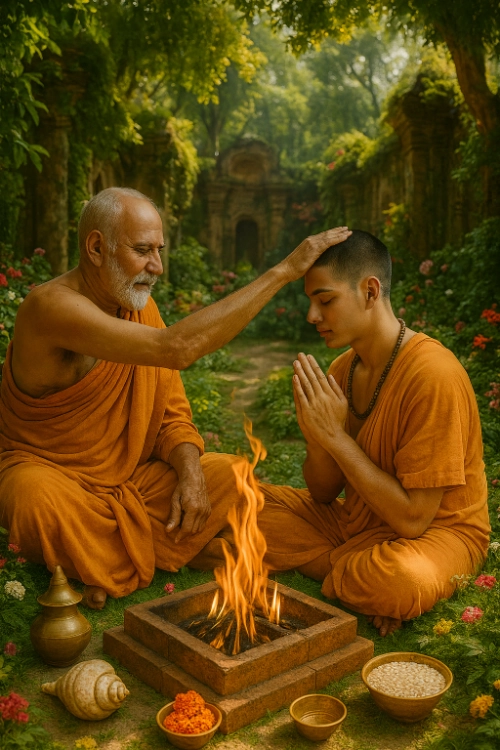
This chapter of the Agni Purāṇa presents dīkṣā (initiation) as a complete reshaping of the human being, not just a formal ceremony. It begins with the preparation of sacred space: Hari is worshipped in a lotus-maṇḍala on an auspicious lunar day, the ground is purified with kuśa and mantra, and Narasiṃha is invoked through a hundredfold recitation and the scattering of phaṭ-charged mustard seeds to drive away all harmful forces. Śakti is then envisioned as a palace enclosing the maṇḍala, and herbs, pañcagavya, and consecrated liquids are empowered with Vāsudeva, Nārāyaṇa, and Astra mantras. Viṣṇu is worshipped outwardly in the kalasha, on the altar and in the fire, and inwardly in the heart, so that space, substances, body, and deity form one saturated field of holiness.
From this purified field, the ritual turns to sacramental cooking and bodily consecration. Milk, ghee, and rice are successively empowered by the four Vyūhas—Vāsudeva, Saṅkarṣaṇa, Pradyumna, Aniruddha—so that food becomes divine presence in edible form. The candidate is marked with ūrdhva-puṇḍra, the offering is divided between deity, vessel, fire, and guru-disciple community, and sacred tree-sap is drunk as a purifying elixir. Through tooth-stick rites, ācamana, and further Narasiṃha offerings, the candidate acknowledges impurity, turns toward the auspicious quarters, and stands in a liminal state: ritually separated from former life, yet not yet reborn. The rite is clearly more than hygiene or symbolism; it is a sacramental re-founding of the candidate’s body and nourishment around Viṣṇu.
At the heart of the chapter lies a sophisticated cosmology enacted on the disciple. A consecrated cord measured to his height, dyed and knotted according to the number of tattvas, becomes the visible symbol of Prakṛti and bondage. The teacher meditates on Prakṛti, the subtle body, senses, tanmātras, mind, intellect, ego, karmic forces, and elements, then installs these tattvas onto the disciple’s body in the order of creation, making him a microcosm. Multiple cosmological schemes (onefold, fivefold, tenfold, twelvefold) are acknowledged as legitimate ways of “weaving” reality. The initiate becomes a walking mandala: the entire adhvāna—divine, subtle, and gross—is consciously mapped into his embodied existence.
Once this cosmic structure is installed, it is systematically dismantled through fire and mantra. Using seed syllables joined with HUṂ and PHAṬ, and specialized formulas for organs of action, perception, and tanmātras (sound, touch, form, taste, smell), the teacher performs tāḍana—ritual striking—to sever each level of bondage. Elements and faculties are detached from the disciple, offered into Agni and reabsorbed into Prakṛti, and then Prakṛti herself is burned and merged back into the Supreme. Life-stages—conception, birth, experience, dissolution—are each symbolically offered as homa, so that biography itself is surrendered. The cosmos is thus installed, withdrawn, and dissolved, not in abstraction but through the disciple’s own body, senses, and subtle ties; initiation becomes a rehearsed liberation, a “death” and reintegration enacted while still alive.
From here, the chapter moves to reconstruction and internalization. The purified tattvas are again joined with Viṣṇu, absorbed “according to His nature,” and brought forth in a new, sanctified order, established simultaneously in Pradhāna (as quiet potential) and in Īśvara (as governing presence). The teacher leads all principles, purified, into unity and then teaches the disciple to carry on the work inwardly through dhyāna-yoga and the “seal of knowledge.” Worship gradually moves from external altar to internal body: the disciple faces the deity, stands alone, contemplates the entire cosmic path in ordered stages, and installs the presiding powers within himself. At this point, the human being truly becomes temple and universe; fire and mantra give way to stabilized awareness.
The chapter is careful to democratize this exalted process. It explicitly states that full initiation is valid even when wealth and implements are lacking, so long as the pūrṇāhuti and contemplative realization are present. Devoted ascetics and the poor alike, if surrendered in bhakti, may be seated beside Viṣṇu as putrakas—spiritual sons—showing adoption rather than mere admission. At the same time, moral and psychological qualifications are emphasized: the disciple must be devoted, disciplined, physically and ethically self-controlled, and “not ignoble.” Initiation is thus framed as recognition of readiness, not a mechanical rite available on demand or a privilege of wealth and status.
The guru’s role extends beyond ritual to governance and succession. The deśika may release disciples from obligations, assign them to spiritual duties, or, abiding in realization, confer further śakti-dīkṣā. Householders are not required to renounce; they are told to remain in their rightful station, perform their duties without laziness, and keep purifying themselves until attachment is exhausted—turning vocation into yoga. When a teacher has become free of attachment and thoroughly purified of sin, he should transfer his authority to son or disciple and step aside. Finally, the fully liberated one, having burned the māyā-bond, is portrayed as a quiet renunciate without outward marks, remaining established in the Self, simply awaiting the body’s fall.
Taken as a whole, the chapter “On All Initiations” presents dīkṣā as a total metaphysical process: preparation of sacred space, sacramental transformation of matter, installation and withdrawal of the cosmos in the body, surgical burning of karmic and ontological bonds, and reestablishment of purified principles in God and Prakṛti. It culminates not in ritual spectacle but in jñāna-yoga: the soul resting in the imperishable state, with initiation defined as truly complete only when knowledge dawns. At the same time, the chapter binds this lofty vision to concrete practice—calendrical timing (Daśamī, Dvādaśī), eligibility, ethical discipline, household and renunciate paths, and the careful transmission of authority. Dīkṣā emerges as both cosmic drama and ethical-liminal turning point, dissolving the old self and re-situating the initiate—whether ascetic or householder—in a life lived transparently in and for Viṣṇu.


Commentary
This verse prescribes:
Daśamī as the preferred lunar day for dīkṣā. Installation and worship of Hari in the lotus-maṇḍala. Full preparation of offering materials before initiation.