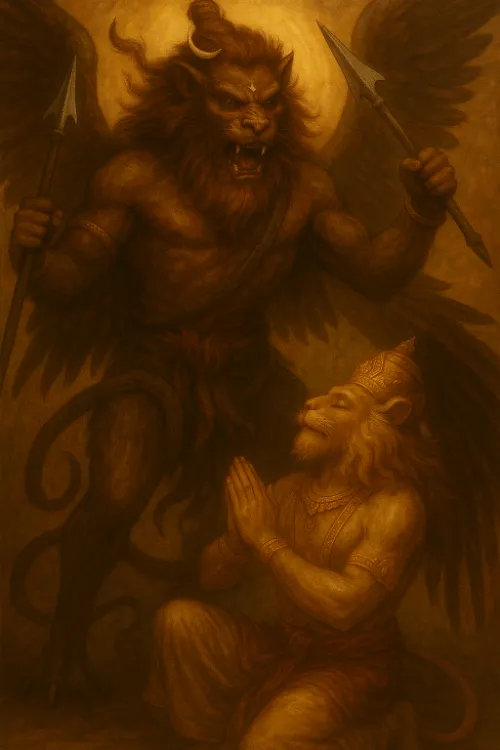
Agni Purana
Chapter 96 - The Manifestation of Śarabha
Verse 1
ऋषय ऊचुः
कथं देवो महादेवो विश्वसंहारकारकः ।
शरभाख्यं महाघोरं विकृतं रूपमास्थितः ॥ १ ॥
किंकिं धैर्यं कृतं तेन ब्रूहि सर्वमशेषतः ।
ṛṣaya ūcuḥ
kathaṃ devo mahādevo viśva-saṃhāra-kārakaḥ |
śarabhākhyaṃ mahāghoraṃ vikṛtaṃ rūpam āsthitaḥ || 1 ||
kiṃ kiṃ dhairyaṃ kṛtaṃ tena brūhi sarvam aśeṣataḥ ||
The Ṛṣis said: How did the god, Mahādeva—the agent of the dissolution of the universe—assume the extraordinarily fearsome form known as Śarabha? What acts of courage were performed by him? Tell us everything in full, without omission.
Verse 2-3
सूत उवाच
एवमभ्यर्थितो देवैर्मतिं चक्रे कृपालयः॥२॥
यत्तेजस्तु नृसिंहाख्यं संहर्तुं परमेश्वरः ।
तदर्थं स्मृतवान् रुद्रो वीरभद्रं महाबलम् ॥३॥
sūta uvāca
evam abhyarthito devair matiṃ cakre kṛpālayaḥ || 2 ||
yat tejas tu nṛsiṃhākhyaṃ saṃhartuṃ parameśvaraḥ |
tad-arthaṃ smṛtavān rudro vīrabhadraṃ mahā-balam || 3 ||
Sūta said: Thus entreated by the gods, the compassionate Lord formed his resolve. To subdue the fierce energy known as Nṛsiṃha, the Supreme Lord Rudra remembered Vīrabhadra, possessed of great might.
Verse 4-11
आत्मनो भैरवं रूपं महाप्रलयकारकम् ।
आजगाम पुरा सद्यो गणानामग्रतो 'हसन्॥४॥
साट्टहासैर्गणवरै रुत्पतद्भिरितस्ततः ।
नृसिंहरूपैरत्युग्रैः कोटिभिः परिवारितः ॥५॥
तावद्भिभितो वीरैर्नृत्यद्भिश्च मुदान्वितैः ।
क्रीडद्भिश्च महाधीरैर्ब्रह्माद्यैः कंदुकैरिव ॥ ६ ॥
अदृष्टपूर्वैरन्यैश्च वेष्टितो वीरवंदितः ।
कल्पांत ज्वलनज्वालो विलसल्लोचनत्रयः ॥७॥
आत्तशस्त्रो जटाजूटे ज्वलद्वालेन्दुमण्डितः ।
बालेंदुद्वितयाकारतीक्ष्णदंष्ट्रांकुरद्वयः ॥ ८ ॥
आखण्डलधनुःखण्डसंनिभभ्रूलतायुतः ।
महाप्रचण्डहुङ्कारबधिरीकृतदिङ्मुखः ॥ ९ ॥
नीलमेघाञ्जनाकार भीषणश्मश्रुरद्भुतः ।
वादखण्डमखण्डाभ्यां भ्रामयंस्त्रिशिखं मुहुः ॥ १० ॥
वीरभद्रोपि भगवान् वीरशक्तिविजृंभितः ।
स्वयं विज्ञापयामास किमत्र स्मृतिकारणम् ॥ ११॥
आज्ञापय जगत्स्वामिन् प्रसादः क्रियतां मयि ।
ātmano bhairavaṃ rūpaṃ mahā-pralaya-kārakam |
ājagāma purā sadyo gaṇānām agrato ’hasan || 4 ||
sāṭṭahāsair gaṇa-varair utpatadbhir itas tataḥ |
nṛsiṃha-rūpair atyugraiḥ koṭibhiḥ parivāritaḥ || 5 ||
tāvad bhibhito vīrair nṛtyadbhis ca mudānvitaḥ |
krīḍadbhis ca mahādhīrair brahmādyaiḥ kandukair iva || 6 ||
adṛṣṭapūrvair anyaiś ca veṣṭito vīra-vanditaḥ |
kalpānta-jvalana-jvālavilasal-locana-trayaḥ || 7 ||
ātta-śastro jaṭā-jūṭe jvalad-bālendu-maṇḍitaḥ |
bālendu-dvitayākāra-tīkṣṇa-daṃṣṭrāṅkura-dvayaḥ || 8 ||
ākhaṇḍala-dhanuḥ-khaṇḍa-sannibha-bhrū-latā-yutaḥ |
mahā-pracaṇḍa-huṃkāra-badhirīkṛta-diṅ-mukhaḥ || 9 ||
nīla-meghāñjana-ākāra-bhīṣaṇa-śmaśrur adbhutaḥ |
vāda-khaṇḍam akhaṇḍābhyāṃ bhrāmayaṃ triśikhaṃ muhuḥ || 10 ||
vīrabhadro ’pi bhagavān vīra-śakti-vijṛmbhitaḥ |
svayaṃ vijñāpayām āsa kim atra smṛti-kāraṇam || 11 ||
ājñāpaya jagat-svāmin prasādaḥ kriyatāṃ mayi ||
Then he (Śiva) came forth immediately, assuming his own Bhairava form, the form that brings about the great dissolution, smiling as he advanced at the head of the gaṇas. He was surrounded on all sides by the excellent gaṇas, who, with roaring laughter, leapt about here and there, taking on exceedingly fierce lion-forms, in countless multitudes. He was attended by heroes, delighted and dancing, and by other mighty ones sporting playfully, as though striking about their weapons like balls. He was encircled by beings never seen before, honored by warriors; his three eyes shone like the flames of the fire at the end of the cosmic cycle. Armed with weapons, his matted locks adorned with a blazing crescent moon, he had two sharp fang-tips shaped like a pair of young crescent moons. His vine-like eyebrows resembled fragments of Indra’s bow; his terrible roar deafened the quarters. His beard and moustache were fearsome; he appeared like a dark rain-cloud or collyrium-mountain. With his two unbroken arms, he whirled his trident again and again. Then Vīrabhadra also, the blessed one—expanding with heroic power—spoke for himself: ‘O Lord of the universe, for what reason have I been summoned? Command me; let your grace be shown to me.’
Verse 12-16
श्रीभगवानुवाच
अकाले भयमुत्पन्नं देवानामपि भैरव ॥१२॥
ज्वलितः स नृसिंहाग्निः शमयैनं दुरासदम् ।
सांत्वयन् बोधयादौ तं तेन किं नोपशाम्यति ॥ १३ ॥
ततो मत्परमं भावं भैरवं संप्रदर्शय ।
सूक्ष्मं सूक्ष्मेण संहृत्य स्थूलं स्थूलेन तेजसा ॥ १४॥
वक्त्रमानय कृत्तिं च वीरभद्र ममाज्ञया ।
इत्यादिष्टो गणाध्यक्षः प्रशांतवपुरास्थितः ॥ १५ ॥
जगाम रंहसा तत्र यत्रास्ते नरकेसरी |
ततस्तं बोधयामास वीरभद्रो हरो हरिम् ॥ १६ ॥
उवाच वाक्यमीशानः पितापुत्रमिवौरसम् ।
śrī-bhagavān uvāca
akāle bhayam utpannaṃ devānām api bhairava |
jvalitaḥ sa nṛsiṃhāgniḥ śamaya enaṃ durāsadam || 12 ||
sāntvayan bodhayādau taṃ tena kiṃ nopaśāmyati |
tato mat-paramaṃ bhāvaṃ bhairavaṃ saṃpradarśaya || 13 ||
sūkṣmaṃ sūkṣmeṇa saṃhṛtya sthūlaṃ sthūlena tejasā |
vaktram ānaya kṛttiṃ ca vīrabhadra mamājñayā || 14 ||
ityādiṣṭo gaṇādhyakṣaḥ praśānta-vapur āsthitaḥ |
jagāma raṃhasā tatra yatrāste narakesarī || 15 ||
tatas taṃ bodhayām āsa vīrabhadro haro harim |
uvāca vākyam īśānaḥ pitā putram ivaurasam || 16 ||
The Blessed Lord said: O Bhairava, an untimely fear has arisen even for the gods. The fire of Nṛsiṃha is blazing; pacify him, for he is difficult to approach.
First soothe him and awaken him; yet why does he not become calm? Then reveal to him my supreme Bhairava-state.
Withdraw the subtle by the subtle, and the gross by the gross radiance. Bring forth the face and the outer covering (of his form), O Vīrabhadra, by my command.
Thus instructed, the Lord of the Gaṇas adopted a tranquil form and swiftly went to where the Man-Lion was abiding.
Then Vīrabhadra awakened him; Hara addressed Hari, speaking words as a father to his own son.
Verse 17-22
श्री वीरभद्र उवाच
जगत्सुखाय भगवनवतीर्णोसि माधव ॥ १७॥
स्थित्यर्थेन न युक्तोसि परेण परमेष्ठिना ।
जंतुचक्रं भगवता रक्षितं मत्स्यरूपिणा ॥ १८ ॥
पुच्छेनैव समाबध्य भ्रमन्नेकार्णवे पुरा ।
बिभर्षि कर्मरूपेण वाराहेणोद्धृता मही ॥ १९ ॥
अनेन हरिरूपेण हिरण्यकशिपुर्हतः ।
वामनेन बलिर्बद्धस्त्वया विक्रमता पुनः ॥ २०॥
त्वमेव सर्वभूतानां प्रभवः प्रभुरव्ययः ।
यदायदा हि लोकस्य दुःखं किञ्चित्प्रजायते ॥ २१ ॥
तदातदा वतीर्णस्त्वं करिष्यसि निरामयम् ।
नाधिकस्त्वत्समोप्यस्ति हरे शिवपरायण ॥ २२ ॥
śrī-vīrabhadra uvāca
jagat-sukhāya bhagavan avatīrṇo ’si mādhava || 17 ||
sthit yarthena na yukto ’si pareṇa parameṣṭhinā |
jantu-cakraṃ bhagavatā rakṣitaṃ matsya-rūpiṇā || 18 ||
pucche naiva samābadhya bhramann ekārṇave purā |
bibharṣi karma-rūpeṇa vārāheṇoddhṛtā mahī || 19 ||
anena hari-rūpeṇa hiraṇyakaśipur hataḥ |
vāmaneṇa balir baddhas tvayā vikramatā punaḥ || 20 ||
tvam eva sarva-bhūtānāṃ prabhavaḥ prabhur avyayaḥ |
yadā yadā hi lokasya duḥkhaṃ kiñcit prajāyate || 21 ||
tadā tadā ’vatīrṇas tvaṃ kariṣyasi nirāmayam |
nādhikas tvat-samo ’py asti hare śiva-parāyaṇa || 22 ||
Vīrabhadra said: O Lord Mādhava, you have descended for the happiness of the world. By the command of the Supreme Parameṣṭhin you are appointed for the work of sustaining (the universe). The multitude of beings was protected by you when you took the Fish-form. Tying the boat to your very tail, you moved about in the single great ocean; and in the Boar-form you upheld the earth, lifting her up by your action. By this very Man-Lion form, Hiraṇyakaśipu has been slain; and again, in the Vāmana form, Bali was bound by your great stride. You alone are the source and the imperishable Lord of all beings. Whenever even a little sorrow arises in the world—then and there you descend and make it free of suffering. There is none greater than or even equal to you, O Hari, who art devoted to Śiva.
Verse 23-24
त्वया धर्माश्च वेदाश्च शुभे मार्गे प्रतिष्ठिताः ।
यदर्थमवतारोय निहतः सोपि केशव ॥ २३ ॥
अत्यंतघोरं भगवन्नरसिंह वपुस्तव ।
उपसंहर विश्वात्मंस्त्वमेव मम सन्निधौ ॥ २४॥
tvayā dharmāś ca vedāś ca śubhe mārge pratiṣṭhitāḥ |
yad-artham avatāro ’yaṃ nihataḥ so ’pi keśava || 23 ||
atyanta-ghoraṃ bhagavan narasiṃha vapus tava |
upasaṃhara viśvātmās tvam eva mama sannidhau || 24 ||
By you, O Keśava, dharma and the Vedas have been firmly established upon the auspicious path and the one for whose sake this avatāra arose has now been slain. Your Narasiṃha-form is exceedingly dreadful, O Bhagavan; withdraw this form, O Soul of the Universe, here in my very presence.
Verse 25
सूत उवाच
इत्युक्तो वीरभद्रेण नृसिंहः शांतया गिरा ।
ततोधिकं महाघोरं कोपं प्रज्वालयद्धरिः ॥ २५ ॥
sūta uvāca
ity ukto vīrabhadreṇa nṛsiṃhaḥ śāntayā girā |
tato ’dhikaṃ mahāghoraṃ kopaṃ prajvālayad dhariḥ || 25 ||
Sūta said: Thus addressed by Vīrabhadra in a soothing voice, Nṛsiṃha thereupon ignited an even more tremendous and terrifying wrath.
Verse 26-32
श्रीनृसिंह उवाच
आगतोसि यतस्तत्र गच्छ त्वं मा हितं वद ।
इदानीं संहरिष्यामि जगदेतच्चराचरम्॥२६॥
संहर्तुर्न हि संहारः स्वतो वा परतोपि वा ।
शासितं मम सर्वत्र शास्ता कोपि न विद्यते ॥२७॥
मत्प्रसादेन सकलं समर्यादं प्रवर्तते ।
अहं हि सर्वशक्तीनां प्रवर्तकनिवर्त्तकः ॥२८॥
यद्यद्विभूतिमत्सत्त्वं श्रीमदूर्जितमेव वा ।
तत्तद्विद्धि गणाध्यक्ष मम तेजोविजृंभितम् ॥ २९ ॥
देवतापरमार्थज्ञा ममैव परमं विदुः ।
मदंशाः शक्तिसंपन्ना ब्रह्मशक्रादयः सुराः ॥३०॥
मन्नाभिपङ्कजाज्जातः पुरा ब्रह्मा चतुर्मुखः ।
तल्ललाटसमुत्पन्नो भगवान्वृषभध्वजः॥३१॥
रजसाधिष्ठितः स्रष्टा रुद्रस्तामस उच्यते ।
अहं निहंता सर्वस्य मत्परं नास्ति दैवतम् ॥ ३२ ॥
śrī-nṛsiṃha uvāca
āgato ’si yataḥ tatra gaccha tvaṃ mā hitaṃ vada |
idānīṃ saṃhariṣyāmi jagad etac carācaram || 26 ||
saṃhartur na hi saṃhāraḥ svato vā parato ’pi vā |
śāsitaṃ mama sarvatra śāstā ko ’pi na vidyate || 27 ||
mat-prasādena sakalaṃ samaryādaṃ pravartate |
ahaṃ hi sarva-śaktīnāṃ pravartaka-nivarttakaḥ || 28 ||
yad yad vibhūtimat sattvaṃ śrīmad ūrjitam eva vā |
tat tad viddhi gaṇādhyakṣa mama tejo-vijṛmbhitam || 29 ||
devatā-paramārtha-jñā mamaiva paramaṃ viduḥ |
mad-aṃśāḥ śakti-sampannā brahma-śakrādayaḥ surāḥ || 30 ||
mad-nābhi-paṅkajā jātaḥ purā brahmā catur-mukhaḥ |
tallalāṭa-samutpanno bhagavān vṛṣabhadhvajaḥ || 31 ||
rajas-ādhisṭhitaḥ sraṣṭā rudras tāmasa ucyate |
ahaṃ nihaṃtā sarvasya mat-paraṃ nāsti daivatam || 32 ||
Nṛsiṃha said: Return to the place from which you have come; do not speak counsel to me. Now I shall withdraw (destroy) this entire world of moving and unmoving beings. For the destroyer, there is no hindrance to destruction—neither from himself nor from another. Everywhere I am the ruler; there exists no ruler over me. By my grace, everything proceeds within its proper bounds, for I am the one who sets all powers in motion and who brings them to rest. Whatever being possesses splendor, majesty, vigor, or force—know, O Lord of the Gaṇas, that each is but a manifestation of my radiance. Those who know the highest truth of the deities know me alone to be the Supreme. Brahmā, Śakra, and the other gods—endowed with power—are portions of me. From the lotus of my navel was born long ago the four-faced Brahmā; and from my forehead arose the blessed Bull-bannered Lord. Brahmā, established in rajas, is the creator; Rudra is said to belong to tamas. I am the destroyer of all; there is no deity higher than I.
Verse 33-35
विश्वाधिकः स्वतंत्रश्च कर्ता हर्ताखिलेश्वरः ।
इदं तु मत्परं तेजः कः पुनः श्रोतुमिच्छति ॥ ३३ ॥
अतो मां शरणं प्राप्य गच्छ त्वं विगतज्वरः ।
अवेहि परमं भावमिदं भूतमहेश्वरः ॥ ३४ ॥
कालोस्म्यहं कालविनाशहेतु-
र्लोकान् समाहर्त्तुमहं प्रवृत्तः ।
मृत्योर्मृत्युं विद्धि मां वीरभद्र
जीवंत्येते मत्प्रसादेन देवाः ॥ ३५ ॥
viśvādhikaḥ svatantraś ca kartā hartā ’khileśvaraḥ |
idaṃ tu mat-paraṃ tejaḥ kaḥ punaḥ śrotum icchati || 33 ||
ato māṃ śaraṇaṃ prāpya gaccha tvaṃ vigata-jvaraḥ |
avehi paramaṃ bhāvam idaṃ bhūta-maheśvara || 34 ||
kālosmy ahaṃ kāla-vināśa-hetuḥ
lokān samāhartum ahaṃ pravṛttaḥ |
mṛtyor mṛtyuṃ viddhi māṃ vīrabhadra
jīvanty ete mat-prasādena devāḥ || 35 ||
I surpass the universe; I am independent, the creator and withdrawer, the lord of all. This is my supreme energy—who indeed would wish to hear (words of counsel)? Therefore, seek refuge in me and depart free from agitation. Understand this supreme state of mine, O Great Lord of beings. I am Time; I am the cause of the destruction of Time itself. I have set forth to withdraw the worlds. Know me, O Vīrabhadra, to be the death of death; these gods live only by my grace.
Verse 36
सूत उवाच
साहङ्कारमिदं श्रुत्वा हरेरमितविक्रमः ।
विहस्योवाच सावज्ञं ततो विस्फुरिताधरः ॥३६॥
sūta uvāca
sāhaṅkāram idaṃ śrutvā harer amita-vikramaḥ |
vihasyovāca sāvajñaṃ tato visphurita-adharaḥ || 36 ||
Sūta said: Hearing these proud words of Hari, Vīrabhadra—of immeasurable might—laughed disdainfully; then, with his lower lip quivering, he spoke.
Verse 37
श्रीवीरभद्र उवाच
किं न जानासि विश्वेशं संहर्तारं पिनाकिनम् ।
असद्वादो विवादश्च विनाशस्त्वयि केवलः ॥३७॥
śrī-vīrabhadra uvāca
kiṃ na jānāsi viśveśaṃ saṃhartāraṃ pinākinam |
asad-vādo vivādaś ca vināśas tvayi kevalaḥ || 37 ||
Vīrabhadra said: Do you not know the Lord of the universe, the destroyer who bears the Pināka bow? False speech and contentious boasting—these bring destruction upon you alone.
Verse 38
तवान्योन्यावताराणि कानि शेषाणि सांप्रतम् ।
कृतानि येन केनापि कथाशेषो भविष्यति ॥ ३८ ॥
tavānyonyāvatārāṇi kāni śeṣāṇi sāṃpratam |
kṛtāni yena kenāpi kathā-śeṣo bhaviṣyati || 38 ||
Vīrabhadra said: What remains now of all your various incarnations? Whatever deeds were done by you in whatever form will only end up as mere stories.
Verse 39
दोषं त्वं पश्य एतत्त्वमवस्थामीदृशीं गतः ।
तेन संहारदक्षेण क्षणात्संक्षयमेष्यसि ॥३९॥
doṣaṃ tvaṃ paśya etat tvam avasthām īdṛśīṃ gataḥ |
tena saṃhāra-dakṣeṇa kṣaṇāt saṃkṣayam eṣyasi || 39 ||
See this fault of yours, for you have brought yourself into such a condition. By that one who is skilled in destruction, you will meet your end in a single moment.
Verse 40
प्रकृतिस्त्वं पुमान् रुद्रस्त्वयि वीर्यं समाहितम् ।
त्वन्नाभिपङ्कजाज्जातः पञ्चवक्त्रः पितामहः ॥ ४० ॥
prakṛtis tvaṃ pumān rudras tvayi vīryaṃ samāhitam |
tvannābhi-paṅkajāj jātaḥ pañca-vaktraḥ pitāmahaḥ || 40 ||
You are Prakṛti, and Rudra is the Puruṣa; his potency is established within you. From the lotus of your navel was born the five-faced Grandfather, Brahmā.
Verse 41
सृष्ट्यर्थेन जगत्पूर्वं शङ्करं नीललोहितम् ।
ललाटे चिंतयामास तपस्युग्रे व्यवस्थितः ॥ ४१ ॥
sṛṣṭyarthena jagat-pūrvaṃ śaṅkaraṃ nīlalohitam |
lalāṭe cintayām āsa tapas-yugre vyavasthitaḥ || 41 ||
For the purpose of creation, Brahmā—engaged in intense austerities—meditated within his forehead on Śaṅkara, the primordial Nīlalohita (the blue-red Lord), who is prior to the universe.
Verse 42
तल्ललाटादभूच्छंभो: सृष्टियर्थं तन्न दूषणम्।
अंशोह देवदेवस्य महाभैरवरूपिणः॥४२॥
tallalāṭād abhūc chaṃbhoḥ sṛṣṭy-arthaṃ tan na dūṣaṇam |
aṃśo ’haṃ devadevasya mahā-bhairava-rūpiṇaḥ || 42 ||
From that forehead arose Śambhu for the purpose of creation; there is no fault in this. I am but a portion of the God of gods, who manifests in the form of Mahābhairava.
Verse 43-44
त्वत्संहारे नियुक्तोस्मि विनयेन बलेन च ।
एवं रक्षो विदायैव त्वं शक्तिकलया युतः ॥ ४३॥
अहङ्कारावलेपेन गर्जसि त्वमतंद्रितः ।
उपकारो ह्यसाधूनामपकाराय केवलम् ॥४४॥
tvat-saṃhāre niyuktosmi vinayena balena ca |
evaṃ rakṣo-vidāyaiva tvaṃ śakti-kalayā yutaḥ || 43 ||
ahaṃkārāvalepena garjasi tvam atandritaḥ |
upakāro hy asādhūnām apakārāya kevalam || 44 ||
I am appointed for the restraint of your destructive force— with both discipline and strength. In this way, you who are endowed with a portion of divine power have long been the destroyer of demons. But now, through the taint of ego, you roar incessantly. Indeed, a favor shown to the wicked results only in harm.
Verse 45
यदि सिंह महेशानं स्वपुनर्भूत मन्यसे ।
न त्वं स्रष्टा न संहर्ता न स्वतंत्र हि कुत्रचित् ॥ ४५ ॥
yadi siṃha maheśānaṃ sva-punarbhūtam anyase |
na tvaṃ sraṣṭā na saṃhartā na svatantra hi kutracit || 45 ||
O Lion, if you imagine Maheśāna to be merely a re-manifestation of yourself, then know this: you are not the creator, nor the destroyer, nor are you independent in any way.
Verse 46-50
कुलालचक्रवच्छक्त्या प्रेरितोसि पिनाकिना ।
अद्यापि तव निक्षितं कपालं कूर्मरूपिणः ॥ ४६ ॥
हरहारलतामध्ये मुग्ध कस्मान्न बुध्यसे ।
विस्मृतं किं तदंशेन दंष्ट्रोत्पातनपीडितः ॥४७॥
वाराहविग्रहस्तेऽद्य साक्रोशं तारकारिणा ।
दग्धसि यस्य शूलाग्रे विष्वक्सेनच्छलाद्भवान् ॥४८॥
दक्षयज्ञे शिरश्छिन्नं मया ते यज्ञरूपिणः ।
अद्यापि तव पुत्रस्य ब्रह्मणः पञ्चमं शिरः ॥ ४९॥
छिन्नं तमेनाभिसंधं तदंशं तस्य तद्वलम् ।
निर्जितस्त्वं दधीचेन संग्रामे समरुद्गणः ॥५०॥
कंडूयमाने शिरसि कथं तद्विस्मृतं त्वया ।
kulāla-cakravat śaktyā preritos i pinākinā |
adyāpi tava nikṣiptaṃ kapālaṃ kūrma-rūpiṇaḥ || 46 ||
hara-hāra-latā-madhye mugdha kasmān na budhyase |
vismṛtaṃ kiṃ tad-aṃśena daṃṣṭrotpātana-pīḍitaḥ || 47 ||
vārāha-vigrahas te ’dya sākrośaṃ tārakāriṇā |
dagdhasi yasya śūla-agre viṣvaksena-chalād bhavān || 48 ||
dakṣa-yajñe śiraś chinnaṃ mayā te yajña-rūpiṇaḥ |
adyāpi tava putrasya brahmaṇaḥ pañcamaṃ śiraḥ || 49 ||
chinnaṃ tad ena-abhisandhaṃ tad-aṃśaṃ tasya tad-valam |
nirjitas tvaṃ dadhīcena saṃgrāme samarud-gaṇaḥ || 50 ||
kaṇḍūyamāne śirasi kathaṃ tad vismṛtaṃ tvayā ||
Like a potter’s wheel, you are set in motion by the power of the Pināka-bearing Lord; even now, the shell (kapāla) of your Tortoise-form remains deposited with him.
O deluded one, why do you not understand this while standing amidst Hara’s garlands? Have you forgotten that you were afflicted when your fangs were wrenched away by that portion (of his power)?
In your Boar-form, you were once scorched—crying out—by the Slayer of Tāraka; you were struck on the tip of his spear through the stratagem involving Viṣvaksena. At Dakṣa’s sacrifice, I cut off your head when you had taken the form of the Yajña; and even now, the fifth head of Brahmā—your offspring—remains severed.
That portion and that power of his… have you forgotten how you were subdued in battle by Dadhīci, your head afflicted? How could you forget all this?
Verse 51-54
चक्रं विक्रमतो यस्य चक्रमाणे तव प्रियम् ॥५१॥
कुतः प्राप्तं कृतं येन त्वया तदपि विस्मृतम् ।
ते मया सकला लोका गृहीतास्त्वं पयोनिधौ ॥५२॥
निद्रापरवशः शेषे स कथं सात्त्विको भवान् ।
त्वदादिस्तंवपर्यतं रुद्रशक्तिविजृंभितम् ॥ ५३ ॥
शक्तिमानभितस्त्वं च ह्यनलस्त्वं च मोहितः ।
तत्तेजसोपि माहात्म्यं युवां द्रष्टुं न हि क्षमौ ॥ ५४ ॥
cakraṃ vikramato yasya cakramāṇe tava priyam |
kutaḥ prāptaṃ kṛtaṃ yena tvayā tad api vismṛtam || 51 ||
te mayā sakalā lokā gṛhītās tvaṃ payonidhau |
nidrā-paravaśaḥ śeṣe sa kathaṃ sāttviko bhavān || 52 ||
tvad-ādis taṃ vapar-yantaṃ rudra-śakti-vijṛmbhitam |
śaktimān abhitas tvaṃ ca hy analas tvaṃ ca mohitaḥ || 53 ||
tad-tejaso ’pi māhātmyaṃ yuvāṃ draṣṭuṃ na hi kṣamau || 54 ||
That discus by which you exert your might—your cherished weapon— from where did you obtain it, and by whom was it fashioned? You have forgotten even that.
I seized the entire universe, while you lay helpless under sleep in the ocean; how then do you claim to be ‘sāttvika’? From you at the beginning down to the very end (of beings), all is but the unfolding of Rudra’s Śakti. Though you are powerful everywhere, and Agni as well, both of you were confounded. For neither of you is capable of beholding the greatness of that radiance (of Śiva).
Verse 55-58
स्थूला ये हि प्रपश्यति तद्विष्णोः परमं पदम् ।
द्यावापृथिव्या इंद्राग्नियमस्य वरुणस्य च ॥ ५५॥
ध्वांतोदरे शशाङ्कस्य जनित्वा परमेश्वरः ।
कालोसि त्वं महाकालः कालकालो महेश्वरः ॥५६॥
अतस्त्वमुग्रकलया मृत्योर्मृत्यर्भविष्यसि ।
स्थिरधन्वा क्षयो वीरो वीरो विश्वाधिकः प्रभुः ॥५७॥
उपहस्ता ज्वरं भीमो मृगपक्षिहिरण्मयः ।
शास्ताशेषस्य जगतो न त्वं नैव चतुर्मुखः ॥५८॥
sthūlā ye hi prapaśyanti tad viṣṇoḥ paramaṃ padam |
dyāvā-pṛthivyā indrāgni-yamāsya varuṇasya ca || 55 ||
dhvāntodare śaśāṅkasya janitvā parameśvaraḥ |
kālosi tvaṃ mahākālaḥ kāla-kālo maheśvaraḥ || 56 ||
atas tvaṃ ugra-kalayā mṛtyor mṛtyur bhaviṣyasi |
sthira-dhanvā kṣayo vīro vīro viśvādhikaḥ prabhuḥ || 57 ||
upahastā jvaraṃ bhīmo mṛga-pakṣi-hiraṇmayaḥ |
śāstāśeṣasya jagato na tvaṃ naiva caturmukhaḥ || 58 ||
Those whose perception is gross see that as the supreme abode of Viṣṇu—the realms of heaven and earth, of Indra, Agni, Yama, and Varuṇa.
Paramēśvara, having arisen within the dark cavity from the moon,—you are Kāla, but Maheśvara is Mahākāla, the destroyer of Time.
Thus, through His fierce power, you may be the death of death; but He—of the steadfast bow—is destruction itself, the Hero, the Lord who surpasses the universe.
He is the subduer of the terrible Fever, the lord of beasts, birds, and celestial beings; He is the ruler of the entire world—neither you nor the Four-faced One (Brahmā) are the sovereign.
Verse 59
इत्थं सर्वं समालोक्य संहरात्मानमात्मना।
नो चेदिदानीं क्रोधस्य महाभैरवरूपिणा ॥ ५९ ॥
वज्राशनिरिव स्थाणोस्त्वेवं मृत्युः पतिष्यति ।
itthaṃ sarvaṃ samālokya saṃhara ātmānam ātmanā |
no ced idānīṃ krodhasya mahā-bhairava-rūpiṇā || 59 ||
vajrāśanir iva sthāṇos tvaivaṃ mṛtyuḥ patiṣyati ||
Having considered all this, withdraw your manifested self into your own Self; otherwise, by the wrath of Him who assumes the Mahābhairava form, death will fall upon you—just as lightning falls upon the immovable (sthāṇu).
Verse 60-62
सूत उवाच
इत्युक्तो वीरभद्रेण नृसिंहः क्रोधविह्वलः ॥ ६०॥
ननाद तनुवेदेन तं गृहीतुं प्रचक्रमे ।
अत्रांतरे महाघोरं विपक्षभयकारणम् ॥ ६१॥
गननव्यापि दुर्धर्षशैवतेजः समुद्भवम् ।
वीरभद्रस्य तद्रूपं तत्क्षणादेव दृश्यते ॥ ६२॥
sūta uvāca
ity ukto vīrabhadreṇa nṛsiṃhaḥ krodha-vihvalaḥ |
nanāda tanu-vedena taṃ gṛhītuṃ pracakrame || 60 ||
atrāntare mahā-ghoraṃ vipakṣa-bhaya-kāraṇam |
gaṇana-vyāpi durdharṣa-śaiva-tejaḥ samudbhavam || 61 ||
vīrabhadrasya tad rūpaṃ tat-kṣaṇād eva dṛśyate || 62 ||
Sūta said: When spoken to in this way by Vīrabhadra, Nṛsiṃha—overwhelmed by anger—roared and, with a surge of bodily force, moved to seize him.
At that very moment, there arose the extremely terrible Śaiva splendor—unassailable, spreading through the hosts, and striking fear into the opposing side.
And that very form of Vīrabhadra, manifest through that power, was instantly seen.
Verse 63
न तद्धिरण्मयं सौम्यं न सौरं नाग्निसंभवम् ।
न तडिच्चंद्रसदृशमनौपम्यं महेश्वरम् ॥ ६३ ॥
na tad hiraṇmayaṃ saumyaṃ na sauraṃ nāgni-saṃbhavam |
na taḍit-candra-sadṛśam anaupamyaṃ maheśvaram || 63 ||
That form was not golden, nor gentle; it was neither solar nor born of fire; it resembled neither lightning nor the moon—it was the incomparable form of Maheśvara.
Verse 64
तदा तेजांसि सर्वाणि तस्मिन् लीलानि शाङ्करे ।
ततोव्यक्तो महातेजाव्यक्ते संभवतस्ततः॥६४॥
tadā tejāṃsi sarvāṇi tasmin līlāni śāṅkare |
tato vyakto mahā-tejā avyakte saṃbhavatas tataḥ || 64 ||
Then all the energies were present there as the divine manifestations of Śaṅkara. From the unmanifest, the great radiance became manifest at that moment.
Verse 65
रुद्रसाधारणं चैव चिह्नितं विकृताकृति ।
ततः संहाररूपेण सुव्यक्तः परमेश्वरः ॥ ६५ ॥
rudra-sādhāraṇaṃ caiva cihnitaṃ vikṛtākṛti |
tataḥ saṃhāra-rūpeṇa suvyaktaḥ parameśvaraḥ || 65 ||
He assumed the characteristic Rudra-form, marked with a transformed and fearsome appearance. Then, in the form of destruction, the Supreme Lord became fully manifest.
Verse 66
पश्यातं सर्वदेवानां जयशब्दादिमङ्गलैः ।
सहस्रबाहुर्जटिल श्चंद्रार्धकृतशेखरः ॥ ६६ ॥
paśyatāṃ sarva-devānāṃ jaya-śabda-ādi-maṅgalaiḥ |
sahasra-bāhur jaṭilaś candrārdha-kṛta-śekharaḥ || 66 ||
As all the gods looked on, amidst cries of victory and other auspicious sounds, there appeared the thousand-armed one, with matted locks, bearing the crescent moon upon his crest.
Verse 67
स मृगार्धशरीरेण पक्षाभ्यां चञ्चना द्विजाः ।
अतितीक्ष्णमहादंष्ट्रो वज्रतुल्यनखायुधः ॥६७॥
sa mṛgārdha-śarīreṇa pakṣābhyāṃ cañcanā dvijāḥ |
atitīkṣṇa-mahā-daṃṣṭro vajra-tulya-nakha-āyudhaḥ || 67 ||
O Brāhmaṇas, he had half his body in the form of a beast, and with two wings he moved swiftly. He bore extremely sharp, great fangs, and his nails were weapons equal to the thunderbolt.
Verse 68
कंठे कालो महाबाहुश्चतुष्पाद्वह्निसंभवः ।
युगांतोद्यतजीमूतभीमगंभीरनिःस्वनः ॥६८॥
kaṇṭhe kālo mahābāhuḥ catuṣpād vahni-saṃbhavaḥ |
yugāntodyata-jīmūta-bhīma-gambhīra-niḥsvanaḥ || 68 ||
He was black-throated, mighty-armed, and four-footed of fiery origin. His roar was deep and terrifying, like a storm-cloud rising at the end of the age.
Verse 69
समं कुपितवृत्ताग्निव्यावृत्तनयनत्रयः ।
स्पष्टदंष्ट्रो धरोष्ठश्च हुङ्कारेण युतो हरः ॥ ६९ ॥
samaṃ kupita-vṛttāgni-vyāvṛtta-nayana-trayaḥ |
spaṣṭa-daṃṣṭro dharoṣṭhaś ca huṃkāreṇa yuto haraḥ || 69 ||
Hara’s three eyes simultaneously widened, blazing with circles of furious fire; his great fangs were clearly revealed, and his lower lip was thick—he was accompanied by a terrible huṃkāra.
Verse 70-75
हरिस्तद्दर्शनादेव विनष्टबलविक्रमः ।
बिभ्रदौर्म्यं सहस्रांशोरधः खद्योतविभ्रमम् ॥ ७० ॥
अथ विभ्रम्य पक्षाभ्यां नाभिपादेभ्युदारयन् ।
पादावाबध्य पुच्छेन बाहुभ्यां बाहुमण्डलम् ॥७१॥
भिन्दन्नुरसि बाहुभ्यां निजग्राह हरो हरिम् ।
ततो जगाम गगनं देवैः सह महर्षिभिः ॥ ७२॥
सहसैव भयाद्विष्णुं विहगश्च यथोरगम् ।
उत्क्षिप्योत्क्षिप्य सङ्गृह्य निपात्य च निपात्य च ॥७३॥
उड्डीयोड्डीय भगवान् पक्षाघातविमोहितम् ।
हरिं हरन्तं वृषभं विश्वेशानं तमीश्वरम् ॥७४॥
अनुयांति सुरा सर्वे नमो वाक्येन तुष्टुवुः ।
नीयमानः परवशो दीनवक्त्रः कृताञ्जलि ॥ ७५ ॥
तुष्टार परमेशानं हरिस्तं ललिताक्षरैः ।
haris tad-darśanād eva vinaṣṭa-bala-vikramaḥ |
bibhrad daurmmyaṃ sahasrāṃśor adhaḥ khadyota-vibhramam || 70 ||
atha vibhramya pakṣābhyāṃ nābhi-pādebhy udārayān |
pādāv ābadhya pucchena bāhubhyāṃ bāhu-maṇḍalam || 71 ||
bhindann ūrasi bāhubhyāṃ nijagrāha haro harim |
tato jagāma gaganaṃ devaiḥ saha maharṣibhiḥ || 72 ||
sahasāiva bhayād viṣṇuṃ vihagaś ca yathoragam |
utkṣipyo¬t¬kṣipya saṅgṛhya nipātya ca nipātya ca || 73 ||
uḍḍīyo¬ḍḍīya bhagavān pakṣāghāta-vimohitam |
hariṃ harantaṃ vṛṣabhaṃ viśveśānaṃ tam īśvaram || 74 ||
anuyānti surāḥ sarve namo-vākyena tuṣṭuvuḥ |
nīyamānaḥ paravaśo dīna-vaktraḥ kṛtāñjaliḥ || 75 ||
tuṣṭāva parameśānaṃ haris taṃ lalitākṣaraiḥ |
On seeing that form, Hari immediately lost his strength and valor, and, beneath the thousand-rayed sun, he appeared as feeble as a glow-worm. Then, whirling him with his wings, lifting him by the navel and feet, bounding his legs with his tail, and enclosing his arms with his own arms—Hara struck Hari on the chest with his arms and seized him; then, together with the gods and great ṛṣis, he ascended into the sky. Like a bird carrying a serpent, he repeatedly lifted Viṣṇu up and hurled him down again and again in fearsome haste. And the Lord, rising and rising through the sky, carried Hari—stupefied by the beating of wings—that Bull-bannered Lord, the Sovereign of the Universe. All the gods followed him, praising him with words of reverence. And Hari, being carried off, helpless, with a distressed face and folded hands, praised the Supreme Lord with gentle, pleasing words.
Verse 76-80
श्रीनृसिंह उवाच
नमो रुद्राय शर्वाय महाग्रासाय विष्णवे ॥७६॥
नम उग्राय भीमाय नमः क्रोधाय मन्यवे ।
नमो भवाय शर्वाय शङ्कराय शिवाय ते ॥७७॥
कालकालाय कालाय महाकालाय मृत्यवे।
वीराय वीरभद्राय क्षयद्वीराय शूलिने ॥ ७८ ॥
महादेवाय महते पशूनां पतये नमः ।
एकाय नीलकंठाय श्रीकण्ठाय पिनाकिने ॥७९॥
नमोनंताय सूक्ष्माय नमस्ते मृत्यूमन्यवे ।
पराय परमेशाय परात्परतराय ते ॥ ८० ॥
śrī-nṛsiṃha uvāca
namo rudrāya śarvāya mahāgrāsāya viṣṇave || 76 ||
nama ugrāya bhīmāya namaḥ krodhāya manyave |
namo bhavāya śarvāya śaṅkarāya śivāya te || 77 ||
kāla-kālāya kālāya mahākālāya mṛtyave |
vīrāya vīrabhadrāya kṣaya-dvīrāya śūline || 78 ||
mahādevāya mahate paśūnāṃ pataye namaḥ |
ekāya nīlakaṇṭhāya śrīkaṇṭhāya pinākine || 79 ||
namo ’nantāya sūkṣmāya namas te mṛtyu-manyave |
parāya parameśāya parāt-paratarāya te || 80 ||
Nṛsiṃha said: Salutations to Rudra, to Śarva, to the Great Consumer, to the All-pervading One. Salutations to the Fierce One, to the Terrible One; salutations to Him who is Wrath, who is Anger; salutations to Bhava, to Śarva, to Śaṅkara, to You, O Śiva. Salutations to Him who is the Death of Time, to Time itself, to the Great Time, to Death; to the Hero, to Vīrabhadra, to the Heroic Destroyer, to the Bearer of the Trident. Salutations to the Great God, the Mighty One, the Lord of Creatures; to the One, to Blue-throated One, to Śrīkaṇṭha, to the Wielder of the Pināka. Salutations to the Infinite, to the Subtle; salutations to You whose wrath is death; to the Supreme, to the Lord of lords, to You who are beyond even the beyond.
Verse 81-87
परात्पराय विश्वाय नमस्ते विश्वमूर्त्तये ।
नमो विष्णुकलत्राय विष्णुक्षेत्राय भानवे ॥ ८१ ॥
कैवर्ताय किराताय महाव्याधाय शाश्वते ।
भैरवाय शरण्याय महाभैरवरूपिणे॥८२॥
नमो नृसिंहसंहर्त्रे कामकालपुरारये ।
महापाशौघसंहर्त्रे विष्णुमायांतकारिणे ॥ ८३ ॥
त्र्यंबकाय त्र्यक्षराय शिपिविष्टाय मीढुषे ।
मृत्युञ्जयाय शर्वाय सर्वज्ञाय मखारये ॥८४॥
मखेशाय वरेण्याय नमस्ते वह्निरूपिणे ।
महाघ्राणाय जिह्वाय प्राणापानप्रवर्त्तिने ॥८५॥
त्रिगुणाय त्रिशूलाय गुणातीताय योगिने ।
संसाराय प्रवाहाय महायंत्रप्रवर्तिने ॥ ८६ ॥
नमश्चंद्राग्निसूर्याय मुक्तिवैचित्र्यहेतवे ।
वरदायावताराय सर्वकारणहेतवे ॥ ८७ ॥
parāt-parāya viśvāya namas te viśva-mūrtaye |
namo viṣṇu-kalatrāya viṣṇu-kṣetrāya bhānave || 81 ||
kaivartāya kirātāya mahā-vyādhāya śāśvate |
bhairavāya śaraṇyāya mahā-bhairava-rūpiṇe || 82 ||
namo nṛsiṃha-saṃharitre kāma-kāla-purāriṇe |
mahā-pāśaugha-saṃharitre viṣṇu-māyā-anta-kāriṇe || 83 ||
tryambakāya tryakṣarāya śipiviṣṭāya mīḍhuṣe |
mṛtyuñjayāya śarvāya sarvajñāya makhāriṇe || 84 ||
makheśāya vareṇyāya namas te vahni-rūpiṇe |
mahā-ghrāṇāya jihvāya prāṇāpāna-pravarttine || 85 ||
triguṇāya triśūlāya guṇātītāya yogine |
saṃsārāya pravāhāya mahā-yantra-pravarttine || 86 ||
namaś candrāgni-sūryāya mukti-vaicitrya-hetave |
varadāya avatārāya sarva-kāraṇa-hetave || 87 ||
Salutations to the One who is beyond the beyond, to the All, to the One whose form is the universe. Salutations to Him whose spouse is Viṣṇu’s Śakti, to Him who is the field of Viṣṇu, to the Radiant One.
Salutations to the Ferryman across saṃsāra, to the Hunter, to the Great Archer, to the Eternal One; to Bhairava, the Giver of Refuge, to Him who assumes the form of the Great Bhairava.
Salutations to the Destroyer of Nṛsiṃha, to the Destroyer of Kāma’s time, the Foe of Tripura; to the Destroyer of the great nooses, to Him who brings Viṣṇu’s Māyā to an end.
Salutations to Tryambaka, to the Three-lettered One, to Śipiviṣṭa, to the Bountiful Lord; to the Conqueror of Death, to Śarva, to the Omniscient One, to the Destroyer of Dakṣa’s sacrifice.
Salutations to the Lord of Sacrifice, to the Excellent One, to You whose form is Fire; to the Great Knower (through smell), to the Tongue, to Him who sets forth prāṇa and apāna.
Salutations to the One of the three guṇas, to the Bearer of the Trident, to Him who is beyond the guṇas, to the Yogin; to saṃsāra itself, to its flow, to the Mover of the great cosmic mechanism.
Salutations to Him who is the Moon, Fire, and Sun, the Cause of the manifold forms of liberation; to the Bestower of boons, the Incarnate One, the Cause of all causes.
Verse 88-90
कपालिनेकरालाय पतये पुण्यकीर्त्तये ।
अमोघायाग्निनेत्राय लकुलीशाय शंभवे ॥ ८८ ॥
भिषक्तमाय मुण्डाय दण्डिने योगरूपिणे ।
मेघवाहाय देवाय पार्वतीपतये नमः ॥ ८९ ॥
अव्यक्ताय विशोकाय स्थिराय स्थिरधन्विने ।
स्थाणवे कृत्तिवासाय नमः पञ्चार्थहेतवे ॥ ९० ॥
kapālineka-kālāya pataye puṇya-kīrtaye |
amoghāyāgni-netrāya lakulīśāya śaṃbhave || 88 ||
bhiṣaktamāya muṇḍāya daṇḍine yoga-rūpiṇe |
megha-vāhāya devāya pārvatī-pataye namaḥ || 89 ||
avyaktāya viśokāya sthirāya sthira-dhanvine |
sthāṇave kṛttivāsāya namaḥ pañcārtha-hetave || 90 ||
Salutations to the Skull-bearing Lord, to Him who is the One Time, to the Master of auspicious renown; to the Unfailing One, to Him whose eye is Fire, to Lakulīśa, to Śambhu.
Salutations to the Supreme Physician, to the Shaven-headed Ascetic, to the Bearer of the Staff, to Him whose form is Yoga; to Him who rides the cloud, to the Divine One, to the Husband of Pārvatī.
Salutations to the Unmanifest, to the Sorrowless One, to the Firm and Steadfast Bowman; to the Immutable Lord, the Wearer of the (tiger) hide, to the Cause of the Five-fold Doctrine.
Verse 91-94
वरदायैकपादाय नमश्चंद्रार्धमौलिने ।
नमस्तेऽध्वरराजाय वयसां पतये नमः ॥९१॥
योगीश्वराय नित्याय सत्याय परमेष्ठिने ।
सर्वात्मने नमस्तुभ्यं नमः सर्वेश्वराय ते ॥९२॥
एकद्वित्रिचतुःपञ्चकृत्वस्तेऽस्तु नमोनमः ।
दशकृत्वस्तु साहस्रकृत्वस्ते च नमोनमः ॥९३॥
नमोपरिमितं कृत्वानंतकृत्वो नमोनमः ।
नमो नमो नमो भूयः पुनर्भूयो नमोनमः ॥९४॥
varadāyaika-pādāya namaś candrārdha-mauline |
namas te ’dhvara-rājāya vayāsāṃ pataye namaḥ || 91 ||
yogīśvarāya nityāya satyāya parameṣṭhine |
sarvātmane namas tubhyaṃ namaḥ sarveśvarāya te || 92 ||
eka-dvi-tri-catuḥ-pañca-kṛtvas te ’stu namo namaḥ |
daśa-kṛtvas tu sāhasra-kṛtvas te ca namo namaḥ || 93 ||
namo ’parimitaṃ kṛtvā ananta-kṛtvo namo namaḥ |
namo namo namo bhūyaḥ punar bhūyo namo namaḥ || 94 ||
Salutations to the Bestower of boons, to the One-footed Lord, salutations to Him whose crest bears the half-moon. Salutations to You, the Lord of the sacrifice, salutations to the Lord of all beings.”
Salutations to the Lord of Yogins, to the Eternal One, the True One, the Supreme; salutations to You, the Self of all, salutations to You, the Lord of all.
Let there be salutations to You once, twice, thrice, four times, five times; salutations to You tenfold, a thousandfold.
Salutations without limit, salutations countless times; salutation, salutation, salutation again—yet again and again, salutation to You.
Verse 95
सूत उवाच
नाम्नामष्टशतेनैवं स्तुत्वामृतमयेन तु ।
पुनस्तु प्रार्थयामास नृसिंहः शरभेश्वरम्॥९५॥
sūta uvāca
nāmnām aṣṭaśatenaivaṃ stutvāmṛtamayena tu |
punas tu prārthayām āsa nṛsiṃhaḥ śarabheśvaram || 95 ||
Sūta said: Having thus praised Śarabheśvara with the eight hundred nectar-like names, Nṛsiṃha again addressed his prayer to the Lord Śarabha.
Verse 96
यदायदा ममाज्ञानमत्यहङ्कारदूषितम् ।
तदातदापनेतव्यं त्वयैव परमेश्वर ॥ ९६ ॥
yadā yadā mamājñānam atyahankāra-dūṣitam |
tadā tadāpanetavyaṃ tvayaiva parameśvara || 96 ||
O Parameśvara, whenever my understanding becomes tainted by excessive pride, then at those very times it must be removed by you alone.
Verse 97-98
एवं विज्ञापयन्प्रीतः शङ्करं नरकेसरी ।
नन्वशक्तो भवान् विष्णो जीवितांतं पराजितः ॥९७॥
तद्वक्त्रशेषमात्रांतं कृत्वा सर्वस्य विग्रहम् ।
शुक्तिशित्यं तदा मङ्गं वीरभद्रः क्षणात्ततः ॥९८॥
evaṃ vijñāpayann prītaḥ śaṅkaraṃ narakesarī |
nanvaśakto bhavān viṣṇo jīvitāntaṃ parājitaḥ || 97 ||
tad-vaktra-śeṣa-mātrāntaṃ kṛtvā sarvasya vigraham |
śukti-śityaṃ tadā māṅgaṃ vīrabhadraḥ kṣaṇāt tataḥ || 98 ||
Having thus petitioned Śaṅkara, the Man-lion (Nṛsiṃha) became pacified; but Vīrabhadra said, ‘Indeed, O Viṣṇu, you are powerless — defeated utterly at the end of your strength.’
Then Vīrabhadra, in a moment, reduced the entire body of Nṛsiṃha to nothing but a mere remnant of the face, crushing the rest of the flesh as if it were soft like an oyster-shell.”
Verse 99-101
देवा ऊचुः
अथ ब्रह्मादयः सर्वे वीरभद्र त्वया दृशा ।
जीविताः स्मो वयं देवाः पर्जन्येनेव पादपाः॥९९॥
यस्य भीषा दहत्यग्निरुदेति च रविः स्वयम् ।
वातो वाचि च सोसित्वं मृत्युर्धावति पञ्चमः॥१००॥
यदव्यक्तं परं व्योम कालातीतं सदाशिवम् ।
भगवंस्त्वामेव भवं वदंति ब्रह्मवादिनः ॥१०१॥
devā ūcuḥ
atha brahmādayaḥ sarve vīrabhadra tvayā dṛśā |
jīvitāḥ smo vayaṃ devāḥ parjanyeneva pādapāḥ || 99 ||
yasya bhīṣā dahaty agnir udeti ca raviḥ svayam |
vāto vāci ca so ’si tvaṃ mṛtyur dhāvati pañcamaḥ || 100 ||
yad avyaktaṃ paraṃ vyoma kālātītaṃ sadāśivam |
bhagavan tvām eva bhavaṃ vadanti brahmavādinaḥ || 101 ||
The gods said: O Vīrabhadra, by your very glance we have been restored to life — we gods, like trees revived by the rain-cloud. You are the one from whose dread fire burns, from whose dread the sun rises of its own accord, from whose dread the wind blows; you are he before whom even Death runs as the fifth (power). That which is unmanifest, the supreme expanse, beyond Time, the Eternal Śiva —O Blessed One, the knowers of Brahman declare you alone to be that Bhava.
Verse 102
के वयमेव धातुक्ये वेदने परमेश्वरः ।
न विद्धि परमं धाम रूपलावण्यवर्णने ॥ १०२ ॥
ke vayam eva dhātukye vedane parameśvaraḥ |
na viddhi paramaṃ dhāma rūpa-lāvaṇya-varṇane || 102 ||
O Parameśvara, who indeed are we—bound by embodied, limited perception—to know Your supreme state? We are incapable of describing the beauty and splendour of Your form.
Verse 103
उपसर्गेषु सर्वेषु त्रायस्वास्मान् गणाधिप ।
एकादशात्मन् भगवान्वर्तते रूपवान् हरः ॥ १०३ ॥
upasargeṣu sarveṣu trāyasvāsmān gaṇādhipa |
ekādaśātman bhagavān vartate rūpavān haraḥ || 103 ||
O Lord of the Gaṇas, protect us in all calamities. The Blessed Hara—possessor of many forms—abides as the One of eleven aspects (the Ekādaśātman).
Verse 105
ईदृशान् तेऽवताराणि दृष्ट्वा शिव बहूंस्तमः ।
कदाचित्संहदिहेन्नास्मांस्त्वच्चिन्तास्तमय। तथा ॥
गुञ्जागिरिवरतटामितरूपाणि सर्वशः ।
अभ्यसंहर गम्यं ते न नीतव्यं परापरा ॥१०५॥
īdṛśān te ’vatārāṇi dṛṣṭvā śiva bahūṃs tamaḥ |
kadācit saṃhadihennāsmāṃs tvac-cintās tamaya tathā ||
guñjā-girivara-taṭāmitarūpāṇi sarvaśaḥ |
abhyasaṃhara gamyaṃ te na nītavyaṃ parāparā || 105 ||
O Śiva, having seen so many of your incarnations of this kind, all darkness (of doubt) in us is removed; your very contemplation dispels it. Your forms, immeasurable in every way, are like the clusters of guñjā-berries that cover the slopes of the great mountains. Withdraw this (terrible) form—let it not be displayed among the beings of the higher and lower worlds.
Verse 106
द्वे तनू तव रुद्रस्य वेदज्ञा ब्राह्मणा विदुः ।
घोराप्यन्या शिवाप्यन्या ते प्रत्येकमनेकधा ॥ १०६ ॥
dve tanū tava rudrasya vedajñā brāhmaṇā viduḥ |
ghorāpy anyā śivāpy anyā te pratyekam anekadhā || 106 ||
The Brāhmaṇas who know the Vedas understand that Rudra has two bodies: one is fierce, the other auspicious; and each of these manifests in manifold ways.
Verse 107
इहास्मान्पाहि भगवन्नित्याहतमहाबलः ।
भवता हि जगत्सर्वं व्याप्तं स्वेनैव तेजसा ॥१०७॥
ihāsmān pāhi bhagavan nityāhata-mahābalaḥ |
bhavatā hi jagat sarvaṃ vyāptaṃ svenaiva tejasā || 107 ||
O Blessed Lord, protect us here, You whose great power is ever unobstructed. For truly, the entire universe is pervaded by Your very own radiance.
Verse 108
ब्रह्मविष्णवींद्रचंद्रादि वयं च प्रमुखाः सुराः ।
सुरासुराः संप्रसूतास्त्वत्तः सर्वे महेश्वर ॥१०८॥
brahma-viṣṇav-indra-candrādi vayaṃ ca pramukhāḥ surāḥ |
surāsurāḥ saṃprasūtās tvattaḥ sarve maheśvara || 108 ||
O Maheśvara, Brahmā, Viṣṇu, Indra, the Moon, and we—the foremost among the gods—indeed all the devas and asuras have been brought forth from You alone.
Verse 109-110
ब्रह्मा च इंद्रो विष्णुश्च यमाद्या न सुरासुरान् ।
ततो निगृह्य च हरि सिंह इत्युपचेतसम् ॥ १०९ ॥
यतो बिभर्षि सकलं विभज्य तनुमष्टधा ।
अतोस्मान्पाहि भगवन्सुरान्दानैरभीप्सितैः ॥११०॥
brahmā ca indro viṣṇuś ca yamādyāḥ na surāsurān |
tato nigṛhya ca hari siṃha ity upacetasam || 109 ||
yato bibharṣi sakalaṃ vibhajya tanum aṣṭadhā |
ato asmān pāhi bhagavan surān dānair abhipsitaiḥ || 110 ||
Brahmā, Indra, Viṣṇu, Yama and the other deities cannot restrain the gods and asuras; therefore You, having subdued even Hari in his lion-form—whose mind had become inflamed—(are alone capable). For You uphold the whole universe, having divided Your own form into eight manifestations. Therefore protect us, O Blessed One, the gods—granting the boons we desire.
Verse 111-112
उवाच तान् सुरान्देवो महर्षीश्च पुरातनान् ।
यथा जलं क्षिप्तं क्षीरं क्षीरे घृतं घृते ॥ १११ ॥
एक एव तदा विष्णुः शिवलीनो न चान्यथा ।
एष एव नृसिंहात्मा सदर्पश्च महाबलः ॥ ११२ ॥
uvāca tān surān devo maharṣīś ca purātanān |
yathā jalaṃ kṣiptaṃ kṣīraṃ kṣīre ghṛtaṃ ghṛte || 111 ||
eka eva tadā viṣṇuḥ śiva-līno na cānyathā |
eṣa eva nṛsiṃhātmā sad-arpaś ca mahā-balaḥ || 112 ||
The god then spoke to the gods and the ancient sages: ‘Just as water when poured into milk, and ghee when poured into ghee, become wholly one…In the same way, Viṣṇu becomes one, fully merged into Śiva—there is no other manner. And this very being here, endowed with fierce overflowing energy and great power, is Nṛsiṃha himself.’
Verse 113
जगत्संहारकारेण प्रवृत्तो नरकेसरी ।
याजनीयो नमस्तस्मै मद्भक्तिसिद्धिकांक्षिभिः ॥ ११३
jagat-saṃhāra-kāreṇa pravṛtto narakesarī |
yājaniyo namas tasmai mad-bhakti-siddhi-kāṅkṣibhiḥ || 113 ||
The Man-lion, having become engaged as an agent of world-destruction, is (yet) worthy of worship. Salutations to him—by all who long for perfection through devotion to Me.
Verse 114
एतावदुक्त्वा भगवान्वीरभद्रो महाबलः ।
अपश्यन् सर्वभूतानां तत्रैवांतरधीयत ॥११४॥
etāvad uktvā bhagavān vīrabhadro mahā-balaḥ |
apaśyan sarva-bhūtānāṃ tatraivāntaradhīyata || 114 ||
Having said this, the Blessed Vīrabhadra—mighty in strength—disappeared on the spot, even as he was being seen by all beings.
Verse 115
नृसिंहीकृत्तिवसनस्तदाप्रभृति शङ्करः ।
वक्त्रं तन्मुण्डमालायां नायकत्वेन कल्पितम् ॥११५॥
nṛsiṃhī-kṛtti-vasanas tadā prabhṛti śaṅkaraḥ |
vaktraṃ tan muṇḍa-mālāyāṃ nāyakatvena kalpitam || 115 ||
From that time onward, Śaṅkara was clothed in the hide of Nṛsiṃha; and that (lion) face was set as the chief element in his garland of skulls.
Verse 116
ततो देवा निरातङ्काः कीर्तयतः कथामिमाम् ।
विस्मयोत्फुल्लनयना जग्मुः सर्वे यथागतम् ॥११६॥
tato devā nirātaṅkāḥ kīrtayataḥ kathām imām |
vismayoṭphulla-nayanā jagmuḥ sarve yathā-gatam || 116 ||
Then the gods, freed from all fear and praising this story, their eyes wide with astonishment, all departed again by the way they had come.
Verse 117
य इदं परमाख्यानं पुण्यं वेदैः समन्वितम् ।
पठित्वा शृणुते चैव सर्वदुःखविनाशनम्॥११७॥
ya idaṁ paramākhyānaṁ puṇyaṁ vedaiḥ samanvitam |
paṭhitvā śṛṇute caiva sarva-duḥkha-vināśanam || 117 ||
Whoever recites or even hears this supreme and sacred narrative, endowed with Vedic authority, has all their sorrows destroyed.
Verse 118-121
धन्यं यशस्यमायुष्यमारोग्यं पुष्टिवर्धनम् ।
सर्वविघ्नप्रशमनं सर्वव्याधिविनाशनम् ॥ ११८ ॥
अपमृत्युप्रशमनं महाशांतिकरं शुभम् । अरिचक्रप्रशमनं सर्वाधिप्रविनाशनम् ॥ ११९ ॥
ततो दुःस्वप्नशमनं सर्वभूतनिवारणम् ।
विषग्रहक्षयकरं पुत्रपौत्रादिवर्धनम्॥१२०॥
योगसिद्धिप्रदं सम्यक् शिवज्ञानप्रकाशकम् ।
शेषलोकस्य सोपानं वांछितार्थैकसाधनम् ॥ १२१ ॥
dhanyaṁ yaśasyam āyuṣyam ārogyaṁ puṣṭi-vardhanam |
sarva-vighna-praśamanaṁ sarva-vyādhi-vināśanam || 118 ||
apamṛtyu-praśamanaṁ mahā-śānti-karaṁ śubham |
ari-cakra-praśamanaṁ sarvādhi-pra-vināśanam || 119 ||
tato duḥsvapna-śamanaṁ sarva-bhūta-nivāraṇam |
viṣa-graha-kṣaya-karaṁ putra-pautrādi-vardhanam || 120 ||
yoga-siddhi-pradaṁ samyak śiva-jñāna-prakāśakam |
śeṣa-lokasya sopānaṁ vāñchitārthaika-sādhanam || 121 ||
It brings prosperity and fame, increases longevity, health, and strength; it pacifies all obstacles and destroys every disease. It averts untimely death, produces great peace, and is auspicious; it quells hostile forces and removes all kinds of afflictions. It dispels evil dreams and wards off harmful beings; it destroys poison and planetary afflictions, and increases sons, grandsons, and lineage. It grants success in yoga, fully illuminates the knowledge of Śiva; it is the stairway to the higher world, and the singular means for attaining all desired aims.
Verse 122
विष्णुमायानिरसनं देवतापरमार्थदम् ।
वांछासिद्धिप्रदं चैव ऋद्धिप्रज्ञादिसाधनम् ॥ १२२ ॥
viṣṇu-māyā-nirasanaṁ devatā-paramārtha-dam |
vāñchā-siddhi-pradaṁ caiva ṛddhi-prajñādi-sādhanam || 122 ||
It dispels Viṣṇu’s Māyā, bestows the highest knowledge of the deities, grants the fulfillment of desires, and serves as the means for attaining prosperity, wisdom, and the like.
Verse 123
इदं तु शरभाकारं परं रूपं पिनाकिनः ।
प्रकाशितव्यं भक्तेषु चिरेषु चिरेषूद्यमितेषु च ॥१२३॥
idaṁ tu śarabha-ākāraṁ paraṁ rūpaṁ pinākinaḥ |
prakāśitavyaṁ bhakteṣu cireṣu cirezūdya-miteṣu ca || 123 ||
This supreme Śarabha-form of the wielder of the Pināka is to be revealed to devotees, and in times of long-enduring or extraordinarily strenuous undertakings.
Verse 124
तैरेव पठितव्यं च श्रोतव्यं च शिवात्मभिः ।
शिवोत्सवेषु सर्वेषु चतुर्दश्यष्टमीषु च ॥१२४॥
taireva paṭhitavyaṁ ca śrotavyaṁ ca śivātmabhiḥ |
śivotsaveṣu sarveṣu caturdaśy-aṣṭamīṣu ca || 124 ||
It should be recited and listened to by devotees of Śiva during all Śiva-festivals, and especially on the Caturdaśī and Aṣṭamī days.
Verse 125
पठेत्प्रतिष्ठाकालेषु शिवसन्निधिकारणम् ।
चोरव्याघ्राहिसिंहांतकृतो राजभयेषु च ॥१२५॥
paṭhet pratiṣṭhā-kāleṣu śiva-sannidhikāraṇam |
cora-vyāghrāhi-siṁhāntakṛto rāja-bhayeṣu ca || 125 ||
It should be recited at the time of consecration rites, for it brings about the manifest presence of Śiva; and it is also to be recited in dangers arising from thieves, tigers, serpents, lions, and in fears caused by kings.
Verse 126-128
अत्रान्योत्पातभूकंपदवाग्निपांसुवृष्टिषु ।
उल्कापाते महावाते विना वृष्ट्यतिवृष्टिषु ॥ १२६ ॥
अतस्तत्र पठेद्विद्वाञ्छिवभक्तो दृढव्रतः ।
यः पठेच्छृणुयाद्वापि स्तवं सर्वमनुत्तमम् ॥ १२७॥
स रुद्रत्वं समासाद्य रुद्रस्यानुचरो भवेत् ॥ १२८ ॥
atrānyot-pāta-bhū-kampa-davāgni-pāṁsu-vṛṣṭiṣu |
ulkā-pāte mahā-vāte vinā-vṛṣṭy-ati-vṛṣṭiṣu || 126 ||
atas tatra paṭhed vidvān śiva-bhakto dṛḍha-vrataḥ |
yaḥ paṭhec chṛṇuyād vāpi stavaṁ sarvam anuttamam || 127 ||
sa rudratvaṁ samāsādya rudrasyānucaro bhavet || 128 ||
In other calamities—such as portents, earthquakes, forest fires, dust-storms, the fall of meteors, great winds, droughts, or excessive rains—there, a learned and steadfast devotee of Śiva should recite this; and whoever recites or even hears this supreme and incomparable hymn—he attains the state of Rudra and becomes an attendant of Rudra.
इति श्रीलिङ्गमहापुराणे पूर्वभागे शरभप्रादुर्भावो नाम
षण्णवतितमोऽध्यायः ॥९६॥
iti śrī-liṅga-mahāpurāṇe pūrva-bhāge śarabha-prādurbhāvo nāma ṣaṇṇavatitamo ’dhyāyaḥ || 96 ||
Thus ends the ninety-sixth chapter in the Purva-bhāga of the sacred Liṅga Mahāpurāṇa, entitled ‘The Manifestation of Śarabha.’
Synopsis of Chapter 27 — The Explanation of the Initiation Procedure
1. Narrative Overview and Theological Context
The chapter opens with the Ṛṣis’ inquiry into one of the most dramatic and controversial episodes in Purāṇic mythology: why and how Śiva assumed the fierce Śarabha-form to subdue Nṛsiṃha. Their question frames the episode not merely as a story but as a theological mystery—how Mahādeva, the cosmic dissolver, manifests incomparable ferocity when cosmic order is threatened. This sets a tone of cosmic urgency, linking the episode to pralaya (dissolution), avatāra-theology, and the tension between divine emanations when dharma becomes destabilized.
2. Descent of Vīrabhadra and Bhairava’s Assembly
Śiva answers the gods’ plea by manifesting his Bhairava form and summoning Vīrabhadra, the embodiment of his wrath and destructive power. The text lingers in rich detail on the terrifying beauty of the Bhairava host—thousands of lion-shaped gaṇas, weapons, crescent moons, thunderous laughter—which conveys Śiva’s infinite multiplicity and ability to absorb, mirror, and surpass even the most fearsome divine manifestations. Vīrabhadra’s respectful self-presentation reinforces his role as Śiva’s obedient arm of cosmic regulation, never independent, always aligned with Śiva’s will.
3. Confrontation with Nṛsiṃha and Viṣṇu’s Ahamkāra
Vīrabhadra approaches Nṛsiṃha with courtesy, praising Viṣṇu’s past avatāras and acknowledging his indispensability to cosmic order. But when he urges Nṛsiṃha to withdraw the fierce form, Nṛsiṃha’s ego (ahamkāra) ignites into cosmic arrogance. The theology here is subtle: while Viṣṇu is affirmed as the preserver, his avatāra has become over-charged with destructive śakti, crossing into Rudra’s jurisdiction. Nṛsiṃha declares himself supreme, source of gods, and death of death—statements resonant with Upaniṣadic absolutism but, in Śaiva interpretation, spoken from delusion. This clash of divine egos is not sectarian warfare but a mythic dramatization of cosmic functions slipping out of balance.
4. Vīrabhadra’s Rebuke: A Śaiva Polemic and Metaphysical Argument
Vīrabhadra’s rebuttal is one of the most articulate Śaiva theological speeches in the Purāṇas. He demonstrates that Viṣṇu’s every form, power, and weapon originates from Rudra—including the discus, the avatāras, and even Brahmā, who arises from Viṣṇu only after Rudra’s initiating impulse. He recalls multiple instances in which Śiva (or his energies) subdued Viṣṇu in previous yugas. This section presents a Śaiva cosmology wherein Rudra is the ultimate Puruṣa, Viṣṇu is Prakṛti empowered by Rudra, and the universe unfolds through Rudra’s Śakti. The argument is less historical polemic than a metaphysical demonstration: even the preserver depends on the destroyer to reset, balance, and recalibrate cosmic energies.
5. Manifestation of Śarabha and Subdual of Nṛsiṃha
Nṛsiṃha, enraged by Vīrabhadra’s words, attacks—but the moment he does, the Śaiva tejas, immeasurable and unassailable, appears and manifests the terrible form of Śarabha. The description of Śarabha—part-beast, winged, thousand-armed, thunder-voiced—is symbolic rather than zoological: it represents the concentrated, world-absorbing power of Rudra that exceeds all avatāric manifestations. Nṛsiṃha immediately loses his strength “like a firefly beneath the sun,” showing that the destructive power inherent in his form must ultimately yield to Mahākāla, the destroyer of Time. Śarabha lifts and hurls the Man-lion through the skies like a bird with a serpent, a vivid symbol of cosmic hierarchy restored.
6. The Transformation of Nṛsiṃha and the Hymn to Śiva
When subdued, Viṣṇu sheds the Nṛsiṃha form and, in humility, praises Śiva with an extensive litany of names representing all cosmic functions—creation, preservation, destruction, time, yoga, liberation, sacrifice, and elemental forces. The hymn underscores a core Śaiva teaching: all gods, powers, and manifestations ultimately converge back into the one undivided Śiva-tattva. Śiva accepts the repentance, Vīrabhadra declares the subdual complete, and Nṛsiṃha is restored as a worthy deity—now re-integrated into cosmic order. Śiva’s donning of the Nṛsiṃha hide symbolizes absorption of the excess energy that had destabilized creation, a ritual and mythic act of harmonization.
7. Fruits of Recitation and Devotional Function
The chapter concludes by shifting from cosmic myth to ritual application. Reciting or hearing this Śarabha narrative grants worldly and spiritual benefits—peace, longevity, protection from calamity, destruction of disease, removal of poison and planetary afflictions, growth of lineage, yogic accomplishment, and illumination of Śiva-jñāna. The text asserts that this teaching dispels Viṣṇu-Māyā, revealing supreme knowledge of the divine hierarchy. For devotees, the narrative is not just myth but a protective mantra, a Śaiva soteriology in narrative form, and a ritual key for invoking Śiva’s highest, most transformative power. The story ends by reaffirming Śiva’s completeness and Rudra-identity, positioning the Śarabha episode as a cosmic reset and a theological proclamation of Śiva’s unsurpassable sovereignty.