Visit the best and largest 108 and 1008 names collection

Ch23 — Method of Worship

Summary of Pūjā-vidhi

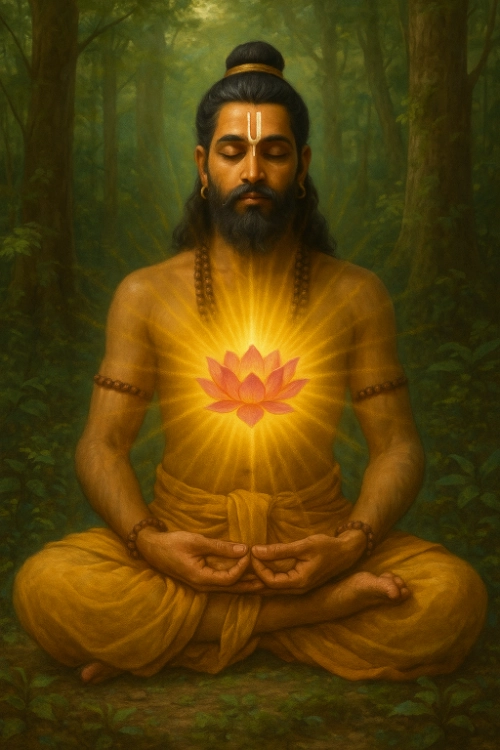
Chapter 23 reveals the whole process of transforming the worshipper into a purified vessel fit for divine presence. It begins with ritual and mental purification—outer cleansing, inner visualization, and the burning away of impurities through fiery meditation, followed by cooling lunar nectar that fills the body through the nāḍīs. After installing the Tattvas and placing mantras upon the hands and body through various nyāsas, the devotee arranges the sacred offerings, empowers the arghya water, establishes cosmic principles around the Yogapīṭha, and prepares the lotus-maṇḍala for the descent of the Lord.

The worship then moves outward and upward into full ritual expression: offering Arghya, Pādya, Madhuparka, garments, ornaments, incense, lamps, and food while placing Viṣṇu’s weapons, emblems, Śrī, Puṣṭi, and the celestial jewels in their appointed directions. After circumambulation and praise, the rite culminates in the profound realization “I am Brahman, and Hari is the Self.” The chapter ends by introducing worship of the nine Vyūhas, installed on the body, the pedestal, and the nine-petalled lotus. Its essence is the union of inner purification, outer ritual, cosmic alignment, and non-dual contemplation, forming a complete path to liberation.

Agni Purana

Chapter 23 - Description of the Method of Worship

Verse 1

नारद उवाच
चक्ष्ये पूजाविधिं विप्रा यं कृत्वा सर्वमाप्नुयात् ।
प्रक्षालिताङ्घ्रिराचम्य वाग्यतः कृतरक्षणः ॥१॥

nārada uvāca
cakṣye pūjā-vidhiṁ viprā yaṁ kṛtvā sarvam āpnuyāt |
prakṣālitāṅghrir ācāmya vāgyataḥ kṛta-rakṣaṇaḥ ||1||

Nārada said:

O Brāhmaṇas, I shall explain the method of worship, by performing which one may attain all auspicious results. Having washed the feet, performed ācamana, restrained speech, and established protection, one should begin the rite.

Commentary

The chapter opens with Nārada declaring that he will now teach a complete and fruitful method of worship, capable of granting all desired attainments—material and spiritual—when performed with sincerity. The worshipper begins by washing the feet, symbolizing humility and readiness; then performs ācamana, purifying the mouth and inner faculties. He next becomes vāgyataḥ, restraining speech so that his words are pure, disciplined, and aligned with sacred intention. Finally, he establishes mantric protection (kṛta-rakṣaṇaḥ), sealing himself against distractions and impurities. Only after these foundational acts is the devotee properly prepared to enter the divine presence and begin the worship-rite.

Verse 2

प्राङ्मुखः स्वस्तिकं बद्ध्वा पद्माद्यपरमेव च ।
यं बीजं नाभिमध्यस्थं धूम्रं चण्डानिलात्मकम् ॥२॥

prāṅmukhaḥ svastikaṁ baddhvā padmādy aparam eva ca |
yaṁ bījaṁ nābhi-madhyasthaṁ dhūmraṁ caṇḍānilātmakam ||2||

Facing the east, he should form the Svastika posture or alternatively the Padma and other seats. The bīja that is situated in the navel-center—smoky in color and embodying fierce wind—should then be invoked.

Commentary

After purifying himself in the opening verse, the worshipper now faces the east—the direction of spiritual awakening—and assumes a proper meditative posture, such as Svastika, Padmāsana, or another approved seat that steadies the body. He then turns inward to the nābhi-madhya, the navel region, the seat of the manipūra center, where the bīja associated with internal fire and wind resides. This bīja is described as dhūmra (smoky) and caṇḍānilātmaka—fierce, wind-like, dynamic—symbolizing prāṇa, inner heat, and transformative energy. By invoking this seed-syllable, the devotee awakens the inner fires that support concentration, vitality, and the unfolding of worship.

Verse 3

विशेषयेदशेषन्तु ध्यायेत्कायात्तु कल्मषम् ।
क्षौं हृत्पङ्कजमध्यस्थं बीजं तेजोनिधिं स्मरन् ॥३॥

viśeṣayed aśeṣaṁ tu dhyāyet kāyāt tu kalmaṣam |
kṣauṁ hṛt-paṅkaja-madhyasthaṁ bījaṁ tejo-nidhiṁ smaran ||3||

He should mentally separate and cast off all impurities, meditating on the faults departing from his body. Then, remembering the bīja kṣauṁ—the radiant repository of divine fire—established in the lotus of the heart, he should contemplate it.

Commentary

This verse describes the inner purification that precedes the actual worship. The devotee first “distinguishes and removes all impurities” by visualization—seeing every form of physical, mental, and karmic defilement leaving the body. He then turns his awareness to the heart-lotus (hṛt-paṅkaja), where the shining seed-syllable kṣauṁ is envisioned. This bīja is called a tejo-nidhi, a “treasure of divine fire,” symbolizing Narasiṃha’s blazing protective energy. By remembering and meditating on kṣauṁ within the heart, the practitioner awakens inner purity, courage, and spiritual luminosity, preparing the mind for deep and concentrated worship.

Verse 4

अधोर्ध्वतिर्यग्गाभिस्तु ज्वालाभिः कल्मषं दहेत् ।
शशाङ्काकृतिवद्ध्यायेदम्बरस्थं सुधाम्बुभिः ॥४॥

adhordhva-tiryaggābhis tu jvālābhiḥ kalmaṣaṁ dahēt |
śaśāṅkākṛtivad dhyāyed ambarasthaṁ sudhāmbubhiḥ ||4||

With flames rising downward, upward, and in all directions, he should burn away his impurities; then he should meditate on a moon-shaped form in the sky, showering him with streams of nectar.

Commentary

This verse describes the powerful twofold inner purification that completes the devotee’s preparatory meditation. First, he visualizes divine flames—descending, ascending, and spreading sideways—completely consuming all remaining kalmaṣa (sin, stain, heaviness, past impressions). This fire is the inner tapas, the fiery grace of Narasiṁha that annihilates all defilement. Immediately afterward, he turns his mind upward and beholds in meditation a cool, luminous, moon-form (śaśāṅka-ākṛti) suspended in the sky. From it flows a gentle nectar-stream (sudhā-ambu) that bathes and soothes him, restoring purity, clarity, and peace. Thus, fire burns the impurities; moon-nectar heals and sanctifies, leaving the worshipper inwardly spotless and ready for worship.

Verse 5

हृत्पद्यव्यापिभिर्द्देहं स्वकमाप्लावयेत्सुधीः ।
सुषुम्नायोनिमार्गेण सर्वनाडीविसर्पिभिः ॥५॥

hṛt-padya-vyāpibhir dehaṁ svakam āplāvayet sudhīḥ |
suṣumnā-yoni-mārgeṇa sarva-nāḍī-visarpibhiḥ ||5||

The wise devotee should flood his entire body with the nectar that expands from the lotus of the heart, letting it spread through the suṣumṇā-channel and flow into all the nāḍīs.

Commentary

After the cooling moon-nectar descends from above, the devotee now visualizes that this sacred nectar fills the lotus of the heart (hṛt-padma) and begins to overflow, spreading throughout the entire body. It first rises through the suṣumṇā, the central spiritual channel, and then moves outward through all the nāḍīs, the subtle pathways of prāṇa and consciousness. This inner bathing washes away subtle residue left after the fire-purification and moon-nectar shower. The entire body is thus suffused with divine coolness, clarity, and spiritual vitality, leaving the practitioner inwardly sanctified, luminous, and perfectly prepared for the sacred worship to come.

Verse 6

शोधयित्वा न्यसेत्तत्त्वं करशुद्धिरथास्त्रकम् ।
व्यापकं हस्तयोरादौ दक्षिणाङ्गुष्ठतोऽङ्गकम् ॥६॥

śodhayitvā nyaset tattvaṁ kara-śuddhir athāstrakam |
vyāpakaṁ hastayor ādau dakṣiṇāṅguṣṭhato ’ṅgakam ||6||

Having purified himself, he should install the Tattva; then, after the purification of the hands, he performs the Astra-nyāsa. First, he places the all-pervading (mantra) on both hands, beginning with the right thumb.

Commentary

This verse describes the transition from internal purification to formal nyāsa, the installation of mantras on the body. After completing the inner cleansing with fire and nectar visualizations, the devotee “purifies” himself once more and then performs Tattva-nyāsa, placing the fundamental principles of creation upon his body to align himself with cosmic order. Next comes kara-śuddhi, the ritual purification of the hands, followed by astra-nyāsa, which seals the body with protective power. The verse says explicitly to begin by placing the vyāpaka mantra—the “all-pervading” protective syllable—on both hands, starting with the right thumb. This prepares the hands to become sacred instruments fit for touching offerings, invoking deities, and performing the rest of the worship.

Verse 7

मूलं देहे द्वादशाङ्गं न्यसेन्मन्त्रैर्द्विषट्ककैः ।
हृदयं च शिरश्चैव शिखा वर्म्मास्त्रलोचने ॥७॥

mūlaṁ dehe dvādaśāṅgaṁ nyasen mantrair dviṣaṭkakaiḥ |
hṛdayaṁ ca śiraś caiva śikhā varma astra-locane ||7||

He should install the Mūla-mantra into the twelve parts of the body using the mantras of the six-fold series:

the Heart, the Head, the Crest-lock, the Armor, the Weapon, and the Eyes.

Commentary

This verse instructs the devotee to perform the full Ṣaḍaṅga-nyāsa—the “six-limbed mantra installation”—which places the protective and sanctifying mantras upon the body. The practitioner installs the Mūla-mantra (the root mantra of the deity) into twelve bodily locations, using the six classic mantra-limbs:

Hṛdaya (heart), Śiras (head), Śikhā (crown), Kavaca (armor), Astra (weapon), and Netra (eyes). By doing so, the worshipper transforms his body into a consecrated vessel, guarded on all sides and permeated with divine presence. This step completes the protective enclosure and prepares him for invoking the deity with purity, stability, and inner strength.

Kavaca literally means armor, but in ritual it refers to a spiritual shield of protection created by mantra. It is recited to surround your body—your energy field—with divine safeguarding. Astra literally means weapon, but spiritually it means a mantra that cuts, burns, or drives away obstacles. It is not a physical object — it is the sharp, fiery, protective energy of the mantra.

Verse 8

उदरं च तथा पृष्ठं बाहूरू जानुपादकम् ।
मुद्रां दत्त्वा स्मरेद्विष्णुं जप्त्वाष्टशतमर्च्चयेत् ॥८॥

udaraṁ ca tathā pṛṣṭhaṁ bāhū rū jānupādakam |
mudrāṁ dattvā smared viṣṇuṁ japtvāṣṭaśatam arcayet ||8||

He should then consecrate the abdomen, the back, the arms, the thighs, the knees, and the feet. After forming the proper mudrā and meditating on Viṣṇu, he should recite the mantra eight hundred times and offer worship.

Commentary

Having completed the nyāsa on the major centers of the body, the devotee now extends sanctification to the entire form—from the abdomen to the feet—thereby transforming the body into a temple of divine presence. With the hands, he forms sacred mudrās (symbolic gestures) that channel spiritual energy and seal the power of the mantras. Then he meditates upon Viṣṇu, the supreme consciousness pervading all creation, and recites the mūla-mantra eight hundred times. This repetition (japa) deepens concentration and fills the body with the vibration of Viṣṇu’s presence, completing the process of physical, mental, and spiritual consecration before formal worship begins.

Verse 9

वामे तु वर्द्धनीं न्यस्य पूजाद्रव्यं तु दक्षिणे ।
प्रक्षाल्यास्त्रेण चार्घ्येऽथ गन्धपुष्पान्विते न्यसेत् ॥ ९ ॥

vāme tu varddhanīṁ nyasya pūjā-dravyaṁ tu dakṣiṇe |
prakṣālyāstreṇa cārghye’tha gandha-puṣpānvite nyaset ||9||

On the left side, one should place Varddhanī (the vessel of increase), and on the right side, the materials for worship. After purifying the Arghya water with the Astra-mantra, he should place it there, endowed with fragrance and flowers.

Commentary

This verse describes the proper arrangement of ritual items before beginning a sacred worship. The Varddhanī—a small vessel symbolizing growth, prosperity, and increase—is placed to the left, the auspicious side for receptivity. All pūjā-dravyas (offerings such as incense, lamps, flowers, and food) are placed on the right side, symbolizing activity and offering. The Arghya, a sacred water offered to the deity for honor and welcome, is then purified with the Astra-mantra, removing all subtle impurities. After chanting the mantra, the devotee places the Arghya vessel, filling it with fragrant water and flowers, transforming it into a worthy offering for the Lord. This careful arrangement expresses order, reverence, and purity—qualities essential to Vedic worship.

Verse 10

चैतन्यं सर्व्वगं ज्योतिरस्त्रजप्तेन वारिणा ।
फडन्तेन त संसिच्य हस्ते ध्यात्वा हरिं परे ॥१०॥

caitanyaṁ sarvagaṁ jyotir astra-japtena vāriṇā |
phaḍ-antena ta saṁsicya haste dhyātvā hariṁ pare ||10||

He should sprinkle himself with water empowered by the Astra-mantra, visualizing it as the all-pervading light of consciousness. With the mantra ending in phaṭ, he sanctifies his hands and then meditates upon the Supreme Hari.

Commentary

This verse describes the moment where ritual purity becomes inward and spiritual. The devotee first consecrates water by chanting the Astra-mantra ending with the syllable phaṭ—a sound traditionally used to cut through impurities and establish divine protection. He then sprinkles this water over himself, not merely as a physical cleansing, but while contemplating it as caitanya, the very light of universal consciousness, the divine radiance permeating all worlds.

After sanctifying the hands—the instruments of worship—he turns his mind inward and meditates upon Hari, the Supreme Being, dwelling beyond and within all things. Thus the outer act of sprinkling becomes an inner act of awakening divine presence.

Verse 11

तु धर्मं ज्ञानं च वैराग्यमैश्वर्य्यं वह्निदिङ्मुखान् ।
अधर्मादीनि गात्राणि पूर्वादौ योगपीठके ॥११॥

tu dharmaṁ jñānaṁ ca vairāgyam aiśvaryyaṁ vahni-diṅmukhān |
adharmādīni gātrāṇi pūrvādau yoga-pīṭhake ||11||

He should establish Dharma, Knowledge, Detachment, and Sovereignty in the fire-facing directions, and assign Adharma and the other negative qualities to the limbs located in the eastern quarter of the Yogapīṭha.

Commentary

The sense is:

the virtues are placed in the auspicious fiery directions, while the vices are pushed out to the outer limbs/edges, beginning with the east.

This verse describes the inner construction of the yogapīṭha, the sacred “inner altar” created within one’s subtle body before worship. The devotee first establishes the four supreme virtues:

Dharma — righteousness Jñāna — spiritual knowledge Vairāgya — detachment from worldly bondage Aiśvarya — divine sovereignty and mastery

These are placed in the vahni-diṅ-mukhāḥ, the “fire-facing directions,” meaning the powerful, transformative quadrants associated with Agni, where virtues naturally flourish. In contrast, all negative qualities — Adharma and its companions — are projected outward to the outer limbs (gātrāṇi) of the mandala, beginning from the eastern side, symbolically expelled from the inner sanctum.

The idea is profound:

Before worshipping the Lord, the practitioner fills the inner altar with virtue and drives out impurity, creating a pure, radiant inner space where the divine presence can dwell.

Verse 12

कूर्मं पीठे ह्यनन्तञ्च यमं सूर्य्यादिमण्डलम् ।
विमलाद्याः केशरस्थानुग्रहाः कर्णिकास्थिताः ॥१२॥

kūrmaṁ pīṭhe hy anantaṁ ca yamaṁ sūryyādi-maṇḍalam |
vimalādyāḥ keśara-sthān anugrahāḥ karṇikā-sthitāḥ ||12||

On the pedestal (pīṭha), one should establish Kūrma and Ananta, then Yama and the circle of deities beginning with the Sun. The pure Śaktis, such as Vimalā, are placed in the lotus’s petal region, while the grace-bestowing Śaktis dwell in the central pericarp.

Commentary

This verse describes the sacred lotus-maṇḍala constructed internally during worship:

Kūrma & Ananta — the foundation (pīṭha). These form the solid pedestal on which the inner altar rests. Kūrma = stability and support Ananta = infinite cosmic base

Yama & the Sūrya-circle — order and illumination. They surround and protect the foundation. Yama symbolizes discipline and moral restraint, The solar circle (sūryyādi-maṇḍala) represents divine light and cosmic harmony.

Vimalā and the Śaktis — petals and pericarp. Pure Śaktis like Vimalā occupy the keśara-sthāna, the luminous petal region. The Anugrahāḥ Śaktis (those who bestow divine grace) dwell in the karṇikā, the lotus-heart.

Thus, the practitioner forms a cosmic lotus in the heart, perfectly arranged to receive the Lord’s presence.

Verse 13

पूर्वं स्वहृदये ध्यात्वा आवाह्यार्चेच्च मण्डले ।
अर्घ्यं पाद्यं तथा चामं मधुपर्कं पुनश्च तत् ॥१३॥

pūrvaṁ sva-hṛdaye dhyātvā āvāhya arcec ca maṇḍale |
arghyaṁ pādyaṁ tathā cāmaṁ madhuparkaṁ punaś ca tat ||13||

First, having meditated upon Him in one’s own heart, one should invite and worship Him in the maṇḍala. Then one should offer Arghya, Pādya, Ācamana, and again the Madhuparka.

Commentary

The verse teaches the fundamental sequence of inner-to-outer worship:

“Meditate in the heart” (sva-hṛdaye dhyātvā) Before any external ritual, the devotee first visualizes the deity within—in the heart-lotus. This internal presence is the true foundation of worship.

“Invite Him into the maṇḍala” (āvāhya) After inward meditation, the deity is ritually invited to the altar or sacred diagram (maṇḍala). This marks the transition from inner contemplation to formal external worship.

Offerings The devotee then presents the four classical welcoming offerings:

Arghya — water for honoring the deity Pādya — water for washing His sacred feet Ācamana — water for sipping or purification Madhuparka — a sweet ceremonial mixture offered to exalted guests

The phrase punaś ca tat (“and again that”) indicates that Madhuparka is offered once more, to complete the ritual hospitality.

Verse 14

स्नानं वस्त्रोपवीतञ्च भूषणं गन्धपुष्पकम् ।
धूपदीपनैवेद्यानि पुण्डरीकाक्षविद्यया ॥१४॥

snānaṁ vastropavītaṁ ca bhūṣaṇaṁ gandha-puṣpakam |
dhūpa-dīpa-naivedyāni puṇḍarīkākṣa-vidyayā ||14||

With the sacred formula of Puṇḍarīkākṣa, one should offer the ritual bath, garments, sacred thread, ornaments, fragrances, and flowers, along with incense, lamp, and food offerings.

Commentary

This verse lists the core items of upacāra-pūjā, the classical sequence of personal services offered to the deity. Each act expresses reverence and intimate care.

Using the Puṇḍarīkākṣa-vidyā—a mantra invoking Viṣṇu as “the Lotus-Eyed One”—the devotee performs:

Snāna — the ceremonial bath of the deity Vastra & Upavīta — fresh garments and sacred thread Bhūṣaṇa — ornaments, symbolizing divine majesty Gandha & Puṣpa — sandal paste and flowers Dhūpa — incense, sanctifying and elevating the atmosphere Dīpa — the sacred lamp, representing divine light Naivedya — food offerings prepared with devotion

These offerings are not merely external acts—they express the devotee’s longing to serve the Lord as a beloved guest, parent, child, or master. By invoking Puṇḍarīkākṣa, the worshipper fills each action with purity, beauty, and the vision of the Lord’s radiant lotus-eyes.

Verse 15

यजेदङ्गानि पूर्वादौ द्वारि पूर्वे परेऽण्डजम् ।
दक्षे चक्रं गदां सौम्ये कोणे शङ्खं धनुर्न्यसेत् ॥१५॥

yajed aṅgāni pūrvādau dvāri pūrve pare ’ṇḍajam |
dakṣe cakraṁ gadāṁ saumye koṇe śaṅkhaṁ dhanur nyaset ||15||

He should first worship the limbs (of the deity). At the eastern doorway, he should place the ‘Egg-born One.’ In the southern direction, he should establish the Discus and the Mace; in the northern quarter, he should place the Conch and the Bow.

Commentary

This verse describes how the aṣṭa-āyudhas—the divine weapons and emblems of Viṣṇu—are to be arranged within the ritual maṇḍala.

1. “Worship the limbs first” Before placing the divine weapons, the devotee honors the aṅgas, the sacred “limbs” of the deity—his heart, head, eyes, and protective aspects. This establishes the presence of the Lord.

2. “At the eastern door place the Aṇḍaja” Aṇḍaja = “the Egg-born One.” This refers to Garuḍa, Viṣṇu’s eagle-vehicle, born from an egg. Garuḍa is placed at the eastern entrance, the gateway of rising light, protection, and ascension.

3. Southern quadrant — the Discus & the Mace Dakṣiṇa (south) is traditionally a direction needing protection. Thus the devotee places:

Cakra — the Sudarśana discus, destroyer of ignorance Gadā — the Kaumodakī mace, symbol of divine strength These guard the ritual space with righteousness and power.

4. Northern quadrant — the Conch & the Bow In the Saumya (north), the gentle and auspicious direction, he places:

Śaṅkha — the conch, embodying purity and the sound Om Dhanus (Śārṅga) — Viṣṇu’s bow, representing divine energy and protection These bring harmony, auspiciousness, and spiritual upliftment.

The maṇḍala becomes a protected sacred universe:

East — Garuḍa, the guardian and carrier South — Cakra & Gadā, protective power North — Conch & Bow, auspicious purity and divine energy By placing these emblems with devotion, the worshipper surrounds the altar with Viṣṇu’s living presence.

Verse 16

देवस्य वामतो दक्षे चेषुधी खड्गमेव च ।
वामे चर्म्म श्रियं दते पुष्टिं वामेऽग्रतो न्यसेत् ॥१६॥

devasya vāmato dakṣe ceṣudhī khaḍgam eva ca |
vāme carmma śriyaṁ dattvā puṣṭiṁ vāme ’grato nyaset ||16||

To the right side of the deity he should place the Arrow and the Sword; on the left he should place the Shield and Śrī; and in front on the left side he should place Puṣṭi.

Commentary

This verse completes the placement of Viṣṇu’s sacred emblems around the deity. On the right side, the devotee sets the Arrow and Sword, symbols of focused action and the cutting of ignorance. On the left, he places the Shield, representing divine protection, along with Śrī, the goddess of auspiciousness and prosperity. In the front-left quadrant, he establishes Puṣṭi, the power of nourishment and vitality. Together, these placements harmonize power and protection, grace and strength, forming a balanced and auspicious ritual maṇḍala for the presence of the Lord.

Verse 17

वनमालाञ्च श्रीवत्सकौस्तुभौ दिक्पतीन्बहिः ।
स्वमन्त्रैः पूजयेत्सर्वान् विष्णुरर्चावसानतः ॥१७॥

vanamālāñ ca śrīvatsa–kaustubhau dikpatīn bahiḥ |
sva-mantraiḥ pūjayet sarvān viṣṇur arcāvasānataḥ ||17||

Next, he should place the Vanamālā, the Śrīvatsa mark, and the Kaustubha gem, and worship the Guardians of the Directions outside the maṇḍala. Using their respective mantras, he should honor all of them, completing the worship of Viṣṇu.

Commentary

This verse concludes the arrangement of Viṣṇu’s sacred emblems.

The devotee places Vanamālā (the forest garland), Śrīvatsa (the auspicious chest-mark), and Kaustubha (the divine jewel), which signify Viṣṇu’s beauty, purity, and supreme radiance.

Around the outer circle he honors the Dikpālas—the eight guardians of the directions—ensuring full protection of the maṇḍala.

Offering each deity their own mantra completes the formal arcana of Viṣṇu, sealing the ritual with cosmic harmony and divine presence.

Verse 18

व्यस्तेन च समस्तेन श्रृङ्गैर्बीजेन वै यजेत् ।
जप्त्वा प्रदक्षिणीकृत्य स्तुत्वार्घ्यञ्च समर्प्य च ॥१८॥

vyastena ca samastena śṛṅgair bījena vai yajet |
japtvā pradakṣiṇī-kṛtya stutvā’rghyañ ca samarpya ca ||18||

He should worship using both the separate and the combined forms of the mantra, with the bīja and with the horn-mantras. After reciting these, he should circumambulate the deity, offer praises, and present the Arghya.

Commentary

This verse describes the final devotional acts of the pūjā. The worshipper uses both vyasta (individual) and samasta (combined) mantra forms, including the bīja (seed-syllable) and the śṛṅga mantras (peak or concluding formulas). After chanting them, he performs pradakṣiṇā—circumambulating the deity with reverence—then offers stuti, heartfelt praise. Finally, he presents the Arghya, the ritual water of honor, completing this phase of Viṣṇu’s worship.

Verse 19

हृदये विन्यसेद्ध्यात्वा अहं ब्रह्म हरिस्त्विति ।
आगच्छावाहने योज्यं क्षमस्वेति विसर्जने ॥१९॥

hṛdaye vinyased dhyātvā ahaṁ brahma haris tv iti |
āgacchā’vāhane yojyaṁ kṣamasvety api visarjane ||19||

Having meditated, he should install in his heart the thought:

‘I am Brahman, and Hari is that very Self.’ For invocation, he should use the mantra ‘Come,’ and for the dismissal, he should say, ‘Forgive me.’

Commentary

This verse teaches the inner attitude that completes the worship.

The devotee first places in his heart the realization that the Supreme Brahman and Hari are one, and that this divine presence is not separate from the innermost Self. For invocation (āvāhana), he calls the Lord with the mantra “āgaccha”—“Come, O Lord.” When the ritual concludes, he releases the deity with humility, saying “kṣamasva”—“Forgive me (for any defects in the worship).”

Thus, the pūjā begins with loving invitation, ends with humble dismissal, and is held together by the understanding that the Lord ultimately resides within the heart.

Verse 20

एवमष्टाक्षराद्यैश्च पूजां कृत्वा विमुक्तिभाक् ।
एकमूर्त्त्यर्च्चनं प्रोक्तं नवव्यूहार्च्चनं शृणु ॥२०॥

evam aṣṭākṣarādyaiś ca pūjāṁ kṛtvā vimukti-bhāk |
eka-mūrty-arcanaṁ proktaṁ nava-vyūhārcanaṁ śṛṇu ||20||

Thus, having performed the worship with the eight-syllable mantra (aṣṭākṣarī) and other sacred mantras, one becomes worthy of liberation. The worship of the single form of the Lord has now been taught—listen now to the worship of the ninefold Vyūhas.

Commentary

This concluding verse transitions from one section of the worship to the next. After describing the general and single-form worship of Viṣṇu, the text affirms that performing pūjā with the Aṣṭākṣarī mantra (“oṁ namo nārāyaṇāya”) grants liberation to the devotee.

Having completed the teaching of eka-mūrti-arcana, the worship of the Lord in a single iconic form, the sage now invites the listener to learn the more esoteric ritual:

the worship of the nava-vyūhas, the nine emanational forms of Viṣṇu.

Verse 21

अङ्गुष्ठकद्वये न्यस्य वासुदेवं बलादिकान् ।
तर्जन्यादौ शरीरेऽथ शिरोललाटवक्त्रके ॥२१॥

aṅguṣṭha-ka-dvaye nyasya vāsudevaṁ balādikān |
tarjanī-ādau śarīre ’tha śiro-lalāṭa-vaktrake ||21||

Placing Vāsudeva on the two thumbs and the other Vyūhas beginning with Bala (Saṅkarṣaṇa), then placing them on the fingers and upon the body—on the head, forehead, and face—(the worship should proceed).

Commentary

The verse describes the nyāsa (ritual placement of divine forms on the body) used in the worship of the nava-vyūhas of Viṣṇu.

The worshipper installs:

Vāsudeva on both thumbs, Saṅkarṣaṇa (Bala) and the remaining Vyūhas on the other fingers, then places them across key centers of the body—the head, forehead, and face.

This creates a sanctified divine body-map, preparing the practitioner for deeper meditation on Viṣṇu’s emanational forms.

Verse 22

हृन्नाभिगुह्यजान्वङ्घ्रौ मध्ये पूर्वादिकं यजेत् ।
एकपीठं नवव्यूहं नवपीठञ्च पूर्ववत् ॥२२॥

hṛn-nābhi-guhya-jānvaṅghrau madhye pūrvādikaṁ yajet |
eka-pīṭhaṁ nava-vyūhaṁ nava-pīṭhaṁ ca pūrvavat ||22||

He should worship according to the cardinal directions along the central axis of the body—at the heart, navel, secret region, knees, and feet. The nine Vyūhas should be installed on the single pedestal and also upon the nine individual pedestals, just as described earlier.

Commentary

This verse continues the nyāsa and maṇḍala-installation for the nava-vyūha worship. The practitioner installs the divine presence along the central vertical axis of the body—heart, navel, guhyasthāna, knees, and feet—moving in the traditional directional order (east → south → west → north).

He then establishes the nine Vyūhas of Viṣṇu in two ways:

1. eka-pīṭha — all nine united on a single cosmic seat (symbolizing Viṣṇu’s indivisible nature) 2. nava-pīṭha — each Vyūha placed on its own separate seat (symbolizing their distinct emanational functions)

Both arrangements follow the earlier pattern of ritual placement. This completes the internal and external sanctification for Vyūha-pūjā.

Verse 23

नवाब्जे नवमूर्त्या च नवव्यूहञ्च पूर्ववत् ।
इष्टं मध्ये ततः स्थाने वासुदेवञ्च पूजयेत् ॥२३॥

navābje nava-mūrtyā ca nava-vyūhaṁ ca pūrvavat |
iṣṭaṁ madhye tataḥ sthāne vāsudevaṁ ca pūjayet ||23||

In the nine-petalled lotus, he should place the nine forms and the nine Vyūhas, just as described before. Then, placing the chosen deity in the center, he should worship Vāsudeva in His proper seat.

Commentary

This verse describes the full lotus-maṇḍala of the Vyūha worship.

The nine petals of the inner lotus receive:

the nine mūrtis (forms of the Lord), and the nine Vyūhas (emanational powers), arranged exactly as previously prescribed.

After establishing these around the periphery, the devotee places his iṣṭa-deva—the main form he adores—at the central lotus pericarp.

There, in the heart of the maṇḍala, he worships Vāsudeva, the supreme and original manifestation from whom all the Vyūhas emanate.

Thus the cosmic lotus is completed:

eight surrounding, one central, with Vāsudeva shining at the core.

इत्यादिमहापुराणे आग्नेये
आदिमूर्त्यादिपूजाविधिर्नाम त्रयोविंशोऽध्यायः

ityādi–mahāpurāṇe āgneyeye ādi–mūrty–ādi–pūjā–vidhir nāma trayoviṁśo ’dhyāyaḥ

Thus ends the twenty-third chapter, entitled ‘The Procedure for the Worship of the Primeval Forms,’ in the Āgneya section of the Great Purāṇa.

Synopsis of Chapter 23 — Pūjā-vidhi (The Procedure of Worship)

Chapter 23 opens with Nārada explaining the foundational method of worship that yields all auspicious results. The devotee begins by purifying himself outwardly and inwardly—washing, performing ācamana, restraining speech, and establishing mantric protection. Seated facing east, he invokes the bīja at the navel, meditates on removing impurities, and visualizes the fiery heart-lotus bīja kṣauṁ. Flames in all directions burn away faults, after which a cooling lunar nectar descends, filling the body through the suṣumṇā and nāḍīs, completing the inner purification.

Once purified, the practitioner installs the Tattvas, performs hand-purification and Astra-nyāsa, and places the mantras upon the hands and the twelve bodily centers. With mudrā and meditation on Viṣṇu, he recites the mantra and arranges the ritual implements: Varddhanī to the left, offerings to the right, and arghya-water sanctified by the Astra-mantra. He assigns Dharma, Knowledge, Detachment, and Sovereignty to the proper directions of the Yogapīṭha, and places Kūrma, Ananta, Yama, the Sūrya-maṇḍala, and the Śaktis upon the lotus-mandala, its petals filled with pure powers and its center with grace-bestowing energies.

After meditating on the Lord in the heart, he invites Him into the maṇḍala and offers Arghya, Pādya, Ācamana, Madhuparka, garments, the sacred thread, ornaments, incense, lamps, and food. He worships the limbs of the deity and then arranges the emblems: Egg-born One to the east, Discus and Mace in the south, Conch and Bow in the north, Arrow and Sword to the right, and Shield, Śrī, and Puṣṭi to the left. The Vanamālā, Śrīvatsa, Kaustubha, and the Guardians of the Directions are honored with their respective mantras. He completes the rite with circumambulation, praises, and final arghya.

The worship concludes with the contemplative realization “I am Brahman, and Hari is that very Self.” Invocation is done with “Come,” and dismissal with “Forgive me.” Worship with the Aṣṭākṣarī and related mantras leads to liberation. The chapter then introduces the worship of the nine Vyūhas: Vāsudeva placed on the thumbs, the remaining forms on the fingers and various body-points, proceeding along the central axis from heart to feet. The nine forms are placed upon a single pedestal, nine individual pedestals, and the nine-petalled lotus, with the chosen deity in the center. Thus ends the chapter on the worship of the Primeval Forms in the Agni Purāṇa.

Bookmark Dharmavidya by pressing Ctrl+D or Cmd+D. 
Visit our YouTube channel.