Agni Purana
Chapter 24 - Constructing the Sacred Fire-Pit
Verse 1
नारद उवाच
अग्निकार्य्यं प्रवक्ष्यामि येन स्यात्सर्वकामभाक्
चतुरभ्यधिकं विंशमङ्गुलं चतुरस्रकम् ॥१॥
Nārada uvāca
agnikāryaṁ pravakṣyāmi yena syāt sarvakāma-bhāk
caturabhy adhikaṁ viṁśam aṅgulaṁ caturasrakām ॥ 1॥
Nārada said:
I shall now explain the rites of Agni, by which a man becomes the enjoyer of all desired objects. The fire-pit should be square in shape and measure twenty-four aṅgulas.
Verse 2
सूत्रेण सूत्रयित्वा तु क्षेत्रं तावत्खनेत्समम्
खातस्य मेखला कार्य्यास्त्यक्त्वा चैवाङ्गुलद्वयम् ॥२॥
sūtreṇa sūtrayitvā tu kṣetraṁ tāvat khanet samam
khātasya mekhalā kāryās tyaktvā caivāṅgula-dvayam ॥ 2॥
Having marked out the ground with a cord, he should then dig the area evenly. A boundary (mekhalā) should be made around the pit, leaving a margin of two aṅgulas.
Verse 3
सत्त्वादि-सञ्ज्ञाः पूर्वास्या द्वादशाङ्गुलम् उच्छ्रिताः
अष्टाङ्गुलाद् व्यङ्गुलाथ चतुरङ्गुल-विस्तृताः ॥ ३॥
sattvādi-saṃjñāḥ pūrvāsyā dvādaśāṅgulam ucchritāḥ
aṣṭāṅgulād vyaṅgulāt catur-aṅgula-vistṛtāḥ ॥ 3॥
These sections, called ‘Sattva’ and so forth, placed on the eastern side, should rise twelve aṅgulas in height, be eight aṅgulas long plus one additional aṅgula, and have a width of four aṅgulas.
Verse 4
योनिर्दशाङ्गुला रम्या षट्चतुर्यलाग्रगा
क्रमान्निम्ना तु कर्तव्या पश्चिमाशाव्यवस्थिता ॥ ४॥
yonir daśāṅgulā ramyā ṣaṭ–catur–aṅgula-āgragā
kramān nimnā tu kartavyā paścimāśā-vyavasthitā ॥ 4॥
The yoni should be ten aṅgulas in size and well-formed, its front measuring six or four aṅgulas. It must be made gradually sloping and placed toward the western side.
Verse 5
अश्वत्थ-पत्र-सदृशी किञ्चित् कुण्डे निवेशिता
तुर्याङ्गुलायतं नालं पञ्चदशाङ्गुलायतम् ॥ ५॥
aśvattha-patra-sadṛśī kiñcit kuṇḍe niveśitā
turyāṅgulāyataṁ nālaṁ pañcadaśāṅgulāyatam ॥ 5॥
Somewhat resembling a peepal leaf, it (the yoni or channel) is to be placed within the fire-pit. The conduit (nāla) should be four aṅgulas long, and its full length fifteen aṅgulas.
Verse 6
मूलं तु त्र्यङ्गुलं योन्याः अग्रं तस्याः षडङ्गुलम्
लक्षणं चैकहस्तस्य द्विगुणं द्विकरादिषु ॥ ६॥
mūlaṁ tu try-aṅgulaṁ yonyāḥ agraṁ tasyāḥ ṣaḍ-aṅgulam
lakṣaṇaṁ caika-hastasya dviguṇaṁ dvi-karādiṣu ॥ 6॥
The base of the yoni should be three aṅgulas, and its front portion six aṅgulas. For each measure of one hasta, its characteristic proportions are doubled when applied to the two hands and so on.
Verse 7
एकत्रि–मेखलं कुण्डं वर्तुलादि वदाम्यहम्
कुण्डार्द्धे तु स्थितं सूत्रं कोणे यदतिरिच्यते ॥ ७॥
ekatri-mekhalaṁ kuṇḍaṁ vartulādi vadāmy aham
kuṇḍārdhe tu sthitaṁ sūtraṁ koṇe yad atiricyate ॥ 7॥
I shall now describe the fire-pit with a single embankment, whether circular or of other shapes. When a measuring cord is placed across half of the pit, the excess appearing at the corner indicates its specific form.
Verse 8
तद् अर्धं दिशि संस्थाप्य भ्रामितं वर्तुलं भवेत्
कुण्डार्द्ध–कोण–भाग–अर्धं दिशश् चोत्तरतो बहिः ॥ ८॥
tad ardhaṁ diśi saṁsthāpya bhrāmitaṁ vartulaṁ bhavet
kuṇḍārdha-koṇa-bhāgārdhaṁ diśaś cottarato bahiḥ ॥ 8॥
When that half-measure is set in the proper direction and rotated, the form becomes circular. Half the corner-measure of the kuṇḍa lies outward toward the northern direction.
Verse 9
पूर्वपश्चिमतो यत्नाल्लाञ्छयित्वा तु मध्यतः
संस्थाप्य भ्रामितं कुण्डमर्द्धचन्द्रं भवेत् शुभम् ॥९॥
pūrva-paścimato yatnāl lāñchayitvā tu madhyataḥ
saṁsthāpya bhrāmitaṁ kuṇḍam ardha-candraṁ bhavet śubham ॥ 9॥
Marking the pit carefully along the east–west line and placing the measure at the center, when it is rotated, the fire pit becomes a propitious half-moon shape.
Verse 10
पद्माकारे दलानि स्युर् मेखलानां तु वर्तुले
बाहु–दण्ड–प्रमाणं तु होमार्थं कारयेत् स्रुचम् ॥ १०॥
padmākāre dalāni syur mekhalānāṁ tu vartule
bāhu-daṇḍa-pramāṇaṁ tu homārthaṁ kārayet srucam ॥ 10॥
In a lotus-shaped pit, the ridges form the petals; in a circular one, they follow the round. For the purpose of offering, the ladle (sruc) should be made the length of the forearm.
Verse 11
सप्त–पञ्चाङ्गुलं वापि चतुरस्रं तु कारयेत्
त्रिभागेन भवेद् गर्त्तं मध्ये वृत्तं सुशोभनम् ॥ ११॥
sapta-pañcāṅgulaṁ vāpi caturasraṁ tu kārayet
tribhāgena bhaved gartaṁ madhye vṛttaṁ suśobhanam ॥ 11॥
Let the square (sruc or pit-base) be made seven or five aṅgulas in measure. Dividing it into three parts, the central hollow should form a beautiful circle.
Verse 12
तिर्यग् ऊर्ध्वं समं खात्वा बहिर् अर्धं तु शोधयेत्
अङ्गुलस्य चतुर्थांशं शेष–अर्धार्धं तथान्ततः ॥ १२॥
tiryag ūrdhvaṁ samaṁ khātvā bahir ardhaṁ tu śodhayet
aṅgulasya caturthāṁśaṁ śeṣa-ardhārdhaṁ tathāntataḥ ॥ 12॥
Dig the pit evenly, both across and deep, and smooth out the outer half. Of one aṅgula, take a quarter, and then again halve whatever remains.
Verse 13
खातस्य मेखलां रम्यां शेषार्धेन तु कारयेत्
कण्ठं त्रिभाग-विस्तारम् अङ्गुष्ठक-समायतम् ॥ १३॥
khātasya mekhalāṁ ramyāṁ śeṣārdhena tu kārayet
kaṇṭhaṁ tribhāga-vistāram aṅguṣṭhaka-samāyatam ॥ 13॥
The remaining half of the measure should be used to form the beautiful embankment (mekhalā) of the pit. The neck (kaṇṭha) should have one-third breadth and be of the length of a thumb.
Verse 14
सार्धम् अङ्गुष्ठकं वा स्यात् तद् अग्रे तु मुखं भवेत्
चतुरङ्गुल-विस्तारं पञ्चाङ्गुलम् अथापि वा ॥ १४॥
sārdham aṅguṣṭhakaṁ vā syāt tad agre tu mukhaṁ bhavet
catur-aṅgula-vistāraṁ pañcāṅgulam athāpi vā ॥ 14॥
It may also measure one and a half thumb-lengths; in front of it is the mouth (opening), which should be four aṅgulas wide, or even five.
Verse 15
त्रिकं द्व्यङ्गुलकं तत् स्याल् मध्यान्तस्य सुशोभनम्
आयामस् तत् समस् तस्य मध्यनिम्नः सुशोभनः ॥ १५॥
trikaṁ dvyaṅgulakaṁ tat syāl madhyāntasya suśobhanam
āyāmas tat samas tasya madhya-nimnaḥ suśobhanaḥ ॥ 15॥
The middle portion should be three units in measure and two aṅgulas wide, well-shaped. Its length must equal that measure, and the central depression should likewise be properly formed.
Verse 16
सूषिरं कण्ठदेशे स्याद् विशेद् यावत् कनीयसी
शेष-कुण्डं तु कर्तव्यं यथारुचि विचित्रितम् ॥ १६॥
sūṣiraṁ kaṇṭha-deśe syād viśed yāvat kanīyasī
śeṣa-kuṇḍaṁ tu kartavyaṁ yathā-ruci vicitritam ॥ 16॥
There should be a small opening in the neck region, extending only as far as the smaller measure permits. The remaining structure of the fire pit should then be fashioned to preference, adorned with various designs.
Verse 17
स्रुवन्तु हस्तमात्रं स्याद् दण्डकेन समन्वितम्
वटुकं द्व्यङ्गुलं वृत्तं कर्त्तव्यं तु सुशोभनम् ॥ १७॥
sruvaṁ tu hasta-mātraṁ syād daṇḍakena samanvitam
vaṭukaṁ dvyaṅgulaṁ vṛttaṁ karttavyaṁ tu suśobhanam ॥ 17॥
The sruva should be forearm-length and fitted with a handle. The small cup (vaṭuka) must be two aṅgulas wide, circular, and well-formed.
Verse 18
गोपदं तु यथा मग्नम् अल्प–पङ्के तथा भवेत्
उपलिप्य लिखेद् रेखाम् अङ्गुलां वज्र–नासिकाम् ॥ १८॥
gopadaṁ tu yathā magnam alpa-paṅke tathā bhavet
upalipya likhed rekhām aṅgulāṁ vajra-nāsikām ॥ 18॥
It should resemble a cow’s hoof sunk lightly in soft mud. After plastering it smooth, one should draw a line of one aṅgula, sharp like the nose of a vajra.
Verse 19
सौम्याग्रां प्रथमां तस्यां रेखे पूर्वमुखे तयोः
मध्ये तिस्रस् तथा कुर्याद् दक्षिणादि–क्रमेण ॥१९॥
saumyāgrāṁ prathamāṁ tasyāṁ rekhe pūrvamukhe tayoḥ
madhye tisras tathā kuryād dakṣiṇādi-krameṇa ॥19॥
The first mark should have a gentle, auspicious point, placed on the line facing east. Between the two (lines) one should draw three more, proceeding in order toward the south.
Verse 20
एवम् उल्लिख्य चाभ्युदय-प्रणवेन तु मन्त्रवित्
विष्टरं कल्पयेत् तेन तस्मिन् शक्तिं तु वैष्णवीम् ॥ २०॥
evam ullikhya cābhyudaya-praṇavena tu mantravit
viṣṭaraṁ kalpayet tena tasmin śaktiṁ tu vaiṣṇavīm ॥ 20॥
Having drawn the marks in this manner, the knower of mantras should recite the auspicious praṇava. By that, he should prepare the sacred base, and upon it establish the Vaishnava power (śakti).
Verse 21
अलंकृत्वा मूर्तिमतीं क्षिपेद् अग्निं हरिं स्मरन्
प्रादेशमात्राः समिधो दत्त्वा परिसमुह्य तम् ॥ २१॥
alaṅkṛtvā mūrtimatīṁ kṣiped agniṁ hariṁ smaran
prādeśa-mātrāḥ samidho dattvā parisamuhya tam ॥ 21॥
After adorning that embodied power, he should place the fire while remembering Hari. Then, offering fuel sticks of one pradeśa in length, he should carefully tend and encircle the fire.
Verse 22
दर्भैस् त्रिधा परिस्तीर्य पूर्वादौ तत्र पात्रकम्
आसादयेद् इध्म-वह्नी भूमौ च स्रुक्–स्रुव-वद् द्वयम् ॥ २२॥
darbhais tridha paristīrya pūrvādau tatra pātrakam
āsādayed idhma-vahnī bhūmau ca sruk-sruva-vad dvayam ॥ 22॥
Spreading darbha grass there in three layers, beginning from the east, he should set down the offering vessel, place the fuel and fire, and on the ground arrange the ladle and the sruva as a pair.
Verse 23
आज्य–स्थालीं चरु–स्थालीं कुश–आज्यं च प्रणीतया
प्रोक्षयित्वा प्रोक्षणीं च गृहीत्वा पूर्य वारिणा ॥ २३॥
ājya-sthālīṁ caru-sthālīṁ kuśa-ājyaṁ ca praṇītayā
prokṣayitvā prokṣaṇīṁ ca gṛhītvā pūrya vāriṇā ॥ 23॥
After sprinkling the ghee vessel, the charu vessel, and the kuśa-ghee with consecrated water, he should take the sprinkling ladle and fill it with water.
Verse 24
पवित्रान्तर्–हिते हस्ते परिश्राव्य च तज्जलम्
प्राङ् नीत्वा प्रोक्षणी–पात्रं ज्योतिर् अग्रे निधाय च ॥ २४॥
pavitrāntar-hite haste pariśrāvya ca taj jalam
prāṅ nītvā prokṣaṇī-pātraṁ jyotir-agre nidhāya ca ॥ 24॥
Placing the pavitra in his hand and filtering the water, he should carry the sprinkling vessel eastward and set it down before the sacred fire.
Verse 25
तद् अद्भिस् त्रिस्च सम्प्रोक्ष्य इध्मं विन्यस्य च अग्रतः
प्रणीतायां सपुष्पायां विष्णुं ध्यात्वा उत्तरॆण च ॥ २५॥
tad adbhis triś ca samprokṣya idhmaṁ vinyasya cāgrataḥ
praṇītāyāṁ sapuṣpāyāṁ viṣṇuṁ dhyātvā uttarena ca ॥ 25॥
Sprinkling (the fire area) three times with that water, he should place the fuel sticks in front. Then, in the consecrated water adorned with flowers, he should meditate on Viṣṇu, standing toward the north.
Verse 26
आज्य–स्थालीम् अथ आज्येन सम्पूर्य अग्रे निधाय च
सम्प्लव–उत्प्लवनाभ्यां तु कुर्याद् आज्यस्य संस्कृतिम् ॥ २६॥
ājya-sthālīm athājyena sampūrya agre nidhāya ca
samplava-utplavanābhyāṁ tu kuryād ājyasya saṁskṛtim ॥ 26॥
Then, filling the ghee vessel with ghee and placing it in front, he should purify the ghee by the rites of washing over and lifting (samplava and utplavana).
Verse 27
अखण्डिताग्रौ निर्गर्भी कुशौ प्रादेशमात्रकौ
ताभ्याम् उत्तान–पाणिभ्याम् अङ्गुष्ठ–अनामिकेन तु ॥ २७॥
akhaṇḍitāgrau nirgarbhī kuśau prādeśa-mātrakau
tābhyām uttāna-pāṇibhyām aṅguṣṭha-anāmikena tu ॥ 27॥
Take two kuśa-blades, each one pradeśa in length, with unbroken tips and their mid-rib intact. Holding them with upturned hands, grasp them using the thumb and the ring finger.
Verse 28
आज्यं तयोस् तु संगृह्य द्विर् नीत्वा त्रिर् अवाङ् क्षिपेत्
स्रुक्–स्रुवौ चापि संगृह्य ताभ्यां प्रक्षिप्य वारिणा ॥ २८॥
ājyaṁ tayos tu saṁgṛhya dvir nītvā trir avāṅ kṣipet
sruk-sruvau cāpi saṁgṛhya tābhyāṁ prakṣipya vāriṇā ॥ 28॥
Taking the ghee with those two blades, he should move it twice and cast it downward three times. Then, taking up the sruk and the sruva, he should sprinkle them with water using those (kuśa blades).
Verse 29
प्रतप्य दर्भैः संमृज्य पुनः प्रक्षाल्य चैव हि
निष्टप्य स्थापयित्वा तु प्रणवेनैव साधकः ॥२९॥
pratapya darbhais saṁmṛjya punaḥ prakṣālya caiva hi
niṣṭapya sthāpayitvā tu praṇavenaiva sādhakaḥ ॥29॥
He should gently heat the implements, wipe them with darbha grass, and then wash them again. After heating them thoroughly and setting them down, the practitioner should consecrate them with the praṇava alone.
Verse 30
प्रणवादिनमोऽन्तेन पश्चाद्धोमं समाचरेत्
गर्भाधानादिकर्म्माणि यावदंशव्यवस्थया ॥३०॥
praṇavādi namo’ntena paścād homaṁ samācaret
garbhādhanādi-karmāṇi yāvad aṁśa-vyavasthayā ॥ 30॥
Beginning with the praṇava and ending with namaḥ, he should thereafter perform the homa, carrying out the rites from garbhādhāna onward according to their prescribed portions.
Verse 31
नामान्ते व्रतबन्धान्तं समावर्त्त–अवसानकम्
अधिकार–अवसानं वा कुर्याद् अङ्ग–अनुसारतः ॥ ३१॥
nāmānte vratabandhāntaṁ samāvarttāvasānakam
adhikāra-avasānaṁ vā kuryād aṅgānusārataḥ ॥ 31॥
After the name-ending mantra, he may conclude with the rite of vow-establishment, the final samāvartaṇa ceremony, or the conclusion of the ritual authority, performing each according to its proper subsidiary rules.
Verse 32
प्रणवेनोपचारं तु कुर्यात् सर्वत्र साधकः
अङ्गैः होमस् तु कर्त्तव्यः यथावित्त–अनुसारतः ॥ ३२॥
praṇavenopacāraṁ tu kuryāt sarvatra sādhakaḥ
aṅgair homas tu karttavyo yathā-vitta-anusārataḥ ॥ 32॥
With the praṇava, he should perform all the ritual attentions; and the homa must be carried out with its proper subsidiary acts, in accordance with one’s means.
Verse 33
गर्भाधानं तु प्रथमं ततः पुंसवनं स्मृतम्
सीमन्तोन्नयनं जातकर्म नाम–अन्नप्राशनम् ॥ ३३॥
garbhādhānaṁ tu prathamaṁ tataḥ puṁsavanaṁ smṛtam
sīmantonnayanaṁ jātakarma nāma–anna-prāśanam ॥ 33॥
First is the rite of Garbhādhāna; next is the Puṁsavana. Then come the Sīmantonnayana, the Jātakarma, the Nāma-karaṇa, and the feeding of the first solid food.
Verse 34
चूडाकृतिं व्रतबन्धं वेद–व्रतान्य् अशेषतः
समावर्तनं पत्यā च योगश् चाथ अधिकारकः ॥ ३४॥
cūḍākṛtiṁ vratabandhaṁ veda-vratāny aśeṣataḥ
samāvarttanaṁ patyā ca yogaś cātha adhikārakaḥ ॥ 34॥
The tonsure ceremony, the vow-binding, the various Vedic vows in full, the completion-of-studies rite, and—together with one’s spouse—the union that grants ritual qualification.
Verse 35
हृदादि–क्रमतो ध्यात्वा एकैकं कर्म पूजा च
अष्टाव् अष्टौ तु जुहुयात् प्रतिकर्म–आहुतिः पुनः ॥ ३५॥
hṛdādi-kramato dhyātvā ekaikaṁ karma pūjya ca
aṣṭāv aṣṭau tu juhuyāt pratikarma-āhutīḥ punaḥ ॥ 35॥
Meditating in order from the heart and honoring each rite individually, he should offer eight oblations each—repeating eight offerings for every rite in turn.
Verse 36
पूर्णाहुतिं ततो दद्यात् स्रुचा मूलेन साधकः
वौषडन्तेन मन्त्रेण प्लुतं सुस्वरमुच्चरन् ॥३६॥
pūrṇāhutiṁ tato dadyāt srucā mūlena sādhakaḥ
vauṣaḍ-antena mantreṇa plutaṁ susvaram uccaran ॥ 36॥
Then the practitioner should offer the final oblation with the root of the sruc, chanting the mantra ending in vauṣaṭ in a prolonged and well-modulated tone.
Verse 37
विष्णोः वह्निं तु संस्कृत्य श्रपयेद् वैष्णवं चरुम्
आराध्य स्थण्डिले विष्णुं मन्त्रान् संस्मृत्य संश्रयेत् ॥ ३७॥
viṣṇoḥ vahniṁ tu saṁskṛtya śrapayed vaiṣṇavaṁ carum
ārādhya sthaṇḍile viṣṇuṁ mantrān saṁsmṛtya saṁśrayet ॥ 37॥
Having consecrated the fire of Viṣṇu, he should cook the Vaiṣṇava caru. Then, worshipping Viṣṇu upon the sacred altar, he should recite and recall the mantras and seek refuge in Him.
Verse 38
आसनादि–क्रमेणैव साङ्ग–आवरणम् उत्तमम्
गन्ध–पुष्पैः समभ्यर्च्य ध्यात्वा देवं सुरोत्तमम् ॥ ३८॥
āsanādi-krameṇaiva sāṅga-āvaraṇam uttamam
gandha-puṣpaiḥ samabhyarcya dhyātvā devaṁ surottamam ॥ 38॥
Following the proper sequence beginning with offering a seat, he should perform the full worship with all its limbs and coverings. Honoring the supreme deity with fragrance and flowers, he should then meditate upon Him, the best of gods.”
Verse 39
आधाय इध्मम् अथ आघाराव् आज्याव् अग्नि–ईश–संस्थितौ
वायव्य–नैरृत–आश–आदि–प्रवृत्तौ तु यथाक्रमम् ॥ ३९॥
ādhāya idhmam athāghārāv ājyāv agnīśa-saṁsthitau
vāyavya-nairṛtāśādi-pravṛttau tu yathākramam ॥ 39॥
After placing the fuel-sticks, he should perform the two ghee libations—one to Agni and one to Īśa—when turning toward the quarters, beginning with the northwest and southwest, in their proper order.
Verse 40
आज्यभागौ ततो हुत्वा चक्षुषी दक्षिणोत्तरे
मध्येऽथ जुहुयात्सर्वमन्त्रैरर्च्चाक्रमेण तु ॥४०॥
ājya-bhāgau tato hutvā cakṣuṣī dakṣiṇottare
madhye’tha juhuyāt sarva-mantrair arcā-krameṇa tu ॥ 40॥
Having offered the two portions of ghee into the southern and northern eyes (of the fire), he should then pour the remaining oblations in the center, reciting all the mantras in proper order of worship.
Verse 41
आज्येन तर्पयेत् मूर्तेः दशांशेन अङ्ग–होमकम्
शतं सहस्रं वाज्याद्यैः समिद्भिर् वा तिलैः सह ॥ ४१॥
ājyena tarpayed mūrter daśāṁśena aṅga-homakam
śataṁ sahasraṁ vājyādyaiḥ samidbhir vā tilaiḥ saha ॥ 41॥
With ghee, he should make the limb-offerings to the deity’s form, using one-tenth of the main portion. These may number a hundred or a thousand, employing offerings of ghee and other substances, or fuel sticks mixed with sesame seeds.
Verse 42
समाप्य आचं तु होम–अन्तां शुचीन् शिष्यान् उपोषितान्
आहूय अग्रे निवेश्याथ ह्यस्त्रेण प्रोक्षयेत् पशून् ॥ ४२॥
samāpya ācaṁ tu homāntāṁ śucīn śiṣyān upoṣitān
āhūya agre niveśyātha hy astreṇa prokṣayet paśūn ॥ 42॥
Having completed the homa and performed purification by sipping water, he should summon the pure disciples who have fasted, seat them in front, and then sprinkle the sacrificial animals with water using the astra-mantra.
Verse 43
शिष्यानात्मनि संयोज्य विद्याकर्म्मबन्धनैः
लिङ्गानुवृत्तञ्चैतन्यं सह लिङ्गेन पाशितम् ॥४३॥
śiṣyān ātmany saṁyojya vidyā-karma-bandhanaiḥ
liṅgānuvṛttaṁ caitanyaṁ saha liṅgena pāśitam ॥ 43॥
Uniting the disciples with himself through the sacred bonds of knowledge and ritual, he should bind the consciousness—linked with the subtle body—together with that very body (liṅga).
Verse 44
ध्यानमार्गेण सम्प्रोक्ष्य वायुबीजेन शोधयेत्
ततो दहनबीजेन सृष्टिं ब्रह्माण्डसञ्ज्ञिकाम् ॥४४॥
dhyāna-mārgeṇa samprokṣya vāyu-bījena śodhayet
tato dahana-bījena sṛṣṭiṁ brahmāṇḍa-sañjñikām ॥ 44॥
By the meditative method, he should sprinkle and purify with the Air-bīja; then, using the Fire-bīja, he should bring forth the creation known as the cosmic egg.
Verse 45
निर्दग्धां सकलां ध्यायेद् भस्म–कूट–निभ–स्थिताम्
प्लावयेद् वारिणा भस्म संसारं वार्म्मयं स्मरेत् ॥ ४५॥
nirdagdhaṁ sakalaṁ dhyāyed bhasma-kūṭa-nibha-sthitam
plāvayed vāriṇā bhasma saṁsāraṁ vārmamayaṁ smaret ॥ 45॥
He should meditate on all creation as entirely burnt, appearing like a heap of ashes; then, flooding those ashes with water, he should contemplate the universe as dissolved into the watery essence.
Verse 46
तत्र शक्तिं न्यसेत् पश्चात् पार्थिवीं बीज–सञ्ज्ञिकाम्
तन्मात्राभिः समस्ताभिः संवृतं पार्थिवं शुभम् ॥ ४६॥
tatra śaktiṁ nyaset paścāt pārthivīṁ bīja-sañjñikām
tanmātrābhiḥ samastābhiḥ saṁvṛtaṁ pārthivaṁ śubham ॥ 46॥
Then he should install there the Earth-power, known by its bīja. The auspicious earthly form is to be conceived as enveloped by all the subtle essences (tanmātras).
Verse 47
अखण्डं तद्भवं ध्यायेत् तदाधारं तदात्मकम्
तन्मध्ये चिन्तयेत् मूर्तिं पौरुषीं प्रणव–आत्मिकाम् ॥ ४७॥
akhaṇḍaṁ tad-bhavaṁ dhyāyet tad-ādhāraṁ tad-ātmakam
tan-madhye cintayet mūrtiṁ pauruṣīṁ praṇavātmikām ॥ 47॥
He should meditate on that (earthly creation) as a whole, arising from it, supported by it, and composed of it; and in its midst, he should contemplate the divine Pauruṣa form, whose essence is the Praṇava.
Verse 48
लिङ्गं सङ्क्रामयेत् पश्चाद् आत्मस्थं पूर्व–संस्कृतम्
विभक्त–इन्द्रिय–संस्थानं क्रमात् वृद्धं विचिन्तयेत् ॥ ४८॥
liṅgaṁ saṅkrāmayet paścād ātmasthaṁ pūrva-saṁskṛtam
vibhakta-indriya-saṁsthānaṁ kramād vṛddhaṁ vicintayet ॥ 48॥
Next, he should transfer the consecrated subtle essence that dwells within himself, and then contemplate it as gradually expanding, with its sense organs distinctly formed and arranged.
Verse 49
ततोऽण्डम् अब्दम् एकं तु स्थित्वा द्वि–शकली–कृतम्
द्यावापृथिव्यौ शकले तयोः मध्ये प्रजापतिम् ॥ ४९॥
tato’ṇḍam abdam ekaṁ tu sthitvā dvi-śakalī-kṛtam
dyāvā-pṛthivyau śakale tayoḥ madhye prajāpatiṁ ॥ 49॥
Then the cosmic egg, after remaining for one year, was split into two halves—forming heaven and earth—with Prajāpati abiding in the space between them.
Verse 50
जातं ध्यात्वा पुनः प्रोच्य प्रणवेन तु संश्रितम्
मन्त्रात्मक–तनुं कृत्वा यथान्यासं पुरोदितम् ॥ ५०॥
jātaṁ dhyātvā punaḥ procyā praṇavena tu saṁśritam
mantrātmaka-tanuṁ kṛtvā yathā-nyāsaṁ puroditam ॥ 50॥
Having meditated again upon the creation, uttering the praṇava that pervades it, he should form the mantra-body according to the nyāsa sequence taught before.
Verse 51
विष्णुः हस्तं ततः मूर्ध्नि दत्त्वा ध्यात्वा तु वैष्णवम्
एवम् एकं बहून् वापि जनित्वा ध्यान–योगतः ॥ ५१॥
viṣṇur hastaṁ tataḥ mūrdhni dattvā dhyātvā tu vaiṣṇavam
evam ekaṁ bahūn vāpi janitvā dhyāna-yogataḥ ॥ 51॥
Then Viṣṇu, placing His hand upon the head, having meditated on the Vaiṣṇava power, creates—through the yoga of meditation—one or many forms as He wills.
Verse 52
करौ संगृह्य मूलेन नेत्रे बद्ध्वा तु वाससा
नेत्र–मन्त्रेण मन्त्री तान् सदनेन आहतेन तु ॥ ५२॥
karau saṅgṛhya mūlena netre baddhvā tu vāsasā
netra-mantreṇa mantrī tān sadanena āhatena tu ॥ 52॥
Having joined the hands at the base and bound the eyes with a cloth, the adept should empower them with the Netra-mantra, the mantra having been struck or energized through the Seat-mantra.
Verse 53
कृत–पूजः गुरुः सम्यक् देव–देवस्य तत्त्ववान्
शिष्यान् पुष्प–अञ्जलि–भृतः प्राङ्मुखान् उपवेशयेत् ॥ ५३॥
kṛta-pūjaḥ guruḥ samyag deva-devasya tattvavān
śiṣyān puṣpāñjali-bhṛtaḥ prāṅmukhān upaveśayet ॥ 53॥
Having duly performed the worship of the God of gods, the guru, knower of His essence, should seat the disciples—bearing offerings of flowers—with their faces turned toward the east.
Verse 54
अर्चयेयुः च ते अपि एवम् प्रसूता गुरुणा हरिम्
क्षिप्त्वा पुष्पाञ्जलिं तत्र पुष्पादिभिः अनन्तरम् ॥ ५४॥
arcayeyuś ca te apy evaṁ prasūtā guruṇā harim
kṣiptvā puṣpāñjaliṁ tatra puṣpādibhir anantaram ॥ 54॥
Then, as instructed by the guru, the disciples should also worship Hari, first offering their handfuls of flowers there, then continuing with other offerings in order.
Verse 55
वासुदेव–अर्चनं कृत्वा गुरोः पाद–अर्चनं ततः
विधाय दक्षिणां दद्यात् सर्वस्वं च अर्धम् एव वा ॥ ५५॥
vāsudevārchanaṁ kṛtvā guroḥ pādārchanaṁ tataḥ
vidhāya dakṣiṇāṁ dadyāt sarvasvaṁ cārdham eva vā ॥ 55॥
After worshipping Vāsudeva, one should worship the guru’s feet. Having done so, he must offer a gift—either all his possessions or at least half—to the teacher.
Verse 56
गुरुः संशिक्षयेत् शिष्यान् तैः पूज्यो नामभिर् हरिः
विष्वक्सेनं यजेद् ईशं शङ्ख–चक्र–गदा–धरम् ॥ ५६॥
guruḥ saṁśikṣayet śiṣyān taiḥ pūjyo nāmabhir hariḥ
viṣvaksenaṁ yajed īśaṁ śaṅkha-cakra-gadādharam ॥ 56॥
The guru should instruct the disciples, and they are to worship Hari through His divine names. They should also worship Viṣvaksena, the Lord who bears the conch, discus, and mace.
Verse 57
तर्जयन्तं च तर्जन्या मण्डल–स्थं विसर्जयेत् ॥ ५७॥
tarjayantaṁ ca tarjanīyā maṇḍala-sthaṁ visarjayet ॥ 57॥
Then, making the threatening gesture with the forefinger, he should ritually dismiss the deity residing within the sacred circle.
Verse 58
विष्णु–निर्माल्यं अखिलं विष्वक्सेनाय च अर्पयेत्
प्रणीताभिः तथा आत्मानम् अभिषिच्य च कुण्डगम् ॥ ५८॥
viṣṇu-nirmālyaṁ akhilaṁ viṣvaksenāya cārpayet
praṇītābhiḥ tathā ātmānam abhiṣićya ca kuṇḍagam ॥ 58॥
All the remnants from Viṣṇu’s worship should then be offered to Viṣvaksena, and with the consecrated waters, he should sprinkle himself and the sacred fire-pit.
Verse 59
वहन् आत्मनि संयोज्य विश्वक्सेनं विसर्जयेत्
बुभुक्षुः सर्वम् आप्नोति मुमुक्षुः लयं ते हरौ ॥ ५९॥
vahan ātmany saṁyojya viṣvaksenaṁ visarjayet
bubhukṣuḥ sarvam āpnoti mumukṣur layaṁ te harau ॥ 59॥
Having internalized and united Viṣvaksena within himself, he should then ritually dismiss him. The one who seeks enjoyment attains all desires, while the one who seeks liberation merges into Hari.
इति आदि–महापुराणे आग्नेये अग्निकार्य्यादि–कथनं नाम चतुर्विंशोऽध्यायः।
iti ādi-mahā-purāṇe āgneyē agni-kāryyādi-kathanaṁ nāma catur-viṁśo’dhyāyaḥ
Thus ends the twenty-fourth chapter of the Āgneya section of the great (Agni) Purāṇa, entitled Description of the Duties pertaining to Fire (Agni-kārya-ādi-kathana).
Synopsis of Chapter 24 — Constructing the Sacred Fire-Pit
1. Establishing the sacred foundation
The chapter opens with Nārada’s declaration of the Agni-kārya, the rites of fire through which one becomes sarva-kāma-bhāk, the enjoyer of all desired aims. It begins with the meticulous construction of the fire-pit (kuṇḍa), whose square, proportionally measured form embodies cosmic order. Using a cord for measurement and defining boundaries (mekhalā), the ritualist creates a geometrically pure space representing the universe in miniature. The physical precision—each aṅgula carefully reckoned—reflects the Vedic principle that ritual architecture mirrors cosmic law.
2. Geometry, symbolism, and the sacred channel
Subsequent verses elaborate the kuṇḍa’s subsidiary parts—its ledges named sattva, rajas, and tamas, and the yoni or channel through which offerings flow. The yoni’s peepal-leaf shape, sloping westward, symbolizes the dynamic outflow of energy from the eastern-facing fire. Detailed ratios—of base, neck, and mouth—ensure harmony between structure and symbolism, turning the altar into a living diagram of creation. Through such geometry the ritualist does not merely build a pit but constructs a cosmic organism, mapping the elements and directions upon the earth.
3. Variety of altar forms and ritual instruments
The text next describes multiple kuṇḍa shapes—circular, lotus-shaped, and half-moon—each suited to particular rites and deities. Using cords and rotation, the practitioner generates arcs and circles, demonstrating ancient Indian geometric ingenuity. The mekhalās (ridges) form lotus petals, while the interior hollow unites square and circle—earth and heaven—signifying the union of stability and infinity. Alongside the altar, the implements are crafted: the sruc and sruva ladles, precisely proportioned to the forearm, with the small cup (vaṭuka) shaped like a cow’s hoofprint, polished and marked with auspicious lines oriented to the cardinal directions.
4. Consecration of fire and implements
After constructing the kuṇḍa, the text turns to ritual animation—sprinkling vessels with consecrated water, heating and purifying ladles, and preparing clarified butter (ghee) through samplava and utplavana. Two kuśa blades serve for sanctification, linking the human hand to the divine element of Agni. The practitioner then installs the sacred fire while remembering Hari (Viṣṇu), spreads darbha grass, and arranges implements east to west. Every step fuses geometry, mantra, and devotion, illustrating how physical preparation culminates in spiritual invocation: Agni, the visible form of Viṣṇu’s energy, is born within the altar.
5. The homa and domestic sacraments
With fire consecrated, the homa begins—each act initiated by Om and completed with namaḥ. The same kuṇḍa becomes the seat for the entire cycle of Vedic saṁskāras, from conception (garbhādhāna) to completion of study (samāvartana). Each rite receives eight double oblations, harmonizing inner meditation and external offering. The pūrṇāhuti or final ghee-offering seals the sacrifice. This section shows that the household fire embodies both worldly duty and spiritual ascent, serving as the axis of domestic and cosmic order.
6. The Vaiṣṇava worship and inner cosmology
The ritual then transforms into Vaiṣṇava worship. The practitioner consecrates a Vaiṣṇava fire, prepares the sacred food (caru), and performs offerings to Viṣṇu and His general Viṣvaksena. Through meditative visualization, he reenacts cosmic creation—from the fire of awareness arises the watery dissolution, the re-emergence of earth, and the manifestation of the Puruṣa whose essence is the Praṇava. Viṣṇu, through meditation, creates innumerable forms, while the adept internalizes this process, realizing that the macrocosm unfolds within the microcosm of consciousness.
7. Initiation, dismissal, and realization
In the final portion, the guru–śiṣya initiation occurs. The guru, knower of Viṣṇu’s essence, seats his disciples facing east, instructs them to worship Hari, and receives their offerings and dakṣiṇā. He teaches them the divine names and the worship of Viṣvaksena. The rite concludes with the visarjana, the respectful release of invoked powers: remnants of Viṣṇu’s worship are offered to Viṣvaksena, the kuṇḍa and practitioner are sprinkled with consecrated water, and the deity is reabsorbed within the heart. The chapter ends with a profound declaration—the enjoyer of desires attains all enjoyments, but the seeker of liberation merges into Hari—signifying that the outer fire ritual consummates in the inner fire of realization.


Commentary
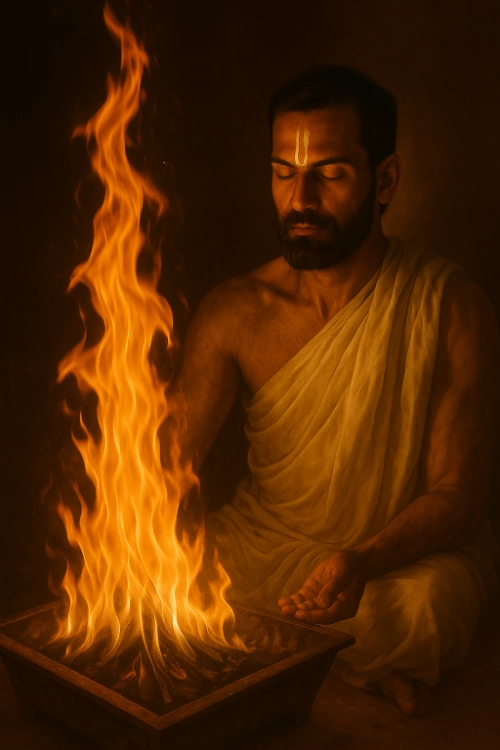
In this opening verse, Nārada introduces the ritual procedure for agnikārya, the sacred rites involving fire. He states that performing these rites correctly leads to becoming sarvakāma-bhāk — “one who attains or enjoys all desirable aims,” a classical Purāṇic phrase indicating the fulfillment of worldly and spiritual goals. The specification of the kuṇḍa (fire-pit) as a square measuring 24 aṅgulas establishes the geometric precision central to Vedic and Purāṇic ritual architecture. Aṅgula is a traditional finger-unit of measurement (≈1.9 cm), so the prescribed kuṇḍa is about 45–50 cm in width, reflecting both symbolic proportion and practical function within homa rites.