Śrī Liṅga Mahāpurāṇa, Pūrvabhāga
Chapter 4 - The Description of the Commencement of Creation
Verse 1
सूत उवाच
अथ प्राथमिकस्येह यः कालस्तदहः स्मृतम्
सर्गस्य तादृशी रात्रिः प्राकृतस्य समासतः ॥१॥
Sūta uvāca
atha prāthamikasyeha yaḥ kālas tad-ahaḥ smṛtam |
sargasya tādṛśī rātriḥ prākṛtasya samāsataḥ ||1||
Sūta said: Now, the period that belongs here to the primordial principle is known as its day. Correspondingly, the creation has such a night—that of Prakṛti—stated here in brief.
Verse 2
दिवा सृष्टिं विकुरुते रजन्यां प्रलयं विभुः
औपचारिकमस्यैतदहोरात्रं न विद्यते ॥२॥
divā sṛṣṭiṃ vikurute rajanyāṃ pralayaṃ vibhuḥ |
aupacārikam asyaitad ahorātraṃ na vidyate ||2||
By ‘day’ the all-pervading Lord brings about creation; by ‘night’ He effects dissolution. Yet this so-called day and night of His is merely figurative—no real day-and-night exists for Him.
Verse 3
दिवा विकृतयः सर्वे विकारा विश्वदेवताः
प्रजानां पतयः सर्वे तिष्ठत्यन्ये महर्षयः ॥३॥
divā vikṛtayaḥ sarve vikārā viśvadevatāḥ |
prajānāṃ patayaḥ sarve tiṣṭhanty anye maharṣayaḥ ||3||
During the (cosmic) day, all evolutes and transformations—the deities of the universe and all the lords of created beings—are active; likewise, other great sages also remain in their respective states.
Verse 4
रात्रौ सर्वे प्रलीयते निशांते संभवंति च
अहस्तु तस्य वैकल्पो रात्रिस्तादृग्विधा स्मृता ॥४॥
rātrau sarve pralīyate niśānte sambhavanti ca |
ahastu tasya vaikalpo rātris tādṛgvidhā smṛtā ||4||
During the (cosmic) night, all is dissolved; and at the end of the night, it comes into being again. Thus, the ‘day’ is merely a conceptual designation of His, and the ‘night’ is said to be of the same kind.
Verse 5
चतुर्युगसहस्रांते मनवस्तु चतुर्दश
चत्वारि तु सहस्राणि वत्सराणां कृतं द्विजाः ॥५॥
caturyuga-sahasrānte manavas tu caturdaśa |
catvāri tu sahasrāṇi vatsarāṇāṃ kṛtaṃ dvijāḥ ||5||
O twice-born ones, at the completion of a thousand cycles of the four yugas, there are fourteen Manus; and this period amounts to four thousand years.
Verse 6
तावच्छती च वै संध्या संध्यांशश्च कृतस्य तु
त्रिशती द्विशती संध्या तथा चैकशती क्रमात् ॥६॥
tāvacchatī ca vai sandhyā sandhyāṃśaś ca kṛtasya tu |
triśatī dviśatī sandhyā tathā caikaśatī kramāt ||6||
The junction (sandhyā) and the junction-portion (sandhyāṃśa) of the Kṛta Yuga are each of one hundred (years). Successively, the junctions are three hundred, two hundred, and one hundred (years) [for the following yugas], in due order.
Verse 7
अंशकः षट्शतं तस्मात्कृतसंध्यांशकं विना
त्रिद्वयेकसाहस्रमितौ विना संध्यांशके न तु ॥७॥
aṃśakaḥ ṣaṭśataṃ tasmāt kṛta-sandhyāṃśakaṃ vinā |
tri-dvaya-eka-sāhasra-mitau vinā sandhyāṃśake na tu ||7||
Therefore, the constituent portion amounts to six hundred, excluding the sandhyā-portion of the Kṛta Yuga. The measures of three, two, and one thousand are likewise reckoned without the sandhyā-portions, and not otherwise.
Verse 8
त्रेताद्वापरकृतानां कृतस्य कथयामि वः ।
निमेषपञ्चदशका काष्ठा स्वस्थस्य सुव्रताः ॥८॥
tretā-dvāpara-kṛtānāṃ kṛtasya kathayāmi vaḥ |
nimeṣa-pañcadaśakā kāṣṭhā svasthasya suvratāḥ ||8||
I shall explain to you the time-measures pertaining to the Kṛta, Tretā, and Dvāpara yugas. O you of good vows, for one who is composed and steady, fifteen blinks of the eye constitute a kāṣṭhā.
Verse 9
मर्त्यस्य च अक्ष्णोः तस्याश् च ततस् त्रिंशतिका कला ।
कलात्रिंशतको विप्रा मुहूर्त इति कल्पितः ॥९॥
martyasya ca akṣṇoḥ tasyāś ca tatas triṃśatikā kalā |
kalā-triṃśatako viprā muhūrta iti kalpitaḥ ||9||
From the blink of the two eyes of a mortal arises a kalā consisting of thirty [such units]. O Brahmins, a muhūrta is conventionally defined as consisting of thirty kalās.
Verse 10
मुहूर्तपञ्चदशिका रजनी तादृशं त्वहः ।
पितृये रात्र्यहनी मासः प्रविभागस्तयोः पुनः ॥१०॥
muḥūrta-pañcadaśikā rajanī tādṛśaṁ tv ahaḥ |
pitṛye rātryahanī māsaḥ pravibhāgas tayoḥ punaḥ ||10||
A night consists of fifteen muhūrtas, and a day is of the same measure. That night and day, belonging to the Pitṛs, together constitute a month—such is the division of their time.
Verse 11
कृष्णपक्षस्त्वहस्तेषां शुक्लः स्वप्नाय शर्वरी ।
त्रिंशद् ये मानुषा मासाः पित्र्यो मासस्तु स स्मृतः ॥११॥
kṛṣṇa-pakṣas tv ahas teṣāṁ śuklaḥ svapnāya śarvarī |
triṁśad ye mānuṣā māsāḥ pitryo māsas tu sa smṛtaḥ ||11||
For them, the dark fortnight is the day, while the bright fortnight is the night, serving for sleep. Thirty human months are remembered as constituting a single month of the Pitṛs.
Verse 12
शतानि त्रीणि मासानां षष्ट्या चाप्यधिकानि वै ।
पित्र्यः संवत्सरो ह्येष मानुषेण विभाव्यते ॥१२॥
śatāni trīṇi māsānāṁ ṣaṣṭyā cāpy adhikāni vai |
pitryaḥ saṁvatsaro hyeṣa mānuṣeṇa vibhāvyate ||12||
Three hundred months, together with an additional sixty, constitute a year of the Pitṛs; this is reckoned according to human calculation.
Verse 13
मानुषेणैव मानेन वर्षाणां यच्छतं भवेत् ।
पितॄणां त्रीणि वर्षाणि संख्यातानीह तानि वै ॥१३॥
mānuṣeṇaiva mānena varṣāṇāṁ yat śataṁ bhavet |
pitṝṇāṁ trīṇi varṣāṇi saṁkhyātānīha tāni vai ||13||
By human reckoning alone, whatever amounts to one hundred years is here counted as three years of the Pitṛs.
Verse 14
दश द्वादशाधिका मासा वृद्धिसंख्येह संस्मृताः ।
लौकिकेनैव मानेन अब्दो यो मानुषः स्मृतः ॥१४॥
daśa dvādaśādhikā māsā vṛddhi-saṁkhyā iha saṁsmṛtāḥ |
laukikenaiva mānena abdo yo mānuṣaḥ smṛtaḥ ||14||
Twelve additional months, together with ten, are here remembered as intercalary increments; according solely to worldly reckoning, this constitutes what is called a human year. (Or more idiomatically: By worldly calculation, the human year is reckoned through the inclusion of additional (intercalary) months.)
Verse 15
एतद्दिव्यमहोरात्रमिति लैंगेऽत्र पठ्यते ।
दिव्ये रात्र्यहनी वर्षं प्रविभागस्तयोः पुनः ॥१५॥
etad divya-mahorātram iti laiṅge ’tra paṭhyate |
divye rātryahanī varṣaṁ pravibhāgas tayoḥ punaḥ ||15||
This is called the divine day-and-night; thus it is taught here in the Liṅga Purāṇa. In the divine realm, the division of that night and day constitutes a year.
Verse 16
अहस्तत्रोदगयनं रात्रिः स्याद्दक्षिणायनम्
एते रात्र्यहनी दिव्ये प्रसंख्याते विशेषतः ॥१६॥
ahas tatrodagayanaṁ rātriḥ syād dakṣiṇāyanam |
ete rātryahanī divye prasaṅkhyāte viśeṣataḥ ||16||
There, the day is the northern course (of the sun), and the night is the southern course. These two—night and day—in the divine realm are thus distinctly reckoned.
Verse 17
त्रिंशद्यानि तु वर्षाणि दिव्यो मासस्तु स स्मृतः
मानुषं तु शतं विप्रा दिव्यमासास्त्रयस्तु ते ॥१७॥
triṁśad yāni tu varṣāṇi divyo māsas tu sa smṛtaḥ |
mānuṣaṁ tu śataṁ viprā divya-māsās trayaḥ tu te ||17||
Thirty years are remembered as a single divine month. One hundred human years, O twice-born ones, amount to three divine months.
Verse 18
दश चैव तथाहानि दिव्यो ह्येष विधिः स्मृतः
त्रीणि वर्षशतान्येव षष्टिवर्षाणि यानि तु ॥१८॥
daśa caiva tathāhāni divyo hyeṣa vidhiḥ smṛtaḥ |
trīṇi varṣa-śatāny eva ṣaṣṭi-varṣāṇi yāni tu ||18||
Ten days likewise—this indeed is remembered as the divine rule. Three hundred years, together with sixty additional years, are reckoned accordingly.
Verse 19
दिव्यः संवत्सरो ह्येष मानुषेण प्रकीर्तितः
त्रीणि वर्षसहस्राणि मानुषाणि प्रमाणतः ॥१९॥
divyaḥ saṁvatsaro hyeṣa mānuṣeṇa prakīrtitaḥ |
trīṇi varṣa-sahasrāṇi mānuṣāṇi pramāṇataḥ ||19||
This divine year, when expressed according to human reckoning, amounts—by standard measure—to three thousand human years.
Verse 20
त्रिंशदन्यानि वर्षाणि मतः सप्तर्षिवत्सरः
नव यानि सहस्राणि वर्षाणां मानुषाणि तु ॥२०॥
triṁśad anyāni varṣāṇi mataḥ saptarṣi-vatsaraḥ |
nava yāni sahasrāṇi varṣāṇāṁ mānuṣāṇi tu ||20||
Thirty additional years are regarded as constituting a year of the Seven Ṛṣis; these amount to nine thousand human years.
Verse 21
अन्यानि नवतीश्चैव ध्रौवः संवत्सरस्तु सः ।
षट्त्रिंशत् तु सहस्राणि वर्षाणां मानुषाणि तु ॥२१॥
anyāni navatiś caiva dhrauvaḥ saṁvatsaras tu saḥ |
ṣaṭ-triṁśat tu sahasrāṇi varṣāṇāṁ mānuṣāṇi tu ||21||
Ninety additional years are regarded as constituting a Dhruva year; this amounts to thirty-six thousand human years.
Verse 22
वर्षाणां तच्छतं ज्ञेयं दिव्यो ह्येष विधिः स्मृतः
त्रीण्येव नियुतान्याहुर्वर्षाणां मानुषाणि तु ॥२२॥
varṣāṇāṁ tac-chataṁ jñeyaṁ divyo hyeṣa vidhiḥ smṛtaḥ |
trīṇy eva niyutāny āhur varṣāṇāṁ mānuṣāṇi tu ||22||
That hundred years is to be understood as such; this indeed is remembered as a divine rule. They state that it amounts to thirty thousand human years.
Verse 23
षष्टिश्चैव सहस्राणि संख्यातानि तु संख्यया
दिव्यं वर्षसहस्रं तु प्राहुः संख्याविदो जनाः ॥२३॥
ṣaṣṭiś caiva sahasrāṇi saṅkhyātāni tu saṅkhyayā |
divyaṁ varṣa-sahasraṁ tu prāhuḥ saṅkhyāvido janāḥ ||23||
Sixty thousand years are reckoned precisely by calculation; those skilled in numerical science declare this to constitute one thousand divine years.
Verse 24
दिव्येनैव प्रमाणेन युगसंख्याप्रकल्पनम्
पूर्वं कृतयुगं नाम ततस्त्रेता विधीयते ॥२४॥
divyenaiva pramāṇena yuga-saṅkhyā-prakalpanam |
pūrvaṁ kṛta-yugaṁ nāma tatas tretā vidhīyate ||24||
The determination of the numerical structure of the yugas is made solely by divine measure. First is what is called the Kṛta Yuga; thereafter the Tretā is established.
Verse 25
द्वापरश्च कलिश्चैव युगान्येतानि सुव्रताः ।
अथ संवत्सरा दृष्टा मानुषेण प्रमाणतः ॥२५॥
dvāparaś ca kaliś caiva yugāny etāni suvratāḥ |
atha saṁvatsarā dṛṣṭā mānuṣeṇa pramāṇataḥ ||25||
Dvāpara and Kali as well—these are the yugas, O virtuous ones. Now their years are set forth according to human reckoning.
Verse 26
कृतस्याद्यस्य विप्रेंद्रा दिव्यमानेन कीर्तितम्
सहस्राणां शतान्यासंश्चतुर्दश च संख्यया ॥२६॥
kṛtasyādyasya viprendrā divya-mānena kīrtitam |
sahasrāṇāṁ śatāny āsan caturdaśa ca saṅkhyayā ||26||
Of the first—namely the Kṛta Yuga—O foremost of the Brahmins, its duration is stated according to divine measure as fourteen hundreds of thousands, by numerical reckoning.
Critical note: This numerical statement is inconsistent with the standard Purāṇic yuga system and almost certainly reflects textual corruption. The Kṛta Yuga, by divine reckoning, should be 4,000 divine years (exclusive of dawn and dusk additions). The surrounding verses and parallel Purāṇas strongly support this correction.
Verse 27
चत्वारिंशत्सहस्राणि तथान्यानि कृतं युगम्
तथा दशसहस्राणां वर्षाणां शतसंख्यया ॥२७॥
catvāriṁśat-sahasrāṇi tathānyāni kṛtaṁ yugam |
tathā daśa-sahasrāṇāṁ varṣāṇāṁ śata-saṅkhyayā ||27||
The Kṛta Yuga consists of forty thousand years, together with further additional ones; likewise, by a reckoning of hundreds of ten-thousands of years.
Critical note: As with the preceding verse, the numerical expressions here are internally inconsistent and doctrinally anomalous. When read alongside the canonical Purāṇic system and the surrounding context, this verse is best understood as a corrupt transmission intended to describe the human-year duration of the Kṛta Yuga, which elsewhere is firmly fixed at 1,728,000 years.
Verse 28
अशीतिश्च सहस्राणि कालस्त्रेतायुगस्य च
सप्तैव नियुतान्याहुर्वर्षाणां मानुषाणि तु ॥२८॥
aśītiś ca sahasrāṇi kālas tretā-yugasya ca |
saptaiva niyutāny āhur varṣāṇāṁ mānuṣāṇi tu ||28||
The duration of the Tretā Yuga is eighty thousand years; they further declare seven niyutas—human years indeed. (= 150,000 human years in total)
Verse 29
विंशतिश्च सहस्राणि कालस्तु द्वापरस्य च
तथा शतसहस्राणि वर्षाणां त्रीणि संख्यया ॥२९॥
viṁśatiś ca sahasrāṇi kālas tu dvāparasya ca |
tathā śata-sahasrāṇi varṣāṇāṁ trīṇi saṅkhyayā ||29||
The duration of the Dvāpara Yuga is twenty thousand years; likewise, three hundred thousand human years by numerical reckoning. (= 320,000 human years)
Verse 30
षष्ठिश्चैव सहस्राणि कालः कलियुगस्य तु
एवं चतुर्युगः काल ऋते संध्यांशकात्स्मृतः ॥३०॥
ṣaṣṭiś caiva sahasrāṇi kālaḥ kali-yugasya tu |
evaṁ catur-yugaḥ kāla ṛte sandhyāṁśakāt smṛtaḥ ||30||
The duration of the Kali Yuga is sixty thousand years. Thus the four-yuga cycle is reckoned, excluding the twilight portions.
Verse 31
नियुतान्येव षट्त्रिंशन्निरंशानि तु तानि वै ।
चत्वारिंशत्तथा त्रीणि नियुतानीह संख्यया ॥३१॥
niyutāny eva ṣaṭ-triṁśan niraṁśāni tu tāni vai |
catvāriṁśat tathā trīṇi niyutānīha saṅkhyayā ||31||
These amount to thirty-six niyutas, without fractional portions indeed; Together with forty and three niyutas—thus are they reckoned here by calculation.
Verse 32
विंशतिश्च सहस्राणि संध्यांशश्च चतुर्युगः
एवं चतुर्युगाख्यानां साधिका ह्येकसप्ततिः ॥३२॥
viṁśatiś ca sahasrāṇi sandhyāṁśaś ca caturyugaḥ |
evaṁ caturyugākhyānāṁ sādhikā hy eka-saptatiḥ ||32||
The twilight portion of the four-yuga cycle amounts to twenty thousand years. Thus, the four yugas together are reckoned as seventy-one (plus the increment), according to calculation. (= 810,000 human years in total)
Verse 33
कृतत्रेतादियुक्तानां मनोरंतरमुच्यते
मन्वन्तरस्य संख्या च वर्षाग्रेण प्रकीर्तिता ॥३३॥
kṛta-tretādi-yuktānāṁ manor antaram ucyate |
manvantarasya saṅkhyā ca varṣāgreṇa prakīrtitā ||33||
A sequence consisting of Kṛta, Tretā, and the other yugas is called a Manvantara. The numerical measure of a Manvantara is also declared in terms of years.
Verse 34
त्रिंशत्कोटयस्तु वर्षाणां मानुषेण द्विजोत्तमाः
सप्तषष्टिस्तथान्यानि नियुतान्यधिकानि तु ॥३४॥
triṁśat-koṭayas tu varṣāṇāṁ mānuṣeṇa dvijottamāḥ |
sapta-ṣaṣṭis tathānyāni niyutāny adhikāni tu ||34||
A Manvantara consists, in human reckoning, of thirty koṭis of years, O best of the twice-born, together with an additional sixty-seven niyutas. (= 300,670,000 human years)
Verse 35
विंशतिश्च सहस्राणि कालोऽयमधिकं विना ।
मन्वन्तरस्य संख्यैषा लैङ्गेऽस्मिन् कीर्तिता द्विजाः ॥३५॥
viṁśatiś ca sahasrāṇi kālo ’yam adhikaṁ vinā |
manvantarasya saṅkhyaiṣā laiṅge ’smin kīrtitā dvijāḥ ||35||
This duration amounts to twenty thousand years, excluding the additional portion. This is the numerical measure of a Manvantara as declared here in the Liṅga Purāṇa, O twice-born ones.
Verse 36
चतुर्युगस्य च तथा वर्षसंख्याप्रकीर्तिता
चतुर्युगसहस्रं वै कल्पश्चैको द्विजोत्तमाः ॥३६॥
caturyugasya ca tathā varṣa-saṅkhyā-prakīrtitā |
caturyuga-sahasraṁ vai kalpaś caiko dvijottamāḥ ||36||
Thus the year-count of the four-yuga cycle has been declared. A thousand such four-yuga cycles indeed constitute a single Kalpa, O best of the twice-born.
Verse 37
निशांते सृजते लोकान् नश्यंते निशि जंतवः
तत्र वैमानिकानां तु अष्टाविंशतिकोटयः ॥३७॥
niśānte sṛjate lokān naśyante niśi jantavaḥ |
tatra vaimānikānāṁ tu aṣṭāviṁśati-koṭayaḥ ||37||
At the end of the night, he creates the worlds; during the night, beings perish. There are, moreover, twenty-eight koṭis of the Vaīmānika beings.
Verse 38
मन्वन्तरेषु वै संख्या सान्तरेषु यथातथा ।
त्रीणि कोटिशतान्यासन् कोट्यो द्विनवतिस्तथा ॥३८॥
manvantarēṣu vai saṅkhyā sāntarēṣu yathā-tathā |
trīṇi koṭi-śatāny āsan koṭyo dvinavatīs tathā ||38||
In the Manvantaras—together with their intervening periods—the numbers are as stated. There were three hundred koṭis, and likewise ninety-two koṭis. (= 392 koṭis in total)
Verse 39
कल्पे तीते तु वै विप्राः सहस्राणां तु सप्ततिः ।
पुनस्तथाष्टसाहस्रं सर्वत्रैव समासतः ॥३९॥
kalpe tīte tu vai viprāḥ sahasrāṇāṁ tu saptatiḥ |
punas tathāṣṭa-sāhasraṁ sarvatraiva samāsataḥ ||39||
When a Kalpa has elapsed, O twice-born ones, there are seventy thousand (units); and again, eight thousand more—this being the total everywhere, in summary.
Verse 40
कल्पावसानिकांस्त्यक्त्वा प्रलये समुपस्थिते
महर्लोकात् प्रयांत्येते जनलोकं जनास्ततः ॥४०॥
kalpāvasānikān tyaktvā pralaye samupasthite |
maharlokāt prayānty ete janalokaṁ janās tataḥ ||40||
When the dissolution has set in, having abandoned the conditions at the end of the Kalpa, the beings depart from Maharloka and proceed to Janaloka.
Verse 41
कोटीनां द्वे सहस्रे तु अष्टौ कोटिशतानि तु
द्विषष्टिश्च तथा कोट्यो नियुतानि च सप्ततिः ॥४१॥
koṭīnāṁ dve sahasre tu aṣṭau koṭi-śatāni tu |
dviṣaṣṭiś ca tathā koṭyo niyutāni ca saptatiḥ ||41||
Two thousand koṭis, further eight hundred koṭis; likewise sixty-two koṭis, and seventy niyutas as well.
Verse 42
कल्पार्धसंख्या दिव्या वै कल्पमेवं तु कल्पयेत्
कल्पानां वै सहस्रं तु वर्षमेकमजस्य तु ॥४२॥
kalpārdha-saṅkhyā divyā vai kalpam evaṁ tu kalpayet |
kalpānāṁ vai sahasraṁ tu varṣam ekam ajasya tu ||42||
The divine measure corresponding to half a Kalpa—thus one should conceive a Kalpa. A thousand Kalpas indeed constitute a single year of the Unborn (Brahmā).
Verse 43
वर्षाणामष्टसाहस्रं ब्राह्मं वै ब्रह्मणो युगम्
सवनं युगसाहस्रं सर्वदेवोद्भवस्य तु ॥४३॥
varṣāṇām aṣṭa-sāhasraṁ brāhmaṁ vai brahmaṇo yugam |
savanaṁ yuga-sāhasraṁ sarva-devodbhavasya tu ||43||
A Brahmic yuga of Brahmā consists of eight thousand years. This is the operative cycle of a thousand yugas, pertaining to the manifestation of all the gods.
Verse 44
सवनानां सहस्रं तु त्रिविधं त्रिगुणं तथा
ब्रह्मणस्तु तथा प्रोक्तः कालः कालात्मनः प्रभो ॥४४॥
savanānāṁ sahasraṁ tu trividhaṁ triguṇaṁ tathā |
brahmaṇas tu tathā proktaḥ kālaḥ kālātmanas prabho ||44||
A thousand savanas, threefold and constituted of the three guṇas—this is declared to be the time of Brahmā, O Lord whose very nature is Time.
Verse 45
भवोद्भवस्तपश्चैव भव्यो रंभः क्रतुः पुनः
ऋतुर्वह्निर्हव्यवाहः सावित्रः शुद्ध एव च ॥४५॥
bhavodbhavas tapaś caiva bhavyo rambhaḥ kratuḥ punaḥ |
ṛtur vahnir havyavāhaḥ sāvitraḥ śuddha eva ca ||45||
(He is) the source of becoming, austerity itself, the auspicious one, the sustaining support, and again the sacrificial will; the season, the fire, the bearer of oblations, the solar impeller, and indeed the pure.
Verse 46
उशिकः कुशिकश्चैव गांधारो मुनिसत्तमाः
ऋषभश्च तथा षड्जो मज्जालीयश्च मध्यमः ॥४६॥
uśikaḥ kuśikaś caiva gāndhāro munisattamāḥ |
ṛṣabhaś ca tathā ṣaḍjo majjālīyaś ca madhyamaḥ ||46||
(He is called) Uśika and Kuśika as well, Gandhāra, O best of sages; Ṛṣabha also, likewise Ṣaḍja, Majjālīya, and the Middle (Madhyama).
Verse 47
वैराजो वै निषादश्च मुख्यो वै मेघवाहनः
पंचमाश्चित्रकश्चैव आकूतिर्ज्ञान एव च ॥४७॥
vairājo vai niṣādaś ca mukhyo vai megha-vāhanaḥ |
pañcamaś citrakaś caiva ākūtir jñāna eva ca ||47||
(He is called) Vairāja and Niṣāda as well, the Principal, whose vehicle is the cloud; the Fifth, Citraka, Intention itself, and indeed Knowledge.
Verse 48
मनः सुदर्शो बृंहश्च तथा वै श्वेतलोहितः ।
रक्तश्च पीतवासाश्च असितः सर्वरूपकः ॥४८॥
manaḥ sudarśo bṛṁhaś ca tathā vai śveta-lohitaḥ |
raktaś ca pīta-vāsāś ca asitaḥ sarva-rūpakaḥ ||48||
(He is) the Mind itself, of radiant vision, expansive; likewise white and red, red also, clad in yellow, dark, and possessing all forms.
Verse 49
एवं कल्पास्तु संख्याता ब्रह्मणोऽव्यक्तजन्मनः
कोटिकोटिसहस्राणि कल्पानां मुनिसत्तमाः ॥४९॥
evaṁ kalpās tu saṅkhyātā brahmaṇo ’vyakta-janmanaḥ |
koṭi-koṭi-sahasrāṇi kalpānāṁ muni-sattamāḥ ||49||
Thus the Kalpas are reckoned for Brahmā, whose birth is from the Unmanifest—amounting to thousands of crores upon crores of Kalpas, O best of sages.
Verse 50
गतानि तावत् शेषाणि अहर्निशानि वै पुनः ।
परान्ते वै विकाराणि विकारं यान्ति विश्वतः ॥५०॥
gatāni tāvat śeṣāṇi aharniśāni vai punaḥ |
parānte vai vikārāṇi vikāraṁ yānti viśvataḥ ||50||
Thus the remaining cycles of day and night pass away in turn. At the final end, all modifications universally return into transformation itself.
Verse 51
विकारस्य शिवस्याज्ञावशेनैव तु संहृतिः
संहृते तु विकारे च प्रधाने चात्मनि स्थिते ॥५१॥
vikārasya śivasyājñā-vaśenaiva tu saṁhṛtiḥ |
saṁhṛte tu vikāre ca pradhāne cātmani sthite ||51||
The withdrawal of all modifications occurs solely under Śiva's command. When modification has been withdrawn, it abides in Pradhāna and in the Self.
Verse 52
साधर्म्येणावतिष्ठेते प्रधानपुरुषावुभौ
गुणानां चैव वैषम्ये विप्राः सृष्टिरिति स्मृता ॥५२॥
sādharmyeṇāvatiṣṭhete pradhāna-puruṣāv ubhau |
guṇānāṁ caiva vaiṣamye viprāḥ sṛṣṭir iti smṛtā ||52||
Pradhāna and Puruṣa both abide in a state of equilibrium. When there is disequilibrium of the guṇas, O Brahmins, that is remembered as creation.
Verse 53
साम्ये लयो गुणानां तु तयोर्हेतुर्महेश्वरः
लीलया देवदेवेन सर्गास्त्वीदृग्विधाः कृताः ॥५३॥
sāmye layo guṇānāṁ tu tayoḥ hetur maheśvaraḥ |
līlayā deva-devena sargās tv īdṛg-vidhāḥ kṛtāḥ ||53||
When there is equilibrium, the guṇas dissolve; and the cause of both states is Mahēśvara. By mere play, the God of gods brings about creations of just this kind.
Verse 54
असंख्याताश्च संक्षेपात् प्रधानादन्वधिष्ठितात्
असंख्याताश्च कल्पाख्या ह्यसंख्यताः पितामहाः ॥५४॥
asaṅkhyātāś ca saṅkṣepāt pradhānād anvadhiṣṭhitāt |
asaṅkhyātāś ca kalpākhyā hy asaṅkhyatāḥ pitāmahāḥ ||54||
In brief, innumerable (creations) arise from Pradhāna, which is presided over. Innumerable indeed are those called Kalpas, and innumerable are the Brahmās.
Verse 55
हरयश्चाप्यसंख्यातास्त्वे एव महेश्वरः
प्रधानादिप्रवृत्तानि लीलया प्राकृतानि तु ॥५५॥
harayaś cāpy asaṅkhyātās tve eva maheśvaraḥ |
pradhānādi-pravṛttāni līlayā prākṛtāni tu ||55||
Viṣṇu-forms (Haris) too are innumerable—yet they are in you alone, O Maheśvara. Those that arise from Pradhāna and the like are brought forth by play and are of Prakṛti.
Verse 56
गुणात्मिका च तद्वृत्तिस्तस्य देवस्य वै त्रिधा
अप्राकृतस्य तस्यादिर्मध्यांतं नास्ति चात्मनः ॥५६॥
guṇātmikā ca tad-vṛttis tasya devasya vai tridhā |
aprākṛtasya tasyādir madhyāntaṁ nāsti cātmanaḥ ||56||
The activity of that deity is constituted of the guṇas and is indeed threefold; but of that Self, which is non-prakṛtic, there is no beginning, middle, or end.
Verse 57
पितामहस्याथ परः परार्धद्वयसंमितः
दिवा सृष्टं तु यत्सर्वं निशि नश्यति चास्य तत् ॥५७॥
pitāmahasyātha paraḥ parārdha-dvaya-saṁmitaḥ |
divā sṛṣṭaṁ tu yat sarvaṁ niśi naśyati cāsya tat ||57||
Then, the further measure of the Grandfather (Brahmā) is reckoned as two parārdhas. Whatever of his is created during the day, all of that perishes during the night.
Verse 58
भूर्भुवःस्वर्महस्तत्र नश्यते चोर्ध्वतो न च
रात्रौ चैकार्णवे ब्रह्मा नष्टे स्थावरजंगमे ॥५८॥
bhūr bhuvaḥ svar mahas tatra naśyate cordhvato na ca |
rātrau caikārṇave brahmā naṣṭe sthāvara-jaṅgame ||58||
At that time, Bhūḥ, Bhuvaḥ, Svaḥ, and Mahaḥ perish, but not the realms above them. During the night, when all has become a single ocean, Brahmā remains, after the stationary and the moving have perished.
Verse 59
सुष्वापाम्भसि यस्तस्मान्नारायण इति स्मृतः ।
शर्वर्यं प्रबुद्धो वै दृष्ट्वा शून्यं चराचरम् ॥५९॥
suṣvāpa ambhasi yas tasmān nārāyaṇa iti smṛtaḥ |
śarvaryaṁ prabuddho vai dṛṣṭvā śūnyaṁ carācaram ||59||
Because he slept in the waters, he is therefore remembered as Nārāyaṇa. Awakening after the night, he beheld the entire moving and unmoving universe as void.
Verse 60
स्रष्टुं तदा मतिं चक्रे ब्रह्मा ब्रह्मविदां वरः ।
उदकैराप्लुतां क्ष्मां तां समादाय सनातनः ॥६०॥
sraṣṭuṁ tadā matiṁ cakre brahmā brahma-vidāṁ varaḥ |
udakair āplutāṁ kṣmāṁ tāṁ samādāya sanātanaḥ ||60||
Then Brahmā, the foremost among the knowers of Brahman, formed the intention to create. Taking up that earth which was flooded by the waters, the eternal one (set about creation).
Verse 61
पूर्ववत्स्थापयामास वाराहं रूपमास्थितः ।
नदीनदसमुद्रांश्च पूर्ववच्चाकरोत्प्रभुः ॥६१॥
pūrvavat sthāpayām āsa vārāhaṁ rūpam āsthitaḥ |
nadī-nada-samudrāṁś ca pūrvavac cākarot prabhuḥ ||61||
Assuming the form of the Boar, he re-established everything just as before. The Lord likewise recreated the rivers, streams, and oceans as they had been previously.
Verse 62
कृत्वा धरां प्रयत्नेन निम्नोन्नतिविवर्जिताम् ।
धरायां सोचिनोत्सर्वान् गिरीन् दग्धान् पुराग्निना ॥६२॥
kṛtvā dharāṁ prayatnena nimnonnati-vivarjitām |
dharāyāṁ socinot sarvān girīn dagdhān purāgninā ||62||
Having, with deliberate effort, made the earth level—free from depressions and elevations—he then gathered together upon the earth all the mountains that had earlier been burnt by fire.
Verse 63
भूराद्यांश् चतुरो लोकान् कल्पयामास पूर्ववत् ।
स्रष्टुं च भगवांश् चक्रे तदा स्रष्टा पुनर्मतिम् ॥६३॥
bhūrādyāṁś caturō lokān kalpayām āsa pūrvavat |
sraṣṭuṁ ca bhagavāṁś cakre tadā sraṣṭā punar matim ||63||
He re-established the four worlds beginning with Bhūḥ, just as before. Then the Blessed One—the creator—again formed the intention to create.
Verse 4
इति श्रीलिङ्गमहापुराणे पूर्वभागे
सृष्टिप्रारम्भवर्णनं नाम चतुर्थोऽध्यायः ॥४॥
iti śrī-liṅga-mahāpurāṇe pūrva-bhāge |
sṛṣṭi-prārambha-varṇanaṃ nāma caturtho’dhyāyaḥ ||4||
Thus ends the Fourth Chapter, entitled ‘The Description of the Commencement of Creation’, in the Pūrvabhāga of the Śrī Liṅga Mahāpurāṇa.
Synopsis of Chapter 4 — The Description of the Commencement of Creation
Frame of cosmic time (day/night of manifestation).
The chapter opens by defining “day” and “night” not as literal astronomy but as metaphysical phases of the primordial principle: day is the active unfolding of sarga, night is the prākṛta latency in which the cosmos withdraws into its material ground. This establishes creation and dissolution as rhythmic, lawful cycles rather than linear history.
Śiva’s transcendence over time-language.
Although the text speaks of Śiva “creating by day” and “dissolving by night,” it immediately safeguards non-literalism: for the all-pervading Lord, no actual day-and-night exists. The temporal vocabulary is pedagogical—useful for describing real cosmic processes without implying that the divine is bound by succession.
Ordered manifestation and measured degeneration.
During the cosmic “day,” the evolutes (vikṛtis), their presiding deities, prajāpatis, and great sages function in a stable hierarchy. The chapter then transitions into chronological structure: sandhyā and sandhyāṃśa periods frame each yuga, and the decline across yugas is gradual and mathematically regulated. Time is presented as a calibrated architecture, linking cosmic order to dharma’s measured contraction.
From micro-units to realm-dependent time.
The discourse descends into perceptible measures (kāṣṭhā, kalā, muhūrta) and then ascends through relativized time-scales: Pitṛ time (fortnights as day/night; months and years scaled beyond human measure) and divine time (udagāyana/dakṣiṇāyana as day/night). The point is consistent: time expands by orders of magnitude across cosmic strata, yet remains internally coherent as a conversion system.
Yuga and manvantara arithmetic and the Kalpa.
The chapter sets yuga reckoning “by divine measure” and then expresses it in human years, culminating in the four-yuga cycle and its twilight portions, then defining the manvantara and finally the Kalpa as a thousand caturyugas. Even where manuscript figures show compression or instability, the chapter’s intent is unmistakable: to present a closed, systematic ladder of temporal units leading to the Kalpa framework.
Brahmā’s day–night, graded pralaya, and re-creation.
Creation resumes at the end of Brahmā’s night; beings perish during his night; higher lokas endure longer than lower ones. At dissolution, inhabitants migrate upward (e.g., Maharloka to Janaloka), the cosmos becomes an ekārṇava (single ocean), and Nārāyaṇa imagery is invoked through “sleep in the waters.” When re-creation begins, Brahmā resolves to create, restores the earth through the Varāha motif, re-establishes rivers, seas, mountains, and the four lower worlds “as before,” emphasizing cyclic restoration rather than novelty.
Metaphysical closure: Sāṃkhya mechanics under Śaiva sovereignty.
The chapter culminates by integrating Sāṃkhya terms—Pradhāna, Puruṣa, guṇa-sāmya/vaiṣamya—into an explicit Śaiva doctrine: dissolution and creation occur by Mahēśvara’s command and by līlā. The deity’s operative activity is threefold and guṇa-conditioned, yet His Self is aprākṛta—without beginning, middle, or end. Finally, creation, Kalpas, Brahmās, and even Viṣṇu-forms are declared “innumerable,” dissolving numerical cosmology into the supremacy and timelessness of Śiva.


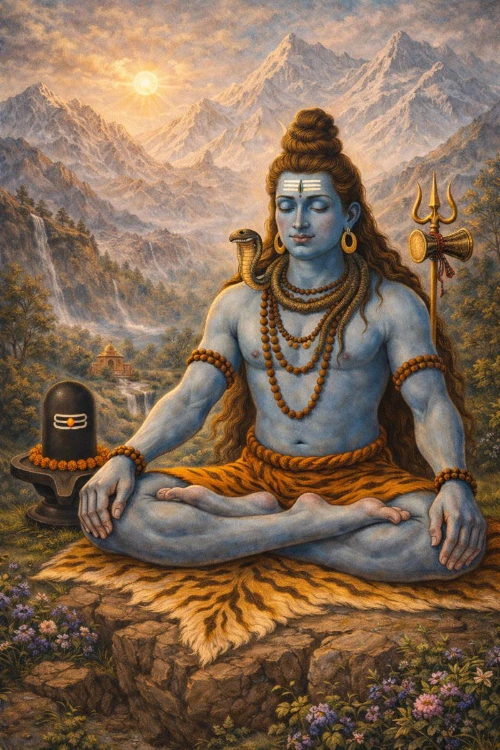
Commentary
This verse introduces a cosmic time-framework central to Purāṇic cosmology. The “day” (ahaḥ) and “night” (rātriḥ) are not literal but metaphysical cycles. The day represents the active phase of manifestation, when creation (sarga) unfolds, while the night denotes the latent state of Prakṛti, when the cosmos rests in potentiality. By calling the night prākṛta, the text emphasizes that dissolution is not destruction but re-absorption into the primordial material cause. The verse thus prepares the reader for later descriptions of creation and dissolution as rhythmic, law-governed processes rather than linear events.