Visit the best and largest 108 and 1008 names collection

Ch8 — Doctrine of the Ashtanga Yoga

Summary of Systematic Doctrine of the Ashtanga Yoga

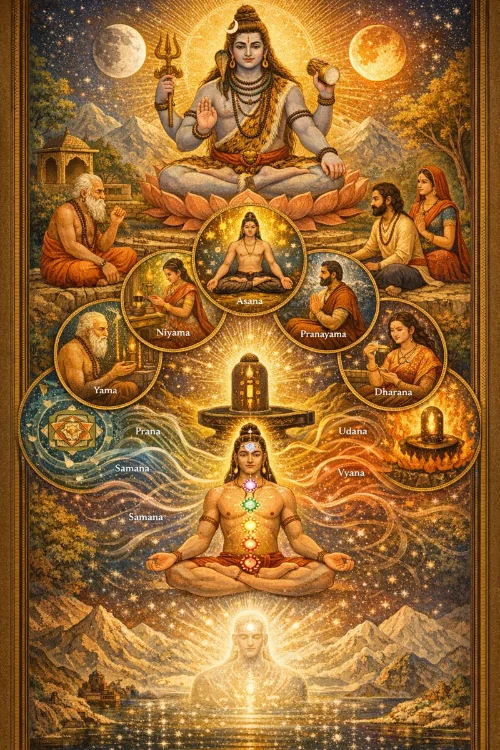
This chapter of the Liṅga Mahāpurāṇa presents a complete and authoritative Śaiva exposition of Aṣṭāṅga Yoga, taught as a divine system formulated by Śiva himself for the welfare of all beings. Yoga is defined not merely as technique, but as the maturation of knowledge into one-pointed awareness, arising through disciplined practice and Śiva’s grace. The text systematically unfolds the eight limbs—ethical restraint, observance, posture, breath regulation, sensory withdrawal, concentration, meditation, and absorption—while grounding them in rigorous moral discipline, renunciation, inner purity, and devotion to guru and deity.

Moving beyond ethics and method, the chapter develops a detailed science of prāṇāyāma, mapping the five primary and five subsidiary vital airs, their regulation, signs of mastery, and progressive inner fruits culminating in prasāda, total inner clarity. Meditation is taught through precise bodily loci, yantric geometries, and luminous Śiva-forms, ultimately dissolving all supports into non-dual realization (samarasa). The culmination is Śiva as attributeless, self-luminous Brahman—blissful, imperishable, beyond rebirth—realized within the body itself through disciplined practice, grace, and direct identity with consciousness.

Śrī Liṅga Mahāpurāṇa, Pūrvabhāga

Chapter 8 - Systematic Doctrine of the Aṣṭāṅga Yoga

Contents hide
Śrī Liṅga Mahāpurāṇa, Pūrvabhāga
Chapter 8 - Systematic Doctrine of the Aṣṭāṅga Yoga

Verse 1

सूत उवाच
संक्षेपतः प्रवक्ष्यामि योगस्थानानि सांप्रतम् ।
कल्पितानि शिवेनैव हिताय जगतां द्विजाः ॥१॥

sūta uvāca
saṃkṣepataḥ pravakṣyāmi yogasthānāni sāṃpratam |
kalpitāni śivenaiva hitāya jagatāṃ dvijāḥ ||1||

Now I shall briefly expound the stations of yoga—devised by Śiva himself—for the welfare of the worlds, O twice-born ones.

Commentary

These teachings are Śiva’s own formulation (kalpitāni śivenaiva), not merely human speculation, and they are intended for universal benefit (hitāya jagatām), even though addressed to dvijāḥ (learned “twice-born” listeners).

Verse 2

गलादधो वितस्त्या यन्नाभेरुपरि चोत्तमम् ।
योगस्थानमधो नाभेरावर्तं मध्यमं भ्रुवोः ॥२॥

galād adho vitastyā yat nābheḥ upari ca uttamam |
yogasthānam adho nābheḥ āvartaṃ madhyamaṃ bhruvoḥ ||2||

That yogic centre which lies a vitasti below the throat and above the navel is the best. The yogic centre below the navel is (called) Āvarta; the middle (centre) is at/between the eyebrows.

Verse 3

सर्वार्थज्ञाननिष्पत्तिरात्मनो योग उच्यते ।
एकाग्रता भवेच्चैव सर्वदा तत्प्रसादतः ॥३॥

sarvārthajñānaniṣpattir ātmano yogaḥ ucyate |
ekāgratā bhavec caiva sarvadā tatprasādataḥ ||3||

Yoga is said to be the attainment of knowledge of all things by/for the Self. And one-pointed concentration indeed arises always through His (that) grace.

Commentary

This verse defines yoga in an emphatically Śaiva way. Yoga is not merely posture or breath-control, but the maturing (niṣpatti) of cognition into a state where the self attains comprehensive, clarified knowing (sarvārthajñāna). The second line adds the practical hallmark of yogic success: ekāgratā, unwavering one-pointedness of mind. Crucially, it is said to arise “always” through grace (tatprasādataḥ), which in context points to Śiva’s favor rather than sheer effort alone. The verse thus balances inner discipline with divine assistance as the basis of realization.

Verse 4

प्रसादस्य स्वरूपं यत्स्वसंवेद्यं द्विजोत्तमाः ।
वक्तुं न शक्यं ब्रह्माद्यैः क्रमशो जायते नृणाम् ॥४॥

prasādasya svarūpaṃ yat svasaṃvedyaṃ dvijottamāḥ |
vaktuṃ na śakyaṃ brahmādyaiḥ kramaśo jāyate nṛṇām ||4||

O best of twice-born ones, the true nature of divine grace—being self-experienced—cannot be described even by Brahmā and the other gods; it manifests gradually within human beings.

Commentary

Here the Purāṇa deepens the definition of prasāda (grace) introduced in the previous verse. It declares that the essence of divine grace (prasādasya svarūpam) is beyond verbal expression, even for the highest deities like Brahmā. Grace is not an external phenomenon; it is svasaṃvedya—known only through direct inner experience, when consciousness itself becomes luminous and serene. Yet it is not instantaneous: it “arises gradually” (kramaśo jāyate), implying a progressive purification of mind through devotion, discipline, and Śiva’s mercy. The verse upholds the ineffable and experiential nature of realization, transcending intellectual description.

Verse 5

योगशब्देन निर्वाणं माहेशं पदमुच्यते ।
तस्य हेतुर्ऋषिर्ज्ञानं ज्ञानं तस्य प्रसादतः ॥५॥

yogaśabdena nirvāṇaṃ māheśaṃ padam ucyate |
tasya hetur ṛṣer jñānaṃ jñānaṃ tasya prasādataḥ ||5||

By the word ‘yoga’ is meant nirvāṇa, the Maheśa-related state (supreme station). The cause of that is the seer’s (ṛṣi’s) knowledge—and that knowledge arises from His grace.

Commentary

The verse tightens the chapter’s definitions: “yoga” is not merely technique, but a label for the final goal—nirvāṇa, described as the māheśa padam, the Śaiva supreme state (liberation in/through Maheśa). Then it sketches a causal chain. Liberation’s immediate “cause” is jñāna—specifically ṛṣer jñāna, knowledge as realized and transmitted by the seer-sage tradition (i.e., authentic, realized insight rather than opinion). Yet even that saving knowledge is not autonomous: it is said to arise from grace (prasādataḥ), harmonizing disciplined understanding with Śiva’s bestowal.

Verse 6

ज्ञानेन निर्दहेत्पापं निरुध्य विषयान् सदा ।
निरुद्धेद्रियवृत्तेस्तु योगसिद्धिर्भविष्यति ॥६॥

jñānena nirdahēt pāpaṃ nirudhya viṣayān sadā |
niruddhendriyavṛttes tu yogasiddhir bhaviṣyati ||6||

By knowledge one should burn away sin; having restrained the sense-objects at all times, then—when the activities of the senses are restrained—perfection in yoga will arise.

Commentary

This verse presents the practical mechanics of yoga following its philosophical definition. Knowledge (jñāna) is not merely cognitive; it is purifying, capable of burning away sin (pāpa), much like fire consumes fuel. Yet knowledge must be enacted through discipline: the yogin must continually restrain the senses from their objects. The crucial condition is not the annihilation of the senses, but the cessation of their restless activity (indriya-vṛtti-nirodha). When this restraint becomes stable, yoga-siddhi—successful realization—naturally follows. The verse thus unites insight, ethical purification, and sensory mastery into a single coherent yogic path.

Verse 7

योगो निरोधो वृत्तेषु चित्तस्य द्विजसत्तमाः ।
साधनान्यष्टधा चास्य कथितानीह सिद्धये ॥७॥

yogo nirodho vṛtteṣu cittasya dvijasattamāḥ |
sādhanāny aṣṭadhā cāsya kathitānīha siddhaye ||7||

O best among the twice-born, yoga is the restraint of the mind with respect to its modifications; and the eightfold disciplines for its attainment are taught here.

Commentary

This verse gives a formal definition of yoga, closely resonating with classical formulations while retaining a Śaiva Purāṇic voice. Yoga is defined as nirodha—the deliberate stilling—of the mind’s vṛttis, its fluctuating movements and tendencies. The locative vṛtteṣu emphasizes regulation in relation to mental activity rather than annihilation of the mind itself. The second line announces the pedagogical structure that follows: the eightfold means (aṣṭadhā sādhanāni) through which this restraint is accomplished. Thus, the verse serves as a doctrinal hinge, moving from definition to method, and prepares the reader for a systematic yogic exposition.

Verse 8

यमस्तु प्रथमः प्रोक्तो द्वितीयो नियमस्तथा ।
तृतीयमासनं प्रोक्तं प्राणायामस्ततः परम् ॥८॥

yamas tu prathamaḥ prokto dvitīyo niyamas tathā |
tṛtīyam āsanaṃ proktaṃ prāṇāyāmas tataḥ param ||8||

Ethical restraint (yama) is declared to be the first; observance (niyama) likewise the second. Posture (āsana) is declared the third, and breath regulation (prāṇāyāma) comes next.

Commentary

This verse begins the explicit enumeration of the eightfold yogic discipline announced earlier. The sequence aligns broadly with classical yoga while remaining within a Purāṇic–Śaiva frame. Yama and niyama establish the ethical and personal foundation; without them, higher practices lack stability. Āsana provides bodily steadiness, preparing the practitioner for subtle work, while prāṇāyāma introduces conscious regulation of vital energy. The orderly progression reflects a principle central to Indian yogic systems: mastery moves from conduct, to body, to breath, before advancing to inward and contemplative limbs.

Verse 9

प्रत्याहारं पंचमो वै धारणा च ततः परा ।
ध्यानं सप्तममित्युक्तं समाधिस्त्वष्टमः स्मृतः ॥९॥

pratyāhāraṃ pañcamo vai dhāraṇā ca tataḥ parā |
dhyānaṃ saptamam ity uktaṃ samādhis tv aṣṭamaḥ smṛtaḥ ||9||

Withdrawal of the senses (pratyāhāra) is indeed the fifth; concentration (dhāraṇā) comes next. Meditation (dhyāna) is said to be the seventh, and absorption (samādhi) is remembered as the eighth.”

Commentary

This verse completes the enumeration of the eightfold yogic discipline (aṣṭāṅga-yoga). After external foundations—ethics, posture, and breath—the practice turns decisively inward. Pratyāhāra marks the transition, withdrawing the senses from their objects. Dhāraṇā then fixes awareness upon a chosen locus, stabilizing attention. Dhyāna deepens this fixation into continuous, unbroken contemplation. Finally, samādhi represents complete absorption, where the distinction between meditator and object dissolves. In the Śaiva Purāṇic context, this culmination is oriented toward realization through Śiva’s grace, not merely technical mastery.

Verse 10

तपस्युपरमश्चैव यम इत्यभिधीयते ।
अहिंसा प्रथमो हेतुर्यमस्य यमिनां वराः ॥१०॥

tapasy uparamaś caiva yama ity abhidhīyate |
ahiṃsā prathamo hetur yamasya yamināṃ varāḥ ||10||

Moderation with respect to austerity is indeed called yama, and non-violence (ahiṃsā) is the primary principle of yama, O best among the self-restrained.

Commentary

This verse gives a Śaiva–Purāṇic nuance to the concept of yama. Rather than defining yama merely as external moral rules, it emphasizes uparama—measured restraint—even in tapas itself. Excessive or ego-driven austerity is implicitly rejected. At the heart of yama stands ahiṃsā, named as its prathama hetu, the foundational principle from which all other restraints derive. Addressing seasoned practitioners (yaminām varāḥ), the verse underscores that genuine yogic discipline begins not with severity, but with harmlessness, balance, and inner control, aligning ethical conduct with spiritual maturity.

Verse 11

सत्यमस्तेयमपरं ब्रह्मचर्यापरिग्रहौ ।
नियमस्यापि वै मूलं यम एव न संशयः ॥११॥

satyam asteyam aparaṃ brahmacaryāparigrahau |
niyamasya api vai mūlaṃ yama eva na saṃśayaḥ ||11||

Truthfulness, non-stealing, as well as celibacy and non-possessiveness—yama alone is indeed the very foundation even of niyama; of this there is no doubt.

Commentary

This verse completes the exposition of yama by listing its remaining components: satya (truthfulness), asteya (non-stealing), brahmacarya (sexual restraint), and aparigraha (non-possessiveness). Significantly, the text asserts that yama is the root even of niyama, collapsing any sharp hierarchy between ethical restraint and personal observance. Without yama, niyama lacks stability and sincerity. The verse thus emphasizes ethical purity as the ground of all yogic discipline, reinforcing the Purāṇic view that spiritual practice is invalid unless anchored in moral restraint and self-mastery.

Verse 12

आत्मवत्सर्वभूतानां हितायैव प्रवर्तनम् ।
अहिंसैषा समाख्याता या चात्मज्ञानसिद्धिदा ॥१२॥

ātmavat sarvabhūtānāṃ hitāyaiva pravartanam |
ahiṃsaiṣā samākhyātā yā cātmajñānasiddhidā ||12||

Conduct undertaken for the welfare of all beings, seeing them as oneself, is declared to be non-violence (ahiṃsā); and it is that which bestows the attainment of self-knowledge.

Commentary

This verse offers a deeply interiorized definition of ahiṃsā. Non-violence is not limited to refraining from harm; it is active, compassionate engagement (pravartanam) motivated solely by the welfare of all beings, grounded in self-identification with others (ātmavat). Such conduct arises naturally from an expanding sense of self that no longer stops at the individual body. Crucially, the verse states that ahiṃsā itself leads to ātma-jñāna, the realization of the Self. Ethics and metaphysics thus converge: true knowledge is impossible without universal empathy, and true non-violence is itself a mode of realization.

Verse 13

दृष्टं श्रुतं चानुमितं स्वानुभूतं यथार्थतः ।
कथनं सत्यमित्युक्तं परपीडाविवर्जितम् ॥१३॥

dṛṣṭaṃ śrutaṃ cānumitaṃ svānubhūtaṃ yathārthataḥ |
kathanaṃ satyam ity uktaṃ parāpīḍāvivarjitam ||13||

A statement that accords with reality—based on what is seen, heard, inferred, or personally experienced—and that is free from harm to others, is declared to be truth (satya).

Commentary

This verse gives a carefully balanced definition of satya (truthfulness). Truth is not restricted to sensory perception alone; it may arise from direct observation, authoritative testimony, reasoned inference, or personal realization—the four classical means implicitly invoked here. Yet factual correctness alone is insufficient. Speech must also be non-injurious (parapīḍā-vivarjitam), aligning truth with compassion. Thus, the text rejects both harmful “truth” and well-intentioned falsehood. Satya, in this Śaiva–Purāṇic framing, is truth spoken responsibly, harmonizing epistemic validity with ethical restraint, and remaining firmly rooted in ahiṃsā.

Verse 14

नाश्लीलं कीर्तयेदेवं ब्राह्मणानामिति श्रुतिः ।
परदोषान् परिज्ञाय न वदेदिति चापरम् ॥१४॥

nāślīlaṃ kīrtayed evaṃ brāhmaṇānām iti śrutiḥ |
paradoṣān parijñāya na vaded iti cāparam ||14||

Śruti declares thus regarding the conduct of Brahmins: one should not utter what is obscene or improper. And another injunction states: even knowing the faults of others, one should not speak of them.

Commentary

This verse further refines satya by introducing ethical restraint in speech. Truthfulness is not license for vulgarity or fault-finding. First, speech must be free from obscenity or indecency (aślīla), reflecting purity of mind and culture. Second, even when another’s faults are genuinely known, one is enjoined not to voice them—unless a higher dharmic necessity demands it. By citing śruti, the text grounds these rules in authoritative tradition. The verse reinforces that yogic truth is disciplined speech, governed by discretion, compassion, and social responsibility, not mere factual accuracy.

Verse 15

अनादानं परस्वानामापद्यपि विचारतः ।
मनसा कर्मणा वाचा तदस्तेयं समासतः ॥१५॥

anādānaṃ parasvānām āpady api vicārataḥ |
manasā karmaṇā vācā tad asteyaṃ samāsataḥ ||15||

Not taking what belongs to others, even in times of distress, and that deliberately—whether by mind, by action, or by speech—this, in brief, is declared to be non-stealing (asteya).

Commentary

This verse defines asteya with striking rigor. Non-stealing is not limited to physical theft; it includes mental intention, verbal manipulation, and subtle exploitation. The inclusion of āpadi api (“even in adversity”) removes common justifications based on necessity or crisis. Moreover, vicārataḥ stresses conscious ethical discernment rather than mere habit. By invoking the triad of mind, body, and speech, the text frames asteya as a total discipline of integrity. In the yogic context, such comprehensive restraint prevents inner fragmentation, making the mind fit for concentration and higher realization.

Verse 16

मैथुनस्याप्रवृत्तिर्हि मनोवाक्कायकर्मणा ।
ब्रह्मचर्यमिति प्रोक्तं यतीनां ब्रह्मचारिणाम् ॥१६॥

maithunasyāpravṛttir hi manovāk-kāya-karmaṇā |
brahmacaryam iti proktaṃ yatīnāṃ brahmacāriṇām ||16||

Complete abstention from sexual activity, indeed—by mind, speech, and bodily action—is declared to be brahmacarya, for ascetics and celibate practitioners.

Commentary

This verse defines brahmacarya with uncompromising clarity. Celibacy is not merely physical restraint; it requires total non-engagement (apravṛtti) at the levels of thought, speech, and action. Even subtle mental indulgence or verbal provocation is excluded. By specifying yatīs and brahmacārins, the text situates this definition within a renunciant and disciplined yogic context, where conservation and redirection of vital energy are essential. Such comprehensive continence stabilizes the mind, strengthens concentration, and removes one of the most powerful sources of distraction, thereby supporting higher yogic realization.

Verse 17

इह वैखानसानां च विदाराणां विशेषतः ।
सदाराणां गृहस्थनां तथैव च वदामि वः ॥१७॥

iha vaikhānasānāṃ ca vidārāṇāṃ viśeṣataḥ |
sadārāṇāṃ gṛhasthānāṃ tathaiva ca vadāmi vaḥ ||17||

Here I explain to you, especially with regard to the Vaikhānasa ascetics and the wife-less (celibate) practitioners, and likewise with regard to householders who have wives.

Commentary

This verse serves as a transition and scope clarification. Having defined brahmacarya in strict terms, the text now signals that its teachings will be differentiated according to āśrama and mode of life. Ascetics—particularly Vaikhānasas and other celibates—naturally follow complete abstinence, while householders with wives require contextualized discipline consistent with dharma. By explicitly addressing both groups, the Purāṇa avoids a one-size-fits-all ethic and prepares the ground for graded observances. The verse thus reflects a classical Indian concern for harmonizing yogic ideals with social and ritual realities, without diluting spiritual intent.

Verse 18

स्वदारे विधिवत्कृत्वा निवृत्तिश्चान्यतः सदा ।
मनसा कर्मणा वाचा ब्रह्मचर्यमिति स्मृतम् ॥१८॥

svadāre vidhivat kṛtvā nivṛttiś cānyataḥ sadā |
manasā karmaṇā vācā brahmacaryam iti smṛtam ||18||

Engaging lawfully with one’s own wife, and always abstaining from others—by mind, by action, and by speech—this is remembered as brahmacarya.

Commentary

This verse provides the householder’s definition of brahmacarya, complementing the stricter renunciant standard given earlier. Celibacy here does not mean total abstinence, but exclusive, regulated sexuality confined to one’s lawful spouse (svadāra), performed according to dharma (vidhivat). Crucially, restraint must still operate at all levels—thought, speech, and action—with absolute abstention from others. Thus, brahmacarya is redefined as fidelity, discipline, and inner restraint, not indulgence. The verse illustrates the Purāṇic method of adapting yogic ethics to life-stage (āśrama) without compromising moral or spiritual integrity.

Verse 19

मेध्या स्वनारा संभोगं कृत्वा स्नानं समाचरेत् ।
एवं गृहस्थो युक्तात्मा ब्रह्मचारी न संशयः ॥१९॥

medhyā svanārā saṃbhogaṃ kṛtvā snānaṃ samācaret |
evaṃ gṛhastho yuktātmā brahmacārī na saṃśayaḥ ||19||

Having engaged in intercourse with his own wife in a ritually proper manner, one should duly perform purificatory bathing. Thus, a householder, disciplined in mind, is indeed a brahmacārī—there is no doubt.

Commentary

This verse clinches the Purāṇic householder doctrine of brahmacarya. Sexual activity is not denied to the gṛhastha, but it must be lawful, ritually pure, exclusive, and followed by purification (snāna). The emphasis on medhya (ritual propriety) and post-act cleansing underscores that sexuality remains a sacred, regulated act, not indulgence. When practiced with restraint and awareness, such conduct does not violate brahmacarya, but fulfills it in a life-stage-appropriate way. The verse decisively affirms that inner discipline, not mere abstinence, is the true criterion of yogic continence.

Verse 20

अहिंसाप्येवमेवैषा द्विजगुर्वग्निपूजने ।
विधिना यादृशी हिंसा सात्वहिंसा इति स्मृता ॥२०॥

ahiṃsāpy evam evaiṣā dvija-guru-agni-pūjane |
vidhinā yādṛśī hiṃsā sā tv ahiṃsā iti smṛtā ||20||

Even non-violence is understood in precisely this way: whatever violence occurs according to prescribed rule in the worship of dharma for the twice-born, the teacher, and the sacred fire, that is remembered as non-violence itself.

Commentary

This verse introduces a crucial ethical refinement: non-violence is not naïvely absolute. In ritual and dharmic contexts—such as Vedic rites involving fire, service to the guru, or duties of the twice-born—certain acts that outwardly appear violent may be sanctioned by injunction (vidhi). Such action, when free from malice, ego, and desire, and performed solely as a sacred obligation, is classified as “ahiṃsā itself”, often termed sāttvika hiṃsā. The verse safeguards ritual order while preserving the primacy of compassion, affirming that intention, authority, and purpose determine the moral quality of an act, not mere physical appearance.

Verse 21

स्त्रियः सदा परित्याज्याः संगं नैव च कारयेत् ।
कुणपेषु यथा चित्त तथा कुर्याद्विचक्षणः ॥२१॥

striyaḥ sadā parityājyāḥ saṅgaṃ naiva ca kārayet |
kuṇapeṣu yathā cittaṃ tathā kuryād vicakṣaṇaḥ ||21||

Women are to be completely avoided, and association is not to be allowed at all. As one’s mind is toward corpses, so should the discerning practitioner make it (here).

Commentary

This verse reflects the extreme renunciant discipline taught for advanced ascetics, not for householders or general society. “Women” here function as a symbol of sexual attraction and attachment, not a sociological judgment. The graphic simile—maintaining the same mental disposition as toward a corpse—aims to eradicate desire at its root by inducing radical dispassion (vairāgya). Such language is characteristic of ascetic manuals that prioritize psychological severance over moderation. Earlier verses already established graded discipline by life-stage; this verse applies only to those pursuing complete sensory withdrawal. It must therefore be read contextually, not universally.

Verse 22

विण्मूत्रोत्सर्गकालेषु बहिर्भूमौ यथा मतिः ।
तथा कार्यातौ चापि स्वदारे चान्यतः कुतः ॥२२॥

viṇmūtrotsarga-kāleṣu bahirbhūmau yathā matiḥ |
tathā kāryataḥ cāpi svadāre cānyataḥ kutaḥ ||22||

As one’s mental attitude is when relieving oneself of feces and urine on the ground outside, so should it be in the act itself as well—even toward one’s own wife; how much more so toward others?

Commentary

This verse continues the radical ascetic psychology introduced earlier. It prescribes cultivating the same neutral, non-attractive mental attitude toward sexual activity as one naturally has toward bodily excretion—an act devoid of desire or fascination. The instruction applies even with respect to one’s lawful spouse, and by rhetorical force excludes all others entirely. The aim is not social conduct but inner de-eroticization: dissolving desire by reframing sexuality as a purely functional bodily process. Such language is characteristic of extreme vairāgya training, intended only for advanced practitioners seeking complete mastery over instinctual impulses, not for ordinary household life.

Verse 23

अंगारसदृशी नारी घृतकुंभसमः पुमान् ।
तस्मान्नारीषु संसर्गं दूरतः परिवर्जयेत् ॥२३॥

aṅgāra-sadṛśī nārī ghṛta-kumbha-samaḥ pumān |
tasmān nārīṣu saṃsargaṃ dūrataḥ parivarjayet ||23||

A woman is like burning embers, and a man is like a pot of ghee; therefore, one should avoid association with women from afar.

Commentary

This verse employs a classical ascetic metaphor to dramatize the danger of uncontrolled desire. Embers ignite ghee instantly; likewise, proximity between the sexes is portrayed as naturally inflaming passion. The intent is psychological caution, not ontological judgment: the imagery underscores human susceptibility, especially for renunciants training in strict brahmacarya. Addressed to advanced yogins, the rule prescribes distance (dūrataḥ) as a preventative discipline, cutting desire off before it arises. Read alongside earlier verses that allow regulated conduct for householders, this injunction belongs to the extreme vairāgya register, aimed at those seeking complete sensory mastery rather than general social norms.

Verse 24

भोगेन तृप्तिर्नैवास्ति विषयाणां विचारतः ।
तस्माद्विरागः कर्तव्यो मनसा कर्मणा गिरा ॥२४॥

bhogena tṛptir naivāsti viṣayāṇāṃ vicārataḥ |
tasmād virāgaḥ kartavyo manasā karmaṇā girā ||24||

No satisfaction whatsoever arises from enjoyment of sense-objects, when examined thoughtfully. Therefore, dispassion must be cultivated—by mind, by action, and by speech.

Commentary

This verse articulates a foundational insight of Indian renunciant psychology: sense-enjoyment cannot yield lasting fulfillment. Pleasure exhausts itself and often intensifies craving rather than extinguishing it. The phrase vicārataḥ underscores that this is not dogma but a conclusion reached through clear reflection and lived observation. From this insight follows a practical imperative: virāga, disciplined detachment, must be consciously developed at every level of being—thought, behavior, and expression. The verse thus links philosophical understanding with ethical practice, presenting detachment not as repression, but as a rational and liberating response to the nature of desire.

Verse 25

न जातु कामः कामानामुपभोगेन शाम्यति ।
हविषा कृष्णवर्त्मेव भूय एवाभिवर्धते ॥२५॥

na jātu kāmaḥ kāmānām upabhogena śāmyati |
haviṣā kṛṣṇavartmeva bhūya evābhivardhate ||25||

The enjoyment of desired objects never appeases desire; like fire fed with oblations, it only grows ever more intensely.

Commentary

This verse delivers one of the most enduring insights of Indian ethical psychology. Desire (kāma) is not extinguished by gratification; enjoyment merely conditions the mind to crave repetition, strengthening the impulse. The simile of fire (Agni)—specifically kṛṣṇavartmā, whose dark smoke-marked path expands as it is fed—captures this dynamic vividly: offerings do not quench fire, they intensify it. The teaching reinforces the preceding call to virāga (dispassion), grounding it not in moralism but in experiential realism. Mastery of desire, the text implies, requires withdrawal and insight, not indulgence.

Verse 26

तस्मात्त्यागः सदा कार्यस्त्वमृतत्वाय योगिना ।
अविरक्तो यतो मर्त्यो नानायोनिषु वर्तते ॥२६॥

tasmāt tyāgaḥ sadā kāryas tv amṛtatvāya yoginā |
avirakto yato martyo nānāyoniṣu vartate ||26||

Therefore, renunciation must always be practiced by the yogin, for the sake of immortality. For the mortal who lacks dispassion continues to revolve through many forms of birth.

Commentary

This verse draws a firm soteriological conclusion from the prior analysis of desire. Since enjoyment only intensifies craving, the yogin must adopt tyāga—deliberate relinquishment—not as a temporary measure, but continually (sadā). The goal is explicitly amṛtatva, freedom from death, i.e., liberation from saṃsāra. The second line explains the necessity: lack of dispassion (avirāga) binds the mortal to repeated embodiment across diverse wombs (nānāyoni). Thus, renunciation is not framed as world-denial, but as the causal antidote to transmigration. The verse tightly links psychology (desire), ethics (renunciation), and metaphysics (rebirth and liberation).

Verse 27

त्यागेनैवामृतत्वं हि श्रुतिस्मृतिविदां वराः ।
कर्मणा प्रजया नास्ति द्रव्येण द्विजसत्तमाः ॥२७॥

tyāgenaivāmṛtatvaṃ hi śruti-smṛti-vidāṃ varāḥ |
karmaṇā prajayā nāsti dravyeṇa dvijasattamāḥ ||27||

By renunciation alone, indeed, is immortality attained, O best among the knowers of Śruti and Smṛti. Not by ritual action, not by progeny, nor by wealth (is it attained), O best of the twice-born.”

Commentary

This verse delivers a categorical Upaniṣadic conclusion, echoing themes from texts such as the Kaivalya and Muṇḍaka Upaniṣads. Liberation (amṛtatva) is declared to arise exclusively from tyāga, complete inner relinquishment. The verse explicitly negates the three classical worldly supports: ritual action (karma), lineage continuation (prajā), and material resources (dravya). While these may sustain social and religious life, they cannot transcend mortality. By addressing scholars of Śruti and Smṛti, the text asserts that this is not sectarian opinion but scriptural consensus. Renunciation here signifies not abandonment of duty, but release from possessiveness and self-identification—the final condition for liberation.

Verse 28

तस्माद्विरागः कर्तव्यो मनोवाक्कायकर्मणा ।
ऋतौ तु निवृत्तिस्तु ब्रह्मचर्यमिति स्मृतम् ॥२८॥

tasmād virāgaḥ kartavyo mano-vāk-kāya-karmaṇā |
ṛtau tu nivṛttis tu brahmacaryam iti smṛtam ||28||

Therefore, dispassion must be cultivated—by mind, speech, body, and action. Abstinence except during the proper season is remembered as brahmacarya.

Commentary

This verse synthesizes the chapter’s teaching on desire, renunciation, and regulated conduct. First, it reiterates that virāga must be total—encompassing thought, speech, bodily behavior, and intentional action. The second line clarifies the householder standard of brahmacarya: restraint is the norm, with sexual activity permitted only during ṛtu, the ritually sanctioned period traditionally associated with procreation. Outside this limited context, abstinence is required. Thus, brahmacarya is defined not as indulgence, but as disciplined containment of desire, harmonizing yogic detachment with social responsibility. The verse closes the ethical arc of Chapter 8 with precision and balance.

Verse 29

यमाः संक्षेपतः प्रोक्ता नियमांश्च वदामि वः ।
शौचमिज्या तपो दानं स्वाध्यायोपस्थनिग्रहः ॥२९॥

yamāḥ saṃkṣepataḥ proktā niyamāṃś ca vadāmi vaḥ |
śaucam ijyā tapo dānaṃ svādhyāyopastha-nigrahaḥ ||29||

The yamas have been explained briefly; now I shall tell you the niyamas: purity, worship, austerity, charity, self-study, and restraint of sexual impulse.

Commentary

This verse marks a structural transition from yama to niyama. After completing the ethical restraints, the text enumerates the positive observances that cultivate inner purity and discipline. Unlike the classical five niyamas of Pātañjala Yoga, this Purāṇic system lists six, explicitly including upastha-nigraha (sexual restraint) as a niyama rather than subsuming it elsewhere. The list integrates ritual (ijyā), social ethics (dāna), ascetic discipline (tapas), and scriptural interiorization (svādhyāya), presenting niyama as a holistic cultivation of body, conduct, and consciousness within a Śaiva–Purāṇic yogic framework.

Verse 30

व्रतोपवासमौनं च स्नानं च नियमाः दश ।
नियमाः स्यादनिहा च शौचं तुष्टिस्तपस्तथा ॥३०॥

vratopavāsa-maunaṃ ca snānaṃ ca niyamāḥ daśa |
niyamāḥ syād anihā ca śaucaṃ tuṣṭis tapas tathā ||30||

Vows, fasting, silence, and bathing—these constitute the ten niyamas. The niyamas further include absence of craving, purity, contentment, and austerity.

Commentary

This verse expands the niyama framework beyond the earlier six, completing a tenfold system characteristic of Purāṇic yoga rather than the Pātañjala five. The practices listed balance outer discipline (vows, fasting, silence, ritual bathing) with inner cultivation (non-craving, purity, contentment, austerity). Especially notable is anihā—freedom from compulsive desire—which aligns directly with the chapter’s sustained emphasis on virāga. The niyamas here function as habitual stabilizers of consciousness, preparing the practitioner for prāṇāyāma, concentration, and meditation by steadily weakening desire, restlessness, and impurity at their roots.

Verse 31

जपः शिवप्रणिधानं पद्मकाद्यासनं तथा ।
बाह्यमाभ्यंतरं प्रोक्तं शौचमाभ्यंतरं वरम् ॥३१॥

japaḥ śiva-praṇidhānaṃ padmakādy-āsanaṃ tathā |
bāhyam ābhyantaraṃ proktaṃ śaucam ābhyantaraṃ varam ||31||

Mantra repetition, devotion to Śiva, and postures such as padmaka are likewise (niyamas). Purity is declared to be external and internal, and internal purity is the superior.

Commentary

This verse completes the niyama exposition by integrating devotional, bodily, and ethical dimensions. Japa and Śiva-praṇidhāna ground yogic discipline in continuous remembrance and surrender to Śiva, ensuring that practice remains theocentric rather than merely technical. Āsana, exemplified by padmaka, stabilizes the body for higher practices. The verse then distinguishes external purity (ritual cleanliness) from internal purity (freedom from desire, anger, and delusion), explicitly declaring the latter superior. This hierarchy aligns with the chapter’s sustained emphasis on inner transformation over outward observance, preparing the practitioner for concentration and meditative absorption.

Verse 32

बाह्यशौचेन युक्तः सन् तथा चाभ्यंतरं चरेत् ।
आग्नेयं वारुणं ब्राह्मं कर्तव्यं शिवपूजकैः ॥३२॥

bāhya-śaucena yuktaḥ san tathā cābhyantaraṃ caret |
āgneyam vāruṇaṃ brāhmaṃ kartavyaṃ śiva-pūjakaiḥ ||32||

Being endowed with external purity, one should likewise practice internal purity. Fiery, watery, and Brahmic (forms of purification) are to be performed by the worshippers of Śiva.

Commentary

This verse systematizes purification (śauca) for Śaiva practitioners by uniting outer observance with inner discipline. External cleanliness alone is insufficient; it must be paired with internal purification—the cleansing of intention, emotion, and cognition. The text then enumerates three recognized modes: āgneya (fire-based rites or tapas), vāruṇa (water-based ablutions and consecrations), and brāhma (mental-spiritual purification through knowledge, mantra, and contemplation). By assigning these specifically to Śiva-pūjakas, the verse integrates yogic purity with ritual theology, reinforcing the chapter’s consistent hierarchy: inner transformation crowns outer practice.

Verse 33

स्नानं विधानतः सम्यक् पश्चाद् आभ्यंतरं चरेत् ।
आदेहान्तं मृदा आलिप्य तीर्थतोयेषु सर्वदा ॥३३॥

snānaṃ vidhānataḥ samyak paścād ābhyantaraṃ caret |
ādehāntaṃ mṛdā ālipya tīrtha-toyeṣu sarvadā ||33||

Having properly bathed according to prescription, one should thereafter practice internal purification. Having smeared the body from head to foot with earth, one should always bathe in sacred waters.

Commentary

This verse gives procedural precision to the practice of śauca. External bathing must be done strictly according to rule (vidhānataḥ), not casually. Only after this does one proceed to internal purification, reinforcing the hierarchy already established in earlier verses. The instruction to smear the body from head to foot with earth (mṛdā) reflects classical Indian purification rites, where clay symbolizes absorptive cleansing of impurity. Bathing in tīrtha waters sacralizes the act further, integrating personal hygiene with cosmic sanctity. The verse thus unites ritual exactness, symbolic purification, and spiritual intent into a single disciplined practice.

Verse 34

अवगाह्यापि मलिनो ह्यन्तःशौचविवर्जितः ।
शैवला झषका मत्स्याः सत्त्वाः मत्स्योपजीविनः ॥३४॥

avagāhyāpi malino hy antaḥ-śauca-vivarjitaḥ |
śaivalā jhaṣakā matsyāḥ sattvāḥ matsyopajīvinaḥ ||34||

Even after bathing, one remains impure if inner purity is absent. Algae, aquatic creatures, fish, and other beings that live by fish (are constantly immersed in water).

Commentary

This verse delivers a sharp didactic contrast. Mere immersion in water does not confer purity if inner cleanliness (antaḥ-śauca) is lacking. The second line drives the point home with a naturalistic example: algae and fish dwell perpetually in water, yet they are not thereby “pure” in any moral or spiritual sense. The implication is unmistakable—external bathing alone is insufficient. True purification requires inner transformation, the cleansing of intention, desire, and cognition. The verse thus reinforces the chapter’s central hierarchy: ritual acts have value only when crowned by inner discipline and awareness, without which they become empty repetitions.

Verse 35

सदा अवगाह्याः सलिले विशुद्धाः किं द्विजोत्तमाः ।
तस्मादाभ्यंतरं शौचं सदा कार्यं विधानतः ॥३५॥

sadā avagāhyāḥ salile viśuddhāḥ kiṃ dvijottamāḥ |
tasmād ābhyantaraṃ śaucaṃ sadā kāryaṃ vidhānataḥ ||35||

Are those who are constantly immersed in water, therefore pure, O best of the twice-born? Hence, internal purity must always be practiced, according to the rule.

Commentary

This verse concludes and seals the argument developed over the preceding verses. Constant immersion in water does not automatically yield purity—otherwise, aquatic beings would be the purest of all. By framing the point as a rhetorical question, the text forces the listener to acknowledge the inadequacy of external acts when severed from inner discipline. The conclusion follows inexorably: ābhyantara-śauca, inner purification of thought, intention, and awareness, is indispensable and must be cultivated continually and methodically (sadā, vidhānataḥ). The verse thus reinforces the chapter’s core hierarchy: outer ritual supports, but inner purity alone consummates yogic practice.

Verse 36

आत्मज्ञानाम्भसि स्नात्वा सकृद् आलिप्य भावतः ।
सुवैराग्यमृदा शुद्धः शौचम् एवं प्रकीर्तितम् ॥३६॥

ātma-jñānāmbhasi snātvā sakṛd ālipya bhāvataḥ |
su-vairāgya-mṛdā śuddhaḥ śaucam evaṃ prakīrtitam ||36||

Having bathed in the waters of self-knowledge, and once for all smeared inwardly with the clay of perfect dispassion, one becomes purified. Such is purity (śauca) as it is thus proclaimed.

Commentary

This verse offers the culminating, interior definition of śauca. External water is replaced by the waters of self-knowledge, and ritual clay by the earth of profound dispassion (su-vairāgya). The act is performed once for all (sakṛt), indicating an irreversible transformation rather than repetitive ritual. Purification here is ontological, not procedural: it cleanses the very basis of identity by dissolving attachment and ignorance. By concluding the section this way, the text decisively subordinates outer rites to inner realization, affirming that true purity arises from knowledge and detachment, not from physical substances or repeated acts.

Verse 37

शुद्धस्य सिद्धयो दृष्टा नैव अशुद्धस्य सिद्धयः ।
न्यायेन आगतया वृत्त्या सन्तुष्टो यस्तु सुव्रतः ॥३७॥

śuddhasya siddhayo dṛṣṭā naiva aśuddhasya siddhayaḥ |
nyāyena āgatayā vṛttyā santuṣṭo yas tu suvrataḥ ||37||

Perfections are seen in one who is pure, but never in one who is impure. He who is content with a livelihood obtained by righteous means—such a one is a disciplined practitioner (suvrata).

Commentary

This verse draws a firm causal boundary between purity and yogic success. Siddhis—here meaning genuine attainments rather than occult display—arise only in one who is internally purified; impurity blocks realization entirely. The second line specifies a concrete marker of such purity: contentment with a justly acquired livelihood (nyāyena āgatā vṛtti). Ethical means of sustenance are not peripheral but central to yogic integrity. The suvrata, one steadfast in right vows, neither exploits nor covets. Thus, spiritual attainment is inseparable from moral clarity, inner cleanliness, and contentment, reinforcing the chapter’s consistent union of ethics and realization.

Verse 38

संतोषस् तस्य सततम् अतीतार्थस्य च अस्मृतिः ।
चांद्रायणादि-निपुणस् तपांसि सुशुभानि च ॥३८॥

santoṣas tasya satatam atītārthasya cāsmṛtiḥ |
cāndrāyaṇādi-nipuṇas tapāṃsi suśubhāni ca ||38||

For him, there is constant contentment and no recollection of past objects. Skilled in observances such as the Cāndrāyaṇa, he also practices excellent and auspicious austerities.

Commentary

This verse completes the portrait of the suvrata, the rightly disciplined yogin. True contentment (santoṣa) is not episodic but continuous, and it is marked by freedom from brooding over past experiences, which are a major source of renewed desire. Such inner stability is paired with ritual competence: the practitioner is adept in demanding vows like the Cāndrāyaṇa, a lunar-cycle fast emblematic of measured self-control. Importantly, these austerities are called suśubha—beautiful and auspicious—indicating harmony rather than harshness. The verse thus unites psychological release from memory-driven craving with disciplined, luminous practice, sealing the chapter’s ethic of purified, balanced yogic life.

Verse 39

स्वाध्यायस् तु जपः प्रोक्तः प्रणवस्य त्रिधा स्मृतः ।
वाचिकश्चाधमो मध्य उपांशुश्चोत्तमोत्तमः ॥३९॥

svādhyāyas tu japaḥ proktaḥ praṇavasya tridhā smṛtaḥ |
vācikaś cādhamaḥ madhya upāṃśuś cottamottamaḥ ||39||

Self-study is declared to be japa, and the japa of the praṇava (Oṁ) is remembered as threefold. Audible recitation is the lower, the murmured (upāṃśu) is the middle, and the most excellent of all is the highest.

Commentary

The “highest” implicitly points toward mental japa, though not named explicitly here.

This verse refines svādhyāya by equating it with japa, specifically of the praṇava (Oṁ), and classifying it into a threefold hierarchy. Audible recitation (vācika) is outward and supportive but limited by sound and distraction. Upāṃśu, the whispered or barely audible form, internalizes attention and is therefore superior. The phrase uttamo’ttamaḥ signals the culmination—purely inward, mental absorption, where sound dissolves into awareness itself. In line with the chapter’s trajectory, progress moves from external action to interior realization, reinforcing the supremacy of inwardness over form while preserving graded practice for aspirants at different stages.

Verse 40

मानसो विस्तरेणैव जपे पञ्चाक्षरे स्मृतः ।
तथा शिवप्रणिधानं मनोवाक्कायकर्मणा ॥४०॥

mānaso vistareṇaiva jape pañcākṣare smṛtaḥ |
tathā śiva-praṇidhānaṃ mano-vāk-kāya-karmaṇā ||40||

Mental japa, performed fully and inwardly, is traditionally prescribed with the five-syllabled mantra. Likewise, devotion to Śiva is to be practiced by mind, speech, and bodily action.

Commentary

This verse culminates the teaching on japa and svādhyāya. The highest form is identified as mānasa-japa, entirely inward, performed with the pañcākṣarī mantra (Namaḥ Śivāya), and carried out with sustained, expansive awareness (vistareṇa), not mechanical repetition. The second line widens the scope: Śiva-praṇidhāna is not confined to meditation alone but must pervade thought, speech, and action. Thus mantra, devotion, and conduct merge into a single discipline. The verse reinforces the chapter’s central movement—from outward forms to total interiorization and lived devotion, where yoga becomes continuous orientation toward Śiva.

Verse 41

शिवज्ञानं गुरोः भक्तिर् अचला सुप्रतिष्ठिता ।
निग्रहो हि अपहृत्य आशु प्रसक्तानि इन्द्रियाणि च ॥४१॥

śiva-jñānaṃ guroḥ bhaktir acalā supratiṣṭhitā |
nigraho hi apahṛtyāśu prasaktāni indriyāṇi ca ||41||

Knowledge of Śiva and steadfast devotion to the guru, firm and unwavering—and the restraint that swiftly withdraws the attached senses: these (constitute the discipline).

Commentary

This verse condenses the inner supports of Śaiva yoga. First, it pairs Śiva-jñāna with guru-bhakti, asserting that realization is inseparable from unwavering devotion to the living transmitter of knowledge. Such devotion must be acalā—unshaken—and supratiṣṭhitā, deeply grounded. Second, it defines effective sense-restraint (nigraha) not as suppression but as swift withdrawal of the senses when they incline outward. Together, these elements—proper knowledge, firm discipleship, and prompt control of sensory engagement—form a stable triad that secures meditative absorption and protects the practitioner from relapse into distraction.

Verse 42

विषयेषु समासेन प्रत्याहारः प्रकीर्तितः ।
चित्तस्य धारणा प्रोक्ता स्थानबंधः समासतः ॥४२॥

viṣayeṣu samāsena pratyāhāraḥ prakīrtitaḥ |
cittasya dhāraṇā proktā sthāna-bandhaḥ samāsataḥ ||42||

Withdrawal with respect to sense-objects is briefly declared to be pratyāhāra. Dhāraṇā is declared to be the binding (fixation) of the mind to a single locus, in summary.

Commentary

This verse provides concise technical definitions of two consecutive limbs of yoga. Pratyāhāra is not the destruction of the senses but their withdrawal from engagement with objects, reversing the outward flow of attention. Once this withdrawal stabilizes, dhāraṇā becomes possible: the intentional binding of the mind (citta) to a chosen point—such as a mantra, inner center, or form of Śiva. The imagery of bandha emphasizes firmness and continuity, not momentary focus. The verse thus marks the transition from sensory regulation to deliberate mental fixation, preparing the ground for uninterrupted meditation (dhyāna).

Verse 43

तस्याः स्वास्थ्येन ध्यानं च समाधिश्च विचारतः ।
तत्रैकचित्तता ध्यानं प्रत्ययांतरवर्जितम् ॥४३॥

tasyāḥ svāsthyena dhyānaṃ ca samādhiś ca vicārataḥ |
tatraika-cittatā dhyānaṃ pratyayāntara-varjitam ||43||

From the steadiness of that (concentration) arise meditation and absorption, upon proper analysis. Therein, meditation is one-pointedness of mind, free from any other mental content.

Commentary

This verse completes the progressive chain from dhāraṇā to dhyāna and samādhi. When concentration (dhāraṇā) becomes stable and undisturbed (svāsthya), it naturally matures into dhyāna and culminates in samādhi. The text carefully defines meditation not as effortful focusing, but as eka-cittatā—continuous, unbroken awareness of a single object. The decisive criterion is absence of pratyaya-antara, any intrusion of secondary thoughts or images. Thus, meditation is distinguished from ordinary attention by its seamless continuity, and samādhi is implied as the further deepening where even the sense of meditating dissolves.

Verse 44

चिद्भासमर्थमात्रस्य देहशून्यमिव स्थितः समाधिः ।
सर्वहेतुश्च प्राणायाम इति स्मृतः ॥४४॥

cid-bhāsa-mārtha-mātrasya deha-śūnyam iva sthitaḥ samādhiḥ |
sarva-hetuś ca prāṇāyāma iti smṛtaḥ ||44||

Samādhi is the state that abides as if bodiless, supported solely by the radiance of consciousness. Prāṇāyāma, indeed, is remembered as the cause of all (these attainments).

Commentary

This verse gives a phenomenological definition of samādhi and a causal claim about prāṇāyāma. In samādhi, awareness rests only on cit-bhāsa—the self-luminous presence of consciousness—so thoroughly that embodiment is experienced as absent, though the body remains. This is not annihilation but transcendence of somatic reference. The second line grounds the path practically: prāṇāyāma is declared the universal causal support, because regulation of breath steadies the nervous and mental currents that make withdrawal, concentration, meditation, and absorption possible. Thus, physiology (breath), psychology (mind), and metaphysics (consciousness) are unified in a single yogic arc.

Verse 45

प्राणः स्वदेहजो वायुर् यामस् तस्य निरोधनम् ।
त्रिधा द्विजैर् यामः प्रोक्तो मन्दो मध्योत्तमस् तथा ॥४५॥

prāṇaḥ svadehajo vāyur yāmas tasya nirodhanam |
tridhā dvijair yāmaḥ prokto mando madhyottamas tathā ||45||

Prāṇa is the air born within one’s own body; its measured regulation (yāma) is the restraint of that prāṇa. The twice-born declares this regulation to be threefold: gentle, moderate, and supreme.

Commentary

This verse gives a precise technical definition of prāṇāyāma. Prāṇa is identified not abstractly but physiologically as the vital air generated within the body. Its control is not suppression but yāma—measured regulation. Crucially, the text distinguishes three grades of practice: manda (gentle), suitable for beginners; madhya (moderate), stabilizing breath and mind; and uttama (supreme), where breath becomes subtle and nearly motionless. This graded model prevents excess and aligns practice with capacity. The verse reinforces the Purāṇic emphasis on regulated progression, not force, as the basis of yogic success.

Verse 46

प्राणापाननिरोधस् तु प्राणायामः प्रकीर्तितः ।
प्राणायामस्य मानं तु मात्राद्वादशकं स्मृतम् ॥४६॥

prāṇāpāna-nirodhas tu prāṇāyāmaḥ prakīrtitaḥ |
prāṇāyāmasya mānaṃ tu mātrā-dvādaśakaṃ smṛtam ||46||

Prāṇāyāma is declared to be the restraint of prāṇa and apāna. The standard measure of prāṇāyāma, moreover, is remembered as twelve mātrās.

Commentary

This verse offers a technical and operational definition of prāṇāyāma. Rather than focusing on inhalation or exhalation alone, it defines the practice as the mutual regulation of prāṇa (ascending vital air) and apāna (descending vital air)—a balance fundamental to yogic physiology. The second line introduces quantification, specifying a norm of twelve mātrās, a traditional unit of subtle time often measured by mantra, pulse, or mental count. By combining energetic theory with precise temporal structure, the verse underscores the Purāṇic insistence that higher yogic states arise from measured, disciplined practice, not arbitrary breath manipulation.

Verse 47

नीचः द्वादशमात्रस्तु उद्धातो द्वादशः स्मृतः ।
मध्यमस्तु द्विगुणोऽसौ चतुर्विंशतिमात्रकः ॥४७॥

nīcaḥ dvādaśa-mātras tu uddhāto dvādaśaḥ smṛtaḥ |
madhyamas tu dviguṇo’sau caturviṃśati-mātrakaḥ ||47||

Twelve mātrās measure the lower (grade), and this raised measure is so remembered. The middle (grade), however, is twice that, consisting of twenty-four mātrās.

Commentary

This verse refines the quantitative structure of prāṇāyāma introduced earlier. The practice is graded not by force but by duration and steadiness. The lower (nīca) prāṇāyāma consists of twelve mātrās and is suitable for beginners establishing control. The middle (madhyama) doubles this measure to twenty-four mātrās, demanding greater calm, lung capacity, and mental stability. The progression is explicitly arithmetical and disciplined, preventing reckless escalation. By defining advancement as measured extension rather than intensity, the text reinforces a central yogic principle: mastery arises through regulated continuity, not strain or ambition.

Verse 48

मुख्यस् तु यस् त्रिरुद्धातः षट्त्रिंशन्मात्र उच्यते ।
प्रस्वेदकम्पनोत्थानजनकश् च यथाक्रमम् ॥४८॥

mukhyaḥ tu yas trir-uddhātaḥ ṣaṭ-triṃśan-mātra ucyate |
prasveda-kampana-utthāna-janakaś ca yathākramam ||48||

The highest (grade)—that which is raised threefold—is said to consist of thirty-six mātrās. It produces perspiration, trembling, and bodily rising, in due sequence.

Commentary

This verse completes the three-tiered system of prāṇāyāma by defining the highest (mukhya/uttama) level. Built arithmetically on the base unit of twelve mātrās, it extends breath regulation to thirty-six mātrās, demanding exceptional steadiness of body and mind. The listed effects—perspiration, trembling, and utthāna (a sense of lightness or spontaneous bodily lifting)—are diagnostic signs, not goals, indicating deep physiological and energetic engagement. The careful phrase yathā-kramam warns that these arise progressively, reinforcing the chapter’s consistent insistence on graded, regulated advancement, never forceful or premature escalation.

Verse 49

आनन्दोद्भवयोगार्थं निद्राघूर्णिस् तथैव च ।
रोमाञ्चध्वनिसंविद्धस्वाङ्गोत्थानकम्पनम् ॥४९॥

ānandodbhava-yogārthaṃ nidrā-ghūrṇis tathaiva ca |
romāñca-dhvani-saṃviddha-svāṅgotthāna-kampanam ||49||

For the sake of yoga arising from bliss, there occur sleepiness and dizziness, and likewise thrilling of the hairs, inner sounds, a sense of bodily rising, and trembling.

Commentary

This verse continues the phenomenology of advanced prāṇāyāma begun in the previous section. The experiences listed—drowsiness, dizziness, goosebumps, inner sounds, trembling, and sensations of bodily lightness—are transitional signs accompanying the emergence of ānanda-born yoga. They indicate a reconfiguration of sensory and nervous processes as breath becomes subtle and awareness inward-turning. Crucially, the verse does not valorize these phenomena as goals; they are by-products of practice. Their inclusion serves a diagnostic purpose, helping practitioners recognize stages while remaining detached, consistent with the chapter’s emphasis on discipline without fascination.

Verse 50

भ्रमणं स्वेदजन्या सा संविन्मूर्च्छा भवेद् यदा ।
तद् उत्तमोत्तमः प्रोक्तः प्राणायामः सुशोभनः ॥५०॥

bhramaṇaṃ svedajanyā sā saṃvid-mūrcchā bhaved yadā |
tad uttamottamaḥ proktaḥ prāṇāyāmaḥ suśobhanaḥ ||50||

When dizziness born of perspiration occurs, and there arises absorption of consciousness, then that prāṇāyāma is declared to be the highest of the high, truly excellent.

Commentary

This verse identifies the culminating state of prāṇāyāma described in the preceding phenomenological sequence. The signs—perspiration-induced dizziness and saṃvid-mūrcchā—do not indicate pathology, but a temporary eclipse of ordinary sensory awareness as consciousness turns inward and stabilizes in itself. Crucially, mūrcchā here is not unconsciousness; it is absorption into pure awareness, where discursive cognition subsides. The text therefore designates this state as uttamottama, the supreme grade of breath regulation. The adjective suśobhana underscores its auspiciousness and harmony, affirming that such effects arise only from well-regulated, mature practice, not force or excess.

Verse 51

सगर्भोऽगर्भ इत्युक्तः सजपोऽजपः क्रमात् ।
इभो वा शरभो वापि दुराधर्षोऽथ केसरी ॥५१॥

sa-garbho’garbha ity uktaḥ sa-japo’japaḥ kramāt |
ibho vā śarabho vāpi durādharṣo’tha kesarī ||51||

Prāṇāyāma (or yogic practice) is said to be with seed and without seed, and with japa and without japa, progressively. One becomes unassailable, whether like an elephant, a śarabha, or indeed a lion.

Commentary

This verse marks a subtle transition from technique to mastery. Yogic practice advances from sa-garbha (supported, object-based) to a-garbha (supportless), and from intentional japa (sa-japa) to ajapa, the spontaneous inner vibration where mantra no longer needs repetition. These are not different practices but stages of maturation (kramāt). The striking animal imagery—elephant, śarabha, lion—symbolizes irresistible steadiness, power, and fearlessness attained through perfected control of prāṇa and awareness. The verse does not glorify domination, but inner invincibility: the yogin becomes unshakeable, inwardly sovereign, and no longer overpowered by senses, breath, or mind.

Verse 52

गृहीतः दम्यमानस् तु यथास्वस्थस् तु जायते ।
तथा समीरणोऽस्वस्थो दुराधर्षश् च योगिनाम् ॥५२॥

gṛhītaḥ damyamānas tu yathā-svasthaḥ tu jāyate |
tathā samīraṇo’svastho durādharṣaś ca yoginām ||52||

When seized and gradually disciplined, it becomes steady and well-balanced. Likewise, the vital wind (prāṇa)—when undisciplined—is hard to overcome, even for yogins.

Commentary

This verse uses a didactic contrast to conclude the prāṇāyāma section. Anything that is properly grasped and trained (gṛhītaḥ damyamānaḥ) becomes stable and manageable; without discipline, it remains erratic. The analogy is applied directly to samīraṇa, the moving force of prāṇa. When unregulated (asvastha), prāṇa is difficult to master, overpowering even serious practitioners. The implication is practical and cautionary: yogic success does not come from aspiration alone, but from patient, progressive regulation. The verse reinforces the chapter’s recurring principle—control through measured discipline, never force—bringing the technical teaching on breath to a coherent close.

Verse 53

न्यायतः सेव्यमानस् तु स एवं स्वस्थतां व्रजेत् ।
यथैव मृगराट् नागः शरभो वापि दुर्मदः ॥५३॥

nyāyataḥ sevyamānas tu sa evaṃ svasthatāṃ vrajet |
yathaiva mṛgarāṭ nāgaḥ śarabho vāpi durmadaḥ ||53||

When practiced according to the right method, it indeed attains steadiness. Just as a lion, an elephant, or even a fierce śarabha, though wild, (can be brought under control).

Commentary

This verse completes the extended animal simile begun earlier. Even creatures that are naturally powerful, wild, and difficult to restrain—the lion, elephant, and the mythic śarabha—can be brought into discipline through proper method. Likewise, prāṇa (and the practice that regulates it), though inherently restless and formidable, becomes stable (svastha) when cultivated nyāyataḥ, in accordance with correct procedure. The emphasis again is not on force, but on proper technique and gradual training. The verse reinforces the chapter’s consistent pedagogical message: mastery arises from methodical practice aligned with dharma, not from coercion or impatience.

Verse 54

कालान्तरवशात् योगात् दम्यते परमादरात् ।
तथा परिचयात् स्वास्थ्यं समत्वं च अधिगच्छति ॥५४॥

kālāntara-vaśāt yogāt damyate paramādarāt |
tathā paricayāt svasthyaṃ samatvaṃ cādhigacchati ||54||

Through the passage of time and through yoga, practiced with the utmost care, it is brought under discipline. Likewise, through continued practice, one attains steadiness and equanimity.

Commentary

This verse distills the methodological heart of the prāṇāyāma teaching. Mastery does not arise suddenly or violently; it occurs over time, through yoga practiced with sustained attentiveness (paramādara). The key term paricaya emphasizes familiarization through repetition—the quiet power of habit refined by awareness. From this emerges svasthya, a stable, balanced condition of body and mind, and samatva, equanimity amid fluctuations. The verse thus affirms a deeply pragmatic yogic insight: discipline matures through patience, and inner balance is the fruit of long, careful, uninterrupted practice, not intensity alone.

Verse 55

योगाद् अभ्यसते यस् तु व्यसनं नैव जायते ।
एवम् अभ्यस्यमानस् तु मुनेः प्राणो विनिर्दहेत् ॥५५॥

yogād abhyasate yas tu vyasanaṃ naiva jāyate |
evam abhyasyamānas tu muneḥ prāṇo vinirdahēt ||55||

For one who practices yoga, no affliction or harmful addiction arises at all. Thus, when practiced in this manner, the sage’s prāṇa completely burns away (impurities).

Commentary

This verse emphasizes the protective and purifying power of disciplined practice. Yoga, properly undertaken, does not create imbalance or dependency (vyasana); instead, it stabilizes the practitioner. The second line deepens the claim: prāṇa itself becomes a purifying fire, vinirdahēt, thoroughly consuming residual impurities and latent disturbances when practice is steady and correct. Addressing the muni, the verse underscores maturity and restraint—this is not novice experimentation but seasoned discipline. The teaching aligns with the chapter’s recurring theme: regulated repetition over time transforms vital energy from a source of restlessness into an agent of inner combustion, preparing the ground for higher yogic realization.

Verse 56

मनोवाक्कायजान् दोषान् कर्तुर्देहं च रक्षति ।
संयुक्तस्य तथा सम्यक् प्राणायामेन धीमतः ॥५६॥

mano-vāk-kāya-jān doṣān kartur dehaṃ ca rakṣati |
saṃyuktasya tathā samyak prāṇāyāmena dhīmataḥ ||56||

For the practitioner, faults arising from mind, speech, and body, and the body itself, are protected (from harm) by proper prāṇāyāma, when one is rightly engaged and wise.

Commentary

This verse states the protective function of correctly practiced prāṇāyāma. Regulation of breath does not merely purify; it guards (rakṣati) both the body and the ethical–psychological field from faults generated by thought, speech, and action. The protection applies specifically to one who is saṃyukta—properly aligned in method—and dhīmān, guided by discernment rather than impulse. Thus prāṇāyāma becomes a stabilizing shield, preventing the resurgence of disturbances even as deeper purification proceeds. The verse neatly integrates physiology, ethics, and wisdom, reinforcing the chapter’s consistent message: right method + intelligence = safety and progress in yoga.

Verse 57

दोषास् तस्माच् च नश्यन्ति निश्वासस् तेन जीर्यते ।
प्राणायामेन सिध्यन्ति दिव्याः शान्त्यादयः क्रमात् ॥५७॥

doṣās tasmāc ca naśyanti niśvāsas tena jīryate |
prāṇāyāmena sidhyanti divyāḥ śāntyādayaḥ kramāt ||57||

Therefore the impurities are destroyed, and the breath is refined thereby. Through prāṇāyāma, divine qualities such as peace are attained gradually, in due order.

Commentary

This verse states the positive culmination of disciplined prāṇāyāma. As defects (doṣa) are eliminated, the breath itself becomes refined and assimilated (jīryate), no longer coarse or agitated. From this refined vital flow arise divine inner states—foremost among them śānti, deep peace—followed by other higher qualities implied by ādayaḥ. The crucial term kramāt again emphasizes orderly progression, not sudden transformation. The verse thus completes the prāṇāyāma cycle: regulation → purification → refinement → emergence of higher yogic states. It reinforces the Purāṇic teaching that inner peace is the natural by-product of disciplined breath and time, not a forced achievement.

Verse 58

शान्तिः प्रशान्तिर् दीप्तिश् च प्रसादश् च तथा क्रमात् ।
आदौ चतुष्टयस्येह प्रोक्ता शान्तिर् इह द्विजाः ॥५८॥

śāntiḥ praśāntir dīptiś ca prasādaś ca tathā kramāt |
ādau catuṣṭayasyeha proktā śāntir iha dvijāḥ ||58||

Peace, deep peace, radiance, and clarity (grace)—these arise in due sequence. Of this fourfold set, peace is declared to be the first here, O twice-born.

Commentary

This verse systematizes the inner fruits of prāṇāyāma into a clear fourfold progression. The first attainment is śānti, the settling of agitation. From this emerges praśānti, a deeper and more stable pacification. Next arises dīpti, an inner luminosity often associated with clarity of awareness and vitality. Finally comes prasāda, a state of serene lucidity and grace, where mind and perception are transparent and unobstructed. By explicitly stating that śānti is the initial stage, the text emphasizes that yogic transformation begins not with power or brilliance, but with calm stability. The sequence reinforces the Purāṇic principle of ordered inner maturation through disciplined breath and practice.

Verse 59

सहजागन्तुकानां च पापानां शान्तिर् उच्यते ।
प्रशान्तिः संयमः सम्यग् वचसाम् इति संस्मृता ॥५९॥

sahajāgantukānāṃ ca pāpānāṃ śāntir ucyate |
praśāntiḥ saṃyamaḥ samyag vacasām iti saṃsmṛtā ||59||

Peace (śānti) is said to be the cessation of sins, both innate and acquired. Deep peace (praśānti) is traditionally remembered as the proper restraint of speech.

Commentary

This verse defines the first two members of the fourfold yogic fruit introduced earlier. Śānti is not merely a feeling of calm but the actual subsiding of impurities (pāpa), whether sahaja (arising from one’s nature and latent tendencies) or āgantuka (acquired through actions and circumstances). Praśānti, the deeper stage, is identified with disciplined control of speech—a crucial ethical threshold, since speech mediates between thought and action. By anchoring inner peace in moral purification and verbal restraint, the text reinforces its core principle: yogic states are inseparable from ethical transformation, not psychological quietude alone.

Verse 60

प्रकाशो दीप्तिरित्युक्तः सर्वतः सर्वदा द्विजाः ।
सर्वेन्द्रियप्रसादस्तु बुद्धेर्वै मरुतामपि ॥६०॥

prakāśo dīptir ity uktaḥ sarvataḥ sarvadā dvijāḥ |
sarvendriya-prasādas tu buddher vai marutām api ||60||

Illumination is called dīpti, O twice-born—everywhere and at all times. Prasāda, indeed, is the serenity of all the senses, of the intellect, and even of the vital airs.

Commentary

This verse defines the final two stages of the fourfold yogic fruition. Dīpti is identified as prakāśa—a pervasive, continuous illumination of awareness, not episodic insight or visionary brightness. It is sarvataḥ and sarvadā, all-encompassing and uninterrupted. Prasāda, the culmination, is described as a state of complete lucidity and harmony, extending simultaneously to the senses, the intellect, and even the prāṇic currents (marut). This total integration marks yogic maturity: perception, cognition, and vitality function transparently and without friction. The verse thus presents liberation not as withdrawal from life, but as perfect inner coherence and clarity.

Verse 61

प्रसाद इति सम्प्रोक्तः स्वान्ते त्विह चतुष्टये ।
प्राणोऽपानः समानश् च उदानो व्यान एव च ॥६१॥

prasāda iti samproktaḥ svānte tv iha catuṣṭaye |
prāṇo’pānaḥ samānaś ca udāno vyāna eva ca ||61||

Prasāda is thus declared, here within one’s own inner being, as the culmination of the fourfold (fruition). Prāṇa, apāna, samāna, udāna, and vyāna (are thereby brought into clarity and harmony).

Commentary

This verse concludes the fourfold sequence (śānti–praśānti–dīpti–prasāda) by locating prasāda firmly within the inner being (svānta). Prasāda is not an external blessing but an internal state of complete coherence. Its defining mark is the harmonization of the five vital airs—prāṇa, apāna, samāna, udāna, and vyāna—whose balance signifies total physiological, psychological, and energetic integration. When these prāṇic functions operate without obstruction, serenity permeates perception, intellect, and vitality alike. The verse thus presents prasāda as yogic consummation: the inner economy of life itself becomes transparent, stable, and grace-filled.

Verse 62

नागः कूर्मस्तु कृकलो देवदत्तो धनंजयः ।
एतेषां यः प्रसादस्तु मरुतामिति संस्मृतः ॥६२॥

nāgaḥ kūrmas tu kṛkalo devadatto dhanañjayaḥ |
eteṣāṃ yaḥ prasādas tu marutām iti saṃsmṛtaḥ ||62||

Nāga, kūrma, kṛkala, devadatta, and dhanañjaya—the clarity (prasāda) that arises with respect to these is traditionally remembered as the serenity of the vital airs.

Commentary

This verse reiterates and completes the definition of prasāda by extending it to the five subsidiary prāṇas, which govern involuntary and reflexive functions of the body. These subtle airs operate beneath conscious control, shaping digestion, respiration reflexes, ocular motion, yawning, and residual vitality. When prasāda pervades even these automatic currents, the organism is free from hidden turbulence. The teaching thus insists that yogic fulfillment is not partial or mental alone: clarity must permeate the deepest physiological layers. Only when both primary and subsidiary prāṇas are harmonized does the practitioner attain complete inner coherence and stability.

Verse 63

प्रयाणं कुरुते तस्माद्वायुः प्राण इति स्मृतः ।
अपानयत्यपानस्तु आहारादीन् क्रमेण च ॥६३॥

prayāṇaṃ kurute tasmād vāyuḥ prāṇa iti smṛtaḥ |
apānayaty apānas tu āhārādīn krameṇa ca ||63||

Because it affects forward movement, the vital air is remembered as prāṇa. Apāna, on the other hand, drives downward and expels, in proper sequence, food and the like.

Commentary

This verse begins a functional definition of the vital airs. Prāṇa is identified by its role in outward and upward movement—breathing, ingestion, and the general forward propulsion of life processes. Apāna, by contrast, governs downward motion and elimination, responsible for the orderly expulsion of food residues and other wastes. The emphasis on krameṇa (“in proper sequence”) highlights physiological intelligence rather than forceful action: elimination follows rhythm and order. By defining prāṇas in terms of function rather than abstraction, the text reinforces its integrative vision of yoga, in which realization includes a clear understanding and harmonization of the body’s most fundamental vital processes.

Verse 64

व्यानो व्यानामयति अङ्गं व्याध्यादीनां प्रकोपकः ।
उद्वेजयति मर्माणि उदानोऽयम् प्रकीर्तितः ॥६४॥

vyāno vyānāmayati aṅgaṃ vyādhyādīnāṃ prakopakaḥ |
udvejayati marmāṇi udāno’yam prakīrtitaḥ ||64||

Vyāna pervades the entire body, and is the provoker of diseases and the like (when disturbed). Udāna, on the other hand, agitates the vital points; thus is it declared.

Commentary

This verse continues the functional taxonomy of the prāṇas by defining vyāna and udāna in terms of their physiological and energetic effects. Vyāna is the all-pervading vital air responsible for circulation and distribution throughout the limbs; when imbalanced, it can become a catalyst for systemic disorders. Udāna, by contrast, operates in the upward-moving axis and strongly affects the marmas, the body’s vital junctions; its disturbance produces agitation and instability. The verse reinforces the chapter’s practical orientation: yogic mastery requires not only transcendence, but precise knowledge of how prāṇic forces function and malfunction within the embodied system.

Verse 65

समं नयति गात्राणि समानः पञ्च वायून् ।
उद्गारे नाग आख्यातः कूर्म उन्मीलने तु सः ॥६५॥

samaṃ nayati gātrāṇi samānaḥ pañca vāyūn |
udgāre nāga ākhyātaḥ kūrma unmilane tu saḥ ||65||

Samāna brings the limbs into balance and equalizes the five vital airs. Nāga is declared to function in belching, while kūrma functions in the opening of the eyes.

Commentary

This verse continues the functional mapping of the prāṇic system. Samāna is presented as the harmonizing force, coordinating not only digestion but the equilibrium of all five primary vital airs, thereby maintaining bodily integration. The verse then specifies two subsidiary prāṇas: nāga, responsible for expulsive reflexes such as belching, and kūrma, governing involuntary ocular movements, especially eye-opening. By detailing even such subtle reflexes, the text underscores its holistic yogic physiology: nothing in embodied life lies outside prāṇa’s domain, and mastery requires understanding both major currents and minor reflexive functions.

Verse 66

कृकलः क्षुतकायैव देवदत्तो विजृंभणे ।
धनंजयो महाघोषः सर्वगः स मृतेऽपि हि ॥६६॥

kṛkalaḥ kṣuta-kāya eva devadatto vijṛmbhaṇe |
dhanañjayo mahā-ghoṣaḥ sarvagaḥ sa mṛte’pi hi ||66||

Kṛkala operates in sneezing and similar bodily reflexes; Devadatta functions in yawning. Dhanañjaya is resonant and all-pervading, and remains even after death.

Commentary

This verse completes the taxonomy of the subsidiary vital airs by assigning them precise physiological domains. Kṛkala governs expulsive reflexes such as sneezing (and related bodily jolts), while Devadatta presides over yawning and involuntary stretching—threshold states between activity and rest. Dhanañjaya is distinguished from the others: it is described as sarvaga, pervading the body, and persisting even after death, accounting for residual warmth, rigidity, or sound at the corpse’s dissolution. The verse reinforces the text’s holistic vision: yogic clarity (prasāda) must encompass not only conscious functions but also the deepest autonomic and post-mortem prāṇic processes.

Verse 67

इति यो दशवायूनां प्राणायामेन सिध्यति ।
प्रसादोऽस्य तुरीया तु संज्ञा विप्राश्चतुष्टये ॥६७॥

iti yo daśa-vāyūnāṃ prāṇāyāmena sidhyati |
prasādo’sya turīyā tu saṃjñā viprāś catuṣṭaye ||67||

Thus, the clarity (prasāda) that is accomplished by prāṇāyāma with respect to the ten vital airs—this is designated as the ‘fourth’, O learned ones, within the fourfold (sequence).

Commentary

This verse formally concludes the prāṇic exposition by naming prasāda as the turīya, the “fourth” and culminating state of the yogic sequence (śānti–praśānti–dīpti–prasāda). By grounding this attainment in the harmonization of all ten vital airs, the text makes a decisive claim: yogic consummation is not merely mental or contemplative, but physiological, energetic, and ethical in totality. The term turīya deliberately evokes Upaniṣadic language, elevating prasāda from a quality to a state of being. Liberation here is complete inner transparency, where breath, senses, mind, and awareness function as a single, unobstructed whole.

Verse 68

निःस्वरस् तु महान् प्रज्ञो मनो ब्रह्मचितिः स्मृतिः ।
ख्यातिः संवित्ततः पश्चात् ईश्वरो मतिरेव च ॥६८॥

niḥsvaras tu mahān prajño mano brahma-citiḥ smṛtiḥ |
khyātiḥ saṃvittataḥ paścāt īśvaro matir eva ca ||68||

Then there is soundlessness, and great wisdom; the mind becomes Brahman-consciousness and steady remembrance. Thereafter arise direct luminous knowledge, and then sovereign awareness (Īśvara) itself—indeed, pure understanding alone.

Commentary

This verse moves beyond prāṇic and meditative phenomenology into gnostic culmination. After inner sound and vibration subside, awareness becomes niḥsvara—free from even subtle resonance. The mind is no longer an instrument but brahma-citi, consciousness grounded in Brahman itself. From this arise khyāti, immediate luminous knowing, followed by the recognition of īśvara—not as an external deity, but as sovereign, unconditioned awareness. The sequence charts dissolution of all mediating structures: breath → sound → cognition → identity. What remains is mati alone, understanding without object. The verse thus articulates a Śaiva–Upaniṣadic realization, where yoga consummates in non-dual, self-luminous knowledge.

Verse 69

बुद्धेर् एताः द्विजाः संज्ञा महतः परिकीर्तिताः ।
अस्या बुद्धेः प्रसादस् तु प्राणायामेन सिद्ध्यति ॥६९॥

buddher etāḥ dvijāḥ saṃjñā mahataḥ parikīrtitāḥ |
asyā buddheḥ prasādas tu prāṇāyāmena sidhyati ||69||

These are the designations of the intellect, O twice-born, as proclaimed with regard to the Great (Mahat). The clarity (prasāda) of this intellect, indeed, is perfected through prāṇāyāma.

Commentary

This verse draws the final doctrinal line between prāṇic discipline and gnosis. The states listed previously—soundlessness, great wisdom, Brahman-consciousness, luminous knowledge, sovereignty—are here identified as saṃjñās of buddhi, specifically of Mahat, the cosmic intellect of Sāṃkhya–Purāṇic cosmology. Crucially, the verse affirms that prasāda of buddhi—its complete lucidity and stability—is not achieved by speculation, but by prāṇāyāma. Breath regulation is thus elevated from preparatory technique to direct causal agent of noetic clarity. The teaching seals the chapter’s thesis: mastery of prāṇa consummates in the purification and illumination of intelligence itself, culminating in realization.

Verse 70

विश्वरः विश्वरीभावो द्वन्द्वानां मुनिसत्तमाः ।
अग्रजः सर्वतत्त्वानां महान् यः परिमाणतः ॥७०॥

viśvaraḥ viśvarī-bhāvo dvandvānāṃ munisattamāḥ |
agrajaḥ sarva-tattvānāṃ mahān yaḥ parimāṇataḥ ||70||

Universal and universalized, beyond the dualities, O best of sages—he who is Mahān, primordial to all principles, and great by ontological magnitude.

Commentary

This verse explicitly identifies Mahat (Mahābuddhi) as the first emergent principle, prior to all differentiated tattvas and beyond the play of dualities (dvandva). Described as viśvara and viśvarī-bhāva, it is not a limited intellect but a universalized field of intelligence, the ground from which all structured cognition arises. The emphasis on parimāṇataḥ (“by magnitude”) underscores that Mahat is not merely first in sequence but supreme in scope and ontological reach. In the chapter’s trajectory, this verse seals the ascent from prāṇic regulation to cosmic intelligence, completing the yoga-to-tattva arc.

Verse 71

यत् प्रमाणगुह्या प्रज्ञा मनस् तु मनुते यतः ।
बृहत्त्वात् ग्रहणत्वाच् च ब्रह्मा ब्रह्मविदां वराः ॥७१॥

yat pramāṇa-guhyā prajñā manas tu manute yataḥ |
bṛhattvāt grahaṇatvāc ca brahmā brahma-vidāṃ varāḥ ||71||

That intelligence which lies hidden within the means of knowledge, through which the mind itself cognizes, is called Brahmā, O best among the knowers of Brahman—because of its vastness and because of its power of apprehension.

Commentary

This verse completes the chapter’s ascent by naming the ultimate noetic principle. The intelligence (prajñā) that underlies and animates all pramāṇas (means of valid knowledge) is not an object known by the mind; rather, it is that by which the mind knows at all. Because it is bṛhat (vast, all-encompassing) and possesses grahaṇa-śakti (the power to apprehend and hold all cognition), it is designated Brahmā/Brahman. Addressing realized knowers, the text affirms that yogic purification—culminating in prāṇāyāma and prasāda—resolves finally into recognition of the cosmic intellect as one’s own deepest ground of knowing.

Verse 72

सर्वकर्माणि भोगार्थं यच् चिनोति चितिः स्मृता ।
स्मरते स्मृतिर् यत् सर्वं संवित् वै विन्दते यतः ॥७२॥

sarva-karmāṇi bhogārthaṃ yac chinoti citiḥ smṛtā |
smarate smṛtir yat sarvaṃ saṃvit vai vindate yataḥ ||72||

That intelligence which gathers all actions for the sake of experience is called citi. Memory remembers by it, and through it consciousness indeed knows everything.

Commentary

This verse completes the noetic ladder by unifying action, memory, and consciousness under a single principle. Citi is defined as the intelligence that collects karmic actions for experiential fruition, linking volition with lived consequence. Smṛti (memory) is not autonomous; it remembers by means of citi, and saṃvit (consciousness) knows all objects through that same ground. The text thus dissolves psychological fragmentation: action, recollection, and awareness are functions of one integrative intelligence. In the arc of the chapter, this seals the teaching that yogic purification—rooted in prāṇāyāma—culminates not merely in calm or insight, but in recognition of the single cognitive source underlying all experience.

Verse 73

ख्यायते यत् त्विति ख्यातिर् ज्ञानादिभिर् अनेकशः ।
सर्वतत्त्वाधिपः सर्वं विजानाति यद् ईश्वरः ॥७३॥

khyāyate yat tv iti khyātir jñānādibhir anekaśaḥ |
sarva-tattvā-dhipaḥ sarvaṃ vijānāti yad īśvaraḥ ||73||

That which becomes manifest is called khyāti, for it is apprehended in many ways through knowledge and the like. Īśvara, the lord of all principles, is that by which everything is distinctly known.

Commentary

This verse defines khyāti as luminous manifestation, the stage where knowing is no longer mediated or effortful but self-revealing. It arises through multiple modalities (jñāna–ādi), indicating that cognition here is not restricted to a single instrument. The second line identifies the ground of this luminosity as Īśvara, not a sectarian deity but the sovereign knower of all tattvas—the integrative intelligence presiding over every principle of reality. In the chapter’s progression, khyāti bridges purified intellect (buddhi-prasāda) and ultimate sovereignty (īśvara), marking the point where knowledge coincides with being, and knowing becomes universal, immediate, and authoritative.

Verse 74

मनुते मन्यते यस्मात् मतिः, मतिमतां वराः ।
अर्थं बोधयते यच् च बुध्यते बुद्धिर् उच्यते ॥७४॥

manute manyate yasmāt matiḥ, matimatāṃ varāḥ |
arthaṃ bodhayate yac ca budhyate buddhir ucyate ||74||

That by which one thinks and reflects is called mati, O best among the intelligent. That which illuminates meaning and awakens to understanding is called buddhi.

Commentary

This verse carefully distinguishes mati and buddhi, two closely related but functionally distinct noetic faculties. Mati denotes intentional, reflective cognition—the mind’s capacity to entertain, consider, and direct thought. Buddhi, by contrast, is the illuminative and decisive intellect, that which makes meaning intelligible and truly awakens understanding (budhyate). The distinction mirrors classical Sāṃkhya and Vedāntic psychology: mati initiates cognitive movement, while buddhi completes it through discernment. In the chapter’s progression, this verse clarifies the internal architecture of knowing, showing how yogic purification culminates not in vague awareness, but in precise, awakened intelligence.

Verse 75

अस्या बुद्धेः प्रसादस् तु प्राणायामेन सिद्ध्यति ।
दोषान् विनिर्दहेत् सर्वान् प्राणायामाद् असौ यमी ॥७५॥

asyā buddheḥ prasādas tu prāṇāyāmena sidhyati |
doṣān vinirdahēt sarvān prāṇāyāmād asau yamī ||75||

The clarity of this intellect is indeed perfected by prāṇāyāma. Through prāṇāyāma, that disciplined yogin burns away all defects.

Commentary

This verse concludes the noetic arc of the chapter by reaffirming prāṇāyāma as the direct cause of intellectual clarity (buddhi-prasāda). The verb vinirdahēt underscores an active, thorough purification: defects are not merely suppressed but consumed. Addressing the yamī—the disciplined practitioner—the text integrates ethics and technique: restraint (yama) and breath regulation operate together. The teaching thus resolves the chapter’s thesis: mastery of prāṇa purifies the entire cognitive apparatus, culminating in lucid, awakened intelligence. Liberation is presented not as abstraction but as a measurable transformation—the intellect becomes clear because the vital force that animates it has been rightly regulated.

Verse 76

पातकं धारणाभिस् तु प्रत्याहारेण निर्दहेत् ।
विषयान् विषवद् ध्यात्वा ध्यानेन अनिश्वरान् गुणान् ॥७६॥

pātakaṃ dhāraṇābhis tu pratyāhāreṇa nirdahēt |
viṣayān viṣavad dhyātvā dhyānena aniśvarān guṇān ||76||

Through concentration (dhāraṇā), and by withdrawal of the senses (pratyāhāra), one burns away sin. Having contemplated sense-objects as poison, one removes by meditation the non-sovereign (binding) guṇas.

Commentary

This verse assigns specific purificatory functions to successive yogic limbs. Pratyāhāra withdraws the senses from their objects, while dhāraṇā fixes awareness, together incinerating moral impurity (pātaka). The second half addresses subtler bondage: even refined qualities (guṇas) can bind if mistaken for the goal. By contemplating sense-objects as poison, attachment is decisively severed, and through dhyāna these non-sovereign guṇas—those lacking liberating power—are dissolved. The verse thus clarifies that yoga purifies in layers: first ethical and behavioral, then psychological, and finally ontological, removing even subtle constituents that obstruct sovereignty (īśvaratva) and freedom.

Verse 77

समाधिना यतिश्रेष्ठाः प्रज्ञावृद्धिं विवर्धयेत् ।
स्थानं लब्ध्वा एव कुर्वीत योगाष्टाङ्गानि वै क्रमात् ॥७७॥

samādhinā yatiśreṣṭhāḥ prajñā-vṛddhiṃ vivardhayet |
sthānaṃ labdhvā eva kurvīta yogāṣṭāṅgāni vai kramāt ||77||

By samādhi, O best of ascetics, one cultivates the growth of wisdom. Only after attaining a firm footing, one should practice the eight limbs of yoga, indeed, in proper sequence.

Commentary

This verse provides a methodological closure to the chapter by reconciling attainment and practice. Samādhi is presented not as an end that abolishes discipline, but as a means to expand prajñā, awakened wisdom. Crucially, the text insists on sthāna, a stable inner grounding: only when such a foundation is secured should one undertake the aṣṭāṅga-yoga—and always kramāt, in correct order. The verse thus avoids two extremes: premature technique without stability, and complacent absorption without structure. It affirms a mature yogic vision in which realization deepens practice, and practice, rightly ordered, sustains realization.

Verse 78

लब्ध्वा आसनानि विधिवद् योगसिद्ध्यर्थम् आत्मवित् ।
आदेशकाले योगस्य दर्शनं हि न विद्यते ॥७८॥

labdhvā āsanāni vidhivad yoga-siddhy-artham ātmavit |
ādeśa-kāle yogasya darśanaṃ hi na vidyate ||78||

Having mastered the postures according to proper method for the attainment of yoga, the knower of the Self (proceeds). For at the time of instruction, yoga itself is not something that can be directly shown, indeed.

Commentary

This verse articulates a crucial epistemological boundary of yoga. While āsana can be learned, demonstrated, and corrected according to method, yoga itself cannot be ‘shown’ at the moment of instruction. It is not an object of sensory perception or verbal transmission. Hence the emphasis on preparatory mastery: bodily discipline creates the conditions for realization, but realization itself arises internally, through practice and maturation. By addressing the ātmavit, the verse clarifies that true yoga unfolds beyond pedagogy—teachers can guide methods, but the essence of yoga must be directly realized, not displayed or handed over.

Verse 79

अग्न्यभ्यासे जले वापि शुष्कपर्णचये तथा ।
जन्तुव्याप्ते श्मशाने च जीर्णगोष्ठे चतुष्पथे ॥७९॥

agny-abhyāse jale vāpi śuṣka-parṇa-caye tathā |
jantu-vyāpte śmaśāne ca jīrṇa-goṣṭhe catuṣ-pathe ||79||

Near fire, in water, upon a heap of dry leaves, in places infested with creatures, in a cremation ground, in a dilapidated cowshed, or at a crossroads—(yogic practice or instruction should not be undertaken there).

Commentary

This verse enumerates locations unsuitable for yogic practice or instruction, continuing the text’s insistence on method, safety, and inward stability. Each site represents either physical danger (fire, water, dry leaves), distraction or disturbance (creatures, crossroads), or psychological impurity and instability (cremation grounds, ruins). The teaching is pragmatic rather than symbolic: yoga requires an environment that supports steadiness (sthāna) and non-agitation of prāṇa. By rejecting extreme or sensational settings, the text distances itself from ascetic exhibitionism and emphasizes measured, disciplined practice. Proper place (deśa) is thus presented as an essential condition for yogic success, alongside posture, breath, and ethical restraint.

Verse 80

सशब्दे सभये वापि चैत्यवल्मीकसञ्चये ।
अशुभे दुर्जनाक्रान्ते मशकादिसमन्विते ॥८०॥

saśabde sabhaye vāpi caitya-valmīka-sañcaye |
aśubhe durjanākrānte maśakādi-samanvite ||80||

In a noisy place, in a fearful place, in a heap of shrines or anthills, in an inauspicious location, where wicked people abound, or where mosquitoes and the like are present—(yoga should not be practiced there).

Commentary

This verse completes the environmental prohibitions for yogic practice by excluding places that disturb attention, safety, and purity. Noise (saśabda) agitates the mind; fear (sabhaya) destabilizes prāṇa. Shrines and anthills, though symbolically charged, attract activity and distraction. Inauspicious settings and the presence of unsuitable company (durjana) compromise ethical and mental clarity, while insects such as mosquitoes disrupt bodily steadiness. The instruction is again practical, not symbolic: yoga thrives in quiet, secure, clean, and morally neutral surroundings. Together with the previous verse, this passage underscores that proper place (deśa) is a foundational support for inner discipline and success in yoga.

Verse 81

न आचरेद् देहबाधायां दौर्मनस्यादिसम्भवे ।
गुप्ते तु शुभे रम्ये गुहायां पर्वतस्य तु ॥८१॥

na ācaret deha-bādhāyāṃ daurmanasyādi-sambhave |
gupte tu śubhe ramye guhāyāṃ parvatasya tu ||81||

One should not practice when there is bodily affliction or when despondency and the like arise. Rather, (one should practice) in a secluded, auspicious, and pleasant place, in a mountain cave.

Commentary

This verse completes the section on appropriate conditions for yogic practice by introducing both internal and external criteria. Internally, yoga should not be forced during physical illness or mental distress (daurmanasya), since such states disturb prāṇa and concentration. Externally, the text recommends a place that is secluded (gupta), pure (śubha), and pleasant (ramya)—conditions that naturally support steadiness and inwardness. The mention of a mountain cave is not romantic symbolism but practical advice: such places are quiet, stable, and free from interruption. Overall, the verse reinforces a consistent Purāṇic principle: yoga succeeds through harmony with body, mind, and environment—not through coercion or extremity.

Verse 82

भवक्षेत्रे सुगुप्ते वा भवारामे वनेऽपि वा ।
गृहे तु सुशुभे देशे विजने जन्तुवर्जिते ॥८२॥

bhava-kṣetre sugupe vā bhavārāme vane’pi vā |
gṛhe tu suśubhe deśe vijane jantu-varjite ||82||

(One may practice) in a sacred field of Bhava, in a well-protected place, in a garden of Bhava, or even in a forest; or else in a house, provided it is very auspicious, secluded, and free from living disturbances.

Commentary

This verse completes the guidance on appropriate locations for yogic practice, broadening the options while preserving essential conditions. Whether in explicitly Śaiva sacred spaces (bhava-kṣetra, bhavārāma), in nature (forest), or even within one’s own home, the decisive factors are security, auspiciousness, seclusion, and freedom from disturbance. The teaching is notably pragmatic and inclusive: yoga is not restricted to dramatic ascetic settings but may be practiced wherever these supporting conditions are met. By emphasizing inner steadiness supported by outer order, the text reinforces its recurring principle that yogic success depends on harmony of place, body, and mind, not on external austerity alone.

Verse 83

अत्यन्तनिर्मले सम्यक् सुप्रलिप्ते विचित्रिते ।
दर्पणोदर-सङ्काशे कृष्णागरु-सुधूपिते ॥८३॥

atyanta-nirmale samyak su-pralipte vicitrite |
darpaṇodara-saṅkāśe kṛṣṇāgaru-su-dhūpite ||83||

(One should practice) in a place that is extremely clean, properly prepared, well-plastered and orderly, resembling the surface of a mirror, and pleasantly fumigated with black agaru incense.

Commentary

This verse specifies the ideal interior conditions for yogic practice, shifting from general location to precise environmental refinement. Cleanliness (nirmalatā) ensures physical and subtle purity, while a smooth, well-prepared surface promotes bodily stability in posture. The comparison to a mirror’s surface conveys both physical polish and symbolic clarity—an environment that reflects the practitioner’s inward aim. The use of agaru incense is not ornamental but functional: it purifies the air, repels insects, and creates a calming sensory field. Together, these details reveal a sophisticated yogic psychology: outer order and subtle sensory harmony directly support inner stillness and concentration.

Verse 84

नानापुष्पसमाकीर्णे वितानोपरी शोभिते ।
फलपल्लवमूलाढ्ये कुशपुष्पसमन्विते ॥८४॥

nānā-puṣpa-samākīrṇe vitānoparī śobhite |
phala-pallava-mūlāḍhye kuśa-puṣpa-samanvite ||84||

(One should practice) in a place strewn with many kinds of flowers, adorned with a canopy above, abundant in fruits, shoots, and roots, and furnished with kuśa grass and flowers.

Commentary

This verse completes the description of the ideal yogic environment by emphasizing aesthetic harmony and ritual purity. Flowers, canopy, and natural abundance create a calm, life-affirming sensory field, countering distraction and lethargy. The presence of kuśa grass, sacred in Vedic and Purāṇic rites, signals ritual correctness and subtle purity, aligning bodily posture with sacred order. Fruits, shoots, and roots suggest natural sustenance and a sattvic atmosphere. Together with the preceding verses, the text presents a carefully curated space where outer beauty, cleanliness, and sanctity support inward concentration—affirming that yogic realization is aided by an environment that mirrors clarity, balance, and auspiciousness.

Verse 85

समासनस्थो योगाङ्गानि अभ्यसेद् हृषितः स्वयम् ।
प्रणिपत्य गुरुं पश्चाद् भवं देवीं विनायकम् ॥८५॥

samāsana-stho yogāṅgāni abhyased hṛṣitaḥ svayam |
praṇipatya guruṃ paścād bhavaṃ devīṃ vināyakam ||85||

Seated in a steady posture, one should practice the limbs of yoga, joyfully and by oneself. Thereafter, having bowed to the teacher, to Bhava (Śiva), to the Goddess, and to Vināyaka, (one proceeds).

Commentary

This verse integrates method, attitude, and devotion. Practice begins with samāsana, bodily steadiness that supports inner balance, and proceeds through the yogāṅgas with a joyful disposition—indicating willingness and inner readiness rather than strain. Crucially, practice is framed by praṇipāta (obeisance): first to the guru, the living conduit of instruction, and then to Śiva, Śakti, and Gaṇeśa, representing consciousness, power, and obstacle-removal. The sequence is deliberate: discipline is grounded in humility and devotion. Yoga here is not a merely technical regimen; it is a sacralized practice where right posture, right effort, and right reverence together enable fruition.

Verse 86

योगीश्वरान् सशिष्यांश् च योगं युञ्जीत योगवित् ।
आसनं स्वस्तिकं बद्ध्वा पद्मम् अर्धासनं तु वा ॥८६॥

yogīśvarān saśiṣyāṃś ca yogaṃ yuñjīta yogavit |
āsanaṃ svastikaṃ baddhvā padmam ardhāsanaṃ tu vā ||86||

The knower of yoga should engage in (or impart) the practice of yoga to yogic masters together with their disciples. Having assumed the svastika posture, or the lotus posture, or else the half-posture, (he should proceed).

Commentary

This verse formalizes the pedagogical and practical setting of yoga. A yogavit—one grounded in understanding—may practice and transmit yoga within a lineage context, involving both accomplished practitioners and students. Instruction is inseparable from personal embodiment: the teacher-practitioner must first establish āsana, choosing among svastika, padma, or ardha postures according to capacity and steadiness. The emphasis is not variety but stability and suitability. By situating yoga within both community (śiṣya-paramparā) and correct posture, the verse reinforces the Purāṇic view that authentic yoga unfolds through right transmission, bodily steadiness, and disciplined continuity, not isolated technique.

Verse 87

समजानुस् तथा धीमान् एकजानुर् अथापि वा ।
समं दृढासनॊ भूत्वा संहृत्य चरणाव् उभौ ॥८७॥

sama-jānus tathā dhīmān eka-jānur athāpi vā |
samaṃ dṛḍhāsano bhūtvā saṃhṛtya caraṇāv ubhau ||87||

The wise practitioner, with both knees even, or with one knee (raised) as well, having established a firm and balanced posture, should draw in both feet.

Commentary

This verse refines the technical precision of seated posture. Whether the knees are symmetrical (as in padma or svastika) or asymmetrical (as in certain half-postures), the essential requirements are balance (sama) and firm stability (dṛḍhāsana). The instruction to draw in both feet emphasizes containment and steadiness, preventing outward dispersion of prāṇa. The text again prioritizes function over form: multiple configurations are permitted, provided they support immobility, comfort, and energetic coherence. In the chapter’s methodical arc, this verse ensures that the physical base of practice is secure—an indispensable condition for breath regulation, concentration, and the higher limbs of yoga.

Verse 88

संवृतास्य उपबद्धाक्षः उरः विष्टभ्य च अग्रतः ।
पार्ष्णिभ्यां वृषणौ रक्षन् तथा प्रजननं पुनः ॥८८॥

saṃvṛtāsya upabaddhākṣaḥ uraḥ viṣṭabhya ca agrataḥ |
pārṣṇibhyāṃ vṛṣaṇau rakṣan tathā prajananam punaḥ ||88||

With the mouth gently closed and the eyes restrained, holding the chest steady and upright, one should protect the testicles with the heels, and likewise the generative organ.

Commentary

This verse specifies subtle bodily safeguards essential for advanced yogic posture. Closing the mouth and restraining the gaze prevent outward dissipation of prāṇa, while steadying the chest maintains spinal alignment and unobstructed breath flow. The instruction to protect the reproductive organs with the heels reflects a classical yogic concern: conserving ojas and preventing involuntary excitation or energetic leakage during prolonged sitting and prāṇāyāma. The language is practical rather than symbolic, aimed at physiological containment and stability. Together with the preceding verses, this instruction completes the somatic foundation of practice—ensuring that body, breath, and vital energy remain securely integrated before higher yogic processes proceed.

Verse 89

किञ्चिद् उन्नामितशिराः दन्तैर् दन्तान् न संस्पृशेत् ।
सम्प्रेक्ष्य नासिकाग्रं स्वं दिशश् च अनवलोकयन् ॥८९॥

kiñcid unnāmi¬ta-śirāḥ dantair dantān na saṃspṛśet |
samprekṣya nāsikāgraṃ svaṃ diśaś ca anavalokayan ||89||

With the head slightly raised, one should avoid letting the teeth touch. Fixing the gaze on one’s own nasal tip, and not looking in any direction.

Commentary

This verse completes the fine adjustments of yogic posture and gaze. Slightly raising the head maintains cervical alignment and supports unobstructed breath flow. Keeping the teeth apart prevents jaw tension, which would otherwise ripple into the neck and chest, disturbing prāṇa. Fixing the gaze on the nasal tip (nāsikāgra-dṛṣṭi) is a classical method for stabilizing attention without inducing strain or imagery. The injunction not to look in any direction underscores sensory withdrawal (pratyāhāra): vision is centered inward, not outward. Together, these details cultivate physical ease, mental stillness, and prāṇic containment, forming the immediate threshold to breath regulation and concentration.

Verse 90

तमः प्रच्छाद्य रजसा रजः सत्त्वेन आच्छादयेत् ।
ततः सत्त्वस्थितो भूत्वा शिवध्यानं समभ्यसेत् ॥९०॥

tamaḥ pracchādya rajasā rajaḥ sattvena ācchādayet |
tataḥ sattva-sthito bhūtvā śiva-dhyānaṃ samabhyaset ||90||

Having subdued tamas by means of rajas, and rajas by means of sattva, then, becoming established in sattva, one should steadily practice meditation on Śiva.”

Commentary

This verse articulates a precise yogic psychology of transcendence. The guṇas are not rejected abruptly but skillfully employed against one another. Rajas, though itself binding, is used to overcome tamas, inertia and obscuration. Sattva, in turn, subdues rajas, yielding clarity, balance, and lucidity. Only when the practitioner is firmly established in sattva does Śiva-dhyāna become viable, for meditation requires transparency of mind rather than agitation or dullness. The verse thus rejects premature transcendence and prescribes a graduated inner alchemy. Liberation is not achieved by suppressing the mind, but by refining its constituents until it becomes a fit mirror for Śiva-consciousness.

Verse 91

ओंकारवाच्यं परमं शुद्धं दीपशिखाकृतिम् ।
ध्यायेद् वै पुण्डरीकस्य कर्णिकायां समाहितः ॥९१॥

oṃkāra-vācyaṃ paramaṃ śuddhaṃ dīpa-śikhā-kṛtim |
dhyāyed vai puṇḍarīkasya karṇikāyāṃ samāhitaḥ ||91||

One should indeed meditate, with full concentration, upon the supreme and pure reality signified by Oṁ, in the form of a flame of a lamp, situated in the pericarp of the lotus.”

Commentary

This verse prescribes a classical Śaiva–Upaniṣadic meditation. The object is not a gross symbol but the supreme reality denoted by Oṁ, visualized as a steady flame—motionless, luminous, and self-sustaining. The lotus represents the purified inner locus of awareness (commonly the heart-lotus), while its pericarp (karṇikā) signifies the most concentrated point of consciousness. The flame imagery avoids imagination-heavy form and instead cultivates clarity without distraction. By uniting mantric essence (Oṁ) with luminous form, the practice bridges sound and sight, leading the mind toward non-dual absorption rather than devotional visualization alone.

Verse 92

नाभेर् अधस्ताद् वा विद्वान् ध्यात्वा कमलम् उत्तमम् ।
त्र्यङ्गुले च अष्टकोणं वा पञ्चकोणम् अथापि वा ॥९२॥

nābher adhas¬tād vā vidvān dhyātvā kamalam uttamam |
tryaṅgule ca aṣṭakoṇaṃ vā pañcakoṇam athāpi vā ||92||

Or else, the wise practitioner, having meditated upon the excellent lotus below the navel, may (contemplate it) at a distance of three finger-breadths, either as an eight-sided figure, or as a five-sided one.

Commentary

This verse introduces alternative inner loci and geometric supports for meditation. While earlier instructions centered on the heart-lotus, here attention is directed below the navel, a region associated with prāṇic stability and generative power. The specification of three finger-breadths reflects precise yogic measurement (aṅgula), ensuring consistency of inner visualization. The eight-sided and five-sided forms point to yantric abstraction, allowing the practitioner to move beyond organic imagery toward structural concentration. Such geometric supports reduce imaginative fluctuation and sharpen focus. The verse thus expands the meditative toolkit, showing that realization is supported not by a single visualization, but by adaptable, methodical inner technologies aligned with the practitioner’s capacity.

Verse 93

त्रिकोणं च तथा आग्नेयं सौम्यं सौरं स्वशक्तिभिः ।
सौरं सौम्यं तथा आग्नेयम् अथ वा अनुक्रमेण तु ॥९३॥

trikoṇaṃ ca tathā āgneyam saumyaṃ sauraṃ svaśaktibhiḥ |
sauraṃ saumyaṃ tathā āgneyam atha vā anukrameṇa tu ||93||

One may contemplate the triangle as fiery, lunar, and solar, each endowed with its own power; or alternatively, one may arrange them in the proper sequence as solar, lunar, and fiery.

Commentary

This verse formalizes yantric flexibility within meditation. The triangle (trikoṇa) serves as a geometric support embodying the three cosmic forces—Agni (fire), Soma (moon), and Sūrya (sun)—each with its distinct śakti. The text explicitly allows variation in sequence, indicating that realization does not hinge on a single rigid order but on correct integration of powers. Such adaptability accommodates differing temperaments and stages of practice: fiery activation, lunar stabilization, and solar illumination may be emphasized differently. The instruction underscores a recurring Purāṇic principle: method is precise yet adaptable, and successful meditation lies in harmonizing elemental forces rather than mechanically fixing forms.

Verse 94

आग्नेयं च ततः सौरं सौम्यम् एवं विधानतः ।
अग्नेः अधः प्रकल्प्यैवं धर्मादीनां चतुष्टयम् ॥९४॥

āgneyam ca tataḥ sauraṃ saumyām evaṃ vidhānataḥ |
agneḥ adhaḥ prakalpyai¬vaṃ dharmādīnāṃ catuṣṭayam ||94||

Thus, according to prescribed method, one should place the fiery principle, then the solar, and the lunar. Below the fiery (principle), one should accordingly arrange the fourfold set beginning with dharma.

Commentary

This verse tightens the yantric and doctrinal structure introduced earlier. After allowing flexibility in sequencing (v.93), the text now gives a formal arrangement: Agni, Sūrya, and Soma are placed in a defined order, establishing a vertical hierarchy of forces. Beneath Agni, the practitioner installs the ethical–cosmic quartet beginning with dharma (typically dharma, jñāna, vairāgya, aiśvarya in Śaiva systems). This placement is not symbolic ornamentation but ontological mapping: ethical order is grounded beneath transformative fire. The verse thus integrates cosmic energy, geometry, and moral structure into a single meditative architecture, showing that realization rests upon both energetic alignment and dharmic foundation.

Verse 95

गुणत्रयं क्रमेणैव मण्डलोपरी भावयेत् ।
सत्त्वस्थं चिन्तयेद् रुद्रं स्वशक्त्या परिमण्डितम् ॥९५॥

guṇa-trayaṃ krameṇaiva maṇḍaloparī bhāvayet |
sattva-sthaṃ cintayed rudraṃ sva-śaktyā parimaṇḍitam ||95||

One should contemplate the three guṇas, indeed in proper sequence, upon the maṇḍala. Meditating upon Rudra, established in sattva, one should envision Him fully encircled and adorned by His own Śakti.

Commentary

This verse unifies cosmic psychology, yantric structure, and Śaiva theology. The three guṇas—tamas, rajas, and sattva—are to be consciously ordered and installed upon the maṇḍala, reflecting the practitioner’s inner refinement. From this ordered field arises the vision of Rudra established in sattva, signifying supreme clarity beyond agitation and obscuration. Crucially, Rudra is not isolated: He is parimaṇḍita by His own Śakti, affirming non-duality—power and consciousness are inseparable. The practice thus moves beyond mere elemental arrangement into theological realization, where disciplined inner structure culminates in the recognition of Śiva as luminous awareness dynamically one with His power.

Verse 96

नाभौ वा अथ गले वापि भ्रूमध्ये वा यथाविधि ।
ललाटफलिकायां वा मूर्ध्नि ध्यानं समाचरेत् ॥९६॥

nābhau vā atha gale vāpi bhrūmadhye vā yathāvidhi |
lalāṭa-phalīkāyāṃ vā mūrdhni dhyānaṃ samācaret ||96||

One should practice meditation, according to the proper method, in the navel, or in the throat, or between the eyebrows, or upon the frontal region, or upon the crown of the head.

Commentary

This verse authoritatively affirms multiple valid centers for meditation, rejecting any single rigid locus. Each site corresponds to a distinct functional axis of yogic physiology: the navel stabilizes prāṇa, the throat refines vibration and mantra, the brow center concentrates cognition, the forehead supports luminous awareness, and the crown opens toward transcendence. The phrase yathāvidhi is crucial—correct method, not mere location, determines efficacy. By offering sanctioned alternatives, the text accommodates individual constitution and stage of practice, emphasizing adaptability within discipline. Yoga here is shown not as a fixed technique, but as a precise yet flexible science of inner orientation, culminating in unified awareness rather than mechanical uniformity.

Verse 97

द्विदले षोडशारे वा द्वादशारे क्रमेण तु ।
दशारे वा षडस्रे वा चतुरस्रे स्मरेत् शिवम् ॥९७॥

dvidale ṣoḍaśāre vā dvādaśāre krameṇa tu |
daśāre vā ṣaḍasre vā caturasre smaret śivam ||97||

One should remember (meditate upon) Śiva in the two-petalled, sixteen-petalled, or twelve-petalled (lotus), then in due sequence in the ten-petalled, the six-angled, or the four-angled (figure).

Commentary

This verse completes the yantric spectrum of meditation supports, authorizing a wide range of lotus and geometric forms as valid loci for Śiva-remembrance. The numbers correspond to classical yogic and Śaiva mappings of subtle centers and maṇḍalas, progressing from petalled lotuses to abstract polygons. The key term krameṇa again safeguards method: movement through forms should follow an orderly maturation, not arbitrary choice. By permitting multiple structures, the text affirms that Śiva-consciousness is not confined to a single symbol. Form serves concentration; realization transcends form. The practitioner advances from sensory imagery to geometric abstraction, culminating in stable, non-dual remembrance of Śiva.

Verse 98

कनकाभे तथा अङ्गारसन्निभे सुसिते अपि वा ।
द्वादशादित्यसङ्काशे चन्द्रबिम्बसमे अपि वा ॥९८॥

kanakābhe tathā aṅgāra-sannibhe susite api vā |
dvādaśāditya-saṅkāśe candra-bimba-same api vā ||98||

One may (meditate upon Śiva) as golden in hue, as resembling glowing embers, or as brilliantly white; or else as radiant like twelve suns, or as gentle and even like the disc of the moon.

Commentary

This verse authorizes multiple luminous visualizations of Śiva, spanning the full spectrum of radiance—from the fierce intensity of embers and many suns to the cool serenity of moonlight. The diversity is deliberate: yogic visualization must suit the practitioner’s psychophysical constitution. Fiery forms awaken energy and dissolve inertia; lunar brilliance calms and stabilizes awareness; golden and white hues signal purity and balance. The text thus avoids fixation on a single iconography, emphasizing instead that Śiva is approached through light itself, not color-bound form. Visualization functions as a means of concentration, ultimately dissolving into formless luminosity where Śiva is realized beyond appearance.

Verse 99

विद्युत्कोटिनिभे स्थाने चिन्तयेत् परमेश्वरम् ।
अग्निवर्णेऽथ वा विद्युद्वलयाभे समाहितः ॥९९॥

vidyut-koṭi-nibhe sthāne cintayet parameśvaram |
agni-varṇe’tha vā vidyud-valayābhe samāhitaḥ ||99||

With full concentration, one should contemplate the Supreme Lord in a locus resembling a million flashes of lightning; or else, absorbed, as fiery in color, or as appearing like a radiant ring of lightning.

Commentary

This verse intensifies the luminous theology of Śiva-meditation. Lightning (vidyut) symbolizes instantaneous, self-luminous consciousness—brilliant, ungraspable, and transformative. The comparison to a crore of lightning flashes emphasizes overwhelming clarity that annihilates obscuration. The alternative forms—fiery color or a lightning-halo—balance intensity with containment, allowing the practitioner to stabilize awareness without dissipation. Crucially, the meditation is anchored in a sthāna, an inner locus refined by prior discipline. Visualization here is not aesthetic but ontological: light is the nearest symbol to consciousness itself. By meditating on Śiva as pure radiance, the yogin approaches non-dual awareness, where perceiver and perceived dissolve into luminous presence.

Verse 100

वज्रकोटिप्रभे स्थाने पद्मरागनिभे अपि वा ।
नीललोहितबिम्बे वा योगी ध्यानं समभ्यसेत् ॥१००॥

vajra-koṭi-prabhe sthāne padmarāga-nibhe api vā |
nīla-lohita-bimbe vā yogī dhyānaṃ samabhyaset ||100||

The yogin should steadily practice meditation in a locus radiant like a crore of thunderbolts, or else in one resembling a ruby, or in a blue-red luminous orb.

Commentary

This verse completes the chromatic and energetic spectrum of Śiva-meditation. The thunderbolt radiance (vajra) conveys indestructible clarity and penetrating power; ruby-red (padmarāga) suggests concentrated vitality and auspiciousness; the blue–red orb unites cooling depth with fiery dynamism, a classic Śaiva polarity. The repeated allowance—“or else”—signals methodical adaptability: the visualization must stabilize attention without strain, matching the practitioner’s constitution. Across these verses, light is the common denominator, guiding the mind from form-bound color toward pure luminosity. Meditation here is not aesthetic choice but a calibrated approach to non-dual awareness, where radiance functions as the final support before form dissolves.

Verse 101

महेश्वरं हृदि ध्यायेत् नाभिपद्ये सदाशिवम् ।
चन्द्रचूडं ललाटे तु भ्रूमध्ये शङ्करं स्वयम् ॥१०१॥

maheśvaraṃ hṛdi dhyāyet nābhi-padye sadāśivam |
candra-cūḍaṃ lalāṭe tu bhrūmadhye śaṅkaraṃ svayam ||101||

One should meditate upon Maheśvara in the heart, upon Sadāśiva in the navel-region, upon the Moon-crested Lord on the forehead, and upon Śaṅkara Himself between the eyebrows.

Commentary

This verse presents a precise Śaiva inner mapping, assigning distinct aspects of Śiva to specific psychospiritual centers. Maheśvara in the heart signifies sovereign consciousness as the core of being; Sadāśiva at the navel anchors unchanging awareness within the seat of prāṇic dynamism. Candra-cūḍa on the forehead evokes cool, regulating luminosity governing perception, while Śaṅkara at the brow center marks the point of decisive awakening and beneficence. The progression moves upward and inward, integrating devotion, ontology, and yogic physiology. Rather than symbolic variety, the verse encodes a functional theology: Śiva is realized not abstractly, but as fully present throughout the embodied field of awareness.

Verse 102

दिव्ये च शाश्वतस्थाने शिवध्यानं समभ्यसेत् ।
निर्मलं निष्कलं ब्रह्म सुशान्तं ज्ञानरूपिणम् ॥१०२॥

divye ca śāśvata-sthāne śiva-dhyānaṃ samabhyaset |
nirmalaṃ niṣkalaṃ brahma suśāntaṃ jñāna-rūpiṇam ||102||

One should steadily practice meditation on Śiva in the divine and eternal locus, (realizing Him as) the stainless, partless Brahman, perfectly tranquil, whose very nature is knowledge.

Commentary

This verse culminates the chapter’s meditative ascent by dissolving all remaining supports. After detailed bodily loci, colors, forms, and yantras, the practitioner is directed to the śāśvata-sthāna—the eternal, non-localized ground of awareness itself. Śiva is no longer visualized as light, form, or center, but recognized as nir-mala (utterly pure), niṣ-kala (without parts or attributes), and jñāna-svarūpa (knowledge itself). Meditation here is no longer an act toward an object; it becomes abidance in reality. The verse thus seals the teaching: yoga matures from methodical concentration into direct, tranquil realization of non-dual Brahman as Śiva.

Verse 103

अलक्षणम् अनिर्देश्यम् अणोः अल्पतरं शुभम् ।
निरालम्बम् अतर्क्यं च विनाशोत्पत्तिवर्जितम् ॥१०३॥

alakṣaṇam anirdeśyam aṇoḥ alpataraṃ śubham |
nirālambam atarkyaṃ ca vināśotpatti-varjitam ||103||

(That reality is) without characteristics, indescribable, smaller than the smallest, and auspicious; without any support, beyond reasoning, and free from both destruction and origination.

Commentary

This verse gives a pure apophatic definition of the ultimate reality realized through Śiva-meditation. All phenomenal categories are negated: it has no marks by which it may be recognized, no language by which it may be defined, and no conceptual handle for reasoning. Even magnitude fails—being smaller than the smallest—yet it remains śubha, intrinsically beneficent. By denying origin and dissolution, the text removes the last traces of temporality. What remains is not a void but self-subsisting awareness, independent of supports and conditions. This verse thus seals the transition from yogic practice to non-dual realization, where Śiva is known not by form or function, but as that which forever eludes all predicates while enabling all experience.

Verse 104

कैवल्यं चैव निर्वाणं निःश्रेयसम् अनुपमम् ।
अमृतं च अक्षरं ब्रह्म हि अपुनर्भवम् अद्भुतम् ॥१०४॥

kaivalyaṃ caiva nirvāṇaṃ niḥśreyasam anupamam |
amṛtaṃ ca akṣaraṃ brahma hi apunarbhavam adbhutam ||104||

It is kaivalya and indeed nirvāṇa, the supreme and incomparable good; immortal, imperishable Brahman, indeed free from rebirth, wondrous.

Commentary

This verse gathers multiple soteriological vocabularies into a single, unified realization. Terms drawn from Yoga (kaivalya), Śramaṇa traditions (nirvāṇa), Vedānta (brahman, akṣara), and Purāṇic devotion converge without contradiction. Liberation is presented as the highest good (niḥśreyasa), incomparable and beyond all conditioned attainments. By declaring it amṛta and apunarbhava, the text removes both death and recurrence, affirming absolute finality. The concluding adbhuta is not poetic excess but doctrinal emphasis: this state surpasses all conceptual expectation. Thus the chapter closes by affirming that Śiva-realization is not one liberation among others, but the consummation of every authentic path.

Verse 105

महानन्दं परानन्दं योगानन्दम् अनामयम् ।
हेयोपादेयरहितं सूक्ष्मात् सूक्ष्मतरं शिवम् ॥१०५॥

mahānandaṃ parānandaṃ yogānandam anāmayam |
heyopādeya-rahitaṃ sūkṣmāt sūkṣmataraṃ śivam ||105||

(That reality is) great bliss, supreme bliss, the bliss of yoga, free from all affliction; beyond both rejection and acceptance, subtler than the subtle—Śiva.

Commentary

This final verse crowns the chapter with a positive (cataphatic) description after extensive negation. Having denied all limiting predicates, the text now affirms what remains experientially undeniable: ānanda. Yet bliss is layered—ordinary joy (mahānanda), transcendent bliss (parānanda), and the direct yogic bliss (yogānanda) arising from realization. Crucially, this bliss is anāmayam, untouched by suffering, and beyond ethical calculus—neither something to grasp nor avoid (heya–upādeya-rahitam). Its subtlety surpasses even the subtlest categories of mind. The verse thus resolves the teaching: Śiva is not an object attained, but the ever-present, self-luminous bliss revealed when all dualities fall away.

Verse 106

स्वयंवेद्यम् अवेद्यं तत् शिवं ज्ञानमयं परम् ।
अतीन्द्रियम् अनाभासं परं तत्त्वं परात् परम् ॥१०६॥

svayaṃvedyam avedyaṃ tat śivaṃ jñānamayaṃ param |
atīndriyam anābhāsaṃ paraṃ tattvaṃ parāt param ||106||

That Śiva is self-revealing yet unknowable, supreme, consisting entirely of knowledge; beyond the senses, without phenomenal appearance—the supreme principle, higher than the highest.

Commentary

This verse provides the final metaphysical resolution of the chapter. The apparent paradox—self-known yet unknowable—is deliberate: Śiva is not an object grasped by cognition, but the very light by which knowing occurs. Hence He is svayaṃvedya (immediately evident as awareness itself) and yet avedya (inaccessible to objectifying knowledge). Declared atīndriya and anābhāsa, the ultimate transcends sensory fields and all phenomenal manifestation. By calling Śiva jñānamaya, the text affirms pure consciousness as reality’s essence. The climactic phrase parāt param seals the ascent: nothing remains beyond this. Yoga here culminates not in experience, but in identity with the ground of all experience itself.

Verse 107

सर्वोपाधिविनिर्मुक्तं ध्यानगम्यं विचारतः ।
अद्वयं तमसश् चैव परस्तात् संस्थितं परम् ॥१०७॥

sarvopādhi-vinirmuktaṃ dhyāna-gamyaṃ vicārataḥ |
advayaṃ tamasaś caiva parastāt saṃsthitaṃ param ||107||

(That reality is) entirely free from all limiting adjuncts, realizable through meditation and discernment; non-dual, indeed beyond darkness, abiding beyond all, supreme.

Commentary

This verse delivers the final ontological clarification of the chapter. Ultimate reality is sarvopādhi-vinirmukta—free from every conditioning factor that gives rise to individuality, causality, or distinction. Yet it is not inaccessible: it is dhyāna-gamya, realized through sustained meditation, and vicāra, lucid discernment. Declared advaya, it negates even the subtlest duality between knower and known. By placing it beyond tamas, the text excludes ignorance, obscuration, and unconsciousness altogether. What remains is not an abstract beyond, but a steadfastly abiding presence (saṃsthita), supreme and self-sufficient. The yogic journey thus concludes in non-dual abidance, where all practices resolve into direct identity with Śiva.

Verse 108

मनसि एव महादेवं हृत्पद्मे वा अपि चिन्तयेत् ।
नाभौ सदाशिवं चापि सर्वदेवात्मकं विभुम् ॥१०८॥

manasi eva mahādevaṃ hṛt-padme vā api cintayet |
nābhau sadāśivaṃ cāpi sarva-devātmakaṃ vibhum ||108||

One should meditate upon Mahādeva in the mind itself, or else in the heart-lotus; and also upon Sadāśiva in the navel, the all-pervading Lord whose essence is all the gods.

Commentary

This verse integrates all prior instructions into a final, non-exclusive synthesis. Mahādeva may be contemplated directly in the mind, emphasizing immediacy of awareness; or in the heart-lotus, the classical seat of devotion and consciousness. Sadāśiva in the navel anchors transcendence within the energetic center of embodiment. By declaring Him sarva-devātmaka, the text resolves all plurality: every deity, power, and function is an expression of this single reality. The practitioner is thus freed from rigid localization—Śiva is accessible wherever awareness stabilizes. The verse affirms the chapter’s ultimate message: yoga culminates not in choosing one locus or form, but in recognizing the one all-pervading Śiva present in every center of being.

Verse 109

देहमध्ये शिवं देवं शुद्धज्ञानमयं विभुम् ।
कनिष्ठेन एव मार्गेण च उद्घातेन अपि शङ्करम् ॥१०९॥

deha-madhye śivaṃ devaṃ śuddha-jñāna-mayaṃ vibhum |
kaniṣṭhena eva mārgeṇa ca udghātena api śaṅkaram ||109||

One should realize Śiva, the divine and all-pervading Lord, whose nature is pure knowledge, within the body—either by the subtle (lesser) method alone, or also by the method of expansion (udghāta)—(thus realizing) Śaṅkara.

Commentary

This verse affirms a key Śaiva–yogic principle: realization of Śiva occurs within the embodied field, not apart from it. Śiva is explicitly defined as śuddha-jñāna-maya, pure consciousness itself, pervading the body as its innermost reality. The verse authorizes more than one legitimate means: the kaniṣṭha-mārga, a subtle and inward method suitable for steady practitioners, and udghāta, an expansive or elevating process often associated with the upward movement of awareness or prāṇa. By validating multiple approaches, the text emphasizes competence over uniformity—what matters is not the technique’s label, but its capacity to reveal Śaṅkara already present within.

Verse 110

क्रमशः कनिष्ठेन एव मध्यमेन अपि सुव्रतः ।
उत्तमेन अपि वै विद्वान् कुम्भकेन समभ्यसेत् ॥११०॥

kramaśaḥ kaniṣṭhena eva madhyamena api suvrataḥ |
uttamena api vai vidvān kumbhakena samabhyaset ||110||

The disciplined practitioner, progressing gradually, should steadily practice—by the lesser method, also by the intermediate, and also by the highest method—indeed, through kumbhaka (breath-retention).

Commentary

This verse systematizes the progressive pedagogy of prāṇāyāma. Practice is not abrupt but kramaśaḥ, unfolding in stages suited to capacity: kaniṣṭha (gentle), madhyama (moderate), and uttama (supreme). Crucially, all three are unified by kumbhaka, breath-retention, identified here as the core operative principle rather than mere inhalation or exhalation. The verse thus confirms the chapter’s stance that mastery arises from regulated stillness of prāṇa, not force. Wisdom (vidvat) and discipline (suvrata) are prerequisites: without ethical steadiness and discernment, higher kumbhaka is unsafe or ineffective. Yoga, therefore, advances through graduated refinement, culminating in stable interiorization where breath, mind, and awareness converge.

Verse 111

द्वात्रिंशद् रेचयेद् धीमान् हृदि नाभौ समाहितः ।
रेचकं पूरकं त्यक्त्वा कुम्भकं च द्विजोत्तमाः ॥१११॥

dvātriṃśad recayed dhīmān hṛdi nābhau samāhitaḥ |
recakaṃ pūrakaṃ tyaktvā kumbhakaṃ ca dvijottamāḥ ||111||

The wise practitioner, fully concentrated in the heart or in the navel, should exhale for thirty-two (counts). Abandoning exhalation and inhalation, O best among the twice-born, one should enter kumbhaka (breath-retention).

Commentary

This verse defines the threshold between measured breath and true prāṇāyāma. The precise count—thirty-two mātrās—anchors practice in discipline rather than intuition. Exhalation (recaka) is completed first, emptying residual movement; inhalation (pūraka) is then relinquished altogether. What remains is kumbhaka, the suspension where prāṇa becomes still and mind follows. The instruction to focus either in the heart or the navel preserves earlier flexibility of locus while maintaining interiorization (samāhita). The verse reinforces the chapter’s central doctrine: yogic fruition arises not from breath manipulation per se, but from the cessation of oscillation, wherein awareness stabilizes and higher realization becomes possible.

Verse 112

साक्षात् समरसेन एव देहमध्ये स्मरेत् शिवम् ।
एकीभावं समेत्यैवं तत्र यद् रससम्भवम् ॥११२॥

sākṣāt samarase¬na eva deha-madhye smaret śivam |
ekī-bhāvaṃ sametyaivaṃ tatra yad rasa-sambhavam ||112||

One should directly remember Śiva within the body by non-dual identity itself. Thus, having entered into oneness, there arises that essence (rasa) which is born therefrom.

Commentary

This verse marks the final experiential turn of the chapter. Meditation is no longer relational or positional; it is samarasa—identity without remainder. Śiva is not visualized in the body as an object, but recognized as the body’s innermost reality. The act of smaraṇa here is not recollection but direct knowing (sākṣāt). When ekībhāva, absolute oneness, is attained, what manifests is rasa—the ineffable essence or bliss intrinsic to consciousness itself. This rasa is not produced by practice; it emerges when duality dissolves. The verse thus confirms the culmination: yoga ends not in effort, but in immediate, embodied non-dual realization of Śiva as oneself.

Verse 113

आनन्दं ब्रह्मणो विद्वान् साक्षात् समरसे स्थितः ।
धारणा द्वादशायामाः ध्यानं द्वादश धारणाः ॥११३॥

ānandaṃ brahmaṇo vidvān sākṣāt samarase sthitaḥ |
dhāraṇā dvādaśāyāmāḥ dhyānaṃ dvādaśa dhāraṇāḥ ||113||

The wise one, abiding directly in non-dual identity, knows the bliss of Brahman. Twelve measures constitute dhāraṇā, and twelve dhāraṇās constitute dhyāna.

Commentary

This verse provides the technical culmination of yogic process alongside its experiential fulfillment. While established in samarasa, non-dual identity, the knower abides in Brahmānanda, bliss intrinsic to ultimate reality—not an emotional state but the self-luminosity of consciousness. Simultaneously, the text codifies temporal structure: twelve āyāmas define a unit of dhāraṇā, and twelve dhāraṇās mature into dhyāna. The juxtaposition is deliberate: even at the threshold of realization, yoga retains precision and measurability. Experience and method are not opposed; disciplined continuity enables the mind to stabilize until measurement dissolves into immediacy, where bliss is no longer practiced but is.

Verse 114

ध्यानं द्वादशकं यावत् समाधिर् अभिधीयते ।
अथवा ज्ञानिनां विप्राः सम्पर्काद् एव जायते ॥११४॥

dhyānaṃ dvādaśakaṃ yāvat samādhir abhidhīyate |
athavā jñānināṃ viprāḥ samparkād eva jāyate ||114||

When meditation reaches twelvefold continuity, it is designated as samādhi. Or else, O brāhmaṇas, for the knowers, it arises solely through contact (with truth).

Commentary

This verse completes the graded yogic calculus while simultaneously transcending it. Formally, samādhi is defined as the culmination of twelve continuous units of dhyāna, preserving methodological clarity and discipline. Yet the verse immediately offers a higher exception: for jñānins, samādhi arises spontaneously, samparkāt eva—through direct contact with reality, without temporal accumulation. The juxtaposition is intentional. Yoga accommodates both practice-based realization and immediate recognition. Measurement belongs to the path; spontaneity belongs to maturity. The teaching thus affirms a non-dogmatic culmination: samādhi may be cultivated by precision or dawn instantly where knowledge is ripe, without contradicting either approach.

Verse 116

प्रयत्नाद् वा तयोः तुल्यः चिराद् वा हि अचिरात् द्विजाः ।
योगान्तरायाः तस्य अथ जायन्ते युञ्जतः पुनः ॥११५॥
नश्यन्त्य् अभ्यासतः ते अपि प्रणिधानेन वै गुरोः ॥११६॥

prayatnād vā tayoḥ tulyaḥ cirād vā hi acirāt dvijāḥ |
yogāntarāyāḥ tasya atha jāyante yuñjataḥ punaḥ ||115||
naśyanty abhyāsataḥ te api praṇidhānena vai guroḥ ||116||

Whether through effort, or whether after a long time or a short time, the two (paths) are equal, O twice-born. For one who practices, obstacles to yoga may arise again. Yet even those are destroyed through sustained practice, and indeed through devoted surrender to the guru.

Commentary

These concluding verses reconcile method and grace. The text affirms the equal validity of gradual effort and swift realization—time to fruition may vary, but truth does not. Yet even after attainment, yogic obstacles (antarāyas) can reappear, underscoring the dynamic nature of embodied practice. The remedy is twofold: abhyāsa, steady repetition that stabilizes realization, and guru-praṇidhāna, devoted surrender that aligns the practitioner with an unbroken current of insight. Significantly, neither is dispensable—discipline without guidance may falter, and devotion without practice may remain ungrounded. The chapter thus ends on a balanced axiom: yoga matures through perseverance, and it is secured through the living presence of the guru.

Verse 8

इति श्रीलिङ्गे महापुराणे पूर्वभागे
अष्टाङ्गयोगनिरूपणं नाम अष्टमोऽध्यायः ॥८॥

iti śrī-liṅge mahāpurāṇe pūrva-bhāge |
aṣṭāṅga-yoga-nirūpaṇaṃ nāma aṣṭamo’dhyāyaḥ ||8||

Thus ends the Eighth Chapter, entitled ‘The Exposition of Aṣṭāṅga Yoga’, in the Pūrvabhāga of the Śrī Liṅga Mahāpurāṇa.

Commentary

This colophon formally closes a systematic and unusually complete Purāṇic yoga chapter. Unlike abridged ritual summaries, Chapter 8 presents a full aṣṭāṅga-yoga framework—ethics, posture, breath science, concentration metrics, meditative iconography, and non-dual realization—integrated into Śaiva metaphysics. The title Aṣṭāṅga-yoga-nirūpaṇa is precise: not merely “description,” but careful exposition. The chapter’s arc—from bodily discipline to samarasa (non-dual identity)—confirms the Liṅga Purāṇa’s stance that Śiva-yoga culminates in attributeless Brahman, without abandoning method, lineage, or embodied practice.

Synopsis of Chapter 8 — Systematic Doctrine of the Aṣṭāṅga Yoga

Śiva as the source and aim of yoga.

The chapter opens with Sūta declaring that the “stations” or inner loci of yoga are not human inventions but were devised by Śiva for the welfare of all worlds. Yoga is framed from the outset as a Śaiva science: universal in benefit, yet transmitted within an initiatic, learned milieu. Its authority rests on divine formulation and on its power to transform embodied beings, not merely to inform them.

Inner centers and the Śaiva definition of yoga.

The text identifies key yogic loci—between throat and navel, below the navel (āvarta), and at the brow—establishing a subtle cartography for concentration. Yoga itself is defined in strongly gnostic terms: the maturation of the Self into comprehensive knowing (sarvārthajñāna), whose practical sign is unwavering one-pointedness. Yet this is not credited to effort alone; ekāgratā is said to arise “always” through Śiva’s grace, placing discipline within a theology of prasāda.

Grace, knowledge, and liberation as one causal chain.

Prasāda is declared ineffable and self-known: even gods cannot describe it, and it arises gradually in humans as inner clarity ripens. “Yoga” is then equated with nirvāṇa, the supreme Maheśa-state, and the text sketches a chain: liberation is caused by saving knowledge, and that knowledge itself arises from grace. Yoga is thus simultaneously soteriological (nirvāṇa), epistemic (jñāna), and devotional (prasāda), while remaining rigorously practical.

Nirodha and the full eightfold method.

Yoga is defined as restraint of the mind’s modifications, and the chapter lays out the aṣṭāṅga sequence: yama, niyama, āsana, prāṇāyāma, pratyāhāra, dhāraṇā, dhyāna, samādhi. Ethical groundwork is treated as non-negotiable, and yama is given both classical components and Purāṇic nuance: ahiṃsā stands first, and even tapas is to be moderated. The chapter insists that ethics is not preliminary decorum but the very condition for yogic cognition and stability.

Ethics sharpened into inner psychology: truth, non-stealing, continence, and dispassion.

Satya is defined as reality-accordant speech grounded in valid knowing (seen, heard, inferred, personally known) and bound by non-harm; speech discipline includes avoiding obscenity and fault-speaking. Asteya extends to mind, speech, and action even in adversity. Brahmacarya is graded by life-stage: total abstinence for renunciants, regulated fidelity for householders (with purification), and restraint outside ṛtu. The chapter then turns insistently toward virāga: sense-enjoyment never satiates desire, and renunciation—rather than karma, progeny, or wealth—is declared the direct cause of immortality.

Niyamas and purity redefined from outer rite to inner realization.

The niyamas expand beyond Pātañjala lists to include worship, charity, japa, Śiva-pranidhāna, fasting, silence, bathing, and especially anihā (absence of craving). The text sharply relativizes external purity: fish live in water and are not thereby “pure.” True śauca culminates as bathing in the “waters of self-knowledge” and being inwardly smeared with the “clay of perfect dispassion.” Contentment and righteous livelihood are elevated as decisive marks of the suvrata whose purity can bear siddhi in the genuine sense of attainment.

Prāṇāyāma as the engine: measures, signs, fruits, and the whole prāṇic economy.

Breath discipline is graded (manda/madhyama/uttama) and quantified in mātrās, with kumbhaka as the core. Advanced symptoms are described as diagnostic by-products, and prāṇāyāma is asserted to be the cause of the higher limbs. Its fruits unfold in a fourfold sequence—śānti, praśānti, dīpti, prasāda—defined ethically and physiologically, culminating in serenity of senses, intellect, and the vital airs. The chapter then maps the five primary and five subsidiary vāyus in detail, insisting that yogic consummation includes harmony even in reflexive, autonomic functions.

From posture and place to yantra-light and non-dual Śiva-realization.

The text prescribes suitable environments, refined practice spaces, and precise āsana details (gaze, jaw, pelvic containment), then teaches a guṇa-alchemy—using rajas to overcome tamas, sattva to overcome rajas—before Śiva-dhyāna. Meditation is presented through Oṃ as a flame in the lotus, geometric maṇḍalas, and sanctioned loci (navel, throat, brow, crown), with luminous forms ranging from moonlike to lightning-like radiance. Finally, all supports are surpassed: Śiva is realized as stainless, partless, indescribable Brahman—advaya, beyond tamas—yet directly knowable in samarasa, non-dual identity. Samādhi is measured (twelvefold dhyāna) yet may also arise by direct contact for the ripe knower; obstacles may recur, and are resolved through steady practice and guru-pranidhāna, sealing the chapter’s union of method, grace, and living transmission.

Bookmark Dharmavidya by pressing Ctrl+D or Cmd+D. 
Visit our YouTube channel.