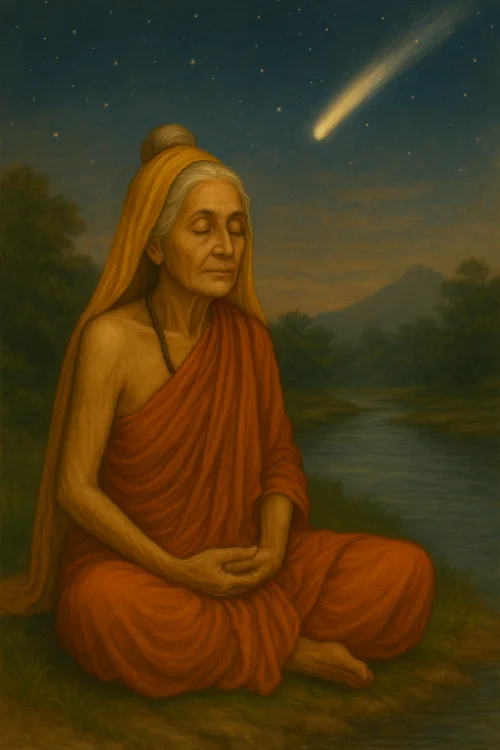
This account by Vaishampāyana tells of a maiden born from the penance of the sage Kuni-Garga, who, after her birth, ascended to heaven. The daughter, left alone, embraced a life of intense austerity and celibacy in the forest, rejecting all suitors as unworthy. Though her body was emaciated from years of penance, her spirit remained unwavering. When she reached old age and prepared to relinquish her body, the celestial sage Nārada appeared and told her that without marriage, her path to the afterlife remained incomplete. To fulfill this requirement, she offered half her merit to anyone who would marry her.
The sage Śṛṅgavat, son of Gālava, accepted under the condition their union would last only one night. Upon marriage, the maiden transformed into a radiant young woman. After their night together, she departed for heaven, having completed her vow, and proclaimed the sacredness of the Tīrtha where they had united. Anyone observing celibacy and offering rites there for a single night would gain immense merit. Śṛṅgavat, overcome with love and sorrow, later gave up his life and joined her in the celestial realms.
जनमेजय उवाच कथं कुमारी भगवंस्तपोयुक्ता ह्यभूत् पुरा । किमर्थं च तपस्तेपे को वास्या नियमोऽभवत् ॥ १ ॥ सुदुष्करमिदं ब्रह्मस्त्वत्तः श्रुतमनुत्तमम् । आख्याहि तत्त्वमखिलं यथा तपसि सा स्थिता ॥ २ ॥
janamejaya uvāca kathaṃ kumārī bhagavaṃstapoyuktā hyabhūt purā | kimarthaṃ ca tapastepe ko vāsyā niyamo’bhavat || 1 || suduṣkaramidaṃ brahmastvattaḥ śrutamanuttamam | ākhyāhi tattvamakhilaṃ yathā tapasi sā sthitā || 2 ||
Janamejaya said "Why, O Rishi, did that maiden practice ascetic penances in the day of yore? Why did she practice penances, and what was her vow?" Matchless and mysterious are topics that I have already heard from you. Describe particularly how that maid practiced penances."
वैशम्पायन उवाच ऋषिरासीन्महावीर्यः कुणिर्गर्गो महायशाः । स तप्त्वा विपुलं राजंस्तपो वै तपतां वरः ॥ ३ ॥ मनसाऽथ सुतां सुभ्रं समुत्पादितवान् विभुः । तां च दृष्ट्वा मुनिः प्रीतः कुणिर्गर्गो महायशाः ॥ ४ ॥
Vaishampayana said "There was a highly illustrious and energetic Rishi named Kuni-Garga. Having practiced the austerest of penances, O king, that best of ascetics, created a fair-browed daughter by his desire. Seeing her, the celebrated ascetic Kuni-Garga was filled with joy. He renounced his body, O king, and then went to heaven.
Meanwhile, that faultless, amiable, fair-browed maiden, having eyes like lotus petals, continued practicing severe and very rigid penances. She adored the Pitris and the gods with fasts.
She passed a long time in the practice of such severe penances. Though her father had been for giving her away in marriage, she did not wish for it, for she was no husband worthy of her.
At last, when she became very old and physically incapable of moving even a single step without being helped by anyone, she made up her mind to depart to the other world.
Seeing her about to relinquish her body, Narada said to her - O sinless one, you cannot attain any blissful region since you have not cleansed yourself by the rite of marriage.
एवं तु श्रुतमस्माभिर्देवलोके महाव्रते ॥ १२ ॥ तपः परमकं प्राप्तं न तु लोकास्त्वया जिताः ।
evaṃ tu śrutamasmābhirdevaloke mahāvrate || 12 || tapaḥ paramakaṃ prāptaṃ na tu lokāstvayā jitāḥ |
O you of great vows, we have heard this in heaven. Great has been your ascetic merit, but you have no claim to blissful regions.
After she said these words, the Galava's son, a Rishi known as Shringavat, married her under the following conditions. On this term, O fair one, I shall marry you, that you shall live with me for only one night!' Having agreed to that term, she gave him her hand.
यथादृष्टेन विधिना हुत्वा चाग्निं विधानतः । चक्रे च पाणिग्रहणं तस्योद्वाहं च गालविः ॥ १७ ॥
yathādṛṣṭena vidhinā hutvā cāgniṃ vidhānataḥ | cakre ca pāṇigrahaṇaṃ tasyodvāhaṃ ca gālaviḥ || 17 ||
According to the rites, Galava's son accepted her hand and married her after duly pouring libations on the fire.
सा रात्रावभवद् राजंस्तरुणी वरवर्णिनी । दिव्याभरणवस्त्रा च दिव्यगन्धानुलेपना ।। १८ ।।
On the night, she became a handsome young lady robed in celestial dress, decked in celestial ornaments, and smeared with celestial unguents and perfumes.
तां दृष्ट्वा गालविः प्रीतो दीपयन्तीमिव श्रिया । उवास च क्षपामेकां प्रभाते साऽब्रवीच्च तम् ॥ १९ ॥ यस्त्वया समया विप्र कृतो मे तपतां वर । नोषितास्मि भद्रं ते स्वस्ति तेऽस्तु ब्रजाम्यहम् ॥ २० ॥
tāṃ dṛṣṭvā gālaviḥ prīto dīpayantīmiva śriyā | uvāsa ca kṣapāmekāṃ prabhāte sā’bravīcca tam || 19 || yastvayā samayā vipra kṛto me tapatāṃ vara | noṣitāsmi bhadraṃ te svasti te’stu brajāmyaham || 20 ||
Seeing her beauty, Galava's son became very happy and spent one night in her company. In the morning, she said to him, ' O Brahmana, the agreement I had made with you has been satisfied, O best of ascetic! Blessed be you, I shall now leave you.'
सा निर्गताऽब्रवीद् भूयो योऽस्मिंस्तीर्थे समाहितः । वसन्ते रजनीमेकां तर्पयित्वा दिवौकसः ॥ २१॥ चत्वारिंशतमष्टौ च द्वौ चाष्टौ सम्यगाचरेत् । यो ब्रह्मचर्यं वर्षाणि फलं तस्य लभेत सः ॥ २२ ॥
After getting his permission, she once more said- 'He who will, with attention, pass one night in this Tirtha after having satisfied the celestials it oblations of water, shall obtain that merit which one, observing the vow of Brahmacharya for eight and fifty years, reaps.'
After saying these words, the chaste lady left for heaven. Her husband, Rishi, became very disappointed by thinking of her beauty.
समयेन तपोऽर्थं त कृच्छ्रात् प्रतिगृहीतवान् । साधयित्वा तदाऽऽत्मानं तस्याः स गतिमन्वियात् ॥ २४ ॥ दुःखितो भरतश्रेष्ठ तस्या रूपबलात्कृतः ।
samayena tapo’rthaṃ ta kṛcchrāt pratigṛhītavān | sādhayitvā tadā’’tmānaṃ tasyāḥ sa gatimanviyāt || 24 || duḥkhito bharataśreṣṭha tasyā rūpabalātkṛtaḥ |
Because of his agreement, he accepted half her penances with difficulty. Casting off his body, he soon followed her, O Bharata's chief, drawn by her sorrow and beauty.
एतत्ते वृद्धकन्याया व्याख्यातं चरितं महत् ॥ २५ ॥ तथैव ब्रह्मचर्यं च स्वर्गस्य च गतिः शुभा ।
etatte vṛddhakanyāyā vyākhyātaṃ caritaṃ mahat || 25 || tathaiva brahmacaryaṃ ca svargasya ca gatiḥ śubhā |
This illustrious history of the old woman illustrates that the path of celibacy and the way to celestial realms are auspicious.
While there, Baladeva heard of the destruction of Shalya. Having made presents to the Brahmanas there, he bewailed, O destroyer of foes, for Shalya, who the Pandavas had killed in battle.
Then, having come out of Samantapanchaka, Baladeva enquired with the Rishis about the results of the battle at Kurukshetra.
ते पृष्टा यदुसिंहेन कुरुक्षेत्रफलं विभो । समाचख्युर्महात्मानस्तस्मै सर्वं यथातथम्॥ २९॥
te pṛṣṭā yadusiṃhena kurukṣetraphalaṃ vibho | samācakhyurmahātmānastasmai sarvaṃ yathātatham|| 29||
When Yadu's chief asked about the Kurukshetra battle results, the great ones told him everything that had happened.
Full Synopsis of The Story of the Old Maiden
This narrative, recounted by Vaishampayana, details the extraordinary story of a maiden born of the ascetic power of the sage Kuni-Garga.
Kuni-Garga, an illustrious Rishi, created a daughter through his penances and departed for heaven after her birth. Left alone, the beautiful and virtuous maiden devoted her life to severe penances in a solitary forest, worshiping the gods and Pitris with unshakable determination. Despite her father’s intention for her to marry, she chose a life of celibacy, considering no one worthy of her.
Over the years, her devotion and austerities emaciated her body, yet she found joy in her ascetic life. The celestial sage Narada appeared when she reached an advanced age and prepared to relinquish her body. He revealed that despite her immense penance, she could not attain a blissful afterlife because she had not undergone the rite of marriage.
Determined to fulfill this requirement, the aged maiden approached a gathering of Rishis, offering half her accumulated penances to anyone who would marry her. A sage named Shringavat, the son of Galava agreed to wed her under the condition that their union would last only one night.
Upon marriage, the maiden transformed into a radiant young woman adorned in celestial beauty. Enchanted by her splendor, Shringavat spent a joyful night with her. By morning, the maiden, having fulfilled her vow, bid farewell to her husband and departed for heaven, declaring the sanctity of the Tirtha where they had united. She proclaimed that anyone observing Brahmacharya and offering oblations there for one night would gain immense merit equivalent to years of penance.
Shringavat, deeply enamored by her beauty and sorrowful at her departure, soon renounced his life and followed her to the celestial regions.
This tale accounts for the maiden's unwavering commitment to her vow of celibacy, her extraordinary penance, and her eventual attainment of the celestial realms. It underscores the sacred nature of duty, the transformative power of vows, and the spiritual significance of penance and ritual in achieving higher states of existence.