Vamana Mahapurana
Chapter 8 - Prahlāda’s Battle with Nara-Nārāyaṇa: Victory Through Devotion
Verse 1-3
पुलस्त्य उवाच ।
शार्ङ्गपाणिनमायान्तं दृष्ट्वाऽग्रे दानवेश्वरः ।
परिभ्राम्य गदां वेगान्मूर्ध्नि साध्यमताडयत् ॥ १ ॥
ताडितस्याथ गदया धर्मपुत्रस्य नारद ।
नेत्राभ्यामपतद् वारि वह्निवर्षनिभं भुवि ॥ २ ॥
मूर्ध्नि नारायणस्यापि सा गदा दानवार्पिता ।
जगाम शतधा ब्रह्मञ्छैलशृङ्गे यथाशनिः ॥ ३ ॥
pulastya uvāca |
śārṅgapāṇinam āyāntaṃ dṛṣṭvāgre dānaveśvaraḥ |
paribhrāmya gadāṃ vegān mūrdhni sādhyam atāḍayat || 1 ||
tāḍitasyātha gadayā dharmaputrasya nārada |
netrābhyām apatad vāri vahnivarṣanibhaṃ bhuvi || 2 ||
mūrdhni nārāyaṇasyāpi sā gadā dānavārpitā |
jagāma śatadhā brahmañ chailaśṛṅge yathāśaniḥ || 3 ||
Pulastya said: Seeing the wielder of Śārṅga approaching before him, the lord of the Dānavas swiftly whirled his mace and struck the Sādhya upon the head.
When that son of Dharma was struck by the mace, O Nārada, tears fell from his eyes to the ground like a shower of fire.
Yet that mace hurled by the Dānava shattered into a hundred pieces upon Nārāyaṇa’s head, O Brahman, like a thunderbolt striking the summit of a mountain.
Verse 4-6
ततो निवृत्य दैत्येन्द्रः समास्थाय रथं द्रुतम् ।
आदाय कार्मुकं वीरस्तूणाद् बाणं समाददे ॥ ४ ॥
आनम्य चापं वेगेन गार्ध्रपत्रान् शिलीमुखान् ।
मुमोच साध्याय तदा क्रोधान्धकारिताननः ॥ ५ ॥
तानापतत एवाशु बाणांश्चन्द्रार्धसन्निभान् ।
चिच्छेद बाणैरपरैर्निर्बिभेद च दानवम् ॥ ६ ॥
tato nivṛtya daityendraḥ samāsthāya rathaṃ drutam |
ādāya kārmukaṃ vīras tūṇād bāṇaṃ samādade || 4 ||
ānamya cāpaṃ vegena gārdhrapatrān śilīmukhān |
mumoca sādhyāya tadā krodhāndhakāritānanaḥ || 5 ||
tān āpatata evāśu bāṇāṃś candrārdhasannibhān |
ciccheda bāṇair aparair nirbibheda ca dānavam || 6 ||
The lord of the Daityas then withdrew, swiftly mounted his chariot, took up his bow, and drew an arrow from his quiver.
Bending his bow forcefully, he discharged at the Sādhya vulture-feathered arrows with sharp heads, his face darkened by anger.
Even as those crescent-moon-shaped arrows came rushing toward him, Nārāyaṇa swiftly cut them apart with other arrows and then thoroughly pierced the Dānava.
Verse 7-9
ततो नारायणं दैत्यो दैत्यं नारायणः शरैः ।
आविध्येतां तदाऽन्योन्यं मर्मभिद्भिरजिह्मगैः ॥ ७ ॥
ततोऽम्बरे संनिपातो देवानामभवन्मुने ।
दिदृक्षूणां तदा युद्धं लघु चित्रं च सुष्ठु च ॥ ८ ॥
ततः सुराणां दुन्दुभ्यस्त्ववाद्यन्त महास्वनाः ।
पुष्पवर्षमनौपम्यं मुमुचुः साध्यदैत्ययोः ॥ ९ ॥
tato nārāyaṇaṃ daityo daityaṃ nārāyaṇaḥ śaraiḥ |
āvidhyetāṃ tadānyonyaṃ marmabhidbhir ajihmagaiḥ || 7 ||
tato ’mbare saṃnipāto devānām abhavan mune |
didṛkṣūṇāṃ tadā yuddhaṃ laghu citraṃ ca suṣṭhu ca || 8 ||
tataḥ surāṇāṃ dundubhyas tv avādyanta mahāsvanāḥ |
puṣpavarṣam anaupamyaṃ mumucuḥ sādhyadaityayoḥ || 9 ||
Then the Daitya pierced Nārāyaṇa with arrows, and Nārāyaṇa pierced the Daitya; thus they wounded one another with straight-flying shafts that penetrated vital points.
Then, O sage, the gods who desired to witness that swift, extraordinary, and superbly conducted battle assembled in the sky.
Thereupon the loud-sounding drums of the gods were played, and they showered an incomparable rain of flowers upon both the Sādhya and the Daitya.
Verse 10-12
ततः पश्यत्सु देवेषु गगनस्थेषु तावुभौ ।
अयुध्येतां महेष्वासौ प्रेक्षकप्रीतिवर्द्धनम् ॥ १० ॥
बबन्धतुस्तदाकाशं तावुभौ शरवृष्टिभिः ।
दिशश्च विदिशश्चैव छादयेतां शरोत्करैः ॥ ११ ॥
ततो नारायणश्चापं समाकृष्य महामुने ।
बिभेद मार्गणैस्तीक्ष्णैः प्रह्लादं सर्वमर्मसु ॥ १२ ॥
tataḥ paśyatsu deveṣu gaganastheṣu tāv ubhau |
ayudhyetāṃ maheṣvāsau prekṣakaprītivarddhanam || 10 ||
babandhatus tad ākāśaṃ tāv ubhau śaravṛṣṭibhiḥ |
diśaś ca vidiśaś caiva chādayetāṃ śarotkaraiḥ || 11 ||
tato nārāyaṇaś cāpaṃ samākṛṣya mahāmune |
bibheda mārgaṇais tīkṣṇaiḥ prahlādaṃ sarvamarmasu || 12 ||
Then, while the gods watched from their positions in the sky, those two mighty bowmen fought in a manner that continually increased the delight of the spectators.
With their showers of arrows, the two of them seemed to bind the sky itself; with masses of shafts, they covered the cardinal and intermediate directions.
Then Nārāyaṇa, drawing back his bow, O great sage, pierced Prahlāda in all his vital points with sharp arrows.
Verse 13-15
तथा दैत्येश्वरः क्रुद्धश्चापमानम्य वेगवान् ।
बिभेद हृदये बाह्वोर्वदने च नरोत्तमम् ॥ १३ ॥
ततोऽस्यतो दैत्यपतेः कार्मुकं मुष्टिबन्धनात् ।
चिच्छेदैकेन बाणेन चन्द्रार्धाकारवर्चसा ॥ १४ ॥
अपास्यत् धनुश्छिन्नं चापमादाय चापरम् ।
अधिज्यं लाघवात् कृत्वा ववर्ष निशिताञ्शरान् ॥ १५ ॥
tathā daityeśvaraḥ kruddhaś cāpam ānamya vegavān |
bibheda hṛdaye bāhvor vadane ca narottamam || 13 ||
tato ’syato daityapateḥ kārmukaṃ muṣṭibandhanāt |
cicchedaikena bāṇena candrārdhākāravarcasā || 14 ||
apāsyat dhanuś chinnaṃ cāpam ādāya cāparam |
adhijyaṃ lāghavāt kṛtvā vavarṣa niśitāñ śarān || 15 ||
Likewise, the enraged and swift lord of the Daityas bent his bow and pierced that foremost of men in the heart, both arms, and face.
Then, while the lord of the Daityas was shooting, Nārāyaṇa severed his bow at the handgrip with a single arrow whose brilliant form resembled a crescent moon.
Prahlāda cast aside the severed bow, took up another bow, swiftly strung it with great dexterity, and showered forth sharp arrows.
Verse 16-18
तानप्यस्य शरान् साध्यश्छित्त्वा बाणैरवारयत् ।
कार्मुकं च क्षुरप्रेण चिच्छेद पुरुषोत्तमः ॥ १६ ॥
छिन्नं छिन्नं धनुर्दैत्यस्त्वन्यदन्यत्समाददे ।
समादत्तं तदा साध्यो मुने चिच्छेद लाघवात् ॥ १७ ॥
संछिन्नेष्वथ चापेषु जग्राह दितिजेश्वरः ।
परिघं दारुणं दीर्घं सर्वलोहमयं दृढम् ॥ १८ ॥
tān apy asya śarān sādhyaś chittvā bāṇair avārayat |
kārmukaṃ ca kṣurapreṇa ciccheda puruṣottamaḥ || 16 ||
chinnaṃ chinnaṃ dhanur daityas tv anyad anyat samādade |
samādattaṃ tadā sādhyo mune ciccheda lāghavāt || 17 ||
saṃchinneṣv atha cāpeṣu jagrāha ditijeśvaraḥ |
parighaṃ dāruṇaṃ dīrghaṃ sarvalohamayaṃ dṛḍham || 18 ||
The Sādhya cut apart those arrows of his as well and repelled them with his own shafts; then Puruṣottama severed his bow with a razor-headed arrow.
Whenever one bow was cut, the Daitya took up another and yet another; but each bow, the moment it was taken up, the Sādhya severed through his extraordinary dexterity, O sage.
Then, when all his bows had been cut apart, the lord of the descendants of Diti seized a formidable, long, solid weapon made entirely of iron—a parigha.
Verse 19-21
परिगृह्याथ परिघं भ्रामयामास दानवः ।
भ्राम्यमाणं स चिच्छेद नाराचेन महामुनिः ॥ १९ ॥
छिन्ने तु परिघे श्रीमान् प्रह्लादो दानवेश्वरः ।
मुद्गरं भ्राम्य वेगेन प्रचिक्षेप नराग्रजे ॥ २० ॥
तमापतन्तं बलवान् मार्गणैर्दशभिर्मुने ।
चिच्छेद दशधा साध्यः स छिन्नो न्यपतद् भुवि ॥ २१ ॥
parigṛhyātha parighaṃ bhrāmayāmāsa dānavaḥ |
bhrāmyamāṇaṃ sa ciccheda nārācena mahāmuniḥ || 19 ||
chinne tu parighe śrīmān prahlādo dānaveśvaraḥ |
mudgaraṃ bhrāmya vegena pracikṣepa narāgraje || 20 ||
tam āpatantaṃ balavān mārgaṇair daśabhir mune |
ciccheda daśadhā sādhyaḥ sa chinno nyapatad bhuvi || 21 ||
Having grasped the iron bar, the Dānava began to whirl it. But the great sage cut it apart with a nārāca arrow while it was still spinning.
When the iron bar had been severed, the illustrious Prahlāda, lord of the Dānavas, forcefully whirled a heavy hammer-like club and hurled it at Nara’s elder brother.
As that weapon came rushing toward him, the mighty Sādhya cut it into ten pieces with ten arrows, O sage. Thus severed, it fell to the ground.
Verse 22-24
मुद्गरे वितथे जाते प्रासमाविध्य वेगवान् ।
प्रचिक्षेप नराग्र्याय तं च चिच्छेद धर्मजः ॥ २२ ॥
प्रासे छिन्ने ततो दैत्यः शक्तिमादाय चिक्षिपे ।
तां च चिच्छेद बलवान् क्षुरप्रेण महातपाः ॥ २३ ॥
छिन्नेषु तेषु शस्त्रेषु दानवोऽन्यन्महद्धनुः ।
समादाय ततो बाणैरवतस्तार नारद ॥ २४ ॥
mudgare vitathe jāte prāsam āvidhya vegavān |
pracikṣepa narāgryāya taṃ ca ciccheda dharmajaḥ || 22 ||
prāse chinne tato daityaḥ śaktim ādāya cikṣipe |
tāṃ ca ciccheda balavān kṣurapreṇa mahātapāḥ || 23 ||
chinneṣu teṣu śastreṣu dānavo ’nyan mahad dhanuḥ |
samādāya tato bāṇair avatastāra nārada || 24 ||
When the heavy hammer had proved ineffective, the swift Prahlāda brandished a spear and hurled it at the foremost of men, but the son of Dharma cut it apart.
When the spear had been severed, the Daitya took up a śakti and hurled it. But the powerful great ascetic cut that weapon apart with a razor-headed arrow.
When those weapons had been destroyed, the Dānava took up another great bow and then covered Nārāyaṇa with arrows, O Nārada.
Verse 25-27
ततो नारायणो देवो दैत्यनाथं जगद्गुरुः ।
नाराचेन जघानाथ हृदये सुरतापसः ॥ २५ ॥
सम्भिन्नहृदयो ब्रह्मन् देवेनाद्भुतकर्मणा ।
निपपात रथोपस्थे तमपोवाह सारथिः ॥ २६ ॥
स संज्ञां सुचिरेणैव प्रतिलभ्य दितीश्वरः ।
सुदृढं चापमादाय भूयो योद्धुमुपागतः ॥ २७ ॥
tato nārāyaṇo devo daityanāthaṃ jagadguruḥ |
nārācena jaghānātha hṛdaye suratāpasaḥ || 25 ||
sambhinnahṛdayo brahman devenādbhutakarmaṇā |
nipapāta rathopasthe tam apovāha sārathiḥ || 26 ||
sa saṃjñāṃ sucireṇaiva pratilabhya ditīśvaraḥ |
sudṛḍhaṃ cāpam ādāya bhūyo yoddhum upāgataḥ || 27 ||
Then the divine Nārāyaṇa—the teacher of the world and ascetic among the gods—struck the lord of the Daityas in the heart with a nārāca arrow.
His heart deeply pierced by the god of wondrous deeds, Prahlāda collapsed upon the platform of his chariot, O Brahman, and his charioteer carried him away.
Only after a long time did the lord of the Diti descendants regain consciousness. Taking up a very strong bow, he returned once more to fight.
Verse 28-30
तमागतं संनिरीक्ष्य प्रत्युवाच नराग्रजः ।
गच्छ दैत्येन्द्र योत्स्यामः प्रातस्त्वाह्निकमाचर ॥ २८ ॥
एवमुक्तो दितीशस्तु साध्येनाद्भुतकर्मणा ।
जगाम नैमिषारण्यं क्रियां चक्रे तदाह्निकीम् ॥ २९ ॥
एवं युध्यति देवे च प्रह्लादो ह्यसुरो मुने ।
रात्रौ चिन्तयते युद्धे कथं जेष्यामि दाम्भिकम् ॥ ३० ॥
tam āgataṃ saṃnirīkṣya pratyuvāca narāgrajaḥ |
gaccha daityendra yotsyāmaḥ prātas tv āhnikam ācara || 28 ||
evam ukto ditīśas tu sādhyenādbhutakarmaṇā |
jagāma naimiṣāraṇyaṃ kriyāṃ cakre tadāhnikīm || 29 ||
evaṃ yudhyati deve ca prahlādo hy asuro mune |
rātrau cintayate yuddhe kathaṃ jeṣyāmi dāmbhikam || 30 ||
Seeing him return, Nara’s elder brother said to him: “Go now, O lord of the Daityas. We shall fight in the morning; perform your prescribed daily observance.”
Thus addressed by the Sādhya of wondrous deeds, the lord of Diti’s descendants went to the Naimiṣa forest and performed his daily religious rites.
Thus engaged in battle with the god, the Asura Prahlāda, O sage, reflected during the night: “How shall I defeat this hypocrite in combat?”
Verse 31-33
एवं नारायणेनासौ सहायुध्यत नारद ।
दिव्यं वर्षसहस्रं तु दैत्यो देवं न चाजयत् ॥ ३१ ॥
ततो वर्षसहस्रान्ते ह्यजिते पुरुषोत्तमे ।
पीतवाससमभ्येत्य दानवो वाक्यमब्रवीत् ॥ ३२ ॥
किमर्थं देवदेवेश साध्यं नारायणं हरिम् ।
विजेतुं नाद्य शक्नोमि एतन्मे कारणं वद ॥ ३३ ॥
evaṃ nārāyaṇenāsau sahāyudhyata nārada |
divyaṃ varṣasahasraṃ tu daityo devaṃ na cājayat || 31 ||
tato varṣasahasrānte hy ajite puruṣottame |
pītavāsasam abhyetya dānavo vākyam abravīt || 32 ||
kimarthaṃ devadeveśa sādhyaṃ nārāyaṇaṃ harim |
vijetuṃ nādya śaknomi etan me kāraṇaṃ vada || 33 ||
In this manner, he fought with Nārāyaṇa, O Nārada; yet even throughout a thousand divine years, the Daitya was unable to conquer the god.
Then, at the end of those thousand years, when Puruṣottama still remained unconquered, the Dānava approached the Yellow-robed Lord and addressed him.
“Why, O Lord of the gods of gods, am I even now unable to conquer the Sādhya—Nārāyaṇa, Hari? Tell me the reason for this.”
Verse 34-36
पीतवासा उवाच ।
दुर्जयोऽसौ महाबाहुस्त्वया प्रह्लाद धर्मजः ।
साध्यो विप्रवरो धीमान् मृधे देवासुरैरपि ॥ ३४ ॥
प्रह्लाद उवाच ।
यद्यसौ दुर्जयो देव मया साध्यो रणाजिरे ।
तत्कथं यत्प्रतिज्ञातं तदसत्यं भविष्यति ॥ ३५ ॥
हीनप्रतिज्ञो देवेश कथं जीवेत मादृशः ।
तस्मात्तवाग्रतो विष्णो करिष्ये कायशोधनम् ॥ ३६ ॥
pītavāsā uvāca |
durjayo ’sau mahābāhus tvayā prahlāda dharmajaḥ |
sādhyo vipravaro dhīmān mṛdhe devāsurair api || 34 ||
prahlāda uvāca |
yady asau durjayo deva mayā sādhyo raṇājire |
tat kathaṃ yat pratijñātaṃ tad asatyaṃ bhaviṣyati || 35 ||
hīnapratijño deveśa kathaṃ jīveta mādṛśaḥ |
tasmāt tavāgrato viṣṇo kariṣye kāyaśodhanam || 36 ||
The Yellow-robed Lord said: “O Prahlāda, that mighty-armed son of Dharma cannot be conquered by you. The Sādhya—wise and foremost among Brahmins—is unconquerable in battle even by gods and Asuras.”
Prahlāda said: “O Lord, if that Sādhya cannot be conquered by me upon the field of battle, what then of the vow I made? It will prove false.
O Lord of the gods, how could one such as I continue to live after failing in his vow? Therefore, O Viṣṇu, before your very presence, I shall undertake the purification of my body.”
Verse 37-38
पुलस्त्य उवाच ।
इत्येवमुक्त्वा वचनं देवाग्रे दानवेश्वरः ।
शिरःस्नातस्तदा तस्थौ गृणन् ब्रह्म सनातनम् ॥ ३७ ॥
ततो दैत्यपतिं विष्णुः पीतवासाऽब्रवीद् वचः ।
गच्छ जेष्यसि भक्त्या तं न युद्धेन कथञ्चन ॥ ३८ ॥
pulastya uvāca |
ity evam uktvā vacanaṃ devāgre dānaveśvaraḥ |
śiraḥsnātas tadā tasthau gṛṇan brahma sanātanam || 37 ||
tato daityapatiṃ viṣṇuḥ pītavāsābravīd vacaḥ |
gaccha jeṣyasi bhaktyā taṃ na yuddhena kathañcana || 38 ||
Pulastya said: Having spoken these words, the lord of the Dānavas performed a purificatory bath and then stood before the god, praising the eternal Brahman.
Then Viṣṇu, the Yellow-robed Lord, addressed the lord of the Daityas: “Go—you will conquer him through devotion, but never through battle.”
Verse 39-40
प्रह्लाद उवाच ।
मया जितं देवदेव त्रैलोक्यमपि सुव्रत ।
जितोऽयं त्वत्प्रसादेन शक्रः किमुत धर्मजः ॥ ३९ ॥
असौ यद्यजयो देव त्रैलोक्येनापि सुव्रतः ।
न स्थातुं त्वत्प्रसादेन शक्यं किमु करोम्यज ॥ ४० ॥
prahlāda uvāca |
mayā jitaṃ devadeva trailokyam api suvrata |
jito ’yaṃ tvatprasādena śakraḥ kim uta dharmajaḥ || 39 ||
asau yady ajayo deva trailokyenāpi suvrataḥ |
na sthātuṃ tvatprasādena śakyaṃ kim u karomy aja || 40 ||
Prahlāda said: “O God of gods, O you of excellent vows, even the three worlds have been conquered by me. Through your grace, this Śakra too was conquered—how much more, then, the son of Dharma?
Even if that observer of excellent vows is unconquerable, O Lord, even by all the three worlds, through your grace, he should not be able to stand against me. What, then, am I to do, O Unborn One?”
Verse 41-43
पीतवासा उवाच ।
सोऽहं दानवशार्दूल लोकानां हितकाम्यया ।
धर्मं प्रवर्त्तापयितुं तपश्चर्यां समास्थितः ॥ ४१ ॥
तस्माद्यदिच्छसि जयं तमाराधय दानव ।
तं पराजेष्यसे भक्त्या तस्माच्छुश्रूष धर्मजम् ॥ ४२ ॥
पुलस्त्य उवाच ।
इत्युक्तः पीतवासेन दानवेन्द्रो महात्मना ।
अब्रवीद्वचनं हृष्टः समाहूयाऽन्धकं मुने ॥ ४३ ॥
pītavāsā uvāca |
so ’haṃ dānavaśārdūla lokānāṃ hitakāmyayā |
dharmaṃ pravarttāpayituṃ tapaścaryāṃ samāsthitaḥ || 41 ||
tasmād yad icchasi jayaṃ tam ārādhaya dānava |
taṃ parājeṣyase bhaktyā tasmāc chuśrūṣa dharmajam || 42 ||
pulastya uvāca |
ity uktaḥ pītavāsena dānavendro mahātmanā |
abravīd vacanaṃ hṛṣṭaḥ samāhūyāndhakaṃ mune || 43 ||
The Yellow-robed Lord said: “I am that very one, O tiger among the Dānavas. Desiring the welfare of the worlds, I have undertaken the practice of austerity in order to establish dharma.
Therefore, O Dānava, since you desire victory, worship him. Through devotion, you will conquer him; hence, render devoted service to the son of Dharma.”
Pulastya said: Thus instructed by the magnanimous Yellow-robed Lord, the delighted king of the Dānavas summoned Andhaka and addressed him, O sage.
Verse 44-47
प्रह्लाद उवाच ।
दैत्याश्च दानवाश्चैव परिपाल्यास्त्वयाऽन्धक ।
मयोत्सृष्टमिदं राज्यं प्रतीच्छस्व महाभुज ॥ ४४ ॥
इत्येवमुक्तो जग्राह राज्यं हैरण्यलोचनिः ।
प्रह्लादोऽपि तदाऽगच्छत् पुण्यं बदरिकाश्रमम् ॥ ४५ ॥
दृष्ट्वा नारायणं देवं नरं च दितिजेश्वरः ।
कृताञ्जलिपुटो भूत्वा ववन्दे चरणौ तयोः ॥ ४६ ॥
तमुवाच महातेजा वाक्यं नारायणोऽव्ययः ।
किमर्थं प्रणतोऽसीह मामजित्वा महासुर ॥ ४७ ॥
prahlāda uvāca |
daityāś ca dānavāś caiva paripālyās tvayāndhaka |
mayotsṛṣṭam idaṃ rājyaṃ pratīcchasva mahābhuja || 44 ||
ity evam ukto jagrāha rājyaṃ hairaṇyalocaniḥ |
prahlādo ’pi tadāgacchat puṇyaṃ badarikāśramam || 45 ||
dṛṣṭvā nārāyaṇaṃ devaṃ naraṃ ca ditijeśvaraḥ |
kṛtāñjalipuṭo bhūtvā vavande caraṇau tayoḥ || 46 ||
tam uvāca mahātejā vākyaṃ nārāyaṇo ’vyayaḥ |
kimarthaṃ praṇato ’sīha mām ajitvā mahāsura || 47 ||
Prahlāda said: “O Andhaka, the Daityas and Dānavas must now be protected by you. I relinquish this kingdom; accept it, O mighty-armed one.”
Thus addressed, the golden-eyed Andhaka accepted the kingdom. Prahlāda then went to the sacred hermitage of Badarī.
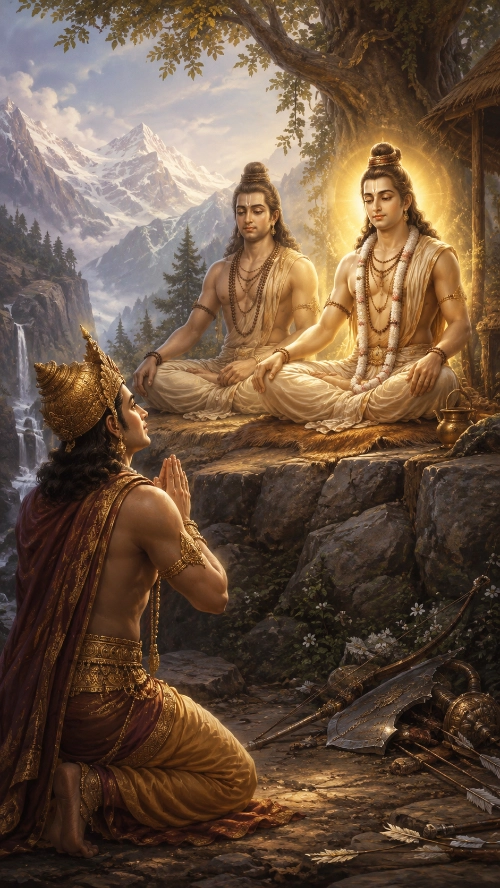
Seeing the divine Nārāyaṇa and Nara, the lord of the descendants of Diti joined his hands reverently and bowed at the feet of both.
The imperishable and greatly radiant Nārāyaṇa addressed him: “Why have you bowed before me here, O great Asura, without first defeating me?”
प्रह्लाद उवाच
कस्त्वां जेतुं प्रभो शक्तः कस्त्वत्तः पुरुषोऽधिकः
त्वं हि नारायणोऽनन्तः पीतवासा जनार्दनः ४८
त्वं देवः पुण्डरीकाक्षस्त्वं विष्णुः शार्ङ्गचापधृक्
त्वमव्ययो महेशानः शाश्वतः पुरुषोत्तमः ४६
त्वां योगिनश्चिन्तयन्ति चार्चयन्ति मनीषिणः
जपन्ति स्नातकास्त्वां च यजन्ति त्वां च याज्ञिकाः ५०
prahlāda uvāca |
kas tvāṃ jetuṃ prabho śaktaḥ kas tvattaḥ puruṣo ’dhikaḥ |
tvaṃ hi nārāyaṇo ’nantaḥ pītavāsā janārdanaḥ || 48 ||
tvaṃ devaḥ puṇḍarīkākṣas tvaṃ viṣṇuḥ śārṅgacāpadhṛk |
tvam avyayo maheśānaḥ śāśvataḥ puruṣottamaḥ || 49 ||
tvāṃ yoginaś cintayanti cārcayanti manīṣiṇaḥ |
japanti snātakās tvāṃ ca yajanti tvāṃ ca yājñikāḥ || 50 ||
Prahlāda said: “Who, O Lord, is capable of conquering you? What being could be superior to you? For you are Nārāyaṇa, the Infinite One, the Yellow-robed Lord, Janārdana.
You are the divine Lotus-eyed One; you are Viṣṇu, the bearer of the Śārṅga bow. You are imperishable, the Supreme Lord, eternal, and the Highest Person.
Yogins meditate upon you, and the wise worship you; those who have completed their sacred studentship repeat your name, while the performers of sacrifice offer sacrifice to you.”
Verse 51-53
त्वमच्युतो हृषीकेशश्चक्रपाणिर्धराधरः ।
महामीनो हयशिरास्त्वमेव वरकच्छपः ॥ ५१ ॥
हिरण्याक्षरिपुः श्रीमान् भगवानथ सूकरः ।
मत्पितुर्नाशनकरो भवानपि नृकेसरी ॥ ५२ ॥
ब्रह्मा त्रिनेत्रोऽमरराड् हुताशः
प्रेताधिपो नीरपतिः समीरः ।
सूर्यो मृगाङ्कोऽचलजङ्गमाद्यो
भवान् विभो नाथ खगेन्द्रकेतो ॥ ५३ ॥
tvam acyuto hṛṣīkeśaś cakrapāṇir dharādharaḥ |
mahāmīno hayaśirās tvam eva varakacchapaḥ || 51 ||
hiraṇyākṣaripuḥ śrīmān bhagavān atha sūkaraḥ |
matpitur nāśanakaro bhavān api nṛkesarī || 52 ||
brahmā trinetro ’mararāḍ hutāśaḥ
pretādhipo nīrapatiḥ samīraḥ |
sūryo mṛgāṅko ’calajaṅgamādyo
bhavān vibho nātha khagendraketo || 53 ||
You are Acyuta, Hṛṣīkeśa, the wielder of the discus, and the supporter of the earth. You are the Great Fish, the Horse-headed Lord, and you alone are the excellent Tortoise.
You are the glorious Lord in the form of the Boar, the enemy of Hiraṇyākṣa, and you are also the Man-lion who brought about the destruction of my father.
You are Brahmā; you are the Three-eyed Lord, the king of the immortals, and the consuming Fire. You are the lord of the departed, the lord of the waters, and the Wind. You are the Sun and the Moon, and the primordial source of all that is immovable and moving. You are all these, O all-pervading Lord, O Master whose banner bears the king of birds.
Verse 54-55
त्वं पृथ्वी ज्योतिराकाशं जलं भूत्वा सहस्रशः ।
त्वया व्याप्तं जगत्सर्वं कस्त्वां जेष्यति माधव ॥ ५४ ॥
भक्त्या यदि हृषीकेश तोषमेषि जगद्गुरो ।
नान्यथा त्वं प्रशक्योऽसि जेतुं सर्वगताव्यय ॥ ५५ ॥
tvaṃ pṛthvī jyotir ākāśaṃ jalaṃ bhūtvā sahasraśaḥ |
tvayā vyāptaṃ jagat sarvaṃ kas tvāṃ jeṣyati mādhava || 54 ||
bhaktyā yadi hṛṣīkeśa toṣam eṣi jagadguro |
nānyathā tvaṃ praśakyo ’si jetuṃ sarvagatāvyaya || 55 ||
Becoming earth, light, space, and water in countless forms, you pervade the entire universe. Who could conquer you, O Mādhava?
It is through devotion that you become pleased, O Hṛṣīkeśa, O teacher of the world. In no other way can you be conquered, O all-pervading and imperishable Lord.
Verse 56-57
भगवानुवाच ।
परितुष्टोऽस्मि ते दैत्य स्तवेनानेन सुव्रत ।
भक्त्या त्वनन्यया चाहं त्वया दैत्य पराजितः ॥ ५६ ॥
पराजितश्च पुरुषो दैत्य दण्डं प्रयच्छति ।
दण्डार्थं ते प्रदास्यामि वरं वृणु यमिच्छसि ॥ ५७ ॥
bhagavān uvāca |
parituṣṭo ’smi te daitya stavenānena suvrata |
bhaktyā tv ananyayā cāhaṃ tvayā daitya parājitaḥ || 56 ||
parājitaś ca puruṣo daitya daṇḍaṃ prayacchati |
daṇḍārthaṃ te pradāsyāmi varaṃ vṛṇu yam icchasi || 57 ||
The Blessed Lord said: “O Daitya, O you of excellent vows, I am completely pleased with this hymn of yours. Through your exclusive devotion, O Daitya, I have been conquered by you.
A person who has been defeated must offer a forfeit, O Daitya. Therefore, as my recompense for defeat, I shall grant you a boon—choose whatever you desire.”
Verse 58-59
प्रह्लाद उवाच ।
नारायण वरं याचे यं त्वं मे दातुमर्हसि ।
तन्मे पापं लयं यातु शारीरं मानसं तथा ॥ ५८ ॥
वाचिकं च जगन्नाथ यत्त्वया सह युध्यतः ।
नरेण यद्यप्यभवद् वरमेतत्प्रयच्छ मे ॥ ५९ ॥
prahlāda uvāca |
nārāyaṇa varaṃ yāce yaṃ tvaṃ me dātum arhasi |
tan me pāpaṃ layaṃ yātu śārīraṃ mānasaṃ tathā || 58 ||
vācikaṃ ca jagannātha yat tvayā saha yudhyataḥ |
nareṇa yady apy abhavad varam etat prayaccha me || 59 ||
Prahlāda said: “O Nārāyaṇa, I ask for the boon that you should grant me: may the sin I incurred—bodily and mental— and verbal as well, O Lord of the world—whatever arose while I was fighting with you and also with Nara—pass into dissolution. Grant me this boon.”
Verse 60-61
नारायण उवाच ।
एवं भवतु दैत्येन्द्र पापं ते यातु संक्षयम् ।
द्वितीयं प्रार्थय वरं तं ददामि तवाऽसुर ॥ ६० ॥
प्रह्लाद उवाच ।
या या जायेत मे बुद्धिः सा सा विष्णो त्वदाश्रिता ।
देवार्चने च निरता त्वच्चित्ता त्वत्परायणा ॥ ६१ ॥
nārāyaṇa uvāca |
evaṃ bhavatu daityendra pāpaṃ te yātu saṃkṣayam |
dvitīyaṃ prārthaya varaṃ taṃ dadāmi tavāsura || 60 ||
prahlāda uvāca |
yā yā jāyeta me buddhiḥ sā sā viṣṇo tvadāśritā |
devārcane ca niratā tvaccittā tvatparāyaṇā || 61 ||
Nārāyaṇa said: “So be it, O lord of the Daityas. May your sin pass into complete destruction. Ask for a second boon, O Asura, and I shall grant it to you.”
Prahlāda said: “Whatever thought or disposition may arise within me, O Viṣṇu, may each one remain dependent upon you—constantly devoted to divine worship, with its consciousness fixed upon you and wholly directed toward you.”
Verse 62-63
नारायण उवाच ।
एवं भविष्यत्यसुर वरमन्यं यमिच्छसि ।
तं वृणीष्व महाबाहो प्रदास्याम्यविचारयन् ॥ ६२ ॥
प्रह्लाद उवाच ।
सर्वमेव मया लब्धं त्वत्प्रसादादधोक्षज ।
त्वत्पादपङ्कजाभ्यां हि ख्यातिरस्तु सदा मम ॥ ६३ ॥
nārāyaṇa uvāca |
evaṃ bhaviṣyaty asura varam anyaṃ yam icchasi |
taṃ vṛṇīṣva mahābāho pradāsyāmy avicārayan || 62 ||
prahlāda uvāca |
sarvam eva mayā labdhaṃ tvatprasādād adhokṣaja |
tvatpādapaṅkajābhyāṃ hi khyātir astu sadā mama || 63 ||
Nārāyaṇa said: “So shall it be, O Asura. Choose whatever other boon you desire, O mighty-armed one; I shall grant it without hesitation.”
Prahlāda said: “Through your grace, O Adhokṣaja, I have already obtained everything. May my renown always arise from devotion to your lotus feet.”
Verse 64-66
नारायण उवाच ।
एवमस्त्वपरं चास्तु नित्यमेवाक्षयोऽव्ययः ।
अजरश्चामरश्चापि मत्प्रसादाद् भविष्यसि ॥ ६४ ॥
गच्छस्व दैत्यशार्दूल स्वमावासं क्रियारतः ।
न कर्मबन्धो भवतो मच्चित्तस्य भविष्यति ॥ ६५ ॥
प्रशासयामून् दैत्यान् राज्यं पालय शाश्वतम् ।
स्वजातिसदृशं दैत्य कुरु धर्ममनुत्तमम् ॥ ६६ ॥
nārāyaṇa uvāca |
evam astv aparaṃ cāstu nityam evākṣayo ’vyayaḥ |
ajaraś cāmaraś cāpi matprasādād bhaviṣyasi || 64 ||
gacchasva daityaśārdūla svam āvāsaṃ kriyārataḥ |
na karmabandho bhavato maccittasya bhaviṣyati || 65 ||
praśāsayāmūn daityān rājyaṃ pālaya śāśvatam |
svajātisadṛśaṃ daitya kuru dharmam anuttamam || 66 ||
Nārāyaṇa said: “So be it. And let there be this further blessing: through my grace, you shall remain forever undecaying and imperishable, free from old age and immortal.
Return to your own abode, O tiger among the Daityas, and remain devoted to your prescribed duties. No bondage arising from action shall befall you, for your mind is fixed upon me.
Govern these Daityas and protect the enduring kingdom. O Daitya, practice the unsurpassed dharma that is appropriate to your own people and station.”
Verse 67-69
पुलस्त्य उवाच ।
इत्युक्तो लोकनाथेन प्रह्लादो देवमब्रवीत् ।
कथं राज्यं समादास्ये परित्यक्तं जगद्गुरो ॥ ६७ ॥
तमुवाच जगत्स्वामी गच्छ त्वं निजमाश्रयम् ।
हितोपदेष्टा दैत्यानां दानवानां तथा भव ॥ ६८ ॥
नारायणेनैवमुक्तः स तदा दैत्यनायकः ।
प्रणिपत्य विभुं तुष्टो जगाम नगरं निजम् ॥ ६९ ॥
pulastya uvāca |
ity ukto lokanāthena prahlādo devam abravīt |
kathaṃ rājyaṃ samādāsye parityaktaṃ jagadguro || 67 ||
tam uvāca jagatsvāmī gaccha tvaṃ nijam āśrayam |
hitopadeṣṭā daityānāṃ dānavānāṃ tathā bhava || 68 ||
nārāyaṇenaivam uktaḥ sa tadā daityanāyakaḥ |
praṇipatya vibhuṃ tuṣṭo jagāma nagaraṃ nijam || 69 ||
Pulastya said: Thus addressed by the Lord of the worlds, Prahlāda said to the god: “O teacher of the world, how can I take up again the kingdom that I have relinquished?”
The Lord of the universe replied to him: “Return to your own abode and become a beneficent counselor to the Daityas and Dānavas.”
Thus instructed by Nārāyaṇa, the leader of the Daityas bowed before the all-pervading Lord and, filled with contentment, returned to his own city.
Verse 70-72
दृष्टः सभाजितश्चापि दानवैरन्धकेन च ।
निमन्त्रितश्च राज्याय न प्रत्यैच्छत्स नारद ॥ ७० ॥
राज्यं परित्यज्य महासुरेन्द्रो
नियोजयन् सत्पथि दानवेन्द्रान् ।
ध्यायन् स्मरन् केशवमप्रमेयं
तस्थौ तदा योगविशुद्धदेहः ॥ ७१ ॥
एवं पुरा नारद दानवेन्द्रो
नारायणेनोत्तमपूरुषेण ।
पराजितश्चापि विमुच्य राज्यं
तस्थौ मनो धातरि सन्निवेश्य ॥ ७२ ॥
dṛṣṭaḥ sabhājitaś cāpi dānavair andhakena ca |
nimantritaś ca rājyāya na pratyaicchat sa nārada || 70 ||
rājyaṃ parityajya mahāsurendro
niyojayan satpathi dānavendrān |
dhyāyan smaran keśavam aprameyaṃ
tasthau tadā yogaviśuddhadehaḥ || 71 ||
evaṃ purā nārada dānavendro
nārāyaṇenottamapūruṣeṇa |
parājitaś cāpi vimucya rājyaṃ
tasthau mano dhātari sanniveśya || 72 ||
He was received and honored by the Dānavas and by Andhaka, and was invited to assume the kingdom; but he did not accept it, O Nārada.
Having relinquished the kingdom, the great lord of the Asuras directed the chiefs of the Dānavas along the righteous path. Meditating upon and continually remembering the immeasurable Keśava, he remained there with his embodied being purified through yoga.
Thus, in ancient times, O Nārada, the lord of the Dānavas, was defeated by Nārāyaṇa, the Supreme Person. Relinquishing the kingdom, he remained with his mind firmly established in the divine Sustainer.
Synopsis of Chapter 8 — Prahlāda’s Battle with Nara-Nārāyaṇa: Victory Through Devotion
The Escalation of the Divine Combat
The chapter opens with Prahlāda’s direct assault upon Nārāyaṇa, identified through titles such as Śārṅgapāṇin, Sādhya, Dharmaja, and Nara’s elder brother. The battle progresses through increasingly powerful classes of weapons: mace, bow and arrows, iron bar, hammer-club, spear, and śakti. Nārāyaṇa neutralizes each attack with exceptional precision, repeatedly severing Prahlāda’s weapons in mid-flight. The detailed martial vocabulary emphasizes not brute force alone, but mastery of archery, specialized arrowheads, speed, and technical dexterity.
A Cosmically Witnessed Contest
Prahlāda and Nārāyaṇa initially appear evenly matched, piercing one another with arrows aimed at vital points and filling the entire sky with showers of shafts. The gods assemble in the heavens to observe the duel, sounding celestial drums and showering flowers upon both combatants. Their reaction frames the conflict as an extraordinary display of divine and heroic skill rather than a conventional struggle between good and evil. Nevertheless, Nārāyaṇa’s superiority gradually becomes unmistakable: he destroys every weapon Prahlāda takes up and finally strikes him in the heart, causing him to lose consciousness.
Warfare Governed by Dharma
Even while engaged in prolonged combat, Nārāyaṇa remains an ascetic and guardian of the religious order. When Prahlāda returns after recovering from his wounds, Nārāyaṇa suspends the battle at night and instructs him to perform his prescribed daily rites before fighting resumes. The episode demonstrates that warfare does not override ritual discipline. The conflict continues for a thousand divine years, yet Prahlāda remains unable to conquer his opponent, proving that perseverance, military expertise, and supernatural strength are insufficient against the divine ascetic.
Viṣṇu Reveals His Identity
Unable to understand his failure, Prahlāda approaches the Yellow-robed Viṣṇu and asks why Nārāyaṇa cannot be defeated. Viṣṇu reveals the central theological truth of the chapter: “I am that very one.” Nārāyaṇa is not an independent ascetic warrior but Viṣṇu himself, performing austerities for the welfare of the worlds and the establishment of dharma. Prahlāda’s apparent attempt to gain Viṣṇu’s assistance against Nārāyaṇa is therefore based on a fundamental misunderstanding of divine identity.
Conquest Redefined as Bhakti
Viṣṇu explains that Nārāyaṇa cannot be defeated through battle but may be “conquered” through devotion. Prahlāda consequently renounces his kingdom, approaches Nara and Nārāyaṇa at Badarikāśrama, bows before them, and praises Nārāyaṇa as the supreme and all-pervading Lord. His hymn identifies Nārāyaṇa with Viṣṇu’s principal avatāras, the major cosmic deities, the elements, and the source of all moving and unmoving existence. The chapter thus transforms the language of military victory into a theology of bhakti: the omnipresent and imperishable God willingly allows himself to be overcome by exclusive devotion.
Purification, Boons, and the Renunciation of Kingship
Having been “defeated” by Prahlāda’s devotion, Nārāyaṇa offers him boons. Prahlāda first requests the destruction of every bodily, verbal, and mental sin incurred during his hostility toward Nara and Nārāyaṇa. He then asks that every movement of his intellect remain fixed upon Viṣṇu and that his renown arise solely from devotion to the Lord’s lotus feet. Nārāyaṇa grants him freedom from decay, old age, death, and karmic bondage, and instructs him to guide the Daityas in accordance with dharma. Prahlāda refuses to reclaim the throne and instead becomes a spiritual counselor, continually meditating upon Keśava. His physical defeat, therefore, culminates in a higher victory: purification, unwavering God-consciousness, and liberation from the binding effects of action.


Commentary
Śārṅgapāṇin, “he who holds Śārṅga in his hand,” identifies the approaching warrior as Nārāyaṇa.
Sādhya is likewise used in the following verses as a designation for him: Prahlāda shoots arrows sādhyāya, “at the Sādhya,” and the battle is later described as occurring between the Sādhya and the Daitya. It should therefore be retained as an epithet rather than translated as “one who can be subdued.”
The mace-blow is powerful enough to make water fall from Nārāyaṇa’s eyes, poetically compared to a fiery rain. This does not imply serious injury: verse 3 immediately emphasizes the invulnerability of his body. The weapon itself breaks apart upon his head.