Vamana Mahapurana
Chapter 2 - Dakṣa’s Sacrifice and the Origin of Śiva as Kapālī
Verse 1
पुलस्त्य उवाच
ततस्त्रिनेत्रस्य गतः प्रावृट्कालो घनोपरि ।
लोकानन्दकरी रम्या शरत् समभवन्मुने ॥ १ ॥
Pulastya uvāca
tatas trinetrasya gataḥ prāvṛṭ-kālo ghanopari |
lokānandakārī ramyā śarat samabhavan mune || 1 ||
Pulastya said: Thereafter, O sage, when the rainy season of the Three-eyed Lord had passed, with the clouds now gone, the beautiful autumn arose — a season that brings delight to the worlds.
Verse 2
त्यजन्ति नीलाम्बुधरा नभस्तलं वृक्षांश्च कङ्काः सरितस्तटानि ।
पद्माः सुगन्धं निलयानि वायसा रुरुर्विषाणं कलुषं जलाशयः ॥ २ ॥
tyajanti nīlāmbudharā nabhastalaṃ vṛkṣāṃś ca kaṅkāḥ saritas taṭāni |
padmāḥ sugandhaṃ nilayāni vāyasā rurur viṣāṇaṃ kaluṣaṃ jalāśayaḥ || 2 ||
Dark rain-clouds abandon the expanse of the sky; the cranes leave the trees, and the rivers their banks. The lotuses release their fragrance; the crows leave their nests; the ruru deer sheds its horn, and the reservoirs cast off their muddiness.
Verse 3
विकासमायन्ति च पङ्कजानि चन्द्रांशवो भान्ति लताः सुपुष्पाः ।
नन्दन्ति हृष्टान्यपि गोकुलानि सन्तश्च संतोषमनुव्रजन्ति ॥ ३ ॥
vikāsam āyanti ca paṅkajāni candrāṃśavo bhānti latāḥ supuṣpāḥ |
nandanti hṛṣṭāny api gokulāni santaś ca santoṣam anuvrajanti || 3 ||
The lotuses come into full bloom; the rays of the moon shine beautifully; the creepers are rich with blossoms. The herds of cattle rejoice in gladness, and the virtuous attain contentment.
Verse 4
सरस्सु पद्मा गगने च तारका जलाशयेष्वेव तथा पयांसि ।
सतां च चित्तं हि दिशां मुखैः समं वैमल्यमायान्ति शशाङ्ककान्तयः ॥ ४ ॥
sarassu padmā gagane ca tārakā jalāśayeṣv eva tathā payāṃsi |
satāṃ ca cittaṃ hi diśāṃ mukhaiḥ samaṃ vaimalyam āyānti śaśāṅka-kāntayaḥ || 4 ||
In the lakes, the lotuses; in the sky, the stars; and likewise the waters in the reservoirs — all attain purity and clarity. So too the minds of the virtuous become clear, together with the quarters of space, through the radiance of the moon.
Verse 5
एतादृशे हरः काले मघपृष्ठाधिवासिनीम् ।
सतीमादाय शैलेन्द्रं मन्दरं समुपाययौ ॥ ५ ॥
etādṛśe haraḥ kāle magha-pṛṣṭhādhivāsinīm |
satīm ādāya śailendraṃ mandaraṃ samupāyayau || 5 ||
At that season, Hara, taking Satī with him, went to Mandara, the foremost of mountains, Satī who had been dwelling upon the height called Magha.
Verse 6
ततो मन्दरपृष्ठेऽसौ स्थितः समशिलातले ।
रराम शंभुर्भगवान् सत्या सह महाद्युतिः ॥ ६ ॥
tato mandara-pṛṣṭhe ’sau sthitaḥ sama-śilātale |
rarāma śambhur bhagavān satyā saha mahā-dyutiḥ || 6 ||
Then, upon the slope of Mandara, that blessed Lord Śambhu, of great splendor, stayed upon a level slab of rock and delighted there together with Satī.
Verse 7
ततो व्यतीते शरदि प्रतिबुद्धे च केशवे ।
दक्षः प्रजापतिश्रेष्ठो यष्टुमारभत क्रतुम् ॥ ७ ॥
tato vyatīte śaradi pratibuddhe ca keśave |
dakṣaḥ prajāpati-śreṣṭho yaṣṭum ārabhata kratum || 7 ||
Then, when autumn had passed, and Keśava had awakened, Dakṣa, the foremost of the Prajāpatis, began to perform a sacrifice.
Verse 8
द्वादशैव स चादित्याञ्शक्रादींश्च सुरोत्तमान् ।
सकश्यपान् समामन्त्र्य सदस्यान् समचीकरत् ॥ ८ ॥
dvādaśaiva sa cādityāñ śakrādīṃś ca surottamān |
sa-kaśyapān samāmantrya sadasyān samacīkarat || 8 ||
He then invited the twelve Ādityas, together with Śakra and the other foremost gods, along with Kaśyapa, and appointed them as members of the sacrificial assembly.
Verse 9
अरुन्धत्य च सहितं वसिष्ठं शंसितव्रतम् ।
सहानसूययाऽत्रिं च सह धृत्या च कौशिकम् ॥ ९ ॥
arundhatyā ca sahitaṃ vasiṣṭhaṃ śaṃsita-vratam |
sahānasūyayā ’triṃ ca saha dhṛtyā ca kauśikam || 9 ||
He also summoned Vasiṣṭha, of renowned vows, together with Arundhatī; Atri together with Anasūyā; and Kauśika together with Dhṛti.
Verse 10
अहल्यया गौतमं च भरद्वाजममायया ।
चन्द्रया सहितं ब्रह्मन्नृषिमङ्गिरसं तथा ॥ १० ॥
ahalyayā gautamaṃ ca bharadvājam amāyayā |
candrayā sahitaṃ brahmann ṛṣim aṅgirasaṃ tathā || 10 ||
And, O Brahman, he invited Gautama together with Ahalyā; Bharadvāja together with Amāyā; and likewise the sage Aṅgiras, accompanied by Candrā.
Verse 11
आमन्त्र्य कृतवान्दक्षः सदस्यान् यज्ञसंसदि ।
विद्वान् गुणसंपन्नान् वेदवेदाङ्गपारगान् ॥ ११ ॥
āmantrya kṛtavān dakṣaḥ sadasyān yajña-saṃsadi |
vidvān guṇa-saṃpannān veda-vedāṅga-pāragān || 11 ||
Having invited them, the learned Dakṣa appointed them as members in the sacrificial assembly — men endowed with virtues, and thoroughly versed in the Vedas and the Vedāṅgas.
Verse 12
धर्मं च स समाहूय भार्ययाऽहिंसया सह ।
निमन्त्र्य यज्ञवाटस्य द्वारपालत्वमादिशत् ॥ १२ ॥
dharmaṃ ca sa samāhūya bhāryayā ’hiṃsayā saha |
nimantrya yajña-vāṭasya dvārapālatvam ādiśat || 12 ||
And having summoned Dharma, together with his wife Ahiṃsā, he invited him and assigned to him the guardianship of the entrance to the sacrificial enclosure.
Verse 13
अरिष्टनेमिनं चक्रे इध्माहरणकारिणम् ।
भृगुं च मन्त्रसंस्कारे सम्यग् दक्षः प्रयुक्तवान् ॥ १३ ॥
ariṣṭaneminaṃ cakre idhmāharaṇa-kāriṇam |
bhṛguṃ ca mantra-saṃskāre samyag dakṣaḥ prayuktavān || 13 ||
Dakṣa appointed Ariṣṭanemi to bring the sacrificial fuel, and he properly assigned Bhṛgu to the sanctification and preparation of the mantras.
Verse 14
तथा चन्द्रमसं देवं रोहिण्या सहितं शुचिम् ।
धनानामाधिपत्ये च युक्तवान् हि प्रजापतिः ॥ १४ ॥
tathā candramasaṃ devaṃ rohiṇyā sahitaṃ śucim |
dhanānām ādhipatye ca yuktavān hi prajāpatiḥ || 14 ||
Likewise, Prajāpati appointed the pure god Candra, accompanied by Rohiṇī, to the lordship over the treasures and wealth of the sacrifice.
Verse 15
जामातृदुहितृश्वैव दौहित्रांश्च प्रजापतिः ।
सशङ्करां सतीं मुक्त्वा मखे सर्वान् न्यमन्त्रयत् ॥ १५ ॥
jāmātṝn duhitṝś caiva dauhitrāṃś ca prajāpatiḥ |
sa-śaṅkarāṃ satīṃ muktvā makhe sarvān nyamantrayat || 15 ||
The Prajāpati invited all his sons-in-law, his daughters, and his daughters’ sons to the sacrifice — but he left out Satī together with Śaṅkara.
Verse 16
नारद उवाच
किमर्थं लोकपतिना धनाध्यक्षो महेश्वरः ।
ज्येष्ठः श्रेष्ठो वरिष्ठोऽपि आद्योऽपि न निमन्त्रितः ॥ १६ ॥
Nārada uvāca
kimarthaṃ lokapatinā dhanādhyakṣo maheśvaraḥ |
jyeṣṭhaḥ śreṣṭho variṣṭho ’pi ādyo ’pi na nimantritaḥ || 16 ||
Nārada said: For what reason was Maheśvara not invited by the lord of the worlds — he who is the overseer of wealth, the eldest, the best, the most excellent, and indeed the primordial one?
Verse 17
पुलस्त्य उवाच
ज्येष्ठः श्रेष्ठो वरिष्ठोऽपि द्योऽपि भगवाशिवः ।
कपालीति विदित्वेशो दक्षेण न निमन्त्रितः ॥ १७ ॥
Pulastya uvāca
jyeṣṭhaḥ śreṣṭho variṣṭho ’py ādyo ’pi bhagavān śivaḥ |
kapālīti viditvā īśo dakṣeṇa na nimantritaḥ || 17 ||
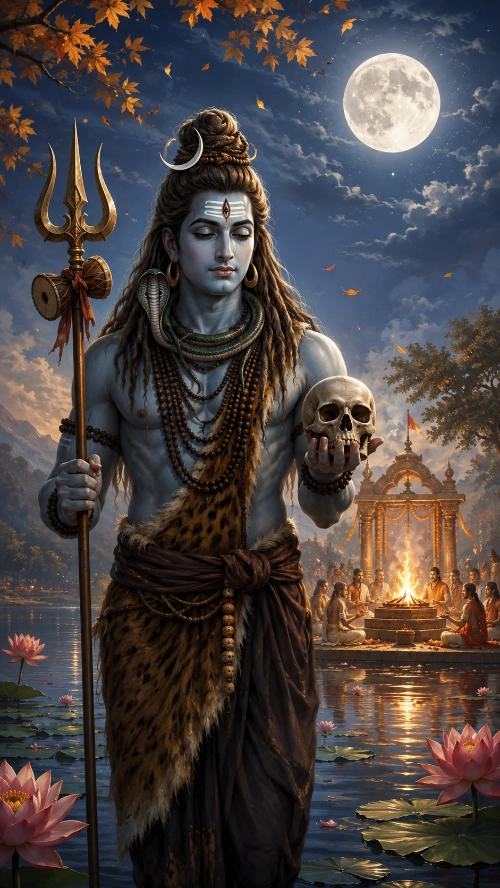
Pulastya said: Although Bhagavān Śiva is the eldest, the best, the most excellent, and even the primordial one, Dakṣa did not invite the Lord, knowing him as “Kapālī” — the skull-bearer. Though Śiva is supreme in seniority, excellence, and primordial divinity, Dakṣa refused to invite him because he regarded him as Kapālī, the skull-bearing ascetic.
Verse 18
नारद उवाच
किमर्थं देवताश्रेष्ठः शूलपाणिस्त्रिलोचनः ।
कपाली भगवाञ्जातः कर्मणा केन शङ्करः ॥ १८ ॥
Nārada uvāca
kimarthaṃ devatā-śreṣṭhaḥ śūla-pāṇis trilocanaḥ |
kapālī bhagavāñ jātaḥ karmaṇā kena śaṅkaraḥ || 18 ||
Nārada said: For what reason did Bhagavān Śaṅkara — the best of the gods, the trident-bearing Three-eyed Lord — become Kapālī, the skull-bearer? By what deed did this come about?
Verse 19
पुलस्त्य उवाच
शृणुष्वावहितो भूत्वा कथामेतां पुरातनीम् ।
प्रोक्तमादिपुराणे च ब्रह्मणाऽव्यक्तमूर्त्तिना ॥ १९ ॥
Pulastya uvāca
śṛṇuṣvāvahito bhūtvā kathām etāṃ purātanīm |
proktām ādi-purāṇe ca brahmaṇā ’vyakta-mūrtinā || 19 ||
Pulastya said: Listen attentively to this ancient account, which was declared in the Ādi-Purāṇa by Brahmā, whose form is the Unmanifest.
Verse 20
पुरा त्वेकार्णवं सर्वं जगत्स्थावरजङ्गमम् ।
नष्टचन्द्रार्कनक्षत्रम् प्रणष्टपवनानलम् ॥ २० ॥
purā tv ekārṇavaṃ sarvaṃ jagat sthāvara-jaṅgamam |
naṣṭa-candrārka-nakṣatraṃ praṇaṣṭa-pavanānalam || 20 ||
Long ago, the entire universe — all that moves and does not move — had become one single ocean. The moon, the sun, and the stars had disappeared; wind and fire, too, had vanished.
Verse 21
अप्रतर्क्यमविज्ञेयं भावाभावविवर्जितम् ।
निमग्नपर्वततरु तमोभूतं सुदुर्दशम् ॥ २१ ॥
apratarkyam avijñeyaṃ bhāvābhāva-vivarjitam |
nimagna-parvata-taru tamobhūtaṃ sudurdarśam || 21 ||
It was beyond reasoning, unknowable, devoid of both existence and non-existence; mountains and trees were submerged, and all had become darkness, exceedingly difficult to behold.
Verse 22
तस्मिन् स शेते भगवान् निद्रां वर्षसहस्रिकीम् ।
रात्र्यन्ते सृजते लोकान् राजसं रूपमास्थितः ॥ २२ ॥
tasmin sa śete bhagavān nidrāṃ varṣa-sahasrikīm |
rātry-ante sṛjate lokān rājasaṃ rūpam āsthitaḥ || 22 ||
In that cosmic ocean, Bhagavān sleeps a sleep lasting a thousand years. At the end of the night, assuming a rajas-characterized form, he creates the worlds.
Verse 23
राजसः पञ्चवदनो वेदवेदाङ्गपारगः ।
स्रष्टा चराचरस्यास्य जगतोऽद्भुतदर्शनः ॥ २३ ॥
rājasaḥ pañca-vadano veda-vedāṅga-pāragaḥ |
sraṣṭā carācarasya asya jagato ’dbhuta-darśanaḥ || 23 ||
In his rajasic form, he is five-faced, fully versed in the Vedas and the Vedāṅgas, the creator of this world of moving and unmoving beings, wondrous to behold.
Verse 24
तमोमयस्तथैवान्यः समुद्भूतस्त्रिलोचनः ।
शूलपाणिः कपर्दी च अक्षमालां च दर्शयन् ॥ २४ ॥
tamomayas tathaivānyaḥ samudbhūtas trilocanaḥ |
śūla-pāṇiḥ kapardī ca akṣamālāṃ ca darśayan || 24 ||
Then another arose, consisting of tamas — the Three-eyed One, bearing a trident in his hand, wearing matted locks, and displaying a rosary of beads.
Verse 25
ततो महात्मा ह्यसृजदहङ्कारं सुदारुणम् ।
येनाक्रान्तावुभौ देवौ तावेव ब्रह्मशङ्करौ ॥ २५ ॥
tato mahātmā hy asṛjad ahaṅkāraṃ sudāruṇam |
yenākrāntāv ubhau devau tāv eva brahmaśaṅkarau || 25 ||
Then the Great One indeed created a very dreadful ego, by which those two gods themselves, Brahmā and Śaṅkara, were seized.
Verse 26
अहङ्कारावृतो रुद्रः प्रत्युवाच पितामहम् ।
को भवानिह संप्राप्तः केन सृष्टोऽसि मां वद ॥ २६ ॥
ahaṅkārāvṛto rudraḥ pratyuvāca pitāmaham |
ko bhavān iha saṃprāptaḥ kena sṛṣṭo ’si māṃ vada || 26 ||
Covered over by ego, Rudra replied to Pitāmaha: “Who are you? Who has come here? By whom were you created? Tell me.”
Verse 27
पितामहोऽप्यहङ्कारात् प्रत्युवाचाथ को भवान् ।
भवतो जनकः कोऽत्र जननी वा तदुच्यताम् ॥ २७ ॥
pitāmaho ’py ahaṅkārāt pratyuvācātha ko bhavān |
bhavato janakaḥ ko ’tra jananī vā tad ucyatām || 27 ||
Then Pitāmaha too, out of ego, replied: “And who are you? Who here is your father, and who is your mother? Let that be told.”
Verse 28
इत्यन्योन्यं पुरा ताभ्यां ब्रह्मेशाभ्यां कलिप्रिय ।
परिवादोऽभवत् तत्र उत्पत्तिर्भवतोऽभवत् ॥ २८ ॥
ity anyonyaṃ purā tābhyāṃ brahmeśābhyāṃ kali-priya |
parivādo ’bhavat tatra utpattir bhavato ’bhavat || 28 ||
Thus, long ago, O lover of quarrel, there arose between those two — Brahmā and Īśa — a mutual dispute. And there, your own origin came about.
Verse 29
भवानप्यन्तरिक्षं हि जातमात्रस्तदोत्पतत् ।
धारयन्नतुलां वीणां कुर्वन् किलकिलाध्वनिम् ॥ २९ ॥
bhavān apy antarikṣaṃ hi jāta-mātras tadotpatat |
dhārayann atulāṃ vīṇāṃ kurvan kilakilā-dhvanim || 29 ||
You too, immediately upon being born, sprang up into the mid-region of the sky, holding an incomparable vīṇā and making a shrill, jubilant sound.
Verse 30
ततो विनिर्जितः शंभुर्मानिना पद्मयोनिना ।
तस्थावधोमुखो दीनो ग्रहाक्रान्तो यथा शशी ॥ ३० ॥
tato vinirjitaḥ śambhur māninā padma-yoninā |
tasthāv adho-mukho dīno grahākrānto yathā śaśī || 30 ||
Then Śambhu, defeated by the proud Lotus-born one, stood with his face cast downward, dejected — like the moon seized by an eclipse.
Verse 31
पराजिते लोकपतौ देवेन परमेष्ठिना ।
क्रोधान्धकारितं रुद्रं पञ्चमोऽथ मुखोऽब्रवीत् ॥ ३१ ॥
parājite lokapatau devena parameṣṭhinā |
krodhāndhakāritaṃ rudraṃ pañcamo ’tha mukho ’bravīt || 31 ||
When the Lord of the worlds had been defeated by the god Parameṣṭhin, the fifth face then spoke to Rudra, who was darkened and blinded by anger.
Verse 32
अहं ते प्रतिजानामि तमोमूर्ते त्रिलोचन ।
दिग्वासा वृषभारूढो लोकक्षयकरो भवान् ॥ ३२ ॥
ahaṃ te pratijānāmi tamo-mūrte trilocana |
digvāsā vṛṣabhārūḍho loka-kṣaya-karo bhavān || 32 ||
“I declare this to you, O Three-eyed one, embodiment of tamas: You are sky-clad, mounted upon a bull, and the bringer of the destruction of the worlds.”
Verse 33
इत्युक्तः शङ्करः क्रुद्धो वदनं घोरचक्षुषा ।
निर्दग्धुकामस्त्वनिशं ददर्श भगवानजः ॥ ३३ ॥
ity uktaḥ śaṅkaraḥ kruddho vadanaṃ ghora-cakṣuṣā |
nirdagdhu-kāmas tv aniśaṃ dadarśa bhagavān ajaḥ || 33 ||
Thus addressed, Śaṅkara became enraged. The unborn Bhagavān fixed his terrible eye upon that face, desiring to burn it completely.
Verse 34
ततस्त्रिनेत्रस्य समुद्भवन्ति वक्त्राणि पञ्चाथ सुदर्शनानि ।
श्वेतं च रक्तं कनकावदातं नीलं तथा पिङ्गजटं च शुभ्रम् ॥ ३४ ॥
tatas trinetrasya samudbhavanti vaktrāṇi pañcātha sudarśanāni |
śvetaṃ ca raktaṃ kanakāvadātaṃ nīlaṃ tathā piṅgajaṭaṃ ca śubhram || 34 ||
Then five beautiful faces arose from the Three-eyed Lord: one white, one red, one bright like gold, one dark-blue, and another radiant, with tawny matted locks.
Verse 35
वक्त्राणि दृष्ट्वाऽर्कसमानि सद्यः पैतामहं वक्त्रमुवाच वाक्यम् ।
समाहतस्याथ जलस्य बुद्बुदा भवन्ति किं तेषु पराक्रमोऽस्ति ॥ ३५ ॥
vaktrāṇi dṛṣṭvā ’rka-samāni sadyaḥ paitāmahaṃ vaktram uvāca vākyam |
samāhatasyātha jalasya budbudā bhavanti kiṃ teṣu parākramo ’sti || 35 ||
Having seen these faces equal to the sun, [Brahmā] immediately spoke these words: “When water is struck, bubbles arise in it. What strength or heroic power is there in them?”
Verse 36
तच्छ्रुत्वा क्रोधयुक्तेन शङ्करेण महात्मना ।
नखाग्रेण शिरश्छिन्नं ब्राह्मं परुषवादिनम् ॥ ३६ ॥
tac chrutvā krodha-yuktena śaṅkareṇa mahātmanā |
nakhāgreṇa śiraś chinnaṃ brāhmaṃ paruṣa-vādinam ||
Hearing that, the great-souled Śaṅkara, filled with anger, cut off with the tip of his nail the Brahmā-head that had spoken harshly.
Verse 37
तच्छिन्नं शङ्करस्यैव सव्ये करतलेऽपतत् ।
पतते न कदाचिच्च तच्छङ्करकराच्छिरः ॥ ३७ ॥
tac chinnaṃ śaṅkarasyaiva savye karatale ’patat |
patate na kadācic ca tac chaṅkara-karāc chiraḥ || 37 ||
That severed head fell directly into Śaṅkara’s left palm, and that head would never again fall away from Śaṅkara’s hand.
Verse 38
अथ क्रोधावृतेनापि ब्रह्मणाऽद्भुतकर्मणा ।
सृष्टस्तु पुरुषो धीमान् कवची कुण्डली शरी ॥ ३८ ॥
atha krodhāvṛtenāpi brahmaṇā ’dbhuta-karmaṇā |
sṛṣṭas tu puruṣo dhīmān kavacī kuṇḍalī śarī || 38 ||
Then Brahmā, though enveloped by anger and possessed of wondrous power, created a wise and mighty being, armored, adorned with earrings, and bearing arrows.
Verse 39
धनुष्पाणिर्महाबाहुर्बाणशक्तिधरोऽव्ययः ।
चतुर्भुजो महातूणी आदित्यसमदर्शनः ॥ ३९ ॥
dhanuṣ-pāṇir mahā-bāhur bāṇa-śakti-dharo ’vyayaḥ |
catur-bhujo mahā-tūṇī āditya-sama-darśanaḥ || 39 ||
He had a bow in hand, mighty arms, and bore arrows and a spear. He was imperishable, four-armed, equipped with a great quiver, and his appearance was like the sun.
Verse 40
स प्राह गच्छ दुर्बुद्धे मा त्वां शूलिन् निपातये ।
भवान् पापसमायुक्तः पापिष्ठं को जिघांसति ॥ ४० ॥
sa prāha gaccha durbuddhe mā tvāṃ śūlin nipātaye |
bhavān pāpa-samāyuktaḥ pāpiṣṭhaṃ ko jighāṃsati || 40 ||
He said: “Go away, O evil-minded one! Do not make me strike you down, O trident-bearer. You are joined with sin — but who would wish to slay one so utterly sinful?”
Verse 41
इत्युक्तः शङ्करःस्तेन पुरुषेण महात्मना ।
त्रपायुक्तो जगामाथ रुद्रो बदरिकाश्रमम् ॥ ४१ ॥
ity uktaḥ śaṅkaras tena puruṣeṇa mahātmanā |
trapā-yukto jagāmātha rudro badarikāśramam || 41 ||
Thus addressed by that mighty being, Śaṅkara, filled with shame, then departed; Rudra went to Badarikāśrama.
Verse 42
नरनारायणस्थानं पर्वते हि हिमाश्रये ।
सरस्वती यत्र पुण्या स्यन्दते सरितां वरा ॥ ४२ ॥
nara-nārāyaṇa-sthānaṃ parvate hi himāśraye |
sarasvatī yatra puṇyā syandate saritāṃ varā || 42 ||
It was the abode of Nara and Nārāyaṇa, upon the mountain sheltered by snow, where the holy Sarasvatī, the foremost of rivers, flows.
Verse 43
तत्र गत्वा च तं दृष्ट्वा नारायणमुवाच ह ।
भिक्षां प्रयच्छ भगवन् महाकापालिकोऽस्मि भोः ॥ ४३ ॥
tatra gatvā ca taṃ dṛṣṭvā nārāyaṇam uvāca ha |
bhikṣāṃ prayaccha bhagavan mahākāpāliko ’smi bhoḥ || 43 ||
Having gone there and seen Nārāyaṇa, he addressed him: “Grant me alms, O Bhagavān! For I am a great skull-bearing ascetic, O Lord.”
Verse 44
इत्युक्तो धर्मपुत्रस्तु रुद्रं वचनमब्रवीत् ।
सव्यं भुजं ताडयस्व त्रिशूलेन महेश्वर ॥ ४४ ॥
ity ukto dharma-putras tu rudraṃ vacanam abravīt |
savyaṃ bhujaṃ tāḍayasva triśūlena maheśvara || 44 ||
Thus addressed, the Son of Dharma then spoke these words to Rudra: “O Maheśvara, strike left arm with the trident.”
Verse 45
नारायणवचः श्रुत्वा त्रिशूलेन त्रिलोचनः ।
सव्यं नारायणभुजं ताडयामास वेगवान् ॥ ४५ ॥
nārāyaṇa-vacaḥ śrutvā triśūlena trilocanaḥ |
savyaṃ nārāyaṇa-bhujaṃ tāḍayāmāsa vegavān || 45 ||
Hearing Nārāyaṇa’s words, the swift Three-eyed Lord struck Nārāyaṇa’s left arm with his trident.
Verse 46
त्रिशूलाभिहतान्मार्गांत् तिस्रो धारा विनिर्ययुः ।
एका गगनमाक्रम्य स्थिता ताराभिमण्डिता ॥ ४६ ॥
triśūlābhihatān mārgāt tisro dhārā viniryayuḥ |
ekā gaganam ākramya sthitā tārābhimaṇḍitā ||
From the wound struck by the trident, three streams flowed forth. One of them ascended into the sky and remained there, adorned with stars.
Verse 47
द्वितीया न्यपतद् भूमौ तां जग्राह तपोधनः ।
अत्रिस्तस्मात् समुद्भूतो दुर्वासाः शङ्करांशतः ॥ ४७ ॥
dvitīyā nyapatad bhūmau tāṃ jagrāha tapodhanaḥ |
atris tasmāt samudbhūto durvāsāḥ śaṅkarāṃśataḥ || 47 ||
The second descended to earth and was received by the great sage Atrı. From it was born Durvasas from a portion of Śaṅkara.
Verse 48
तृतीया न्यपतद् धारा कपाले रौद्रदर्शने ।
तस्माच्छिशुः समभवत् संनद्धकवचो युवा ॥ ४८ ॥
tṛtīyā nyapatad dhārā kapāle raudra-darśane |
tasmāc chiśuḥ samabhavat saṃnaddha-kavaco yuvā || 48 ||
The third stream fell into the skull, terrible to behold. From it there arose a child, yet a youth, fully clad in armor.
Verse 49
श्यामावदातः शरचापपाणिर्गर्जन्यथा प्रावृषि तोयदोऽसौ ।
इत्थं ब्रुवन् कस्य विशातयामि स्कन्धाच्छिरस्तालफलं यथैव ॥ ४९ ॥
śyāmāvadātaḥ śara-cāpa-pāṇir garjan yathā prāvṛṣi toyado ’sau |
itthaṃ bruvan kasya viśātayāmi skandhāc chiras tāla-phalaṃ yathaiva || 49 ||
Dark yet radiant in complexion, with arrows and bow in hand, he roared like a rain-cloud in the monsoon and spoke thus: “Whose head shall I strike off from his shoulders, like a palmyra fruit?”
Verse 50
तं शंकरोऽभ्येत्य वचो बभाषे नरं हि नारायणबाहुजातम् ।
निपातयैनं नर दुष्टवाक्यं ब्रह्मात्मजं सूर्यशतप्रकाशम् ॥ ५० ॥
taṃ śaṅkaro ’bhyetya vaco babhāṣe naraṃ hi nārāyaṇa-bāhu-jātam |
nipātayainaṃ nara duṣṭa-vākyaṃ brahmātmajaṃ sūrya-śata-prakāśam || 50 ||
Śaṅkara approached that man, indeed born from Nārāyaṇa’s arm, and spoke these words: “Strike down this evil-speaking son of Brahmā, who shines with the brilliance of a hundred suns.”
Verse 51
इत्येवमुक्तः स तु शङ्करेण प्राद्यं धनुस्त्वाजगवं प्रसिद्धम् ।
जग्राह तूणानि तथाक्षयाणि युद्धाय वीरः स मतिं चकार ॥ ५१ ॥
ity evam uktaḥ sa tu śaṅkareṇa prādyam dhanus tv ājagavaṃ prasiddham |
jagrāha tūṇāni tathākṣayāṇi yuddhāya vīraḥ sa matiṃ cakāra ||
Thus addressed by Śaṅkara, that hero took up the famous primordial bow called Ājagava, together with inexhaustible quivers, and resolved upon battle.
Verse 52
ततः प्रयुद्धौ सुभृशं महाबलौ ब्रह्मात्मजो बाहुभवश्च शार्वः ।
दिव्यं सहस्रं परिवत्सराणां ततो हरोऽभ्येत्य विरञ्चिमूचे ॥ ५२ ॥
tataḥ prayuddhau subhṛśaṃ mahā-balau brahmātmajo bāhu-bhavaś ca śārvaḥ |
divyaṃ sahasraṃ parivatsarāṇāṃ tato haro ’bhyetya virañcim ūce || 52 ||
Then the two mighty warriors fought fiercely: the son of Brahmā and the arm-born one belonging to Śarva. For a thousand divine years, they battled. Thereafter, Hara approached Virañci and spoke to him.
Verse 53
जितस्त्वदीयः पुरुषः पितामह नरेण दिव्याद्भुतकर्मणा बली ।
महापृषत्कैरभिपत्य ताडितस्तदद्भुतं चेह दिशो दशैव ॥ ५३ ॥
jitas tvadīyaḥ puruṣaḥ pitāmaha nareṇa divyādbhuta-karmaṇā balī |
mahā-pṛṣat-kair abhipatya tāḍitas tad adbhutaṃ ceha diśo daśaiva || 53 ||
“O Pitāmaha, your powerful warrior has been defeated by Nara, whose deeds are divine and wondrous. Assailed and struck by great arrows, he has been driven through all ten directions — and this indeed is astonishing.”
Verse 54
ब्रह्मा तमीशं वचनं बभाषे नेहास्य जन्मान्यजितस्य शंभो ।
पराजितश्चेष्यतेऽसौ त्वदीयो नरो मदीयः पुरुषो महात्मा ॥ ५४ ॥
brahmā tam īśaṃ vacanaṃ babhāṣe |
na iha asya janma anyajitasya, śambho |
parājitaḥ ca iṣyate asau tvadīyaḥ naraḥ |
madīyaḥ puruṣaḥ mahātmā ||
Brahmā said to Īśa: “O Śambhu, this one of mine is unborn and unconquered, defeated by no other. It is your Nara who should be regarded as defeated; my Puruṣa is a great-souled being.”
Verse 55
इत्येवमुक्तो वचनं त्रिनेत्रश्चिक्षेप सूर्ये पुरुषं विरिञ्चेः ।
नरं नरस्यैव तदा स विग्रहे चिक्षेप धर्मप्रभवस्य देवः ॥ ५५ ॥
ity evam ukto vacanaṃ trinetras cikṣepa sūrye puruṣaṃ viriñceḥ |
naraṃ narasyaiva tadā sa vigrahe cikṣepa dharma-prabhavasya devaḥ || 55 ||
Thus addressed, the Three-eyed Lord cast the Puruṣa of Viriñci into the Sun. Then that god cast Nara into the very body of Nara, the son of Dharma.
Finis
इति श्रीवामनपुराणे द्वितीयोऽध्यायः ॥ २ ॥
iti śrī-vāmana-purāṇe dvitīyo ’dhyāyaḥ || 2 ||
Thus ends the second chapter in the revered Vāmana Purāṇa.
Synopsis of Chapter 2 — Dakṣa’s Sacrifice and the Origin of Śiva as Kapālī
Autumnal Purification and Śiva on Mandara
The chapter opens with a refined description of śarad [autumn] after the rainy season. Clouds withdraw, rivers recede, waters become clear, lotuses bloom, moonlight brightens the quarters, and the minds of the virtuous attain serenity. This purified natural setting frames Śiva and Satī’s movement to Mount Mandara, where Śambhu dwells with Satī upon a level rock, surrounded by the calm and clarity of the post-monsoon world.
Dakṣa’s Sacrificial Assembly
When autumn has passed and Keśava has awakened, Dakṣa Prajāpati begins a grand yajña. The sacrifice is externally magnificent: the twelve Ādityas, Indra, Kaśyapa, great sages, their wives, Dharma with Ahiṃsā, Ariṣṭanemi, Bhṛgu, Candra, and Rohiṇī are all assigned ritual roles. The scene emphasizes technical ritual order: proper officiants, sacred fuel, mantra preparation, wealth, and moral guardianship are all in place.
The Ritual Flaw: Exclusion of Satī and Śiva
The central defect of the yajña appears when Dakṣa invites his sons-in-law, daughters, and grandsons, yet deliberately excludes Satī together with Śaṅkara. This omission is not accidental but a theological and emotional rejection. The text contrasts external ritual perfection with inner adharma: a sacrifice may be formally complete, but if it excludes Śiva — the primordial Lord and source of auspiciousness — its spiritual foundation is already fractured.
Nārada’s Question and the Problem of Kapālī
Nārada challenges the exclusion by asking why Maheśvara, though eldest, best, most venerable, and primordial, was not invited. Pulastya answers that Dakṣa rejected Śiva because he knew him as Kapālī, the skull-bearer. The title becomes the pivot of the chapter: Dakṣa sees only the transgressive outer form of Śiva, while the narrative will reveal that this form conceals a profound cosmic history.
Cosmic Dissolution and the Emergence of Brahmā and Rudra
Pulastya then narrates an ancient account that begins with cosmic dissolution, when the universe had become a single ocean, beyond reason, knowledge, existence, and non-existence. From this state, the divine assumes a rajasic form as the five-faced creator Brahmā, master of the Vedas and Vedāṅgas. Another form arises as Rudra, tamasic, three-eyed, trident-bearing, matted-haired, and ascetic. These two divine functions — creation and dissolution — are then seized by the fierce principle of ahaṅkāra [ego].
Ego, Rivalry, and the Severing of Brahmā’s Fifth Head
Under the influence of ahaṅkāra, Brahmā and Rudra dispute each other’s origin and superiority. Brahmā’s fifth face insults Rudra as sky-clad, bull-mounted, tamasic, and world-destroying, failing to recognize these as sacred signs of Śiva’s cosmic function. In anger, Śiva manifests five radiant faces and then cuts off Brahmā’s harsh-speaking fifth head with the tip of his nail. The severed skull falls into Śiva’s left palm and remains there, explaining the origin of his form as Kapālī.
Nārāyaṇa, Nara, and the Resolution of Divine Conflict
The later episode moves to Badarikāśrama, where Śiva approaches Nārāyaṇa as a skull-bearing ascetic seeking alms. Nārāyaṇa instructs him to strike his left arm with the trident, from which three streams emerge: one becomes celestial, one reaches Atri and gives rise to Durvāsas, and one fills the skull, producing a warrior born from Nārāyaṇa’s arm. This warrior battles Brahmā’s being for a thousand divine years. The chapter closes by resolving the conflict through divine reintegration: Brahmā’s being is cast into the Sun, while Nara is returned into the body of Nara, the son of Dharma. The myth thus reveals Śiva’s skull-bearing form as a sign of cosmic justice, ego destruction, and transcendence of conventional purity.


Commentary