

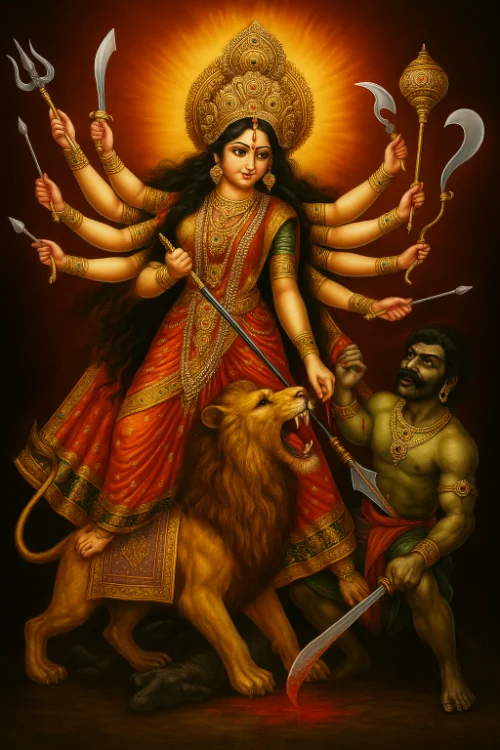
Goddess Durgā, the invincible divine mother, is the embodiment of strength, protection, and unwavering compassion. Worshipped as the fierce destroyer of evil and the compassionate savior of devotees, Durgā’s mantras carry the immense power to remove obstacles, conquer inner fears, and grant spiritual and material prosperity. Rooted in the ancient Vedas, Purāṇas, and Tantric traditions, her sacred sounds awaken divine energy (śakti) and empower the soul to face life's challenges with courage and grace.
On this page, discover a curated collection of Durga mantras — from the powerful Durgā Gāyatrī to the potent Chamunda and Mahishasuramardini invocations. Whether you seek spiritual protection, inner peace, strength, or success, chanting these mantras with devotion brings the blessings of Mother Durgā into your life. Her sacred names and seed syllables ignite divine awareness and guide the soul toward ultimate victory over all darkness.
ॐ कात्यायन्यै विद्महे
कन्याकुमार्यै धीमहि
तन्नो दुर्गा प्रचोदयात् ॥
Oṁ Kātyāyanyai Vidmahe
Kanyākumāryai Dhīmahi
Tanno Durgā Prachodayāt
Om! Let us contemplate upon Kātyāyanī, the youthful virgin goddess.
May that supreme power, Durgā, inspire and guide our intellect.
ॐ गिरिजायै विद्महे
शिवप्रियायै धीमहि
तन्नो दुर्गा प्रचोदयात्
Oṁ Girijāyai Vidmahe
Śivapriyāyai Dhīmahi
Tanno Durgā Prachodayāt
Om! Let us contemplate Goddess Girijā,
the beloved of Lord Śiva.
May that divine Mother Durgā inspire and guide our intellect.
ॐ ऐं ह्रीं क्लीं चामुण्डायै विच्चे
Oṁ Aiṁ Hrīṁ Klīṁ Cāmuṇḍāyai Vicce
Om! I invoke the wisdom (Aiṁ), energy (Hrīṁ), and attraction (Klīṁ) of Goddess Chamundā. May her power and realization fully manifest within me.
(alternative translation) Om! Salutations to Goddess Chamundā, embodiment of divine wisdom, power, and attraction. Manifest fully within me!"
The mantra "Oṁ Aiṁ Hrīṁ Klīṁ Cāmuṇḍāyai Vicce" is derived from Tantric and Śākta traditions, and it appears in the context of the worship of Goddess Cāmuṇḍā — a fierce form of Durgā / Kālī.
Its textual roots trace back to Devī Mahātmya (also called Durga Saptashati or Candi Pāṭha), which is part of the Mārkaṇḍeya Purāṇa (Chapters 81–93).
The Devī Mahātmya is the primary Purāṇic source where the battles of Goddess Durgā (including her manifestation as Cāmuṇḍā) against demons like Canda and Munda are narrated. In Chapter 8 (Canda-Munda Vadha), the goddess Durgā specifically manifests Chamundā to kill the powerful demons Canda and Munda — two generals of the demon king Śumbha. Durgā creates a ferocious form — Chamundā — from her forehead. Chamundā slays the demons and offers their heads to the goddess. Chamundā becomes a symbol of divine wrath against evil, a protector of dharma, and a liberator for those trapped in lower tendencies.
The Devī Mahātmya itself does not state the mantra in this exact bīja form ("Oṁ Aiṁ Hrīṁ Klīṁ Cāmuṇḍāyai Vicce") inside the story.
However, traditional Tantric practices developed this bīja mantra based on: