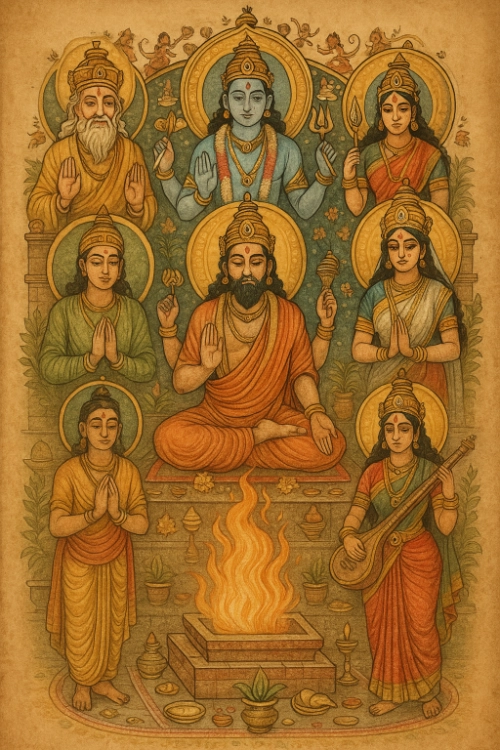
This chapter presents a universal and sanctifying ritual meant for the worship of Viṣṇu, Śiva, Devī, and all divine beings. It begins by preparing the sacred space with humility and reverence: the worshipper first offers honor to Gaṅgā and Yamunā, to Dhātṛ and Vidhātṛ, to the guardians of the threshold and the deities of the dwelling, thereby inviting purity, order, and auspiciousness into the place of worship.
Next, the practitioner centers himself in the virtues that uphold the world—the Earth, Dharma, Knowledge, Detachment, and Sovereignty—likened to the foundation and blooming of a divine lotus. Through these virtues, the heart becomes a fit vessel for divine presence. The text further pays homage to the cosmic pillars of existence: the Vedas, the holy Yugas, the qualities of nature, and the rightful duties of life, alongside the supreme powers of Jñāna, Kriyā, and Yoga, which elevate the soul toward purity and liberation.
A wide circle of deities is then invoked—Dawn, Truth, Durgā, Speech, and the Gaṇas—together with the divine forms and weapons of the Lord: the conch, discus, mace, lotus, Śrīvatsa, Kaustubha, and the sacred garland. Each of these symbols embodies a celestial function: purity, righteousness, protection, and illumination. The rituals for Śiva and Viṣṇu are described with equal devotion: Śiva is adored through his holy bījas, reflecting his five-faced cosmic form; Viṣṇu is invoked with mantras of sweetness and power—Śrīṁ, Hrīṁ, Klīṁ—bringing together protection, grace, and auspiciousness.
The chapter then extends worship to Lakṣmī, Sarasvatī, Gaurī, Durgā, and the other luminous goddesses who bestow prosperity, wisdom, purity, and strength. The Gaṇapati-bīja, the Śakti-bījas, and the sacred sounds of Tripurā are explained, reminding the devotee that the Divine Mother manifests in countless blessed forms to uplift the world.
A solemn section follows, invoking the Sun and placing his divine radiance upon the head, eyes, and heart. The fierce syllable Huṁ becomes the protective armor around the devotee. The planets—Moon, Mars, Mercury, Jupiter, Venus, Saturn—along with Rāhu and Ketu, are honored as administrators of divine order in the cosmos.
The chapter teaches that all mantras should begin in Om, the eternal seed of creation, or with the initial divine syllable united with the sacred bindu. In this way the worship takes root in the very vibration from which the universe arose.
Finally, it concludes with a gentle assurance:
Whoever recites these mantras, performs homa with faith using sesame, ghee, and pure offerings, and worships the Lord and His attendants with sincerity, attains righteousness, prosperity, fulfillment of rightful desires, and ultimately liberation. Blessed in this world and radiant in the next, such a devotee rises to heavenly realms by the grace of the Divine.