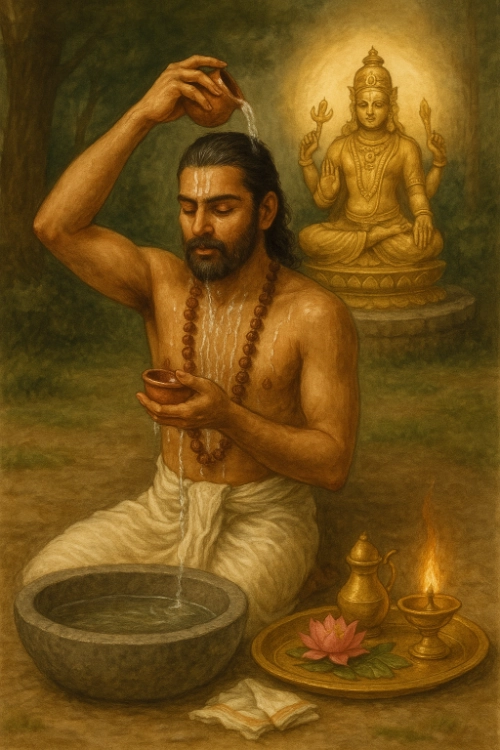
Nārada teaches the sacred bathing ritual required before worship. The devotee begins by taking the Nṛsiṁha-consecrated clay, dividing it into two portions, and using one to perform the mala-snāna, the bath that removes impurity. After immersing himself, sipping water for internal purification, and establishing protective rites through the Nṛsiṁha-mantra, he proceeds to the formal ritual bath, beginning with prāṇāyāma.
Meditating on Hari within the heart and reciting the eight-syllabled mantra, he takes the clay into his hand in three portions and performs the directional protections (dig-bandha). He then consecrates the water with the Vāsudeva-mantra, uses Vedic mantras to cleanse the body, and thereby worships the divine presence within himself.
After performing the Aghamarṣaṇa rite and putting on clean garments, he conducts further purification, placing mantras upon his limbs through nyāsa and twice sanctifying himself with water. Holding the breath with the Nārāyaṇa-mantra, he inhales, releases, and then meditates on Hari within the water, offering arghya with the twelve-syllabled mantra.
He recites the associated mantras a hundred times, beginning with those of the Yoga-pīṭha, followed by the guardians of the directions, the Ṛṣis, and the hosts of the ancestors. He mentally assigns all beings—from humans down to immovable creatures—to their proper places within the ritual cosmos. Finally, withdrawing the mantras and completing limb-nyāsa, he returns to the worship-house.
Nārada concludes: in all acts of worship, this foundational method of ritual bathing should always be performed first. Thus ends the twenty-second chapter, the “Description of the Bathing Rite,” in the Āgneya section of the Mahāpurāṇa.