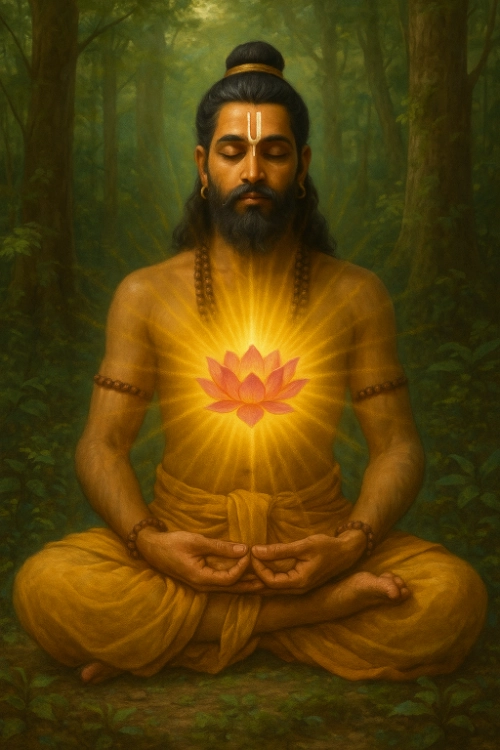
Chapter 23 opens with Nārada explaining the foundational method of worship that yields all auspicious results. The devotee begins by purifying himself outwardly and inwardly—washing, performing ācamana, restraining speech, and establishing mantric protection. Seated facing east, he invokes the bīja at the navel, meditates on removing impurities, and visualizes the fiery heart-lotus bīja kṣauṁ. Flames in all directions burn away faults, after which a cooling lunar nectar descends, filling the body through the suṣumṇā and nāḍīs, completing the inner purification.
Once purified, the practitioner installs the Tattvas, performs hand-purification and Astra-nyāsa, and places the mantras upon the hands and the twelve bodily centers. With mudrā and meditation on Viṣṇu, he recites the mantra and arranges the ritual implements: Varddhanī to the left, offerings to the right, and arghya-water sanctified by the Astra-mantra. He assigns Dharma, Knowledge, Detachment, and Sovereignty to the proper directions of the Yogapīṭha, and places Kūrma, Ananta, Yama, the Sūrya-maṇḍala, and the Śaktis upon the lotus-mandala, its petals filled with pure powers and its center with grace-bestowing energies.
After meditating on the Lord in the heart, he invites Him into the maṇḍala and offers Arghya, Pādya, Ācamana, Madhuparka, garments, the sacred thread, ornaments, incense, lamps, and food. He worships the limbs of the deity and then arranges the emblems: Egg-born One to the east, Discus and Mace in the south, Conch and Bow in the north, Arrow and Sword to the right, and Shield, Śrī, and Puṣṭi to the left. The Vanamālā, Śrīvatsa, Kaustubha, and the Guardians of the Directions are honored with their respective mantras. He completes the rite with circumambulation, praises, and final arghya.
The worship concludes with the contemplative realization “I am Brahman, and Hari is that very Self.” Invocation is done with “Come,” and dismissal with “Forgive me.” Worship with the Aṣṭākṣarī and related mantras leads to liberation. The chapter then introduces the worship of the nine Vyūhas: Vāsudeva placed on the thumbs, the remaining forms on the fingers and various body-points, proceeding along the central axis from heart to feet. The nine forms are placed upon a single pedestal, nine individual pedestals, and the nine-petalled lotus, with the chosen deity in the center. Thus ends the chapter on the worship of the Primeval Forms in the Agni Purāṇa.