

The Supreme Secret Is Meant to Be Shared

When Teaching Becomes an Act of Devotion
The Bhagavad-gītā does not end where a teaching normally ends. Having brought Arjuna to the most intimate conclusion He has to offer, Kṛṣṇa immediately turns to a different question: what happens to this teaching now that someone has received it? His answer is a promise about anyone who faithfully explains it to somebody else.
य इदं परमं गुह्यं
मद्भक्तेष्वभिधास्यति ।
भक्तिं मयि परां कृत्वा
मामेवैष्यत्यसंशयः ॥
ya idaṁ paramaṁ guhyaṁ
mad-bhakteṣv abhidhāsyati
bhaktiṁ mayi parāṁ kṛtvā
mām evaiṣyaty asaṁśayaḥ
“Whoever explains this supreme secret among My devotees, acting in supreme devotion toward Me, will certainly attain Me. There is no doubt.”
“For one who explains this supreme secret to the devotees, pure devotional service is guaranteed, and at the end he will come back to Me.”
Bhagavad-gītā 18.68
The familiar translation is theological rather than mechanically literal. The phrase
भक्तिं मयि परां कृत्वा
bhaktiṁ mayi parāṁ kṛtvā
means more directly “having performed” or “acting in supreme devotion toward Me.” The published rendering reflects a Gauḍīya reading of it: that faithfully transmitting Kṛṣṇa’s highest teaching is itself an exalted act of bhakti, through which the teacher becomes progressively established in supreme devotion and finally attains Kṛṣṇa.
Which makes the verse considerably more than a commendation of public speaking. It states a principle: spiritual knowledge reaches one of its highest expressions when knowledge becomes service. One receives Kṛṣṇa’s teaching, understands it, tries to live it — and then helps somebody else understand it.
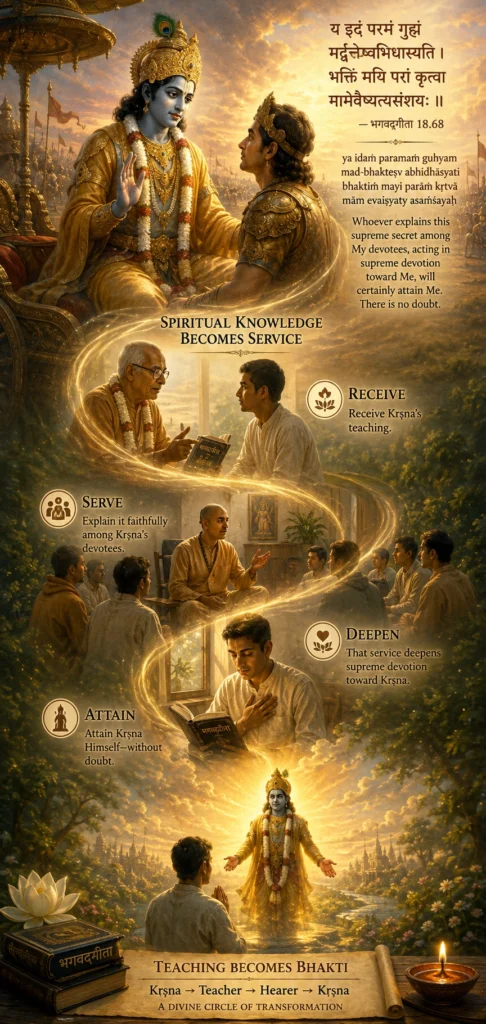
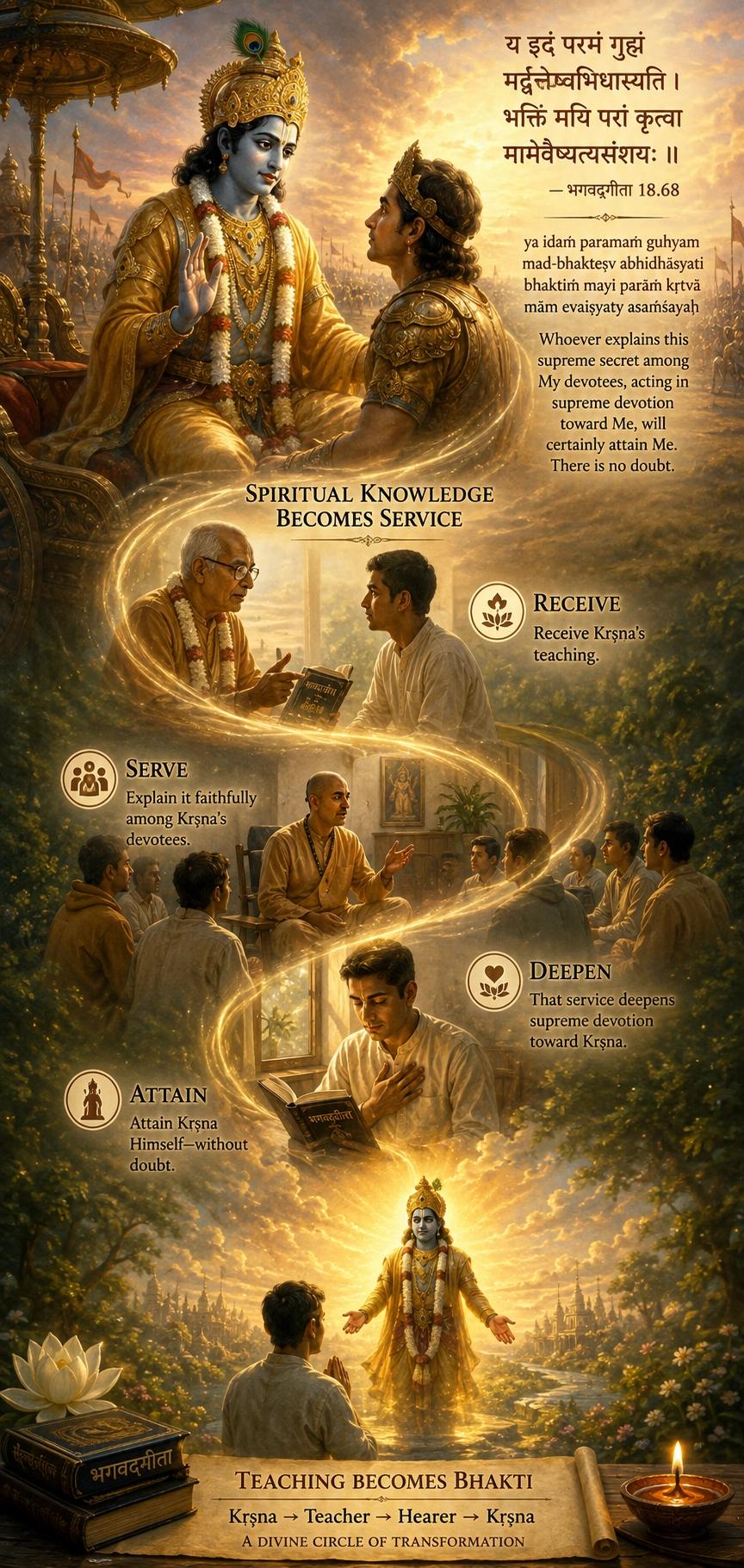
The verse and its four movements on one sheet: receive, serve, deepen, attain — following the path from Kṛṣṇa's instruction to Arjuna, through the teacher and the hearer, and back to Kṛṣṇa.
Where the Verse Stands
Its position is doing a great deal of the work. Kṛṣṇa has spent the whole dialogue on the self, karma, yoga, knowledge, renunciation, prakṛti, the guṇas, the cosmos, the Supreme Person, bhakti and surrender. Near the end He announces something further:
सर्वगुह्यतमं भूयः
शृणु मे परमं वचः ।
इष्टोऽसि मे दृढमिति
ततो वक्ष्यामि ते हितम् ॥
sarva-guhyatamaṁ bhūyaḥ
śṛṇu me paramaṁ vacaḥ
iṣṭo ’si me dṛḍham iti
tato vakṣyāmi te hitam
“Hear again My supreme instruction, the most confidential of all. Because you are very dear to Me, I shall speak what is for your benefit.”
Bhagavad-gītā 18.64
calling it:
सर्वगुह्यतमम्
sarva-guhyatamam
— the most confidential of all confidential teachings. What follows is intensely personal:
मन्मना भव मद्भक्तो
मद्याजी मां नमस्कुरु ।
मामेवैष्यसि सत्यं ते
प्रतिजाने प्रियोऽसि मे ॥
man-manā bhava mad-bhakto
mad-yājī māṁ namaskuru
mām evaiṣyasi satyaṁ te
pratijāne priyo ’si me
“Think of Me, become My devotee, worship Me, and bow before Me. You will certainly come to Me. I promise you this because you are dear to Me.”
Bhagavad-gītā 18.65
and then the famous climax:
सर्वधर्मान्परित्यज्य
मामेकं शरणं व्रज ।
अहं त्वां सर्वपापेभ्यो
मोक्षयिष्यामि मा शुचः ॥
sarva-dharmān parityajya
mām ekaṁ śaraṇaṁ vraja
ahaṁ tvāṁ sarva-pāpebhyo
mokṣayiṣyāmi mā śucaḥ
“Abandon all other dharmas and take refuge in Me alone. I shall free you from all sinful reactions. Do not fear.”
Bhagavad-gītā 18.66
Only after that does Kṛṣṇa address what should become of the teaching once Arjuna has it. The answer of 18.68 is: it should be faithfully passed on.
What Is the “Supreme Secret”?
परमं गुह्यम्
paramaṁ guhyam
Paramam, supreme or highest; guhyam, secret, confidential, hidden. Two readings are available, and they do not compete.
The whole Gītā is what gets transmitted; its inner heart is bhakti and śaraṇāgati:
मामेकं शरणं व्रज
mām ekaṁ śaraṇaṁ vraja
Confidential Does Not Mean Hidden
The Bhagavad-gītā is printed in millions of copies. Its Sanskrit is freely available; anyone can read mām ekaṁ śaraṇaṁ vraja within seconds. So in what sense is the teaching guhyam?
Because there is a difference between having the words and realizing what they mean. A person may read take refuge in Kṛṣṇa alone and find it perfectly comprehensible as a sentence. The lived recognition — I actually belong to Bhagavān, and I may entrust myself to Him — is something else entirely. The words are public; the realization stays inward.
Love works the same way. The words “I love you” use simple vocabulary, and the reality inside them is understood only within relationship. The grammar of surrender can be public while surrender itself remains a realization.
Kṛṣṇa had already described His teaching in these terms much earlier, and the qualification He names is telling:
स एवायं मया तेऽद्य
योगः प्रोक्तः पुरातनः ।
भक्तोऽसि मे सखा चेति
रहस्यं ह्येतदुत्तमम् ॥
sa evāyaṁ mayā te ’dya
yogaḥ proktaḥ purātanaḥ
bhakto ’si me sakhā ceti
rahasyaṁ hy etad uttamam
“This ancient yoga is spoken by Me to you today because you are My devotee and My friend. Therefore you are able to understand this supreme mystery.”
Bhagavad-gītā 4.3
— bhakto ‘si me, you are My devotee, and sakhā ca, and My friend. Arjuna’s qualification is not intellectual. It is relational.
The Warning Immediately Before
Verse 18.68 cannot be read apart from the one just before it, which is a caution:
इदं ते नातपस्काय
नाभक्ताय कदाचन ।
न चाशुश्रूषवे वाच्यं
न च मां योऽभ्यसूयति ॥
idaṁ te nātapaskāya
nābhaktāya kadācana
na cāśuśrūṣave vācyaṁ
na ca māṁ yo ’bhyasūyati
“This should never be spoken to one who lacks spiritual discipline, to one who is not devoted, to one who is unwilling to hear, or to one who is envious of Me.”
Bhagavad-gītā 18.67
and then 18.68 says: explain it among My devotees. So the principle is neither “force the highest teaching on everyone indiscriminately” nor “hide the Gītā from humanity.” It is to teach responsibly, according to receptivity.
And the bar for receptivity turns out to be low. A few verses later Kṛṣṇa says:
श्रद्धावाननसूयश्च
शृणुयादपि यो नरः ।
सोऽपि मुक्तः शुभाँल्लोकान्
प्राप्नुयात्पुण्यकर्मणाम् ॥
śraddhāvān anasūyaś ca
śṛṇuyād api yo naraḥ
so ’pi muktaḥ śubhāḻ lokān
prāpnuyāt puṇya-karmaṇām
“Even a person who simply hears this teaching with faith and without envy becomes freed from sinful reactions and attains auspicious destinations.”
Bhagavad-gītā 18.71
The two qualifications named — śraddhāvān, faithful or receptive, and anasūyaḥ, free from envious fault-finding — are strikingly accessible. The passage makes room for different kinds of participation: one may teach, or study, or simply hear faithfully.
“Will Explain”
अभिधास्यति
abhidhāsyati
— will explain, declare, expound, communicate. The verb matters, because the verse is not about mentioning Kṛṣṇa’s name or repeating a slogan. The teacher helps another person understand what Kṛṣṇa said, what it means, how the parts fit together, and what conclusion He finally gives. That gives real spiritual dignity to teaching, translation, commentary, writing, discussion and faithful scriptural explanation.
But it also constrains them. The teacher of the Gītā is not asked to produce a new revelation; the service lies precisely in explaining idam — this, the teaching Kṛṣṇa has given. The message does not belong to the teacher. The teacher belongs to the message.
Teaching as Sevā
Bhakti is usually associated with chanting, prayer, deity worship, offering, bowing, remembrance and meditation. This verse adds another form to that list: helping another person understand Bhagavān’s teaching. It becomes sevā because another living being is being helped toward Kṛṣṇa — and the teacher is serving three parties at once, Kṛṣṇa, the teaching, and the hearer.
The theological center of the verse is the phrase already noted, and it repays a word-by-word look:
Traditional Gauḍīya commentary adds the dimension that makes the verse move: the one who faithfully teaches Kṛṣṇa’s conclusion performs an exalted devotional service, and through that service becomes increasingly established in parā-bhakti. The act is not merely rewarded from outside. Teaching transforms the teacher.
Which is observably true of the work itself. To explain the Gītā carefully one has to read Kṛṣṇa’s words repeatedly, remember them, reflect on them, compare passages, organize their meaning, answer questions, and confront their implications. One cannot explain surrender at length without repeatedly confronting surrender; cannot explain remembrance without remembering; cannot explain bhakti without examining one’s own. Teaching functions as a mirror.
Both Sides Are Purified
The Bhāgavatam describes the exchange as purifying in both directions:
शृण्वतां स्वकथाः कृष्णः
पुण्यश्रवणकीर्तनः ।
हृद्यन्तःस्थो ह्यभद्राणि
विधुनोति सुहृत्सताम् ॥
śṛṇvatāṁ sva-kathāḥ kṛṣṇaḥ
puṇya-śravaṇa-kīrtanaḥ
hṛdy antaḥ-stho hy abhadrāṇi
vidhunoti suhṛt satām
“Kṛṣṇa, dwelling within the heart, cleanses away what is inauspicious in those who hear His own kathā. Hearing and glorifying Him are themselves spiritually purifying.”
Śrīmad-Bhāgavatam 1.2.17
— puṇya-śravaṇa-kīrtanaḥ: hearing and glorifying Kṛṣṇa are themselves purifying. So sacred teaching is not simply a knowledgeable speaker transmitting to an ignorant listener. The speaker remembers Kṛṣṇa; the hearer remembers Kṛṣṇa; both are brought into relation with His words.
Nārada tells Vyāsa where learning is ultimately aimed:
इदं हि पुंसस्तपसः श्रुतस्य वा
स्विष्टस्य सूक्तस्य च बुद्धिदत्तयोः ।
अविच्युतोऽर्थः कविभिर्निरूपितो
यदुत्तमश्लोकगुणानुवर्णनम् ॥
idaṁ hi puṁsas tapasaḥ śrutasya vā
sviṣṭasya sūktasya ca buddhi-dattayoḥ
avicyuto ’rthaḥ kavibhir nirūpito
yad-uttamaśloka-guṇānuvarṇanam
“The wise have concluded that the unfailing purpose of austerity, sacred learning, sacrifice, eloquent speech, intelligence, and charity is the repeated description of the qualities of Uttamaśloka, the Supreme Lord.”
Śrīmad-Bhāgavatam 1.5.22
The culmination is uttamaśloka-guṇānuvarṇanam, describing Bhagavān’s qualities. Learning reaches its fulfillment when knowledge becomes glorification. And Nārada then makes a stronger claim still:
तद्वाग्विसर्गो जनताघविप्लवो
यस्मिन्प्रतिश्लोकमबद्धवत्यपि ।
नामान्यनन्तस्य यशोऽङ्कितानि यत्
शृण्वन्ति गायन्ति गृणन्ति साधवः ॥
tad-vāg-visargo janatāgha-viplavo
yasmin prati-ślokam abaddhavaty api
nāmāny anantasya yaśo ’ṅkitāni yat
śṛṇvanti gāyanti gṛṇanti sādhavaḥ
“Speech that carries the names and glories of the unlimited Lord can bring about a revolution in the sinful and misdirected lives of people. Even if such compositions are imperfectly expressed in places, saintly persons hear them, sing them, and accept them.”
Śrīmad-Bhāgavatam 1.5.11
whose remarkable word is:
विप्लवः
viplavaḥ
— upheaval, reversal, revolution. Sacred communication is not decorative. Speech centered on Bhagavān can participate in a transformation of consciousness.
No Service More Dear
The verse immediately following raises the stakes:
न च तस्मान्मनुष्येषु
कश्चिन्मे प्रियकृत्तमः ।
भविता न च मे तस्माद्
अन्यः प्रियतरो भुवि ॥
na ca tasmān manuṣyeṣu
kaścin me priya-kṛttamaḥ
bhavitā na ca me tasmād
anyaḥ priya-taro bhuvi
“Among human beings there is no one who performs service more dear to Me than such a person, nor will there ever be anyone on earth more dear to Me.”
Bhagavad-gītā 18.69
प्रियकृत्तमः
priya-kṛt-tamaḥ
— roughly, one who does what is most dear or pleasing. Why should this particular service rank so high? A natural Vaiṣṇava explanation is that the teacher helps another living being hear Kṛṣṇa’s invitation and turn toward Him. The movement runs Kṛṣṇa → teacher → hearer → Kṛṣṇa, and the authentic teacher does not let it terminate in himself.
Nothing in these verses praises fame, audience size, charisma, institutional prominence or reputation. The stated qualification is bhaktiṁ mayi parām — supreme devotion toward Kṛṣṇa. Which means sacred teaching becomes corrupted precisely when it is used for prestige, money, followers, power, or intellectual superiority. A person can speak about Kṛṣṇa while inwardly saying admire me, and then sacred knowledge has become fuel for ego. The genuine teacher tries to disappear behind the message rather than make the message disappear behind the teacher.
Three Ways to Take Part
The conclusion blesses more than teaching. Kṛṣṇa continues:
अध्येष्यते च य इमं
धर्म्यं संवादमावयोः ।
ज्ञानयज्ञेन तेनाहम्
इष्टः स्यामिति मे मतिः ॥
adhyeṣyate ca ya imaṁ
dharmyaṁ saṁvādam āvayoḥ
jñāna-yajñena tenāham
iṣṭaḥ syām iti me matiḥ
“One who studies this sacred dialogue of ours worships Me through the sacrifice of knowledge. Such is My conclusion.”
Bhagavad-gītā 18.70
making study itself a jñāna-yajña, a sacrifice of knowledge. Read together, the closing verses open three doors rather than one:
Nobody is required to begin as a teacher. One may begin simply by hearing — which is, after all, exactly how Arjuna began. And Arjuna himself demonstrates the result:
नष्टो मोहः स्मृतिर्लब्धा
त्वत्प्रसादान्मयाच्युत ।
स्थितोऽस्मि गतसन्देहः
करिष्ये वचनं तव ॥
naṣṭo mohaḥ smṛtir labdhā
tvat-prasādān mayācyuta
sthito ’smi gata-sandehaḥ
kariṣye vacanaṁ tava
“My delusion has been destroyed and my memory restored by Your grace, O Acyuta. I now stand firm, free from doubt. I shall act according to Your word.”
Bhagavad-gītā 18.73
His movement runs from confusion through hearing, questioning, understanding, the removal of doubt, and surrender, to action. The teacher of 18.68 is helping somebody else enter that same kind of transformative dialogue.
The Gītā Ends by Creating a Tradition
This is one of the finest structural features of the text. The dialogue does not close with “Arjuna understood, and that was that.” Kṛṣṇa prepares the teaching for people who were not on the battlefield: it is to be heard, studied, explained, remembered and transmitted. A private conversation becomes a living tradition.
And the text had already said so from the other end:
एवं परम्पराप्राप्तम्
इमं राजर्षयो विदुः ।
evaṁ paramparā-prāptam
imaṁ rājarṣayo viduḥ
“Thus this teaching was received through paramparā, and the saintly kings understood it.”
Bhagavad-gītā 4.2
परम्परा
paramparā
— transmission from one person to the next. So the Gītā opens by describing spiritual knowledge as something received through succession and closes by blessing those who carry it forward, which makes a coherent arc: received truth, realized truth, transmitted truth.
The Gauḍīya Parallel
Śrī Caitanya Mahāprabhu gives an instruction with strikingly similar logic:
যারে দেখ, তারে কহ ‘কৃষ্ণ’ উপদেশ ।
আমার আজ্ঞায় গুরু হঞা তার’ এই দেশ ॥
yāre dekha, tāre kaha ‘kṛṣṇa’-upadeśa
āmāra ājñāya guru hañā tāra’ ei deśa
“Whomever you meet, speak to that person Kṛṣṇa’s instruction. On My order, become a guru and help deliver this land.”
Caitanya-caritāmṛta, Madhya-līlā 7.128
The operative phrase is kṛṣṇa-upadeśa — Kṛṣṇa’s instruction, or instruction concerning Kṛṣṇa. Receive it, understand it, do not distort it, carry it forward.
Notably, becoming guru in this instruction is not defined by originality, self-promotion, or producing an unprecedented doctrine. It is kaha kṛṣṇa-upadeśa — speak Kṛṣṇa’s teaching. One does not have to invent something new to be spiritually useful; one may serve by learning accurately, understanding carefully, living sincerely and explaining faithfully. Whatever originality the work has lies not in altering Kṛṣṇa’s conclusion but in helping another person actually grasp it.
“Whomever you meet” and “do not teach the hostile” are not in conflict, though they are often read that way. Caitanya’s instruction is expansive; the Gītā’s warning is pastoral. There is a difference between making spiritual truth widely available and forcing intimate instruction on someone who does not want it. Together they suggest: share generously, but teach intelligently. And note that receptivity is not the same as sophistication — a simple but sincere hearer may benefit greatly where a brilliant but contemptuous one stays closed.
The Teacher Is a Bridge
Two implications follow from all this, and both are pastoral rather than grammatical. The first is that faithful transmission is not mechanical repetition regardless of who is listening. Responsible teaching asks what this person is ready to understand, what language will help, what needs explaining first, which assumptions are causing the confusion, when correction is useful, and when silence is wiser. The goal is understanding, not delivery.
The second follows from the shape of transmission itself. A healthy teacher moves the student toward Kṛṣṇa, śāstra, bhakti and their own spiritual responsibility. The teacher does not say remain centered on me; the teacher says understand Kṛṣṇa. The teacher is a bridge, not the destination.
Which suggests one practical question that exposes motive fairly quickly: if nobody praised me for teaching this, would I still want Kṛṣṇa’s teaching to be understood? If the answer is yes, the work is moving toward sevā. If admiration has become indispensable, something else has entered. The verse does not only challenge the hearer.
“He Will Come to Me”
The promise at the end of the verse is unusually direct:
मामेवैष्यति
mām evaiṣyati
— mām, Me; eva, indeed, precisely; eṣyati, will come or attain. Kṛṣṇa does not promise religious merit, knowledge, honor, heaven, or intellectual accomplishment. The result is Kṛṣṇa Himself. And the verse closes by removing any hedge:
असंशयः
asaṁśayaḥ
The whole final chapter keeps returning to this personal register — mayi, in Me; mat-paraḥ, having Me as supreme; mac-cittaḥ, mind fixed on Me; man-manā, think of Me; mad-bhaktaḥ, become My devotee; mām ekaṁ śaraṇaṁ vraja, take refuge in Me alone; mām evaiṣyati, he will attain Me. The culmination is not “understand reality.” It is “come to Me.”
Teaching Need Not Mean Preaching
The verse does not say “whoever becomes famous.” It says abhidhāsyati — whoever faithfully explains. Which covers a teacher guiding one student, a parent explaining a verse to a child, a translator preserving a meaning, a writer making śāstra intelligible, a devotee answering a sincere question, a classroom, a private conversation, or a public talk. The outward form varies entirely. What is constant is that Kṛṣṇa’s teaching is being carried toward another person as service to Kṛṣṇa.
And that is what changes the character of the knowledge itself. Knowledge can be held as a possession — I know something you do not — at which point it becomes egoic capital. Spiritual knowledge matures when it becomes a gift: one receives something transformative and thinks, may somebody else have this too. That single movement turns jñāna into sevā.
The Whole Movement of the Ending
The verse itself compresses to four movements, which is how it is easiest to hold:
The path begins with knowledge. It does not end there.
Kṛṣṇa does not allow this teaching to stay locked inside Arjuna’s private experience. Two verses after telling him to take refuge, He turns to transmission — and promises the one who carries it forward the deepening of supreme devotion, and finally Himself. So the Gītā ends not by producing a single enlightened hearer but by creating a lineage of people who hear, understand, live, and pass the truth onward. In that faithful transmission, teaching itself becomes bhakti.
य इदं परमं गुह्यं
मद्भक्तेष्वभिधास्यति ।
भक्तिं मयि परां कृत्वा
मामेवैष्यत्यसंशयः ॥
ya idaṁ paramaṁ guhyaṁ
mad-bhakteṣv abhidhāsyati
bhaktiṁ mayi parāṁ kṛtvā
mām evaiṣyaty asaṁśayaḥ
“Whoever explains this supreme secret among My devotees, acting in supreme devotion toward Me, will certainly attain Me. There is no doubt.”
Bhagavad-gītā 18.68