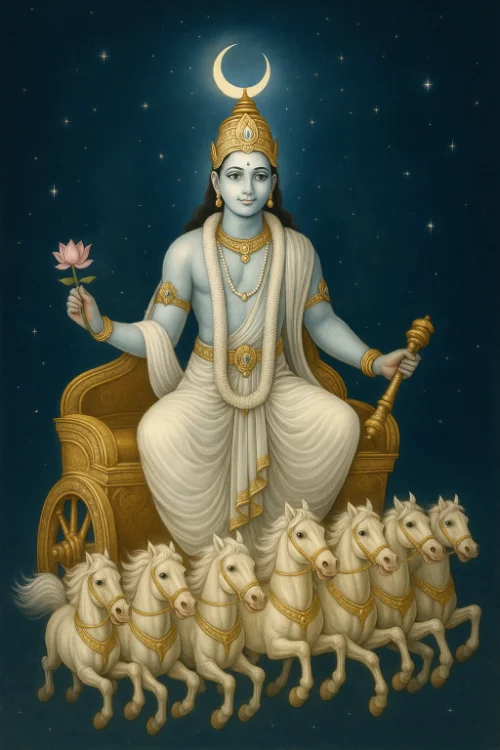
Chandra Mantras – Invoking the Mind’s Light, Peace, and Soma Energy
Synopsis
Chandra, the Moon God in Vedic tradition, governs the mind (manas), emotions, and intuition. His cooling, luminous presence is associated with soma, the nectar of immortality, and his mantras are used to cultivate mental clarity, emotional stability, and spiritual receptivity. As the fastest-moving graha, Chandra deeply influences our moods and thoughts. Mantras like “ॐ चन्द्राय नमः” or the powerful Gāyatrī variations offer remedies for astrological afflictions, strengthen calm reflection, and restore emotional balance.
This page presents authentic Vedic and Tantric Chandra mantras, including bīja mantras, Gāyatrīs, and poetic dhyāna verses such as “dadhi-śaṅkha-tuṣārābhaṁ…”. Each mantra is explained with transliteration, meaning, and the context of its spiritual and astrological use. Whether used in meditation, Jyotiṣa remedies, or lunar rituals like Pūrṇimā, Chandra mantras awaken the moon’s power within—the light of peace, intuition, and quiet brilliance.
Chandra Beeja Mantra
ॐ श्रां श्रीं श्रौं सः चन्द्राय नमः।
oṁ śrāṁ śrīṁ śrauṁ saḥ candrāya namaḥ
Om — I bow to Chandra, the Moon God, who is evoked through the sacred syllables Shrāṁ, Shrīṁ, and Shrauṁ, and who bestows peace, emotional balance, and inner luminosity.
SHRĀM (श्रां) – A bīja (seed syllable) invoking Chandra’s influence on the body; often linked to cooling energy and calm strength.
SHRĪM (श्रीं) – The bīja of Lakṣmī, associated with beauty, peace, prosperity, and nourishment. Here, it emphasizes Chandra’s role in emotional richness and gentleness.
SHRAUM (श्रौं) – A powerful variation intensifying lunar grace, adding subtle intuition, healing, and devotion to the energy.
CHANDRĀYA (चन्द्राय) – “To Chandra,” the Moon deity, who rules over the mind (manas), emotions, fertility, and subtle perception.
Spiritual & Practical Significance:
Used to balance the lunar energy in the subtle body — especially helpful when Chandra is weak or afflicted in a birth chart.
Improves emotional regulation, intuition, mental clarity, and relationship harmony.
Commonly used in Jyotisha (Vedic astrology) for moon-related remedies, especially on Mondays or during Pūrṇimā (full moon).
A great mantra for meditators, healers, artists, or anyone seeking mental peace and emotional healing.
We seek to know the son of the Ocean of Milk; we meditate on him whose very nature is the nectar of immortality. May Chandra inspire our understanding.
Kṣīraputra, “son of milk”: the Moon rose from the Ocean of Milk when the gods and the asuras churned it, the samudra-manthana. Amṛtatattva, “whose essence is the nectar of immortality”: Chandra is Soma, the sacred drink of the Veda, and the Moon is the vessel of the nectar the gods drink.
The prayer keeps the form of every Gāyatrī: vidmahe, “may we know”; dhīmahi, “we meditate”; pracodayāt, “may he inspire”.
This Gāyatrī comes from the collections of Navagraha and deity Gāyatrīs and is printed in ritual manuals such as the Karmakāṇḍ Pradīp. It is not a verse of the Vedic Saṃhitās, though the worship of Soma is as old as the Ṛgveda. It is chanted on Mondays, Somavāra, the Moon’s day, on the full moon and in Navagraha worship, to calm the mind (manas), which the Moon governs, and to pacify an afflicted Moon in a birth chart. It is customarily repeated 108 times.
I bow to Soma, the Moon God, Who rides a chariot drawn by seven horses, Who is intensely radiant, the son of Sage Kaśyapa, Who holds a white lotus, and is revered as a divine being (deva).
saptāśva-ratham-ārūḍham – “Mounted upon a chariot drawn by seven horses”. This mirrors the Vedic image of celestial gods (like Sūrya) traveling in chariots. The seven horses can symbolize the seven days of the week, seven colors of light, or seven phases of the moon (visible).
pracaṇḍam – “Radiant, fierce, intensely shining”. Though the Moon is soft and cooling, this word highlights his inner spiritual brilliance, which illuminates the mind and awakens intuition.
kaśyapātmajam – “The son of Sage Kaśyapa”. In Hindu cosmology, Chandra (Soma) is born of Kaśyapa and Aditi, placing him among the Ādityas, divine sons of cosmic order.
śveta-padma-dharam – “The bearer of a white lotus”. The white lotus symbolizes mental purity, calmness, serenity, and the unfolding of inner wisdom.
devam – “The divine being”. Chandra is addressed as a deva, a celestial light-being and source of soma (nectar) and psychic nourishment.
taṁ somaṁ prapadyaye – “I surrender to that Soma (Moon God)”. A declaration of devotional surrender, often found in mantras and stotras, expressing humility and openness to divine grace.
The white lotus and chariot are not just imagery—they reflect the Moon’s role as a carrier of consciousness, moving across time and inner moods like his chariot across the sky.
dadhi-śaṅkha-tuṣārābham “One whose form is like curd (dadhi), a conch (śaṅkha), and snow (tuṣāra)” → Symbolizing Chandra’s coolness, purity, and radiant whiteness.
kṣīrodārṇava-sambhavam “Born from the ocean of milk” → Refers to Chandra’s mythical origin during the Samudra Manthana (Churning of the Milky Ocean).
namāmi śaśinaṁ somaṁ “I bow to Śaśin (moon-bearer), to Soma (moon deity)” → Śaśin is a name of Chandra meaning “marked with a hare” (referring to the moon’s surface). Soma is both the moon and the divine nectar.
śambhoḥ mukuṭa-bhūṣaṇam “Who is the ornament of Śiva’s crown” → Refers to how Chandra is worn on Śiva’s head, symbolizing mastery of time and mind.
This śloka beautifully expresses the cooling, calming, sattvic nature of the moon:
Aids in emotional healing, devotion, and peace of mind.
Evokes Chandra as a source of mental clarity, fertility, and mystic illumination.
Also reflects Chandra’s connection to Śiva, representing control over time, ego, and the restless mind.
For Chandra-related problems:
Worship the ruling deity Gauri.
Recite the Annapurna stotram.
Japa of Moon’s moola mantra: 10000 times in 40 days.
Recite the Chandra stotra:
dadhi-śaṅkha-tuṣārābhaṁ kṣīrodārṇava-sambhavam
namāmi śaśinaṁ somaṁ śambhoḥ mukuṭa-bhūṣaṇam
Charity: Donate cow’s milk or rice on Monday.
Fasting: On Mondays.
Pooja: Devi pooja on Monday.
Rudraksha: Wear 2-mukhi Rudraksha.
Propitiation of the Moon (Monday)
CHARITY: Donate a pearl or moonstone, conch shell, silver, water, cow’s milk or white rice to a female leader on Monday evening.
FASTING: On Mondays, especially during Moon transits and major or minor Moon periods.
MANTRA: to be chanted on Monday evening, especially during major or minor Moon periods.
RESULT
The planetary deity Chandra is pleased to increase mental health and peace of mind.