

Higher Than Worshiping Viṣṇu?
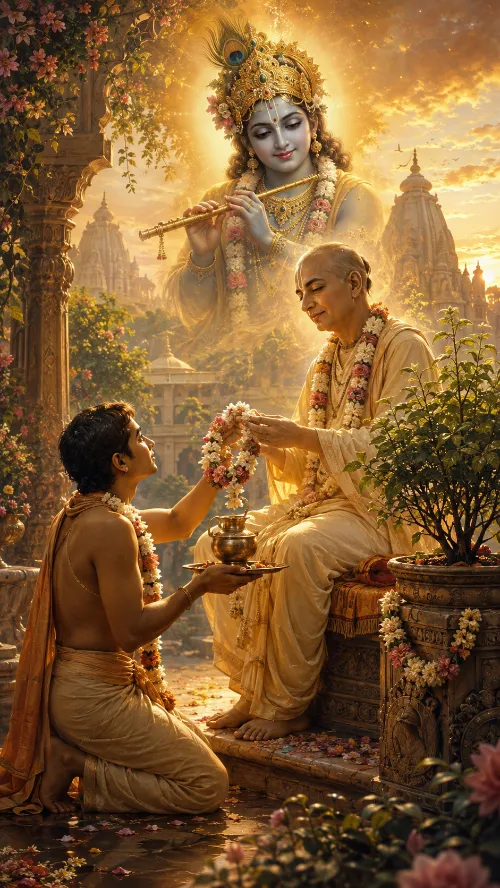
Higher Than Worshiping Viṣṇu? The Meaning of Tadīya-sevā and Why Serving Bhagavān’s Devotees Is So Exalted
What could possibly be higher than worshiping God? Vaiṣṇava scripture gives a startling answer: serving those who belong to Him. The famous verse quoted in Śrī Caitanya-caritāmṛta Madhya 11.31 declares that among all forms of worship, worship of Viṣṇu is supreme—but then immediately says that something is higher still: the worship and service of His tadīyas.
Those who are His. Those who belong to Him. Those who are intimately connected with Him. The verse reads:
आराधनानां सर्वेषां
विष्णोराराधनं परम् ।
तस्मात्परतरं देवि
तदीयानां समर्चनम् ॥
ārādhanānāṁ sarveṣāṁ
viṣṇor ārādhanaṁ param
tasmāt parataraṁ devi
tadīyānāṁ samarcanam
“Of all forms of worship, worship of Viṣṇu is supreme. But higher even than that, O Devī, is the proper worship of those who belong to Him.”
Padma Purāṇa, Uttara-khaṇḍa 6.253.176; quoted in Caitanya-caritāmṛta, Madhya 11.31
At first this sounds paradoxical. If Viṣṇu is the Supreme Lord, how can service to someone else be superior to worship of Viṣṇu? The answer reveals something profound about bhakti.
The verse is not ranking: God versus devotee as competing objects of divinity. It is ranking forms of service according to what most deeply pleases Bhagavān. Viṣṇu remains Supreme.
But because He loves His devotees, service to them becomes an especially intimate way of serving Him. In one sentence: The highest way to show love for Bhagavān is to love what Bhagavān loves.
The Verse Really Is Found in the Padma Purāṇa
This quotation is sometimes introduced cautiously as: “traditionally attributed to the Padma Purāṇa.” But the verse is present in an extant Sanskrit text of the Padma Purāṇa, Uttara-khaṇḍa 6.253.176.
Its immediate context is especially valuable because the surrounding verses explain what tadīya means. The preceding verse says:
एवमभ्यर्चयेद्विष्णुं
यावज्जीवमतन्द्रितः ।
तदीयांश्च विशेषेण
पूजयेत्सर्वदा शुभे ॥
evam abhyarcayed viṣṇuṁ
yāvaj jīvam atandritaḥ
tadīyāṁś ca viśeṣeṇa
pūjayet sarvadā śubhe
“Thus one should attentively worship Viṣṇu throughout one’s life, and one should especially always honor those who belong to Him, O auspicious one.”
Padma Purāṇa 6.253.175
Then comes the famous verse: ārādhanānāṁ sarveṣāṁ… And the following verses make the intended meaning even clearer.
The Sanskrit Does Not Literally Begin With “Demigod Worship”
Prabhupāda translates the verse: “Although the Vedas recommend worship of demigods, the worship of Lord Viṣṇu is topmost. However, above the worship of Lord Viṣṇu is the rendering of service to Vaiṣṇavas, who are related to Lord Viṣṇu.”
That accurately expresses the Vaiṣṇava theological context. But the Sanskrit itself begins more broadly:
आराधनानां सर्वेषाम्
ārādhanānāṁ sarveṣām
“of all forms of worship.” It does not explicitly say: deva-pūjā in the first line. Therefore the most literal hierarchy is:
- all forms of worship
- Viṣṇu-ārādhana — supreme
- tadīya-samarcana — higher still
Prabhupāda’s reference to the devas explains the religious setting: Vedic culture contains many prescribed forms of worship, but Vaiṣṇava theology identifies Viṣṇu as their supreme object.
That is a theological explanation of the verse rather than a word-for-word rendering of the first line.
Param —and Then Something Parataram
The Sanskrit deliberately uses two related words. First:
परम्
param
highest, supreme, most exalted. Thus: viṣṇor ārādhanaṁ param “Worship of Viṣṇu is supreme.” Then:
परतरम्
parataram
more exalted, higher still, superior to that. Thus: tasmāt parataraṁ devi “But higher even than that, O Devī…” This is intentionally striking. The text does not merely say: “Serving Vaiṣṇavas is also good.”
It constructs a comparison: Viṣṇu worship is supreme—yet tadīya-sevā possesses an even more intimate excellence. The question is: Why?
The Key Word: Tadīya
Everything depends upon:
तदीय
tadīya
It means: His, belonging to Him, related to Him, connected with Him. The important point is that tadīya derives its sacredness entirely from relationship with Bhagavān. A Vaiṣṇava is dear because: the Vaiṣṇava belongs to Viṣṇu.
A sacred place is dear because: it belongs to Him. A scripture is dear because: it reveals Him. Tulasī is dear because: she is intimately connected with His worship and līlā.
Thus tadīya is fundamentally a relational category.
The Next Padma Purāṇa Verse Makes the Warning Severe
Immediately after declaring tadīya-samarcana superior, the Padma Purāṇa says:
अर्चयित्वापि गोविन्दं
तदीयान्नार्चयेत्पुनः ।
न स भागवतो ज्ञेयः
केवलं दाम्भिकः स्मृतः ॥
arcayitvāpi govindaṁ
tadīyān nārcayet punaḥ
na sa bhāgavato jñeyaḥ
kevalaṁ dāmbhikaḥ smṛtaḥ
“Even though one may worship Govinda, if one does not honor those who belong to Him, such a person should not be regarded as a true Bhāgavata; he is considered merely pretentious.”
Padma Purāṇa 6.253.177
This is an extraordinarily strong statement. It tells us that direct worship of God can become spiritually contradictory if the worshiper simultaneously despises or neglects those who genuinely belong to God.
One may perform: ārati, mantra, pūjā, offerings, ritual, and prayer— yet if the heart contains contempt toward Bhagavān’s devotees, something fundamental is missing.
The Following Verse Says “Vaiṣṇavas” Explicitly
Then the text removes any ambiguity:
पुमांस्तस्मात्प्रयत्नेन
वैष्णवान्पूजयेत्सदा ।
सर्वं तरति दुःखौघं
महाभागवतार्चनात् ॥
pumāṁs tasmāt prayatnena
vaiṣṇavān pūjayet sadā
sarvaṁ tarati duḥkhaughaṁ
mahā-bhāgavatārcanāt
“Therefore one should always carefully honor the Vaiṣṇavas. Through the worship of a great Bhāgavata one crosses the flood of suffering.”
Padma Purāṇa 6.253.178
Now the sequence is unmistakable.
Why Can Serving the Devotee Be Called “Higher”?
It cannot mean: the devotee is ontologically greater than Viṣṇu. Vaiṣṇava theology does not teach that. Viṣṇu remains: Bhagavān, the Supreme Lord, the source, the protector, the object of bhakti.
The comparison concerns something else: which form of service gives Bhagavān particular pleasure? A simple analogy helps. Suppose someone gives you an expensive gift. You are pleased.
But suppose that same person lovingly helps someone who is extraordinarily dear to you. You may be even more deeply touched. Why? Not because your loved one has suddenly become ontologically greater than you.
But because: love recognizes what the beloved loves. That is the principle of tadīya-sevā.
Kṛṣṇa Himself Says the Same Thing
The Śrīmad-Bhāgavatam gives a striking parallel when Kṛṣṇa instructs Uddhava. Among the practices of devotion He lists:
आदरः परिचर्यायां
सर्वाङ्गैरभिवन्दनम् ।
मद्भक्तपूजाभ्यधिका
सर्वभूतेषु मन्मतिः ॥
ādaraḥ paricaryāyāṁ
sarvāṅgair abhivandanam
mad-bhakta-pūjābhyadhikā
sarva-bhūteṣu man-matiḥ
“One should show great respect in My service, offer obeisances with one’s entire body, render especially exalted worship to My devotees, and see consciousness of Me in all living beings.”
Śrīmad-Bhāgavatam 11.19.21
The crucial expression is:
मद्भक्तपूजाभ्यधिका
mad-bhakta-pūjābhyadhikā
Literally: “worship of My devotee is especially superior/preeminent.” The word: abhyadhikā indicates something: surpassing, especially excellent, preeminent. So the Padma Purāṇa teaching is not isolated.
Kṛṣṇa Himself speaks in almost exactly the same theological direction: My devotee’s worship is especially exalted.
Why? Because the Devotee Is in Bhagavān’s Heart
The deepest explanation may come from the Ambarīṣa episode. Bhagavān says:
साधवो हृदयं मह्यं
साधूनां हृदयं त्वहम् ।
मदन्यत् ते न जानन्ति
नाहं तेभ्यो मनागपि ॥
sādhavo hṛdayaṁ mahyaṁ
sādhūnāṁ hṛdayaṁ tv aham
mad-anyat te na jānanti
nāhaṁ tebhyo manāg api
“The sādhus are My heart, and I am the heart of the sādhus. They know nothing apart from Me, and I am never separate from them even slightly.”
Śrīmad-Bhāgavatam 9.4.68
This is extraordinarily intimate language. Bhagavān does not merely say: “I approve of devotees.” He says: sādhavo hṛdayaṁ mahyam “The sādhus are My heart.” That explains both sides of Vaiṣṇava theology: vaiṣṇava-sevā is extraordinarily powerful; and: vaiṣṇava-aparādha is extraordinarily dangerous.
Both arise from the same fact: Bhagavān loves His devotees.
The Principle Works in Both Directions
If someone genuinely loves you, you naturally expect that person not to mistreat those you deeply love. Imagine somebody saying: “I adore you.” Then he repeatedly humiliates your closest friend or child.
You would reasonably question the reality of his love. Likewise, the Padma Purāṇa asks: Can someone truly worship Govinda while despising Govinda’s devotees? Verse 177 gives the severe answer: such worship risks becoming: dāmbhika pretentious, ostentatious, hypocritical.
This Is Not Merely Ritual Courtesy
The doctrine goes much deeper than: “Be polite to other members of the religion.” A Vaiṣṇava is spiritually significant because bhakti itself resides in the heart. Through association with devotees one learns: how to hear; how to chant; how to remember Bhagavān; how to serve; how to surrender; how to understand śāstra; how to live devotion rather than merely define it.
Bhakti is communicated not only through propositions. It is transmitted through: bhaktas.
A Book Can Explain Bhakti—A Bhakta Shows What It Looks Like
One can read: “Be humble.” Then meet someone genuinely humble. Those are different experiences. One can read: “Remember Kṛṣṇa.” Then live near someone whose life genuinely revolves around Kṛṣṇa.
Again, different. One can study: faith, detachment, service, compassion, kīrtana. But when those things become embodied in a person, theology becomes visible. That is one reason association with devotees occupies such a central position in bhakti traditions.
Caitanya-caritāmṛta Broadens the Meaning of Tadīya
Later Caitanya-caritāmṛta explicitly explains the Gauḍīya understanding of the term:
‘তদীয়’—তুলসী, বৈষ্ণব, মথুরা, ভাগবত ।
এই চারির সেবা হয় কৃষ্ণের অভিমত ॥
‘tadīya’ — tulasī, vaiṣṇava, mathurā, bhāgavata
ei cārira sevā haya kṛṣṇera abhimata
“Tadīya refers to Tulasī, the Vaiṣṇavas, Mathurā, and the Bhāgavata. Service to these four is especially pleasing to Kṛṣṇa.”
Caitanya-caritāmṛta, Madhya 22.125
This expands the principle beyond persons alone. Four manifestations are singled out: Tulasī Vaiṣṇava Mathurā Bhāgavata Why these? Because each is intimately connected with Kṛṣṇa.
Tulasī: Sacred Because She Belongs to Kṛṣṇa
Tulasī is not sacred merely because a plant has independently acquired supernatural status. Her significance is relational. She is intimately associated with: Viṣṇu worship, Kṛṣṇa worship, Vṛndāvana, bhakti.
Therefore serving Tulasī becomes: tadīya-sevā. The principle is: what Kṛṣṇa loves becomes precious to the devotee.
Vaiṣṇava: Sacred Through Devotion
The Vaiṣṇava is not worshiped because a human being has become an independent Supreme God. The devotee is honored because: the heart belongs to Bhagavān. The more deeply a devotee actually belongs to Kṛṣṇa, the more meaningful the category tadīya becomes.
Thus genuine Vaiṣṇava honor is fundamentally: Kṛṣṇa-centered.
Mathurā and Vraja: Sacred Geography
Why should one piece of earth be spiritually different from another? The bhakti answer is: relationship. Mathurā is sacred because of: Kṛṣṇa’s appearance, His līlā, His presence.
Vṛndāvana is not cherished merely as attractive countryside. It is: Kṛṣṇa’s dhāma. The place is sacred because it belongs to the beloved Lord. Again: tadīya.
Bhāgavata: The Scripture That Reveals Bhagavān
The Śrīmad-Bhāgavatam is honored because it: reveals Kṛṣṇa; narrates His līlā; glorifies His devotees; explains bhakti; draws the hearer toward Bhagavān. Thus service to the Bhāgavata becomes: service to something belonging intimately to Bhagavān.
Gauḍīya tradition also famously speaks of: grantha-bhāgavata the scripture Bhāgavata; and: bhakta-bhāgavata the devotee who embodies its teaching. The two illuminate one another.
“By Serving the Bhāgavata…”
The Bhāgavatam says:
नष्टप्रायेष्वभद्रेषु
नित्यं भागवतसेवया ।
भगवत्युत्तमश्लोके
भक्तिर्भवति नैष्ठिकी ॥
naṣṭa-prāyeṣv abhadreṣu
nityaṁ bhāgavata-sevayā
bhagavaty uttama-śloke
bhaktir bhavati naiṣṭhikī
“By regular service to the Bhāgavata, when the inauspicious things within the heart are almost destroyed, steady devotion to Bhagavān Uttamaśloka becomes established.”
Śrīmad-Bhāgavatam 1.2.18
The phrase: bhāgavata-sevā naturally resonates with the same theology. The Bhāgavata brings one toward: Bhagavān. The tadīya leads toward the One to whom it belongs.
Tadīya Shows How Bhakti Perceives Sacredness
This offers a powerful way to understand Vaiṣṇava sacred culture. Why is prasāda sacred? Because it has been offered to Bhagavān. Why is caraṇāmṛta sacred? Because it has touched Him.
Why is a dhāma sacred? Because it is His place. Why is Tulasī sacred? Because she is dear to Him. Why is a Vaiṣṇava sacred? Because the devotee belongs to Him. Why is scripture sacred?
Because it reveals Him. Sacredness flows outward from relationship with Bhagavān.
The Sacred Is Therefore Personal
This is important. In bhakti, holiness is not merely an impersonal metaphysical substance. Things become sacred through: belonging, contact, relationship, service, love. That is why the word: tadīya is so powerful.
It means: “His.” Bhakti sees the world through the eyes of belonging.
This Principle Explains Guru-sevā
The theology of service to the spiritual master also fits naturally here. A genuine guru is not honored because he becomes an independent rival to Bhagavān. We honor him because he belongs to Bhagavān and directs others toward Bhagavān.
The spiritual master represents: instruction, service, bhakti, the transmission of revelation. Thus guru-sevā belongs naturally within the logic of: tadīya-sevā. The guru’s importance is derived from connection to Bhagavān—not separation from Him.
This Is an Important Safeguard Against Personality Cults
The same principle that exalts service to devotees also sets its limits. If the devotee is honored because he belongs to Kṛṣṇa, then he cannot legitimately use that honor to redirect people away from Kṛṣṇa and toward his own ego.
The center must remain: Bhagavān. Therefore: tadīya-sevā does not make the tadīya independent of Bhagavān. Its entire meaning comes from dependence upon Him.
“Higher” Means More Intimately Pleasing—not More Supreme
This distinction deserves repetition because it resolves the apparent contradiction.
Ontologically
Viṣṇu is Bhagavān. The Vaiṣṇava is the devotee. There is no reversal.
Relationally
Bhagavān may be especially pleased when His devotee is honored. Therefore tadīya-sevā can be called: parataram higher as an intimate form of worship. So the hierarchy concerns: rasa and divine pleasure rather than: which being is ultimately Supreme.
Bhakti Is Not Only “God and Me”
This verse also challenges a highly individualistic understanding of spirituality. One might imagine: “My relationship with God is private. Other devotees are irrelevant.”
Vaiṣṇava theology disagrees. Bhakti creates: association, service, community, transmission, relationship. If Bhagavān loves devotees, then approaching Bhagavān necessarily changes how one sees devotees.
Spiritual life cannot remain: “God loves me, therefore everyone else is secondary.” It becomes: “God loves His devotees; therefore I want to serve them.”
This Is Why Sādhu-saṅga Is So Central
One of the fundamental principles of Gauḍīya bhakti is: association with sādhus. Why? Because devotees create an environment in which: Kṛṣṇa is remembered, Kṛṣṇa is discussed, Kṛṣṇa is served, Kṛṣṇa becomes the center.
The devotee therefore functions almost like a living doorway into a Kṛṣṇa-centered reality. Serving such persons is not a distraction from bhakti. It deepens bhakti.
But Not Everyone Called “Vaiṣṇava” Should Be Treated Identically
A necessary qualification is discernment. Vaiṣṇava scripture itself distinguishes levels of spiritual realization. Not everyone who wears: tilaka, robes, sacred beads, or religious titles has the same realization.
Therefore honoring Vaiṣṇavas does not require abandoning: judgment, ethics, reason, boundaries. One may respect someone’s sincere devotional connection while still recognizing: immaturity, error, or misconduct.
Honor Does Not Require Blind Obedience
This point is especially important. Tadīya-sevā does not justify: spiritual manipulation, abuse, financial exploitation, covering wrongdoing, or obedience to unethical commands.
The spiritual logic is: serve what genuinely belongs to Bhagavān. Adharma does not become sacred merely because a religious person performs it. Devotional honor and moral discernment must remain together.
Nor Is Every Disagreement Vaiṣṇava-aparādha
Vaiṣṇava traditions warn strongly against offenses to devotees. But disagreement is not automatically offense. One can: disagree philosophically; correct factual errors; set boundaries; challenge misconduct; reject harmful behavior— without contempt for another person’s genuine devotion.
The danger lies especially in: envy, malicious ridicule, hatred, deliberate humiliation, or hostility toward bhakti itself. Discernment is not the same as contempt.
Why Is Vaiṣṇava-aparādha Treated So Seriously?
Because the same relationship that makes service powerful makes offense dangerous. Bhagavān says:
साधवो हृदयं मह्यं
sādhavo hṛdayaṁ mahyam
“The sādhus are My heart.” If the devotee is dear to Him, then knowingly attacking the devotee touches something dear to Bhagavān. The theology is relational. The seriousness of the offense reflects: the seriousness of love.
The Ambarīṣa–Durvāsā Episode Is the Perfect Example
Durvāsā Muni is immensely powerful. Ambarīṣa is externally a king, yet internally a pure devotee. When Durvāsā tries to harm him, the Lord refuses to treat the matter as irrelevant.
Why? Because Ambarīṣa belongs completely to Him. The Lord says in the same passage:
अहं भक्तपराधीनो
ह्यस्वतन्त्र इव द्विज ।
साधुभिर्ग्रस्तहृदयो
भक्तैर्भक्तजनप्रियः ॥
ahaṁ bhakta-parādhīno
hy asvatantra iva dvija
sādhubhir grasta-hṛdayo
bhaktair bhakta-jana-priyaḥ
“I am dependent upon My devotees—as though I were not independent. My heart has been captured by the sādhus, and My devotees and those devoted to My devotees are exceedingly dear to Me.”
Śrīmad-Bhāgavatam 9.4.63
Here again the same theology appears. Why serve devotees? Because: Bhagavān’s heart has been captured by them.
Even “Those Devoted to My Devotees” Are Dear
The ending:
भक्तैर्भक्तजनप्रियः
bhaktair bhakta-jana-priyaḥ
contains another remarkable idea. Bhagavān is dear to devotees. And He is especially pleased by: those who love His devotees. This is almost another formulation of: tadīyānāṁ samarcanam.
Bhakti begins creating a chain of love: Bhagavān loves bhakta. Bhakta loves Bhagavān. Another devotee serves the bhakta because the bhakta belongs to Bhagavān. Bhagavān becomes pleased by that service.
This is the relational ecology of bhakti.
Why Serving a Devotee Can Destroy Ego
There is also a practical spiritual reason for the exaltation of Vaiṣṇava-sevā. Direct worship can sometimes be subtly appropriated by ego: “I am a great worshiper.” “I perform elaborate pūjā.”
“I know the scriptures.” Serving another devotee can confront ego more directly. It may require: listening, helping, humility, cooperation, patience, giving credit, accepting instruction.
Thus Vaiṣṇava-sevā can become a powerful discipline of self-forgetfulness.
Bhakti Becomes Real When It Leaves the Altar
A person may treat the Deity beautifully while treating living beings harshly. The Padma Purāṇa warns that this contradiction matters. The altar cannot be isolated from character.
If worship makes someone more: proud, contemptuous, exploitative, envious— the external ritual has not yet transformed the heart sufficiently. The test of devotion includes: how the devotee treats Bhagavān’s people.
Service to Devotees Does Not Replace Direct Worship
The teaching should not be reversed. The verse does not say: “Stop worshiping Viṣṇu.” Its context explicitly says: worship Viṣṇu throughout your life. Then: especially honor His devotees.
So the complete spiritual life contains both: Bhagavad-ārādhana and: tadīya-sevā. They reinforce one another.
The Second Is the Intimate Extension of the First
That gives us the proper relation: Viṣṇu worship reveals His supremacy and awakens devotion. Then: tadīya-sevā reveals whether that devotion has entered Bhagavān’s relational world.
If I love Viṣṇu, I begin to love: His devotees, His words, His dhāma, His service, what He loves. Thus the second does not compete with the first. It is the flowering of the first.
A Beautiful Way to Understand Tadīya
Imagine Kṛṣṇa saying: “If you love Me, learn to recognize what is Mine.” My devotees. My dhāma. My Tulasī. My Bhāgavata. My service. Then the spiritual world stops being organized around: “What can I get from God?”
It becomes organized around: “What belongs to Him, and how can I serve it?” That is a profound movement from: consumption to: devotion.
This Is a Theology of Belonging
The word tadīya ultimately means: “His.” That one word captures an entire spiritual worldview. The Vaiṣṇava does not merely ask: Who is powerful? Who is useful? Who is impressive?
The devotee asks: Who belongs to Kṛṣṇa? What belongs to Kṛṣṇa? What is dear to Kṛṣṇa? And then: How can I serve it?
The Hierarchy, Properly Understood
The original hierarchy can therefore be refined like this:
Ordinary and diverse forms of worship
Viṣṇor ārādhanam param
“Worship of Viṣṇu is supreme.” Because Bhagavān is the ultimate object of worship.
Tadīyānāṁ samarcanam parataram
“Service to those who belong to Him is higher still.” Not because the devotee becomes a higher God— but because serving what is dear to Bhagavān is one of the most intimate ways to please Bhagavān.
The Verse Is Really About Love, Not Ritual Ranking
If we reduce the verse to: “ritual A gives 100 points; ritual B gives 120 points,” we miss its heart. The teaching is relational. Imagine telling someone: “I love you, but I despise everyone you love.”
The contradiction is obvious. The Padma Purāṇa applies the same logic to devotion. One cannot fully separate: love for Bhagavān from: respect for those Bhagavān loves.
What the Verse Does Not Mean
The teaching does not mean that:
- devotees are ontologically greater than Viṣṇu;
- Viṣṇu worship is now unnecessary;
- every religious leader should be worshiped unquestioningly;
- anyone calling himself a Vaiṣṇava is infallible;
- unethical conduct becomes acceptable when performed by a devotee;
- guru-sevā means replacing Kṛṣṇa with guru;
- disagreement is automatically Vaiṣṇava-aparādha;
- or ordinary human personality should become an object of cultic devotion.
Those conclusions would distort the principle.
What the Verse Does Mean
The teaching means that:
- Viṣṇu is the supreme object of worship;
- Bhagavān deeply loves His devotees;
- therefore service to His devotees gives Him extraordinary pleasure;
- the immediate Padma Purāṇa context explicitly identifies Vaiṣṇavas as tadīyas;
- Gauḍīya theology extends tadīya especially to Tulasī, Vaiṣṇavas, Mathurā, and the Bhāgavata;
- sacredness is understood relationally—things become especially precious because they belong to Bhagavān;
- direct worship that coexists with contempt for Bhagavān’s devotees is spiritually contradictory;
- and serving devotees is not a detour away from Bhagavān but a more intimate entrance into His relational world.
The Deepest Spiritual Test
The verse eventually becomes a question directed at the worshiper: Do I love only God as an idea? Or: Do I love what God Himself loves? The first can remain abstract. The second becomes relational.
And bhakti is ultimately: relationship.
The famous verse begins by establishing the supremacy of Viṣṇu:
आराधनानां सर्वेषां
विष्णोराराधनं परम्
ārādhanānāṁ sarveṣāṁ
viṣṇor ārādhanaṁ param
“Of all forms of worship, worship of Viṣṇu is supreme.”
That is straightforward Vaiṣṇava theology. But then Śiva tells Devī:
तस्मात्परतरं देवि
तदीयानां समर्चनम्
tasmāt parataraṁ devi
tadīyānāṁ samarcanam
“But higher even than that, O Devī, is the worship of those who belong to Him.”
At first this sounds like a contradiction. It is actually a revelation about the personality of Bhagavān. God does not exist in isolation. He loves. He has devotees. He has relationships.
He has what is dear to Him. Therefore love for God naturally expands into love for: His people, His abode, His revelation, His service, His sacred belongings. That is why Kṛṣṇa can say:
मद्भक्तपूजाभ्यधिका
mad-bhakta-pūjābhyadhikā
“The worship of My devotee is especially exalted.” And why He says:
साधवो हृदयं मह्यं
sādhavo hṛdayaṁ mahyam
“The sādhus are My heart.” The spiritual logic is beautifully simple: If the devotee is in Kṛṣṇa’s heart, then serving the devotee touches: Kṛṣṇa’s heart. Thus tadīya-sevā is not competition with worship of Bhagavān.
It is worship of Bhagavān reaching a deeper relational maturity. Direct worship says: “Kṛṣṇa, I love You.” Tadīya-sevā adds: “And because I love You, what is dear to You has become dear to me.”
That may be the real meaning of: tasmāt parataraṁ devi tadīyānāṁ samarcanam. And the whole teaching can be remembered in one line: Worship Bhagavān because He is Supreme; serve His devotees because they are dear to Him—and the second becomes one of the most intimate expressions of the first.
Primary Texts Cited
Padma Purāṇa , Uttara-khaṇḍa 6.253
Śrī Caitanya-caritāmṛta
Śrīmad-Bhāgavatam
Digital Texts and Reference Sites Consulted
- For formal academic publication, citations to the Padma Purāṇa should specify the exact edition used, since numbering can vary among recensions and printed editions.