

Govinda, the Well-Wisher of the Whole World
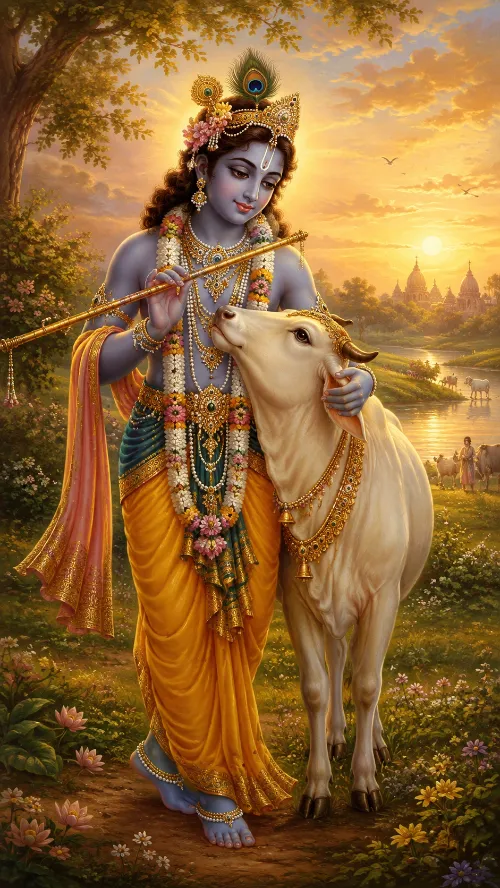
Cows, Brāhmaṇas, and the Whole World: The Particular and the Universal in Prahlāda’s Prayer
One of the most quoted Vaiṣṇava prayers to Kṛṣṇa names two things specifically — cows and brāhmaṇas — and then, in the very next breath, names the whole world. Most readings seize on one half and lose the other. The verse is more interesting than either, because it holds particular care and universal care together without letting go of either one.
नमो ब्रह्मण्यदेवाय
गोब्राह्मणहिताय च ।
जगद्धिताय कृष्णाय
गोविन्दाय नमो नमः ॥
“Obeisances to the brahmaṇya Lord, to Him who acts for the welfare of cows and brāhmaṇas, to Kṛṣṇa who acts for the welfare of the whole world, to Govinda—obeisances again and again.”
Viṣṇu Purāṇa 1.19.65
It is often rendered more freely as a prayer to Kṛṣṇa as well-wisher of cows, brāhmaṇas, human society and the world. That carries the devotional force, but the Sanskrit has a structure worth setting out:
So the verse holds far more than a statement about one social group or one form of animal protection. It gathers sacred knowledge, ethical culture, care for dependent life, social responsibility, universal welfare and devotion to Kṛṣṇa into four lines. But to read it properly one has to begin where it actually sits.
It Is Prahlāda, and He Is Drowning
The verse comes from the Viṣṇu Purāṇa, in the story of Prahlāda. His father Hiraṇyakaśipu has tried repeatedly to destroy him for his devotion; at this point he has been thrown into the ocean and buried under mountains. He remains absorbed in Acyuta, and he begins to pray. Immediately before the famous line he says:
नमस्ते पुण्डरीकाक्ष नमस्ते पुरुषोत्तम ।
नमस्ते सर्वलोकात्मन् नमस्ते तिग्मचक्रिणे ॥
“Obeisances to You, O lotus-eyed Lord. Obeisances to You, O Supreme Person. Obeisances to You, O Self of all worlds. Obeisances to You, O wielder of the blazing disc.”
Viṣṇu Purāṇa 1.19.64
Only then comes namo brahmaṇya-devāya. The context matters enormously: Prahlāda is not standing outside society issuing a social policy. He is addressing Puruṣottama, the Supreme Person, and sarva-lokātman, the Self of all worlds — and then calling that same Lord Kṛṣṇa, Govinda, and benefactor of the whole world. The horizon is theological and cosmic before it is ever social.
And the frame is worship, which is the easiest thing to overlook. The verse opens and closes with obeisance:
नमः
namaḥ
“obeisance,”
Every title in it belongs to praise, not analysis. Its movement is: because You are the protector of sacred order, because You act for the welfare of cows and brāhmaṇas, because Your concern embraces the world, because You are Kṛṣṇa and Govinda — I bow again and again. Ethics, theology and bhakti are not separable here.
Brahmaṇya-devāya: More Than “God of the Brāhmaṇas”
ब्रह्मण्यदेवाय
brahmaṇya-devāya
This is the most easily mistranslated word in the verse. It is commonly given as “God of the brāhmaṇas” or “the Lord worshipable by brāhmaṇas” — both possible, both narrower than the term’s traditional horizon. Brahmaṇya is associated with Brahman, with the Veda, with sacred learning, austerity, spiritual culture, and with the people expected to preserve and embody those things. A traditional gloss expands it toward the welfare of Veda, austerity and sacred culture generally.
तपोवेदादिहिताय देवाय
tapo-vedādi-hitāya devāya
“the Lord who promotes the welfare of austerity, the Veda, and related sacred principles.”
That gloss circulates in commentarial transmission without a consistent attribution in modern reproductions, so it is presented here as traditional rather than assigned to a named commentator on the strength of an unverified edition. The point it makes still stands: brahmaṇya-deva should not be flattened into “God favors a hereditary social elite.” The term belongs to a wider sacred ecology of knowledge, discipline, truth, teaching, ritual responsibility and spiritual cultivation.
Which raises the obvious question of what brahminical actually means. The Bhagavad-gītā answers it in terms of character, not descent:
शमो दमस्तपः शौचं
क्षान्तिरार्जवमेव च ।
ज्ञानं विज्ञानमास्तिक्यं
ब्रह्मकर्म स्वभावजम् ॥
“Peacefulness, self-control, austerity, purity, tolerance, straightforwardness, knowledge, realized wisdom, and faith are the natural qualities of brahminical work.”
Bhagavad-gītā 18.42
Whatever role birth plays in traditional systems of varṇa, a passage like that makes one principle hard to avoid: brahminical status without brahminical qualities is spiritually hollow. The value of the culture lies in preserving and embodying the qualities the label is meant to stand for, not in the label. The Bhāgavatam presses the same point through the idea of lakṣaṇa, actual characteristics:
यस्य यल्लक्षणं प्रोक्तं
पुंसो वर्णाभिव्यञ्जकम् ।
यदन्यत्रापि दृश्येत
तत्तेनैव विनिर्दिशेत् ॥
“Whatever characteristics have been described as indicating a particular varṇa, if those characteristics are observed elsewhere, one should identify the person according to those characteristics.”
Śrīmad-Bhāgavatam 7.11.35
That verse has been read differently in long-running debates about varṇa and birth, and it would be too convenient to claim it settles them. What it does do is make lakṣaṇa explicit. On a Vaiṣṇava reading, protecting brāhmaṇa culture therefore means supporting truthfulness, self-discipline, spiritual knowledge, ethical instruction, study and teaching — and those who genuinely live by them. Prestige without qualification cannot be the ideal.
Go-brāhmaṇa-hitāya: The Phrase Everyone Argues About
गोब्राह्मणहिताय
go-brāhmaṇa-hitāya
“for the welfare of cows and brāhmaṇas.”
The construction is simple enough — go, cow; brāhmaṇa; hita, welfare or benefit; hitāya, for the welfare of. The difficulty is not translation but interpretation: why do these two receive special mention at all?
Later Vaiṣṇava social theology has often treated the pair as standing for two kinds of nourishment. The cow represents physical sustenance, agricultural continuity, gentleness, and a form of provision that does not require killing the animal providing it. The brāhmaṇa represents spiritual nourishment — wisdom, ethical direction, scriptural learning, the preservation of sacred knowledge. The cow nourishes bodily life; the brāhmaṇa nourishes consciousness. A healthy society is held to need both responsible material nourishment and authentic spiritual guidance.
This is a theological and civilizational reading of the pair, not the lexical content of go-brāhmaṇa-hitāya itself. It explains why teachers have treated the two together; it is not what the compound says.
And the Bhāgavatam itself declines to leave the two standing alone:
विप्रा गावश्च वेदाश्च
तपः सत्यं दमः शमः ।
श्रद्धा दया तितिक्षा च
क्रतवश्च हरेस्तनूः ॥
“Brāhmaṇas, cows, the Vedas, austerity, truthfulness, sense control, mental tranquility, faith, compassion, tolerance, and sacrifice are manifestations belonging to Hari.”
Śrīmad-Bhāgavatam 10.4.41
There, cows and brāhmaṇas appear inside a much longer list — Veda, tapas, satya, dama, śama, śraddhā, dayā, titikṣā, and sacrificial performance, all described together as manifestations associated with Hari. The ideal being described is not “protect two privileged categories.” It is a civilization organized around truth, self-restraint, knowledge, compassion and sacred responsibility.
Why the Cow
The cow’s status makes most sense inside the agrarian world that produced the verse. She gives nourishment repeatedly while remaining alive, which in a pastoral society associates her with milk, maternal giving, agricultural continuity, gentleness, and a reciprocal human obligation. That is the root of go-rakṣā as an ethical principle, and the moral intuition behind it is not complicated: a living being that contributes continually to human welfare should not be treated purely as an expendable commodity. The response to benefit received is responsibility.
cow protection
In developed Vaiṣṇava devotional culture the cow becomes a paradigmatic instance of protected, nourishing life, and a standing symbol of ahiṁsā.
अहिंसा
ahiṁsā
restraint from unnecessary harm.
Historical Vedic communities did not all follow one economic or ritual model, and the history of Vedic animal ethics is considerably more complicated than any single slogan. Later Vaiṣṇava norms should not be projected backward unchanged onto every earlier period. What can be said is what the developed tradition holds.
In Kṛṣṇa theology the significance deepens sharply, because Kṛṣṇa is Govinda and Gopāla. He does not merely own cows — he tends them, protects them, walks among them, calls them, and brings them home to Vraja. Animal care becomes part of divine līlā rather than a rule imposed from outside it.
Jagad-dhitāya: The Phrase That Stops a Narrow Reading
जगद्धिताय
jagad-dhitāya
“for the welfare of the whole world.”
This is the balancing term, and it arrives immediately. Prahlāda does not say Kṛṣṇa cares for cows and brāhmaṇas instead of everyone else. He says Kṛṣṇa acts for the welfare of cows and brāhmaṇas, and Kṛṣṇa acts for the welfare of the whole world. The particular and the universal are placed side by side in a single verse.
And jagat is wider than humanity — the world, the moving universe, the living cosmos. That breadth fits the surrounding hymn exactly, which expands through devas, yakṣas, siddhas, nāgas, gandharvas, humans, animals, birds, plants, reptiles and the elements themselves. So the phrase is better understood as concern for all that lives and moves than as concern for human society.
“the benefactor of the entire living world,”
“the one acting for the welfare of the whole world.”
Prahlāda Has Already Said Why
The universal horizon is not read into the prayer from modern ethics. Prahlāda states its basis himself, earlier in the same chapter:
सोऽहं न पापमिच्छामि
न करोमि वदामि वा ।
चिन्तयन् सर्वभूतस्थम्
आत्मन्यपि च केशवम् ॥
“Therefore I neither desire evil, nor perform it, nor speak it, because I contemplate Keśava dwelling in all beings and also within myself.”
Viṣṇu Purāṇa 1.19.7
He cannot desire, do or speak evil, because he contemplates Keśava present within all beings. His ethics follow from a vision, not from a rule. And he continues:
एवं सर्वेषु भूतेषु
भक्तिरव्यभिचारिणी ।
कर्तव्या पण्डितैर्ज्ञात्वा
सर्वभूतमयं हरिम् ॥
“Knowing Hari as present throughout all beings, the wise should cultivate unwavering devotion with this understanding.”
Viṣṇu Purāṇa 1.19.9
The operative phrase is sarva-bhūta-mayaṁ harim — Hari as present throughout all beings — which is the essential context for go-brāhmaṇa-hitāya. The same speaker who glorifies the welfare of cows and brāhmaṇas describes a vision embracing sarva-bhūta, all living entities. His hymn then closes by making the horizon unmistakable:
एतेषां परमार्थश्च
सर्वमेतत्त्वमच्युत ॥
“You are the ultimate reality of all these; all this is You, O Acyuta.”
Viṣṇu Purāṇa 1.19.69
Particular Care Inside Universal Care
A modern reader can still fairly ask why, if Kṛṣṇa benefits everyone, two categories are singled out. The verse does not grammatically explain itself. Vaiṣṇava theology has generally understood the pair as naming conditions of wider welfare: care for gentle, nourishing life, and care for authentic spiritual wisdom, both understood as contributing to jagad-hita.
That is an interpretation of the sequence, not a grammatical entailment of it. It is worth saying so plainly, because the reading is doing real work and should be visible as a reading.
Put that way, the structure is not strange. Societies routinely give particular protection to what is vulnerable, socially necessary, educationally important, or hard to replace. The real question is whether the particular protection genuinely serves the whole — and the verse supplies its own test, because the two phrases sit one after the other.
The task is not to erase the difficult words. It is to understand them — and the safeguard against both failures is simply refusing to read either phrase without the other.
Kṛṣṇāya, Govindāya
The third line is striking on its own terms, because Prahlāda belongs primarily to the Nṛsiṁha cycle — and yet here the Supreme Lord is addressed as Kṛṣṇa:
कृष्णाय
kṛṣṇāya
“unto Kṛṣṇa.”
Within Purāṇic theology the names Viṣṇu, Nārāyaṇa, Hari, Acyuta, Kṛṣṇa and Govinda can all refer to the one Supreme Lord without being pinned to the chronology of avatāra narratives. For Gauḍīya Vaiṣṇavas the explicit appearance of Kṛṣṇa and Govinda here naturally carries particular weight.
गोविन्दाय
govindāya
“unto Govinda.”
Sanskrit tradition explains Govinda in several ways, because go itself carries several senses:
In this verse the immediately preceding go-brāhmaṇa-hitāya makes the cow-related resonance especially strong. And in Gauḍīya devotion the name goes straight to Vraja, where Kṛṣṇa herds the cows, calls them, protects them, walks among them, plays His flute in their company and brings them home at sunset. The theology turns intimate: the Supreme Lord is not merely the abstract ruler of the universe but bends into pastoral relationship.
Cosmic Lord and Cowherd, in One Prayer
The sequence of Prahlāda’s address is what makes the point. First:
पुरुषोत्तम
Puruṣottama
“the Supreme Person.”
then:
सर्वलोकात्मन्
sarva-lokātman
“the Self of all worlds.”
and then Govinda — the cowherd. The same Supreme Being is the Self of all worlds and Govinda among the cows. For Gauḍīya theology this is the heart of it: the highest God is not made less supreme by entering intimate līlā. His intimacy is not a reduction of divinity but one of its perfections. The Gītā states the universal half in almost the same terms:
भोक्तारं यज्ञतपसां
सर्वलोकमहेश्वरम् ।
सुहृदं सर्वभूतानां
ज्ञात्वा मां शान्तिमृच्छति ॥
“Knowing Me as the enjoyer of sacrifice and austerity, the great Lord of all worlds, and the well-wishing friend of all beings, one attains peace.”
Bhagavad-gītā 5.29
सुहृदं सर्वभूतानाम्
suhṛdaṁ sarva-bhūtānām
“the well-wishing friend of all beings.”
— suhṛdaṁ sarva-bhūtānām, the well-wishing friend of all beings, which parallels jagad-dhitāya closely. The Lord may have particular relationships. His benevolence is not confined to one group.
Caitanya Mahāprabhu Recites It Before Jagannātha
The verse acquires one more sacred context for Gauḍīya Vaiṣṇavas. During Ratha-yātrā at Jagannātha Purī, Śrī Caitanya Mahāprabhu stands before Lord Jagannātha and offers prayers, and Kṛṣṇadāsa Kavirāja records him reciting this same śloka:
নমো ব্রহ্মণ্যদেবায় গোব্রাহ্মণহিতায় চ ।
জগদ্ধিতায় কৃষ্ণায় গোবিন্দায় নমো নমঃ ॥
Śrī Caitanya-caritāmṛta, Madhya 13.77, citing the Viṣṇu Purāṇa
The continuity is remarkable. Prahlāda prays to Acyuta from beneath the ocean; centuries later Caitanya Mahāprabhu stands before Jagannātha and says the same words. One verse thereby connects Prahlāda, Viṣṇu, Kṛṣṇa, Govinda, Jagannātha and Caitanya Mahāprabhu — which goes a long way toward explaining how deeply it became embedded in Gauḍīya devotional life.
Three Levels at Once
There is a reasonable ecological observation available here — the verse does link animal welfare, spiritual culture and world welfare, and does not present human flourishing as independent of other life. How dependent beings are treated matters; how food is produced matters; which knowledge is preserved and which qualities are honored matter. That is broader than progress measured in production and consumption alone. But these are applications, and should be named as applications rather than smuggled in as the lexical meaning of the Sanskrit.
The same discipline applies to the brāhmaṇa. On this framework the value does not lie in political domination or material power — the Gītā’s own list of qualities points the other way entirely, toward self-control, simplicity, knowledge, purity, tolerance and conviction. The ideal is service through wisdom: a brāhmaṇa is spiritually valuable insofar as knowledge is preserved and used for teaching, ethical guidance, ritual competence, spiritual counsel and the cultivation of truth. The institution goes hollow precisely when the prestige outlives the functions.
Translation and Commentary, Kept Apart
Where textual precision matters, the safest rendering stays close to the words. A more interpretive Vaiṣṇava rendering can say considerably more:
“Repeated obeisances to Kṛṣṇa, Govinda—the Lord who cherishes sacred wisdom and brahminical culture, who protects cows and those who genuinely preserve spiritual knowledge, and whose concern extends to the welfare of the entire living world.”
The first is translation; the second is commentary. Keeping the two levels visibly distinct is what makes the interpretation trustworthy rather than merely devotional.
The verse is usually quoted to establish the importance of cows and brāhmaṇas, and that genuinely is part of it — but it is not the whole, and the surrounding chapter will not let it be read narrowly. Prahlāda says he cannot desire evil because he sees Keśava within all beings; he speaks of Hari as present throughout all life; his hymn expands from particular beings to the entire cosmic order. So go-brāhmaṇa-hitāya has to be read together with jagad-dhitāya. The verse neither asks us to erase cows and brāhmaṇas from the Sanskrit nor permits us to turn their protection into indifference toward everyone else. Gentle, nourishing life deserves protection. Sacred knowledge deserves preservation. Those entrusted with that knowledge have to actually embody its virtues. And every particular responsibility stays situated within the welfare of the whole. Yet the prayer’s last word is not social theory at all:
कृष्णाय गोविन्दाय नमो नमः
kṛṣṇāya govindāya namo namaḥ
“To Kṛṣṇa, to Govinda—obeisances again and again.”
Prahlāda’s final concern is not how a civilization should be organized. It is who Govinda is — the Lord who is Puruṣottama, the Self of all worlds, protector of sacred wisdom, benefactor of cows and brāhmaṇas and well-wisher of the whole world, and who is also the intimate cowherd of Vraja. That is the deepest thing in the verse: His care can be particular without ceasing to be universal, and universal without becoming abstract.