ॐ ऐं सरस्वत्यै नमः
Om Eim (Aim) Sarasvatyei Namaha
Om, I offer my salutations to Goddess Sarasvatī, the embodiment of wisdom and learning, through her sacred seed-sound Aim.


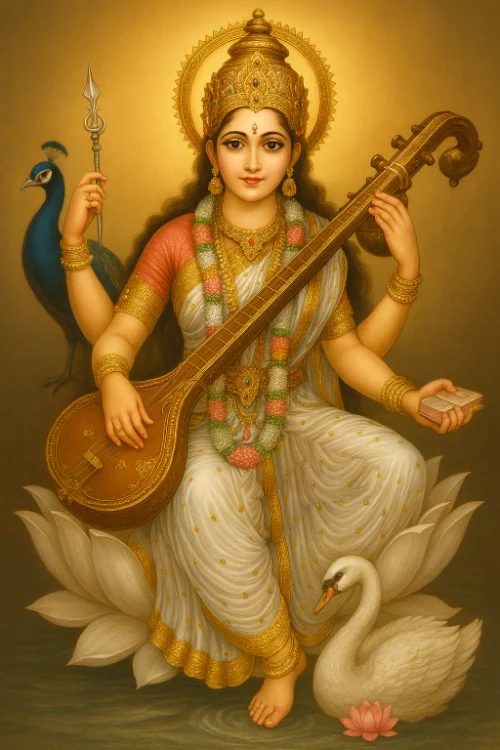
Sarasvatī, the Vedic goddess of knowledge, speech, music, and the arts, has been honored for millennia as the divine source of learning and refined expression. Her mantras—rooted in ancient Sanskrit texts like the Vedas and Tantras—are used to sharpen intellect, enhance memory, and unlock creative potential. Chanting Sarasvatī mantras is believed to purify the mind, improve concentration, and inspire eloquence, making them especially cherished by students, teachers, writers, and artists. These sacred sounds are not just devotional tools—they are vibrational technologies for aligning thought, language, and consciousness with higher wisdom.
Aiṁ is the seed syllable (bīja) of Sarasvatī, the sound of knowledge and speech, and the same syllable that opens the Bīja and Aṣṭākṣarī mantras above. Vāgdevī, from vāk, speech, and devī, goddess, names her as the power through which knowledge is spoken and understood. Kāmarāja, “king of desire”, is read in more than one way; devotional explanations take it as the power that rules desire and turns it toward knowledge and creative work.
The prayer keeps the form of every Gāyatrī: vidmahe, “may we know”; dhīmahi, “we meditate”; pracodayāt, “may she inspire”.
This form is given in the Bṛhat Tantrasāra attributed to Kṛṣṇānanda Āgamavāgīśa, of sixteenth-century Bengal, which names it the Sarasvatī Gāyatrī. It is recited before study, writing, teaching or music, and on Vasanta Pañcamī, the spring festival of learning and the arts, when Sarasvatī is worshipped dressed in white and holding the vīṇā.