

Durgā’s Weapons: The Powers of the Cosmos in the Mother’s Hands
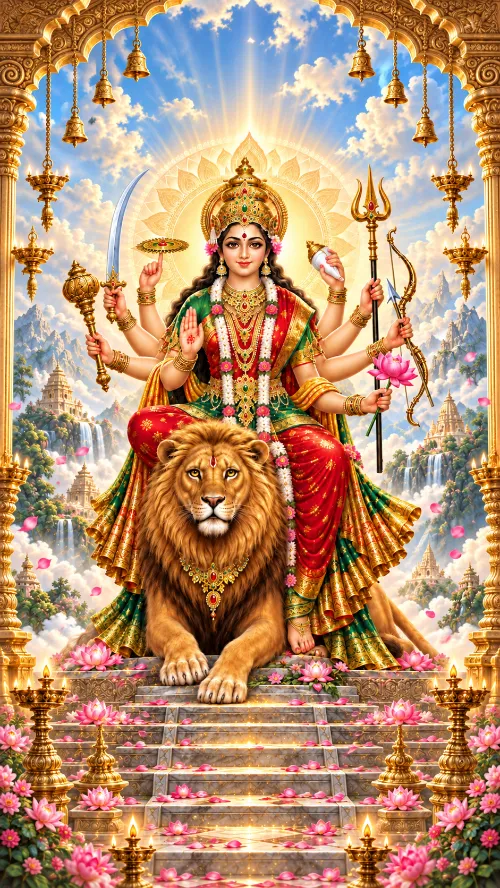
Durgā’s Weapons: The Powers of the Cosmos in the Hands of the Mother
A study of divine weapons, sacred imagery, and spiritual transformation through Sanskrit scripture and Bengali devotional reflection. Durgā carries a sword, but she is not simply a goddess of warfare. She holds a lotus, but she is not merely an image of serenity. Her hands can threaten, protect, restrain, nourish, and bless.
That combination is the point. Her many arms gather together powers that ordinarily appear separate: destruction and preservation, discipline and generosity, knowledge and action, fierceness and compassion. To understand her image, we must look beyond a list of attractive labels such as “sword means discrimination” or “lion means courage.”
Some of these interpretations have strong scriptural foundations. Others are useful contemplative associations. Still others are modern simplifications. The distinction matters because the original texts offer something considerably richer: Durgā’s weapons express a vision of the universe’s powers gathered into a conscious, protective, and ultimately liberating presence.
The principal source is the Devī Māhātmya, “The Glorification of the Goddess,” a thirteen-chapter work within the Mārkaṇḍeya Purāṇa, also transmitted as the Durgā Saptaśatī. Its narrative must be distinguished from the meditation verses and ritual texts commonly transmitted alongside it. These associated texts are important witnesses to Durgā’s worship, but they do not all belong to the same textual layer.
The quotations below follow the commonly used Saptaśatī chapter-and-verse numbering. Translations are rendered directly for this article; website sources are collected at the end.
1. The Goddess appears—but she does not begin to exist
The weapon-giving episode begins with a cosmic crisis. Mahīṣāsura, the buffalo demon, has defeated the gods and taken over their functions. Their defeat is not merely a change of ruler: the differentiated powers responsible for maintaining the world have been displaced.
The gods approach Brahmā, Viṣṇu, and Śiva. An immense radiance emerges from the divine assembly and converges into a single form. The Devī Māhātmya 2.13 describes the moment:
अतुलं तत्र तत्तेजः सर्वदेवशरीरजम् ।
एकस्थं तदभून्नारी व्याप्तलोकत्रयं त्विषा ॥
atulaṃ tatra tat tejaḥ sarvadevaśarīrajam |
ekasthaṃ tad abhūn nārī vyāptalokatrayaṃ tviṣā ||
“That incomparable radiance, arising from the bodies of all the gods, gathered into one and became a woman, filling the three worlds with her splendour.”
Devī Māhātmya 2.13
The key word is तेजस् — tejas — radiance, brilliance, or potent energy. The text proceeds to describe her face arising from Śiva’s radiance, her arms from Viṣṇu’s, and other features from the powers of other gods. Her three eyes arise from the radiance of Agni, the fire god.
Read in isolation, this might suggest that the gods manufacture a previously nonexistent goddess. But the text has already ruled out that conclusion. In 1.64, the sage declares:
नित्यैव सा जगन्मूर्तिस्तया सर्वमिदं ततम् ॥
nityaiva sā jaganmūrtis tayā sarvam idaṃ tatam ||
“She is eternal, whose form is the universe; all this is pervaded by her.”
Devī Māhātmya 1.64
The following verses explain that when she appears to accomplish the purposes of the gods, people speak of her as having been “born,” although she is eternal. Manifestation is not the same as manufacture.
Within the text’s Goddess-centered theology, the divine powers do not create ultimate power from nothing. Their convergence makes visible a reality that was already present.
This is the foundation for understanding everything placed in her hands.
2. The gods give her more than military equipment
The gift of Śiva’s weapon and Viṣṇu’s discus is described with unusual precision:
शूलं शूलाद्विनिष्कृष्य ददौ तस्यै पिनाकधृक् ।
चक्रं च दत्तवान् कृष्णः समुत्पाट्य स्वचक्रतः ॥
śūlaṃ śūlād viniṣkṛṣya dadau tasyai pinākadhṛk |
cakraṃ ca dattavān kṛṣṇaḥ samutpāṭya svacakrataḥ ||
“The bearer of Pināka drew forth a śūla from his own śūla and gave it to her. Kṛṣṇa likewise gave her a discus, drawing it from his own discus.”
Devī Māhātmya 2.20
“The bearer of Pināka” is Śiva; Kṛṣṇa here names Viṣṇu. The narrative does not simply say that Śiva hands her an available weapon. Her weapon is drawn from his own. Viṣṇu’s discus and Indra’s thunderbolt are similarly expressions of their donors’ distinctive powers.
The next verse continues:
शङ्खं च वरुणः शक्तिं ददौ तस्यै हुताशनः ।
मारुतो दत्तवांश्चापं बाणपूर्णे तथेषुधी ॥
śaṅkhaṃ ca varuṇaḥ śaktiṃ dadau tasyai hutāśanaḥ |
māruto dattavāṃś cāpaṃ bāṇapūrṇe tatheṣudhī ||
“Varuṇa gave the conch, and the fire god gave her a lance. The wind god gave a bow and two quivers filled with arrows.”
Devī Māhātmya 2.21
Notice two details easily lost in simplified retellings: the conch comes from Varuṇa, not Viṣṇu, and Vāyu gives two arrow-filled quivers, not merely one arrow.
The principal gifts and attributes
The following inventory separates what the narrative explicitly assigns from what appears elsewhere in the Goddess’s arsenal.
The principal passage is Devī Māhātmya 2.20–31, with the acknowledgment of further gifts continuing into 2.32. The gifts also include the Sun’s rays, placed in the pores of her body; garments, jewels, and ornaments from the Milk Ocean; and additional weapons and adornments from other gods.
This is not merely an armoury. It is an assemblage of radiance, sovereignty, beauty, ascetic discipline, abundance, protection, and martial power. Several small corrections preserve the text’s precision. Kāla, the giver of the sword and shield, means Time or Death; the name should not be confused with Kālī. The rosary is not explicitly identified here as a rudrākṣa rosary. Prajāpati and Brahmā are named separately in the gift verse, but their titles can overlap elsewhere; the wording should not be forced into a rigid system of wholly separate divine identities.
And Kubera’s gift should not be silently rewritten as “nectar.” The text says surā, an intoxicating drink. Recognizing what a religious narrative contains does not turn its imagery into a universal instruction for personal conduct.
3. Why eight, ten, eighteen—and a thousand—arms can all occur
There is no single universal list of “Durgā’s ten weapons.” But the opposite claim—that the weapons may be arranged in any order whatsoever—is also misleading. There are multiple iconographic prescriptions, and particular prescriptions can be quite exact.
The narrative itself describes the Goddess filling the directions with a thousand arms (Devī Māhātmya 2.39). The associated Vaikṛtika Rahasya, a ritual text concerning the Goddess’s manifested forms, explains how this vastness is represented in a worship image:
अष्टादशभुजा पूज्या सा सहस्रभुजा सती ।
आयुधान्यत्र वक्ष्यन्ते दक्षिणाधःकरक्रमात् ॥
aṣṭādaśabhujā pūjyā sā sahasrabhujā satī |
āyudhāny atra vakṣyante dakṣiṇādhaḥkarakramāt ||
“She is to be worshipped with eighteen arms, although she is thousand-armed. Her implements will now be described in order, beginning with the lower right hand.”
Vaikṛtika Rahasya 10
This is an unusually clear explanation of sacred imagery: a finite arrangement makes an inexhaustible divine capacity visible. The text then lists eighteen implements: rosary, lotus, arrow, sword, thunderbolt, mace, discus, trident, axe, conch, bell, noose, lance, staff, shield, bow, drinking vessel, and water pot.
The meditation traditionally placed before the middle episode likewise presents an eighteen-armed Mahālakṣmī, the buffalo-demon slayer. This warrior form should not be confused automatically with every other image bearing the name Lakṣmī.
The same Rahasya describes a ten-armed Mahākālī and an eight-armed Sarasvatī form associated with other episodes. Names, forms, and functions operate within a particular ritual framework.
A separately transmitted Durgādhyāna, meanwhile, prescribes a ten-armed Mahīṣāsuramardinī. Its right-hand attributes are the trident, sword, discus, arrow, and lance; its left-hand attributes include shield, bow, noose, elephant goad, and either a bell or an axe.
That last alternative is expressly authorized:
घण्टां वा परशुं वापि वामतः सन्निवेशयेत् ।
ghaṇṭāṃ vā paraśuṃ vāpi vāmataḥ sanniveśayet |
“One should place a bell or an axe on the left.”
Durgādhyāna 6, excerpt
Thus variation need not mean carelessness. Sometimes the tradition itself gives alternatives. For an artist, the practical rule is straightforward: identify the particular form being represented before deciding the number of arms and their contents. Also remember that “right” and “left” in such prescriptions refer to the deity’s own sides, not the viewer’s.
A devotional illustration may be artistically excellent without following one specific ritual prescription. It should simply not be described as the uniquely canonical arrangement.
4. The sword: a weapon of cutting, and an ancient image of knowledge
“Durgā’s sword represents discrimination” is a meaningful interpretation—but it requires a carefully stated foundation. In the Devī Māhātmya, the sword is first a sword. Kāla gives it to her, and she uses it to cut weapons and defeat opponents.
The narrative does not append the explanation: “This sword is discrimination.” Yet the idea of knowledge as a sword is not merely a modern motivational invention. The Bhagavad-gītā makes the metaphor explicit:
तस्मादज्ञानसम्भूतं हृत्स्थं ज्ञानासिनात्मनः ।
छित्त्वैनं संशयं योगमातिष्ठोत्तिष्ठ भारत ॥
tasmād ajñānasambhūtaṃ hṛtsthaṃ jñānāsinātmanaḥ |
chittvainaṃ saṃśayaṃ yogam ātiṣṭhottiṣṭha bhārata ||
“Therefore, with the sword of knowledge, cut this doubt in your heart that has arisen from ignorance. Take your stand in yoga and arise, descendant of Bharata.”
Bhagavad-gītā 4.42
Here ज्ञानासि — jñānāsi — “the sword of knowledge” is unmistakable. We can therefore distinguish three levels without dismissing any of them. In Durgā’s battle narrative, the sword cuts. In the Gītā, knowledge cuts ignorance-born doubt. In contemplation of Durgā, the sword can consequently become an image of clear understanding that cuts confusion.
The third reading is supported by a genuine scriptural analogy, but it is not a verbatim explanation supplied by Devī Māhātmya 2. Its practical force is also sharper than the vague word “discrimination”: clarity sometimes requires cutting an attachment, not merely collecting another reassuring idea.
5. The bow and arrow: concentrated action, not merely “character”
The bow does not act by possessing force alone. It must gather tension, take aim, and release. That makes it a compelling image of disciplined attention. But again, “bow equals character” is not the explanation given in the weapon-gifting passage.
A much stronger comparison comes from the Muṇḍaka Upaniṣad:
प्रणवो धनुः शरो ह्यात्मा ब्रह्म तल्लक्ष्यमुच्यते ।
अप्रमत्तेन वेद्धव्यं शरवत्तन्मयो भवेत् ॥
praṇavo dhanuḥ śaro hy ātmā brahma tal lakṣyam ucyate |
apramattena veddhavyaṃ śaravat tanmayo bhavet ||
“Om is the bow; the self is the arrow; Brahman is said to be the target. It is to be pierced without inattention; like an arrow, one should become one with that.”
Muṇḍaka Upaniṣad 2.2.4
The preceding verse speaks of an arrow sharpened through contemplative practice. This is not directly a commentary on Durgā’s bow. It is a scriptural demonstration that bow-and-arrow imagery can express spiritual concentration: preparation, direction, unwavering attention, and complete engagement.
There is an earlier, equally striking parallel in the Ṛgveda’s Devīsūkta:
अहं रुद्राय धनुरा तनोमि ।
ahaṃ rudrāya dhanur ā tanomi |
“I stretch the bow for Rudra.”
Ṛgveda 10.125.6, opening
This Vedic hymn is not a description of the later ten-armed Durgā image. Nevertheless, its feminine divine voice already presents herself as the power enabling a god’s action.
That makes a profound companion to the later story: the Goddess is not merely standing beside divine agency. She is the power through which divine agency becomes effective.
6. The trident and lance: distinguish the weapon from the interpretation
The gift verse uses शूल — śūla. The more explicit त्रिशूल — triśūla, “three-pointed weapon” or trident, occurs in the battle narrative at 2.55 and in the protective prayer at 11.26.
It is therefore reasonable to depict Śiva’s gift as a trident. But a precise quotation should retain the word actually used in its verse. The trident is frequently interpreted through triads: creation, preservation, and dissolution; or the three qualities of nature—clarity, activity, and inertia, called sattva, rajas, and tamas.
Such readings can fit the broader theology of the text, which describes the Goddess as the source of the three qualities and the power of cosmic processes. They should not, however, be presented as though the weapon-gift verse explicitly assigns one quality to each prong.
The text’s clearest direct interpretation is protection from fear: in 11.26, the gods pray that her terrible, flame-like trident protect them. The lance carries another suggestive feature. Its Sanskrit name is: शक्ति — śakti — a lance; also power, capacity, or divine potency.
Agni gives the Goddess a weapon whose name is also the central theological term for divine power. The resonance is compelling: fire contributes concentrated, penetrating power to the Goddess’s arsenal. Nevertheless, literary suggestiveness is not proof that the narrator intended a formal philosophical wordplay.
One can appreciate the connection without overstating it.
7. Discus, conch, and mace: scriptural symbolism is not one universal code
The discus comes from Viṣṇu. The conch comes from Varuṇa. The mace is unquestionably present, but its individual donor is not identified in the central gift sequence. This already corrects several popular shortcuts.
There is no statement in that passage that “conch means happiness” or “mace means loyalty and love.” The discus can reasonably suggest divine order or irresistible action, but “discus equals righteousness” is not the passage’s own explanatory formula.
A valuable comparison appears in the Śrīmad-Bhāgavatam, where Viṣṇu’s attributes are explicitly interpreted cosmologically:
ओजःसहोबलयुतं मुख्यतत्त्वं गदां दधत् ।
अपां तत्त्वं दरवरं तेजस्तत्त्वं सुदर्शनम् ॥
ojaḥsahobalayutaṃ mukhyatattvaṃ gadāṃ dadhat |
apāṃ tattvaṃ daravaraṃ tejastattvaṃ sudarśanam ||
“He bears the mace as the principal vital principle, endowed with vigour, potency, and strength; the excellent conch as the principle of water; and Sudarśana as the principle of fire.”
Śrīmad-Bhāgavatam 12.11.14
The following verse associates other attributes with space, darkness, time, and activity. This passage demonstrates two things. First, explicit scriptural explanations of divine weapons do exist. We need not invent them.
Second, they are not always lists of moral virtues. An object can represent a cosmic element, a divine function, an aspect of consciousness, or a means of protection. The Bhāgavatam passage explains Viṣṇu’s iconography. It should not simply be transferred to Durgā as though both texts supplied an identical commentary. But it gives a sound comparative basis for contemplating the mace as strength, the conch in relation to water, and the discus as fiery divine power.
Its most important lesson is methodological: sacred imagery has multiple textual languages, not one universal dictionary.
8. Bell, noose, staff, thunderbolt, and shield: protection takes different forms
The bell is not an ornamental afterthought. Indra gives it from Airāvata. During the battle, its sound bewilders the demons. After victory, the gods ask for protection not only through weapons but through sound itself:
शूलेन पाहि नो देवि पाहि खड्गेन चाम्बिके ।
घण्टास्वनेन नः पाहि चापज्यानिःस्वनेन च ॥
śūlena pāhi no devi pāhi khaḍgena cāmbike |
ghaṇṭāsvanena naḥ pāhi cāpajyāniḥsvanena ca ||
“Protect us with your śūla, O Goddess; protect us with your sword, O Mother. Protect us with the sound of your bell and with the twang of your bowstring.”
Devī Māhātmya 4.24
The later hymn at 11.27 again asks her bell to protect the worshippers as though they were her children. The noose likewise has a clear narrative function: she binds and drags opponents with it. Restraint is therefore not a symbolic meaning imposed from nowhere; it is what the object does in the story.
A contemplative reading may extend this to the restraint of destructive impulses. But the noose is not automatically “attachment” in every deity’s hand. Here the Goddess uses binding power against hostile forces.
Yama’s staff brings another register of power: authority associated with death and the limits no being can indefinitely evade. Reading it as discipline, accountability, or judgment is coherent with its donor, although the gift verse does not provide that moral glossary.
Indra’s thunderbolt suggests overwhelming force. Kāla’s shield introduces defence rather than attack. Viśvakarman’s axe adds another mode of cutting or striking. Together, these objects resist a simplistic picture of power as one repeated action. Sometimes protection cuts. Sometimes it restrains. Sometimes it withstands. Sometimes it announces its presence before a blow is struck.
That last sentence is a contemplative synthesis—not an additional Sanskrit quotation—but it arises from the actual diversity of the objects.
9. The lotus, rosary, and water pot: why not every hand holds a weapon
A lotus, a rosary, and an ascetic’s water vessel belong to the same divine image as sword and trident. Their presence matters. Durgā’s power is not exhausted by fighting.
The Ocean gives the lotus, called पङ्कज — paṅkaja — “mud-born.” Its association with purity and nonattachment has a firm comparative scriptural foundation:
ब्रह्मण्याधाय कर्माणि सङ्गं त्यक्त्वा करोति यः ।
लिप्यते न स पापेन पद्मपत्रमिवाम्भसा ॥
brahmaṇy ādhāya karmāṇi saṅgaṃ tyaktvā karoti yaḥ |
lipyate na sa pāpena padmapatram ivāmbhasā ||
“One who acts, placing actions in Brahman and abandoning attachment, is not stained by evil, just as a lotus leaf is not wetted by water.”
Bhagavad-gītā 5.10
Strictly speaking, the verse refers to a lotus leaf, not the flower. But the connection between lotus imagery and unstained participation in the world is explicit. Thus “lotus—nonattachment” is a strong contemplative interpretation. It should be presented as a comparison supported by the Gītā, not as the Devī Māhātmya’s own explanation of the Ocean’s gift.
The rosary can suggest recollection, repetition, and disciplined practice; the water pot can suggest ascetic life and purification. These are readings based on the objects’ uses, not definitions supplied in the gift verse.
The broader insight is compelling: the hand that acts must belong to a being who also knows how to attend, remember, and remain inwardly free.
10. The lion, red clothing, and blessing hands deserve better explanations
The lion: more than courage
Himavān gives the lion as the Goddess’s vehicle. The narrative shows it fighting alongside her. “Courage” is an understandable association. Yet an associated ritual text gives a more specific interpretation.
The Vaikṛtika Rahasya 30–31 directs worship of the lion as the Goddess’s vehicle and describes it as:
समग्रं धर्ममीश्वरम्
samagraṃ dharmam īśvaram
“Dharma in its fullness, sovereign.”
Vaikṛtika Rahasya 30–31
The surrounding passage speaks of the support of the moving and unmoving world. Here धर्म — dharma means more than a private moral preference: it concerns sustaining order, rightness, and the principles that uphold existence.
Consequently, the lion can be understood, within this ritual interpretation, as power placed in the service of sustaining order. This is more substantial than simply “lion equals courage.” It also distinguishes controlled, protective strength from aggression pursued for its own sake.
Red: not simply human passion
“Red means passion” is too narrow to serve as a universal explanation. The meditation associated with the middle episode describes the Goddess as प्रवालप्रभा — pravālaprabhā — coral-radiant. The Vaikṛtika Rahasya gives an even more varied visualization: a white face, blue arms, and red portions of the body, together with richly coloured garments and ornaments.
These prescriptions already show why no single modern colour chart can govern all her forms. In contemplation, red can suggest energy, vitality, and active power. It should not be treated as a textual declaration that the Goddess embodies ordinary human craving or uncontrolled passion.
Nor should a colour association be confused with a complete account of her nature: the text presents her as the power underlying all three qualities of nature, not merely one.
The raised palm: protection, not specifically forgiveness
Two gestures require careful distinction: अभयमुद्रा — abhaya-mudrā — the gesture of fearlessness or protection. वरदमुद्रा — varada-mudrā — the gesture of granting a boon.
A raised, outward-facing palm commonly communicates reassurance: “Do not fear.” A downward-facing boon-giving hand communicates generosity or the granting of a blessing. Neither is a weapon. “Forgiveness” may be a devotional association, but it is not the literal meaning of abhaya.
Moreover, not every prescribed form leaves a hand free for either gesture. Some visualizations fill all the hands with objects. These are different arrangements, not necessarily errors.
11. Her fierceness and compassion are not opposites
The Devī Māhātmya does not conceal the violence of its battles. Weapons are broken, bodies are struck, and demons are killed. Its theological question is not how to pretend that the Goddess never destroys. It is how destruction relates to protection and compassion.
The gods identify the paradox directly:
चित्ते कृपा समरनिष्ठुरता च दृष्टा
त्वय्येव देवि वरदे भुवनत्रयेऽपि ॥
citte kṛpā samaraniṣṭhuratā ca dṛṣṭā
tvayy eva devi varade bhuvanatraye ’pi ||
“Compassion in the heart and severity in battle are seen together in you alone, O boon-giving Goddess, throughout the three worlds.”
Devī Māhātmya 4.22, concluding half
The surrounding hymn goes further: even opponents struck down by her weapons may be purified and attain higher states. The Vaikṛtika Rahasya 30 similarly includes the defeated Mahīṣa in the worship arrangement and speaks of his attainment of union with the Goddess. This is not merely the image of an enemy condemned to remain eternally outside the divine.
These are claims about divine action within the texts. They are not permission for human beings to sanctify their anger or harm others in the Goddess’s name. The Mahīṣāsura battle also rewards close reading. He changes from buffalo to lion, human figure, elephant, and buffalo again. The Goddess restrains him, overcomes these transformations, presses him down, and pierces him. When he emerges partly from the buffalo form, she finally beheads him with a great sword (Devī Māhātmya 3.28–42).
Thus an image emphasizing the trident captures an important moment, but it does not reproduce every stage of the narrative. As a contemplative analogy, his changing forms can suggest the way a destructive tendency survives by changing its justification. Pride can disguise itself as virtue; possessiveness can call itself care.
That is a useful application, provided we identify it as an application. The text should not be reduced to the claim that every demon is “really only” a psychological condition with one fixed modern equivalent.
12. The many powers are ultimately her own
The weapon-giving episode becomes still more significant when read beside the confrontation with Śumbha. During the later battles, divine female powers appear in forms corresponding to various gods, carrying their characteristic implements and using their vehicles. Śumbha then accuses the Goddess of relying on others.
Her answer is decisive:
एकैवाहं जगत्यत्र द्वितीया का ममापरा ।
पश्यैता दुष्ट मय्येव विशन्त्यो मद्विभूतयः ॥
ekaivāhaṃ jagaty atra dvitīyā kā mamāparā |
paśyaitā duṣṭa mayy eva viśantyo madvibhūtayaḥ ||
“I alone am here in this world. Who else is there besides me? Look, wicked one: these manifestations of mine are entering back into me.”
Devī Māhātmya 10.5
The other goddesses then merge into her. This does not erase the narrative distinctions between Śiva, Viṣṇu, Indra, and the other gods. It reveals how those distinctions are understood within this Goddess-centred vision.
At the level of the story, the gods give her their powers. At the theological level, those powers are not ultimately foreign to her. Her many arms therefore communicate more than a coalition of separate strengths. They make visible the unity underlying their differentiation.
A later Bengali expression of a closely related insight appears in the Śrī Śrī Rāmakṛṣṇa Kathāmṛta, in a conversation recorded on 28 November 1883:
এই আদ্যাশক্তি আর পরব্রহ্ম অভেদ। একটিকে ছেড়ে আর-একটিকে চিন্তা করবার জো নাই।
Ei ādyāśakti ār parabrahma abhed. Ekṭike chheṛe ār-ekṭike cintā karbār jo nāi.
“This Primordial Power and the Supreme Brahman are non-different. There is no way to conceive of one apart from the other.”
Śrī Śrī Rāmakṛṣṇa Kathāmṛta, 28 November 1883
Ramakrishna illustrates the point through a jewel and its radiance: one cannot isolate the luminous jewel from its luminosity. This is a nineteenth-century Bengali devotional and philosophical formulation, not an ancient verse from the Devī Māhātmya. Nor must every Hindu theological school express the relationship in precisely the same way.
Nevertheless, it illuminates the central intuition: divine power is not merely an accessory attached to reality. It is inseparable from reality’s living expression.
13. The Mother is present beyond the battlefield
The Goddess’s power does not appear only when she raises a weapon. The great hymn in Chapter 5 repeatedly recognizes her presence in living beings:
या देवी सर्वभूतेषु शक्तिरूपेण संस्थिता ।
नमस्तस्यै नमस्तस्यै नमस्तस्यै नमो नमः ॥
yā devī sarvabhūteṣu śaktirūpeṇa saṃsthitā |
namas tasyai namas tasyai namas tasyai namo namaḥ ||
“To the Goddess who abides in all beings as power: homage to her, homage to her, homage to her, again and again.”
Devī Māhātmya 5
The hymn also recognizes her in intelligence, sleep, hunger, memory, compassion, motherhood, and other conditions of embodied existence. This is a much broader vision than a goddess who exists principally to defeat enemies. The power that fights is also the power through which beings think, remember, rest, and care.
The text even includes delusion within her cosmic scope. To say that all capacities depend upon her is not to say that every use of those capacities is good. The same text distinguishes bondage from liberation.
Chapter 11 adds another powerful recognition:
विद्याः समस्तास्तव देवि भेदाः
स्त्रियः समस्ताः सकला जगत्सु ।
vidyāḥ samastās tava devi bhedāḥ
striyaḥ samastāḥ sakalā jagatsu |
“All forms of knowledge are your manifestations, O Goddess; so too are all women throughout the worlds.”
Devī Māhātmya 11.6, opening half
The image consequently challenges a merely decorative reverence for the feminine. To praise the Mother in a shrine while dismissing knowledge, compassion, or actual women would sit uneasily beside this hymn. Its theology asks the reader to recognize divine significance beyond the beautifully ornamented image.
14. The real human question is attachment—and the story ends with knowledge
The Devī Māhātmya does not begin with someone asking how many weapons Durgā possesses. Its human frame concerns a dispossessed king, Suratha, and a merchant, Samādhi, rejected by his own family. Both remain emotionally attached to what has harmed or abandoned them.
Their question is painfully familiar: Why does understanding a situation not free us from it? The sage explains the Goddess’s power through the workings of attachment and delusion. He also identifies her as the supreme knowledge that brings liberation when she is gracious (Devī Māhātmya 1.53–58).
The battles unfold within that larger inquiry. At the end, the king and merchant worship the Goddess, making an earthen image by a river. Their requests differ. Suratha seeks restoration of his kingdom. Samādhi seeks a more inward freedom:
सोऽपि वैश्यस्ततो ज्ञानं वव्रे निर्विण्णमानसः ।
ममेत्यहमिति प्राज्ञः सङ्गविच्युतिकारकम् ॥
so ’pi vaiśyas tato jñānaṃ vavre nirviṇṇamānasaḥ |
mamety aham iti prājñaḥ saṅgavicyutikārakam ||
“The merchant, disenchanted in mind and understanding, chose knowledge that would loosen attachment to ‘mine’ and ‘I.’”
Devī Māhātmya 13.18
Both receive a response appropriate to their request. This ending transforms the meaning of the entire work. The Goddess protects life within the world, but she can also release the possessiveness through which the world binds us.
Her weapons therefore belong to a story whose final human horizon is not merely victory over somebody else. It is freedom from the tyranny of “I” and “mine.”
15. “Divine qualities lead to liberation”: what the phrase actually says
A phrase sometimes attached to devotional posters is:
दैवी सम्पद्विमोक्षाय निबन्धायासुरी मता ।
daivī sampad vimokṣāya nibandhāyāsurī matā |
“Divine qualities lead toward liberation; demonic qualities are understood to lead toward bondage.”
Bhagavad-gītā 16.5, first half
The correct opening is दैवी — daivī — “divine,” an adjective. It should not be confused with देवी — devī — “goddess.” The phrase is from the Bhagavad-gītā, not the Devī Māhātmya. It does not introduce an object-by-object explanation of Durgā’s weapons.
The Gītā’s actual account of divine qualities includes fearlessness, purity, generosity, self-restraint, non-injury, truthfulness, freedom from anger, compassion, gentleness, forgiveness, and freedom from excessive pride.
This provides an important corrective. An image of divine strength should not become a justification for arrogance, cruelty, or domination. The connection to Durgā is best made thoughtfully: her image can inspire the cultivation of protective strength, disciplined attention, clear understanding, generosity, and freedom from attachment. But a modern teacher’s chosen correspondence between a weapon and a virtue should be identified as that teacher’s interpretation.
Likewise, an English sentence such as “Her blessings will be showered upon us once we practise her teachings” may be a devotional exhortation. Without an identified source, it should not be presented as a translated scriptural quotation.
A final Sanskrit clarification
The broad term for a weapon is आयुध — āyudha; its plural is आयुधानि — āyudhāni. Thus: दुर्गायुधानि — Durgāyudhāni — “Durgā’s weapons.” शस्त्र — śastra often denotes a wielded weapon, while अस्त्र — astra often denotes a discharged weapon or missile. The distinction is useful, but it is not absolute: the Devī Māhātmya uses martial terminology flexibly.
Similarly, असि — asi, “sword,” can occur where another passage uses khaḍga. शर — śara and इषु — iṣu are additional words for an arrow. The dictionary stem dhanus, “bow,” appears as dhanuḥ in the nominative singular; carma, “shield” or “hide,” belongs to the stem carman.
These variations are normal features of Sanskrit usage, not evidence that each passage describes an entirely different object.
Durgā’s image becomes less profound when every object is reduced to a fixed one-word label. The sword is not only a slogan about wisdom. The lion is not only courage. The conch is not simply happiness. The many hands do not amount to a supernatural inventory assembled for visual effect.
They belong to a coherent religious vision: the powers of the world, which appear dispersed and sometimes opposed, find their unity in the Goddess. Her strength can destroy, but its purpose is not destruction for its own sake. Her sovereignty can grant worldly restoration, but it can also free the seeker from possessiveness. Her beauty does not cancel her fierceness, and her fierceness does not cancel compassion.
The text gathers these themes into a single prayer:
सर्वस्वरूपे सर्वेशे सर्वशक्तिसमन्विते ।
भयेभ्यस्त्राहि नो देवि दुर्गे देवि नमोऽस्तु ते ॥
sarvasvarūpe sarveśe sarvaśaktisamanvite |
bhayebhyas trāhi no devi durge devi namo ’stu te ||
“You whose forms are all forms, sovereign of all, endowed with every power: protect us from fears, O Goddess. O Durgā, homage to you.”
Devī Māhātmya 11.24
That is the governing idea. Not power for domination, but power capable of protection. Not merely the defeat of an enemy, but the restoration of order—and, finally, freedom.
Primary texts and online sources
- Devī Māhātmya / Durgā Saptaśatī — Sanskrit Documents.
The principal Sanskrit text used for the Goddess’s eternal nature, manifestation, weapon gifts, battles, protective hymns, divine manifestations, and the concluding requests of Suratha and Samādhi. Especially relevant are 1.53–85; 2.13–32, 2.39, 2.55–58; 3.28–42; 4.18–27; Chapters 5 and 8; 10.5–8; 11.6, 11.24–28; and Chapter 13. The edition also includes associated meditation verses and, after the narrative, the Ṛgveda’s Devīsūkta, 10.125. - Vaikṛtika Rahasya — Sanskrit Documents.
A ritual text transmitted with the Goddess’s scriptural corpus, used here for the eighteen-armed visualization, the distinction between finite worship forms and the thousand-armed Goddess, alternative divine forms, and the lion’s identification with dharma. Especially verses 7–15 and 29–31. - Śrī Durgādhyāna — Sanskrit Documents.
A separately transmitted visualization prescribing a ten-armed Mahīṣāsuramardinī, including the arrangement of weapons and the explicit alternative of bell or axe. Its prescriptions are treated here as a particular iconographic witness, not as the only valid Durgā image. - Muṇḍaka Upaniṣad 2.2.3–4 — Sanskrit Documents.
The source for the spiritual analogy of bow, arrow, attention, and Brahman as the target. - Bhagavad-gītā 4.42 and 5.10 — Vedabase.
The Sanskrit foundations for the sword of knowledge and the lotus-leaf analogy of unattached action. The comparisons in this article do not claim that these verses directly explain Durgā’s individual weapons.
The sword of knowledge, 4.42 · The lotus leaf, 5.10. - Bhagavad-gītā 16.1–3 and 16.5 — Vedabase.
The enumeration of divine qualities and the source of daivī sampad vimokṣāya, “divine qualities lead toward liberation.”
Divine qualities, 16.1–3 · Liberation and bondage, 16.5. - Śrīmad-Bhāgavatam 12.11.14–15 — Vedabase.
An explicit cosmological interpretation of Viṣṇu’s implements, used comparatively rather than transferred indiscriminately to Durgā. - Śrī Śrī Rāmakṛṣṇa Kathāmṛta — Bengali text.
Mahendranath Gupta’s record of Ramakrishna’s conversation of 28 November 1883, in the section concerning the non-difference of Brahman and Śakti. This is the source of the Bengali quotation and jewel–radiance comparison.