

Kubera’s Family
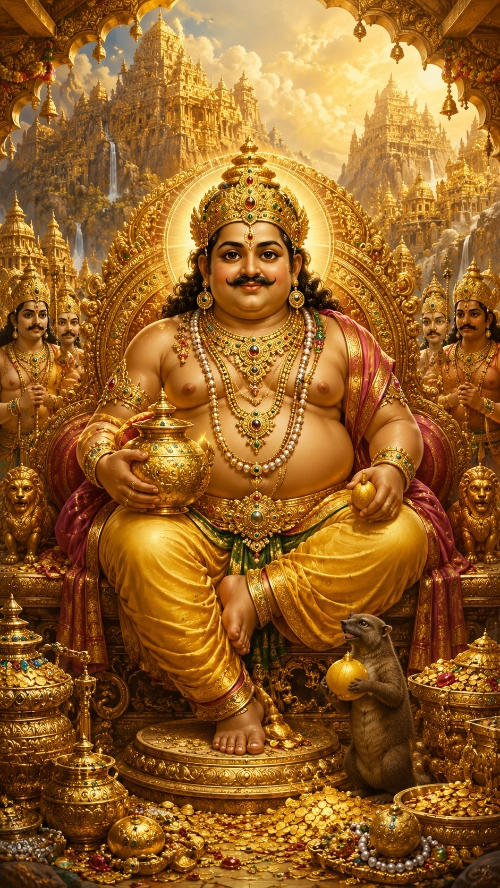
A Source-Critical Reconstruction
Kubera—also known as Vaiśravaṇa, Dhanada, Dhaneśa, and Vitteśvara—is one of the most important divine figures associated with wealth, Yakṣas, guardianship of the directions, and the northern quarter. Yet reconstructing his family is surprisingly difficult.
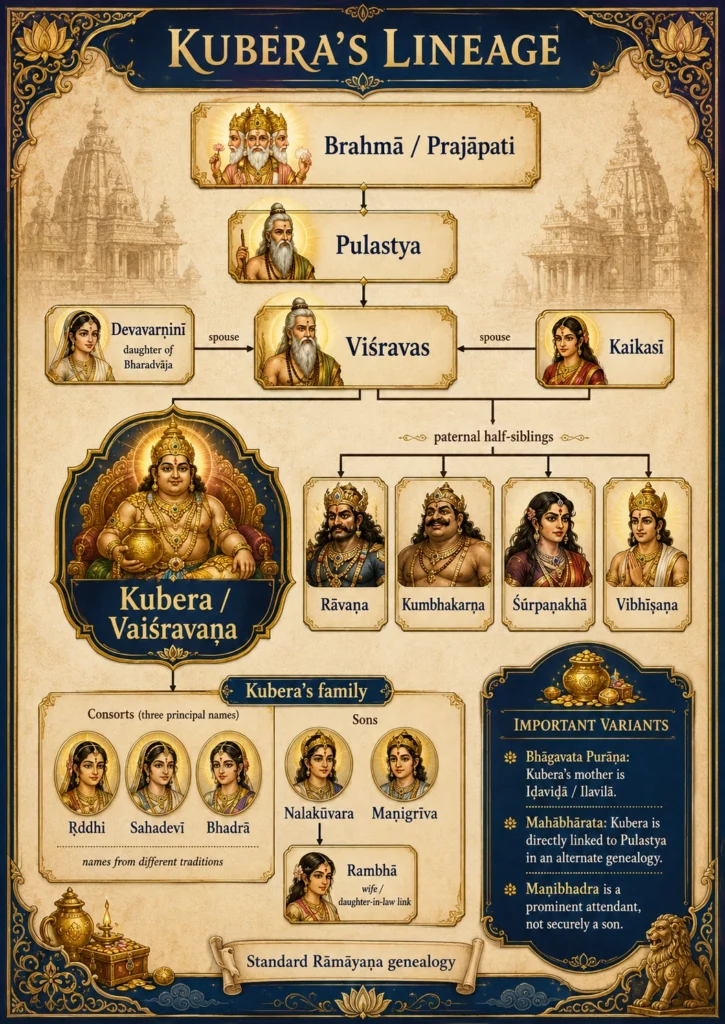
The standard Rāmāyaṇa genealogy, with the principal variants.
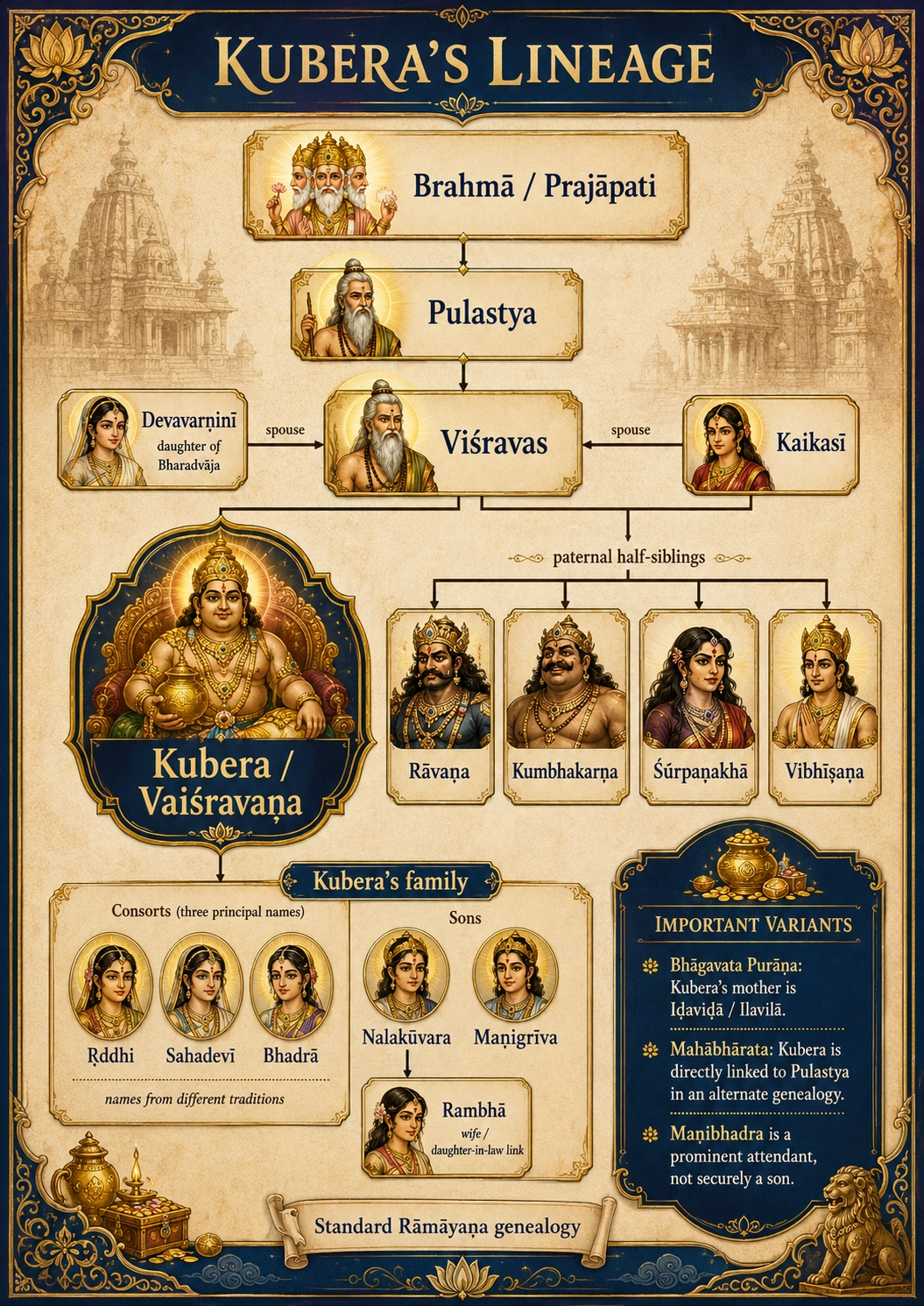
There is no single completely consistent genealogy of Kubera across Sanskrit literature.
The Vālmīki Rāmāyaṇa gives what may be called the standard epic genealogy: Kubera is the son of Viśravas, grandson of Pulastya, and paternal half-brother of Rāvaṇa, Kumbhakarṇa, Śūrpaṇakhā, and Vibhīṣaṇa.
The Bhāgavata Purāṇa also makes Kubera the son of Viśravā, but gives a substantially different arrangement of the preceding generations: Pulastya’s wife is Havirbhū, while Kubera’s mother is Iḍaviḍā/Ilavilā, elsewhere explicitly identified as the daughter of Tṛṇabindu.
The Mahābhārata, in its Rāmopākhyāna, preserves an even more radical alternative: Vaiśravaṇa is directly the son of Pulastya, while Viśravas subsequently arises from half of Pulastya’s own being.
These accounts should therefore not be merged indiscriminately into a single family tree. A source-critical reconstruction has to preserve the differences.
I. The Standard Vālmīki Rāmāyaṇa Genealogy
The genealogy of the Uttarakāṇḍa may be represented as follows:
Brahmā / Prajāpati
└── Pulastya + unnamed daughter of Tṛṇabindu
    └── Viśravas + Devavarṇinī, daughter of Bharadvāja
        └── Kubera / Vaiśravaṇa
Viśravas later unites with Kaikasī, daughter of Sumālī:
Viśravas + Kaikasī
├── Rāvaṇa / Daśagrīva
├── Kumbhakarṇa
├── Śūrpaṇakhā
└── Vibhīṣaṇa
This is the clearest genealogy for explaining why Kubera and Rāvaṇa are normally described as paternal half-brothers.
II. Brahmā, Pulastya, and the Beginning of the Lineage
The Rāmāyaṇa introduces Pulastya as the son of Prajāpati:
पुरा कृतयुगे राम प्रजापतिसुतः प्रभुः ।
पुलस्त्यो नाम ब्रह्मर्षिः साक्षादिव पितामहः ॥
purā kṛtayuge rāma prajāpati-sutaḥ prabhuḥ
pulastyo nāma brahmarṣiḥ sākṣād iva pitāmahaḥ
“Formerly, in the Kṛta age, O Rāma, there was a powerful Brahmarṣi named Pulastya, a son of Prajāpati, resembling the Grandfather [Brahmā] himself.”
Vālmīki Rāmāyaṇa, Uttarakāṇḍa 7.2.4
Thus Kubera belongs to the ancient Paulastya lineage—the descendants of Pulastya.
Pulastya establishes himself at the āśrama of the royal sage Tṛṇabindu, where he performs austerities and Vedic recitation.
A peculiar conception narrative follows. Pulastya, disturbed by young women visiting the hermitage, pronounces that any maiden who comes within his sight will become pregnant.
Tṛṇabindu’s daughter unknowingly enters the hermitage:
तृणबिन्दोस्तु राजर्षेस्तनया न शृणोति तत् ।
गत्वाश्रमपदं तस्य विचचार सुनिर्भया ॥
tṛṇabindos tu rājarṣes tanayā na śṛṇoti tat
gatvāśramapadaṁ tasya vicacāra sunirbhayā
“But the daughter of the royal sage Tṛṇabindu had not heard of this. She entered his hermitage and wandered there without fear.”
Vālmīki Rāmāyaṇa 7.2.12
When Tṛṇabindu understands what has occurred, he formally gives his daughter to Pulastya.
The Rāmāyaṇa does not give her a personal name in this passage.
This is important because later genealogical summaries frequently call her Māninī, Havirbhū, or even Ilavilā. Those identifications belong to other textual or harmonizing traditions and should not simply be inserted into the Rāmāyaṇa genealogy.
III. The Birth of Viśravas
Pulastya is pleased by Tṛṇabindu’s daughter and tells her that she will bear an extraordinary son.
The narrative itself explains his name:
यस्मात्तु विश्रुतो वेदस्त्वयेहाभ्यस्यतो मम ।
तस्मात्स विश्रवा नाम भविष्यति न संशयः ॥
yasmāt tu viśruto vedas tvayehābhyasyato mama
tasmāt sa viśravā nāma bhaviṣyati na saṁśayaḥ
“Because the Veda recited by me here has been heard by you, he shall therefore undoubtedly be named Viśravā.”
Vālmīki Rāmāyaṇa 7.2.27
She subsequently gives birth to Viśravas:
अचिरेणैव कालेन सूता विश्रवसं सुतम् ॥
acireṇaiva kālena sūtā viśravasaṁ sutam
“Before long she gave birth to the son Viśravas.”
Vālmīki Rāmāyaṇa 7.2.28
Viśravas is described as learned, pure, detached from sensual pleasures, devoted to Vedic study, and deeply committed to dharma.
IV. Kubera’s Mother in the Rāmāyaṇa: Devavarṇinī, Daughter of Bharadvāja
Here the Rāmāyaṇa is considerably more specific than many modern summaries acknowledge.
The great sage Bharadvāja, impressed by Viśravas’s character, gives him his daughter Devavarṇinī:
ज्ञात्वा तस्य तु तद्वृत्तं भरद्वाजो महानृषिः ।
ददौ विश्रवसे भार्यां स्वां सुतां देववर्णिनीम् ॥
jñātvā tasya tu tad-vṛttaṁ bharadvājo mahān ṛṣiḥ
dadau viśravase bhāryāṁ svāṁ sutāṁ devavarṇinīm
“Knowing his conduct, the great sage Bharadvāja gave his own daughter Devavarṇinī to Viśravas as his wife.”
Vālmīki Rāmāyaṇa 7.3.3
The following verses say that Viśravas fathered through her an extraordinary son possessing Brahmanical qualities.
Thus the standard Rāmāyaṇa genealogy is more precisely:
Bharadvāja
└── Devavarṇinī
    + Viśravas
    └── Kubera
Bharadvāja should therefore be included as Kubera’s maternal grandfather when following the Vālmīki genealogy.
V. Why Kubera Is Called Vaiśravaṇa
The Rāmāyaṇa itself explains the name Vaiśravaṇa.
यस्माद्विश्रवसोऽपत्यं सादृश्याद्विश्रवा इव ।
तस्माद्वैश्रवणो नाम भविष्यत्येष विश्रुतः ॥
yasmād viśravaso ’patyaṁ sādṛśyād viśravā iva
tasmād vaiśravaṇo nāma bhaviṣyaty eṣa viśrutaḥ
“Because he is the offspring of Viśravas and resembles Viśravas, he shall therefore become renowned by the name Vaiśravaṇa.”
Vālmīki Rāmāyaṇa 7.3.7
Vaiśravaṇa therefore expresses Kubera’s descent from Viśravas.
This is one of Kubera’s most ancient and important names.
Other genealogically significant names include:
- Paulastya — descendant of Pulastya;
- Ailavila/Ailavida — son or descendant of Ilavilā in traditions giving that name to his mother;
- Dhanada — “giver of wealth”;
- Dhaneśa / Dhanapati — “lord of wealth”;
- Yakṣapati — “lord of the Yakṣas.”
The existence of both Vaiśravaṇa and Ailavila is itself significant: Kubera’s genealogy became embedded in his names.
VI. Kubera’s Austerities, Office, Puṣpaka, and Laṅkā
In the Rāmāyaṇa, Vaiśravaṇa performs severe austerities for thousands of years and eventually asks Brahmā for the position of Lokapāla and guardian of wealth.
भगवंल्लोकपालत्वमिच्छेयं वित्तरक्षणम् ॥
bhagavaṁl lokapālatvam iccheyaṁ vittarakṣaṇam
“O Lord, I desire the position of a Lokapāla and the guardianship of wealth.”
Vālmīki Rāmāyaṇa 7.3.14
Brahmā grants his request and declares that he will become the fourth great directional guardian alongside Yama, Indra, and Varuṇa.
Brahmā also gives him Puṣpaka:
एतच्च पुष्पकं नाम विमानं सूर्यसंनिभम् ।
प्रतिगृह्णीष्व यानार्थं त्रिदशैः समतां व्रज ॥
etac ca puṣpakaṁ nāma vimānaṁ sūryasaṁnibham
pratigṛhṇīṣva yānārthaṁ tridaśaiḥ samatāṁ vraja
“Accept also for your conveyance this aerial vehicle called Puṣpaka, radiant like the Sun, and attain equality with the gods.”
Vālmīki Rāmāyaṇa 7.3.18
A subtle but important point follows.
Brahmā does not grant Laṅkā to Kubera in this particular Rāmāyaṇa account.
After receiving his divine offices and Puṣpaka, Kubera asks his father where he should live. Viśravas recommends the abandoned city of Laṅkā:
लङ्का नाम पुरी रम्या निर्मिता विश्वकर्मणा ।
राक्षसानां निवासार्थं यथेन्द्रस्यामरावती ॥
laṅkā nāma purī ramyā nirmitā viśvakarmaṇā
rākṣasānāṁ nivāsārthaṁ yathendrasyāmarāvatī
“There is a beautiful city named Laṅkā, constructed by Viśvakarman for the habitation of the Rākṣasas, like Amarāvatī of Indra.”
Vālmīki Rāmāyaṇa 7.3.24
Kubera therefore settles there on his father’s advice.
This differs significantly from the alternative Mahābhārata genealogy discussed below.
VII. Kaikasī and Kubera’s Half-Siblings
Viśravas later fathers children through Kaikasī, a daughter of the Rākṣasa Sumālī.
The Rāmāyaṇa explicitly names the four:
- Rāvaṇa / Daśagrīva
- Kumbhakarṇa
- Śūrpaṇakhā
- Vibhīṣaṇa
Of Vibhīṣaṇa it says:
ततः शूर्पणखा नाम संजज्ञे विकृतानना ।
विभीषणश्च धर्मात्मा कैकस्याः पश्चिमः सुतः ॥
tataḥ śūrpaṇakhā nāma saṁjajñe vikṛtānanā
vibhīṣaṇaś ca dharmātmā kaikasyāḥ paścimaḥ sutaḥ
“Then Śūrpaṇakhā was born, and Vibhīṣaṇa, righteous by nature, was Kaikasī’s last son.”
Vālmīki Rāmāyaṇa 7.9.27
Thus if we say: “Vibhīṣaṇa was Kubera’s youngest brother,” the more precise genealogical wording is: Vibhīṣaṇa was Kubera’s youngest paternal half-brother in the Vālmīki Rāmāyaṇa genealogy.
Kubera and the children of Kaikasī share the same father, Viśravas, but have different mothers.
VIII. The Rāmāyaṇa Explicitly Calls Kubera Rāvaṇa’s Brother
This relationship is not merely inferred from the genealogy.
When Kubera later visits Viśravas, Kaikasī points him out to Rāvaṇa:
पुत्र वैश्रवणं पश्य भ्रातरं तेजसा वृतम् ।
putra vaiśravaṇaṁ paśya bhrātaraṁ tejasā vṛtam
“My son, look at your brother Vaiśravaṇa, surrounded by splendour.”
Vālmīki Rāmāyaṇa 7.9.33
Rāvaṇa subsequently vows to become equal or superior to his brother.
This makes the Rāmāyaṇa relationship unambiguous: Kubera and Rāvaṇa are paternal half-brothers.
Their later struggle over Laṅkā and Puṣpaka is therefore also a family conflict between two branches of Viśravas’s descendants.
IX. A Different Genealogy in the Bhāgavata Purāṇa
The Śrīmad-Bhāgavatam preserves another important genealogy.
Here Pulastya’s wife is explicitly named Havirbhū:
पुलस्त्योऽजनयत्पत्न्यामगस्त्यं च हविर्भुवि ।
सोऽन्यजन्मनि दह्राग्निर्विश्रवाश्च महातपाः ॥
pulastyo ’janayat patnyām agastyaṁ ca havirbhuvi
so ’nya-janmani dahrāgnir viśravāś ca mahā-tapāḥ
“Pulastya begot in his wife Havirbhū Agastya, and also the greatly austere Viśravā.”
Śrīmad-Bhāgavatam 4.1.36
The next verse makes Kubera the son of Iḍaviḍā:
तस्य यक्षपतिर्देवः कुबेरस्त्विडविडासुतः ।
रावणः कुम्भकर्णश्च तथान्यस्यां विभीषणः ॥
tasya yakṣa-patir devaḥ kuberas tv iḍaviḍā-sutaḥ
rāvaṇaḥ kumbhakarṇaś ca tathānyasyāṁ vibhīṣaṇaḥ
“His son through Iḍaviḍā was the divine Kubera, lord of the Yakṣas; through another [wife] came Rāvaṇa, Kumbhakarṇa, and Vibhīṣaṇa.”
Śrīmad-Bhāgavatam 4.1.37
The Sanskrit itself says simply anyasyām, “in another [woman/wife],” although traditional translations identify this other wife as Keśinī.
The essential genealogy is nevertheless clear:
Pulastya + Havirbhū
└── Viśravā

Viśravā + Iḍaviḍā
└── Kubera
This already differs from the Rāmāyaṇa, where Tṛṇabindu’s daughter gives birth to Viśravas and Bharadvāja’s daughter Devavarṇinī gives birth to Kubera.
X. The Bhāgavata Makes Ilavilā the Daughter of Tṛṇabindu
An especially important passage appears elsewhere in the Bhāgavata Purāṇa.
It says that the Apsaras Alambuṣā became the wife of Tṛṇabindu and bore him several children, including a daughter named Ilavilā:
तं भेजेऽलम्बुषा देवी भजनीयगुणालयम् ।
वराप्सरा यतः पुत्राः कन्या चेलविलाभवत् ॥
taṁ bheje ’lambuṣā devī bhajanīya-guṇālayam
varāpsarā yataḥ putrāḥ kanyā celavilābhavat
“The excellent Apsaras Alambuṣā accepted Tṛṇabindu as her husband. From them came sons and a daughter named Ilavilā.”
Śrīmad-Bhāgavatam 9.2.31
The next verse states:
यस्यामुत्पादयामास विश्रवा धनदं सुतम् ॥
yasyām utpādayām āsa viśravā dhanadaṁ sutam
“In her [Ilavilā], Viśravā begot the son Dhanada [Kubera].”
Śrīmad-Bhāgavatam 9.2.32
This creates a fascinating genealogical difference.
The same connection with Tṛṇabindu has effectively shifted by one generation.
This is precisely why a source-critical treatment should not simply say: “Kubera’s mother was Bharadvāja’s daughter Ilavilā.” That formulation harmonizes incompatible traditions.
The safer statement is: in the Vālmīki Rāmāyaṇa, Kubera’s mother is Devavarṇinī, daughter of Bharadvāja. In important Purāṇic genealogies, his mother is Iḍaviḍā/Ilavilā, whose ancestry is given differently.
XI. The Alternative Mahābhārata Genealogy
The Mahābhārata’s Rāmopākhyāna preserves a remarkably different account.
It first identifies Brahmā as Rāvaṇa’s great ancestor and Pulastya as Brahmā’s mind-born son.
Then comes the surprising statement:
पुलस्त्यो नाम तस्यासीन्मानसो दयितः सुतः ।
तस्य वैश्रवणो नाम गवि पुत्रोऽभवत्प्रभुः ॥
pulastyo nāma tasyāsīn mānaso dayitaḥ sutaḥ
tasya vaiśravaṇo nāma gavi putro ’bhavat prabhuḥ
“He had a beloved mind-born son named Pulastya; to him was born a powerful son named Vaiśravaṇa, gavi.”
Mahābhārata 3.258.12
The expression gavi literally means “in a cow” and is an unusual and difficult feature of this account. It should not be silently replaced by the much more familiar Rāmāyaṇa genealogy.
Most importantly, Vaiśravaṇa is here directly the son of Pulastya.
Then the story becomes stranger.
Vaiśravaṇa leaves his father and attaches himself to his grandfather Brahmā. Pulastya becomes angry:
पितरं स समुत्सृज्य पितामहमुपस्थितः ।
तस्य कोपात्पिता राजन्ससर्जात्मानमात्मना ॥
स जज्ञे विश्रवा नाम तस्यात्मार्धेन वै द्विजः ॥
pitaraṁ sa samutsṛjya pitāmaham upasthitaḥ
tasya kopāt pitā rājan sasarjātmānam ātmanā
sa jajñe viśravā nāma tasyātmārdhena vai dvijaḥ
“Abandoning his father, he attended upon his grandfather. Because of this, his father, angered, generated himself from himself; from half of his own being was born the Brāhmaṇa named Viśravā.”
Mahābhārata 3.258.13–14
Thus Viśravas is not Kubera’s ordinary biological father in this version.
He is a second manifestation or partial reproduction of Pulastya.
XII. Brahmā’s Gifts to Kubera in the Mahābhārata
Brahmā is pleased with Vaiśravaṇa and grants him extraordinary privileges:
पितामहस्तु प्रीतात्मा ददौ वैश्रवणस्य ह ।
अमरत्वं धनेशत्वं लोकपालत्वमेव च ॥
ईशानेन तथा सख्यं पुत्रं च नलकूबरम् ।
राजधानीनिवेशं च लङ्कां रक्षोगणान्विताम् ॥
pitāmahas tu prītātmā dadau vaiśravaṇasya ha
amaratvaṁ dhaneśatvaṁ lokapālatvam eva ca
īśānena tathā sakhyaṁ putraṁ ca nalakūbaram
rājadhānīniveśaṁ ca laṅkāṁ rakṣogaṇānvitām
“The delighted Grandfather granted Vaiśravaṇa immortality, lordship over wealth, the status of Lokapāla, friendship with Īśāna [Śiva], a son named Nalakūbara, and Laṅkā, inhabited by hosts of Rākṣasas, as his royal capital.”
Mahābhārata 3.258.15–16
This passage is extremely valuable because it establishes several things directly:
- Kubera is lord of wealth;
- he is a Lokapāla;
- Śiva/Īśāna is his friend;
- Nalakūvara is explicitly his son;
- Laṅkā is assigned to him.
It also illustrates an important difference between the two epics.
The two passages should therefore not be conflated.
XIII. Rāvaṇa’s Family in the Alternative Mahābhārata Account
The next Mahābhārata chapter makes the differences even more pronounced.
Kubera supplies three Rākṣasa women to attend upon Viśravas: Puṣpotkaṭā, Rākā and Mālinī.
Viśravas fathers different children through them:
पुष्पोत्कटायां जज्ञाते द्वौ पुत्रौ राक्षसेश्वरौ ।
कुम्भकर्णदशग्रीवौ बलेनाप्रतिमौ भुवि ॥
puṣpotkaṭāyāṁ jajñāte dvau putrau rākṣaseśvarau
kumbhakarṇa-daśagrīvau balenāpratimau bhuvi
“Through Puṣpotkaṭā were born two lords of Rākṣasas, Kumbhakarṇa and Daśagrīva, unequalled in strength on earth.”
Then:
मालिनी जनयामास पुत्रमेकं विभीषणम् ।
राकायां मिथुनं जज्ञे खरः शूर्पणखा तथा ॥
mālinī janayām āsa putram ekaṁ vibhīṣaṇam
rākāyāṁ mithunaṁ jajñe kharaḥ śūrpaṇakhā tathā
“Mālinī gave birth to the single son Vibhīṣaṇa; through Rākā were born the twins Khara and Śūrpaṇakhā.”
Mahābhārata 3.259.7–8
This is plainly incompatible with the standard Rāmāyaṇa account in which Kaikasī alone is the mother of Rāvaṇa, Kumbhakarṇa, Śūrpaṇakhā, and Vibhīṣaṇa.
It therefore makes little sense to force the two versions into one biological tree.
XIV. Are Rāvaṇa and Vibhīṣaṇa Always Kubera’s Half-Brothers?
In the Vālmīki Rāmāyaṇa: yes. They all share Viśravas as father and have different mothers. Therefore:
- Rāvaṇa = younger paternal half-brother of Kubera;
- Kumbhakarṇa = younger paternal half-brother;
- Vibhīṣaṇa = youngest paternal half-brother;
- Śūrpaṇakhā = paternal half-sister.
In the alternative Mahābhārata account, the situation is much less straightforward.
Kubera is directly Pulastya’s son, while Viśravas is generated subsequently from half of Pulastya’s being. Yet Kubera also treats this Viśravas as a father-like figure.
Consequently, the ordinary phrase “Kubera and Rāvaṇa had the same father” is not accurate for this Mahābhārata version.
XV. Kubera’s Wives and Consorts
The names of Kubera’s wives vary considerably across sources.
There is no secure basis for creating a single list and assuming that all the names refer either to one woman or to several distinct wives.
Ṛddhi. The strongest epic attestation is Ṛddhi. The Mahābhārata, in a list of celebrated divine couples, states:
ऋद्धिर्वैश्रवणस्य च
ṛddhir vaiśravaṇasya ca
“Ṛddhi [is the wife] of Vaiśravaṇa.”
Mahābhārata, Anuśāsanaparvan 13.134.3–4
The name Ṛddhi means prosperity, increase, success, flourishing, abundance. It is therefore exceptionally appropriate for the consort of the god of wealth.
XVI. Sahadevī
The Padma Purāṇa gives Sahadevī as Kubera’s wife in its account of Dakṣa’s sacrifice.
Kubera, the ruler of the Yakṣas and son of Viśravas, arrives there accompanied by Sahadevī.
This should be treated as a different textual tradition, not automatically as proof that Sahadevī and Ṛddhi are two distinct wives—or, conversely, that they are definitely two names for the same goddess.
XVII. Bhadrā
Bhadrā is also found in traditional Sanskrit lexicographical and epic-reference literature as a wife of Vaiśravaṇa.
Her name means auspicious, fortunate, gracious, blessed. The association is thematically suitable for Kubera.
However, the primary attestation is less straightforward to locate and establish than the Mahābhārata statement concerning Ṛddhi.
Bhadrā should therefore be presented with somewhat more caution.
XVIII. Are Ṛddhi, Sahadevī, and Bhadrā One Goddess?
Modern summaries frequently combine the names and present Ṛddhi = Bhadrā = Sahadevī = Kauberī = Yakṣī = Cārvī = Manoramā as if the primary texts explicitly stated that all these names belong to a single consort.
They do not.
The safer statement is: different textual traditions give Kubera’s principal consort different names, among which Ṛddhi, Sahadevī, and Bhadrā are prominent. Their precise relationship to one another is not securely defined by the primary passages.
Moreover:
- Kauberī can simply mean “Kubera’s wife,” “belonging to Kubera,” or the feminine counterpart of Kubera;
- Yakṣī is a class designation for a female Yakṣa and need not be a personal name;
- claims concerning additional names should be tied to their individual sources rather than merged automatically.
The widely repeated claim that Bhadrā was “the daughter of the demon Mura” is particularly difficult to establish from strong primary Sanskrit evidence and should not be repeated without qualification.
XIX. Kubera’s “Thousand Wives”
The Mahābhārata’s description of Kubera’s magnificent celestial assembly says that he is surrounded by a thousand wives.
This is best understood as part of the epic language of divine kingship and abundance.
The passage does not identify these thousand women individually.
It therefore cannot be used to determine whether Ṛddhi, Sahadevī, Bhadrā, or other named figures are mutually distinct.
XX. Kubera’s Securely Attested Sons
Two sons stand on particularly strong textual ground: Nalakūvara / Nalakūbara and Maṇigrīva.
The phrase securely attested sons is preferable to only sons, because other traditions may attribute additional children to Kubera.
XXI. Nalakūvara
Nalakūvara is explicitly called Kubera’s son in the Mahābhārata passage already quoted:
पुत्रं च नलकूबरम्
putraṁ ca nalakūbaram
“and a son, Nalakūbara.”
Mahābhārata 3.258.16
Thus Nalakūvara is one of the most securely established members of Kubera’s family.
XXII. Nalakūvara and Rambhā
The Apsaras Rambhā is another securely identifiable member of the extended family.
In the Uttarakāṇḍa, when Rāvaṇa accosts her, Rambhā explicitly tells him:
धर्मतश्च स्नुषा तेऽहं तत्त्वमेतद्ब्रवीमि ते ॥
dharmataś ca snuṣā te ’haṁ tattvam etad bravīmi te
“By dharma I am your daughter-in-law; I tell you this truly.”
Vālmīki Rāmāyaṇa 7.26.21
Rāvaṇa questions how this can be so, and Rambhā explains:
धर्मतस्ते सुतस्याहं भार्या राक्षसपुङ्गव ।
पुत्रः प्रियतरः प्राणैर्भ्रातुर्वैश्रवणस्य ते ।
ख्यातो यस्त्रिषु लोकेषु नलकूबर इत्यसौ ॥
dharmatas te sutasyāhaṁ bhāryā rākṣasapuṁgava
putraḥ priyataraḥ prāṇair bhrātur vaiśravaṇasya te
khyāto yas triṣu lokeṣu nalakūbara ity asau
“By dharma I am the wife of your son [i.e. nephew], O lord of Rākṣasas—the son of your brother Vaiśravaṇa, dearer to him than life, renowned throughout the three worlds as Nalakūbara.”
Vālmīki Rāmāyaṇa 7.26.23–24
Rambhā may therefore safely be described, within this narrative, as Nalakūvara’s wife and hence Kubera’s daughter-in-law.
XXIII. Nalakūvara’s Curse on Rāvaṇa
Rāvaṇa ignores Rambhā’s appeal and violates her.
When Nalakūvara learns what has happened, he curses Rāvaṇa:
यदा त्वकामां कामार्तो धर्षयिष्यति योषितम् ।
मूर्धा तु सप्तधा तस्य शकलीभविता तदा ॥
yadā tv akāmāṁ kāmārto dharṣayiṣyati yoṣitam
mūrdhā tu saptadhā tasya śakalībhavitā tadā
“If, overcome by lust, he should violate another unwilling woman, then his head shall split into seven pieces.”
Vālmīki Rāmāyaṇa 7.26.44
This curse becomes significant for the later story of Sītā: Rāvaṇa may threaten and pressure her, but he does not forcibly violate her.
XXIV. Maṇigrīva
Kubera’s other securely attested son is Maṇigrīva.
The Bhāgavata Purāṇa presents Nalakūvara and Maṇigrīva together as the two wealthy sons of Dhanada/Kubera.
Śukadeva describes them as:
रुद्रस्यानुचरौ भूत्वा सुदृप्तौ धनदात्मजौ ॥
rudrasyānucarau bhūtvā sudṛptau dhanadātmajau
“The two sons of Dhanada [Kubera], having become associates of Rudra, were exceedingly proud.”
Śrīmad-Bhāgavatam 10.10.2
The dual dhanadātmajau means literally “the two sons of Dhanada.” The narrative context identifies them as Nalakūvara and Maṇigrīva.
XXV. Nalakūvara and Maṇigrīva as the Yamala-Arjuna Trees
The brothers are described as enormously privileged young Yakṣas associated with Rudra and living near Kailāsa.
Wealth and privilege lead them into intoxication and arrogance. Nārada encounters them naked and drunk with Vāruṇī in the celestial gardens.
He therefore curses them to become trees—but preserves their consciousness and arranges that their punishment will ultimately become a blessing.
Nārada says:
यदिमौ लोकपालस्य पुत्रौ भूत्वा तमःप्लुतौ ॥
yad imau loka-pālasya putrau bhūtvā tamaḥ-plutau
“Although these two are sons of the Lokapāla, they have become overwhelmed by darkness.”
Śrīmad-Bhāgavatam 10.10.20
They become the two arjuna trees in the courtyard of Nanda and Yaśodā.
Later the child Kṛṣṇa, dragging the mortar to which he has been bound, passes between the trees and uproots them.
Nalakūvara and Maṇigrīva emerge in celestial form, recognize Kṛṣṇa, offer prayers, and are liberated from Nārada’s curse.
Their story is consequently a remarkable inversion of Kubera’s symbolism: the sons of the god of wealth are spiritually endangered precisely by excessive wealth.
XXVI. Is Maṇibhadra Another Son?
Maṇibhadra should not automatically be confused with Maṇigrīva. They are different Sanskrit names:
- Maṇigrīva — “jewel-necked”;
- Maṇibhadra — approximately “auspicious through jewels” or “fortunate jewel.”
In the Mahābhārata’s description of Kubera’s court, Maṇibhadra appears as a prominent Yakṣa associated with Kubera, while Nalakūvara is separately identified as Kubera’s son.
This strongly suggests that, at least within that epic context, Maṇibhadra is better treated as an important Yakṣa chief, attendant, general, or subordinate rather than automatically as Kubera’s son.
Later Buddhist, Tantric, and regional traditions sometimes identify Maṇibhadra as a son of Vaiśravaṇa or bring him into a relationship similar to that of Maṇigrīva.
These later identifications should be described as tradition-specific, not projected back into every Sanskrit epic account.
XXVII. The Doubtful Children: Mayūrāja and Mīnākṣī
Modern internet family trees frequently give Kubera four children: Nalakūvara, Maṇigrīva, Mayūrāja and Mīnākṣī.
The first two have strong primary narrative attestation. The latter two are much more problematic.
Mayūrāja. No comparably clear passage in the major Sanskrit epics or Purāṇas securely establishes Mayūrāja as a separate son of Kubera. The name may derive from a later regional tradition, an epithet, a confusion with another Yakṣa, or a variant associated with another member of Kubera’s retinue.
Until a specific primary source is supplied, he should be listed as “a later or uncertain son attributed to Kubera in some secondary traditions.”
Mīnākṣī. The claim that Kubera had a daughter named Mīnākṣī is likewise widespread in modern summaries but difficult to establish from major epic or Purāṇic narrative passages.
She should not be confused with the celebrated goddess Mīnākṣī of Madurai.
Again, the safest classification is: uncertain later daughter tradition.
XXVIII. Śiva and Kubera
Śiva is not a blood relative of Kubera. Their relationship is one of divine friendship and association.
The Mahābhārata explicitly includes among Brahmā’s gifts to Vaiśravaṇa:
ईशानेन तथा सख्यम्
īśānena tathā sakhyam
“and friendship with Īśāna [Śiva].”
Mahābhārata 3.258.16
This is important because Kubera’s later history is deeply connected with Kailāsa, the northern mountains, Yakṣas, and the world of Śiva.
Kubera should therefore be described as Śiva’s divine friend and ally, not his relative.
XXIX. Maṇibhadra and Kubera’s Yakṣa Court
Numerous Yakṣas and supernatural beings appear in descriptions of Kubera’s assembly. Figures such as Maṇibhadra, Śvetabhadra, Piṅgalaka and many other Yakṣas belong to his divine court or administration.
Their close association with Kubera does not automatically make them his children.
This is one of the major causes of confusion in modern family trees: court membership, divine service, friendship, and genealogy are often collapsed into one category.
They need to remain distinct.
XXX. The Most Important Genealogical Differences
The three principal traditions may be summarized as follows.
1. Vālmīki Rāmāyaṇa
Brahmā / Prajāpati
└── Pulastya + Tṛṇabindu's unnamed daughter
    └── Viśravas + Devavarṇinī, daughter of Bharadvāja
        └── Kubera / Vaiśravaṇa

Viśravas + Kaikasī
├── Rāvaṇa
├── Kumbhakarṇa
├── Śūrpaṇakhā
└── Vibhīṣaṇa
Here Kubera and Rāvaṇa are straightforward paternal half-brothers.
2. Bhāgavata Purāṇa
Pulastya + Havirbhū
└── Viśravā + Iḍaviḍā / Ilavilā
    └── Kubera

A separate Bhāgavata genealogy gives:
Tṛṇabindu + Alambuṣā
└── Ilavilā + Viśravā
    └── Kubera / Dhanada
Thus the Tṛṇabindu relationship appears one generation later than in the Rāmāyaṇa.
3. Mahābhārata Rāmopākhyāna
Brahmā / Prajāpati
└── Pulastya
    └── Vaiśravaṇa / Kubera        (directly)

Pulastya then generates Viśravas from half of himself:
Viśravas + Puṣpotkaṭā  →  Rāvaṇa, Kumbhakarṇa
Viśravas + Mālinī      →  Vibhīṣaṇa
Viśravas + Rākā        →  Khara, Śūrpaṇakhā
This version cannot be comfortably harmonized with the Vālmīki Rāmāyaṇa.
XXXI. Safest Final Family Record
If one wishes to give readers a concise family record based primarily upon the standard Vālmīki Rāmāyaṇa genealogy, the safest formulation is:
But one qualification should always accompany this list: the Mahābhārata preserves an independent genealogy in which Kubera is directly Pulastya’s son and Viśravas is subsequently generated from half of Pulastya’s being. It should be presented separately rather than silently harmonized with the Rāmāyaṇa family tree.
Kubera’s family illustrates an important principle in the study of Hindu sacred literature: Purāṇic and epic genealogies are not always fixed biological records.
Different texts reorganize relationships in accordance with different narrative and theological purposes.
The Vālmīki Rāmāyaṇa gives the clearest familiar genealogy: Pulastya → Viśravas → Kubera, with Rāvaṇa and Vibhīṣaṇa as Kubera’s paternal half-brothers.
The Bhāgavata Purāṇa retains Viśravā → Kubera but changes the surrounding genealogy, identifying Kubera’s mother as Iḍaviḍā/Ilavilā and linking Ilavilā directly with Tṛṇabindu.
The Mahābhārata goes further and places Vaiśravaṇa directly under Pulastya, while making Viśravas a later emanation of half of Pulastya himself.
The same caution applies to Kubera’s wives and children. Ṛddhi has particularly strong epic attestation as his wife. Sahadevī and Bhadrā belong to other traditions and should not automatically be merged with her.
Among his offspring, Nalakūvara and Maṇigrīva are securely established, while Maṇibhadra, Mayūrāja, and Mīnākṣī require varying degrees of qualification.
The strongest source-critical conclusion is therefore not to search for one artificial “perfect” family tree, but to preserve the textual traditions accurately: Kubera has several overlapping genealogical identities, and the differences between them are themselves part of the history.