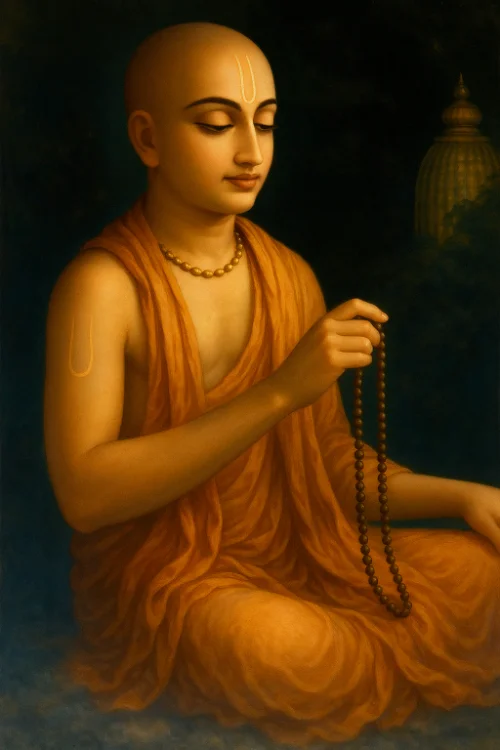
Caitanya Beeja Mantra
क्लीं गौराय स्वाहा
Klīṁ Gaurāya Svāhā
I offer myself to the golden Lord Gaura, with the sacred bīja Klīṁ, the seed of divine attraction and love.
This is a devotional mantra, particularly potent in Gaudiya Vaiṣṇavism, where Śrī Caitanya Mahāprabhu is revered as Kṛṣṇa in the mood and complexion of Rādhā—the embodiment of ecstatic divine love.
- Klīṁ draws the essence of loving devotion (bhakti) toward the divine.
- Gaurāya personalizes this devotion toward Śrī Gaura, the golden avatāra who spread the saṅkīrtana movement—the congregational chanting of Kṛṣṇa’s holy names.
Śrī Caitanya Mahāprabhu Gayatrī Mantra
क्लीं चैतन्याय विद्महे।
विश्वम्भराय धीमहि।
तन्नो गौरः प्रचोदयात्॥
Klīṁ Caitanyāya Vidmahe
Viśvambharāya Dhīmahi
Tanno Gauraḥ Prachodayāt
We contemplate Śrī Caitanya, who is Viśvambhara (the sustainer of the universe). May that golden Lord Gaura inspire and guide our intellect.
This mantra invokes Śrī Caitanya Mahāprabhu not only as a divine being but as the inspirer of spiritual wisdom, love, and surrender.
- Klīṁ brings in the devotional potency of Kṛṣṇa and Rādhā unified in Gaura.
- Caitanya and Viśvambhara point to his dual nature—the inner ecstatic divinity and outer role as universal nurturer.
- Gauraḥ prachodayāt asks him to awaken and direct our buddhi (higher intellect) toward pure bhakti and divine realization.
Nityānanda Beeja Mantra
क्लीं देव जाह्नवी वल्लभाय स्वाहा
Klīṁ Deva Jāhnavī Vallabhāya Svāhā
I offer myself to the divine Lord, the beloved of Jāhnavī, with the sacred bīja Klīṁ.
- क्लीं (Klīṁ): the Kāma-bīja, a powerful seed mantra symbolizing attraction, love, devotion, and fulfillment. In the context of devotional practice, it draws the soul closer to divine love and grace.
- देव (Deva): “divine one,” “lord,” or “shining being.” Refers here to a divine masculine form—in this case, Śrī Nityānanda.
- जाह्नवी वल्लभाय (Jāhnavī Vallabhāya): “to the beloved of Jāhnavī.” This is an epithet of Nityānanda Prabhu, who was married to Jāhnavī Devī, a highly revered spiritual figure in the Gaudiya Vaiṣṇava tradition.
- स्वाहा (Svāhā): a sacred offering; means “I offer,” “I surrender,” or “let this be fully and joyfully offered.” Commonly used in Tantric and fire rituals to seal the mantra with intention.
This mantra is a devotional offering to Śrī Nityānanda, the eternal brother of Caitanya Mahāprabhu, revered as the personification of compassion, mercy, and unconditional love. He is considered an avatāra of Balarāma, Kṛṣṇa’s elder brother.
Nityānanda Gayatrī Mantra
क्लीं नित्यानन्दाय विद्महे।
सङ्कर्षणाय धीमहि।
तन्नो बलः प्रचोदयात्॥
Klīṁ Nityānandāya Vidmahe
Saṅkarṣaṇāya Dhīmahi
Tanno Balaḥ Prachodayāt
Let us contemplate Śrī Nityānanda.
We meditate upon Saṅkarṣaṇa (Balarāma).
May that divine strength (Bala) inspire and guide our intellect.
- नित्यानन्दाय (Nityānandāya): “To Nityānanda” — the eternal blissful one; refers to Śrī Nityānanda Prabhu, the avatāra of Balarāma in Gaudiya Vaiṣṇavism.
- सङ्कर्षणाय (Saṅkarṣaṇāya): “To Saṅkarṣaṇa” — another name of Balarāma, the original expansion of Kṛṣṇa and the Lord of spiritual strength, support, and the foundation of creation.
- बलः (Balaḥ): “Strength” or “Bala,” which is both a divine quality and a name for Balarāma, the personification of spiritual and physical power.
This mantra is a powerful devotional invocation to Śrī Nityānanda as the embodiment of compassion, the source of spiritual and emotional strength, and the divine support (ādhāra) for the soul’s journey toward Kṛṣṇa.
It affirms that spiritual strength (Bala) is a divine force guiding the soul and that Nityānanda, as Saṅkarṣaṇa, is both accessible and compassionate, providing support and liberation through love and surrender.
Advaita Ācārya Bīja Mantra
क्लीं अद्वैताय स्वाहा
Klīṁ Advaitāya Svāhā
I offer myself to Śrī Advaita, with the sacred bīja Klīṁ.
- अद्वैताय (Advaitāya): “To Advaita” — the dative case of Advaita, referring to Śrī Advaita Ācārya, considered a combined incarnation of Mahā-Viṣṇu and Sadāśiva. His name means “non-dual,” signifying the unity of divine reality.
This mantra is a devotional offering to Śrī Advaita Ācārya, who played a crucial role in invoking Śrī Caitanya Mahāprabhu’s descent. He represents the unifying power of non-duality and the compassionate aspect of the divine, acting as both a guru and god.
- The bīja Klīṁ brings the energy of divine desire and attraction, making the heart receptive to bhakti (devotion).
- Advaitāya reminds us that the Absolute is both one and manifest — and that true knowledge is unified with love.
Advaita Gayatrī Mantra
क्लीं अद्वैताय विद्महे।
महाविष्णवे धीमहि।
तन्नो अद्वैतः प्रचोदयात्॥
Klīṁ Advaitāya Vidmahe
Mahāviṣṇave Dhīmahi
Tanno Advaitaḥ Prachodayāt
We contemplate Advaita. We meditate upon Mahāviṣṇu. May that Advaita inspire and guide our intellect.
This mantra honors Śrī Advaita Ācārya as:
- The non-dual reality (advaita tattva) manifest in form,
- The Mahāviṣṇu, who sustains and governs the universe,
- The devotee who invokes God and yet is divine himself.
It connects the chanter with:
- The wisdom of unity (advaita) between the soul and God through devotion,
- The cosmic sustaining power of Viṣṇu,
- The grace and compassion of Advaita Ācārya, who made Śrī Caitanya’s advent possible.
Gadādhara Bīja Mantra
श्रीं गदाधराय स्वाहा
Śrīṁ Gadādhārāya Svāhā
I offer myself to Śrī Gadādhara, with the sacred seed-syllable Śrīṁ.
Śrī Gadādhara Paṇḍita is considered a combined manifestation of Rādhārāṇī and a partial aspect of Lakṣmī, appearing in a male form.
This mantra is a heartfelt devotional offering to Śrī Gadādhara Paṇḍita, the quiet, deeply emotional devotee who stood constantly by Śrī Caitanya’s side, embodying moodful devotion (bhāva-bhakti) and divine gentleness.
- Śrīṁ invokes grace and loving energy—qualities that Gadādhara personifies.
- Gadādhara, whose name means “he who holds the mace,” shares the same name as Viṣṇu, but in Gaudiya Vaiṣṇavism, he represents the compassionate mood of Rādhā serving in silent love.
- Svāhā indicates surrender to that sweetness and inner strength.
Gadādhara Gayatrī Mantra
गं गदाधराय विद्महे।
पण्डिताख्याय धीमहि।
तन्नो गदाधरः प्रचोदयात्॥
Gaṁ Gadādharāya Vidmahe
Paṇḍitākhyāya Dhīmahi
Tanno Gadādharaḥ Prachodayāt
We contemplate Śrī Gadādhara. We meditate upon the one known as Paṇḍita. May that Gadādhara inspire and illumine our intellect.
- गदाधराय (Gadādharāya): “To Gadādhara” – the dative case. Śrī Gadādhara Paṇḍita is considered a manifestation of Śrī Rādhā, appearing as a male associate of Caitanya.
- पण्डिताख्याय (Paṇḍitākhyāya): “To the one known as Paṇḍita” – a title of honor given to Gadādhara, indicating his scholarly nature, humility, and devotional wisdom.
This mantra honors Śrī Gadādhara Paṇḍita as:
- The embodiment of silent, inner devotion, rich in depth and humility.
- The personification of Rādhā’s bhāva—divine longing, sweetness, and selfless love.
- A scholar-saint, whose devotional knowledge was lived through heart-centered surrender.
Śrīvāsa Bīja Mantra
Śrīvāsa is considered an incarnation of Nārada Muni, and he represents devotional service (bhakti) in pure form.
श्रीं श्रीवासाय स्वाहा
Śrīṁ Śrīvāsāya Svāhā
I offer myself to Śrīvāsa with the sacred seed syllable Śrīṁ.
- श्रीं (Śrīṁ): the bīja mantra of Lakṣmī, symbolizing beauty, abundance, auspiciousness, and divine grace. In devotional usage, it invokes pure devotional energy (bhakti-śakti), and in this context, it sanctifies the offering to Śrīvāsa Ṭhākura.
- श्रीवासाय (Śrīvāsāya): “To Śrīvāsa” – the dative case of Śrīvāsa. He is one of the closest associates of Śrī Caitanya Mahāprabhu and the constant host of His saṅkīrtana gatherings. Śrīvāsa represents the ideal devotee whose life is fully absorbed in loving service and glorification of Kṛṣṇa.
This mantra is an invocation of devotion in its purest and most surrendered form, as embodied by Śrīvāsa Ṭhākura. Chanting this mantra can help one:
- Deepen their bhakti (devotion)
- Develop the mood of joyful service and saṅkīrtana
- Align with the inner circle of Śrī Caitanya’s līlā, which Śrīvāsa was part of
The bīja Śrīṁ enhances the mantra’s devotional vibration, drawing in spiritual prosperity and grace, not in the form of wealth, but in the form of loving connection with the divine.
Śrīvāsa Gayatrī Mantra
श्रीं श्रीवासाय विद्महे।
नारदाख्याय धीमहि।
तन्नो भक्तः प्रचोदयात्॥
Śrīṁ Śrīvāsāya Vidmahe
Nāradākhyāya Dhīmahi
Tanno Bhaktaḥ Prachodayāt
Let us contemplate Śrīvāsa. We meditate upon the one known as Nārada. May that divine devotee (bhakta) inspire and illumine our intellect.
- श्रीं (Śrīṁ): The Lakṣmī bīja mantra, symbolizing auspiciousness, spiritual grace, and devotion. Here it enhances the devotional energy of the mantra and honors Śrīvāsa’s pure-hearted bhakti.
- श्रीवासाय (Śrīvāsāya): “To Śrīvāsa” — dative case, offering reverence to Śrīvāsa Ṭhākura, the foremost devotee who hosted the first saṅkīrtana gatherings of Śrī Caitanya Mahāprabhu.
- नारदाख्याय (Nāradākhyāya): “To the one known as Nārada” — ākhyāya means “named” or “called.” Śrīvāsa is believed to be an incarnation of Nārada Muni, the celestial sage and eternal devotee.
- भक्तः (Bhaktaḥ): “The devotee” — here it refers to Śrīvāsa, as the ideal and personified bhakta.
This mantra honors Śrīvāsa Ṭhākura as:
- The manifestation of Nārada Muni, who eternally sings the names of the Lord.
- The ideal devotee (bhakta-śreṣṭha) who fully surrendered his life to saṅkīrtana and the divine mission of Śrī Caitanya.
- A living example of unshakable faith, joyful service, and spiritual simplicity.