

Through Rāga-Bhakti One Attains Svayaṁ-Bhagavān in Vraja
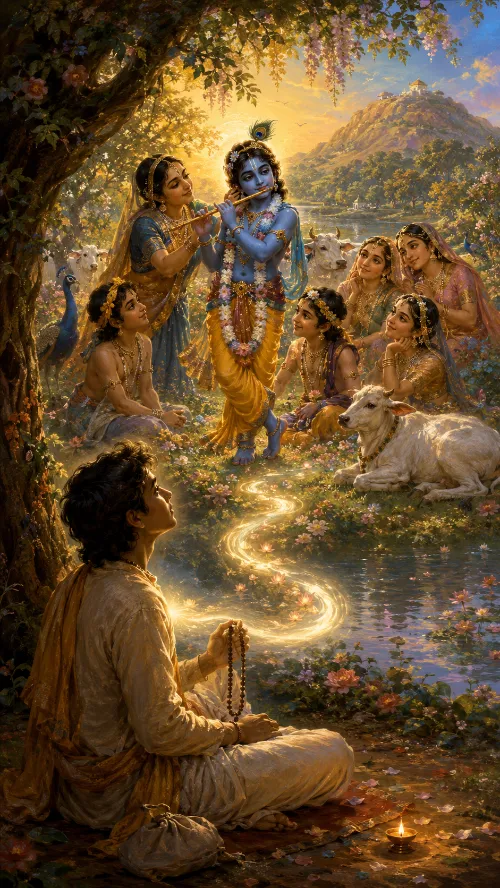
The Love You Cultivate Becomes the Kṛṣṇa You Meet
One of the most compact yet theologically dense statements in the Caitanya-caritāmṛta occurs during Śrī Caitanya Mahāprabhu’s explanation of the Ātmārāma verse to Sanātana Gosvāmī. Mahāprabhu says:
রাগভক্ত্যে ব্রজে স্বয়ং-ভগবানে পায় ॥
rāga-bhaktye vraje svayaṁ-bhagavāne pāya
“Through rāga-bhakti one attains Svayaṁ-Bhagavān in Vraja.”
Śrī Caitanya-caritāmṛta, Madhya 24.85
A.C. Bhaktivedanta Swami Prabhupāda translates:
“By executing spontaneous devotional service in Vṛndāvana, one attains the original Supreme Personality of Godhead, Kṛṣṇa.”
The traditional translation conveys the verse’s Gauḍīya theological direction well. Yet the Bengali is so compressed that almost every word deserves attention. It contains four major ideas.
The line therefore raises several questions at once. What exactly is rāga, and who possesses it naturally? What distinguishes rāgātmikā from rāgānugā bhakti? Does vraje mean merely that sādhana is performed physically in Vṛndāvana, or does it also describe Kṛṣṇa as attained in Vraja? Why does Mahāprabhu specifically say Svayaṁ-Bhagavān — and why, in the surrounding verses, does He contrast rāga-bhakti with vidhi-bhakti, and Vraja with Vaikuṇṭha? The answers lead directly into the heart of Gauḍīya Vaiṣṇava theology.
The Immediate Context: Two Modes of Devotional Relationship
Madhya 24.85 should not be read in isolation. Immediately beforehand, Mahāprabhu says:
রাগভক্তি, বিধিভক্তি হয় দুইরূপ ।
‘স্বয়ং-ভগবত্ত্বে’, ভগবত্ত্বে — প্রকাশ দ্বিরূপ ॥
rāga-bhakti, vidhi-bhakti haya dui-rūpa
‘svayaṁ-bhagavattve’, bhagavattve — prakāśa dvi-rūpa
“Rāga-bhakti and vidhi-bhakti are two modes of devotion, and corresponding to them are two modes of manifestation—as Svayaṁ-Bhagavān and as Bhagavān.”
Madhya 24.84
And two verses later:
বিধিভক্ত্যে পার্ষদদেহে বৈকুণ্ঠেতে যায় ॥
vidhi-bhaktye pārṣada-dehe vaikuṇṭhete yāya
“Through vidhi-bhakti one attains the body of an associate and goes to Vaikuṇṭha.”
Madhya 24.87
Within the particular contrast Mahāprabhu develops here, the two trajectories are therefore parallel and deliberate.
This should not be turned into the simplistic claim that every devotional practice containing regulation necessarily terminates in Vaikuṇṭha. Rāgānugā itself retains regulated practices such as hearing, chanting, remembrance and worship. Mahāprabhu’s point is subtler: different governing devotional dispositions correspond to different modes of relationship with Bhagavān and therefore to different modes of divine self-revelation.
What Does Svayaṁ-Bhagavān Mean?
The Sanskrit expression:
स्वयं भगवान्
svayaṁ bhagavān
means “Bhagavān Himself.” Its most famous scriptural foundation is Śrīmad-Bhāgavatam 1.3.28:
एते चांशकलाः पुंसः कृष्णस्तु भगवान् स्वयम् ।
इन्द्रारिव्याकुलं लोकं मृडयन्ति युगे युगे ॥
ete cāṁśa-kalāḥ puṁsaḥ
kṛṣṇas tu bhagavān svayam
indrāri-vyākulaṁ lokaṁ
mṛḍayanti yuge yuge
“All these are portions or portions of portions of the Supreme Person, but Kṛṣṇa is Bhagavān Himself.”
Śrīmad-Bhāgavatam 1.3.28
The decisive phrase is:
कृष्णस्तु भगवान् स्वयम्
kṛṣṇas tu bhagavān svayam. For Gauḍīya theologians this becomes one of the foundational Bhāgavata statements concerning Kṛṣṇa’s unique theological position.
But Madhya 24.85 says something even more specific. It does not merely say “through bhakti one reaches Kṛṣṇa.” It says “through rāga-bhakti one attains Svayaṁ-Bhagavān in Vraja.” The word Vraja is therefore as important as the title Svayaṁ-Bhagavān. The issue is not only who God is. It is how God is known in relationship.
Kṛṣṇa as the Son of Yaśodā
Mahāprabhu immediately supports His statement by quoting one of the most extraordinary verses in the Bhāgavata:
नायं सुखापो भगवान् देहिनां गोपिकासुतः ।
ज्ञानिनां चात्मभूतानां यथा भक्तिमतामिह ॥
nāyaṁ sukhāpo bhagavān
dehināṁ gopikā-sutaḥ
jñānināṁ cātma-bhūtānāṁ
yathā bhaktimatām iha
“This Bhagavān, the son of the gopī, is not so easily attained by embodied beings, nor even by those established in jñāna, as He is by those endowed with bhakti.”
Śrīmad-Bhāgavatam 10.9.21
quoted in Caitanya-caritāmṛta, Madhya 24.86
The most revealing expression here is not merely bhagavān. It is:
गोपिकासुतः
gopikā-sutaḥ
— “the son of the gopī.” The gopī is Mother Yaśodā. The verse belongs to the Dāmodara episode, where Yaśodā chases Kṛṣṇa, catches Him and attempts to bind Him with rope. The object sought by yogīs and jñānīs is standing before a cowherd mother, afraid of her stick.
This is one of the clearest demonstrations of Vraja-mādhurya. Kṛṣṇa is infinite, yet Yaśodā treats Him as her son. She does not ordinarily approach Him with the thought “I am now interacting with the omnipotent cause of all universes.” Her immediate consciousness is “my child has been naughty.”
This does not mean Yaśodā lacks spiritual perfection. It means her love is so intimate that awareness of Kṛṣṇa’s majesty does not dominate the relationship. The Lord remains fully Bhagavān; His majesty simply becomes concealed beneath childhood, friendship, family affection, playfulness, romance, jealousy, care and love. That is the distinctive relational atmosphere of Vraja.
What Is Rāga?
The English expression “spontaneous devotional service” is useful, but it can also mislead. “Spontaneous” may suggest doing whatever one feels, rejecting discipline, or simply experiencing strong emotion. That is not Rūpa Gosvāmī’s definition. He writes:
इष्टे स्वारसिकी रागः परमाविष्टता भवेत् ।
तन्मयी या भवेद् भक्तिः सात्र रागात्मिकोदिता ॥
iṣṭe svārasikī rāgaḥ paramāviṣṭatā bhavet
tan-mayī yā bhaved bhaktiḥ sātra rāgātmikoditā
“Rāga is a natural, deeply relishable and intense absorption in the beloved object. Bhakti completely permeated by such rāga is called rāgātmikā.”
Bhakti-rasāmṛta-sindhu 1.2.272
Three features of that definition are especially important.
Rāga therefore does not mean “I occasionally feel inspired.” It means a deeply established loving thirst and absorption in a particular relationship with Kṛṣṇa.
“Deep Thirst”: Kṛṣṇadāsa’s Explanation
Kṛṣṇadāsa Kavirāja paraphrases Rūpa with remarkable clarity:
ইষ্টে ‘গাঢ়-তৃষ্ণা’ — রাগের স্বরূপ-লক্ষণ ।
ইষ্টে ‘আবিষ্টতা’ — এই তটস্থ-লক্ষণ ॥
iṣṭe ‘gāḍha-tṛṣṇā’ — rāgera svarūpa-lakṣaṇa
iṣṭe ‘āviṣṭatā’ — ei taṭastha-lakṣaṇa
“Deep thirst for the beloved is the intrinsic characteristic of rāga; absorption in the beloved is its accompanying characteristic.”
Caitanya-caritāmṛta, Madhya 22.151
The crucial expression is:
গাঢ়-তৃষ্ণা
gāḍha-tṛṣṇā
— deep thirst. This is often more illuminating than the vague English “spontaneous.” The devotee does not merely act without rules; the devotee thirsts for a particular relationship with Kṛṣṇa.
Rāgātmikā and Rāgānugā Are Not the Same
This distinction is fundamental. The natural rāga of Kṛṣṇa’s eternal associates in Vraja is called rāgātmikā-bhakti; the devotion of a practitioner who follows in the wake of that love is called rāgānugā-bhakti. Kṛṣṇadāsa Kavirāja says:
রাগাত্মিকা-ভক্তি — ‘মুখ্যা’ ব্রজবাসি-জনে ।
তার অনুগত ভক্তির ‘রাগানুগা’-নামে ॥
rāgātmikā-bhakti — ‘mukhyā’ vraja-vāsi-jane
tāra anugata bhaktira ‘rāgānugā’-nāme
“Rāgātmikā-bhakti is principally manifest in the residents of Vraja. The devotion that follows after it is called rāgānugā.”
Madhya 22.149
Rūpa gives the Sanskrit definition:
विराजन्तीमभिव्यक्तां व्रजवासिजनादिषु ।
रागात्मिकामनुसृता या सा रागानुगोच्यते ॥
virājantīm abhivyaktāṁ vraja-vāsi-janādiṣu
rāgātmikām anusṛtā yā sā rāgānugocyate
“That devotion which follows the rāgātmikā-bhakti splendidly manifested among the residents of Vraja is called rāgānugā.”
Bhakti-rasāmṛta-sindhu 1.2.270
Thus Yaśodā possesses rāgātmikā, and the sādhaka attracted to her mode of love follows through rāgānugā. The same principle applies to the devotional currents embodied by Nanda, Subala, Śrīdāma, Śrī Rādhā, Lalitā, Viśākhā and the other eternal Vrajavāsīs.
Rāgānugā Means Following, Not Pretending
The word itself gives the principle: rāga plus anugā, “that which follows after rāga.” The practitioner does not declare “I am Yaśodā,” nor “I already possess the love of Rādhā’s sakhīs.” The sādhaka recognizes the perfection of the Vrajavāsīs’ love and longs to follow its current. Rūpa gives the qualification:
रागात्मिकैकनिष्ठा ये व्रजवासिजनादयः ।
तेषां भावाप्तये लुब्धो भवेदत्राधिकारवान् ॥
rāgātmikaika-niṣṭhā ye vraja-vāsi-janādayaḥ
teṣāṁ bhāvāptaye lubdho bhaved atrādhikāravān
“One who becomes deeply desirous of attaining the bhāva of those residents of Vraja who are exclusively established in rāgātmikā-bhakti is qualified for this path.”
Bhakti-rasāmṛta-sindhu 1.2.291
The key word is:
लुब्धः
lubdhaḥ
— intensely desirous, deeply longing. From this comes the Gauḍīya theological term lobha: spiritual greed, or intense longing.
What Is Spiritual Lobha?
Rūpa explains:
तत्तद्भावादिमाधुर्ये श्रुते धीर्यदपेक्षते ।
नात्र शास्त्रं न युक्तिं च तल्लोभोत्पत्तिलक्षणम् ॥
tat-tad-bhāvādi-mādhurye śrute dhīr yad apekṣate
nātra śāstraṁ na yuktiṁ ca tal-lobhotpatti-lakṣaṇam
“When, upon hearing of the sweetness of those particular bhāvas, the intelligence longs for them without needing scriptural command or logical persuasion, that is the symptom of the arising of lobha.”
Bhakti-rasāmṛta-sindhu 1.2.292
This verse is sometimes misunderstood to mean that rāgānugā devotees reject scripture. It says the opposite. The process itself begins with:
श्रुते
śrute
— “having heard.” One hears about Yaśodā’s vātsalya, Subala’s friendship, the gopīs’ love, Śrī Rādhā’s prema and the intimacy of Vraja-līlā. Then the heart may respond: “I want to follow love like this.” The desire no longer needs an external command telling the practitioner that such love ought to be desired.
This creates a beautiful paradox: rāgānugā is not principally moved by scriptural command, yet it arises through hearing what scripture reveals. Śāstra first reveals the beauty; then beauty itself produces attraction.
Rāga-Mārga Is Not “Do Whatever Feels Right”
This needs explicit emphasis. A passing emotion is not rāga. Personal preference is not rāga. Neglect of discipline is not rāga. Self-invented spiritual identity is not rāga. Rāgānugā means specifically following the rāgātmikā love of the eternal Vrajavāsīs: its model is not the practitioner’s unexamined imagination, it is Vraja.
Nor can lobha be manufactured by declaring “I now possess lobha.” Rūpa’s sequence is far more organic — hearing → attraction → longing → following. First tat-tad-bhāvādi-mādhurye śrute, one hears the sweetness of those bhāvas; then, if genuine attraction awakens, longing follows. The heart is attracted before it claims anything.
Rāgānugā Still Includes Hearing and Chanting
Rūpa makes this completely explicit:
श्रवणोत्कीर्तनादीनि वैधभक्त्युदितानि तु ।
यान्यङ्गानि च तान्यत्र विज्ञेयानि मनीषिभिः ॥
śravaṇotkīrtanādīni vaidha-bhakty-uditāni tu
yāny aṅgāni ca tāny atra vijñeyāni manīṣibhiḥ
“The wise should understand that those limbs described in relation to vaidhī-bhakti—such as hearing and chanting—also apply here.”
Bhakti-rasāmṛta-sindhu 1.2.296
Thus rāgānugā includes the ordinary limbs of devotional practice:
- śravaṇa — hearing;
- kīrtana — chanting;
- smaraṇa — remembrance;
- arcana;
- guru-sevā and Vaiṣṇava-sevā.
The difference is not that one follows practice while the other abandons it. The difference lies principally in the governing motive and desired bhāva. A simplified contrast:
The outward activity may be the same. Both may chant, worship, hear the Śrīmad-Bhāgavatam and observe devotional discipline. The distinction is the interior force. A highly disciplined devotee can therefore be following rāga-mārga, and an undisciplined person does not thereby become “spontaneous” in Rūpa’s technical sense. Spontaneity belongs to love; discipline belongs to practice. There is no contradiction between them.
What Does Vraje Mean in Madhya 24.85?
The Bengali word:
ব্রজে
vraje
requires careful attention. The familiar English translation reads:
“By executing spontaneous devotional service in Vṛndāvana…”
That is entirely compatible with Gauḍīya theology, because residence in Vraja is indeed integral to Rūpa’s presentation of rāgānugā sādhana. But the Bengali can also naturally be read “through rāga-bhakti one attains Svayaṁ-Bhagavān in Vraja,” and the immediate context gives this reading considerable force. Verse 85 speaks of vraje svayaṁ-bhagavāne pāya while verse 87 speaks of vaikuṇṭhete yāya, “one goes to Vaikuṇṭha.” The parallel suggests that Vraja functions not merely as the location where practice occurs but also as the relational divine world in which Svayaṁ-Bhagavān is attained.
Residence in Vraja Is Part of Rūpa’s Sādhana
Rūpa writes:
कृष्णं स्मरन् जनं चास्य प्रेष्ठं निजसमीहितम् ।
तत्तत्कथारतश्चासौ कुर्याद्वासं व्रजे सदा ॥
kṛṣṇaṁ smaran janaṁ cāsya preṣṭhaṁ nija-samīhitam
tat-tat-kathā-rataś cāsau kuryād vāsaṁ vraje sadā
“Remembering Kṛṣṇa and His beloved associate corresponding to one’s desired relationship, remaining absorbed in narrations about them, one should always reside in Vraja.”
Bhakti-rasāmṛta-sindhu 1.2.294
The verse contains a remarkably concentrated description of rāgānugā practice.
Rāgānugā is therefore not simply a feeling. It has an object, a devotional world, concrete exemplars, remembrance, hearing and service.
External and Internal Vraja-Sādhana
Does this mean rāgānugā is impossible unless one physically lives in present-day Vṛndāvana? The tradition does not reduce the principle so narrowly. Physical residence in Vraja is highly valued, but Gauḍīya texts also describe an internal dimension of practice through remembrance. Kṛṣṇadāsa Kavirāja says:
বাহ্য, অন্তর, — ইহার দুই ত’ সাধন ।
‘বাহ্যে’ সাধক-দেহে করে শ্রবণ-কীর্তন ॥
‘মনে’ নিজ-সিদ্ধদেহ করিয়া ভাবন ।
রাত্রি-দিনে করে ব্রজে কৃষ্ণের সেবন ॥
bāhya, antara — ihāra dui ta’ sādhana
‘bāhye’ sādhaka-dehe kare śravaṇa-kīrtana
‘mane’ nija-siddha-deha kariyā bhāvana
rātri-dine kare vraje kṛṣṇera sevana
Caitanya-caritāmṛta, Madhya 22.156–157
The passage distinguishes an external and an internal dimension. Externally, in the practitioner’s present body, hearing, chanting, worship and service continue. Internally, through devotional contemplation, the practitioner meditates upon service to Kṛṣṇa in Vraja.
That summary should not be mistaken for a claim that physical Vraja is unimportant, nor should internal contemplation be used as an excuse to abandon external practice. The two dimensions are meant to support one another. A person may live physically in Vṛndāvana while remaining absorbed in money, conflict, status or ordinary enjoyment — physical proximity alone does not constitute Vraja-bhāva. Conversely, a devotee living far away may spend the day hearing Vraja-kathā, chanting Kṛṣṇa’s name, serving Vaiṣṇavas and longing inwardly for Vraja-sevā.
Thus Vraja is both sacred geography and a devotional world entered through consciousness and relationship.
The Essential Principle: Follow the People of Vraja
Rūpa summarizes the path in one extraordinarily important phrase:
सेवा साधकरूपेण सिद्धरूपेण चात्र हि ।
तद्भावलिप्सुना कार्या व्रजलोकानुसारतः ॥
sevā sādhaka-rūpeṇa siddha-rūpeṇa cātra hi
tad-bhāva-lipsunā kāryā vraja-lokānusārataḥ
“One who longs for that bhāva should perform service, in the sādhaka form and in the internally contemplated perfected form, following the people of Vraja.”
Bhakti-rasāmṛta-sindhu 1.2.295
The decisive expression is:
व्रजलोकानुसारतः
vraja-lokānusārataḥ
— “following the inhabitants of Vraja.” This may be the clearest practical commentary on Madhya 24.85: to attain Kṛṣṇa in Vraja, one follows the mode of love through which Kṛṣṇa is loved in Vraja. Again the principle is not invention, not imitation, but following.
Vraja Is a World of Relationships
What makes Vraja unique is not merely geography. Vraja is a network of intimate relationships, and Kṛṣṇa stands at its center under many names at once.
- Nanda’s son;
- Yaśodā’s child;
- Subala’s friend;
- Śrīdāma’s wrestling companion;
- the beloved of the gopīs;
- and Śrī Rādhā’s Kṛṣṇa.
Those relationships are not principally governed by theological awe. They are filled with affection, belonging, intimacy, familiarity, playfulness, care, jealousy and prema. That is why Vraja and rāga naturally belong together.
The love of the Vrajavāsīs is not primarily activated by the thought “Kṛṣṇa is Bhagavān; therefore I ought to worship Him.” Yaśodā does not need an injunction telling her to love Kṛṣṇa as her child. Subala does not consult a rule before running to play with Him. Śrī Rādhā does not require a philosophical proof that She should long for Him. Their love is self-moving — this is rāgātmikā — and the sādhaka’s rāgānugā path follows the current flowing from it.
Rāga-Bhakti Reveals a Particular Kṛṣṇa
Gauḍīya theology does not understand spiritual realization merely as perceiving an abstract divine essence. The relationship itself corresponds to a particular mode of divine self-disclosure: to Yaśodā, Kṛṣṇa reveals Himself as son; to Subala, as friend; to Śrī Rādhā, as beloved. This is not because the devotee invents Kṛṣṇa. It is because Kṛṣṇa reciprocally manifests Himself according to love. The Bhagavad-gītā gives the general principle:
ये यथा मां प्रपद्यन्ते तांस्तथैव भजाम्यहम् ॥
ye yathā māṁ prapadyante
tāṁs tathaiva bhajāmy aham
“As people approach Me, I reciprocate with them accordingly.”
Bhagavad-gītā 4.11
In Vraja this reciprocity reaches extraordinary intimacy. The Supreme Lord becomes a child who can be chastised, a friend who can be defeated in play, and a beloved who can plead before those who love Him.
Does Vidhi-Bhakti Lead to a “Lesser” God?
No. Mahāprabhu’s contrast between Vraja and Vaikuṇṭha should not be misunderstood as a doctrine of two competing Supreme Gods. Rūpa Gosvāmī gives the balance precisely:
सिद्धान्ततस्त्वभेदेऽपि श्रीशकृष्णस्वरूपयोः ।
रसेनोत्कृष्यते कृष्णरूपमेषा रसस्थितिः ॥
siddhāntatas tv abhede ’pi śrīśa-kṛṣṇa-svarūpayoḥ
rasenotkṛṣyate kṛṣṇa-rūpam eṣā rasa-sthitiḥ
“Although in philosophical truth there is no difference between the forms of Śrīśa [Nārāyaṇa] and Kṛṣṇa, the form of Kṛṣṇa excels through rasa. Such is the nature of rasa.”
Bhakti-rasāmṛta-sindhu 1.2.59
The balance can be summarized as abheda in tattva yet distinction in rasa. The divine reality is not divided into competing absolutes; the distinction concerns the mode of relationship. This is often expressed through two terms.
This is not less divinity. It is divinity concealed beneath intimacy.
The Goal Is Already Present in the Path
Madhya 24.85 therefore expresses a profound spiritual principle: the destination corresponds to the bhāva cultivated on the path. Within the theological contrast Mahāprabhu presents here, devotion governed by reverential relation to Bhagavān corresponds to the majestic world of Vaikuṇṭha, whereas devotion following Vraja-rāga corresponds to Kṛṣṇa’s Vraja manifestation.
The destination is not simply assigned arbitrarily once practice is complete. It is already present as a seed within the relationship being cultivated. This is why rāgānugā is so specifically concerned with which Kṛṣṇa one longs to serve, in which relationship, and following which Vrajavāsī.
“Attaining Kṛṣṇa” Means Attaining Relationship
The Bengali verb:
পায়
pāya
means to attain, obtain, reach, receive. Its meaning should not be reduced to the geographical picture “after death the soul travels to a location.” That eschatological dimension is present, but Gauḍīya theology understands attainment relationally: to attain Vraja means to attain Kṛṣṇa together with a particular loving relationship with Kṛṣṇa.
One does not merely arrive in a divine landscape as a spectator. Vraja is a world of sevā. The fundamental question is not only “where am I?” but “who is Kṛṣṇa to me, and how do I serve Him?”
Love Makes Bhagavān Accessible in a Way Power Cannot
The Dāmodara episode provides perhaps the perfect symbol. Yaśodā tries to bind Kṛṣṇa; every rope is mysteriously too short, because the infinite Lord cannot be measured. Then Kṛṣṇa sees His mother’s exhaustion, and He allows Himself to be bound. The rope did not conquer God. Love did.
That is the theological force behind nāyaṁ sukhāpo bhagavān … yathā bhaktimatām iha: Bhagavān is not attained by other means, but becomes accessible through bhakti. The Vraja devotee does not overcome infinity by spiritual power. The Infinite voluntarily becomes accessible because of prema.
From “God” to “My Kṛṣṇa”
Madhya 24.85 therefore moves spiritual realization toward increasing relational specificity. One may understand, in turn:
- “There is an Absolute.”
- “The Absolute is conscious.”
- “The Absolute is Bhagavān.”
- “Bhagavān is Kṛṣṇa.”
- “Kṛṣṇa is Nanda’s son.”
And then, according to one’s relationship: “He is my master.” “He is my friend.” “He is my child.” “He is my beloved.” The movement is from metaphysical truth toward personal intimacy — which does not negate metaphysical truth, but reveals what that truth becomes within love.
Three Ways to Translate Madhya 24.85
Three renderings serve different purposes, and it is worth seeing them side by side.
The third is intentionally not word-for-word. It makes explicit the Gauḍīya theological system within which the compact Bengali statement functions.
What Madhya 24.85 Does Not Mean
The verse should not be reduced to any of the following.
The actual teaching is considerably more disciplined than any of these.
What the Verse Does Mean
Madhya 24.85 teaches that Kṛṣṇa’s Vraja manifestation corresponds to Vraja-bhāva. The eternal residents of Vraja possess that love naturally, as rāgātmikā-bhakti. A practitioner becomes qualified for rāgānugā-bhakti when hearing about those relationships produces genuine longing to follow their current.
The practitioner continues to hear, chant, remember, worship, serve guru and Vaiṣṇavas, and follow śāstra. But these practices become increasingly oriented toward Kṛṣṇa in Vraja, and toward the bhāva of those eternal associates whose love attracts the heart. That bhāva contains the seed of the destination.
The Central Idea
The full meaning of rāga-bhaktye vraje svayaṁ-bhagavāne pāya cannot be reduced to “do spontaneous devotion and go to Vṛndāvana.” The statement is considerably deeper. Vraja is a world whose spiritual architecture is made of relationship. There Kṛṣṇa is not principally experienced as the remote ruler of infinity; He is Yaśodā’s son, Subala’s friend, the beloved of the gopīs, and Śrī Rādhā’s Kṛṣṇa.
The love governing these relationships is rāga — deep, natural, self-moving attachment. The Vrajavāsīs possess it eternally. The sādhaka hears of it; the heart becomes attracted; attraction becomes longing; longing becomes following. Hearing continues, chanting continues, service continues, śāstra continues, discipline continues.
But where genuine lobha awakens, the governing inner movement changes from “I serve because I have been instructed to serve” toward “I have heard of this love, and I long to follow it.” That longing shapes the bhāva; the bhāva shapes the relationship; and the relationship corresponds to the manner in which Bhagavān reveals Himself.
This is one of the most distinctive principles of Gauḍīya theology: the deepest way of attaining Kṛṣṇa is inseparable from the way one learns to love Him — the same logic that runs through Madhya 21.119, where that sweetness is called sulabha on the path of rāga. And so Mahāprabhu can summarize an entire theology of Vraja in one compact line:
rāga-bhaktye vraje svayaṁ-bhagavāne pāya
“Through rāga-bhakti one attains Svayaṁ-Bhagavān in Vraja.”
Principal Scriptural and Theological Sources
The passages drawn on above, gathered by text. Each is quoted in full — in its own script, with transliteration and translation — at the point where it is discussed.
Śrīmad-Bhāgavatam
Bhagavad-gītā
Rūpa Gosvāmī — Bhakti-rasāmṛta-sindhu
Kṛṣṇadāsa Kavirāja — Śrī Caitanya-caritāmṛta
The Sanskrit of the Bhakti-rasāmṛta-sindhu circulates in several printed and electronic recensions whose readings differ in small particulars. The verses above are reproduced as supplied; anyone citing them in formal scholarship should check them against the specific edition they are working from.