

Kṛṣṇa’s Personal World in Vraja
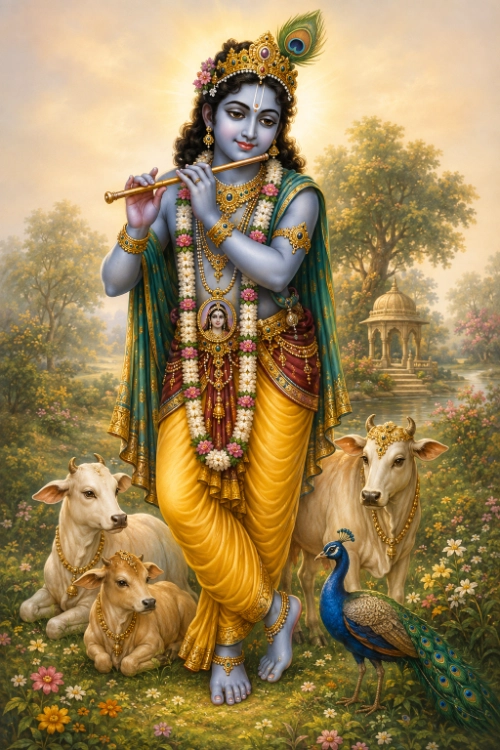
Kṛṣṇa's Personal World in Vraja: His Animals, Sacred Places, Flutes, Ornaments and Implements
Gauḍīya literature does not present Śrī Kṛṣṇa in Vraja as an abstract deity surrounded by generic divine symbols. He inhabits an extraordinarily concrete world. His cows have names. So do His flute, His horn, His mirror, His bow and His milking pail. Particular trees, caves, ghāṭas and groves have individual identities; His necklaces and anklets have names and characteristic effects; even His house on Nandīśvara Hill and the boat waiting for Him at Mānasī-gaṅgā are named.
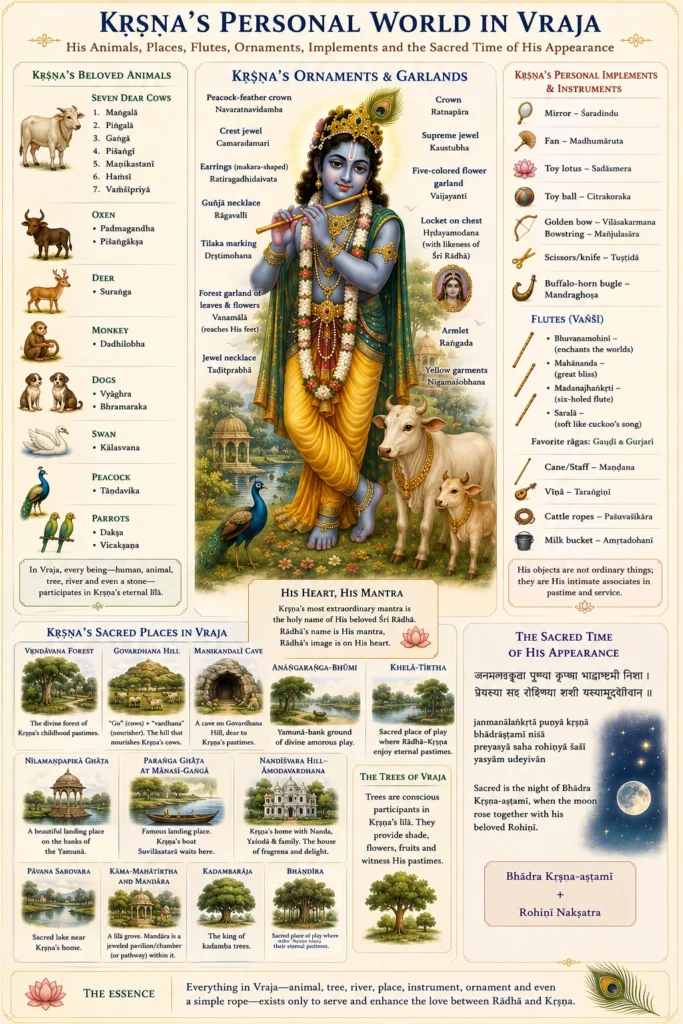
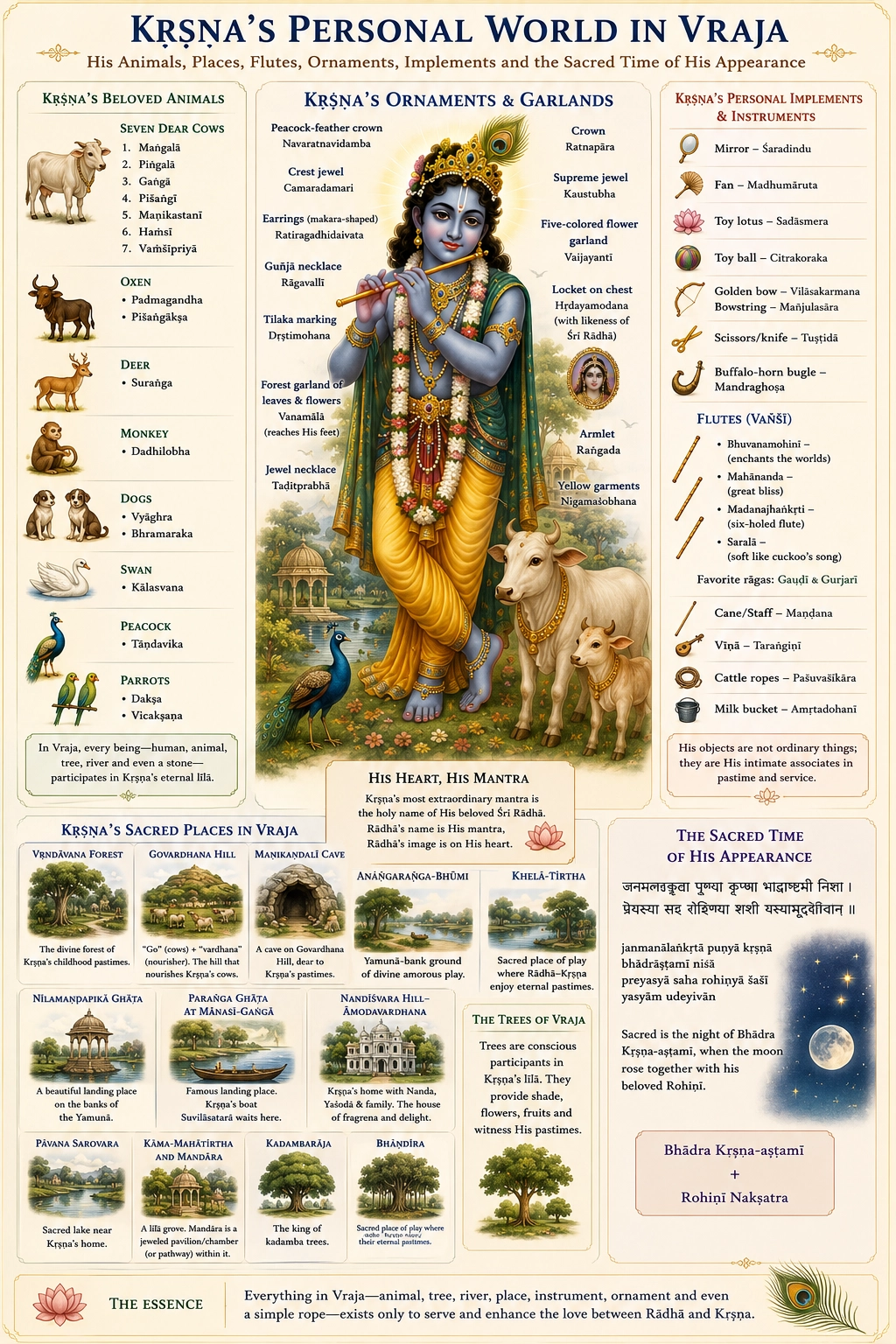
The whole inventory on one sheet: the seven dear cows and the other animals, the ornaments and garlands named on the body, the implements and flutes, fourteen sacred places of Vraja, and the verse on the night of His appearance.
Most of this highly specific material comes from Śrī Rūpa Gosvāmī’s Rādhā-kṛṣṇa-gaṇoddeśa-dīpikā, particularly the latter portion of its shorter division. The work functions almost as a directory of the eternal Vraja-līlā, identifying Kṛṣṇa’s relatives, friends, servants, animals, sacred places, instruments, ornaments and garments so that the devotional world of Rādhā and Kṛṣṇa can be contemplated concretely rather than vaguely.
The emphasis corresponds closely to the way Kṛṣṇadāsa Kavirāja describes Kṛṣṇa’s supreme form:
কৃষ্ণের যতেক খেলা, সর্বোত্তম নরলীলা,
নরবপু তাহার স্বরূপ ।
গোপবেশ, বেণুকর, নবকিশোর, নটবর,
নরলীলার হয় অনুরূপ ॥
kṛṣṇera yateka khelā, sarvottama nara-līlā,
nara-vapu tāhāra svarūpa
gopa-veśa, veṇu-kara, nava-kiśora, naṭa-vara,
nara-līlāra haya anurūpa
“Of all Kṛṣṇa’s pastimes, His humanlike pastimes are supreme. His humanlike form is His own form: dressed as a cowherd, flute in hand, eternally youthful and the best of dancers.”
Caitanya-caritāmṛta, Madhya 21
The named objects of Vraja belong to this principle. Kṛṣṇa is met as Gopāla — a particular cowherd boy living in a particular house, walking particular paths, playing particular instruments, surrounded by particular beings whom He loves.
The Sacred Time of His Appearance
Rūpa Gosvāmī does not end his catalogue with material objects. He also names the sacred time in which Kṛṣṇa appears.
जन्मनालङ्कृता पुण्या कृष्णा भाद्राष्टमी निशा ।
प्रेयस्या सह रोहिण्या शशी यस्यामुदेयिवान् ॥
janmanālaṅkṛtā puṇyā kṛṣṇā bhādrāṣṭamī niśā
preyasyā saha rohiṇyā śaśī yasyām udeyivān
“Sacred is the night of Bhādra Kṛṣṇa-aṣṭamī, adorned by Kṛṣṇa’s birth, when the moon rose together with his beloved Rohiṇī.”
The correct calendrical expression is therefore Bhādra Kṛṣṇa-aṣṭamī — the eighth lunar tithi of the waning or dark fortnight of the month of Bhādra. The sequence is precise: Bhādra → Kṛṣṇa-pakṣa → Aṣṭamī → Rohiṇī.
It should not be called the “eighth dark-moon night.” Amāvasyā, the dark or new-moon night, falls later, at the end of the waning fortnight. The verse also describes Rohiṇī as the Moon’s beloved: in Purāṇic cosmology the lunar mansions are personified as the wives of the Moon-god, and Rohiṇī is especially dear to him.
The Beloved Animals
The seven especially dear cows
These are not anonymous sacred cattle. They belong to Kṛṣṇa’s personal world, and that idea is central to Vraja theology: animals are participants in Kṛṣṇa’s relationships, not picturesque background.
The rest of the household
The catalogue continues almost like the register of a royal household — except that this is a pastoral kingdom.
The theological implication is striking. Vraja is a community in which human beings, animals, vegetation, rivers and sacred geography all participate in the divine līlā.
The Sacred Places
Govardhana, the hill that nourishes the cows
Rūpa’s devotional reading of the name takes go as cows and vardhana as increasing or causing to thrive: Govardhana is that which nourishes the cows. Its grasses, springs, caves, trees and secluded places support Kṛṣṇa’s cowherding life and His confidential meetings with Rādhā and the gopīs. The hill is therefore landscape, servant, shelter, pasture, meeting place and participant in līlā at once. On it is a cave named Maṇikaṇḍalī.
Water, boat and home
Āmodavardhana is not an architectural curiosity. It is the domestic centre of Kṛṣṇa’s childhood and youth — the household of Nanda Mahārāja, Yaśodā, Kṛṣṇa, Balarāma, Rohiṇī and the extended Vraja family.
English editions do not interpret Mandāra uniformly: it has been read as a jewelled chamber, a pavilion and a pathway. The safest description is that within or alongside the grove Kāma-mahātīrtha stands a jewelled structure called Mandāra, variously interpreted. This is a good example of why precise claims about these names should stay tied to the particular edition being followed.
Trees, and grounds of play
Rūpa treats individual trees as famous personalities within the landscape. The splendid kadambas are Kadambarāja, king of kadambas; the celebrated banyan is Bhāṇḍīra, associated with Bhāṇḍīravana. Trees are not decorative scenery — they give shade, meeting places, hiding places and flowers, and they stand as witnesses to the līlā.
That second name captures a central feature of Vraja theology: the Absolute is encountered not principally through majesty and solemnity but through play — līlā.
The Personal Implements
From geography Rūpa moves to the objects Kṛṣṇa handles every day. They are named individually because they too participate in the līlā.
Some English versions transmit the fan as Marumaruta; Madhumāruta is the more convincing Sanskrit reading. Kartarī may mean scissors or a small cutting knife depending on context, so “jewel-handled scissors or cutting knife” is safer than insisting on one modern object.
Note what happens in these names. A weapon is aestheticised as an object of beauty and playful skill; ordinary cowherding equipment is translated into the language of transcendental sweetness.
The Flutes
No group of objects is more intimately connected with Kṛṣṇa than His flutes, and Rūpa’s catalogue preserves several individual names.
The associated poetry compares the flute to something capable of hooking the fish of Rādhā’s mind. The metaphor matters: the flute attracts not because it is supernaturally loud, but because its sound speaks differently to every relationship in Vraja.
Two rāgas are named as especially dear to Him — Gauḍī and Gurjarī. Their presence is significant. Kṛṣṇa’s flute-playing is not undifferentiated supernatural sound; it participates in a sophisticated musical culture of rasa.
Ornaments, Garments and Garlands
Before the arm ornaments, Rūpa records a household detail that is easy to pass over and is among the most meaningful in the whole inventory: Mother Yaśodā ties a protective amulet set with nine precious jewels upon Kṛṣṇa’s arm. The ornament exists because she worries about her son. He may be the Supreme Lord, but in Vraja He is the child His mother believes must be guarded from danger — so His ornamentation carries not only beauty but vātsalya-rasa, parental love.
An ornament here does not merely decorate Kṛṣṇa. It acts upon Vraja.
Earrings, crown and crest
कुण्डले मकराकारे रतिरागाधिदैवते ।
किरीटं रत्नपाराख्यं चूडा चामरडामरी ॥
kuṇḍale makarākāre ratirāgādhidaivate
kirīṭaṁ ratnapārākhyaṁ cūḍā cāmara-ḍāmarī
The two earrings are makara-shaped — formed like the fabulous aquatic creature of classical Indian ornament — and named Ratirāgādhidaivata. The crown is Ratnapāra, and the cūḍā is Cāmara-ḍāmarī.
The crown is Ratnapāra, not the occasionally encountered misreading Ratnapura. And rather than calling Cāmara-ḍāmarī a second “crown,” it is safer to describe it as a topknot or crest ornament.
The Kaustubha jewel
कौस्तुभाख्यो मणिर् येन प्रविश्य ह्रदमौरगम् ।
कालिय-प्रेयसी-वृन्द-हस्तैर् आत्मोपहारितः ॥
kaustubhākhyo maṇir yena praviśya hradam auragam
kāliya-preyasī-vṛnda-hastair ātmopahāritaḥ
“The jewel is called Kaustubha. When Kṛṣṇa entered the serpent’s lake, the wives of Kāliya personally presented it to Him.”
This is a specifically Vraja-oriented account of the jewel, and it differs on its surface from the famous Purāṇic tradition in which Kaustubha emerges from the churning of the Ocean of Milk and belongs to Viṣṇu. The two need not be treated as mutually exclusive: Rūpa is describing a particular narrative acquisition of an ornament that eternally belongs to the Lord. It is a useful source-critical distinction — līlā literature can describe an eternal divine object as received within a particular pastime.
Vanamālā and Vaijayantī are not the same garland
These two are frequently conflated. Rūpa distinguishes them explicitly:
पत्रपुष्पमयी माला वनमाला पदावधिः ।
वैजयन्ती तु कुसुमैः पञ्चवर्णैर् विनिर्मिता ॥
patra-puṣpamayī mālā vanamālā padāvadhiḥ
vaijayantī tu kusumaiḥ pañca-varṇair vinirmitā
“The garland composed of leaves and flowers and extending to His feet is the Vanamālā; the Vaijayantī, however, is made of flowers of five colours.”
So the Vanamālā is a forest garland of fresh leaves and flowers hanging down towards His feet, while the Vaijayantī is a distinct garland of five-coloured flowers. They may look related in devotional art, but Rūpa lists them apart.
Rādhā at the Centre
Set among the flutes and implements, Rūpa gives one of the most revealing statements in the entire catalogue: the extraordinary mantra Kṛṣṇa chants to attain His desired goal is the name of His beloved Śrī Rādhā.
That single detail transforms the meaning of the whole list. The section is not really about possessions. Kṛṣṇa enchants all worlds with His flute — and Kṛṣṇa Himself is enchanted by Rādhā.
রাধিকা হয়েন কৃষ্ণের প্রণয়-বিকার ।
স্বরূপ-শক্তি ‘হ্লাদিনী’ নাম যাঁহার ॥
rādhikā hayena kṛṣṇera praṇaya-vikāra
svarūpa-śakti ‘hlādinī’ nāma yāṅhāra
“Rādhikā is the transformation of Kṛṣṇa’s love. She is His intrinsic potency known as hlādinī.”
Caitanya-caritāmṛta, Ādi 4
The second detail is the locket worn upon His chest: Hṛdayamodana — hṛdaya, heart, and modana, gladdening: that which delights the heart. Within it is a Rādhā-pratikṛti, a likeness of Śrī Rādhā. Its placement is the point. Rādhā is carried over Kṛṣṇa’s heart.
“Likeness” is more cautious than “portrait,” and certainly than the modern “photograph”: pratikṛti simply denotes an image or representation.
Taken together with the tradition that Kṛṣṇa’s mantra is Rādhā’s name, Hṛdayamodana reveals the emotional centre of the whole inventory. Kṛṣṇa possesses many treasures. His deepest treasure is Rādhā.
Why These Objects Have Names
A modern reader may reasonably wonder why it matters that the mirror is called Śaradindu, the ball Citrakoraka, the horn Mandraghoṣa and the milk pail Amṛtadohanī. The answer lies in the purpose of the literature. These names are aids to līlā-smaraṇa, the remembrance of divine pastime; Rūpa Gosvāmī is helping the contemplative reader build a fully inhabited Vraja.
The result is a Vraja that can be remembered relationally and sensorially rather than abstractly.
The five senses of Vraja
Vraja spirituality is, in other words, profoundly embodied and aesthetic.
Where forest beauty outranks royal beauty
Two kinds of ornament meet on Kṛṣṇa’s body. Kaustubha and precious jewels suggest divine royalty; guñjā berries, peacock feathers, forest flowers and leaves suggest pastoral simplicity. In Vraja the second can surpass the first. The peacock feather mocks the nine jewels; the guñjā necklace becomes an emblem of divine love; a garland gathered in the forest hangs more beautifully than royal gold.
This expresses a settled Gauḍīya preference: mādhurya, intimate sweetness, surpasses merely awe-inspiring aiśvarya, majesty. Kṛṣṇa does not need an imperial crown to be beautiful. A peacock feather becomes greater than nine kinds of gem because He wears it.
The structure of His personal world
Nothing in that series stands alone. Everything exists within līlā. The apparent inventory is actually a map of relationships: the flute calls others, the ropes care for the cattle, the amulet expresses Yaśodā’s anxiety, the animals respond to Him personally, the sacred places make friendship and confidential meeting possible, the ornaments enchant the gopīs — and the heart bears Rādhā.
A Note on Sources and Variants
These highly specific names should not be presented as though each were independently and uniformly attested across the Purāṇas. Their principal source is Rūpa Gosvāmī’s Rādhā-kṛṣṇa-gaṇoddeśa-dīpikā, a work belonging to the early Gauḍīya project of systematically articulating the personalities, places and paraphernalia of the Vraja-līlā. Its colophon is commonly read as dating its completion at Nandagrāma in Śaka 1472 — 1550 CE.
Several names vary between manuscripts, Sanskrit editions and English translations:
- Madhumāruta / Marumaruta;
- Gurjarī / Garjarī;
- the interpretation of Mandāra as chamber, pavilion or pathway;
- whether Bhuvanamohinī and Mahānanda are separate flutes or overlapping names for one;
- the bracelet reading commonly rendered Śobhana.
Such variants are normal in the transmission of premodern Sanskrit literature. They should be acknowledged rather than silently harmonised — which is why the readings above are given with their alternatives rather than presented as settled.
The Rādhā-kṛṣṇa-gaṇoddeśa-dīpikā is not a handbook of divine trivia. It describes a world in which everything has become personal because everything participates in love. A cow is no longer merely a cow — she is Maṅgalā, or Vaṁśīpriyā. A flute is Bhuvanamohinī. A horn is Mandraghoṣa. A mirror is Śaradindu. A hill becomes Govardhana, a home becomes Āmodavardhana, a boat becomes Suvilāsatarā, a garland becomes Vanamālā or Vaijayantī. A medallion becomes Hṛdayamodana because Rādhā’s likeness rests over Kṛṣṇa’s heart. And even the Supreme Enchanter has a mantra: Rādhā’s name.
So the catalogue expresses one of the deepest ideas of Vraja theology — that the perfection of an object, animal, place, sound, skill or ornament lies in its relationship to loving service. Vraja is not sacred simply because Kṛṣṇa happens to live there. It is Vraja because every element of the world has entered into relationship with Him; and at the centre of that relational universe stands Rādhā-Kṛṣṇa prema.
Principal Textual Sources
- Śrī Rūpa Gosvāmī, Rādhā-kṛṣṇa-gaṇoddeśa-dīpikā — especially the Laghu-bhāga sections on Kṛṣṇa’s animals, places, implements, ornaments, garlands and birth;
- Śrī Caitanya-caritāmṛta, Madhya 21 — Kṛṣṇa’s supreme humanlike Vraja form as the youthful cowherd with flute;
- Śrī Caitanya-caritāmṛta, Ādi 4 — Rādhā as Kṛṣṇa’s hlādinī-śakti and the centrality of Rādhā-Kṛṣṇa love;
- Purāṇic accounts of Kaustubha emerging at the churning of the Milk Ocean, which supply the broader Viṣṇu tradition alongside Rūpa Gosvāmī’s Vraja account of the jewel.