

Kṛṣṇa Alone Is Īśvara
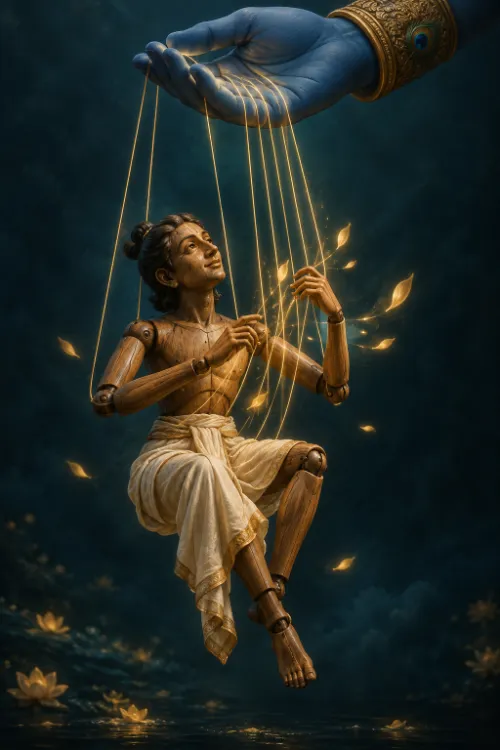
Divine control, human freedom, and the paradox of love
One of the most memorable theological statements in the Caitanya-caritāmṛta appears in a deceptively simple Bengali couplet:
একলে ঈশ্বর কৃষ্ণ, আর সব ভৃত্য ।
যারে যৈছে নাচায়, সে তৈছে করে নৃত্য ॥
ekale īśvara kṛṣṇa, āra saba bhṛtya
yāre yaiche nācāya, se taiche kare nṛtya
“Kṛṣṇa alone is the supreme controller, and all others are His servants. Whoever He causes to dance in whatever way dances accordingly.”
Caitanya-caritāmṛta, Ādi 5.142
At first glance, the meaning seems obvious: Kṛṣṇa controls everything. But Kṛṣṇadāsa Kavirāja is saying much more than that. The verse raises several profound questions:
- What exactly does it mean that Kṛṣṇa alone is īśvara?
- If everyone else is a servant, does that include Balarāma and Nityānanda, who are themselves divine?
- Does “He makes everyone dance” mean that living beings possess no freedom?
- If Kṛṣṇa is the supreme controller, why does the Bhāgavata repeatedly portray Him as being controlled by His devotees?
- And why does Kṛṣṇadāsa immediately apply the same principle to Śrī Caitanya?
The verse is therefore not merely a slogan about divine sovereignty. It contains, in compressed form, major elements of Gauḍīya Vaiṣṇava theology: Kṛṣṇa-tattva, jīva-tattva, śakti-tattva, free will, karma, bhakti, rasa, and Caitanya-tattva.
Its deepest teaching is not crude fatalism. It is this:
Kṛṣṇa alone is absolutely independent. Everything else exists through dependence upon Him. Yet conscious beings possess real but dependent agency, and the perfection of that agency is loving cooperation with the divine will. Most astonishingly, the supreme controller freely allows Himself to become controlled by the love of His devotees.
“Kṛṣṇa Alone Is Īśvara”
The first half of the verse is uncompromising: ekale īśvara kṛṣṇa “Kṛṣṇa alone is īśvara.” The word īśvara comes from the verbal root √īś, “to rule, possess power, govern, control.”
An īśvara is therefore:
- a ruler,
- lord,
- master,
- possessor of power,
- controller.
But the key word here is: ekale — “alone,” “only.” Kṛṣṇadāsa is not merely saying:
“Kṛṣṇa is powerful.”
Nor even:
“Kṛṣṇa is one divine controller among many.”
He is making a stronger ontological claim:
Only Kṛṣṇa possesses ultimate, underived independence.
Other beings may exercise genuine power. A king rules. Brahmā creates within the universe. Śiva exercises cosmic functions. The devas govern elements and natural processes.
A parent controls aspects of a household. A human being can make choices and influence the world. But all such power is derived, limited, conditional, and dependent. Only one controller stands behind the entire hierarchy of controllers.
The Sanskrit parallel: īśvaraḥ paramaḥ kṛṣṇaḥ
The classic Sanskrit formulation appears in the Brahma-saṁhitā.
ईश्वरः परमः कृष्णः
सच्चिदानन्दविग्रहः ।
अनादिरादिर्गोविन्दः
सर्वकारणकारणम् ॥
īśvaraḥ paramaḥ kṛṣṇaḥ
sac-cid-ānanda-vigrahaḥ
anādir ādir govindaḥ
sarva-kāraṇa-kāraṇam
“Kṛṣṇa, known as Govinda, is the supreme controller. His form consists of eternal being, consciousness and bliss. He is beginningless, yet the origin of all, the cause of all causes.”
Brahma-saṁhitā 5.1
The correspondence with Kṛṣṇadāsa’s Bengali is unmistakable:
- īśvaraḥ paramaḥ kṛṣṇaḥ
- “Kṛṣṇa is the supreme īśvara” becomes: ekale īśvara kṛṣṇa
- “Kṛṣṇa alone is the ultimate īśvara.”
The reason is given in the final expression: sarva-kāraṇa-kāraṇam “the cause of all causes.” Many things function as causes. But Kṛṣṇa is presented as the cause standing behind the entire causal network.
Kṛṣṇa is not merely the strongest being inside reality
The Bhagavad-gītā gives the same principle in Kṛṣṇa’s own words.
अहं सर्वस्य प्रभवो
मत्तः सर्वं प्रवर्तते ।
इति मत्वा भजन्ते मां
बुधा भावसमन्विताः ॥
ahaṁ sarvasya prabhavo
mattaḥ sarvaṁ pravartate
iti matvā bhajante māṁ
budhā bhāva-samanvitāḥ
“I am the source of everything. From Me everything proceeds. Understanding this, the wise worship Me with deep devotional feeling.”
Bhagavad-gītā 10.8
The crucial statement is: mattaḥ sarvaṁ pravartate “Everything proceeds from Me.” This prevents us from imagining Kṛṣṇa as simply the strongest participant within a universe that otherwise exists independently.
In the Gauḍīya theological vision, Kṛṣṇa is the source of the entire structure:
- divine expansions,
- spiritual energies,
- jīvas,
- material nature,
- cosmic order,
- and ultimately every dependent power of action.
That is the metaphysical meaning of ekale īśvara.
The Lord of all lords
The Śvetāśvatara Upaniṣad expresses the same hierarchy without specifically naming Kṛṣṇa.
तमीश्वराणां परमं महेश्वरं
तं देवतानां परमं च दैवतम् ।
पतिं पतीनां परमं परस्ताद्
विदाम देवं भुवनेशमीड्यम् ॥
tam īśvarāṇāṁ paramaṁ maheśvaraṁ
taṁ devatānāṁ paramaṁ ca daivatam
patiṁ patīnāṁ paramaṁ parastād
vidāma devaṁ bhuvaneśam īḍyam
“We know that worshipable divine Lord as the supreme Lord of rulers, the supreme deity of deities, the highest master of masters, the Lord of the universe.”
Śvetāśvatara Upaniṣad 6.7
The wording is revealing: īśvarāṇāṁ paramam “the supreme among controllers.” Thus the existence of lesser rulers is not denied. What is denied is their absolute independence.
There may be many īśvaras in a relative sense. There is only one parama-īśvara.
Why this verse appears in a chapter about Nityānanda
This context is essential. Ādi-līlā Chapter 5 is devoted largely to Śrī Nityānanda Prabhu and His identity with Balarāma. Only a little earlier, Kṛṣṇadāsa states:
সর্ব-অবতারী কৃষ্ণ স্বয়ং ভগবান্ ।
তাঁহার দ্বিতীয় দেহ শ্রীবলরাম ॥
sarva-avatārī kṛṣṇa svayaṁ bhagavān
tāṅhāra dvitīya deha śrī-balarāma
“Kṛṣṇa, Svayaṁ Bhagavān, is the source of all avatāras. Śrī Balarāma is His second body.”
Caitanya-caritāmṛta, Ādi 5.4
And then:
একই স্বরূপ দোঁহে, ভিন্নমাত্র কায় ।
আদ্য কায়ব্যূহ, কৃষ্ণলীলার সহায় ॥
eka-i svarūpa doṅhe, bhinna-mātra kāya
ādya kāya-vyūha, kṛṣṇa-līlāra sahāya
“The two possess the same essential nature and differ only in bodily form. Balarāma is Kṛṣṇa’s first bodily expansion and assists Kṛṣṇa in His līlā.”
Caitanya-caritāmṛta, Ādi 5.5
This creates an important theological puzzle. If Balarāma is one in divine nature with Kṛṣṇa, how can Kṛṣṇadāsa later say: “Kṛṣṇa alone is īśvara; all others are servants”?
The answer lies in the difference between:
- ontology
- and
- relational role.
God can expand as the perfect servant of God
Balarāma is not reduced to an ordinary jīva by being called Kṛṣṇa’s servant. Rather, Gauḍīya theology makes a remarkable claim:
The divine itself expands in order to serve the divine.
Balarāma’s function is to expand Kṛṣṇa’s existence, līlā, surroundings, associates, and instruments of service. Kṛṣṇadāsa writes:
সৃষ্ট্যাদিক সেবা,—তাঁর আজ্ঞার পালন ।
‘শেষ’-রূপে করে কৃষ্ণের বিবিধ সেবন ॥
sṛṣṭy-ādika sevā—tāṅra ājñāra pālana
‘śeṣa’-rūpe kare kṛṣṇera vividha sevana
“He performs services such as those connected with creation by carrying out Kṛṣṇa’s order, and in the form of Śeṣa He renders many kinds of service to Kṛṣṇa.”
Caitanya-caritāmṛta, Ādi 5.10
And immediately afterward:
সর্বরূপে আস্বাদয়ে কৃষ্ণ-সেবানন্দ ।
সেই বলরাম—গৌরসঙ্গে নিত্যানন্দ ॥
sarva-rūpe āsvādaye kṛṣṇa-sevānanda
sei balarāma—gaura-saṅge nityānanda
“In all His forms He tastes the bliss of serving Kṛṣṇa. That same Balarāma appears with Gaura as Nityānanda.”
Caitanya-caritāmṛta, Ādi 5.11
The phrase is beautiful: kṛṣṇa-sevā-ānanda “the bliss of serving Kṛṣṇa.” Service here is not humiliation. It is an expression of divine bliss.
Nityānanda says, “I am Caitanya’s servant”
Kṛṣṇadāsa makes the same point explicitly about Nityānanda.
এইরূপে নিত্যানন্দ ‘অনন্ত’-প্রকাশ ।
সেইভাবে—কহে মুঞি চৈতন্যের দাস ॥
ei-rūpe nityānanda ‘ananta’-prakāśa
sei-bhāve—kahe muñi caitanyera dāsa
“Thus Nityānanda possesses unlimited manifestations; nevertheless, in that devotional mood He says, ‘I am Caitanya’s servant.’”
Caitanya-caritāmṛta, Ādi 5.134
The crucial expression is: sei-bhāve “in that mood.” This prevents us from mistaking devotional identity for ontological reduction. Nityānanda remains divine. Yet divine love leads Him to relish service.
Sometimes elder, sometimes friend, sometimes servant
Kṛṣṇadāsa continues:
কভু গুরু, কভু সখা, কভু ভৃত্য-লীলা ।
পূর্বে যেন তিনভাবে ব্রজে কৈল খেলা ॥
kabhu guru, kabhu sakhā, kabhu bhṛtya-līlā
pūrve yena tina-bhāve vraje kaila khelā
“Sometimes He acts as an elder or guru, sometimes as a friend, and sometimes in the līlā of a servant, just as He played with Kṛṣṇa in Vraja in these three ways.”
Caitanya-caritāmṛta, Ādi 5.135
This is extraordinarily important. Balarāma can relate to Kṛṣṇa as:
- superior in age,
- equal in friendship,
- subordinate in service.
Thus rasa and ontology are not the same category. One may be ontologically divine while relationally choosing the mood of service.
Balarāma Himself proclaims Kṛṣṇa’s supremacy
The immediate context of 5.142 makes this even clearer. The preceding verse quotes Balarāma speaking about Kṛṣṇa.
यस्याङ्घ्रिपङ्कजरजोऽखिललोकपालैः
मौल्यूत्तमैर्धृतमुपासिततीर्थतीर्थम् ।
ब्रह्मा भवोऽहमपि यस्य कलाः कलायाः
श्रीश्चोद्वहेम चिरमस्य नृपासनं क्व ॥
yasyāṅghri-paṅkaja-rajo ’khila-loka-pālair
mauly-uttamair dhṛtam upāsita-tīrtha-tīrtham
brahmā bhavo ’ham api yasya kalāḥ kalāyāḥ
śrīś codvahema ciram asya nṛpāsanaṁ kva
“The dust of Kṛṣṇa’s lotus feet is borne upon the exalted crowns of all the rulers of the worlds and sanctifies even the holy places. Brahmā, Śiva, I Myself, and Lakṣmī perpetually bear that dust. What significance can an earthly royal throne possibly have for Him?”
Śrīmad-Bhāgavatam 10.68.37, quoted in Caitanya-caritāmṛta, Ādi 5.141
The speaker is Balarāma. Then Kṛṣṇadāsa summarizes:
ekale īśvara kṛṣṇa, āra saba bhṛtya
Thus 5.142 is not an abstract philosophical statement dropped randomly into the chapter. It is Kṛṣṇadāsa’s theological summary of Balarāma’s own devotional attitude toward Kṛṣṇa.
“All others are servants”
The second major statement is: āra saba bhṛtya “everyone else is a servant.” The word bhṛtya comes from a root associated with bearing, supporting, serving, being maintained or dependent.
A bhṛtya is:
- servant,
- attendant,
- dependent retainer.
But in the Gauḍīya context, this is not merely an external social role. For the jīva, service belongs to svarūpa, intrinsic identity. Caitanya Mahāprabhu tells Sanātana Gosvāmī:
জীবের ‘স্বরূপ’ হয়—কৃষ্ণের ‘নিত্যদাস’ ।
কৃষ্ণের ‘তটস্থা-শক্তি’, ‘ভেদাভেদ-প্রকাশ’ ॥
jīvera ‘svarūpa’ haya—kṛṣṇera ‘nitya-dāsa’
kṛṣṇera ‘taṭasthā-śakti’, ‘bhedābheda-prakāśa’
“The intrinsic nature of the jīva is to be Kṛṣṇa’s eternal servant. The jīva is Kṛṣṇa’s marginal potency, a manifestation simultaneously distinct from and nondifferent from Him.”
Caitanya-caritāmṛta, Madhya 20.108
The key phrase is: kṛṣṇera nitya-dāsa “Kṛṣṇa’s eternal servant.” Not merely: “someone who temporarily performs religious service.” Service is presented as the natural relationship between the finite conscious being and the infinite conscious source.
One eternal among many eternals
The Upaniṣads offer a useful metaphysical foundation.
नित्यो नित्यानां चेतनश्चेतनानाम्
एको बहूनां यो विदधाति कामान् ॥
nityo nityānāṁ cetanaś cetanānām
eko bahūnāṁ yo vidadhāti kāmān
“He is the one Eternal among the many eternals, the one conscious Being among the many conscious beings, the One who supplies the needs of the many.”
Kaṭha Upaniṣad 2.2.13, parallel in Śvetāśvatara Upaniṣad 6.13
This gives a remarkably concise ontology: one supreme eternal conscious being and many dependent eternal conscious beings. The many are not unreal. They are not inert. They are cetana—conscious.
But they are not self-sufficient. They depend upon the One. That is very close to the philosophical logic of: ekale īśvara kṛṣṇa, āra saba bhṛtya.
What does it mean that Kṛṣṇa “makes everyone dance”?
Now we reach the vivid second line: yāre yaiche nācāya, se taiche kare nṛtya “Whoever He causes to dance in whatever way dances accordingly.” Taken carelessly, this could sound like absolute determinism:
human beings are puppets, God controls every motion, therefore individual choice is meaningless.
But that would oversimplify both the Bhagavad-gītā and Gauḍīya theology. The metaphor of dancing works on several levels.
First: material nature itself operates under divine supervision
मयाध्यक्षेण प्रकृतिः
सूयते सचराचरम् ।
हेतुनानेन कौन्तेय
जगद्विपरिवर्तते ॥
mayādhyakṣeṇa prakṛtiḥ
sūyate sa-carācaram
hetunānena kaunteya
jagad viparivartate
“Under My supervision material nature produces the moving and nonmoving beings. For this reason, O Kaunteya, the universe repeatedly manifests and transforms.”
Bhagavad-gītā 9.10
The key word is: mayādhyakṣeṇa “under My supervision.” Prakṛti possesses causal power. But its operation is not ultimately independent. The universe “dances” because the Lord’s śaktis act.
The Supreme acts through His potencies
The Śvetāśvatara Upaniṣad gives an elegant formulation.
न तस्य कार्यं करणं च विद्यते
न तत्समश्चाभ्यधिकश्च दृश्यते ।
परास्य शक्तिर्विविधैव श्रूयते
स्वाभाविकी ज्ञानबलक्रिया च ॥
na tasya kāryaṁ karaṇaṁ ca vidyate
na tat-samaś cābhyadhikaś ca dṛśyate
parāsya śaktir vividhaiva śrūyate
svābhāvikī jñāna-bala-kriyā ca
“No obligatory work or material instrument belongs to Him, nor is anyone equal to or greater than Him. His supreme potency is described as manifold and naturally endowed with knowledge, power, and activity.”
Śvetāśvatara Upaniṣad 6.8
The Lord does not need to manipulate every event like a human operator pulling individual strings. His śaktis function naturally under His sovereignty. That is a subtler picture than cosmic puppetry.
Second: material action is performed through the guṇas
The Bhagavad-gītā undermines the ego’s claim to absolute authorship.
प्रकृतेः क्रियमाणानि
गुणैः कर्माणि सर्वशः ।
अहङ्कारविमूढात्मा
कर्ताहमिति मन्यते ॥
prakṛteḥ kriyamāṇāni
guṇaiḥ karmāṇi sarvaśaḥ
ahaṅkāra-vimūḍhātmā
kartāham iti manyate
“Actions are carried out in every respect by the guṇas of material nature, but one whose self is bewildered by false ego thinks, ‘I am the doer.’”
Bhagavad-gītā 3.27
The problem is not that the jīva participates in action at all. The problem is the illusion: kartāham “I am the doer.” More precisely:
“I am the independent and sole cause of what happens.”
That is false. Every action depends upon countless conditions the jīva does not create.
The Gītā lists five causes of action
अधिष्ठानं तथा कर्ता
करणं च पृथग्विधम् ।
विविधाश्च पृथक्चेष्टा
दैवं चैवात्र पञ्चमम् ॥
adhiṣṭhānaṁ tathā kartā
karaṇaṁ ca pṛthag-vidham
vividhāś ca pṛthak ceṣṭā
daivaṁ caivātra pañcamam
“The field or body, the agent, the various instruments, the diverse endeavors, and the divine factor—these are the five causes of action.”
Bhagavad-gītā 18.14
Notice something very important. The Gītā includes: kartā “the agent.” So the jīva is not erased. But the jīva is only one factor among several. The body must function. The senses must function.
Circumstances must permit action. Effort must occur. And: daivam the divine factor, must also be present.
The false idea is “I alone am the doer”
The next verses make this explicit.
तत्रैवं सति कर्तारम्
आत्मानं केवलं तु यः ।
पश्यत्यकृतबुद्धित्वान्
न स पश्यति दुर्मतिः ॥
tatraivaṁ sati kartāram
ātmānaṁ kevalaṁ tu yaḥ
paśyaty akṛta-buddhitvān
na sa paśyati durmatiḥ
“One who nevertheless sees the self alone as the doer does not see correctly, because his understanding is undeveloped.”
Bhagavad-gītā 18.16
The crucial word is: kevalam “alone.” The ego says:
“I alone am controller.”
The Caitanya-caritāmṛta says:
“Kṛṣṇa alone is the ultimate controller.”
That is the central confrontation.
Paramātmā as witness and permitter
The Bhagavad-gītā gives an even more refined model of action.
उपद्रष्टानुमन्ता च
भर्ता भोक्ता महेश्वरः ।
परमात्मेति चाप्युक्तो
देहेऽस्मिन्पुरुषः परः ॥
upadraṣṭānumantā ca
bhartā bhoktā maheśvaraḥ
paramātmeti cāpy ukto
dehe ’smin puruṣaḥ paraḥ
“Within this body there is another, the transcendent Person, who is the witness, the permitter, the maintainer, the supreme enjoyer and the great Lord, known as Paramātmā.”
Bhagavad-gītā 13.23
The important word is: anumantā “the permitter.” This produces a subtle model: the jīva desires; the jīva chooses; prakṛti provides the machinery; karma conditions the possibilities; Paramātmā witnesses and permits; and the entire process remains under the sovereignty of Bhagavān.
The jīva is therefore: a real agent, but not an independent agent.
Bhagavad-gītā 18.61 comes closest to the image of dancing
ईश्वरः सर्वभूतानां
हृद्देशेऽर्जुन तिष्ठति ।
भ्रामयन्सर्वभूतानि
यन्त्रारूढानि मायया ॥
īśvaraḥ sarva-bhūtānāṁ
hṛd-deśe ’rjuna tiṣṭhati
bhrāmayan sarva-bhūtāni
yantrārūḍhāni māyayā
“The Supreme Lord resides in the heart of all beings, O Arjuna, causing them to journey while they are mounted upon the machine supplied by material nature.”
Bhagavad-gītā 18.61
Compare: bhrāmayan sarva-bhūtāni “causing all beings to wander” with: yāre yaiche nācāya “as He causes each to dance.” The conceptual resemblance is obvious. Yet the Gītā does not stop there.
Kṛṣṇa still tells Arjuna: “Choose”
Only two verses later:
इति ते ज्ञानमाख्यातं
गुह्याद्गुह्यतरं मया ।
विमृश्यैतदशेषेण
यथेच्छसि तथा कुरु ॥
iti te jñānam ākhyātaṁ
guhyād guhya-taraṁ mayā
vimṛśyaitad aśeṣeṇa
yathecchasi tathā kuru
“I have thus explained to you knowledge more confidential than before. Deliberate fully upon it, and then act as you desire.”
Bhagavad-gītā 18.63
The words are unmistakable: yathā icchasi tathā kuru “act as you desire.” So Kṛṣṇa simultaneously says:
“I am the supreme controller dwelling within all beings,”
and:
“Reflect—and choose.”
Therefore the Gauḍīya understanding cannot be reduced to simple determinism.
Dependent freedom
The best philosophical description is:
- dependent agency
- or
- dependent freedom
. The jīva possesses will. But the jīva does not possess absolute sovereignty. We can genuinely choose between alternatives.
But we cannot independently create:
- our existence,
- the laws of reality,
- the body through which we act,
- the environment,
- the causal field,
- or the final result of every action.
Thus: agency is real but absolute independence is not. This distinction is vital for understanding ekale īśvara kṛṣṇa.
The conditioned illusion: “I am master”
The verse ultimately attacks one of the deepest features of conditioned consciousness: the claim to independent mastery. The jīva thinks:
“I am controller.”
“Everything is mine.”
“I am the sole cause of my success.”
“My power exists independently.”
But ordinary experience already undermines this claim. We do not decide:
- where to be born,
- what body to receive,
- whether the body will age,
- whether memory will remain,
- whether other people obey us,
- whether nature cooperates,
- whether every plan succeeds,
- whether death comes.
We possess some control. But never absolute control. The difference between the jīva and Bhagavān is therefore not: “one acts and the other does nothing.” The difference is: one possesses dependent agency; the other possesses ultimate sovereignty.
What changes in bhakti?
The conditioned jīva also “dances,” but often unknowingly. He dances under:
- desire,
- karma,
- guṇas,
- social pressures,
- fear,
- ambition,
- attraction,
- aversion,
- and māyā.
Bhakti does not make the jīva less active. It changes the center around which activity turns. The devotee increasingly says:
“Let my will become aligned with Kṛṣṇa’s will.”
This is voluntary surrender. Therefore liberation is not:
“I finally become independent of Kṛṣṇa.”
It is:
“I become free from false masters so that I can freely serve the true center of my existence.”
From the Gauḍīya standpoint, this is not the destruction of freedom. It is the perfection of freedom.
Service is not the opposite of freedom
Modern thought often assumes: freedom = serving no one. Gauḍīya theology begins from a different observation: every finite person already serves something. One may serve:
- the senses,
- money,
- reputation,
- family,
- nation,
- ambition,
- ideology,
- fear,
- social approval,
- or ego.
The real question is therefore not:
“Will I serve?”
but:
“Whom or what will I serve?”
The doctrine of nitya-dāsa claims that the jīva finds its deepest freedom when service is redirected toward its eternal center.
Then comes the great paradox: the controller becomes controlled
If the story ended with:
“Kṛṣṇa controls everyone,”
Gauḍīya theology would remain a theology primarily of sovereignty. But the Bhāgavata does something far more astonishing. It shows Kṛṣṇa voluntarily becoming controlled by His devotees.
The most famous example is Mother Yaśodā binding Him.
स्वमातुः स्विन्नगात्राया
विस्रस्तकबरस्रजः ।
दृष्ट्वा परिश्रमं कृष्णः
कृपयासीत् स्वबन्धने ॥
sva-mātuḥ svinna-gātrāyā
visrasta-kabara-srajaḥ
dṛṣṭvā pariśramaṁ kṛṣṇaḥ
kṛpayāsīt sva-bandhane
“Seeing His mother perspiring and exhausted from her effort, with flowers falling from her loosened hair, Kṛṣṇa became merciful and allowed Himself to be bound.”
Śrīmad-Bhāgavatam 10.9.18
The supreme controller allows a village mother to tie Him with rope. And the very next verse explains the theological meaning.
Bhṛtya-vaśyatā : God becomes controlled by His servant
एवं सन्दर्शिता ह्यङ्ग
हरिणा भृत्यवश्यता ।
स्ववशेनापि कृष्णेन
यस्येदं सेश्वरं वशे ॥
evaṁ sandarśitā hy aṅga
hariṇā bhṛtya-vaśyatā
sva-vaśenāpi kṛṣṇena
yasyedaṁ seśvaraṁ vaśe
“In this way Hari displayed His quality of becoming subordinate to His devotee, although Kṛṣṇa is Himself independent and the entire universe, together with its rulers, remains under His control.”
Śrīmad-Bhāgavatam 10.9.19
The extraordinary expression is: bhṛtya-vaśyatā “being controlled by His servant.” Now compare it with: āra saba bhṛtya “everyone else is His servant.” The servants belong to Him— yet He possesses the divine quality of becoming: bhṛtya-vaśya “subject to His servant.”
This is one of the great paradoxes of bhakti theology.
Love does not overthrow God
Yaśodā does not defeat Kṛṣṇa by force. The cowherd boys do not overthrow His sovereignty. Arjuna does not become superior to the Absolute by ordering his charioteer where to drive.
Rather:
Kṛṣṇa voluntarily places Himself under the rule of love.
This is important. Prema does not abolish His supremacy. His loving “subordination” is itself an expression of supreme freedom. He is so independent that He can freely choose not to display independence.
He can become:
- Yaśodā’s child,
- Arjuna’s charioteer,
- the cowherd boys’ wrestling partner,
- the gopīs’ beloved,
- Balarāma’s younger brother.
His apparent subordination is not weakness. It is rasa.
The one who makes everyone dance also dances
This produces a beautiful reversal of Kṛṣṇadāsa’s metaphor. The verse says:
“As Kṛṣṇa makes others dance, they dance.”
Yet Kṛṣṇa Himself dances:
- with the gopīs,
- with His cowherd friends,
- before His devotees,
- in response to love.
In Caitanya-līlā the symbolism becomes even more striking: Bhagavān appears as Śrī Caitanya and Himself dances in saṅkīrtana. Thus the God who is metaphysically the ultimate director enters His own dance of devotion.
The image of dancing therefore carries two levels: cosmic sovereignty and reciprocal divine love.
Why Kṛṣṇadāsa immediately applies the verse to Caitanya
The very next verse is crucial.
এই মত চৈতন্যগোসাঞি একলে ঈশ্বর ।
আর সব পারিষদ, কেহ বা কিঙ্কর ॥
ei mata caitanya-gosāñi ekale īśvara
āra saba pāriṣada, keha vā kiṅkara
“In the same way, Śrī Caitanya Gosāñi alone is the supreme controller; all others are His associates, and some are His servants.”
Caitanya-caritāmṛta, Ādi 5.143
This reveals the argumentative purpose of 5.142. Kṛṣṇadāsa is not merely teaching general theology. He is building an argument about Caitanya’s identity. The logic runs: Kṛṣṇa alone is ultimate īśvara.
↓ Balarāma/Nityānanda eternally serves Him. ↓ That same Nityānanda serves Śrī Caitanya. ↓ The divine associates assemble around Caitanya. ↓ Therefore Caitanya occupies the same theological position as Kṛṣṇa.
The verse thus becomes part of Kṛṣṇadāsa’s broader demonstration that: Śrī Caitanya is Svayaṁ Bhagavān Kṛṣṇa.
The word “servant” does not mean spiritually insignificant
A modern reader may hear: master = important servant = unimportant But this is almost the opposite of the emotional logic of Gauḍīya bhakti. The aspiration is often not:
“Let me become powerful.”
but:
“Let me become servant of the servant.”
Why? Because the spiritual world is conceived not merely as a hierarchy of domination but as a network of reciprocal loving service. Balarāma serves Kṛṣṇa. Kṛṣṇa serves Balarāma.
Yaśodā serves Kṛṣṇa. Kṛṣṇa delights Yaśodā. The cowherd boys serve Kṛṣṇa. Kṛṣṇa carries them on His shoulders when He loses a game. The gopīs exist entirely for Kṛṣṇa’s pleasure.
And Kṛṣṇa becomes utterly captivated by their love. Thus: metaphysical hierarchy remains, but rasa transforms hierarchy into reciprocity.
Servitude and slavery are not the same concept here
This distinction is also important. When Gauḍīya literature describes the jīva as dāsa or bhṛtya, it does not mean that divine service resembles exploitative worldly slavery.
Material slavery is involuntary, coercive and maintained for the master’s gain. Bhakti is described as:
- voluntary,
- loving,
- conscious,
- reciprocal,
- blissful.
Bhagavān lacks nothing. He does not need servants to compensate for deficiency. Therefore service to Him is understood as participation in divine relationship, not exploitation by a needy ruler.
That is why Balarāma can relish: kṛṣṇa-sevānanda “the bliss of serving Kṛṣṇa.”
Acintya-bhedābheda lies behind the whole picture
The Gauḍīya doctrine of acintya-bhedābheda—inconceivable simultaneous difference and nondifference—provides the broader framework. The jīva is related to Kṛṣṇa as His energy.
Therefore the jīva is not wholly separate from Him. Yet the jīva is never identical with the totality of Bhagavān. Likewise, Balarāma is one in divine nature with Kṛṣṇa, yet possesses a distinct eternal personality and relational function.
So Gauḍīya theology can say simultaneously: Balarāma is God. and: Balarāma serves Kṛṣṇa. It can say: the jīva belongs to Kṛṣṇa’s śakti. and: the jīva is eternally distinct as a conscious individual.
These are not contradictions once identity of substance or energy is distinguished from personal relational difference.
The deepest enemy is false sovereignty
The verse ultimately targets a spiritual illusion more basic than intellectual atheism. One may verbally believe in God and still live from the assumption:
“I am the center.”
That is the practical meaning of false īśvaratva—imagined lordship. The ego wants: to control, to possess, to dominate, to define reality according to itself. Bhakti reverses the center.
Instead of asking:
“How can everything serve me?”
the devotee begins asking:
“How can my life participate in Kṛṣṇa’s purpose?”
That shift—from being imagined enjoyer to conscious servant—is one of the central transformations of Gauḍīya spirituality.
A more precise reading of “they dance as He makes them dance”
We can now state exactly what the line does and does not mean. It does mean:
- no being possesses absolute independence;
- material nature functions under divine sovereignty;
- every embodied action depends upon factors beyond the jīva;
- Paramātmā is witness and permitter;
- karmic possibilities condition action;
- Kṛṣṇa is the ultimate source of power and capacity.
It does not mean:
- the jīva is unconscious;
- ethical responsibility disappears;
- desire and intention are meaningless;
- Kṛṣṇa directly forces every sinful choice;
- spiritual surrender is involuntary;
- human beings are nothing more than wooden puppets.
The jīva possesses real but dependent agency. That distinction preserves both divine sovereignty and moral responsibility.
A useful four-level model
The theology of the verse can be summarized in four levels.
This structure explains why “everyone dances” without reducing every dancer to the same ontological category.
From compulsory dancing to loving dancing
There is also an existential dimension. Under material conditioning, the jīva is dragged by forces it barely understands: desire, habit, fear, karma, guṇas, social pressure, ego.
That is one kind of “dance.” Bhakti introduces another. The devotee consciously chooses to move according to divine desire. The dance becomes willing. Thus the spiritual path is not a movement: from dependence → independence.
It is:
- from unconscious dependence
- to conscious dependence
- to loving participation
. The last stage is not experienced as bondage. It is experienced as prema.
The supreme controller is ultimately a lover, not a tyrant
This may be the most important theological conclusion. If sovereignty were Kṛṣṇa’s highest quality, the goal of religion would be submission to overwhelming power. But Gauḍīya theology places love above majestic awareness of power.
Kṛṣṇa’s supremacy makes love possible without making it compulsory. And His love allows Him to voluntarily conceal that supremacy. In Vraja: Yaśodā does not constantly think:
“This child is the supreme controller.”
She thinks:
“He is my son.”
The cowherd boys think:
“He is our friend.”
The gopīs think:
“He is our beloved.”
From the Gauḍīya perspective, this intimacy is not ignorance in the ordinary sense. It is a higher revelation of divine personality in which sovereignty recedes so that love can dominate the relationship.
The final paradox
We can now place two statements beside one another:
Both are true. Metaphysically: everyone depends upon Kṛṣṇa. Relationally: Kṛṣṇa freely becomes dependent upon the love of His devotees.
That paradox lies very close to the heart of Gauḍīya Vaiṣṇavism.
Caitanya-caritāmṛta Ādi 5.142 should therefore not be reduced to:
“God controls everything and humans are puppets.”
Its actual theological content is far richer. It teaches that: Kṛṣṇa alone is absolutely independent. All other powers are derived. The jīva is a real conscious agent, but never an absolutely independent one.
Material action unfolds through body, senses, guṇas, karma, circumstances, endeavor and divine permission. Balarāma-Nityānanda demonstrates that service is not ontological inferiority.
The divine Himself can relish the bliss of serving the divine. Bhakti does not abolish freedom. It transforms dependent agency into voluntary alignment with the divine center.
And finally: Kṛṣṇa’s supremacy is so complete that He can freely allow love to conquer Him. The God who makes everyone dance can Himself dance according to the prema of His devotees.
That is why the verse is simultaneously a teaching about power and humility, sovereignty and service, dependence and freedom, metaphysics and love. Its deepest message could be stated simply:
Kṛṣṇa alone is absolutely independent; everyone else exists through relationship with Him. But the highest form of that relationship is not coercion—it is reciprocal love.
And in the immediate context of the Caitanya-caritāmṛta, Kṛṣṇadāsa takes one further step:
The same supreme position belongs to Śrī Caitanya, around whom Nityānanda and all the divine associates gather in loving service.
Thus a short Bengali couplet ultimately becomes a window into the whole Gauḍīya vision: one supreme center, innumerable dependent persons, real freedom, eternal service—and a God powerful enough to let Himself be conquered by love.
Principal texts
- Caitanya-caritāmṛta, Ādi-līlā 5.4–5, 5.10–11, 5.134–143
- Caitanya-caritāmṛta, Madhya-līlā 20.108–109
- Śrīmad-Bhāgavatam 10.9.18–19; 10.68.37
- Bhagavad-gītā 3.27; 9.10; 10.8; 13.23; 18.14–16; 18.61–63
- Brahma-saṁhitā 5.1
- Kaṭha Upaniṣad 2.2.13
- Śvetāśvatara Upaniṣad
6.7–8, 6.13