

The King of All Months
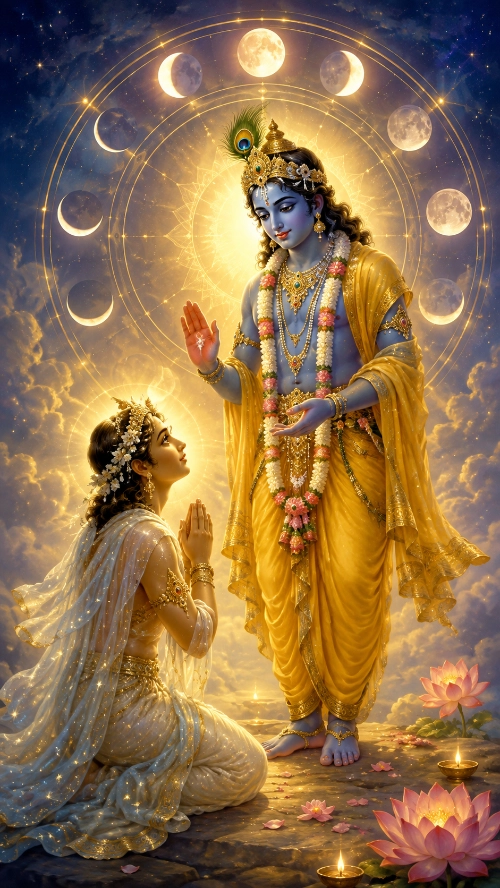
Puruṣottama Month: The King of All Months, and What to Vow During It
Given on the same evening as Bhakti Vijñāna Gosvāmī’s address, and covering the same month from the other side: less astronomy, more practice. Rāsa Līlā d.d. asks what a devotee should actually resolve to do in the thirty days of Puruṣottama-māsa, and answers that nothing new is wanted — only the things already being done, done with a bigger heart. The month that every other month rejected, she says, is the Lord’s invitation card.
Hare Kṛṣṇa, dear devotees, dear Vaiṣṇavīs. On the eve of the great festival of Puruṣottama-māsa, we decided to speak about the benefits this month bestows, so that we may attune ourselves properly and receive the mercy of the Lord. First, let us recite the auspicious prayers.
oṁ ajñāna-timirāndhasya
jñānāñjana-śalākayā
cakṣur unmīlitaṁ yena
tasmai śrī-gurave namaḥ
“I was born in the darkest ignorance, and my spiritual master opened my eyes with the torch of knowledge. I offer my respectful obeisances unto him.”
nama oṁ viṣṇu-pādāya
kṛṣṇa-preṣṭhāya bhū-tale
śrīmate bhaktivedānta-
svāmin iti nāmine
“I offer my respectful obeisances unto His Divine Grace A. C. Bhaktivedanta Swami, who is very dear to Lord Kṛṣṇa, having taken shelter at His lotus feet.”
namas te sārasvate deve
gaura-vāṇī-pracāriṇe
nirviśeṣa-śūnyavādi-
pāścātya-deśa-tāriṇe
“Our respectful obeisances unto you, O servant of Sarasvatī Gosvāmī. You are kindly preaching the message of Lord Caitanyadeva and delivering the Western countries, which are filled with impersonalism and voidism.”
So, dear devotees, tomorrow, May 17, the month of Puruṣottama begins, and it will continue until June 15. Just imagine: over the course of several years, an additional month accumulates, and the Lord gives us, as it were, an extra month of life. We can also regard it as an additional opportunity to come closer to Him — additional time for bhakti. That is the gift of Puruṣottama-māsa. This month has been called the king of all spiritual vows.
Today I would like to speak about three things:
- why this month is unique;
- how to spend it properly and strengthen our service during this period;
- and why this month is considered so special.
Why This Month Is Unique
Every few years — approximately once every three years — an additional month called Adhika-māsa appears. From an astronomical point of view, it is needed to harmonize the lunar and solar calendars. But the śāstras reveal a deeper mystery. During this extra month, material endeavors are said to yield little fruit, whereas spiritual practice brings multiplied results. For this reason, the month is called Puruṣottama-māsa, the month of the Lord. It is a spiritual gift, a spiritual bonus that does not come every year. Kārttika comes every year, but Puruṣottama-māsa does not.
Why, then, was it once called Mala-māsa? The name can be understood as “the useless” or “impure month.” But it is useless only for material purposes. For devotees, it is the opposite. This month is said to purify sins, ignorance and offenses, weakening the effects of aparādha. Therefore, it can be used for a very deep purification of the heart.
Śrīla Bhaktivinoda Ṭhākura, in his article on the glories of Puruṣottama month, explains something very important. The scriptures concerned with the highest spiritual goal — paramārtha-śāstras — glorify Puruṣottama-māsa as an especially favorable time for bhakti. He addresses the soul:
“O jīva, why are you lazy in performing hari-bhajana during this month? Lord Kṛṣṇa Himself has exalted it. It surpasses even Kārttika, Māgha and Vaiśākha. Worship Kṛṣṇa, and you will attain what you truly desire.”
So Śrīla Bhaktivinoda Ṭhākura says: please, do not be lazy. Engage in hari-bhajana. The spiritual tradition therefore does not regard this month as useless or merely “extra time.” It is a unique gift.
How Puruṣottama-māsa Became Sacred
How did this month become holy? The Purāṇas describe this story. Once Nārada Muni asked Lord Nārāyaṇa how people could be helped when they had become immersed in sense gratification, forgotten the purpose of life, and no longer wished to approach the Lord. Lord Nārāyaṇa then retold an ancient conversation between Lord Kṛṣṇa and the Pāṇḍavas.
When auspicious vows and rituals had been distributed among the twelve months of the year, everything had been allotted. But the thirteenth, additional month received nothing. People began to despise it and call it a dirty month, a thief, useless time. Then Adhika-māsa went to Vaikuṇṭha and, in despair, appealed to Lord Viṣṇu: “Everyone has a protector, but I have no one. People do not perform any auspicious activities during my time.”
Lord Viṣṇu comforted him and said: “Do not grieve. I will give you shelter. Come, let us go to Kṛṣṇa. He will free you from your suffering.”
Just imagine. This month had become an outcast among all the other months. No one accepted it. But it desired shelter. When Kṛṣṇa heard its story, He spoke very important words:
“This month will become equal to Me in glory. It will bear My name — Puruṣottama-māsa. I Myself shall become its protector. It will become the king of all months.”
The Lord added that devotional service performed during this month would bring special results. Just as seeds produce an abundant harvest when planted in rich, fertile soil, intensified and conscious spiritual practice during this month can bring very great results.
But the Lord also gave a serious warning: someone who completely ignores this month and lives only for sense gratification loses very great blessings. Therefore the main conclusion is that everyone should engage in some form of devotional service during this month — either continuing what we already do, or deepening it.
The Pāṇḍavas and Draupadī
Kṛṣṇa also told the Pāṇḍavas about Draupadī’s previous life. I will not go into all the details, but according to this narration, when she heard about the glories of the Puruṣottama-māsa vrata, she did not take them seriously. Later, this became one of the causes of the difficult trials she experienced.
Therefore the Lord instructed the Pāṇḍavas to observe the Puruṣottama-vrata carefully. They followed His instruction, and after their exile ended, they regained their kingdom and overcame their obstacles. Thus the scriptures say that observance of Puruṣottama-māsa, devotional service, and vows undertaken during this period can even change one’s destiny.
What Fruits Come from Observing the Month?
The śāstras list remarkable results:
- bad karma is burned away;
- devotion becomes stronger;
- bhakti increases;
- spiritual desires are fulfilled;
- practice becomes easier;
- the Lord becomes especially merciful and especially near.
One inspiring idea is that during this month the Lord is especially patient and may overlook our mistakes. It is almost like a kind of spiritual amnesty. For this reason, it is very important to enter this month consciously and consider how to live it properly.
The Main Practice: Increase Hearing and Chanting
The principal rule of Puruṣottama-māsa is to increase śravaṇa and kīrtana — hearing and chanting. What are some simple practices? We already chant japa, so we can chant more. We already read Śrīmad-Bhāgavatam, so we can read more deeply and more often. We already listen to Kṛṣṇa-kathā, so we can hear more Kṛṣṇa-kathā. We offer lamps, ghee and wicks; we can also offer lamps during Puruṣottama-māsa. We can perform daily parikramā around Tulasī. We can sing bhajanas for the pleasure of Śrī Śrī Rādhā-Mādhava.
The essence of the month is not austerity merely for austerity’s sake. The essence is a closer relationship with Kṛṣṇa. It is the deepening of our relationship with Him. And this is what He is waiting for from us.
Therefore, possible vows for this month include:
- rising earlier;
- chanting the mantra more attentively;
- reading and hearing more śāstra;
- taking on additional service.
If we can help someone — other Vaiṣṇavas or other people — or give charity, this is also favorable. And during this month it is very important to avoid:
- criticism of devotees;
- useless talk;
- lies;
- intoxicants;
- impure food.
The central practice is remembrance of Rādhā-Kṛṣṇa.
How the Ācāryas Regarded This Month
Sometimes one hears that Śrīla Prabhupāda did not speak very much about Puruṣottama-māsa. But we are not calling for strange new practices or unusual observances. We should do exactly what Śrīla Prabhupāda taught:
- chant Hare Kṛṣṇa;
- read Śrīmad-Bhāgavatam;
- sing kīrtana —
but do these things more, and better. This month is a chance to begin what we have been postponing.
Śrīla Bhaktivinoda Ṭhākura was among those who strongly reminded devotees in the modern period of this month’s glory. Later, Śrīla Bhaktisiddhānta Sarasvatī personally demonstrated an example of observing Puruṣottama-vrata. What did he do? He traveled to Vṛndāvana, gave lectures, and continuously engaged in harināma.
So the essence of this month is thirty days of concentrated bhakti — hearing, chanting, remembering and serving. It is the Lord’s invitation. It is, as it were, the Lord’s invitation card, allowing us to come closer to Him.
Puruṣottama-māsa is not simply an unnecessary extra month in the year. Once every few years comes this month that everyone rejected — but that Kṛṣṇa Himself accepted. Therefore it became the king of all months and a special period of divine mercy. And the essential instruction for observing it is very simple: do what you already do, but with a bigger heart, greater attention and greater effort.
Śrīmad-Bhāgavatam 2.2.36
There is a beautiful verse in Śrīmad-Bhāgavatam 2.2.36:
tasmāt sarvātmanā rājan
hariḥ sarvatra sarvadā
śrotavyaḥ kīrtitavyaś ca
smartavyo bhagavān nṛṇām
“Therefore, O King, it is essential that every human being, always and everywhere, hear about the Supreme Lord, glorify Him, and remember Him.”
You see, there are three activities here: hear Kṛṣṇa-kathā; retell and glorify Kṛṣṇa-kathā; and remember Him. The more we hear about the Lord, and the more we try to retell what we have heard, the more our remembrance will naturally increase.
This month does not come every year. It is a spiritual gift. It is a spiritual opportunity. It is a spiritual invitation for us to become closer to Kṛṣṇa. So what vow will each of us take for this month? Each person should think about this and decide.
Someone may record a video glorifying the Lord and share it on social media or YouTube. In that way, the person hears, retells and remembers. If someone feels shy about doing that publicly, he or she can tell stories about Kṛṣṇa within the family every evening. In this way, by hearing and retelling, by finding ears into which we can pour the nectar of Kṛṣṇa-kathā, our smaraṇam, our remembrance of Kṛṣṇa, will increase. And through that remembrance we will come closer to the Lord.
May this Puruṣottama month therefore become a time of purification, deepening, and drawing nearer to Śrī Śrī Rādhā-Mādhava. Hare Kṛṣṇa. Thank you very much, dear Vaiṣṇavas. May everything be successful by the mercy of the spiritual master, by the mercy of Śrīla Prabhupāda, and by the mercy of Śrī Śrī Rādhā-Mādhava. Hare Kṛṣṇa.