

“Kill Me or Protect Me—as You Wish”
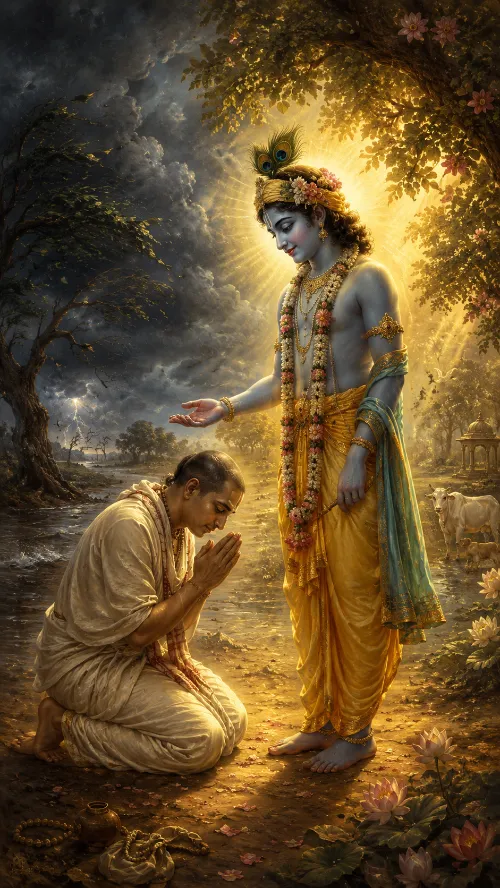
The Real Source and Radical Meaning of Bhaktivinoda Ṭhākura’s Prayer of Surrender
Most prayers ask God to change the outcome. Bhaktivinoda Ṭhākura’s prayer does something more demanding: it hands the outcome back to God.
মারবি রাখবি যো ইচ্ছা তোহারা ।
নিত্যদাস প্রতি তুয়া অধিকারা ॥৩॥
mārabi rākhabi—yo icchā tohārā
nitya-dāsa prati tuyā adhikārā
“Kill me or protect me, as You wish; over Your eternal servant You have full authority.”
These two lines are severe, beautiful, and easy to misunderstand. They do not express despair. They do not make suffering sacred. They do not tell a vulnerable person to submit to an abuser. They express the point at which devotion stops being a contract: “I will serve You if You give me the outcome I want.”
The prayer says instead: “I remain Yours in either outcome.”
That is its force. But before interpreting it, we need to identify it correctly.
Identifying the source
The usual attribution is substantially correct, but the reference can be made more precise.
Thus “ŚB 5.9.14, commentary” identifies a legitimate later quotation location. It does not identify the original source. In Prabhupāda’s edition, “purport” is the exact label.
The distinction matters. Without it, a reader may think the Bengali words were spoken by Jaḍa Bharata or translated from the Bhāgavatam in Sanskrit. Neither is true. Prabhupāda quotes a nineteenth-century Bengali song to illuminate the spiritual disposition he sees in an ancient Sanskrit narrative.
Bhaktivinoda Ṭhākura’s Śaraṇāgati, written in 1893 according to the Bhaktivinoda Institute’s edition, is a collection of fifty devotional songs organized around surrender to Kṛṣṇa. The couplet belongs to its section on ātma-nivedana—the offering or dedication of oneself.
What the two Bengali lines actually say
The published translation reads:
“My Lord, I am now surrendered unto You. I am Your eternal servant, and if You like You can kill me, or, if You like, You can protect me. In any case, I am fully surrendered unto You.”
That is the translation given in Prabhupāda’s purport. It faithfully conveys the devotional meaning, but it is an expanded paraphrase rather than a word-for-word translation of the couplet.
The word adhikāra does not by itself contain the English adjective “complete.” The unrestricted contrast—“kill or protect”—makes the completeness of the claim clear. Prabhupāda’s “I am now surrendered” and “in any case” make explicit what the couplet performs rather than literally states.
The lyric is Bengali devotional poetry, not Sanskrit. Its diction is colored by older vernacular and Brajabuli-like forms: editions therefore print such variants as mārabi/mārobi, yo/jo, tuyā/tuwā, tohārā/tohāra, and sometimes nitya-dāsa prati/nitya-dāse prati. These are minor editorial or pronunciation differences; they do not change the teaching.
Read the whole song, not one frightening line
The famous couplet is stanza 3 of an eight-stanza song. The complete poem reveals what “kill me or protect me” means—and what it does not mean. Surrender begins with offering, passes through uncertainty, and ends in love, community, and a positive identity in service.
1. Everything called “mine” is offered
মানস, দেহ, গেহ, যো কিছু মোর ।
অর্পিলুঁ তুয়া পদে নন্দকিশোর ॥১॥
mānasa, deha, geha, yo kichu mora
arpiluṅ tuyā pade, nanda-kiśora
“Mind, body, home—whatever is mine—I offer at Your feet, O youthful son of Nanda.”
The offering is comprehensive: the inner life (mānasa, mind), embodied life (deha, body), and social or domestic life (geha, home). Surrender is not confined to a temple mood. It reaches thoughts, health, possessions, relationships, and the place where ordinary life happens.
2. The burden of independent control is relinquished
সম্পদে বিপদে জীবনে মরণে ।
দায় মম গেলা তুয়া ও পদ বরণে ॥২॥
sampade vipade, jīvane maraṇe
dāya mama gelā, tuyā o-pada varaṇe
“In prosperity and danger, in life and death, my burden is gone because I have chosen those feet of Yours.”
The word dāya can carry the sense of burden, liability, responsibility, or anxious charge. It cannot responsibly mean, “I no longer have duties.” The later songs explicitly command active stewardship. What is surrendered here is the fantasy of absolute ownership and final control.
The devotee still acts. He no longer imagines himself to be the ultimate controller of what his action will produce.
3. No result cancels the relationship
মারবি রাখবি যো ইচ্ছা তোহারা ।
নিত্যদাস প্রতি তুয়া অধিকারা ॥৩॥
mārabi rākhabi—yo icchā tohārā
nitya-dāsa prati tuyā adhikārā
“Kill me or protect me, as You wish; over Your eternal servant You have full authority.”
This is the song’s center. The devotee does not say pain and safety are identical. He says neither pain nor safety determines whether he belongs to Kṛṣṇa. Bodily preservation is desired naturally, but it is no longer the price Kṛṣṇa must pay to retain the devotee’s loyalty.
4. If birth must come again, let it support devotion
জন্মাওবি মোয়ে ইচ্ছা যদি তোর ।
ভক্তগৃহে জনি জন্ম হউ মোর ॥৪॥
janmāobi moye, icchā yadi tora
bhakta-gṛhe jani janma ha-u mora
“If You wish me to take birth again, let my birth be in a devotee’s home.”
The prayer is not for status, comfort, or even immediate liberation. It is for an environment in which devotion can grow.
5. Spiritual direction matters more than cosmic rank
কীট জন্ম হউ যথা তুয়া দাস ।
বহির্মুখ ব্রহ্মজন্মে নাহি আশ ॥৫॥
kīṭa-janma ha-u yathā tuyā dāsa
bahir-mukha brahmā-janme nāhi āśa
“Let me take birth even as an insect wherever Your servant is; I have no desire for birth as Brahmā if I would be turned away from You.”
The contrast is deliberately extreme: the smallest life near devotion is preferred to the highest cosmic office without devotion. The hierarchy being overturned is not social but spiritual. The decisive question is not, “How important am I?” It is, “Which way is my heart facing?”
This stanza closely echoes Yāmunācārya’s Sanskrit Stotra-ratna—often numbered verse 52, though some editions number it 55:
तव दास्यसुखैकसङ्गिनां
भवनेष्वस्त्वपि कीटजन्म मे ।
इतरावसथेषु मा स्म भूद्
अपि मे जन्म चतुर्मुखात्मना ॥
tava dāsya-sukhaika-saṅgināṁ
bhavaneṣv astv api kīṭa-janma me
itarāvasatheṣu mā sma bhūd
api me janma caturmukhātmanā
“May I be born even as an insect in the homes of those whose sole attachment is the joy of serving You. May I not be born elsewhere, even with the identity of four-faced Brahmā.”
Bhaktivinoda is therefore not inventing surrender in isolation. He is recasting an older Sanskrit Vaiṣṇava current in memorable Bengali song.
6. The surrendered person still desires—carefully
ভুক্তি-মুক্তিস্পৃহা-বিহীন যে ভক্ত ।
লভইতে তাঁ’ক সঙ্গ অনুরক্ত ॥৬॥
bhukti-mukti-spṛhā-vihīna ye bhakta
labha-ite tāṅka saṅga anurakta
“I long to obtain the association of devotees who are free from craving for worldly enjoyment or liberation.”
Surrender is not the extinction of all desire. It is the education of desire. Bhaktivinoda rejects both bhukti—using religion to acquire enjoyment—and mukti—using it merely to escape existence. Yet he intensely desires the company of unselfish devotees.
7. Kṛṣṇa becomes the center of every relationship
জনক, জননী, দয়িত, তনয় ।
প্রভু, গুরু, পতি তুহুঁ—সর্ব্বময় ॥৭॥
janaka, jananī, dayita, tanaya
prabhu, guru, pati—tuhuṅ sarva-maya
“Father, mother, beloved, son, Lord, teacher, husband—you are my all-in-all.”
This does not erase human relationships. It relocates their center. Every genuine form of care is seen in relation to Kṛṣṇa, and no finite relationship is forced to bear the impossible weight of being ultimate.
8. Surrender ends not in emptiness but attachment
ভকতিবিনোদ কহে শুন কান! ।
রাধানাথ! তুহুঁ হামার পরাণ ॥৮॥
bhaktivinoda kahe, śuna kāna
rādhā-nātha! tuhuṅ hāmāra parāṇa
“Bhaktivinoda says, ‘Listen, O Kāna! O Lord of Rādhā, You are my very life.’”
The final word is parāṇa—life, vital breath, the object of one’s deepest attachment. The song does not culminate in numb resignation. It culminates in personal love for Rādhā’s Lord.
Why Prabhupāda quotes it in the story of Jaḍa Bharata
The Sanskrit of Śrīmad-Bhāgavatam 5.9.14 says nothing about Bhaktivinoda and does not contain the Bengali prayer. It narrates a kidnapping:
अथ त एनमनवद्यलक्षणमवमृश्य भर्तृकर्मनिष्पत्तिं मन्यमाना बद्ध्वा रशनया चण्डिकागृहमुपनिन्युर्मुदा विकसितवदनाः ॥१४॥
atha ta enam anavadya-lakṣaṇam avamṛśya bhartṛ-karma-niṣpattiṁ manyamānā baddhvā raśanayā caṇḍikā-gṛham upaninyur mudā vikasita-vadanāḥ
“Then, judging him to have the faultless characteristics needed to complete their master’s undertaking, they bound him with a rope and, their faces bright with delight, brought him to the temple of Caṇḍikā.”
Śrīmad-Bhāgavatam 5.9.14
The wider story supplies the facts a new reader needs.
Jaḍa Bharata had formerly been King Bharata. Though spiritually advanced, he became excessively attached to a deer near the end of his royal life. After another birth as a deer, he was born again as the son of a brāhmaṇa. Determined to avoid fresh worldly entanglement, he concealed his inner realization and allowed people to regard him as dull, deaf, and incapable; hence the name Jaḍa—“inert” or “insensible.”
One night, while he was guarding a field, a band of thieves found him. Their intended human victim had escaped, so they seized Jaḍa Bharata as a replacement for an illicit sacrifice. They bound him, bathed and decorated him, fed him, seated him before Bhadrakālī, and raised a consecrated sword to kill him. Jaḍa Bharata was physically strong enough to resist, but he did not.
At the last moment, the goddess burst from her image, unable to tolerate the violence against him, and turned the thieves’ weapon upon them. The narrative describes Jaḍa Bharata in spiritually decisive terms:
ब्रह्मभूतस्य … निर्वैरस्य सर्वभूतसुहृदः
brahma-bhūtasya … nirvairasya sarva-bhūta-suhṛdaḥ
“Of one established in spiritual realization … who was without hostility and a well-wisher of every living being.”
Śrīmad-Bhāgavatam 5.9.17
Prabhupāda’s purport to 5.9.14 interprets Jaḍa Bharata’s nonresistance as complete dependence on the Supreme Lord. He then quotes Bhaktivinoda’s couplet as a later verbal expression of that mood.
This is a commentarial application, not a hidden quotation from the narrative. Jaḍa Bharata does not speak the Bengali lines. The Bhāgavatam narrates his behavior; Prabhupāda uses Bhaktivinoda to name its devotional logic.
An exceptional saint is not a universal safety policy
Jaḍa Bharata’s conduct must be read with care. The story presents an extraordinarily self-realized person who knew he was not the body, was free from hatred, possessed unusual strength, and chose not to resist. It does not issue a blanket command that devotees must remain passive when threatened.
Nothing in the sixfold doctrine of surrender forbids a person to:
- leave an abusive situation;
- call the police or emergency services;
- seek medical or psychological care;
- protect a child or dependent adult;
- set a firm boundary;
- tell the truth about wrongdoing;
- defend oneself or another within ethical and legal limits.
Those actions can themselves be service. Preserving a life entrusted by God may be the favorable thing to do. Jaḍa Bharata’s silence cannot be weaponized against a frightened person whose actual duty is to seek safety.
Ātma-nivedana: not merely giving things, but giving the owner
Bhaktivinoda places the song in the section called ātma-nivedana: “offering the self” or “dedication of oneself.” The term appears in Prahlāda’s classic list of nine forms of devotion:
श्रीप्रह्राद उवाच
श्रवणं कीर्तनं विष्णोः स्मरणं पादसेवनम् ।
अर्चनं वन्दनं दास्यं सख्यमात्मनिवेदनम् ॥२३॥
इति पुंसार्पिता विष्णौ भक्तिश्चेन्नवलक्षणा ।
क्रियेत भगवत्यद्धा तन्मन्येऽधीतमुत्तमम् ॥२४॥
śrī-prahrāda uvāca
śravaṇaṁ kīrtanaṁ viṣṇoḥ smaraṇaṁ pāda-sevanam
arcanaṁ vandanaṁ dāsyaṁ sakhyam ātma-nivedanam
iti puṁsārpitā viṣṇau bhaktiś cen nava-lakṣaṇā
kriyeta bhagavaty addhā tan manye ’dhītam uttamam
“Prahlāda said: Hearing and chanting about Viṣṇu, remembering Him, serving His feet, worshiping, offering prayers, serving as a servant, relating as a friend, and offering oneself—if these ninefold forms of devotion are offered directly to the Lord, I consider that the highest learning.”
Śrīmad-Bhāgavatam 7.5.23–24
Giving a possession may leave the possessor untouched: “I gave something of mine, but I remain my own.” Ātma-nivedana goes deeper. The person, the faculties, the possessions, and the results of action are all understood as belonging to God.
That does not destroy individuality. A servant must exist in order to serve. The song repeatedly says “I,” “Your servant,” “my birth,” and “I long.” What disappears is not the person but the illusion of independent proprietorship.
Ātma-nivedana within the six movements of śaraṇāgati
Śaraṇāgati means taking refuge. A verse preserved in Hari-bhakti-vilāsa 11.676 and cited in Caitanya-caritāmṛta, Madhya 22.100, describes six interlocking features:
आनुकूल्यस्य सङ्कल्पः प्रातिकूल्यस्य वर्जनम् ।
रक्षिष्यतीति विश्वासो गोप्तृत्वे वरणं तथा ।
आत्मनिक्षेपकार्पण्ये षड्विधा शरणागतिः ॥
ānukūlyasya saṅkalpaḥ prātikūlyasya varjanam
rakṣiṣyatīti viśvāso goptṛtve varaṇaṁ tathā
ātma-nikṣepa-kārpaṇye ṣaḍ-vidhā śaraṇāgatiḥ
“Surrender is sixfold: resolve to accept what is favorable, rejection of what is unfavorable, confidence that the Lord will protect, choosing Him as one’s maintainer, offering oneself, and humility.”
These six protect one another from distortion.
- Accept what nourishes devotion. Surrender has positive disciplines: truthfulness, prayer, remembrance, service, ethical work, sound association, and care for the body and mind.
- Reject what obstructs devotion. One does not surrender to addiction, deceit, exploitation, cruelty, or a destructive environment and call it spirituality.
- Trust the Lord’s protection. The devotee is not spiritually abandoned, even when circumstances are painful.
- Choose the Lord as maintainer. Food, ability, relationships, institutions, and employment may be instruments of support; they are not the ultimate source.
- Offer oneself. One’s body, mind, plans, property, and future become material for service.
- Remain humble. Surrender is not a claim to be spiritually superior or exempt from correction.
The phrase “kill me or protect me” expresses the fifth movement—self-offering—while presupposing the third and fourth. Is that contradictory? If the Lord protects, how can the devotee say, “You may kill me”?
Only if “protection” is reduced to “my present body must never die.” But every embodied devotee eventually dies. In Vaiṣṇava theology, divine protection is ultimately protection of the devotee’s relationship with God and progress toward the highest good. Sometimes bodily safety is part of that protection, as it visibly is for Jaḍa Bharata. It is not a promise that a devotee will never experience illness, loss, persecution, or death.
What “My devotee never perishes” can and cannot mean
Kṛṣṇa gives a powerful assurance in the Bhagavad-gītā:
क्षिप्रं भवति धर्मात्मा शश्वच्छान्तिं निगच्छति ।
कौन्तेय प्रतिजानीहि न मे भक्तः प्रणश्यति ॥३१॥
kṣipraṁ bhavati dharmātmā śaśvac-chāntiṁ nigacchati
kaunteya pratijānīhi na me bhaktaḥ praṇaśyati
“Quickly that person becomes righteous and attains lasting peace. O son of Kuntī, declare it boldly: My devotee never perishes.”
Bhagavad-gītā 9.31
“Never perishes” cannot mean bodily invulnerability. Arjuna, the direct hearer of the Gītā, will still witness death on the battlefield, and his own body will not remain forever. The assurance is that sincere devotion is not spiritually wasted, the devotee is not finally abandoned, and a moral fall is not necessarily the end of the path. The preceding context concerns a devotee correcting serious misconduct and becoming righteous—not receiving immunity from consequences while continuing to harm others.
The Gītā ends with an even more explicit invitation:
सर्वधर्मान्परित्यज्य मामेकं शरणं व्रज ।
अहं त्वां सर्वपापेभ्यो मोक्षयिष्यामि मा शुचः ॥६६॥
sarva-dharmān parityajya mām ekaṁ śaraṇaṁ vraja
ahaṁ tvāṁ sarva-pāpebhyo mokṣayiṣyāmi mā śucaḥ
“Relinquishing all dharmas—all competing paths and claims of duty—take refuge in Me alone. I shall free you from every sinful reaction. Do not grieve.”
Bhagavad-gītā 18.66
This is not permission to discard ethics. Kṛṣṇa speaks it after teaching Arjuna about disciplined action, self-control, sacrifice, knowledge, devotion, and duty. The climax releases Arjuna from competing claims that would keep him from Kṛṣṇa’s will; it does not turn impulse into revelation.
Surrender in adversity: perception, endurance, and continued service
Another Bhāgavatam verse shows how surrender operates when suffering is already present:
तत्तेऽनुकम्पां सुसमीक्षमाणो
भुञ्जान एवात्मकृतं विपाकम् ।
हृद्वाग्वपुर्भिर्विदधन्नमस्ते
जीवेत यो मुक्तिपदे स दायभाक् ॥८॥
tat te ’nukampāṁ su-samīkṣamāṇo
bhuñjāna evātma-kṛtaṁ vipākam
hṛd-vāg-vapurbhir vidadhan namas te
jīveta yo mukti-pade sa dāya-bhāk
“One who, while experiencing the ripened results of one’s own past actions, looks carefully for Your mercy and continues offering obeisance with heart, words, and body becomes a rightful heir to liberation.”
Śrīmad-Bhāgavatam 10.14.8
The verse does not call pain pleasant. It describes a discipline of interpretation: suffering does not automatically become evidence that God has disappeared. Nor does acceptance mean inactivity. The person continues to live, perceive, pray, and act with heart, speech, and body.
The deepest parallel: “Embrace me or break my heart”
Bhaktivinoda’s “kill me or protect me” belongs to an especially intense current of Gauḍīya devotion. The final verse of Śrī Caitanya’s Śikṣāṣṭaka, preserved in Caitanya-caritāmṛta, Antya 20.47, prays:
आश्लिष्य वा पादरतां पिनष्टु माम्
अदर्शनान्मर्महतां करोतु वा ।
यथा तथा वा विदधातु लम्पटो
मत्प्राणनाथस्तु स एव नापरः ॥
āśliṣya vā pāda-ratāṁ pinaṣṭu mām
adarśanān marma-hatāṁ karotu vā
yathā tathā vā vidadhātu lampaṭo
mat-prāṇa-nāthas tu sa eva nāparaḥ
“Let Him embrace me, devoted to His feet, or crush me; let Him break my heart by remaining unseen. Let that wayward Lord do whatever He wishes—still He alone, and no one else, is the Lord of my life.”
The theology is relational, not stoic. The speaker does not pretend absence is painless; she says it breaks the heart. Yet pain does not produce a rival object of ultimate love. Bhaktivinoda’s closing words—“You are my very life”—echo this same structure.
The promise behind surrender
The tradition does not present surrender as falling into an impersonal void. It answers surrender with divine acceptance. Caitanya-caritāmṛta, Madhya 22.102, states:
শরণ লঞা করে কৃষ্ণে আত্মসমর্পণ ।
কৃষ্ণ তারে করে তৎকালে আত্মসম ॥১০২॥
śaraṇa lañā kare kṛṣṇe ātma-samarpaṇa
kṛṣṇa tāre kare tat-kāle ātma-sama
“When a person takes shelter and offers the self to Kṛṣṇa, Kṛṣṇa at once accepts that person as His own intimate associate.”
The phrase ātma-sama literally suggests being treated as like His own self; the received translation emphasizes acceptance among Kṛṣṇa’s confidential associates. The devotee says, “I am Yours,” and the theological answer is, “You are Mine.”
The Caitanya-caritāmṛta also cites a received form of Rāma’s vow from the Rāmāyaṇa, Yuddha-kāṇḍa 18.33. Sanskrit recensions differ slightly in wording, but the promise is stable:
सकृदेव प्रपन्नो यस्तवास्मीति च याचते ।
अभयं सर्वदा तस्मै ददाम्येतद् व्रतं मम ॥
sakṛd eva prapanno yas tavāsmīti ca yācate
abhayaṁ sarvadā tasmai dadāmy etad vrataṁ mama
“To the one who takes refuge even once and pleads, ‘I am Yours,’ I grant fearlessness always. This is My vow.”
Caitanya-caritāmṛta, Madhya 22.34
Fearlessness is not the prediction that nothing frightening will occur. It is the security of belonging even when it does.
Surrender is stewardship, not abandonment
One of the best safeguards against a vague or irresponsible reading comes from Bhaktivinoda himself. Two stanzas later in the Ātma-nivedana section of Śaraṇāgati, he explains what self-offering looks like in household life:
ধন, জন, গৃহ, দ্বার, ‘তোমার’ বলিয়া ।
রক্ষা করি আমি মাত্র সেবক হইয়া ॥৩॥
তোমার কার্য্যের তরে উপার্জ্জিব ধন ।
তোমার সংসারব্যয় করিব বহন ॥৪॥
dhana, jana, gṛha, dvāra, “tomāra” baliyā
rakṣā kari āmi mātra sevaka ha-iyā
tomāra kāryera tare upārjiba dhana
tomāra saṁsāra-vyaya kariba vahana
“Considering wealth, family, home, and household to be Yours, I protect them only as Your servant. I shall earn money for Your work and bear the expenses of Your household.”
This is as practical as theology gets. The surrendered householder does not say, “Nothing is mine, so nothing is my problem.” He says, “Nothing is independently mine; therefore everything entrusted to me deserves responsible care.”
Ownership becomes stewardship:
- The body is not an idol, but it is an instrument to maintain.
- Money is not the self, but it must be earned and used honestly.
- Family members are not possessions, but persons entrusted to one’s care.
- Work is not ultimate, but it can become service.
- Results cannot be controlled completely, but effort can be conscientious.
That is the practical bridge between “You have authority” and getting up tomorrow to do one’s duty.
Four dangerous misreadings
What the prayer means in real life
The couplet becomes useful when translated from dramatic poetry into ordinary decisions.
When making a difficult decision
Do the work: gather facts, ask wise counsel, consider duties, and choose what best supports truth and devotion. Then release the demand that a sincere decision must produce a painless result.
The prayer is not: “I will do nothing; God decides.”
It is: “I will act faithfully; God remains Lord of the result.”
When work or money becomes unstable
Apply Bhaktivinoda’s stewardship principle. Make the budget, seek employment, ask for help, and meet obligations honestly. At the same time, refuse to let income define personal worth or become the final source of security.
When illness comes
Use medicine, qualified care, rest, prayer, and community support. Surrender is compatible with vigorous treatment. Surrender is not neglecting the body; it is refusing to make physical recovery the condition of one’s relationship with God.
When a prayer appears unanswered
Name the pain honestly. The Śikṣāṣṭaka does not deny heartbreak. Continue the practices that keep the relationship alive—hearing, chanting, remembrance, prayer, service, and good association—without pretending to know why the result was withheld.
When another person demands submission
Ask a decisive question: “Is this person inviting my free service to God, or demanding control for themselves?” Divine surrender should clarify conscience and free service. Coercion, secrecy, threats, and immunity from accountability point in the opposite direction.
When success comes
“Protect me” includes the danger of prosperity. Success can feed the illusion, “I am the owner and controller.” Receive capacity, recognition, and resources as entrusted materials, and ask how they can serve rather than merely enlarge the ego.
A compact daily practice
Bhaktivinoda’s teaching can be turned into five questions:
- What has actually been entrusted to me today? Name the body, people, work, money, time, and decision involved.
- What responsible action is mine? Identify the next truthful, compassionate, and competent step.
- What outcome am I trying to own? Notice the result you believe must occur before you will be at peace.
- What must be accepted or rejected? Use the first two limbs of surrender: favor what nourishes devotion; refuse what corrodes it.
- Can I offer both action and outcome? Pray, in effect: “Let me serve well. Protect me as You wish. If events go otherwise, do not let me lose the relationship.”
This practice avoids two opposite errors: anxious control and passive irresponsibility.
The deepest meaning in one sentence
“Kill me or protect me—as You wish” means:
My body, circumstances, and outcomes may change; my identity as Your servant does not. Therefore I will act responsibly in Your service without making my preferred result the price of my devotion.
Bhaktivinoda’s prayer is radical because it removes the devotee’s final veto. But it is not bleak. Read in its full song, it is surrounded by offering, community, service, relationship, and love. Read beside Jaḍa Bharata, it describes extraordinary freedom from fear. Read beside the six limbs of surrender, it requires discerning action. Read beside Bhaktivinoda’s household instructions, it becomes stewardship.
The surrendered person is not someone who has stopped acting. It is someone who has ceased to pretend to be the ultimate owner—then acts with greater care because everything belongs to Kṛṣṇa.
Textual and editorial notes
The Bengali text of mānasa, deha, geha follows a digitized Bengali edition reproduced by Prema Dharma, checked against the Bhaktivinoda Institute’s song edition. Bengali spelling and Romanization vary by edition.
The normalized transliteration used here keeps characteristic vernacular forms while applying diacritics consistently to Sanskrit-derived words. It is therefore a readable scholarly normalization, not a claim that the song is Sanskrit.
The citation Śaraṇāgati 11.3 uses continuous song numbering: Song 11, stanza 3. The sectional citation Ātma-nivedana, Song 3, stanza 3 is equally valid and often clearer.
Prabhupāda’s wording is an interpretive devotional translation of the two Bengali lines. The “close translation” in this article stays nearer to their grammar.
Stotra-ratna numbering varies among editions. The insect-birth stanza is numbered 52 in some editions and 55 in others.
The Rāma verse appears in slightly different forms across received editions and citations. The form printed here is the one cited in Caitanya-caritāmṛta, Madhya 22.34.
Unless otherwise indicated, English renderings in this article are fresh, close translations prepared for clarity; they should not be confused with the copyrighted translations displayed on the consulted sites.