

Sometimes in Heaven, Sometimes in Hell

Why Rising Higher Is Not the Same as Getting Free
One of Śrī Caitanya Mahāprabhu’s most vivid descriptions of material existence appears in His teachings to Sanātana Gosvāmī:
কভু স্বর্গে উঠায়, কভু নরকে ডুবায় ।
দণ্ড্যজনে রাজা যেন নদীতে চুবায় ॥
kabhu svarge uṭhāya, kabhu narake ḍubāya
daṇḍya-jane rājā yena nadīte cubāya
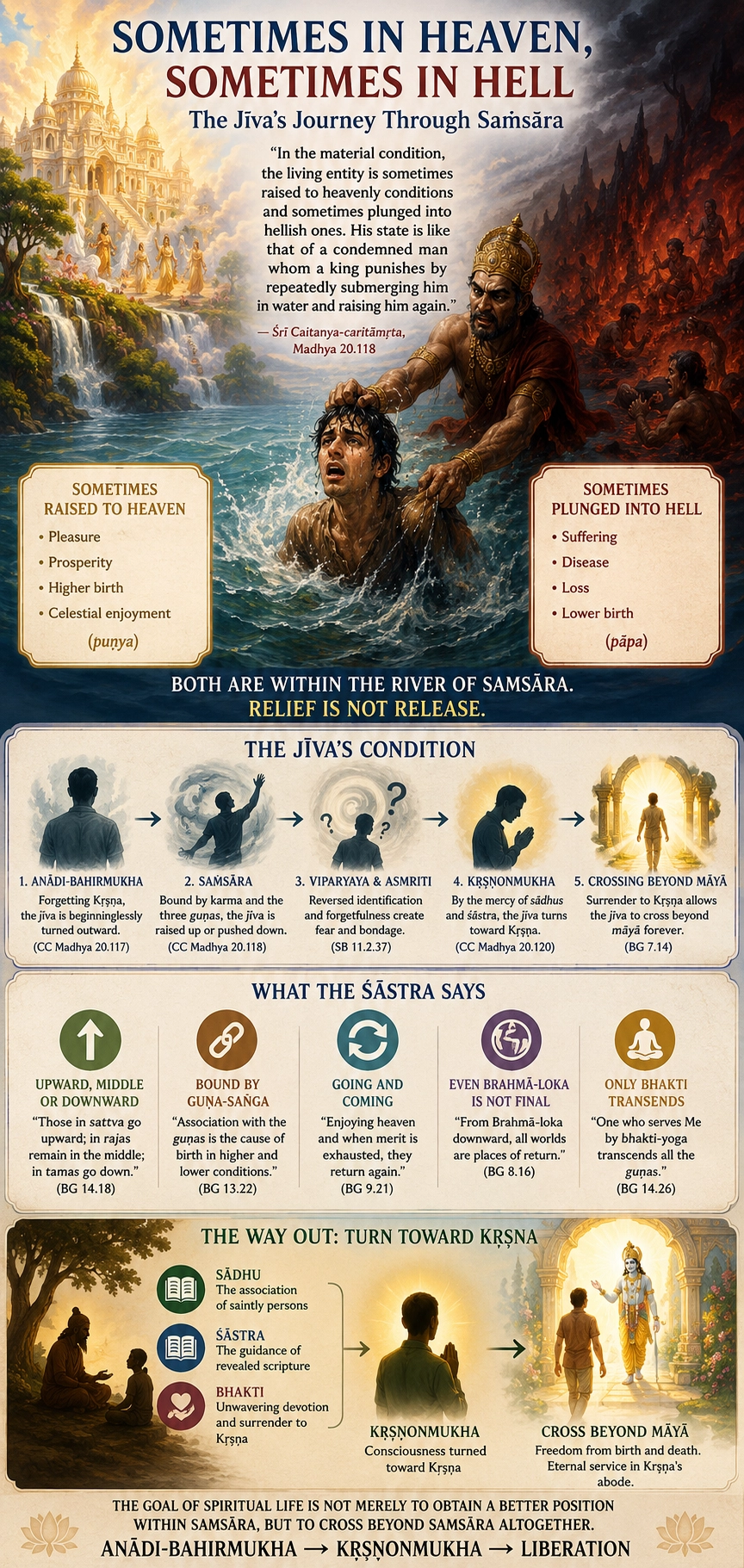
“In the material condition, the living entity is sometimes raised to heavenly conditions and sometimes plunged into hellish ones. His state is like that of a condemned man whom a king punishes by repeatedly submerging him in water and raising him again.”
Śrī Caitanya-caritāmṛta, Madhya 20.118
At first glance this may sound like a description of changing fortune — sometimes happiness, sometimes suffering, sometimes prosperity, sometimes loss. But in context Mahāprabhu is describing something much deeper. He is summarizing saṁsāra itself: the beginningless cycle of material embodiment, karma, pleasure, suffering, death and rebirth. And the metaphor carries a crucial warning — being raised upward within material existence is not the same as being liberated from it.
Heaven and hell are opposites in experience, but both remain inside the same cycle. The real goal of spiritual life is therefore not to obtain a better position within saṁsāra. It is to cross beyond saṁsāra altogether.
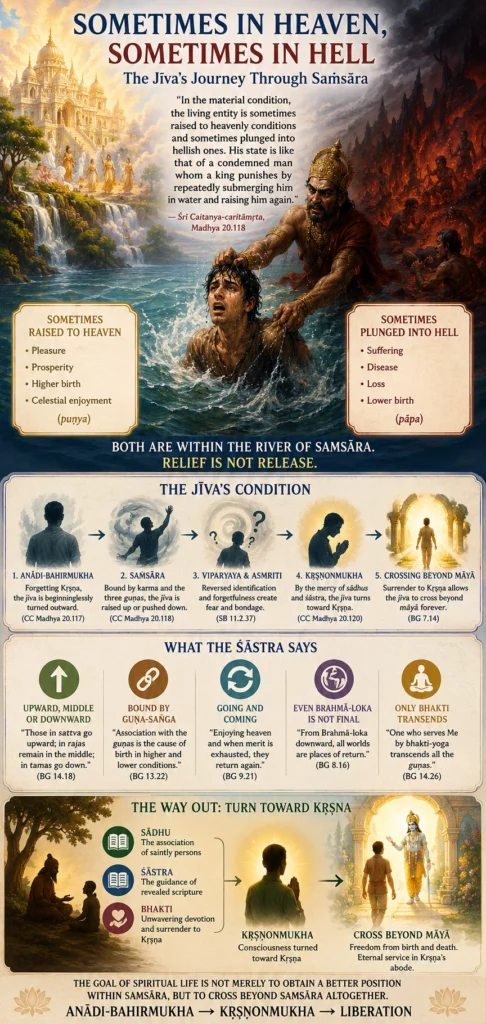
The whole chain on one sheet: the river of saṁsāra with puṇya above and pāpa below, the five stages of the jīva’s condition, five śāstra verses on why elevation is not escape, and the way out through sādhu, śāstra and bhakti.
Sanātana Gosvāmī’s Fundamental Question
The discussion begins with one of the most existential questions in the Caitanya-caritāmṛta:
‘কে আমি’, ‘কেনে আমায় জারে তাপত্রয়’ ।
ইহা নাহি জানি — ‘কেমনে হিত হয়’ ॥
ke āmi, kene āmāya jāre tāpa-traya
ihā nāhi jāni — kemane hita haya
“Who am I? Why do the threefold miseries torment me? If I do not know this, how can I know what is truly beneficial for me?”
Caitanya-caritāmṛta, Madhya 20.102
Sanātana is asking three things at once: who am I?, why do I suffer?, and what is my real welfare? The expression tāpa-traya refers to the three broad forms of material suffering.
Mahāprabhu’s answer does not begin with a theory of suffering. It begins with identity.
The Jīva’s True Identity
জীবের ‘স্বরূপ’ হয় — কৃষ্ণের ‘নিত্যদাস’ ।
কৃষ্ণের ‘তটস্থা-শক্তি’, ‘ভেদাভেদ-প্রকাশ’ ॥
jīvera svarūpa haya — kṛṣṇera nitya-dāsa
kṛṣṇera taṭasthā-śakti, bhedābheda-prakāśa
“The constitutional nature of the jīva is to be Kṛṣṇa’s eternal servant. The jīva is Kṛṣṇa’s marginal potency, simultaneously distinct from and nondistinct from Him.”
Madhya 20.108
This establishes the foundation of the whole discussion: material conditioning does not define what the jīva ultimately is. The jīva is not eternally human, deva, animal, king, beggar, scholar, male, female, wealthy, poor, healthy or sick — all of those belong to temporary material embodiment. The Bhagavad-gītā expresses a related principle:
ममैवांशो जीवलोके
जीवभूतः सनातनः ।
मनःषष्ठानीन्द्रियाणि
प्रकृतिस्थानि कर्षति ॥
mamaivāṁśo jīva-loke
jīva-bhūtaḥ sanātanaḥ
manaḥ-ṣaṣṭhānīndriyāṇi
prakṛti-sthāni karṣati
“The living being in this world is eternally My part. Situated in material nature, he struggles with the six senses, including the mind.”
Bhagavad-gītā 15.7
Two realities stand side by side. The jīva is sanātana, eternal — yet while associated with material nature, karṣati, he struggles. The problem of conditioned existence is therefore not that the jīva has ceased to be spiritual. It is that an eternal spiritual being has become entangled in temporary identities and conditions.
“Forgetting Kṛṣṇa”
Immediately before the river analogy, Mahāprabhu gives His diagnosis:
কৃষ্ণ ভুলি’ সেই জীব অনাদি-বহির্মুখ ।
অতএব মায়া তারে দেয় সংসার-দুঃখ ॥
kṛṣṇa bhuli’ sei jīva anādi-bahirmukha
ataeva māyā tāre deya saṁsāra-duḥkha
“Forgetting Kṛṣṇa, the jīva has been outward-turned from beginningless time; therefore māyā gives him the suffering of material existence.”
Madhya 20.117
The expression:
অনাদি-বহির্মুখ
anādi-bahirmukha
deserves care. Anādi means beginningless; bahirmukha means outward-facing, turned away.
The verse need not be read as describing a particular historical event in which every conditioned jīva was once liberated and then fell into matter. Its direct emphasis is the conditioned jīva’s beginningless outward orientation within saṁsāra. The central contrast is not primarily chronological but directional: away from Kṛṣṇa versus toward Kṛṣṇa. That distinction will eventually become the key to liberation.
Sometimes Up, Sometimes Down
Mahāprabhu then gives the image:
কভু স্বর্গে উঠায়, কভু নরকে ডুবায় ।
kabhu svarge uṭhāya, kabhu narake ḍubāya
“Sometimes raised to heaven, sometimes drowned in hell.”
The Bhagavad-gītā supplies a philosophical framework for that vertical movement:
ऊर्ध्वं गच्छन्ति सत्त्वस्था
मध्ये तिष्ठन्ति राजसाः ।
जघन्यगुणवृत्तिस्था
अधो गच्छन्ति तामसाः ॥
ūrdhvaṁ gacchanti sattva-sthā
madhye tiṣṭhanti rājasāḥ
jaghanya-guṇa-vṛtti-sthā
adho gacchanti tāmasāḥ
“Those established in sattva rise upward; those dominated by rajas remain in the middle; those situated in degraded functions of tamas go downward.”
Bhagavad-gītā 14.18
The movement is therefore not portrayed as meaningless chaos. Material conditions arise within the interaction of karma and the three guṇas — sattva, rajas and tamas. Kṛṣṇa explains:
पुरुषः प्रकृतिस्थो हि
भुङ्क्ते प्रकृतिजान्गुणान् ।
कारणं गुणसङ्गोऽस्य
सदसद्योनिजन्मसु ॥
puruṣaḥ prakṛti-stho hi
bhuṅkte prakṛti-jān guṇān
kāraṇaṁ guṇa-saṅgo ’sya
sad-asad-yoni-janmasu
“Situated in material nature, the living being experiences the qualities produced by prakṛti. Association with those guṇas becomes the cause of birth in higher and lower conditions.”
Bhagavad-gītā 13.22
The decisive expression is:
कारणं गुणसङ्गोऽस्य
kāraṇaṁ guṇa-saṅgo ’sya
— “association with the guṇas is the cause.” Within conditioned embodiment the jīva desires, identifies, associates and acts through prakṛti; those actions generate karmic consequences; those consequences condition future circumstances and embodiments; and within those circumstances the jīva again identifies, desires and acts. Thus saṁsāra perpetuates itself. The Śrīmad-Bhāgavatam summarizes the mechanism:
कर्मणा दैवनेत्रेण
जन्तुर्देहोपपत्तये ।
karmaṇā daiva-netreṇa
jantur dehopapattaye
“According to karma, under divine supervision, the living being obtains a particular body.”
Śrīmad-Bhāgavatam 3.31.1
Two principles operate together: karmaṇā, according to karma, and daiva-netreṇa, under divine supervision. The Bhāgavata therefore portrays material existence as neither morally random nor independent of divine order.
The King in Mahāprabhu’s Analogy
This helps us read the image of the king repeatedly submerging a condemned man. It should not be taken as though Bhagavān arbitrarily enjoys inflicting suffering upon living beings. The Bhagavad-gītā says:
नादत्ते कस्यचित्पापं
न चैव सुकृतं विभुः ।
अज्ञानेनावृतं ज्ञानं
तेन मुह्यन्ति जन्तवः ॥
nādatte kasyacit pāpaṁ
na caiva sukṛtaṁ vibhuḥ
ajñānenāvṛtaṁ jñānaṁ
tena muhyanti jantavaḥ
“The Supreme does not appropriate anyone’s sin or piety. Living beings become bewildered because knowledge is covered by ignorance.”
Bhagavad-gītā 5.15
For this reason the analogy must never be used to look at another person’s suffering and confidently declare “they deserved it.” The network of karma is extraordinarily complex and largely invisible to ordinary human perception. The analogy explains bondage within cosmic law. It is not a licence for moral judgment of suffering people.
Heaven Is Still Inside Saṁsāra
Perhaps the most important feature of the verse is what Mahāprabhu does not contrast. He does not set hell against liberation. He sets hell against heaven — so both remain within material existence. The Gītā explains:
ते तं भुक्त्वा स्वर्गलोकं विशालं
क्षीणे पुण्ये मर्त्यलोकं विशन्ति ।
एवं त्रयीधर्ममनुप्रपन्ना
गतागतं कामकामा लभन्ते ॥
te taṁ bhuktvā svarga-lokaṁ viśālaṁ
kṣīṇe puṇye martya-lokaṁ viśanti
evaṁ trayī-dharmam anuprapannā
gatāgataṁ kāma-kāmā labhante
“Having enjoyed the vast heavenly realm, when their accumulated merit is exhausted they return to the mortal world. Seeking enjoyment, they thus obtain repeated going and coming.”
Bhagavad-gītā 9.21
The key word is:
गतागतम्
gatāgatam
— “going and coming.” One rises; one enjoys; the merit producing the enjoyment is exhausted; one returns. That is remarkably close to Mahāprabhu’s image of being raised above the water and then submerged again. Kṛṣṇa makes the point still more explicit:
आब्रह्मभुवनाल्लोकाः
पुनरावर्तिनोऽर्जुन ।
मामुपेत्य तु कौन्तेय
पुनर्जन्म न विद्यते ॥
ā-brahma-bhuvanāl lokāḥ
punar āvartino ’rjuna
mām upetya tu kaunteya
punar janma na vidyate
“From Brahma-loka downward, all worlds are places from which one returns. But having attained Me, O son of Kuntī, there is no further birth.”
Bhagavad-gītā 8.16
Even Brahma-loka belongs to the realm of return. The real dividing line is therefore not hell versus heaven. It is saṁsāra versus transcendence of saṁsāra.
Puṇya Is Better Than Pāpa — but It Is Not Liberation
Śāstra does not say that virtue and vice are identical. Pāpa and puṇya produce different consequences; cruelty and compassion are not morally equivalent; tamas and sattva are not the same; dharma and adharma are not interchangeable. But even favorable karma remains within karma when its goal remains material. Puṇya can produce:
- better circumstances and higher birth;
- refined enjoyment;
- health, wealth and education;
- or celestial experience.
Those conditions may be genuinely preferable to suffering. But they do not automatically awaken the jīva’s eternal relationship with Kṛṣṇa. Ṛṣabhadeva says:
पराभवस्तावदबोधजातो
यावन्न जिज्ञासत आत्मतत्त्वम् ।
यावत्क्रियास्तावदिदं मनो वै
कर्मात्मकं येन शरीरबन्धः ॥
parābhavas tāvad abodha-jāto
yāvan na jijñāsata ātma-tattvam
yāvat kriyās tāvad idaṁ mano vai
karmātmakaṁ yena śarīra-bandhaḥ
“As long as one does not inquire into the truth of the self, one remains defeated through ignorance. As long as the mind remains absorbed in karma, bodily bondage continues.”
Śrīmad-Bhāgavatam 5.5.5
The goal is therefore not merely better karma. It is awakening to ātma-tattva and bhakti.
Why the Drowning Image Is So Powerful
Imagine a condemned man forced beneath the surface of a river. He struggles; his lungs burn; and just before he can bear no more he is pulled upward and takes a desperate breath. The relief is overwhelming. Then he is submerged again. The interval above water is genuinely preferable to drowning — but the prisoner has not been released.
This captures the structure of conditioned happiness remarkably well. Material happiness is experientially real but ontologically unstable: it depends upon body, health, relationships, wealth, social position, environment, karma and time, and when those conditions change the experience changes. The Bhagavad-gītā says:
मात्रास्पर्शास्तु कौन्तेय
शीतोष्णसुखदुःखदाः ।
आगमापायिनोऽनित्यास्तांस्तितिक्षस्व भारत ॥
mātrā-sparśās tu kaunteya
śītoṣṇa-sukha-duḥkha-dāḥ
āgamāpāyino ’nityās
tāṁs titikṣasva bhārata
“Contacts of the senses produce experiences such as heat and cold, pleasure and pain. They appear and disappear; they are impermanent.”
Bhagavad-gītā 2.14
The prisoner breathing above water is far more comfortable than when submerged. But relief is not release.
Saṁsāra Is Also a Problem of Consciousness
Immediately after the river analogy, Mahāprabhu quotes:
भयं द्वितीयाभिनिवेशतः स्याद्
ईशादपेतस्य विपर्ययोऽस्मृतिः ।
तन्माययातो बुध आभजेत्तं
भक्त्यैकयेशं गुरुदेवतात्मा ॥
bhayaṁ dvitīyābhiniveśataḥ syād
īśād apetasya viparyayo ’smṛtiḥ
tan-māyayāto budha ābhajet taṁ
bhaktyaikayeśaṁ guru-devatātmā
“Fear arises from absorption in what appears separate from the Lord. For one turned away from Īśvara there arise reversed identification and forgetfulness. Therefore the wise should worship the Lord through exclusive devotion.”
Śrīmad-Bhāgavatam 11.2.37
quoted in Caitanya-caritāmṛta, Madhya 20.119
Three expressions there are especially important.
Saṁsāra is therefore not merely a geographical condition. It is also a condition of consciousness. The eternal jīva identifies with what is temporary: the body becomes “I,” possessions become “mine,” the desire for control becomes central, and temporary arrangements are treated as though they could provide permanent satisfaction. That reversal is viparyaya.
The Gītā describes another dimension of the same inversion:
प्रकृतेः क्रियमाणानि
गुणैः कर्माणि सर्वशः ।
अहङ्कारविमूढात्मा
कर्ताहमिति मन्यते ॥
prakṛteḥ kriyamāṇāni
guṇaiḥ karmāṇi sarvaśaḥ
ahaṅkāra-vimūḍhātmā
kartāham iti manyate
“Actions are carried out through the guṇas of material nature, yet one bewildered by false ego thinks, ‘I am the doer.’”
Bhagavad-gītā 3.27
The conditioned jīva is not devoid of agency — but agency operates within a field already shaped by body, mind, guṇas, previous karma, social circumstance, nature, time and ignorance. The illusion is not simply that the jīva acts. It is the belief in radical independence: the jīva imagines himself fully autonomous while depending at every moment on forces he cannot ultimately control.
The Turning Point
Mahāprabhu does not leave Sanātana with the image of endless punishment. Almost immediately He describes the way out:
সাধু-শাস্ত্র-কৃপায় যদি কৃষ্ণোন্মুখ হয় ।
সেই জীব নিস্তরে, মায়া তাহারে ছাড়য় ॥
sādhu-śāstra-kṛpāya yadi kṛṣṇonmukha haya
sei jīva nistare, māyā tāhāre chāḍaya
“If, by the mercy of sādhus and śāstra, the jīva becomes turned toward Kṛṣṇa, that living being crosses beyond material bondage and māyā releases him.”
Caitanya-caritāmṛta, Madhya 20.120
This directly answers the earlier diagnosis. There the jīva is anādi-bahirmukha, beginninglessly turned outward; here the jīva becomes kṛṣṇonmukha, turned toward Kṛṣṇa — through the mercy of sādhu and śāstra. The decisive transformation is a reorientation of consciousness: not lower world to higher world, not bad karma to good karma, but bahirmukha to kṛṣṇonmukha.
Mahāprabhu then quotes Kṛṣṇa:
दैवी ह्येषा गुणमयी
मम माया दुरत्यया ।
मामेव ये प्रपद्यन्ते
मायामेतां तरन्ति ते ॥
daivī hy eṣā guṇa-mayī
mama māyā duratyayā
mām eva ye prapadyante
māyām etāṁ taranti te
“This divine māyā of Mine, composed of the guṇas, is difficult to cross. But those who surrender to Me cross beyond it.”
Bhagavad-gītā 7.14
quoted in Caitanya-caritāmṛta, Madhya 20.121
The crucial verb is:
तरन्ति
taranti
— “they cross over.” This is the answer to the river metaphor. The solution is not to be pulled higher above the water. It is to cross beyond the condition altogether.
Bhakti Does What Karma Cannot
This is why bhakti occupies a unique position in Gauḍīya theology. Sattva can elevate. Puṇya can elevate. Sacrifice can yield celestial results. Dharma can improve material conditions. But Kṛṣṇa says:
मां च योऽव्यभिचारेण
भक्तियोगेन सेवते ।
स गुणान्समतीत्यैतान्
ब्रह्मभूयाय कल्पते ॥
māṁ ca yo ’vyabhicāreṇa
bhakti-yogena sevate
sa guṇān samatītyaitān
brahma-bhūyāya kalpate
“One who serves Me through unwavering bhakti-yoga transcends all these guṇas and comes to the spiritual platform.”
Bhagavad-gītā 14.26
The important expression is:
स गुणान् समतीत्यैतान्
sa guṇān samatītyaitān
— “he completely transcends these guṇas.” Not merely tamas. Not merely tamas and rajas. All three. That is the difference between material elevation and spiritual liberation.
Relief Is Not Release
The analogy can now be understood in its full force. A favorable birth may be better than a painful one; health is preferable to disease; prosperity may be preferable to poverty; heavenly experience may be incomparably more pleasant than hellish suffering. The tradition does not deny those distinctions. But none of them is permanent: death eventually removes every material position, karma produces another condition, and the movement continues.
Gauḍīya theology therefore makes several distinctions that can sound severe but are conceptually precise.
- Svarga is not Vaikuṇṭha.
- Puṇya is not prema.
- A fortunate birth is not freedom from birth.
- Material prosperity is not liberation.
- Temporary relief is not release from saṁsāra.
The point is not that material happiness and suffering are identical. The point is that neither temporary condition can permanently satisfy an eternal jīva.
The Complete Movement of the Teaching
Seen in context, the river image belongs to a remarkably coherent chain.
The progression reveals the real meaning of the passage. The fundamental problem is not merely that life contains suffering, nor that one sometimes occupies an unfortunate material condition. The deeper problem is saṁsāra itself: the repeated attempt of an eternal spiritual being to find permanent fulfillment within impermanent identities and circumstances. And so the solution is not “rise higher.” It is: awaken to what you are, turn toward Kṛṣṇa, cross beyond the cycle.
The image of the condemned man repeatedly lifted from and submerged into the river contains an entire theology of conditioned existence. Material life continually presents the jīva with alternating experiences — pleasure and pain, gain and loss, honor and humiliation, health and illness, heaven and hell, elevation and degradation. Karma changes the circumstances. But changing circumstances does not by itself solve the existential problem: the prisoner above the water may breathe more comfortably, and he remains a prisoner.
Likewise the jīva may obtain a better body, a better world, a better social position, a longer life, or even celestial pleasure — but as long as consciousness remains bahirmukha, turned outward from Kṛṣṇa, the movement continues. Mahāprabhu therefore does not teach the jīva how to obtain a more comfortable place in the river. He teaches how to come out of the river. And that freedom begins when consciousness turns from anādi-bahirmukha to kṛṣṇonmukha, through the grace of sādhu, śāstra and bhakti.
Principal Scriptural Sources
The passages drawn on above, gathered by text. Each is quoted in full — in its own script, with transliteration and translation — at the point where it is discussed.
Śrī Caitanya-caritāmṛta
Bhagavad-gītā
Śrīmad-Bhāgavatam
Verse numbering and readings vary between printed and electronic recensions. The passages above are reproduced as supplied; anyone citing them in formal scholarship should check them against the specific edition they are working from.