

The Fourteen Lokas
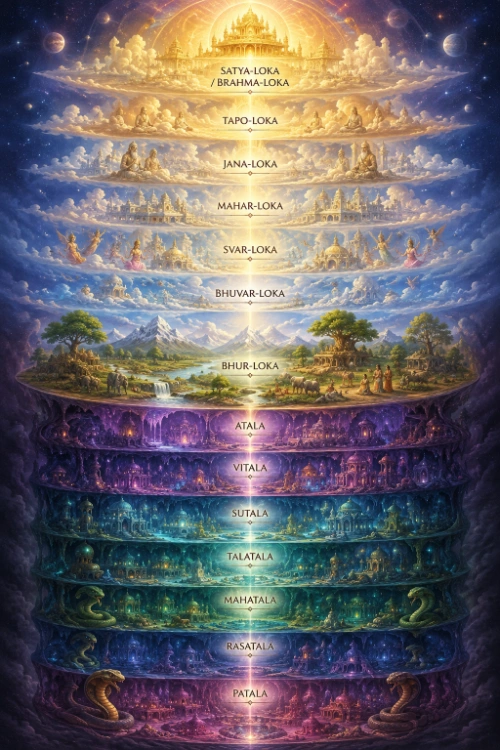
The Fourteen Lokas: The Worlds of the Purāṇic Universe
The classical Purāṇic universe is commonly described as consisting of fourteen principal lokas, or realms of existence. Seven form an ascending hierarchy beginning with the terrestrial world and culminating in Satya-loka, the world of Brahmā; seven more extend beneath the terrestrial sphere as vast subterranean realms inhabited by Daityas, Dānavas, Nāgas and other extraordinary beings. But the scheme is older, stranger and more deliberately constructed than the familiar diagram suggests — and the texts that transmit it do not all transmit the same list.
The seven ascending and seven subterranean realms of the brahmāṇḍa.
The basic arrangement is:
SATYA — TAPA — JANA — MAHAR — SVAR — BHUVAR — BHŪR
──────────────── terrestrial threshold ────────────────
ATALA — VITALA — SUTALA — TALĀTALA — MAHĀTALA — RASĀTALA — PĀTĀLA
This structure occurs in several Purāṇic sources and is described especially clearly in the Śrīmad-Bhāgavatam and the Viṣṇu Purāṇa. Yet the familiar formula “seven worlds above and seven worlds below” requires qualification. Bhūr-loka is itself the terrestrial baseline: it is counted as the lowest of the seven higher lokas, while Atala begins the seven subterranean levels beneath it. The system is therefore better understood as a fourteen-tier hierarchy with Bhūr situated at the boundary between the ascending and descending regions — not as two sevens stacked around an unnumbered earth.
Even more importantly, the hierarchy is cosmographical, not simply moral. Higher does not automatically mean spiritually superior, and lower does not mean evil or hellish. Svarga is high but remains a temporary realm of karmic enjoyment; Sutala is below the earth yet is sanctified by the presence of the great devotee Bali Mahārāja and by Viṣṇu Himself. To read the fourteen lokas properly one must keep three things apart: cosmic location, karmic condition, and spiritual realisation.
Before the Fourteen: Three Worlds and Seven Utterances
The fourteen-loka scheme is not Vedic. It is the end point of a long development whose earlier stages are still visible in the texts, and knowing that development explains several features of the finished system that otherwise look arbitrary.
The Ṛgveda knows a threefold cosmos — pṛthivī, antarikṣa and dyaus — and also, remarkably, a triplicated one, three earths and three heavens:
त्रिरन्तरिक्षं सविता महित्वना
त्री रजांसि परिभुस्त्रीणि रोचना ।
तिस्रो दिवः पृथिवीस्तिस्र इन्वति
त्रिभिर्व्रतैरभि नो रक्षति त्मना ॥
trir antarikṣaṁ savitā mahitvanā
trī rajāṁsi paribhus trīṇi rocanā |
tisro divaḥ pṛthivīs tisra invati
tribhir vratair abhi no rakṣati tmanā ||
“Thrice does Savitṛ by his greatness encompass the mid-region, the three realms, the three luminous spheres; three heavens and three earths he pervades; by three ordinances he protects us of himself.” — Ṛgveda 4.53.5
That nine-fold division was not what the Purāṇas inherited. The Purāṇic seven descends instead from a ritual formula: the vyāhṛtis, the three great utterances that precede the Gāyatrī. The Chāndogya Upaniṣad derives them from Prajāpati’s brooding on the worlds themselves:
प्रजापतिर्लोकानभ्यतपत् ।
तेभ्योऽभितप्तेभ्यस्त्रयी विद्या सम्प्रास्रवत् ।
तामभ्यतपत् । तस्या अभितप्ताया एतान्यक्षराणि
सम्प्रास्रवन्त भूर्भुवः स्वरिति ॥
prajāpatir lokān abhyatapat tebhyo ’bhitaptebhyas trayī vidyā samprāsravat tām abhyatapat tasyā abhitaptāyā etāny akṣarāṇi samprāsravanta bhūr bhuvaḥ svar iti
“Prajāpati brooded upon the worlds; from them, so brooded upon, issued the threefold knowledge. He brooded upon that; from it, so brooded upon, issued these syllables: bhūr, bhuvaḥ, svar.” — Chāndogya Upaniṣad 2.23.2
A fourth is then added — and the way it is added matters enormously for how the finished scheme should be read:
भूर्भुवः सुवरिति वा एतास्तिस्रो व्याहृतयः ।
तासामु ह स्मैतां चतुर्थीं माहाचमस्यः प्रवेदयते मह इति ।
तद्ब्रह्म । स आत्मा । अङ्गान्यन्या देवताः …
bhūr bhuvaḥ suvar iti vā etās tisro vyāhṛtayaḥ |
tāsām u ha smaitāṁ caturthīṁ māhācamasyaḥ pravedayate maha iti |
tad brahma | sa ātmā | aṅgāny anyā devatāḥ …
“Bhūr, bhuvaḥ, suvar — these are the three utterances. A fourth of them, mahaḥ, the son of Mahācamasa made known. That is Brahman, that is the Self; the other gods are its limbs …” — Taittirīya Upaniṣad 1.5.1, opening; the passage continues with the fourfold identifications of the four utterances.
Notice what mahaḥ is in this passage. It is not a fourth storey above the third. It is the integrating term — Brahman and Ātman, of which the other three are limbs — and it is successively identified with the sun, the moon, the Veda and food. The Purāṇic Mahar-loka, a definite region ten million yojanas above Dhruva that empties out at the end of Brahmā’s day, is a later reification of that meditative equation into a place. The odd status of Mahar in the finished scheme — neither perishable like the three below nor durable like the three above — is the fossil of its origin as the term that stands outside the series.
The seven as a fixed set appear only in the latest stratum of the Vedic corpus, in the Māhānārāyaṇa Upaniṣad, which forms the last book of the Taittirīya Āraṇyaka:
ॐ भूः । ॐ भुवः । ॐ सुवः । ॐ महः ।
ॐ जनः । ॐ तपः । ॐ सत्यम् ॥
oṁ bhūḥ | oṁ bhuvaḥ | oṁ suvaḥ | oṁ mahaḥ |
oṁ janaḥ | oṁ tapaḥ | oṁ satyam ||
The seven vyāhṛtis, prefixed to the Gāyatrī in the sapta-vyāhṛti form. — Māhānārāyaṇa Upaniṣad (Taittirīya Āraṇyaka, final book); anuvāka numbering varies between the Āndhra, Drāviḍa and Atharvan recensions.
In the classical sandhyā-vandana the formula is still threefold. Manu states the rule plainly — the syllable oṁ and the Sāvitrī verse, “preceded by the vyāhṛtis,” recited at both twilights, and the three imperishable mahāvyāhṛtis, preceded by oṁkāra and joined to the three-footed Sāvitrī, are to be known as brahmaṇo mukham, the mouth or portal of Brahman (Manu-smṛti 2.78, 2.81). The seven belong to later paddhati practice, where each utterance receives its own ṛṣi, metre, deity and a locus on the reciter’s body, from the feet upward to the head.
That last detail is worth holding on to. The seven upward worlds were mapped onto a human body, foot to crown, in liturgical practice before they were ever mapped onto the cosmos as a stack of regions. As we shall see, the Bhāgavata does exactly the same thing — and does it twice, before it ever offers the fourteen as a survey.
What Does Loka Mean?
The Sanskrit word loka does not mean “planet” in the modern astronomical sense. Its Vedic sense is closer to free space, room, a place secured — the room one wins by ritual action — and only afterwards does it settle into “world.” It can signify a world, a realm, a sphere, a domain, an inhabited region, or a plane of existence. Purāṇic cosmology also uses bhuvana, maṇḍala, antarikṣa, vivara and bila, each describing a different kind of cosmic region, and the choice of word is rarely accidental.
This becomes particularly clear in the description of the subterranean worlds, which the Bhāgavata does not call lokas at all in its opening formula:
सप्त भूविवराः
sapta bhū-vivarāḥ
“the seven cavities of the earth” — Śrīmad-Bhāgavatam 5.24.7
Translating every loka as a physical globe orbiting through astronomical space is therefore misleading. Purāṇic cosmology presents an integrated sacred universe in which space, consciousness, karma, embodied beings, time and divine government are inseparable dimensions of a single description.
The Scheme Is First Given as a Meditation
Before the Bhāgavata ever describes the fourteen worlds as a landscape, it gives them twice as a body — as an object of concentration for a mind not yet capable of anything subtler. In the Second Canto, Śukadeva prescribes posture and breath control and then walks the aspirant up the universal form limb by limb: Pātāla at the soles of the feet, Rasātala at the heels and toes, Mahātala at the ankles, Talātala at the shanks, Sutala at the knees, Vitala and Atala at the thighs, the terrestrial sphere at the hips, the sky at the navel, the luminaries at the chest, Mahar at the neck, Janas at the mouth, Tapas at the forehead and Satya-loka at the head (SB 2.1.26–28). He then says why: the aspirant concentrates on this form because within the material world there is nothing beyond it (SB 2.1.38).
And when Śukadeva finally does turn to the geographical survey in the Fifth Canto, he opens it with a disclaimer:
… तस्मात्प्राधान्येनैव भूगोलकविशेषं
नामरूपमानलक्षणतो व्याख्यास्यामः
… tasmāt prādhānyenaiva bhū-golaka-viṣeṣaṁ
nāma-rūpa-māna-lakṣaṇato vyākhyāsyāmaḥ
“No man, not even with the lifespan of a god, can reach by mind or speech the limit of the Lord’s power of illusion. Therefore I shall describe the terrestrial sphere in outline only, by name, form, measure and mark.” — Śrīmad-Bhāgavatam 5.16.4
This is the interpretive key to everything that follows. The Bhāgavata offers the fourteen lokas first as a body-map for meditation, then as a survey explicitly framed as a selection rather than an exhaustive account, and ends the descent not at a floor but at an object of contemplation (SB 5.25.8). Combined with the liturgical practice of mapping the same seven utterances onto the practitioner’s own body, the whole scheme reads as liturgical anatomy projected outward — not as a gazetteer that later failed a scientific test.
The Fourteen Lokas in the Universal Form
The most compressed scriptural presentation occurs in Śrīmad-Bhāgavatam 2.5.38–41, where Brahmā describes the lokas as portions of the Virāṭ-puruṣa, the cosmic form of the Supreme.
भूर्लोकः कल्पितः पद्भ्यां भुवर्लोकोऽस्य नाभितः ।
हृदा स्वर्लोक उरसा महर्लोको महात्मनः ॥
bhūrlokaḥ kalpitaḥ padbhyāṁ
bhuvarloko ’sya nābhitaḥ |
hṛdā svarloka urasā
maharloko mahātmanaḥ ||
“Bhūr-loka is conceived from the feet of that Great One, Bhuvar-loka from His navel, Svar-loka by the heart, Mahar-loka by the chest.” — Śrīmad-Bhāgavatam 2.5.38
The verb is kalpitaḥ — conceived, constructed, imagined into place. It is doing a great deal of work, and translations that render it simply as “is situated” quietly discard the very point the verse is making. Note also that the Sanskrit distinguishes hṛdā (by the heart) from urasā (by the chest); English versions that merge both into “the chest” lose the distinction between Svar and Mahar.
ग्रीवायां जनलोकोऽस्य तपोलोकः स्तनद्वयात् ।
मूर्धभिः सत्यलोकस्तु ब्रह्मलोकः सनातनः ॥
grīvāyāṁ janaloko ’sya
tapolokaḥ stana-dvayāt |
mūrdhabhiḥ satyalokas tu
brahmalokaḥ sanātanaḥ ||
“Jana-loka at His neck, Tapo-loka from His two breasts, Satya-loka at His heads — and the eternal Brahma-loka.” — Śrīmad-Bhāgavatam 2.5.39
A genuine textual puzzle sits in this verse and is worth naming rather than smoothing over. The neck (grīvā) is anatomically above the breasts (stana-dvaya), yet the verse assigns Jana to the neck and Tapa to the breasts — inverting the ascending order. There is a second tension: 2.5.38 has already given the chest (urasā) to Mahar. Viśvanātha Cakravartī addresses it directly in his Sārārtha-darśinī, remarking that for the purpose of worship it is no fault to reverse the limbs, and that stana can also be taken to mean the lips. English translations more often harmonise the difficulty away by grouping “from the chest up to the neck” as a single band. The honest reading is that the anatomical sequence is approximate because the passage is a meditation aid, not a diagram.
तत्कट्यां चातलं क्लृप्तमूरुभ्यां वितलं विभोः ।
जानुभ्यां सुतलं शुद्धं जङ्घाभ्यां तु तलातलम् ॥
महातलं तु गुल्फाभ्यां प्रपदाभ्यां रसातलम् ।
पातालं पादतलत इति लोकमयः पुमान् ॥
tat-kaṭyāṁ cātalaṁ kḷptam
ūrubhyāṁ vitalaṁ vibhoḥ |
jānubhyāṁ sutalaṁ śuddhaṁ
jaṅghābhyāṁ tu talātalam ||
mahātalaṁ tu gulphābhyāṁ
prapadābhyāṁ rasātalam |
pātālaṁ pāda-talata
iti lokamayaḥ pumān ||
“Atala is conceived at His waist, Vitala at the thighs of the all-pervading One, pure Sutala at the knees, Talātala at the shanks, Mahātala at the ankles, Rasātala at the insteps, Pātāla at the soles of the feet — such is the Person composed of worlds.” — Śrīmad-Bhāgavatam 2.5.40–41
A single adjective in that passage does more to correct popular misunderstanding than any amount of commentary:
सुतलं शुद्धम्
sutalaṁ śuddham
“pure Sutala” — Śrīmad-Bhāgavatam 2.5.40
A little further on, the same chapter offers an entirely different reckoning — and flags it as such:
भूर्लोकः कल्पितः पद्भ्यां भुवर्लोकोऽस्य नाभितः ।
स्वर्लोकः कल्पितो मूर्ध्ना इति वा लोककल्पना ॥
bhūrlokaḥ kalpitaḥ padbhyāṁ
bhuvarloko ’sya nābhitaḥ |
svarlokaḥ kalpito mūrdhnā
iti vā loka-kalpanā ||
“Bhūr-loka is conceived from the feet, Bhuvar-loka from the navel, Svar-loka from the head — or thus is the imagining of the worlds.” — Śrīmad-Bhāgavatam 2.5.42
The first two lines are identical to 2.5.38 word for word; only the second half diverges. The iti vā, “or thus,” explicitly presents a threefold division as an alternative to the sevenfold one just given — the ancient tri-loka of the three vyāhṛtis standing beside the expanded scheme in the same breath. The Bhāgavata is not embarrassed by having two answers. Because the verse shares half its wording with 2.5.38, the two are easily confused in citation; they are separate verses making separate points.
The Seven Higher Lokas
Bhūr-loka — भूर्लोक
Bhūr-loka is the terrestrial realm, containing the inhabited earthly world with its continents, oceans, rivers and mountains. The Viṣṇu Purāṇa gives a concise definition:
पादगम्यं तु यत्किञ्चिद्वस्त्वस्ति पृथिवीमयम् ।
स भूर्लोकः समाख्यातो विस्तरोऽस्य मयोदितः ॥
pāda-gamyaṁ tu yat kiñcid
vastv asti pṛthivī-mayam |
sa bhūrlokaḥ samākhyāto
vistaro ’sya mayoditaḥ ||
“Whatever consists of earth and can be traversed on foot is designated Bhūr-loka; its extent I have already described.” — Viṣṇu Purāṇa 2.7.16
Bhūr-loka should nevertheless not be reduced to the modern planet Earth. Purāṇic geography distinguishes four related terms that overlap without being identical, and confusing them produces most of the muddle in popular accounts:
The Bhāgavata states the last point without qualification:
तत्रापि भारतमेव वर्षं कर्मक्षेत्रमन्यान्यष्ट
वर्षाणि स्वर्गिणां पुण्यशेषोपभोगस्थानानि
भौमानि स्वर्गपदानि व्यपदिशन्ति
tatrāpi bhāratam eva varṣaṁ karma-kṣetram
anyāny aṣṭa varṣāṇi svargiṇāṁ
puṇya-śeṣopabhoga-sthānāni bhaumāni
svarga-padāni vyapadiśanti ||
“Among these, Bhārata-varṣa alone is the field of action; the other eight regions are declared to be earthly heavens, places where those descending from the celestial worlds enjoy the residue of their merit.” — Śrīmad-Bhāgavatam 5.17.11
The Viṣṇu Purāṇa makes the same distinction with the technical term:
अत्रापि भारतं श्रेष्ठं जम्बूद्वीपे महामुने ।
यतो हि कर्मभूरेषा ह्यतोऽन्या भोगभूमयः ॥
atrāpi bhārataṁ śreṣṭhaṁ
jambū-dvīpe mahāmune |
yato hi karma-bhūr eṣā
hy ato ’nyā bhoga-bhūmayaḥ ||
“Within Jambūdvīpa, Bhārata is the best, O great sage, for this is the land of action, while the others are lands of enjoyment.” — Viṣṇu Purāṇa 2.3.22; cf. 2.3.2, karma-bhūmir iyaṁ svargam apavargaṁ ca gacchatām, “this is the field of action for those going to heaven or to liberation.”
The strongest formulation is therefore not that all of Bhūr-loka is equally a karma-bhūmi, but that Bhārata-varṣa within the terrestrial realm is paradigmatically the field of deliberate karmic action. It is worth adding that a verse often cited for this point — ijyā-phalasya bhūr eṣā ijyā cātra pratiṣṭhitā, Viṣṇu Purāṇa 2.7.11 — is in fact the closing summary of that chapter’s account of the vertical extent of the three worlds, saying that the trailokya is the ground on which the fruit of sacrifice is enjoyed. Wilson’s parenthetical gloss “(or in the land of Bhārata)” is a commentator’s note, not the verse’s subject. For Bhārata as karma-bhūmi the correct references are VP 2.3.2, 2.3.5 and 2.3.22–23.
This is why human birth is treated as extraordinarily significant. Although Bhūr stands low in the vertical cosmography, it offers opportunities for dharma, yajña, tapas, yoga, jñāna and bhakti that may lead beyond the entire material cosmos. The Bhāgavata pushes the inversion to its limit: a short life in Bhārata-varṣa is preferable to a life in Brahma-loka, because here devotion can be completed in a single lifetime (SB 5.19.23), and the demigods themselves pray to be born as human beings in it (SB 5.19.21, 5.19.28). The cosmography is built so that its own soteriology can turn it upside down: the smallest and lowest patch of the map is the only one that finally matters.
Bhuvar-loka — भुवर्लोक
Bhuvar-loka is the intermediate cosmic region, closely associated with antarikṣa, the space between the terrestrial world and the celestial sphere. The Viṣṇu Purāṇa defines it by its boundaries:
भूमिसूर्यान्तरं यच्च सिद्धादिमुनिसेवितम् ।
भुवर्लोकस्तु सोऽप्युक्तो द्वितीयो मुनिसत्तम ॥
bhūmi-sūryāntaraṁ yac ca
siddhādi-muni-sevitam |
bhuvarlokas tu so ’py ukto
dvitīyo muni-sattama ||
“The region between the earth and the sun, frequented by the Siddhas and other sages, is called Bhuvar-loka, the second, O best of sages.” — Viṣṇu Purāṇa 2.7.17
That interval is given as a lakh of yojanas (VP 2.7.5). Other Purāṇic descriptions populate the broader atmospheric and celestial intermediary region with Siddhas, Cāraṇas, Vidyādharas, Yakṣas, Rākṣasas and Piśācas. Bhuvar should therefore not be imagined as empty outer space. In the Purāṇic universe it is a populated intermediary domain with its own orders of beings and its own subtle environments.
Svar-loka / Svarga — स्वर्लोक / स्वर्ग
Svar is the great celestial sphere above Bhuvar, and the Viṣṇu Purāṇa again defines it as an interval rather than a body:
ध्रुवसूर्यान्तरं यच्च नियुतानि चतुर्दश ।
स्वर्लोकः सोऽपि गदितो लोकसंस्थानचिन्तकैः ॥
dhruva-sūryāntaraṁ yac ca
niyutāni caturdaśa |
svarlokaḥ so ’pi gadito
loka-saṁsthāna-cintakaiḥ ||
“The interval between the sun and Dhruva, fourteen niyutas [1,400,000 yojanas], is what those who ponder the arrangement of the worlds call Svar-loka.” — Viṣṇu Purāṇa 2.7.18
Svar and Svarga are often used interchangeably in popular descriptions, but they need not be exact synonyms. Svar can denote the broader celestial region, while Svarga — especially Indra’s Svarga — refers more specifically to the celebrated heaven of the devas within that order. Here dwell or operate the devas, Gandharvas, Apsarases and numerous other celestial beings.
Svarga is characterised by extraordinary longevity, beauty, refined pleasure, celestial gardens, music and prosperity. Yet these are the fruits of puṇya, accumulated merit — karmic reward, not liberation. A being who reaches heaven through meritorious action eventually exhausts the karma that sustains that existence and re-enters the changing cycle of saṁsāra. Kṛṣṇa states the mechanism directly in the Gītā: having enjoyed the vast heavenly world, when their merit is spent they enter the mortal world again, and so, following the threefold ritual law and desiring desires, they obtain gatāgatam — going and returning (Bhagavad-gītā 9.20–21).
Mahar-loka — महर्लोक
Above the ordinary celestial worlds lies Mahar-loka, whose inhabitants remain throughout a full kalpa, one day of Brahmā. The Bhāgavata names Bhṛgu among them — and the grammar is worth noticing:
त्रिलोक्यां दह्यमानायां शक्त्या सङ्कर्षणाग्निना ।
यान्त्यूष्मणा महर्लोकाज्जनं भृग्वादयोऽर्दिताः ॥
tri-lokyāṁ dahyamānāyāṁ
śaktyā saṅkarṣaṇāgninā |
yānty ūṣmaṇā maharlokāj
janaṁ bhṛgv-ādayo ’rditāḥ ||
“When the three worlds are burning by the fire of Saṅkarṣaṇa’s potency, Bhṛgu and the others, distressed by the heat, go from Mahar-loka to Jana.” — Śrīmad-Bhāgavatam 3.11.30
Bhṛgv-ādayaḥ means “Bhṛgu and the rest” — he names a class by its first member. Bhṛgu is the standard exemplar of Mahar-loka’s residents, the patriarchs whose lifespan is exactly one day of Brahmā, which is precisely why they must relocate at each of Brahmā’s nights. He is not its proprietor.
The Viṣṇu Purāṇa gives Mahar its distinctive intermediate status, and does so in two consecutive verses that are usually quoted only in half. First the classification:
त्रैलोक्यमेतत्कृतकं मैत्रेय परिपठ्यते ।
जनस्तपस्तथा सत्यमिति चाकृतकं त्रयम् ॥
trailokyam etat kṛtakaṁ
maitreya paripaṭhyate |
janas tapas tathā satyam
iti cākṛtakaṁ trayam ||
“These three worlds are recited as kṛtaka, made; Jana, Tapas and Satya are the three called akṛtaka, unmade.” — Viṣṇu Purāṇa 2.7.19
And then Mahar between them:
कृतकाकृतयोर्मध्ये महर्लोक इति स्मृतः ।
शून्यो भवति कल्पान्ते योऽत्यन्तं न विनश्यति ॥
kṛtakākṛtayor madhye
maharloka iti smṛtaḥ |
śūnyo bhavati kalpānte
yo ’tyantaṁ na vinaśyati ||
“Between the made and the unmade stands what is remembered as Mahar-loka: at the end of the kalpa it becomes empty, yet it is not utterly destroyed.” — Viṣṇu Purāṇa 2.7.20
The seven upper worlds are therefore not a flat ladder. They are three plus one plus three — and that articulation maps exactly onto the history traced above, in which three vyāhṛtis came first, a fourth was added as the term standing outside the series, and three more were appended afterwards.
Jana-loka — जनलोक
Jana-loka is a realm of extraordinarily elevated sages, which the Viṣṇu Purāṇa associates with Brahmā’s pure-minded sons:
द्वे कोटी तु जनो लोको यत्र ते ब्रह्मणः सुताः ।
सनन्दनाद्याः प्रथिता मैत्रेयामलचेतसः ॥
dve koṭī tu jano loko
yatra te brahmaṇaḥ sutāḥ |
sanandanādyāḥ prathitā
maitreyāmala-cetasaḥ ||
“Two koṭis [higher] is Jana-loka, where dwell those renowned pure-minded sons of Brahmā beginning with Sanandana, O Maitreya.” — Viṣṇu Purāṇa 2.7.13
These are the Kumāras — Sanaka, Sanandana, Sanātana and Sanat-kumāra. Jana-loka is also the refuge to which the residents of Mahar ascend during Brahmā’s night. Its defining character is therefore very different from Svarga: not celestial sensual enjoyment, but jñāna, contemplation and purity.
Tapo-loka — तपोलोक
The name comes from tapas — austerity, ascetic discipline, spiritual heat and concentrated power.
चतुर्गुणोत्तरे चोर्ध्वं जनलोकात्तपः स्थितः ।
वैराजा यत्र ते देवाः स्थिता दाहविवर्जिताः ॥
catur-guṇottare cordhvaṁ
janalokāt tapaḥ sthitaḥ |
vairājā yatra te devāḥ
sthitā dāha-vivarjitāḥ ||
“Four times higher, above Jana-loka, stands Tapas, where those gods called Vairājas abide, untouched by burning.” — Viṣṇu Purāṇa 2.7.14
The progression through the upper worlds is therefore not a sequence of increasingly luxurious heavens. Svar is dominated by celestial enjoyment; Mahar by the long-lived ṛṣis; Jana by contemplation; Tapa by austerity and purity. The higher the cosmography rises, the less its defining principle is ordinary karmic pleasure.
Satya-loka / Brahmā’s World — सत्यलोक / ब्रह्मलोक
षड्गुणेन तपोलोकात्सत्यलोको विराजते ।
अपुनर्मारका यत्र ब्रह्मलोको हि संस्मृतः ॥
ṣaḍ-guṇena tapolokāt
satyaloko virājate |
apunar-mārakā yatra
brahmaloko hi saṁsmṛtaḥ ||
“Six times [higher] than Tapo-loka, Satya-loka shines, where dwell those who do not die again; it is indeed remembered as Brahma-loka.” — Viṣṇu Purāṇa 2.7.15
Satya-loka is the summit of the ordinary material fourteen-loka hierarchy, and its inhabitants possess an almost inconceivable longevity — the verse describes them in language approaching freedom from death. Yet this should not be confused with absolute metaphysical eternity. Satya-loka still belongs to the material brahmāṇḍa. The Bhagavad-gītā gives the decisive principle:
आब्रह्मभुवनाल्लोकाः पुनरावर्तिनोऽर्जुन ।
मामुपेत्य तु कौन्तेय पुनर्जन्म न विद्यते ॥
ā-brahma-bhuvanāl lokāḥ
punar āvartino ’rjuna |
mām upetya tu kaunteya
punar janma na vidyate ||
“From Brahmā’s world downward, the worlds are subject to return, O Arjuna; but having come to Me, O son of Kuntī, there is no rebirth.” — Bhagavad-gītā 8.16
The commentators are unanimous that the prefix ā- is inclusive rather than exclusive. Śaṅkara glosses it saha brahma-bhuvanena, “together with Brahmā’s world”; Madhusūdana specifies the grammar, abhividhau ā-kāraḥ. Rāmānuja is the most useful of all for a cosmology article, describing these worlds as brahmāṇḍodara-vartinaḥ — “lying within the belly of the cosmic egg.” Brahmā’s world is not the boundary case; it is squarely inside.
How Far Is Each World?
The Viṣṇu Purāṇa gives the vertical structure as a chain of intervals, each stated relative to the one before:
Three cautions. First, the last two figures are not straightforward. The verses give bare multipliers, catur-guṇa and ṣaḍ-guṇa, without stating what they multiply, and the base was already disputed in antiquity. Wilson computes both against the two-koṭi Mahar–Jana interval, giving eight and twelve; the Agni Purāṇa’s redactor, copying the same passage, arrives at eight and ninety-six. Any figure above Mahar-loka is therefore a reading, not a datum. Second, these figures belong to the Viṣṇu Purāṇa. The Bhāgavata’s own chain (SB 5.22–23) differs at several points and gives no yojana measurements at all for Mahar, Jana, Tapa and Satya; the koṭi figures often quoted “from the Bhāgavata” in fact come to it through the commentators from the Viṣṇu Purāṇa. Third, Wilson’s widely reproduced translation puts 250,000 yojanas between Jupiter and Saturn, where both the vulgate and the critical edition read dvilakṣe, 200,000 — his figure breaks the chapter’s own total of fourteen lakhs.
An Important Distinction: Two Uses of “Brahmaloka”
The word Brahmaloka does not have the same referent in every passage. In Viṣṇu Purāṇa 2.7.15 it clearly means Satya-loka, the material world of Brahmā. But Śrīmad-Bhāgavatam 2.5.39 ends with the phrase brahmalokaḥ sanātanaḥ, “the eternal Brahmaloka,” and the commentators take that adjective as marking a different referent altogether. Śrīdhara Svāmī glosses:
ब्रह्मलोको वैकुण्ठाख्यः सनातनो नित्यः ।
न तु सृज्यप्रपञ्चान्तर्वर्ती ।
brahma-loko vaikuṇṭhākhyaḥ sanātano nityaḥ |
na tu sṛjya-prapañcāntarvartī |
“The Brahma-loka [here] is the one named Vaikuṇṭha; sanātana means eternal — it is not something lying within the created cosmos.” — Śrīdhara Svāmī, Bhāvārtha-dīpikā on SB 2.5.39
Jīva Gosvāmī quotes that gloss verbatim in the Bhagavat-sandarbha, where he adduces the verse under the heading nityatvam — the eternality of Vaikuṇṭha — and adds his own etymological note, brahma-bhūto loko brahma-lokaḥ, “Brahma-loka is the world that is Brahman.” Viśvanātha Cakravartī follows the same reading in the Sārārtha-darśinī, adding an argument of his own: Vaikuṇṭha is excluded from the meditation on the universal form precisely because it is eternal, and so cannot be a limb of a form that is being imagined.
One point of precision often lost in retellings: Śrīdhara Svāmī is not a Gauḍīya commentator. He flourished roughly a century and a half before Caitanya, and is conventionally classed as an advaita-leaning Vaiṣṇava whom the Gauḍīyas received as an authority rather than counted as one of their own. Jīva addresses the question directly in the Tattva-sandarbha. He calls Śrīdhara parama-vaiṣṇava and takes him as his guide; but he describes his writing as karburita-lipi, “variegated” with advaita phrasing deliberately adopted to draw the advaita-vādins of Madhya-deśa into the Lord’s glories, and undertakes to follow him only where he accords with pure Vaiṣṇava siddhānta. The reverence and the reservation are both his. It should also be noted that advaitins read the same gloss in their own way, taking Śrīdhara’s “Vaikuṇṭha” as the state of liberation rather than as a Vaiṣṇava dhāman. The bare words support both; the Gauḍīya use of them is nonetheless entirely well founded.
Thus Brahmaloka can mean Brahmā’s Satya-loka in one context, while sanātana Brahmaloka designates the eternal spiritual realm in another. Context is essential.
The Seven Lower Lokas
Below Bhūr-loka lie the seven subterranean realms. The Bhāgavata introduces them by name and by measure:
उपवर्णितं भूमेर्यथासन्निवेशावस्थानम्
अवनेरप्यधस्तात्सप्त भूविवरा एकैकशो
योजनायुतान्तरेणायामविस्तारेणोपक्लृप्ता
अतलं वितलं सुतलं तलातलं
महातलं रसातलं पातालमिति ॥
upavarṇitaṁ bhūmer yathā-sanniveśāvasthānam
avaner apy adhastāt sapta bhū-vivarā ekaikaśo
yojanāyutāntareṇāyāma-vistāreṇopakḷptā
atalaṁ vitalaṁ sutalaṁ talātalaṁ
mahātalaṁ rasātalaṁ pātālam iti ||
“The situation and arrangement of the earth has been described. Beneath it are the seven cavities, arranged one after another at intervals of ten thousand yojanas, equal in length and breadth [to the earth]: Atala, Vitala, Sutala, Talātala, Mahātala, Rasātala and Pātāla.” — Śrīmad-Bhāgavatam 5.24.7
The ten thousand yojanas in this compound is the interval (antara) between one region and the next; the extent of each is given as equal to that of the earth. The two figures are often conflated into “ten thousand yojanas across and ten thousand apart,” which the Sanskrit does not say.
The Lower Lokas Are Not the Narakas
This is the single most important misconception to correct. The seven lower lokas are not seven hells. The Bhāgavata has a name for them, and it is not naraka:
एतेषु हि बिलस्वर्गेषु
eteṣu hi bila-svargeṣu
“in these subterranean heavens” — Śrīmad-Bhāgavatam 5.24.8
And its description is astonishing:
eteṣu hi bila-svargeṣu svargād apy adhika-kāma-bhogaiśvaryānanda-bhūti-vibhūtibhiḥ susamṛddha-bhavanodyānākrīḍa-vihāreṣu daitya-dānava-kādraveyā nitya-pramuditānurakta-kalatrāpatya-bandhu-suhṛd-anucarā gṛha-pataya īśvarād apy apratihata-kāmā māyā-vinodā nivasanti
“In these subterranean heavens dwell the Daityas, Dānavas and Kādraveyas — householders whose wives, children, kinsmen, friends and attendants are ever delighted and devoted; who live amid opulent mansions, gardens and pleasure grounds furnished with a greater measure of desire, enjoyment, dominion, delight, prosperity and splendour than Svarga itself; whose desires are unobstructed even beyond those of the lord of heaven, and who divert themselves with illusions.” — Śrīmad-Bhāgavatam 5.24.8
These regions contain magnificent cities, mansions, ramparts, gateways, assembly halls, shrines, courtyards and artificial landscapes, all built by Maya Dānava, the master architect of Purāṇic literature (SB 5.24.9), ornamented with jewels of the choicest kind and thronged with nāgas and asuras, pigeons, parrots and mynas.
There are no divisions of day and night there, and consequently no fear born of time (SB 5.24.11); the darkness of those hollows is dispelled instead by the great gems set upon the hoods of the serpents (SB 5.24.12); and their inhabitants, sustained by herbal elixirs, know neither disease, greying hair, wrinkles, fatigue nor ill odour (SB 5.24.13). The Viṣṇu Purāṇa, describing the same regions through the mouth of Nārada, adds a memorable detail of its own: the rays of the sun there give light without heat by day, and the moon shines for illumination without cold by night, so that the inhabitants do not notice time passing at all (VP 2.5.5–9). Nārada, returning from Pātāla to the assembly of the gods, is said to have declared the subterranean worlds lovelier than Svarga.
Yet one power remains unconquered:
न हि तेषां कल्याणानां प्रभवति
कुतश्चन मृत्युर्विना भगवत्तेजसश्चक्रापदेशात् ॥
na hi teṣāṁ kalyāṇānāṁ prabhavati
kutaścana mṛtyur vinā bhagavat-tejasaś cakrāpadeśāt ||
“For those fortunate ones, death from any source whatever has no power — except from the effulgence of the Lord under the designation of the cakra.” — Śrīmad-Bhāgavatam 5.24.14
The theological point is exact, and it is the reason the whole description exists: perfect material comfort is still not immortality.
A Note on Variant Lists
Anyone reading across the Purāṇas quickly discovers that the seven names are not fixed. The Bhāgavata’s list is one of several, and the Viṣṇu Purāṇa — on which this article otherwise leans heavily — gives a demonstrably different one:
अतलं वितलं चैव नितलं च गभस्तिमत् ।
महाख्यं सुतलं चाग्र्यं पातालं चापि सप्तमम् ॥
atalaṁ vitalaṁ caiva
nitalaṁ ca gabhastimat |
mahākhyaṁ sutalaṁ cāgryaṁ
pātālaṁ cāpi saptamam ||
“Atala and Vitala, Nitala and Gabhastimat, that named Mahā[tala], foremost Sutala, and Pātāla as the seventh.” — Viṣṇu Purāṇa 2.5.2
Two names here — nitala and gabhastimat — do not occur in the Bhāgavata at all, and two that do — talātala and rasātala — are absent here. The same list is carried verbatim by the Agni and Garuḍa Purāṇas. Other texts diverge further:
Two observations are worth drawing from this. First, rasātala was originally a general word for the nether region as a whole — that is still its sense in the Mahābhārata, and the Vāyu Purāṇa uses it that way while giving its seven other names. It was later slotted into a fixed position in the series. That is exactly the same move made at the other end of the axis, where mahaḥ — originally the integrating fourth utterance standing outside the series — became Mahar-loka, a definite storey. The scheme grew by turning terms into places at both ends. Second, a caution for readers using Wilson’s translation: his footnote reporting the Vāyu list begins it with rasātala, having taken the generic term of the preceding verse for the first name; the text’s own first member is atala. The Bhāgavata’s list, in short, is authoritative for the Bhāgavata, not for the Purāṇas as a body.
Atala — अतल
अथातले मयपुत्रोऽसुरो बलो निवसति
athātale maya-putro ’suro balo nivasati
“Now in Atala there dwells the asura Bala, the son of Maya.” — Śrīmad-Bhāgavatam 5.24.16
Bala is said to have produced ninety-six varieties of māyā — magical arts — which conjurers still employ. From his mouth, as he yawned, arose three classes of women: svairiṇīs, the independent; kāminīs, the lustful; and puṁścalīs, the wanton. A man who enters that hollow is served by them with a juice called hāṭaka, and, having drunk it, acquires the potency of a magician and sports with them at will. The verse then records the effect:
ईश्वरोऽहं सिद्धोऽहम्
īśvaro ’haṁ siddho ’ham
“I am the lord! I am perfected!” — the boast of the intoxicated man, Śrīmad-Bhāgavatam 5.24.16
The Sanskrit is careful: he conceives himself (ātmānam abhimanyamānaḥ) to possess the strength of ten thousand great elephants, and boasts “like one blinded by intoxication.” The strength is the delusion, not the fact.
The danger of Atala is therefore not torment. It is pleasure so intoxicating that it produces radical self-delusion. Atala embodies one of the central Purāṇic insights into bondage: suffering is not the only thing that binds a being. Pleasure, pride and the illusion of self-sufficiency bind more effectively, because nothing in them prompts the question of escape.
Vitala — वितल
ततोऽधस्ताद्वितले हरो भगवान् हाटकेश्वरः
tato ’dhastād vitale haro bhagavān hāṭakeśvaraḥ
“Below that, in Vitala, is Lord Hara as Hāṭakeśvara.” — Śrīmad-Bhāgavatam 5.24.17
Śiva dwells there surrounded by his own attendants and hosts of bhūtas, united with Bhavānī “for the augmenting of the Prajāpati’s creation.” From that union proceeds the foremost of rivers, named Hāṭakī, born of the vital potency of them both. There Citrabhānu — fire — kindled by Mātariśvan, the wind, drinks that river with force, and what he casts forth is the gold called hāṭaka, from which the men and women of the asura lords’ households fashion their ornaments.
Vitala is therefore associated with an unusual cluster of themes: Śiva, subterranean fire, mysterious substances, gold, abundance, and supernatural transformation. It is worth noting that this nether-world Śiva has a terrestrial double: Hāṭakeśvara is also a pilgrimage site, the area around Vaḍnagar in Gujarat, whose māhātmya is preserved in the Nāgara-khaṇḍa of the Skanda Purāṇa. The cosmographic scheme is repeatedly mapped back onto Indian soil.
The placement is also polemical, and the Bhāgavata knows it. Situating Śiva in the second nether world — and, at the very bottom of the descent, describing Śiva as one who worships Ananta (SB 5.25.1) — is a Vaiṣṇava ordering of the pantheon. The Śaiva Purāṇas reciprocate: the Śiva Purāṇa’s own netherworld chapter drops Mahātala for a bare tala, reorders the series, and uses Vitala as a place of banishment.
Sutala — सुतल
Sutala is theologically the most significant of the seven.
ततोऽधस्तात्सुतले उदारश्रवाः पुण्यश्लोको
विरोचनात्मजो बलिः … तमेव भगवन्तमाराधनीयम्
अपगतसाध्वस आस्तेऽधुनापि
tato ’dhastāt sutale udāra-śravāḥ puṇya-śloko
virocanātmajo baliḥ … tam eva bhagavantam
ārādhanīyam apagata-sādhvasa āste ’dhunāpi
“Below that, in Sutala, is the generous and celebrated Bali, son of Virocana … who, free of all fear, still to this day remains there worshipping that same adorable Lord.” — Śrīmad-Bhāgavatam 5.24.18
Bali is the grandson of Prahlāda and, in the Bhāgavata’s reckoning, one of the twelve mahājanas, the authorities on bhāgavata-dharma (SB 6.3.20–21). During the Vāmana avatāra, Viṣṇu appeared as a dwarf brahmacārī and asked him for three paces of land; with two strides He encompassed everything Bali possessed, leaving nowhere for the third. Bali offered his own head. Because of that surrender the Lord did not merely dispossess him: He granted him Sutala, a realm whose opulence is described as unavailable even to Indra, and promised that in the eighth, Sāvarṇi, manvantara Bali will himself become Indra (SB 8.13.12; 8.22.31).
Most remarkable of all, the Lord took a post at his door:
यस्य भगवान् स्वयमखिलजगद्गुरुर्नारायणो
द्वारि गदापाणिरवतिष्ठते
निजजनानुकम्पितहृदयः
yasya bhagavān svayam akhila-jagad-gurur
nārāyaṇo dvāri gadā-pāṇir avatiṣṭhate
nija-janānukampita-hṛdayo
“At whose door Nārāyaṇa Himself, the guru of all the worlds, stands with club in hand, His heart moved with compassion for His own devotee.” — Śrīmad-Bhāgavatam 5.24.27
The verse ends with a detail that is easy to miss and hard to forget: it was from this doorway that Rāvaṇa, on his campaign of world conquest, was flicked away many thousands of yojanas by a single toe. The Lord’s promise of that permanent presence is given in Canto Eight, spoken to Prahlāda: “There you will constantly see Me, standing with club in hand” (SB 8.23.10; cf. 8.22.35).
The Vāmana narrative itself is not told in this chapter. SB 5.24.18 compresses it into a single participial phrase, and 5.24.27 explicitly defers the account — tasyānucaritam upariṣṭād vistariṣyate, “his deeds will be elaborated later.” The narrative proper occupies Śrīmad-Bhāgavatam 8.15–23. The verses between, 5.24.19–26, are Śukadeva’s discourse on why the Lord withheld liberation while granting opulence.
Sutala therefore overturns any simplistic cosmic morality. Geographically it is lower. Spiritually it is sanctified by one of the tradition’s great devotees and by the personal presence of Viṣṇu. This is why 2.5.40 could call it, without further explanation, sutalaṁ śuddham — pure Sutala.
Talātala — तलातल
ततोऽधस्तात्तलातले मयो नाम दानवेन्द्रस्त्रिपुराधिपतिः …
मायाविनामाचार्यो महादेवेन परिरक्षितो
विगतसुदर्शनभयो महीयते
tato ’dhastāt talātale mayo nāma dānavendras
tri-purādhipatiḥ … māyāvinām ācāryo
mahādevena parirakṣito vigata-sudarśana-bhayo mahīyate
“Below that, in Talātala, the Dānava lord named Maya, master of the three cities … the preceptor of all magicians, protected by Mahādeva and freed from fear of the Sudarśana, is honoured.” — Śrīmad-Bhāgavatam 5.24.28
Maya was lord of the famous three cities, Tripura, burnt by Śiva in His manifestation as Purāri; yet afterwards Śiva was pleased with him, gave him a place, and granted him protection. The closing phrase is pointed: vigata-sudarśana-bhayaḥ, “his fear of the Sudarśana gone” — the one exception, granted through Śiva’s grace, to the rule laid down at 5.24.14 that nothing in these realms escapes the Lord’s disc.
Talātala is consequently associated with architecture, magical technology, illusion and supernatural engineering. Maya should not be reduced to the label “demon architect.” In Purāṇic narrative he represents an entire sophisticated tradition of asuric craftsmanship and māyā — he is māyāvinām ācāryaḥ, the preceptor of a lineage, and it was he who built the assembly hall of the Pāṇḍavas.
Mahātala — महातल
ततोऽधस्तान्महातले काद्रवेयाणां सर्पाणां
नैकशिरसाम्
tato ’dhastān mahātale kādraveyāṇāṁ sarpāṇāṁ
naika-śirasām
“Below that, in Mahātala, of the many-headed serpents descended from Kadrū …” — Śrīmad-Bhāgavatam 5.24.29
Prominent among them are Kuhaka, Takṣaka, Kāliya and Suṣeṇa. Although enormously powerful, these serpent beings live in continual fear of Garuḍa, the carrier of Viṣṇu and traditional enemy of the Nāgas. Yet the text does not portray them as monsters: they are described as living with their wives, offspring, friends and relations, and as sporting freely except when that fear disturbs them. Mahātala is a Nāga household realm — though not the deepest one.
Rasātala — रसातल
Below Mahātala is Rasātala, and its inhabitants are named at once:
दैतेया दानवाः
daiteyā dānavāḥ
“the descendants of Diti and of Danu” — Śrīmad-Bhāgavatam 5.24.30
The distinction is useful and is regularly lost in translation. A Daitya is a descendant of Diti; a Dānava is a descendant of Danu. These are at least partly genealogical categories, not equivalents of the Western theological category “demon.” The Bhāgavata names among them the Paṇis, the Nivāta-kavacas, the Kāleyas and the Hiraṇya-puravāsīs — born enemies of the gods, immensely powerful and ferocious, whose pride in their strength is broken by the effulgence of Hari, so that they live like snakes in holes. They fear Indra, the text adds, on account of the mantra-words spoken by Saramā, Indra’s messenger.
The Bhāgavata calls Saramā only indra-dūtī, Indra’s female messenger — and so, interestingly, does Ṛgveda 10.108, the famous dialogue in which she is sent across the Rasā to the Paṇis to recover the stolen cows: there too she is indrasya dūtīḥ and nothing more. Her familiar identity as a dog comes from elsewhere in the Vedic corpus — the sārameya hounds of ṚV 10.14.10 — and from the commentarial tradition, not from either passage. What is striking is that the Paṇis are standing beside her here in Rasātala: the Purāṇa has preserved the pairing of that ancient hymn intact.
Rasātala is thus primarily an asuric warrior realm, whereas Mahātala is primarily a domain of Nāga families.
Pātāla / Nāga-loka — पाताल / नागलोक
ततोऽधस्तात्पाताले नागलोकपतयो
वासुकिप्रमुखाः
tato ’dhastāt pātāle nāga-loka-patayo
vāsuki-pramukhāḥ
“Below that, in Pātāla, are the lords of Nāga-loka, headed by Vāsuki.” — Śrīmad-Bhāgavatam 5.24.31
Among the great serpent rulers named are Śaṅkha, Kulika, Mahāśaṅkha, Śveta, Dhanañjaya, Dhṛtarāṣṭra, Śaṅkhacūḍa, Kambala, Aśvatara and Devadatta — and the list ends with -ādayaḥ, “and others,” so it is open rather than exhaustive. Some are described as having five, seven or ten hoods; others a hundred, or a thousand. The gems set upon those hoods scatter the mass of darkness in the caverns of Pātāla by their own radiance.
Pātāla therefore appears not as a dark inferno but as a radiant, jewel-filled realm of great Nāga rulers. The casual modern identification of Pātāla with “hell” is consequently very misleading — and the Bhāgavata itself takes trouble to prevent it.
Where Are the Actual Narakas?
The Śrīmad-Bhāgavatam makes the distinction unmistakable through the very architecture of its Fifth Canto. Chapter 24 describes Atala through Pātāla, the bila-svargas. Chapter 25 describes Ananta beneath Pātāla. Only in Chapter 26 does Śukadeva turn to the Narakas — and only because Parīkṣit asks:
नरका नाम भगवन्किं देशविशेषा
अथवा बहिस्त्रिलोक्या आहोस्विदन्तराल इति
narakā nāma bhagavan kiṁ deśa-viśeṣā
athavā bahis tri-lokyā āhosvid antarāla iti
“Those called the Narakas, my lord — are they particular regions, or are they outside the three worlds, or in the intervening space?” — Śrīmad-Bhāgavatam 5.26.4
The question offers three possibilities, and Śukadeva takes the third:
अन्तराल एव त्रिजगत्यास्तु दिशि दक्षिणस्यामधस्ताद्
भूमेरुपरिष्टाच्च जलाद्यस्यामग्निष्वात्तादयः
पितृगणा … निवसन्ति
antarāla eva tri-jagatyās tu diśi dakṣiṇasyām
adhastād bhūmer upariṣṭāc ca jalād
yasyām agniṣvāttādayaḥ pitṛ-gaṇā … nivasanti
“Precisely in the intervening space of the three worlds, in the southern quarter, below the earth and above the water — where the hosts of ancestors headed by the Agniṣvāttas dwell, with supreme concentration desiring true blessings for their own lines.” — Śrīmad-Bhāgavatam 5.26.5
The Narakas are therefore not one of the fourteen. They constitute a distinct zone with its own location, its own population and its own governor — Yamarāja, described in the following verse as administering punishment according to each being’s deeds and never transgressing the Lord’s ordinance (SB 5.26.6). Pātāla is not another name for Naraka; in the Bhāgavata’s cosmography the luxurious subterranean lokas and the punitive Narakas are different categories of region altogether.
And when Śukadeva enumerates them, he does something quietly extraordinary:
तत्र हैके नरकानेकविंशतिं गणयन्ति
tatra haike narakān eka-viṁśatiṁ gaṇayanti
“Here some count the Narakas as twenty-one.” — Śrīmad-Bhāgavatam 5.26.7
He then gives twenty-eight, closing the list with the words ity aṣṭāviṁśatir narakāḥ. The text is openly reporting that the tradition it belongs to did not agree on the number. The twenty-eight are Tāmisra, Andhatāmisra, Raurava, Mahāraurava, Kumbhīpāka, Kālasūtra, Asipatravana, Sūkaramukha, Andhakūpa, Kṛmibhojana, Sandaṁśa, Taptasūrmi, Vajrakaṇṭaka-śālmalī, Vaitaraṇī, Pūyoda, Prāṇarodha, Viśasana, Lālābhakṣa, Sārameyādana, Avīci, Ayaḥpāna, Kṣārakardama, Rakṣogaṇa-bhojana, Śūlaprota, Dandaśūka, Avaṭa-nirodhana, Paryāvartana and Sūcīmukha — each matched to a specific class of act, from theft and the killing of a brāhmaṇa to hunting for sport, hoarding, and the mistreatment of guests or of creatures that came for shelter.
The instability is not confined to the Bhāgavata. Manu-smṛti 4.87–90 gives twenty-one hells; the Viṣṇu Purāṇa 2.6 gives its own list of roughly twenty-eight. Six of Manu’s names recur in the Bhāgavata’s list — Tāmisra, Andhatāmisra, Raurava, Mahāraurava, Kālasūtra and Asipatravana — but only two in the Viṣṇu Purāṇa’s. The number was traditional and comparatively stable; the contents were not. The two great lists also differ in kind: the Viṣṇu Purāṇa’s offences are largely occupational and dharmaśāstric — arrow-makers, weapon-makers, brāhmaṇas who sell forbidden goods, potters who fire unbaked vessels — while the Bhāgavata’s are moral and psychological, turning on violence, appetite and greed. Both chapters end at the same place: remembrance of the Lord is a better expiation than any penance.
What Lies Beneath Pātāla? Ananta
The hierarchy does not stop with the final Nāga realm.
तस्य मूलदेशे त्रिंशद्योजनसहस्रान्तर
आस्ते या वै कला भगवतस्तामसी समाख्यातानन्त
इति सात्वतीया द्रष्टृदृश्ययोः सङ्कर्षणमहमित्य्
अभिमानलक्षणं यं सङ्कर्षणमित्याचक्षते
tasya mūla-deśe triṁśad-yojana-sahasrāntara
āste yā vai kalā bhagavatas tāmasī samākhyātānanta
iti sātvatīyā draṣṭṛ-dṛśyayoḥ saṅkarṣaṇam ity
abhimāna-lakṣaṇaṁ yaṁ saṅkarṣaṇam ity ācakṣate
“At the root region of that [Pātāla], at an interval of thirty thousand yojanas, abides that portion of the Lord called tāmasī, whom the Sātvatas call Ananta; and, since He is characterised as the sense of ‘I’ that draws seer and seen together, they name Him Saṅkarṣaṇa.” — Śrīmad-Bhāgavatam 5.25.1
In the following verse the terrestrial sphere, borne upon a single one of His thousand hoods, is compared to a white mustard seed. At the time of dissolution, when He becomes slightly angry, a three-eyed Rudra bearing a trident emerges from between His brows (SB 5.25.3) — the Śiva-tattva generated from Saṅkarṣaṇa’s wrath. And the chapter closes not with description but with instruction: one who hears of Him from the guru and meditates upon Saṅkarṣaṇa has the knot of material bondage cut at its root (SB 5.25.8).
Structurally this is the hinge of the whole Bhāgavata cosmography, and it is easy to mistake for an interlude. Chapters 16 to 24 descend from Meru to Pātāla; chapter 25 reaches the absolute bottom and finds not a floor but the Lord, and turns immediately into a meditation; only then are the hells appended. The descent is not a survey with a theological postscript. It is an itinerary whose terminus was always the object of dhyāna. The Viṣṇu Purāṇa’s parallel account (2.5.13–27) calls the same figure Śeṣa, describes him bearing the whole earth-circle as a crest-ornament upon his head (2.5.20), and adds a detail the Bhāgavata lacks: it was by propitiating Śeṣa that the ancient sage Garga came to know the stars in their reality (2.5.26) — which makes the serpent at the bottom of the cosmos the first teacher of jyotiṣa.
Ananta is therefore essential to the Purāṇic vertical cosmography, although He is not counted as a fifteenth loka. He is the divine support underlying the material structure itself.
The Lokas and Cosmic Dissolution
The fourteen worlds do not all possess the same degree of permanence. At Brahmā’s night the three worlds beginning with Bhūḥ are obscured:
तमेवान्वपिधीयन्ते लोका भूरादयस्त्रयः ।
निशायामनुवृत्तायां निर्मुक्तशशिभास्करम् ॥
tam evānv api dhīyante
lokā bhūr-ādayas trayaḥ |
niśāyām anuvṛttāyāṁ
nirmukta-śaśi-bhāskaram ||
“When night has fallen and the moon and sun are gone, the three worlds beginning with Bhūḥ are covered over along with it.” — Śrīmad-Bhāgavatam 3.11.29
Fire follows, and the heat of it reaches Mahar-loka, driving Bhṛgu and his companions upward into Jana (3.11.30); then the swollen oceans, their waves lashed by fierce winds, inundate the three worlds (3.11.31). The higher worlds therefore possess progressively greater durability — but only relatively, as the kṛtaka and akṛtaka classification already showed. The Viṣṇu Purāṇa summarises the entire arrangement in a single verse:
एते सप्त मया लोका मैत्रेय कथितास्तव ।
पातालानि च सप्तैव ब्रह्माण्डस्यैष विस्तरः ॥
ete sapta mayā lokā
maitreya kathitās tava |
pātālāni ca saptaiva
brahmāṇḍasyaiṣa vistaraḥ ||
“These seven worlds, Maitreya, and the seven Pātālas too, I have described to you: such is the extent of the brahmāṇḍa.” — Viṣṇu Purāṇa 2.7.21
The Fourteen Are Only the Innermost Layer
That last verse is valuable because it presents the fourteen realms explicitly as the internal structure of the brahmāṇḍa, the cosmic egg. The same chapter goes on to describe what surrounds it — and the picture changes scale dramatically:
The whole is encompassed on every side, above and below, by the shell of Brahmā’s egg, as the seed of a wood-apple is enclosed by its rind. Around the outer surface of that shell flows water, extending ten times the diameter of the world. The waters are encompassed by fire; fire by air; air by mind; mind by ahaṅkāra; and that by intellect — each layer ten times the breadth of the one it encloses. The Bhāgavata gives the same sevenfold envelope, and in almost the same words: etad aṇḍaṁ viśeṣākhyaṁ krama-vṛddhair daśottaraiḥ / toyādibhiḥ parivrṛtam, “this egg called viśeṣa is surrounded by water and the rest, increasing tenfold in order” (SB 3.26.52; cf. 3.11.41).
This is worth pausing over, because it reverses the impression the fourteen-loka diagram gives. Satya-loka is not near the top of anything. The entire fourteen-storey structure, from Pātāla to Brahmā’s own world, is the innermost item in a nested series of seven material coverings, each an order of magnitude greater than the last. Rāmānuja’s phrase for the worlds up to Brahmaloka — brahmāṇḍodara-vartinaḥ, “lying within the belly of the cosmic egg” — is not rhetorical. It is a statement of position.
Cosmic Height Is Not the Same as Spiritual Height
The most important interpretive mistake is to read the fourteen-loka hierarchy as a simple moral ladder, with holiness above and sin below. The texts themselves contradict such a reading at every level.
The hierarchy therefore operates on several axes at once: spatial position, longevity, subtlety, karmic enjoyment, spiritual realisation and relationship with Bhagavān. They are related. They are not identical, and they do not always run in the same direction.
The Real Teaching Is Not Merely “Go Higher”
Purāṇic cosmology might initially appear to invite the reader to ascend from earth toward progressively more magnificent worlds. The Vaiṣṇava conclusion is more radical: the goal is not Satya-loka but the transcendence of the whole structure. Even a being who rises to Brahmā’s extraordinarily exalted realm remains within saṁsāra. The ultimate contrast is therefore not Pātāla against Satya, but the entire material brahmāṇḍa against the eternal spiritual realm.
Wandering Through the Brahmāṇḍa
Centuries after the Purāṇas, Śrī Kṛṣṇadāsa Kavirāja gave the existential meaning of this cosmic hierarchy its most famous formulation, in a single Bengali couplet:
ব্রহ্মাণ্ড ভ্রমিতে কোন ভাগ্যবান্ জীব ।
গুরু-কৃষ্ণ-প্রসাদে পায় ভক্তিলতা-বীজ ॥
brahmāṇḍa bhramite kona bhāgyavān jīva
guru-kṛṣṇa-prasāde pāya bhakti-latā-bīja
“While wandering through the brahmāṇḍa, some fortunate living being, by the grace of guru and Kṛṣṇa, receives the seed of the creeper of bhakti.” — Caitanya-caritāmṛta, Madhya 19.151
The verb is bhramite — to wander, to roam, to be whirled about. The living being does not stand at a fixed point on a cosmic map. Through karma and repeated birth it wanders through the brahmāṇḍa, taking on different bodies, conditions and realms. One may rise. One may descend. One may enjoy Svarga; one may inhabit realms of extraordinary subterranean wealth; one may reach worlds whose lifespans dwarf human imagination. None of it, in itself, addresses the problem.
Bhakti introduces a different trajectory altogether. Instead of asking only how high one can rise within the universe, the devotee asks how to pass beyond it and attain Bhagavān. That is finally why the fourteen-loka cosmology matters within the Vaiṣṇava tradition. It is not merely an ancient map of exotic worlds. It is a map of the entire range of possibilities available within saṁsāra — and therefore a demonstration of the limits of saṁsāra itself.
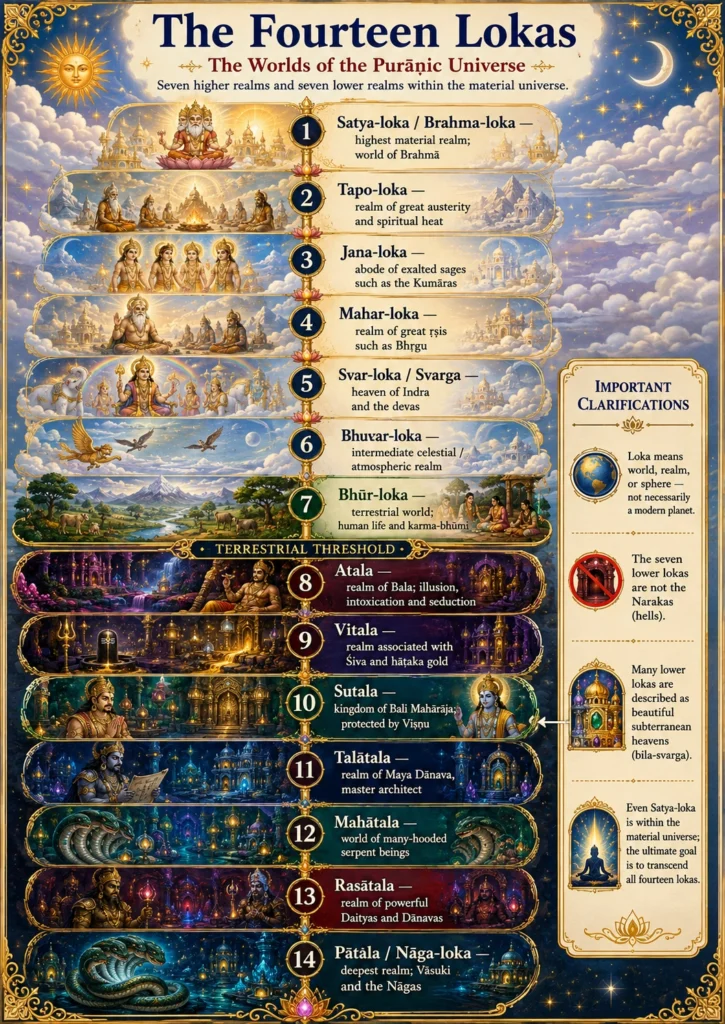
The fourteen realms of the brahmāṇḍa at a glance, with their principal inhabitants.
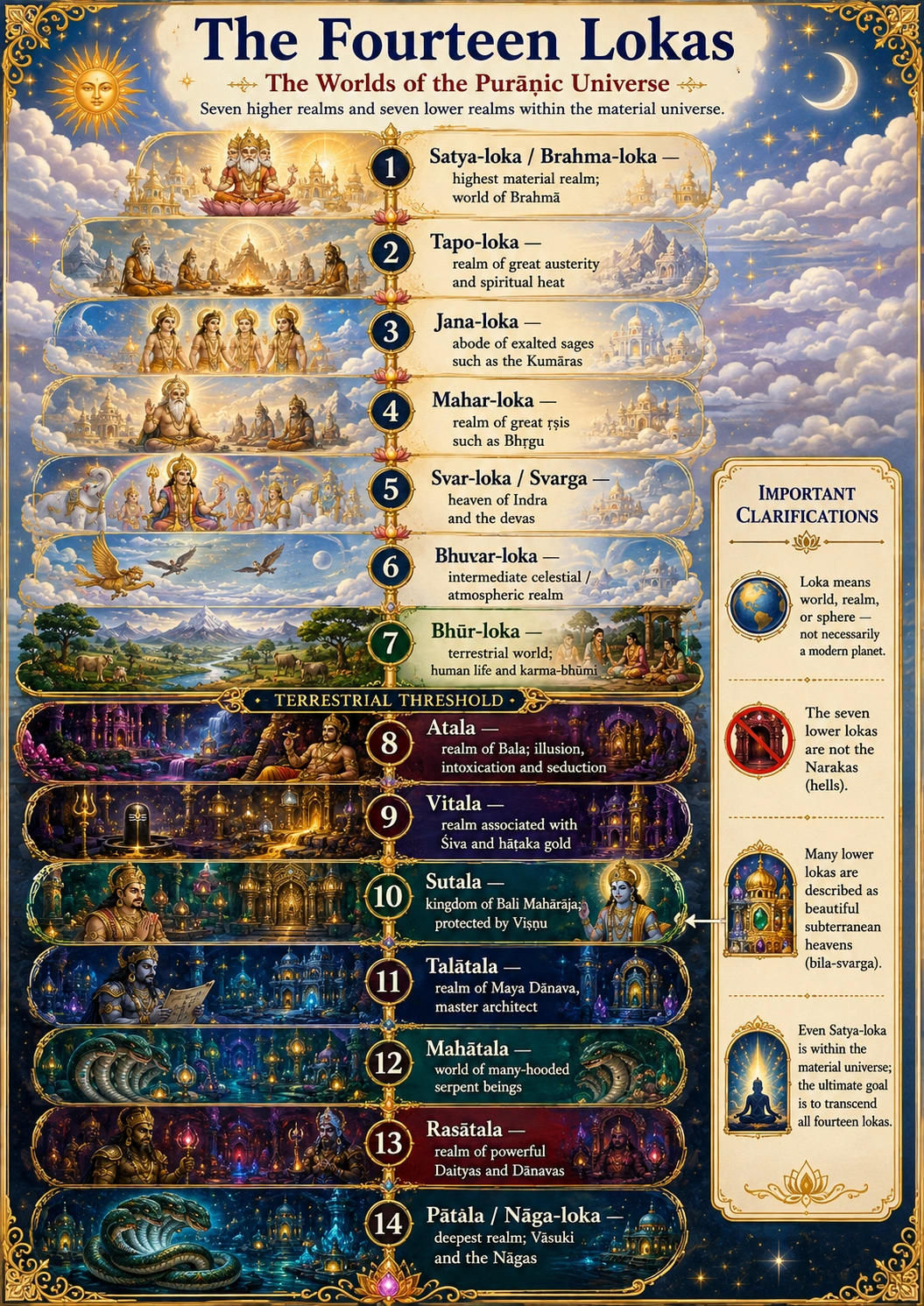
The Fourteen Lokas at a Glance
Seven ascending realms and seven subterranean realms make fourteen principal lokas within the material brahmāṇḍa. That is the simple summary, and it is true as far as it goes. But the Purāṇic universe is not a ladder running from evil below to holiness above. It is a vast hierarchy of material conditions — some of them dazzling, some of them terrible, all of them temporary — assembled over centuries out of ritual utterances, meditative body-maps, older regional cosmographies and narrative necessity, and given twice in the Bhāgavata as an object of concentration before it is ever given as a description. Read that way, its inconsistencies stop being embarrassments and become evidence of what it always was: not a survey of places one might visit, but an instrument for seeing the whole of conditioned existence at once, so as to want something beyond it.
Principal Scriptural Sources
On editions and numbering. Verse numbers for the Viṣṇu Purāṇa follow the vulgate (Veṅkaṭeśvara Press, 1910), which agrees with the Vadodara critical edition and with Wilson’s chapter divisions for Book II, chapters 3, 5 and 7; where the critical edition reads differently the variants are minor (kathitā for prathitā at 2.7.13, smṛtaḥ for sthitaḥ at 2.7.14, yat tu for yac ca at 2.7.17–18). Two slips in Wilson’s widely reproduced translation are worth flagging: his figure of 250,000 leagues between Jupiter and Saturn contradicts dvilakṣe in both editions and breaks the chapter’s own total of fourteen lakhs; and his footnote reporting the Vāyu Purāṇa’s list of nether worlds begins it with rasātala, which in that text is the generic term for the whole group rather than its first member. Readers wanting a scholarly frame for the comparative material will find Willibald Kirfel’s Das Purāṇa vom Weltgebāude (Bonn, 1954) still unsurpassed as a synopsis of the bhuvanakośa chapters, alongside his earlier Die Kosmographie der Inder (1920); Jan Gonda’s Loka: World and Heaven in the Veda (1966) for the word itself; and, from within the tradition, Richard L. Thompson’s Cosmology of the Bhāgavata Purāṇa (2006).