

Gaurāṅga’s Lotus Hands: The Forty-Four Auspicious Marks
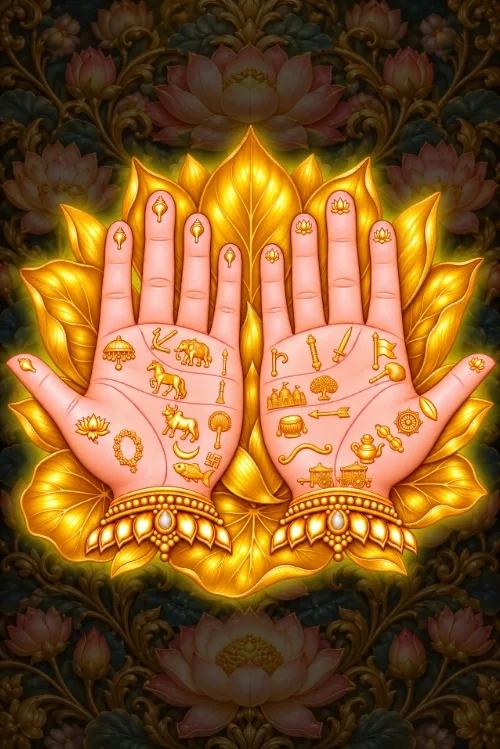
The sacred markings on the hands of Śrī Caitanya Mahāprabhu, their scriptural foundations, their symbolic meanings, and the extraordinary mercy they reveal.
At the fingertips of Lord Gaurāṅga’s left hand are five conchshells. At the fingertips of His right hand are five lotuses. Across His palms appear extraordinary symbols: a thunderbolt, a disc, a sword, an elephant, a plow, a royal umbrella, a victory flag, and many others. Even the principal lines of His palms are regarded as auspicious.
According to a traditional Gauḍīya Vaiṣṇava enumeration, Lord Gaurāṅga’s left palm bears twenty-one auspicious marks, while His right palm bears twenty-three—forty-four altogether.
These markings are not merely decorative emblems. In Vaiṣṇava theology, the Supreme Lord’s bodily characteristics reveal His divine identity, transcendental qualities, and relationship with His devotees. Some symbols proclaim His sovereign power, others suggest protection and spiritual guidance, while still others evoke purity, beauty, devotion, and loving service.
Yet the greatest significance of Gaurāṅga’s hands becomes apparent not by studying their markings alone, but by remembering what He did with them. These are the hands He raised while calling the world to chant the names of Kṛṣṇa. They are the hands with which He embraced His devotees, blessed the fallen, and distributed the treasure of divine love.
The hands bearing the insignia of supreme sovereignty belong to the Lord who appeared as the most compassionate of devotees.
1. The mysterious signs on the hands of the infant Nimāi
The scriptural foundation for Gaurāṅga’s auspicious hand markings appears in Śrī Caitanya-caritāmṛta, the great biographical and theological work of Kṛṣṇadāsa Kavirāja Gosvāmī.
The account begins during the childhood pastimes of Lord Caitanya in Navadvīpa. His parents, Śacī-devī and Jagannātha Miśra, were astonished to discover tiny footprints bearing extraordinary symbols inside their home.
গৃহে দুই জন দেখি লঘুপদ–চিহ্ন ।
তাহে শোভে ধ্বজ, বজ, শঙ্খ, চক্র, মীন ॥
gṛhe dui jana dekhi laghupada-cihna
tāhe śobhe dhvaja, vajra, śaṅkha, cakra, mīna
The two parents saw tiny footprints within their home, beautifully marked with a flag, thunderbolt, conchshell, disc, and fish.
Śrī Caitanya-caritāmṛta, Ādi-līlā 14.7
At first, the parents could not understand how such divine markings had appeared. Jagannātha Miśra wondered whether Lord Kṛṣṇa, worshiped in their household in the form of a śālagrāma-śilā, had manifested as a child and wandered through the room.
The mystery was resolved when mother Śacī noticed the same symbols on the feet of her son Nimāi. Jagannātha Miśra then invited the learned Nīlāmbara Cakravartī, the child’s maternal grandfather, to examine Him.
Nīlāmbara recognized the characteristics of an extraordinary personality. His declaration extended beyond the feet to include the child’s hands.
নারায়ণের চিহ্নযুক্ত শ্রীহস্ত–চরণ ।
এই শিশু সর্ব লোকে করিবে তারণ ॥
nārāyaṇera cihna-yukta śrī-hasta caraṇa
ei śiśu sarva loke karibe tāraṇa
The sacred hands and feet of this child bear the signs of Lord Nārāyaṇa. This child will deliver all the worlds.
Śrī Caitanya-caritāmṛta, Ādi-līlā 14.16
The expression śrī-hasta caraṇa is important. It refers to the Lord’s auspicious hands and feet, thereby confirming that the divine characteristics were not confined to His soles.
The verse also connects these marks with His spiritual mission. The child bearing the characteristics of Nārāyaṇa would become the great teacher of devotion, spreading the holy names of Kṛṣṇa and bringing spiritual deliverance to countless living beings.
The Caitanya-caritāmṛta thus establishes the divine significance of Gaurāṅga’s palms. It does not, however, provide the full enumeration of forty-four marks. That more elaborate arrangement is preserved in a separate body of Gauḍīya devotional literature.
2. The extraordinary bodily characteristics of Gaurāṅga
Before examining the forty-four hand markings, another scriptural distinction must be understood.
In Śrī Caitanya-caritāmṛta, Ādi-līlā 14.14–15, Nīlāmbara Cakravartī identifies thirty-two bodily characteristics belonging to a mahāpuruṣa, an extraordinary or divinely endowed personality.
The text quotes a traditional Sanskrit classification associated with Sāmudrika, the Indian literature concerning significant bodily characteristics.
pañca-dīrghaḥ pañca-sūkṣmaḥ
sapta-raktaḥ ṣaḍ-unnataḥ
tri-hrasva-pṛthu-gambhīro
dvātriṁśal-lakṣaṇo mahān
A great personality possesses thirty-two distinguishing bodily characteristics: five elongated, five delicate, seven reddish, six elevated, three short, three broad, and three deep.
The accompanying commentary identifies these characteristics with different parts of the body. The five elongated features include the arms, while the seven reddish features include the palms and soles. Other characteristics concern the eyes, skin, fingertips, bodily proportions, and even the depth of the voice.
These thirty-two mahāpuruṣa-lakṣaṇas are different from the forty-four emblems traditionally depicted on Gaurāṅga’s palms. They must also be distinguished from the separate devotional enumeration of thirty-two marks on His two soles.
The three descriptions belong to related but distinct classifications:
- Thirty-two bodily characteristics of a mahāpuruṣa.
- Thirty-two traditional auspicious symbols on Gaurāṅga’s two soles.
- Forty-four traditional auspicious markings on His two palms.
Their significance lies in the Vaiṣṇava understanding that the Lord’s transcendental form possesses extraordinary beauty, auspiciousness, and divine characteristics.
3. The Sanskrit tradition of the forty-four hand markings
An extensive Sanskrit devotional description of Gaurāṅga’s palm markings survives in published handprint compilations.
One important source is Pāda-sevanam: Meditation on the Lotus Feet and Hands of Their Lordships, edited by Īśvara Dāsa and Raktak Dāsa and published in Vṛndāvana in 1999. The work gathers textual descriptions and devotional illustrations concerning the hands and feet of Kṛṣṇa, Rādhārāṇī, Caitanya Mahāprabhu, Nityānanda Prabhu, and other divine personalities.
A Sanskrit description also accompanies the traditional painting titled The Lotus Handprints of Lord Caitanya Mahaprabhu. It begins with two invocations enumerating the marks on the right and left palms, followed by further verses describing their positions and significance.
The online transcription contains irregularities in spelling and transliteration, so the following short excerpts are presented in normalized IAST. The precise authorship and original manuscript provenance of these handprint verses remain to be established.
Five lotus flowers on the right fingertips
aṅgulīnām puraḥ pañca padmāni dharati prabhuḥ
The Lord bears five lotus markings at the ends of His fingers.
The passage describes one lotus on each fingertip of the right hand, including the thumb.
Five conchshells on the left fingertips
aṅgulīnām puraḥ pañca śaṅkhān dhatte manoharān
At the ends of His fingers, the Lord bears five beautiful conchshell markings.
This establishes a distinctive contrast between the two hands: five lotuses on the right and five conches on the left.
The lotus and conch are among the most recognizable symbols associated with Lord Viṣṇu. The lotus evokes purity and transcendental beauty, while the conchshell is associated with divine proclamation, auspiciousness, and sacred sound.
Their presence on Gaurāṅga’s fingertips connects His humanlike appearance with the divine characteristics of Nārāyaṇa.
A thunderbolt that destroys suffering
Among the most revealing statements in the Sanskrit handprint description is a verse concerning the thunderbolt.
bhakta-duḥkhādri-nāśāya dhatte vajraṁ ca tat-tale
There He bears a thunderbolt to destroy the mountain of suffering experienced by His devotees.
The image is powerful. The suffering of devotees is compared to a mountain, something enormous and seemingly immovable. The thunderbolt represents the Lord’s ability to shatter such obstacles.
This is not merely an emblem of destructive force. The power described in the verse is directed toward compassion.
The Lord possesses extraordinary strength, but His devotees experience that strength through protection, guidance, and the removal of suffering.
This principle is especially important in the worship of Gaurāṅga, whose appearance is characterized by the extraordinary distribution of divine mercy.
4. The forty-four auspicious marks: How the count is established
The traditional enumeration contains twenty-one markings on the left palm and twenty-three on the right.
The total includes individual emblems, the ten fingertip symbols, and three principal palm lines on each hand.
The left hand contains twenty-one marks: five conchshells, thirteen additional pictorial emblems, and three auspicious lines.
The right hand contains twenty-three marks: five lotuses, fifteen additional pictorial emblems, and three auspicious lines.
The paired carts on the right palm are counted together as one item in the traditional enumeration. Therefore, the number forty-four describes forty-four counted characteristics rather than forty-four entirely different kinds of symbols.
The left lotus hand: Twenty-one auspicious marks
Conchshell — Śaṅkha
Conchshell — Śaṅkha
Conchshell — Śaṅkha
Conchshell — Śaṅkha
Conchshell — Śaṅkha
Umbrella — Chatra
Plow — Hala
Elephant — Kuñjara / madakala
Javelin — Tomara
Horse — Turaga / aśva
Sacrificial post or victory pillar — Yūpa
Fan — Vyajana
Bull or ox — Vṛṣa / ṣaṇḍa
Lotus — Padma
Svastika — Svastika
Half-moon — Ardha-candra
Flower garland — Sraj / mālā
Fish — Jhaṣa / matsya
Life line — Āyu-rekhā
Good-fortune or fate line — Saubhāgya-rekhā
Enjoyment line — Bhoga-rekhā
The Sanskrit supports several refinements to the English terminology.
The animal sometimes described as a cow is identified with words meaning a bull or ox. The pillar is more specifically a yūpa, commonly a sacrificial post, although the term can also denote a victory monument. The elephant is described using terms that can evoke a powerful or excited elephant.
These distinctions are important for both accurate writing and the creation of devotional illustrations.
The right lotus hand: Twenty-three auspicious marks
Lotus — Padma
Lotus — Padma
Lotus — Padma
Lotus — Padma
Lotus — Padma
Elephant goad — Aṅkuśa
Iron club or bar — Parigha
Sword — Asi
Flag — Dhvaja
Yak-tail whisk — Cāmara
Tree — Taru / vṛkṣa
Palace or sacred building — Prāsāda
Ceremonial drum — Dundubhi
Arrow — Śara / bāṇa
Bow, traditionally depicted unstrung — Cāpa / dhanus
Disc — Cakra
Barleycorn — Yava
Thunderbolt — Vajra
Sacred water vessel — Bhṛṅgāraka / kamaṇḍalu
Two carts — Śakaṭau
Life line — Āyu-rekhā
Good-fortune or fate line — Saubhāgya-rekhā
Enjoyment line — Bhoga-rekhā
One particularly important correction concerns the instrument sometimes translated as a trumpet. The Sanskrit term dundubhi refers to a ceremonial drum or kettledrum, not ordinarily to a trumpet.
Similarly, the Sanskrit identifies an elephant goad as one combined emblem, not an elephant and a goad counted separately.
The bow is identified by the general Sanskrit term cāpa or dhanus. Its unstrung appearance belongs to the traditional visual representation rather than being required by the noun itself.
5. The precise positions of the markings
The Sanskrit handprint description gives an unusually detailed account of where the symbols appear.
This information is especially valuable because devotional paintings sometimes rearrange the marks to fit an artistic composition.
The left palm
The five conchshells occupy the tips of the five digits.
Below the thumb appear the lotus and garland. Beneath the index finger is the umbrella, while the plow is placed beneath the middle finger.
The elephant appears in the region below the ring finger. Beneath the little finger, the description places the javelin, sacrificial post or victory pillar, fan, and svastika.
The horse is associated with the region beneath the life line, while the bull is associated with the fortune-line region.
The fish and crescent moon are located near the wrist.
The three principal palm lines cross the hand in their traditional positions.
The right palm
The right fingertips bear five lotus flowers.
Beneath the thumb appear the barleycorn, disc, thunderbolt, and sacred water vessel, arranged successively.
The flag appears below the index finger, accompanied by the yak-tail whisk. The sword is placed beneath the middle finger.
Below the ring finger appear the iron club, tree, and arrow. The region beneath the little finger contains the elephant goad, palace, and ceremonial drum.
Near the wrist are the two carts and bow.
The three auspicious lines complete the arrangement.
The exact scale, orientation, and precise anatomical boundaries of each symbol may vary in illustrations. Nevertheless, this sequence offers a more textually grounded reconstruction than an arrangement based only on decorative symmetry.
6. The left hand: Shelter, sacred service, and spiritual nourishment
The symbols of the left hand suggest several complementary themes: divine protection, auspiciousness, sacred offering, strength, and spiritual growth.
The five conchshells: The call to spiritual awakening
The conchshell, śaṅkha, is one of the principal emblems of Lord Viṣṇu. In religious life, conchshells are associated with auspicious announcements, ceremonial purification, and the presence of the divine.
The Bhagavad-gītā describes Kṛṣṇa and the Pāṇḍavas blowing their sacred conches at the beginning of the Kurukṣetra war. In a devotional context, their sound evokes readiness, proclamation, and the awakening of spiritual consciousness.
Gaurāṅga’s five fingertip conches can therefore inspire remembrance of the sacred call that characterized His mission.
He appeared to awaken people through the chanting of the holy names. His proclamation was not confined to a royal court or a community of scholars. The names of Kṛṣṇa were carried into streets, homes, villages, and public gatherings.
The connection between the five conches and saṅkīrtana is a meaningful devotional interpretation rather than an explicit explanation given for each fingertip by the palm-description verses.
The umbrella: Shelter beneath the Lord’s protection
The umbrella, chatra, was traditionally an emblem of royalty and sovereignty. A parasol protected the ruler from the sun and signified dignity and exalted status.
On the Lord’s hand, it invites contemplation of His supreme authority and the protection He offers to devotees.
Yet the shelter of Gaurāṅga is not simply physical security or freedom from worldly difficulties. Its deepest meaning is spiritual refuge: protection from ignorance, despair, and forgetfulness of the soul’s relationship with Kṛṣṇa.
The emblem therefore combines majesty with accessibility. The supreme sovereign appears as the compassionate Lord who invites everyone to seek His shelter.
The plow: Balarāma, Nityānanda, and the cultivation of the heart
The plow, hala, carries a particularly significant association in Gauḍīya Vaiṣṇavism.
Lord Balarāma, Kṛṣṇa’s elder brother, is famously known as Haladhara, the bearer of the plow. The Gauḍīya tradition identifies Lord Nityānanda Prabhu with Balarāma.
This makes the plow an evocative symbol within the combined mission of Gaurāṅga and Nityānanda.
Before a field can produce a healthy crop, the soil must be loosened and prepared. Unwanted growth must be removed, and the ground must become receptive to the seed.
Similarly, the heart requires cultivation before devotion can mature. Pride, envy, selfish desire, and spiritual inattentiveness obstruct its growth.
The plow therefore provides a natural metaphor for the work of spiritual transformation.
This metaphor is strengthened by the central role of Nityānanda Prabhu, whose extraordinary compassion opens the way for people to approach Gaurāṅga and receive the gift of divine love.
The elephant and horse: Spiritual strength and purposeful movement
The elephant, kuñjara, suggests tremendous strength, majesty, and endurance. In the Sanskrit handprint verses, it is also associated with terminology suggesting a powerful elephant in an excited state.
The horse, aśva or turaga, traditionally evokes energy, movement, vigor, and royal dignity.
Together, these animals suggest two complementary qualities: immense strength and purposeful action.
In the context of devotion, spiritual progress requires both. The practitioner must develop firmness in spiritual principles while continuing to move forward through hearing, chanting, remembrance, and service.
These associations are contemplative interpretations based on the traditional symbolism of the animals. They should not be mistaken for individually prescribed meanings in the Sanskrit palm-description verses.
The bull: Strength, dharma, and the pastoral world
The bull or ox, vṛṣa, is another important emblem.
In classical Indian symbolism, the bull is closely connected with strength, fertility, agriculture, and religious stability. The Śrīmad-Bhāgavatam personifies Dharma in the form of a bull, whose legs represent the sustaining principles of religious life.
The bull also evokes the pastoral setting of Vraja, where Kṛṣṇa’s childhood pastimes unfold among cows, calves, and cowherd families.
In Gauḍīya theology, this connection is meaningful because Gaurāṅga’s mission ultimately directs the heart toward Kṛṣṇa and His intimate pastimes in Vṛndāvana.
The sacred post, fan, and garland: The language of worship
The yūpa represents a sacrificial post, though Sanskrit lexicons also recognize its use for a victory pillar.
It can therefore evoke dedication, consecration, and auspicious triumph.
The vyajana, or fan, suggests personal attendance upon an exalted figure. Rather than representing abstract power, it belongs to the intimate language of service.
The garland, sraj, is a particularly beautiful emblem. Flower garlands are offered as expressions of honor, affection, and devotion. Throughout Vaiṣṇava literature, they appear in ceremonies, worship, and loving exchanges among the Lord and His devotees.
These symbols suggest that the highest expression of devotion is not the desire to possess power, but the desire to serve.
The remaining symbols: Purity, auspiciousness, and protection
The lotus represents transcendental beauty and purity. The svastika is an ancient Indic symbol of auspiciousness and well-being, long predating its appropriation in twentieth-century European political history.
The half-moon evokes cooling gentleness and serenity. The fish recalls protection, preservation, and the divine Matsya incarnation.
The javelin represents penetrating strength, which can be contemplated as the removal of obstacles to spiritual advancement.
Together, the left-hand emblems present an image of a Lord whose majesty is inseparable from nurturing protection and devotional tenderness.
7. The right hand: Divine power placed in the service of mercy
The right palm contains a striking concentration of powerful emblems: the disc, thunderbolt, sword, iron club, arrow, bow, and elephant goad.
Their presence raises an important theological question. Why should the hands of a Lord celebrated for compassion and devotional chanting bear so many weapons?
The answer lies in the Gauḍīya understanding of Caitanya Mahāprabhu’s identity.
Gaurāṅga is not regarded merely as a saint who attained extraordinary spiritual realization. He is worshiped as Kṛṣṇa Himself, appearing in the role of His own devotee.
Thus the sovereign power of the Supreme remains present in Him. But His distinctive mission is characterized not by warfare, but by the distribution of Kṛṣṇa-prema, pure love of Kṛṣṇa.
The disc: Divine authority and the destruction of ignorance
The disc, cakra, is one of the most recognizable weapons of Lord Viṣṇu.
It represents divine sovereignty, protection, and the ability to defeat destructive forces.
In classical descriptions of Kṛṣṇa’s foot markings, the disc also symbolizes the destruction of the six internal enemies of the conditioned soul: lust, anger, greed, delusion, pride, and envy.
This interpretation is particularly suitable for devotional contemplation.
The greatest enemies of spiritual life are not necessarily external opponents. They are often the internal tendencies that prevent the heart from developing humility, compassion, and love.
The disc can therefore remind the devotee of the Lord’s power to remove obstacles within consciousness.
The elephant goad: Directing the restless mind
The elephant goad, aṅkuśa, is used to guide and control a powerful elephant.
Indian spiritual literature frequently compares the uncontrolled mind to an elephant. It can be strong, restless, impulsive, and difficult to restrain.
The goad provides a metaphor for spiritual guidance.
Through devotion, the mind is not simply forced into inactivity. It becomes engaged in hearing, chanting, remembering, and serving the Lord.
The elephant goad may therefore be contemplated as the power of divine guidance to direct the mind toward its highest purpose.
The sword, club, arrow, and bow
The sword, asi, suggests the ability to cut through ignorance and confusion.
The iron club, parigha, represents formidable strength and the removal of obstacles.
The arrow, śara, suggests precision, purposeful action, and the ability to strike a particular target. The bow, cāpa, represents power, readiness, and restraint.
The Sanskrit handprint description associates some of these weapons specifically with the defeat of enemies or obstacles affecting the Lord’s devotees.
In the context of Gaurāṅga’s mission, the deeper devotional application is the removal of whatever prevents a person from approaching Kṛṣṇa.
The Lord’s power is ultimately directed toward the awakening of love.
The thunderbolt: The victory of compassion
The thunderbolt is perhaps the clearest example of this principle because the Sanskrit palm-description verses explicitly explain its compassionate purpose.
The Lord bears it to destroy the mountain of the suffering of His devotees.
The symbolism is forceful because the opposition is immense. A mountain cannot be removed through ordinary human effort, but the divine thunderbolt shatters it.
Similarly, the conditioned soul may experience spiritual obstacles as permanent and overwhelming.
The emblem expresses confidence that divine grace possesses a power greater than the limitations of individual effort.
In Gaurāṅga’s case, the thunderbolt of supreme power becomes an instrument of supreme mercy.
8. The royal emblems: The Lord who possesses everything
Several markings on the right palm belong to the language of kingship, ceremonial honor, and auspicious prosperity.
The flag, dhvaja, represents victory and sovereignty. The palace, prāsāda, evokes divine majesty and sacred residence. The yak-tail whisk, cāmara, is an emblem of royal honor and personal service.
The tree, taru, suggests shelter, nourishment, and the generosity of one who provides for others. The barleycorn, yava, evokes prosperity, growth, and sacred abundance.
The water vessel, described using terms such as bhṛṅgāraka and kamaṇḍalu, is associated with purification and auspicious religious activity.
The two carts, śakaṭau, represent a distinctive paired emblem. Their exact theological significance is not explained unambiguously in the available Sanskrit transcription, although movement and conveyance offer possible subjects for devotional reflection.
These symbols reveal the breadth of the tradition’s sacred imagery.
Gaurāṅga possesses the marks of a sovereign, yet He appears as a devotee. His greatness is not expressed through the accumulation of worldly possessions. Instead, He displays the greatest form of generosity: the distribution of spiritual love.
The ceremonial drum: Proclaiming the victory of devotion
The dundubhi is a large ceremonial drum, traditionally sounded during royal events, celebrations, and announcements of victory.
A verse in the Sanskrit handprint description associates this emblem with the proclamation of the victory of the Lord’s devotees.
Its imagery harmonizes beautifully with the mission of Caitanya Mahāprabhu.
Gaurāṅga’s great proclamation was the public chanting of Kṛṣṇa’s holy names. His movement spread through the sound of voices, drums, cymbals, and congregational singing.
The traditional dundubhi is not the same instrument as the mṛdaṅga commonly used in kīrtana. Nevertheless, both belong to the broader imagery of auspicious sound and spiritual celebration.
The Lord’s victory is announced through the awakening of devotion.
9. The five lotuses: The beauty of the Lord’s giving hand
The five lotus symbols on the fingertips of Gaurāṅga’s right hand provide a striking contrast to its weapons and royal emblems.
The lotus is one of the most important symbols of spiritual beauty in Indian religious literature. It grows in water yet rises above the surface, opening its petals without being stained by the surrounding mud.
For this reason, it frequently represents purity, transcendence, spiritual awakening, and divine beauty.
The term lotus hands expresses a similar idea. It conveys the extraordinary softness, beauty, and auspiciousness of the Lord’s hands.
In devotional imagery, Gaurāṅga’s hands combine tenderness and authority. They possess the marks of supreme power, yet their beauty attracts the hearts of devotees.
The five lotuses at the fingertips therefore invite contemplation of divine gentleness expressed through action.
The Lord raises these hands in saṅkīrtana, blesses His companions, and embraces those who approach Him in devotion.
The symbolism reaches its fullest expression when the sacred markings are understood alongside the Lord’s actual pastimes.
10. The three auspicious palm lines
Six of the forty-four marks are not pictorial symbols. They are lines, three on each palm.
Their inclusion connects the handprint tradition with sāmudrika-lakṣaṇa, the classical Indian study of auspicious bodily characteristics.
The three lines are traditionally identified as the life line, the good-fortune or fate line, and the enjoyment line.
Āyu-rekhā: The line of longevity
The longevity line is associated with auspicious life and vitality.
In the devotional context, its presence indicates extraordinary bodily characteristics rather than providing a means for predicting the Lord’s lifespan through ordinary palmistry.
Gaurāṅga’s transcendental identity, in Vaiṣṇava theology, cannot be reduced to the physical lifespan of His historical appearance.
Saubhāgya-rekhā: The line of good fortune
The Sanskrit word saubhāgya means good fortune, auspiciousness, or prosperity.
Translating the corresponding line simply as a fate line can suggest deterministic fortune-telling. The original terminology places greater emphasis on auspiciousness.
Within devotional contemplation, the highest good fortune is the opportunity to remember and serve the Supreme Lord.
Bhoga-rekhā: The line of enjoyment
The term bhoga means enjoyment, experience, or the enjoyment of objects.
In ordinary palmistry, such a line might be connected with worldly pleasure and fulfillment. In the worship of Gaurāṅga, however, the emphasis must remain on His spiritual mission.
He does not appear principally to distribute material enjoyment. According to Gauḍīya theology, His special gift is pure devotional love.
The presence of these lines should therefore be understood within traditional religious iconography. It does not establish palmistry as a scientifically reliable method for predicting life events.
11. Gaurāṅga’s extraordinary arms: The beauty of the golden Lord
The sacred hands cannot be separated from the extraordinary beauty of Gaurāṅga’s entire form.
One of the most celebrated Sanskrit descriptions of Lord Caitanya and Lord Nityānanda appears in the opening verse of Śrī Caitanya-bhāgavata by Vṛndāvana Dāsa Ṭhākura.
ājānu-lambita-bhujau kanakāvadātau
saṅkīrtanaika-pitarau kamalāyatākṣau
viśvambharau dvija-varau yuga-dharma-pālau
vande jagat-priya-karau karuṇāvatārau
I offer my obeisances to Śrī Caitanya and Śrī Nityānanda, whose beautiful arms extend to Their knees, whose complexions shine like gold, and who inaugurated the congregational chanting of the holy names. Their eyes resemble lotus petals. They nourish the world, are foremost among the brāhmaṇas, protect the religious principles of the age, benefit all living beings, and are incarnations of compassion.
The expression ājānu-lambita-bhujau means that Their arms extend down to Their knees.
Such elongated arms are among the traditional characteristics associated with extraordinary personalities.
Yet the verse immediately connects physical beauty with spiritual activity.
Caitanya and Nityānanda are described as saṅkīrtanaika-pitarau, the inaugurators of congregational chanting.
The same divine arms that possess extraordinary beauty are raised in the glorification of Kṛṣṇa.
The following expression, karuṇāvatārau, identifies the two Lords as embodiments or incarnations of compassion.
Their bodily beauty and spiritual mission are therefore inseparable. The form of the golden Lord reveals a personality whose defining purpose is mercy.
12. The transcendental nature of the Lord’s hands
Gauḍīya theology makes an important distinction between the material body of an ordinary living being and the transcendental form of the Supreme Lord.
An ordinary hand has limited functions. It can grasp, touch, offer, and act, but it cannot independently perform all the functions of the body’s other organs.
The divine form is described differently.
aṅgāni yasya sakalendriya-vṛtti-manti
paśyanti pānti kalayanti ciraṁ jaganti
ānanda-cinmaya-sad-ujjvala-vigrahasya
govindam ādi-puruṣaṁ tam ahaṁ bhajāmi
I worship Govinda, the original Lord, whose transcendental form is full of eternal spiritual existence, consciousness, bliss, and radiant beauty. Each of His limbs possesses the functions of all the senses, and He eternally perceives, maintains, and manifests the worlds.
Śrī Brahma-saṁhitā 5.32
The verse expresses the theological principle that the Supreme Lord’s form is not restricted by the limitations of material anatomy.
His limbs are described as fully endowed with spiritual potency.
Within Gauḍīya theology, which identifies Gaurāṅga with Kṛṣṇa, this principle helps explain why the physical characteristics of His hands are treated as spiritually meaningful rather than merely biological.
Their sacred signs are contemplated as expressions of His divine identity.
This does not require treating every artistic rendering as an exact anatomical record. The purpose of the traditional depiction is devotional remembrance of the Lord’s qualities and form.
13. The hands raised in saṅkīrtana
The most vivid scriptural descriptions of Gaurāṅga’s hands appear in the accounts of His ecstatic chanting and dancing.
During the great Ratha-yātrā festival at Jagannātha Purī, Lord Caitanya moved among seven groups of devotees engaged in congregational chanting.
সাত ঠাঞি বুলে প্রভু ‘হরি’ ‘হরি’ বলি’ ।
‘জয় জগন্নাথ’, বলেন হস্তযুগ তুলি’ ॥
sāta ṭhāñi bule prabhu ‘hari’ ‘hari’ bali’
‘jaya jagannātha’, balena hasta-yuga tuli’
The Lord moved among the seven groups, chanting “Hari! Hari!” Raising both His arms, He called out, “All glories to Lord Jagannātha!”
Śrī Caitanya-caritāmṛta, Madhya-līlā 13.51
The expression hasta-yuga tuli’ means raising His two hands or arms.
The gesture is simple, yet spiritually profound.
The Lord whose palms bear the emblems of divine sovereignty does not raise His hands to demand submission. He raises them in glorification of Jagannātha, inviting others to participate in the celebration of divine love.
A similar scene occurs during His visit to Mathurā.
বাহু তুলি’ বলে প্রভু ‘হরিবোল’-ধ্বনি ।
প্রেমে মত্ত নাচে লোক করি’ হরিধ্বনি ॥
bāhu tuli’ bale prabhu ‘hari-bola’-dhvani
preme matta nāce loka kari’ hari-dhvani
Raising His arms, the Lord loudly called, “Haribol!” The people responded by chanting the name of Hari and danced in the ecstasy of divine love.
Śrī Caitanya-caritāmṛta, Madhya-līlā 17.189
Here the purpose of Gaurāṅga’s raised hands becomes unmistakable.
His gesture creates participation. His call awakens a response. The sacred sound spreads from one heart to another until an entire gathering becomes absorbed in chanting and dancing.
The Lord’s hands become instruments of spiritual transformation.
The traditional markings on those hands therefore acquire an added dimension. The flag of victory is reflected in the triumph of devotion. The ceremonial drum evokes the auspicious proclamation of the holy names. The lotus signifies the tenderness with which divine love is distributed.
The true greatness of Gaurāṅga’s hands is demonstrated through their participation in His mission.
14. The hands that embrace the fallen
Perhaps the most beautiful expression of Gaurāṅga’s mercy is found in His embraces.
The Caitanya-caritāmṛta recounts His deliverance of Jagāi and Mādhāi, two brothers whose lives had become dominated by drunkenness, violence, and sinful behavior.
When Mādhāi injured Lord Nityānanda, Caitanya Mahāprabhu became ready to punish the offenders. Yet Nityānanda’s compassion and the brothers’ repentance transformed the encounter.
Instead of remaining objects of divine punishment, they received mercy and were brought into devotional life.
The episode demonstrates that Gaurāṅga’s extraordinary power is ultimately directed toward spiritual restoration.
An equally moving account appears during the Ratha-yātrā festivities in Jagannātha Purī.
King Pratāparudra approached the Lord in the humble dress of a Vaiṣṇava and recited verses glorifying Kṛṣṇa.
Overwhelmed with devotional emotion, Mahāprabhu embraced him.
Then He spoke:
তুমি মোরে দিলে বহু অমূল্য রতন ।
মোর কিছু দিতে নাহি, দিলুঁ আলিঙ্গন ॥
tumi more dile bahu amūlya ratana
mora kichu dite nāhi, diluṅ āliṅgana
You have given Me many priceless jewels. I have nothing with which to repay you, so I offer you My embrace.
Śrī Caitanya-caritāmṛta, Madhya-līlā 14.11
The Lord calls the devotional verses priceless jewels.
This reverses the ordinary notion of wealth. Pratāparudra was a king possessing worldly riches, but the treasure he offered was the glorification of Kṛṣṇa.
In response, Gaurāṅga bestowed the intimacy of His embrace.
The hands that bear the disc, sword, club, and thunderbolt are also the hands of affection and acceptance.
They possess the symbols of supreme authority, yet their most intimate expression is loving reciprocation with devotees.
15. Why the Lord’s weapons appear in an age of saṅkīrtana
The spiritual mission of Caitanya Mahāprabhu is illuminated by a celebrated verse from the Eleventh Canto of the Śrīmad-Bhāgavatam.
Gauḍīya Vaiṣṇava commentators understand the following passage as describing the Lord’s appearance in the age of Kali.
kṛṣṇa-varṇaṁ tviṣākṛṣṇaṁ
sāṅgopāṅgāstra-pārṣadam
yajñaiḥ saṅkīrtana-prāyair
yajanti hi su-medhasaḥ
In the age of Kali, spiritually discerning people worship the divine manifestation who continually glorifies Kṛṣṇa, whose complexion is not dark, and who appears with His associates, attendants, and divine powers. They worship Him chiefly through the sacrifice of congregational chanting.
Śrīmad-Bhāgavatam 11.5.32
The phrase yajñaiḥ saṅkīrtana-prāyaiḥ establishes the special significance of congregational chanting.
The verse also contains the word astra, meaning weapons.
Within the Gauḍīya interpretation, the Lord’s divine powers and associates accompany His appearance, yet the characteristic means of worship in this age is saṅkīrtana.
This provides an important theological context for the weapons depicted on Gaurāṅga’s hands.
The traditional emblems preserve His identity as the Supreme Lord, while His revealed pastimes emphasize the awakening of devotion through the holy names.
His greatness is not diminished by His refusal to pursue ordinary worldly conquest. Rather, a higher kind of victory is revealed.
Ignorance is conquered through spiritual knowledge. Pride is overcome through humility. Hostility is transformed through compassion. Forgetfulness of God is overcome through remembrance and chanting.
The Lord’s victory is expressed through the transformation of the heart.
16. From marked palms to transformed hearts
Meditation on the sacred markings is intended to deepen devotion, not replace the practices taught by Caitanya Mahāprabhu Himself.
The symbols provide reminders of divine qualities. The lotus evokes purity, the umbrella shelter, the thunderbolt strength, and the garland affectionate service.
But the essential purpose of remembrance is to cultivate an increasingly sincere relationship with Kṛṣṇa.
One of Mahāprabhu’s most famous instructions, preserved as the third verse of His Śikṣāṣṭaka, describes the inner disposition required for constant chanting.
tṛṇād api su-nīcena
taror iva sahiṣṇunā
amāninā māna-dena
kīrtanīyaḥ sadā hariḥ
One should be humbler than a blade of grass, more tolerant than a tree, free from the demand for personal honor, and always ready to offer respect to others. In such a state of consciousness, one can constantly chant the name of Hari.
Śrī Caitanya-caritāmṛta, Ādi-līlā 17.31
This teaching reveals the practical heart of Gaurāṅga’s mission.
The devotee approaches the Lord not through pride in spiritual knowledge, social position, or ritual achievement, but through humility, sincerity, and service.
The sacred hands of the Lord therefore become a reminder of the qualities that must develop in the hands and heart of the worshiper.
Hands that once acted only for personal gain can become instruments of service. They can offer food, flowers, assistance, hospitality, and care.
The Bhagavad-gītā expresses the spiritual importance of even the simplest offering.
patraṁ puṣpaṁ phalaṁ toyaṁ
yo me bhaktyā prayacchati
tad ahaṁ bhakty-upahṛtam
aśnāmi prayatātmanaḥ
Whoever offers Me a leaf, a flower, a fruit, or water with devotion, I accept that offering from the pure-hearted devotee.
Bhagavad-gītā 9.26
The teaching places loving intention above material extravagance.
The Supreme Lord, who lacks nothing, accepts even the simplest offering when it is made with devotion.
This illuminates the relationship between divine hands and human hands.
The devotee offers what little can be given. The Lord receives the love expressed through the offering.
Thus the symbolism of the sacred palms finds its practical fulfillment in devotional service.
17. The supreme gift of Gaurāṅga’s hands: Kṛṣṇa-prema
The highest theological meaning of Gaurāṅga’s mercy is expressed by Śrīla Rūpa Gosvāmī.
In Śrī Caitanya-caritāmṛta, Madhya-līlā 19.53, he offers the following celebrated prayer.
namo mahā-vadānyāya
kṛṣṇa-prema-pradāya te
kṛṣṇāya kṛṣṇa-caitanya-
nāmne gaura-tviṣe namaḥ
I offer my obeisances to the supremely generous Lord, who bestows love of Kṛṣṇa. He is Kṛṣṇa Himself, appearing under the name Kṛṣṇa Caitanya with a golden complexion.
The expression mahā-vadānya means supremely generous or magnanimous.
Gaurāṅga’s generosity does not consist primarily of distributing material wealth, worldly power, or temporary pleasure. His supreme gift is kṛṣṇa-prema, pure love for Kṛṣṇa.
This love is regarded in Gauḍīya Vaiṣṇavism as the highest fulfillment of spiritual existence.
The distinction is essential for understanding the symbolism of the hands.
The sword represents power, but Gaurāṅga’s highest power is to awaken devotion. The flag announces victory, but His greatest victory is the transformation of a conditioned soul. The lotus represents beauty, but the deepest beauty is the loving relationship between the Lord and His devotees.
The forty-four auspicious markings therefore point beyond themselves toward the extraordinary mercy of the golden Lord.
18. How to meditate upon the forty-four auspicious marks
A traditional depiction of Gaurāṅga’s palms can serve as a focus for devotional remembrance, or smaraṇa.
The first stage is visual contemplation. The mind rests upon His golden form, beautifully elongated arms, delicate hands, and the sacred emblems traditionally associated with them.
The second stage is reflection upon the Lord’s qualities. The conchshell recalls divine proclamation, the lotus purity and beauty, the umbrella shelter, and the thunderbolt the destruction of suffering. The weapons evoke His power to overcome ignorance, while the garland and ceremonial ornaments recall affectionate service.
The third stage is remembrance of His pastimes. The devotee contemplates Gaurāṅga raising His hands during saṅkīrtana, inspiring crowds to chant the holy names, and embracing those who approach Him in devotion.
The fourth stage is practical application. The remembrance of divine mercy inspires humility, kindness, service, and the desire to share spiritual benefit with others.
In this way, meditation moves beyond visual observation.
The symbols are not treated as magical devices whose shapes independently guarantee prosperity or liberation. Their value lies in their connection with the Lord and the devotional remembrance they inspire.
The true aim is not mastery of sacred iconography for its own sake. It is the awakening of love.
19. Scripture, tradition, and the importance of authenticity
A serious treatment of the forty-four hand markings must distinguish different levels of textual evidence.
The Śrī Caitanya-caritāmṛta explicitly affirms that the hands and feet of the infant Nimāi possessed the auspicious signs of Nārāyaṇa. This is strong primary scriptural testimony.
The Śrī Caitanya-bhāgavata describes His extraordinary arms and their association with His mission of saṅkīrtana.
The complete arrangement of forty-four palm markings is preserved in a more specialized devotional tradition, represented by Sanskrit descriptions, illustrated palm diagrams, and works such as Pāda-sevanam.
These Sanskrit descriptions provide substantial information, including the number of marks, their identities, and their approximate positions. They also explain certain symbols, such as the thunderbolt, in explicitly devotional terms.
However, the exact historical authorship of the handprint verses and their earliest manuscript source remain uncertain. Their Sanskrit transcription, as currently accessible online, also contains errors requiring comparison with a reliable printed edition.
It would therefore be inappropriate to claim that the complete forty-four-mark enumeration appears verbatim in the Caitanya-caritāmṛta or to attribute it to a particular ancient Purāṇa without documentary evidence.
Equally important is the distinction between meanings explicitly stated in Sanskrit sources and later contemplative interpretations.
The thunderbolt’s association with destroying the suffering of devotees is directly expressed in the handprint verses. Interpretations connecting the tree with generosity or the horse with purposeful spiritual action are meaningful reflections, but they should not be presented as independently verified scriptural explanations.
Maintaining these distinctions strengthens rather than diminishes the authenticity of devotional literature.
The spiritual tradition becomes more intelligible when its primary testimony, classical interpretation, and devotional symbolism are each presented on their own terms.
20. The hands that belong to the Lord of divine love
The sacred palm markings of Lord Gaurāṅga bring together an extraordinary collection of symbols.
Five conchshells adorn His left fingertips, while five lotuses decorate His right. His palms bear the implements of divine sovereignty, the emblems of auspicious prosperity, the instruments of ceremonial worship, and the marks of spiritual protection.
The traditional count is twenty-one on the left hand and twenty-three on the right, forty-four altogether.
Yet the deepest meaning of these markings is not contained in the number itself.
The hands bearing the thunderbolt are the hands that remove suffering. The hands marked with the disc and sword are the hands that conquer ignorance. The hands carrying royal insignia belong to the Lord who appeared in the humble role of a devotee.
The same hands were raised above the great congregations of Navadvīpa, Mathurā, and Jagannātha Purī as Gaurāṅga called upon everyone to chant the names of Hari.
They embraced those who sought His mercy and drew fallen souls toward the path of devotion.
The sacred markings reveal His divinity, but His pastimes reveal the extraordinary tenderness with which that divinity is expressed.
Śrīla Rūpa Gosvāmī therefore praises Him not primarily as the wielder of divine weapons or the sovereign of countless worlds, but as mahā-vadānya, the supremely generous Lord who distributes Kṛṣṇa-prema.
The forty-four auspicious markings are invitations to remember His greatness. Their ultimate significance lies in the mercy flowing through the hands that bear them.
The hands adorned with the emblems of supreme power are the hands that offer the world its greatest treasure: pure love for Kṛṣṇa.
Sources and References
Primary scriptures
- Śrī Caitanya-caritāmṛta, Ādi-līlā 14.6–16. The discovery of the infant Nimāi’s auspicious footmarks, the thirty-two bodily characteristics of a great personality, and the recognition of divine signs on His hands and feet.
- Śrī Caitanya-bhāgavata, Ādi-khaṇḍa 1.1. Vṛndāvana Dāsa Ṭhākura’s invocation describing the extraordinary arms, golden complexions, and saṅkīrtana mission of Śrī Caitanya and Śrī Nityānanda.
- Śrīmad-Bhāgavatam 11.5.32. The appearance of the Lord in the age of Kali and the worship of the Lord through congregational chanting.
- Śrī Brahma-saṁhitā 5.32. The transcendental nature of the Supreme Lord’s form and the unlimited spiritual potency of His limbs.
- Śrī Caitanya-caritāmṛta, Madhya-līlā 13.51. Gaurāṅga raises both arms during the Ratha-yātrā festivities and glorifies Lord Jagannātha.
- Śrī Caitanya-caritāmṛta, Madhya-līlā 17.189. The Lord raises His arms and calls out “Haribol,” inspiring ecstatic congregational chanting.
- Śrī Caitanya-caritāmṛta, Madhya-līlā 14.11. The Lord’s affectionate embrace of King Pratāparudra after hearing devotional verses.
- Śrī Caitanya-caritāmṛta, Ādi-līlā 17.17. The deliverance of Jagāi and Mādhāi and the merciful nature of Gaurāṅga’s mission.
- Śrī Caitanya-caritāmṛta, Ādi-līlā 17.31. The instruction concerning humility, tolerance, respect, and constant chanting of the holy names.
- Śrī Caitanya-caritāmṛta, Madhya-līlā 19.53. Rūpa Gosvāmī’s prayer identifying Gaurāṅga as the supremely generous giver of Kṛṣṇa-prema.
- Bhagavad-gītā 9.26. Kṛṣṇa accepts offerings made with sincere devotion, illustrating the central importance of loving service.
Sanskrit descriptions of the sacred hand markings
- The Lotus Handprints of Lord Caitanya Mahaprabhu — Exotic India Art. A traditional illustration accompanied by Sanskrit invocations and thirteen descriptive verses identifying the palm markings, their positions, and selected spiritual meanings. The transcription requires critical checking because it contains several spelling and translation irregularities.
- Īśvara Dāsa and Raktak Dāsa, editors. Pāda-sevanam: Meditation on the Lotus Feet and Hands of Their Lordships. Vṛndāvana: Kṛṣṇa Balarāma Mandira, 1999. A devotional collection containing textual descriptions and illustrations of the sacred markings on the hands and feet of the Lord and His associates. Later editions and an electronic version are available through Touchstone Media.
- ISKCON Desire Tree, “The Lotus Feet and Hands of Lords Nityananda Gauranga, Lord Krishna, Shri Radha.” A devotional compilation presenting the 21+23 arrangement. Its English list contains some terminological inconsistencies, for which the Sanskrit descriptions provide a more accurate guide.
Lexicographical reference
- Sanskrit dictionaries, including Monier-Williams and Apte. Relevant for distinguishing dundubhi (ceremonial drum), yūpa (sacrificial post or victory pillar), vṛṣa (bull), madakala (an excited or rutting elephant), and bhṛṅgāraka (a ceremonial water vessel).
Note on textual authenticity
The sacred markings on Gaurāṅga’s hands are affirmed in authoritative Gauḍīya scripture, particularly Śrī Caitanya-caritāmṛta. The complete forty-four-mark enumeration is supported by specialized Sanskrit devotional descriptions and later compilations, but the original authorship and earliest manuscript source of those descriptions have not been conclusively established.
Accordingly, the marks and their positions are presented as a traditional Gauḍīya Vaiṣṇava iconographic arrangement. Spiritual explanations explicitly supplied by the Sanskrit handprint verses are distinguished from broader theological associations and devotional contemplations.
This distinction preserves both the value of the tradition and the integrity of its scriptural presentation.