

Imlī-talā
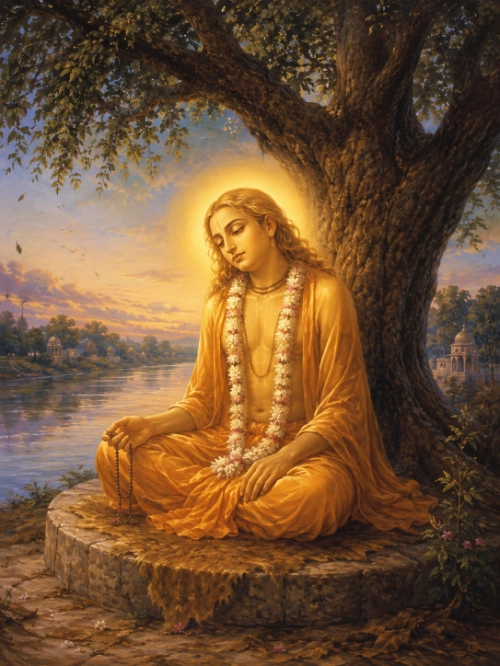
Imlī-talā: The Tamarind Tree of Divine Separation in Vṛndāvana
Among the sacred places of Vṛndāvana, Imlī-talā occupies a particularly important position in Gauḍīya Vaiṣṇava memory. It is associated with two complementary traditions separated by thousands of years in sacred time. In the older Vraja tradition, Śrī Kṛṣṇa is remembered beneath the tamarind tree absorbed in separation from Śrī Rādhā. In the historically much firmer sixteenth-century account of the Caitanya-caritāmṛta, Śrī Caitanya Mahāprabhu sits beneath the same sacred tree in solitary remembrance of Kṛṣṇa, chanting until midday beside the Yamunā.
The theological symmetry is striking: Kṛṣṇa remembers Rādhā. Caitanya, Kṛṣṇa endowed with Rādhā’s mood, remembers Kṛṣṇa. For this reason Imlī-talā came to represent one of the central themes of Gauḍīya spirituality — vipralambha, divine love intensified through separation.
The Name: Imlī-talā, Teṅtulī-talā and Āmli-talā
The sacred place is known by several related names — Imlī-talā, Imlitalā, Teṅtulī-talā and Āmli-talā — reflecting different North Indian and Bengali words for the same tree:
Thus the name means simply “the place beneath the tamarind tree.” The Caitanya-caritāmṛta, being a Bengali work, characteristically calls the place Teṅtulī-talā; the form Imlī-talā became especially common in later Braj and Hindi pilgrimage usage.
Unlike Ṭera-kadamba near Nandagrāma, Imlī-talā lies in Vṛndāvana proper, historically very close to the Yamunā.
Caitanya Mahāprabhu at Teṅtulī-talā
The strongest historical foundation for the sanctity of Imlī-talā comes from Śrī Caitanya-caritāmṛta, Madhya-līlā 18. During Caitanya Mahāprabhu’s pilgrimage through Vraja, He had been staying around Akrūra-tīrtha. Large crowds continually came to see Him, making secluded devotional absorption increasingly difficult. The following morning Caitanya entered Vṛndāvana again:
প্রাতঃকালে পুনঃ গেলা ‘বৃন্দাবন’ ।
চীর-ঘাটে স্নান করি’ দেখিল তেঁতুলী-তল ॥
prātaḥ-kāle punaḥ gelā ‘vṛndāvana’
cīra-ghāṭe snāna kari’ dekhila teṅtulī-tala
“Early in the morning He again went to Vṛndāvana. After bathing at Cīra-ghāṭa, He came to Teṅtulī-talā.”
The text then describes the tamarind tree as extremely ancient, associating it with the age of Kṛṣṇa’s pastimes. Beneath it was a pleasant platform. Nearby flowed the Yamunā, and a cool breeze came from the river, so that Caitanya could sit there looking upon the beauty of Vṛndāvana and the waters of the Yamunā. This is one of the most vivid physical descriptions of His Vraja pilgrimage.
The Ancient Tamarind Tree
The Caitanya-caritāmṛta describes the tree as ati purātana, “extremely ancient,” and presents it within sacred memory as a tree remaining from the period of Kṛṣṇa-līlā. This is the theological-historical claim of the traditional text, and it need not be confused with modern botanical questions about the age of individual living wood. What matters to the narrative is that Caitanya does not merely find a convenient shady tree: He chooses a place already understood as belonging to Kṛṣṇa’s Vṛndāvana.
The Yamunā Beside the Tree
নিকটে যমুনা বহে শীতল সমীর
nikaṭe yamunā vahe śītala samīra
“Nearby flowed the Yamunā, with its cooling breeze.”
The detail is significant. For Caitanya, the Yamunā was not ordinary scenery. In the devotional aesthetics of Vraja, the river, forests, birds, flowers, hills and breezes can all function as uddīpanas — stimuli that awaken remembrance of Kṛṣṇa. Thus the sensory environment of Imlī-talā itself becomes part of Caitanya’s meditation: the ancient tree, the river, the cool breeze, the Vṛndāvana landscape, and the name of Kṛṣṇa. The place was suitable for solitude, but its significance went far beyond quietness. It was saturated with līlā-smaraṇa, remembrance of Kṛṣṇa’s pastimes.
Caitanya’s Daily Practice Beneath the Tree
The Caitanya-caritāmṛta describes His practice simply:
সেই বৃক্ষ-তলে প্রভু করেন কীর্তন ।
মধ্যাহ্ন করি’ আইসে অক্রূর-তীর্থে ভোজন ॥
sei vṛkṣa-tale prabhu karena kīrtana
madhyāhna kari’ āise akrūra-tīrthe bhojana
“Beneath that tree the Lord performed kīrtana. At midday He returned to Akrūra-tīrtha for His meal.”
This establishes Imlī-talā as one of Caitanya Mahāprabhu’s most important Vṛndāvana bhajana-sthalīs. His daily rhythm was approximately:
Akrūra-tīrtha
      ↓
morning journey into Vṛndāvana
      ↓
Cīra-ghāṭa — bathing
      ↓
Teṅtulī-talā — solitary chanting
      ↓
midday
      ↓
return to Akrūra-tīrtha for prasādam
The distinction between the two places is meaningful. At Akrūra-tīrtha, Caitanya encountered people and accepted practical hospitality. At Imlī-talā, He sought solitude and uninterrupted remembrance.
Public Saṅkīrtana and Private Bhajana
This rhythm reflects a larger characteristic of Caitanya Mahāprabhu’s life. His mission was radically public: he distributed the holy name through mass saṅkīrtana, allowing enormous crowds to approach Him. Yet His deepest devotional states required solitude. Two apparently opposite aspects therefore coexist:
Imlī-talā belongs especially to the second dimension. But Caitanya did not permanently withdraw from others. After His period of private chanting, devotees and visitors could approach Him, and He encouraged them to chant Kṛṣṇa’s names. His pattern can therefore be understood as absorption followed by distribution — receive inwardly, give outwardly.
The Rājput Devotee Kṛṣṇadāsa
One of the most important events associated with Caitanya at Imlī-talā is the meeting with a devotee named Kṛṣṇadāsa, described as a Rājput householder living on the other side of the Yamunā. This episode follows directly after the description of Caitanya’s solitary chanting.
Kṛṣṇadāsa had experienced a dream that impelled him toward Caitanya. After bathing at Keśī-tīrtha and moving through the Vṛndāvana area, he came to Āmli-talā and saw Caitanya sitting there. The sight overwhelmed him. He approached the Lord and explained that his coming had been directed through a dream. Caitanya embraced him, and the effect was immediate: Kṛṣṇadāsa became overwhelmed with devotional emotion and began chanting and dancing.
The significance of Imlī-talā therefore expands. It is not merely a place where Caitanya privately remembered Kṛṣṇa. It also becomes a place where Caitanya’s inner devotion transforms another person. The sequence is beautifully characteristic of His mission:
solitary bhajana → encounter → embrace → awakening of bhakti → kīrtana
Kṛṣṇadāsa subsequently accompanied Caitanya and became attached to His service.
The Older Kṛṣṇa-līlā Tradition
Alongside this firmly documented Caitanya episode is another famous tradition concerning Śrī Kṛṣṇa Himself. According to later Vraja and Gauḍīya sacred tradition, Kṛṣṇa once sat beneath the tamarind tree in intense separation from Śrī Rādhā. The story is associated especially with the emotional world surrounding the rāsa-līlā.
The Śrīmad-Bhāgavatam describes the disappearance, searching, longing and separation that occur during the rāsa narrative, but it does not identify Imlī-talā by name and does not explicitly narrate Kṛṣṇa sitting under this particular tree chanting Rādhā’s name. That geographical identification belongs to a later sacred-memory tradition of Vṛndāvana.
Both layers are important, but they should not be confused.
Kṛṣṇa Chanting Rādhā’s Name
In the later Imlī-talā tradition, Kṛṣṇa sits beneath the tamarind tree and becomes absorbed in Rādhā’s name. Meditating on Her love, He begins experiencing something of Rādhā’s own emotional condition. This becomes especially important in Gauḍīya theology because Kṛṣṇa’s desire to understand Rādhā lies at the heart of the theological explanation for the appearance of Śrī Caitanya Mahāprabhu. Kṛṣṇadāsa Kavirāja summarises this mystery in one of the foundational Sanskrit verses of the Caitanya-caritāmṛta:
राधा कृष्ण-प्रणय-विकृतिर् ह्लादिनी शक्तिर् अस्माद्
एकात्मानाव् अपि भुवि पुरा देह-भेदं गतौ तौ ।
चैतन्याख्यं प्रकटम् अधुना तद्-द्वयं चैक्यम् आप्तं
राधा-भाव-द्युति-सुवलितं नौमि कृष्ण-स्वरूपम् ॥
rādhā kṛṣṇa-praṇaya-vikṛtir hlādinī śaktir asmād
ekātmānāv api bhuvi purā deha-bhedaṁ gatau tau
caitanyākhyaṁ prakaṭam adhunā tad-dvayaṁ caikyam āptaṁ
rādhā-bhāva-dyuti-suvalitaṁ naumi kṛṣṇa-svarūpam
“Rādhā is the transformation of Kṛṣṇa’s love, His hlādinī potency. Although They are one, They eternally manifested in separate forms. Now those two have become one as Caitanya. I bow to that form of Kṛṣṇa adorned with Rādhā’s mood and radiance.” — Caitanya-caritāmṛta, Ādi 4.55
The later theology of Imlī-talā reads the sacred place through precisely this mystery.
Imlī-talā as a Siddha-pīṭha
For this reason the site is sometimes called Imlī-talā Siddha-pīṭha:
So siddha-pīṭha means approximately “a sacred seat of spiritual attainment or fulfilment.” In the Imlī-talā tradition, the “attainment” is not generic liberation. It is interpreted as Kṛṣṇa entering deeply into the mystery of Rādhā’s love and emotional condition. The sacred place therefore becomes, in later Gauḍīya reflection, almost a seed-form of Gaura-tattva:
Kṛṣṇa longs for Rādhā
      ↓
Kṛṣṇa contemplates Rādhā’s love
      ↓
Kṛṣṇa desires to taste Rādhā-bhāva
      ↓
Kṛṣṇa appears as golden Śrī Caitanya
This development belongs to later theological interpretation rather than to the direct narrative of Madhya-līlā 18, but it explains why the site became exceptionally meaningful to Gauḍīya Vaiṣṇavas.
Śyāma and Gaura: The Theological Mirror
Imlī-talā therefore produces a remarkable mirror image:
Thus Śyāma moves toward Rādhā and becomes intelligible as Gaura; and Gaura, bearing Rādhā’s mood, longs again for Śyāma. Few places in Vṛndāvana express the internal logic of Gauḍīya theology as elegantly.
Vipralambha: Love in Separation
The central emotional principle of Imlī-talā is often described as vipralambha or vipralambha-bhāva, love experienced in separation. Its opposite or complement is sambhoga, love experienced in union.
In ordinary experience separation may simply diminish relationship. In Sanskrit devotional aesthetics, however, separation can intensify love. Vipralambha heightens:
- remembrance;
- longing;
- awareness of the beloved;
- emotional dependence;
- perception of the beloved in surrounding objects;
- and the intensity of eventual reunion.
The beloved who is absent externally can become more overwhelmingly present internally. This gives Imlī-talā its characteristic paradox: absence becomes a form of presence.
The Landscape as Memory
This also explains the importance of the surrounding Vṛndāvana environment. For Caitanya, remembrance is not an abstract psychological exercise; the landscape itself stimulates love. The Yamunā recalls Kṛṣṇa’s water pastimes, the trees His forest pastimes, the breeze carries the atmosphere of Vraja, the ghāṭas evoke individual līlās, and the very earth is understood as sacred. In rasa terminology these stimuli function as uddīpana-vibhāvas, external objects that awaken and intensify an already existing devotional emotion. Imlī-talā therefore represents a distinctly Vraja form of sacred geography: place itself becomes memory.
The Shifting Yamunā
The Caitanya-caritāmṛta explicitly says nikaṭe yamunā vahe, “the Yamunā flowed nearby.” This is also historically interesting. The Yamunā’s course around Vṛndāvana has shifted over the centuries, so the modern relationship between the river and Imlī-talā is not identical to the landscape described in the sixteenth-century text. The passage therefore preserves something like a literary snapshot of Vṛndāvana’s earlier river geography.
This should not diminish the sacred identity of the place. Sacred geography in Vraja is attached to līlā-sthalīs, even when rivers, vegetation and settlement patterns alter over time.
Is the Present Tree the Original Tree?
Traditional texts identify the tamarind tree Caitanya encountered as ancient even in the sixteenth century. Modern pilgrimage accounts, however, do not all describe the present botanical situation identically. One widely repeated report states that the old tree died in the early 1990s and that an offshoot or descendant growth is preserved at the site; other devotional accounts simply speak of the sacred ancient tamarind without distinguishing old trunk from later growth.
The historically safest formulation is therefore this: the sacred site and the devotional lineage of the Imlī-talā tamarind tree are preserved, while the exact botanical continuity of every currently visible trunk should not be asserted with certainty. This allows sacred tradition and botanical history to remain distinct.
The Present Shrine
The modern Imlī-talā complex preserves the memory of Caitanya’s meditation beneath the tamarind tree. The site has included an image of Śrī Caitanya Mahāprabhu seated in meditation, worship associated with Rādhā and Kṛṣṇa, Gaura-related Deities, the sacred tamarind site, and a devotional environment centred on Caitanya’s Vṛndāvana bhajana. The precise altar arrangement can change, so the essential feature is not any single modern installation but the continuing association of the place with Caitanya beneath the tamarind tree.
Three Levels of Imlī-talā Tradition
For a source-conscious understanding, the traditions can be separated clearly:
This distinction is valuable because Imlī-talā does not need uncertain claims in order to be important. Caitanya Mahāprabhu’s presence there is already exceptionally well attested within the primary Gauḍīya biographical tradition.
Three Forms of Remembrance
This gives the sacred place its extraordinary theological symmetry.
Imlī-talā is much more than “the place with an old tamarind tree.” It represents the Gauḍīya conviction that love reaches extraordinary intensity in separation. Kṛṣṇa’s longing reveals the greatness of Rādhā; Caitanya’s longing reveals the sweetness of Kṛṣṇa. The Yamunā, trees and Vṛndāvana landscape make memory tangible. Caitanya’s solitary chanting shows the interior dimension of nāma-bhajana, and His subsequent meeting with Kṛṣṇadāsa shows that genuine inward realisation naturally overflows into grace for others.
The entire sacred place can therefore be summarised in one theological movement: remembrance, longing, absorption, transformation, and the distribution of love. Or more simply: at Imlī-talā, Śyāma remembers Rādhā; Gaura remembers Śyāma; and the devotee learns that separation can become the deepest form of remembrance.