

Caitanya’s Journeys to Vṛndāvana
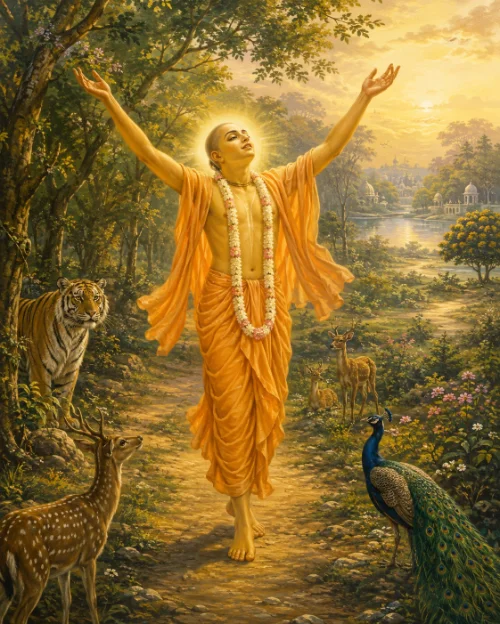
Śrī Caitanya Mahāprabhu’s Journeys to Vṛndāvana: From the Great Procession at Rāmakeli to the Solitary Path through Jhārikhaṇḍa
Śrī Caitanya Mahāprabhu’s journey to Vṛndāvana was not a straightforward pilgrimage from Jagannātha Purī to the land of Kṛṣṇa. The Caitanya-caritāmṛta presents it as a process that unfolds in stages. One journey becomes overwhelmed by immense crowds and ends before Vṛndāvana is reached. A second is deliberately undertaken in seclusion through the forests of Jhārikhaṇḍa, and finally brings Caitanya into the sacred landscape of Vraja.
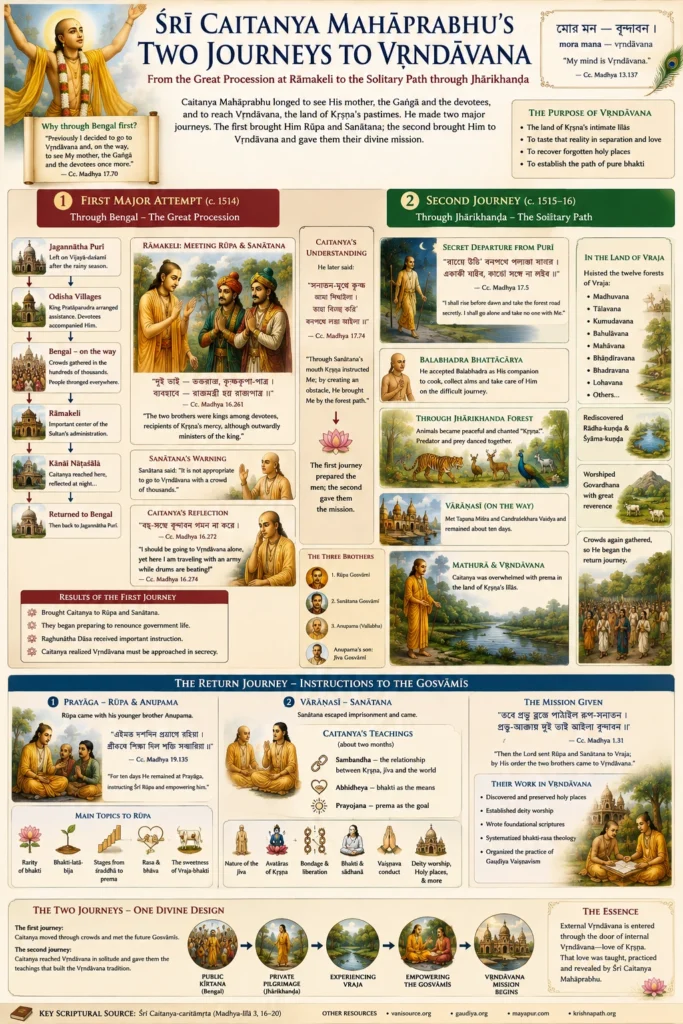
The Bengal route to Rāmakeli and back, the solitary path through Jhārikhaṇḍa into Vraja, and the return instructions to Rūpa at Prayāga and Sanātana at Vārāṇasī.
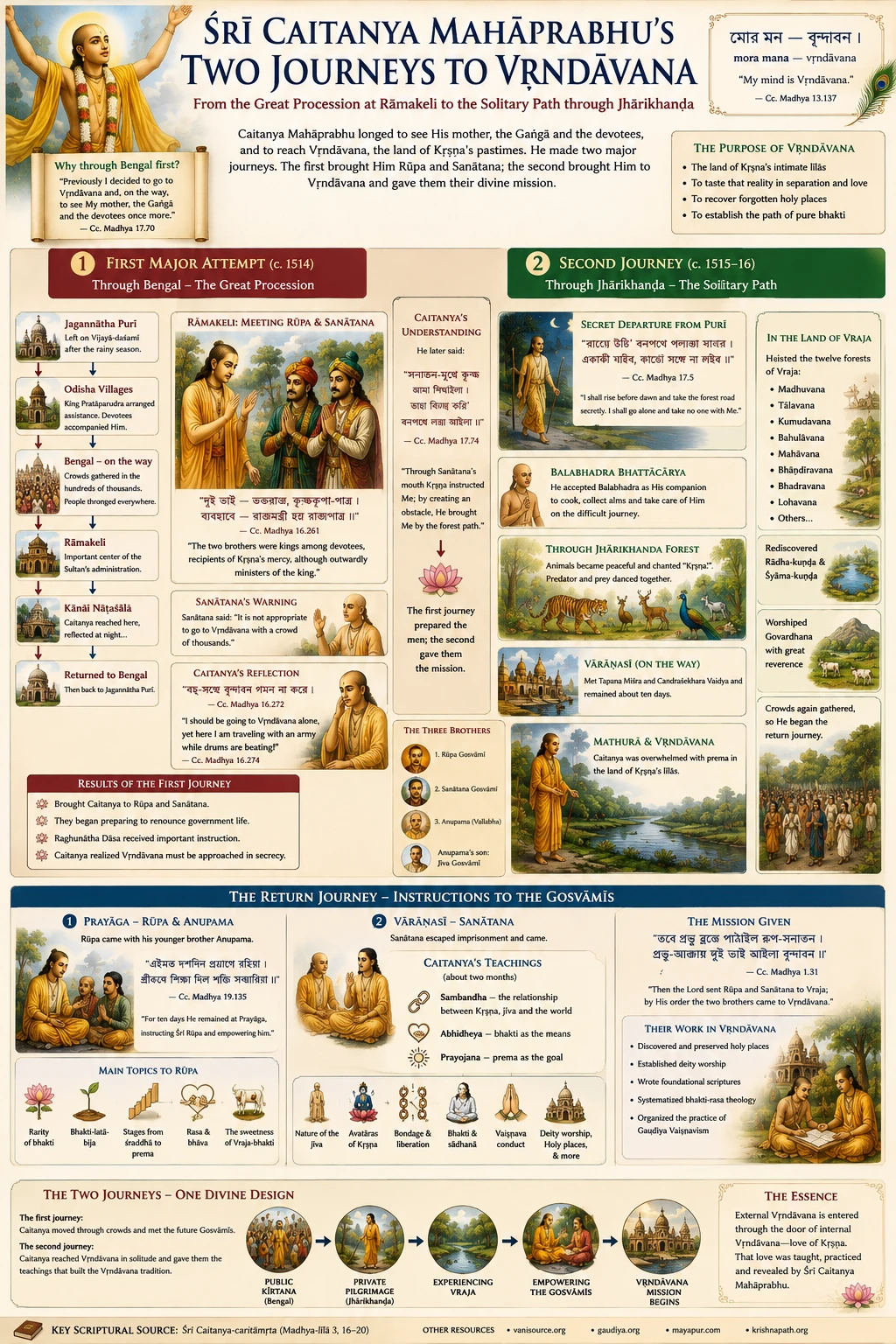
The two journeys are important not merely because one “failed” and the other succeeded. Together they establish many of the relationships that would determine the future of Gauḍīya Vaiṣṇavism. During the first journey Caitanya meets Rūpa and Sanātana at Rāmakeli. During the successful journey He experiences Vṛndāvana directly; on His return He gives extensive teachings to Rūpa at Prayāga and Sanātana at Vārāṇasī. Those two brothers subsequently become the principal architects of the Gauḍīya Vṛndāvana tradition.
Thus the deeper structure is: the first journey discovers the future Gosvāmīs; the second journey gives them their mission.
A note on the dates. The first major journey from Jagannātha Purī through Bengal is conventionally dated to approximately 1514, while the successful journey through Jhārikhaṇḍa is generally placed in 1515, with the pilgrimage and return extending into 1516 in some reconstructions. These CE dates are reconstructed from the traditional biography; the Caitanya-caritāmṛta itself normally dates events relative to Caitanya’s sannyāsa, annual festivals and lunar months rather than supplying modern calendar years.
There is also a technical qualification to the phrase “two attempts.” Immediately after accepting sannyāsa, Caitanya had already set out toward Vṛndāvana in ecstatic absorption, and Nityānanda Prabhu redirected Him toward the Gaṅgā and Śāntipura, where He met Śacīdevī and His devotees. That episode belongs to Madhya-līlā 3. The journeys discussed here are therefore more precisely Caitanya’s two major Purī-era attempts to undertake the Vṛndāvana pilgrimage.
Why Vṛndāvana?
For Caitanya, Vṛndāvana was not merely another tīrtha on an itinerary. It was the sacred landscape of Kṛṣṇa’s most intimate childhood, cowherd and rāsa pastimes — the earthly manifestation of Vraja. Later, during Ratha-yātrā, Caitanya speaks in the mood of Rādhā:
অন্যের হৃদয় — মন, মোর মন — বৃন্দাবন,
‘মনে’ ‘বনে’ এক করি’ জানি ।
anyera hṛdaya — mana, mora mana — vṛndāvana,
‘mane’ ‘vane’ eka kari’ jāni
“For others the heart is the mind; My mind is Vṛndāvana. I know My mind and Vṛndāvana to be one.” — Madhya 13.137
This gives the pilgrimage a double dimension:
Caitanya goes geographically to Vṛndāvana because His consciousness is already immersed in it.
The Desire to Go to Vṛndāvana
Caitanya had wanted to make the pilgrimage for some time, but His close associates Rāmānanda Rāya and Sārvabhauma Bhaṭṭācārya repeatedly persuaded Him to delay it because they could not bear the prospect of separation. The Caitanya-caritāmṛta says that for two years His desire remained unfulfilled. Eventually Caitanya insisted, and He wanted to take the route through Bengal for a deeply personal reason:
বৃন্দাবন যাব আমি গৌড়দেশ দিয়া ।
নিজ-মাতার, গঙ্গার চরণ দেখিয়া ॥
vṛndāvana yāba āmi gauḍa-deśa diyā
nija-mātāra, gaṅgāra caraṇa dekhiyā
“I shall go to Vṛndāvana through Bengal, after seeing My mother and the feet of Mother Gaṅgā.” — Madhya 16.256
Later He explains that He had wanted to see His mother, the Gaṅgā and the devotees once more. The first pilgrimage was therefore simultaneously a journey toward Vṛndāvana and a farewell journey through Caitanya’s Bengali devotional world.
The First Major Attempt: Through Bengal
Rāmānanda and Sārvabhauma finally advised Him to wait until the end of the rainy season. The text specifically states that He departed from Jagannātha Purī on Vijayā-daśamī. King Pratāparudra arranged assistance along the route, and various devotees accompanied Caitanya for portions of the journey.
One particularly revealing episode involves Gadādhara Paṇḍita. Gadādhara wanted desperately to accompany Caitanya, although he had accepted kṣetra-sannyāsa, a vow to remain permanently in Jagannātha Purī while serving Ṭoṭā-Gopīnātha. Caitanya refused to allow personal affection for Him to become a reason for Gadādhara to break his devotional vow.
That episode already establishes an important theme: love must not destroy dharma merely by calling itself love.
A Pilgrimage Becomes a Mass Movement
As Caitanya entered Bengal, the journey ceased to resemble a private pilgrimage. Crowds began gathering everywhere. Caitanya later describes the situation Himself: thousands followed Him continuously, while vastly greater numbers assembled wherever He stopped. Houses and walls were damaged simply by the pressure of people coming to see Him.
The paradox was becoming obvious. Caitanya was attempting to reach the secluded land of Kṛṣṇa’s intimate pastimes while travelling at the centre of what increasingly resembled an enormous popular procession. This problem reached its climax at Rāmakeli.
Rāmakeli: Caitanya Meets Rūpa and Sanātana
Rāmakeli was closely connected with the government of the Bengal Sultanate under Sultan Ḥusain Shah. Here lived two highly educated brothers occupying influential administrative positions: Rūpa and Sanātana. They would later become Rūpa Gosvāmī and Sanātana Gosvāmī, two of the most important theologians and organisers in Gauḍīya Vaiṣṇava history. Caitanya later recalls them in remarkable language:
দুই ভাই — ভক্তরাজ, কৃষ্ণকৃপা-পাত্র ।
ব্যবহারে — রাজমন্ত্রী হয় রাজপাত্র ॥
dui bhāi — bhakta-rāja, kṛṣṇa-kṛpā-pātra
vyavahāre — rāja-mantrī haya rāja-pātra
“The two brothers were kings among devotees and recipients of Kṛṣṇa’s mercy, although in ordinary affairs they were ministers and officers of the king.” — Madhya 16.261
Their outward identity and inward identity are deliberately contrasted:
Caitanya is particularly moved by their humility. The meeting becomes one of the great turning points in the history of the movement.
What about Anupama?
Rūpa and Sanātana had a younger brother named Vallabha, generally known as Anupama, and Anupama’s son was Jīva Gosvāmī:
Rūpa — Sanātana — Anupama / Vallabha
                        └── Jīva Gosvāmī
When the Caitanya-caritāmṛta itself retells the decisive Rāmakeli encounter, however, it repeatedly speaks of Caitanya meeting “the two brothers Rūpa and Sanātana.” Anupama should therefore not simply be inserted as a third principal participant in this scene. His unmistakable role comes slightly later, when he travels with Rūpa to Prayāga and meets Caitanya there.
Sanātana’s Warning
Before Caitanya leaves Rāmakeli, Sanātana says something that changes the entire pilgrimage. He respectfully suggests that it is not appropriate to go to Vṛndāvana while being followed by such an enormous multitude. Caitanya initially continues onward and reaches Kānāi Nāṭaśālā. But during the night He begins seriously reflecting upon Sanātana’s words.
His conclusion is striking. Vṛndāvana is difficult to attain, secluded, and not appropriately entered as the destination of a huge public spectacle. Caitanya later describes His own embarrassment with remarkable vividness:
বৃন্দাবন যাব কাহাঁ ‘একাকী’ হঞা !
সৈন্য সঙ্গে চলিয়াছি ঢাক বাজাঞা !
vṛndāvana yāba kāhāṅ ‘ekākī’ hañā!
sainya saṅge caliyāchi ḍhāka bājāñā!
“I should be going to Vṛndāvana alone, yet here I am travelling with an army while drums are beating!” — Madhya 16.274
A nearby verse uses an even sharper formulation:
বহু-সঙ্গে বৃন্দাবন গমন না করে
bahu-saṅge vṛndāvana gamana nā kare
“One should not go to Vṛndāvana accompanied by a great multitude.” — Madhya 16.272
Caitanya consequently turns back.
Was the First Journey a Failure?
Only geographically. Historically and spiritually it accomplished something extraordinary: it brought Caitanya to Rūpa and Sanātana. The meeting at Rāmakeli helped trigger their withdrawal from government life. Rūpa began arranging the distribution of his wealth and departure; Sanātana’s attempt to leave government service eventually resulted in imprisonment and dramatic escape. The journey also carried Caitanya through the Bengali devotional network and produced further important encounters, including instruction to Raghunātha Dāsa, another future Gosvāmī.
So the first attempt fails to reach Vṛndāvana but succeeds in gathering the people who will later help reveal Vṛndāvana to the world.
Caitanya Interprets Sanātana’s Advice as Kṛṣṇa’s Instruction
This becomes even clearer when Caitanya later reflects on what happened. During the successful journey He says:
সনাতন-মুখে কৃষ্ণ আমা শিখাইলা ।
তাহা বিঘ্ন করি’ বনপথে লঞা আইলা ॥
sanātana-mukhe kṛṣṇa āmā śikhāilā
tāhā vighna kari’ vana-pathe lañā āilā
“Through Sanātana’s mouth Kṛṣṇa instructed Me; after placing an obstacle there, He brought Me by the forest path.” — Madhya 17.74
This is one of the deepest statements in the whole episode. Caitanya does not interpret the interrupted journey merely as unfortunate logistics. He sees it as divine guidance, and Sanātana as the instrument through whom Kṛṣṇa redirected Him.
The Second Journey: Secrecy Instead of Procession
When Caitanya prepares to try again, everything changes. He consults privately with Svarūpa Dāmodara and Rāmānanda Rāya, and this time He announces:
রাত্র্যে উঠি’ বনপথে পলাঞা যাব ।
একাকী যাইব, কাহোঁ সঙ্গে না লইব ॥
rātrye uṭhi’ vana-pathe palāñā yāba
ekākī yāiba, kāhoṅ saṅge nā la-iba
“I shall rise before dawn and secretly take the forest road. I shall go alone and take no one with Me.” — Madhya 17.5
This is almost the exact opposite of the first journey:
Svarūpa and Rāmānanda, however, worry about the practical danger of Caitanya travelling completely alone. They persuade Him to accept Balabhadra Bhaṭṭācārya as His principal companion. A second brāhmaṇa assisted Balabhadra, but the party remained intentionally tiny.
Balabhadra Bhaṭṭācārya
Balabhadra’s importance is largely practical, but that practical service makes the pilgrimage possible. He obtained rice and vegetables in villages, begged alms, cooked when necessary, collected edible greens in the forest, carried supplies and cared for Caitanya throughout the journey.
This is another recurrent theme in Caitanya’s world: profound theological events depend upon seemingly ordinary forms of service. Without Balabhadra, the solitary Vṛndāvana pilgrimage would have been far more difficult.
Through the Jhārikhaṇḍa Forest
The journey through Jhārikhaṇḍa becomes one of the most famous episodes in Caitanya’s biography. The Caitanya-caritāmṛta describes Him moving through wilderness inhabited by tigers, elephants, rhinoceroses, deer, boars, birds and other animals. As Caitanya chants Kṛṣṇa’s name, even animals traditionally hostile to one another become peaceful. Tigers and deer dance together. Animals chant. Predator and prey cease their natural hostility.
The episode is hagiographical, but it also has a clear literary purpose: the forest begins to resemble Vṛndāvana before Caitanya reaches geographical Vṛndāvana. Vraja is repeatedly imagined in Kṛṣṇa literature as a realm in which the presence of Kṛṣṇa harmonises nature, and Jhārikhaṇḍa becomes a foretaste of that reality. Caitanya Himself says:
কৃষ্ণ — কৃপালু, আমায় বহুত কৃপা কৈলা ।
বনপথে আনি’ আমায় বড় সুখ দিলা ॥
kṛṣṇa — kṛpālu, āmāya bahuta kṛpā kailā
vana-pathe āni’ āmāya baḍa sukha dilā
“Kṛṣṇa has shown Me great mercy. By bringing Me along the forest path, He has given Me great happiness.” — Madhya 17.69
Vārāṇasī on the Way to Vṛndāvana
The successful journey also connects directly with the story of Tapana Miśra and Candraśekhara Vaidya. Caitanya reaches Vārāṇasī and bathes at Maṇikarṇikā-ghāṭa. There Tapana Miśra meets Him and brings Him into the small devotional circle that had already formed in Kāśī. Caitanya remains approximately ten days before continuing. Thus the Vārāṇasī devotees become part of the successful Vṛndāvana pilgrimage itself — and on the return journey, Vārāṇasī will become even more important.
From Vārāṇasī to Mathurā
Caitanya continues north through Prayāga and eventually reaches Mathurā, the gateway to the Vraja region. When He first encounters the Yamunā, His reaction is immediate and physical: He plunges into the river in ecstatic love and must be helped out by Balabhadra Bhaṭṭācārya. The narrative has now moved from seeking Vṛndāvana to experiencing Vṛndāvana.
Caitanya in the Twelve Forests of Vraja
The Caitanya-caritāmṛta describes Caitanya travelling through the sacred geography associated with Kṛṣṇa’s pastimes. Among the forests explicitly mentioned are Madhuvana, Tālavana, Kumudavana and Bahulāvana, and elsewhere the narrative continues through the wider Vraja landscape, including Mahāvana, Bhāṇḍīravana, Bhadravana and Lohavana. One verse states:
মধুবন, তাল, কুমুদ, বহুলা-বন গেলা ।
তাহাঁ তাহাঁ স্নান করি’ প্রেমাবিষ্ট হৈলা ॥
madhu-vana, tāla, kumuda, bahulā-vana gelā
tāhāṅ tāhāṅ snāna kari’ premāviṣṭa hailā
“He went to Madhuvana, Tālavana, Kumudavana and Bahulāvana; bathing at those places, He became overwhelmed with prema.” — Madhya 17.193
Caitanya does not move through Vraja like an antiquarian cataloguing ruins. Every place triggers memory of Kṛṣṇa-līlā. The geography is experienced devotionally.
The Rediscovery of Rādhā-kuṇḍa and Śyāma-kuṇḍa
One of the most important episodes takes place at Āriṭ-grāma. Caitanya asks the local people where Rādhā-kuṇḍa is. No one knows. The sacred place had effectively disappeared from common recognition. The text then says:
তীর্থ ‘লুপ্ত’ জানি’ প্রভু সর্বজ্ঞ ভগবান্ ।
দুই ধান্যক্ষেত্রে অল্পজলে কৈলা স্নান ॥
tīrtha ‘lupta’ jāni’ prabhu sarvajña bhagavān
dui dhānya-kṣetre alpa-jale kailā snāna
“Knowing that the tīrtha had become lost, the Lord bathed in the little water lying in two paddy fields.” — Madhya 18.5
These pools are identified as Rādhā-kuṇḍa and Śyāma-kuṇḍa. The episode becomes extremely important for later Gauḍīya sacred geography. The Gosvāmīs and subsequent Vaiṣṇava communities would develop the Vraja pilgrimage landscape systematically, but Caitanya’s own journey serves as a foundational act of recognition and recovery of lost līlā-sthalīs.
Govardhana
Caitanya’s relationship with Govardhana Hill is similarly revealing. For Him Govardhana is not ordinary geography; it is directly connected with Kṛṣṇa and is therefore worshipable. He refuses to climb upon the hill. Instead, He wonders how He will obtain the darśana of the Gopāla Deity, who was being worshipped on Govardhana. The narrative then describes circumstances by which Gopāla comes down from the hill, allowing Caitanya to see Him without violating His reverence for Govardhana.
The theological principle is simple: the sacred landscape is not merely visited — it is served.
Caitanya’s Vṛndāvana Was Not Empty Geography
Throughout the Vraja chapters, trees, rivers, hills, animals and villages trigger Caitanya’s recognition of Kṛṣṇa’s presence. The landscape becomes almost a living participant in the pilgrimage. This explains why the earlier crowded journey had felt wrong. Vṛndāvana is not merely a destination one reaches by walking far enough; its meaning depends upon a devotional mode of perception. The external landscape and internal remembrance must meet.
Crowds Return Even in Vṛndāvana
There is an irony in the successful pilgrimage. Although Caitanya reaches Vṛndāvana secretly, His presence again begins attracting large crowds. The tension therefore returns: Caitanya seeks secluded Vraja, yet Caitanya’s presence generates public saṅkīrtana wherever He goes. Eventually Balabhadra Bhaṭṭācārya becomes concerned that the increasing crowds will again make private pilgrimage impossible, and Caitanya begins His return journey. But the return is almost as important as reaching Vṛndāvana.
Prayāga: Rūpa and Anupama
At Prayāga, Caitanya encounters Rūpa again. This time Rūpa is accompanied not by Sanātana but by their younger brother Vallabha, or Anupama. This is the correct place to emphasise the three-brother structure:
Sanātana is still struggling to free himself from government imprisonment. At Prayāga, Caitanya spends approximately ten days instructing Rūpa:
এইমত দশদিন প্রয়াগে রহিয়া ।
শ্রীরূপে শিক্ষা দিল শক্তি সঞ্চারিয়া ॥
ei-mata daśa-dina prayāge rahiyā
śrī-rūpe śikṣā dila śakti sañcāriyā
“For ten days He remained at Prayāga, instructing Śrī Rūpa and empowering him.” — Madhya 19.135
These teachings contain the conceptual seeds of what Rūpa would later systematise as bhakti-rasa theology. Among the famous themes are:
- the rarity of pure devotion;
- the bhakti-latā-bīja, the seed of the devotional creeper;
- the definition of pure bhakti;
- the stages from devotion to prema;
- devotional relationships with Kṛṣṇa;
- and the distinctive sweetness of Vraja-bhakti.
Rūpa’s later Bhakti-rasāmṛta-sindhu emerges within this theological world.
Vārāṇasī: Sanātana Finally Arrives
After Prayāga, Caitanya returns to Vārāṇasī, where the other Rāmakeli brother finally reaches Him. Sanātana had attempted to leave government service, been imprisoned by Sultan Ḥusain Shah, escaped and travelled with great hardship to find Caitanya. Now the warning Sanātana had once given comes full circle:
For approximately two months Caitanya teaches him.
Sambandha, Abhidheya and Prayojana
One of the foundational formulations appears in these teachings:
বেদশাস্ত্র কহে — ‘সম্বন্ধ’, ‘অভিধেয়,’ ‘প্রয়োজন’ ।
‘কৃষ্ণ’ — প্রাপ্য সম্বন্ধ, ‘ভক্তি’ — প্রাপ্ত্যের সাধন ॥
veda-śāstra kahe — ‘sambandha’, ‘abhidheya’, ‘prayojana’
‘kṛṣṇa’ — prāpya sambandha, ‘bhakti’ — prāptyera sādhana
“The Vedic śāstras teach sambandha, abhidheya and prayojana: Kṛṣṇa is the reality to be known in relationship, and bhakti is the means by which He is attained.” — Madhya 20.124
Sanātana also receives instruction concerning the nature of the jīva; liberation and bondage; Kṛṣṇa’s manifestations; avatāras; bhakti; Vaiṣṇava conduct; deity worship; sacred places; and the practical organisation of devotional life.
The Vṛndāvana Mission Is Born
After these encounters the significance of the journeys becomes clear. Caitanya eventually sends Rūpa and Sanātana to Vraja:
তবে প্রভু ব্রজে পাঠাইল রূপ-সনাতন ।
প্রভু-আজ্ঞায় দুই ভাই আইলা বৃন্দাবন ॥
tabe prabhu vraje pāṭhāila rūpa-sanātana
prabhu-ājñāya dui bhāi āilā vṛndāvana
“Then the Lord sent Rūpa and Sanātana to Vraja; by His order the two brothers came to Vṛndāvana.” — Madhya 1.31
Their work would include identifying and preserving sacred places; establishing deity worship; writing theological texts; defining Vaiṣṇava practice; articulating the theology of bhakti-rasa; and helping transform Vṛndāvana into the intellectual and institutional centre of Gauḍīya Vaiṣṇavism. Later Jīva Gosvāmī, Anupama’s son, would develop this system with extraordinary philosophical depth. Thus the Rāmakeli family becomes central to Caitanya’s Vṛndāvana project.
The Two Journeys Compared
The contrast is almost literary in its symmetry: crowd becomes solitude; public movement becomes intimate pilgrimage; meeting future disciples becomes empowering future theologians; seeking Vṛndāvana becomes establishing the Vṛndāvana mission.
The First Journey Creates the Men; the Second Creates the Mission
The first attempt can therefore no longer be called a simple failure. Without it there is no Rāmakeli meeting, and without Rāmakeli the later roles of Rūpa and Sanātana become difficult to imagine in the form preserved by Gauḍīya history. The second journey then completes what the first began: Caitanya experiences the land whose devotional theology Rūpa and Sanātana will later articulate and organise. Then He meets them separately:
This division should not be made absolute — the two Gosvāmīs’ contributions overlap greatly — but the narrative strongly suggests complementary missions.
Why the Solitary Route Matters
One of the most profound themes running through the entire account is the tension between public saṅkīrtana and intimate Vraja-bhakti. Caitanya’s mission is radically public; He distributes Kṛṣṇa’s name to crowds. Yet His own approach to Vṛndāvana becomes deliberately private.
This does not mean that Vṛndāvana is reserved for an elite. Rather, the narrative suggests that sacred geography cannot be approached merely through spectacle, prestige or mass excitement. The first pilgrimage had begun to resemble what Caitanya Himself compares to an army marching with beating drums. The second begins with “I shall go alone.” That contrast gives the two journeys their spiritual meaning.
External Vṛndāvana and Internal Vṛndāvana
The final theological key is supplied by Caitanya’s own Ratha-yātrā mood — mora mana — vṛndāvana, “My mind is Vṛndāvana.” For Caitanya, Vṛndāvana is at once a place to be physically sought, a sacred geography to be recovered, and a state of consciousness in which Kṛṣṇa’s intimate līlā becomes present.
This is why Gadādhara Paṇḍita can tell Him, in effect, that wherever He is, Vṛndāvana is there — yet immediately add that Caitanya should still physically visit Vṛndāvana “to teach the people.” The two ideas are not contradictory. The earthly dhāma matters, but it must be entered with the consciousness appropriate to it.
The Larger Historical Consequence
The successful pilgrimage ultimately creates one of the great geographic transformations in the history of Gauḍīya Vaiṣṇavism.
Caitanya’s two journeys are therefore the bridge between these worlds, and the route is not merely geographical:
Navadvīpa → Purī → Rāmakeli → Vṛndāvana → Prayāga → Vārāṇasī → the Gosvāmī tradition
It is a map of how an ecstatic devotional movement becomes a lasting theological civilisation. The first journey discovered the men; the second gave them their mission. Between them lies the whole difference between a pilgrimage that is watched and a pilgrimage that is entered.
Principal Textual Passages
On chronology: the frequently cited dates 1514 for the first major attempt and 1515 for the successful departure belong to modern and traditional chronological reconstruction rather than to explicit CE dating inside Kṛṣṇadāsa Kavirāja’s narrative. For a source-critical presentation they are best written as c. 1514 and c. 1515–16 rather than as unquestionable exact dates.