

The Twelve Forests of Vraja
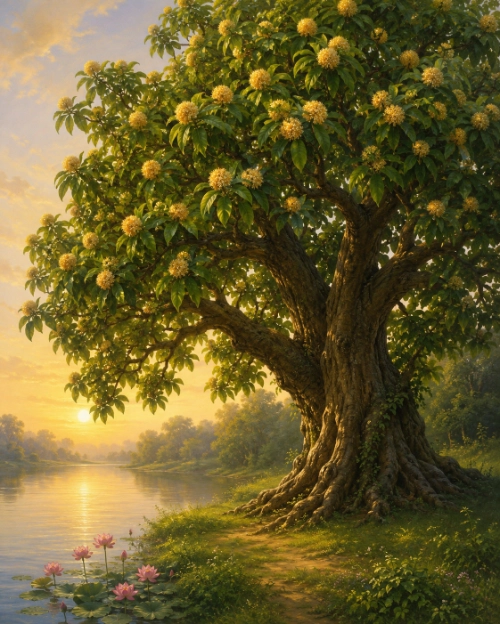
The Twelve Forests of Vraja: Understanding the Sacred Geography of Kṛṣṇa's Eternal Līlā
The traditional list of the twelve forests of Vraja can look at first like an old geographical catalogue. But the passage in which it occurs is doing something far more ambitious: it presents Vraja as a sacred map of Kṛṣṇa’s līlā — forests, villages, hills, ponds, groves and individual pastime-sites arranged symbolically as a vast lotus centred upon Govinda.
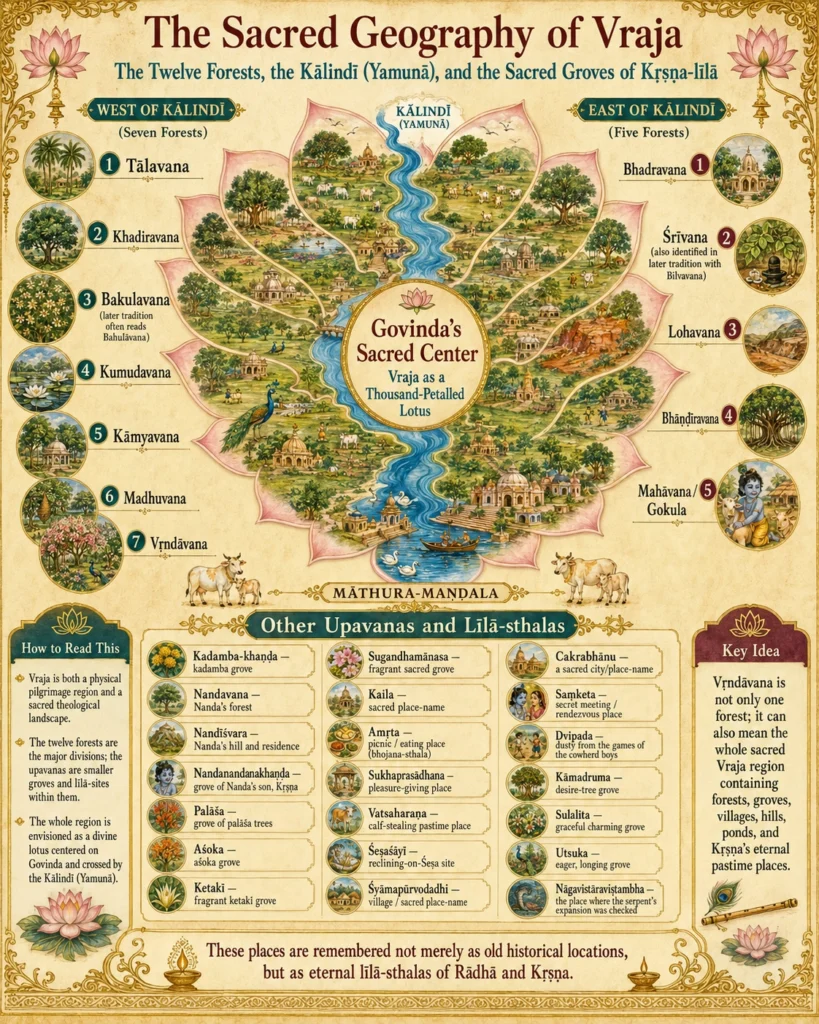
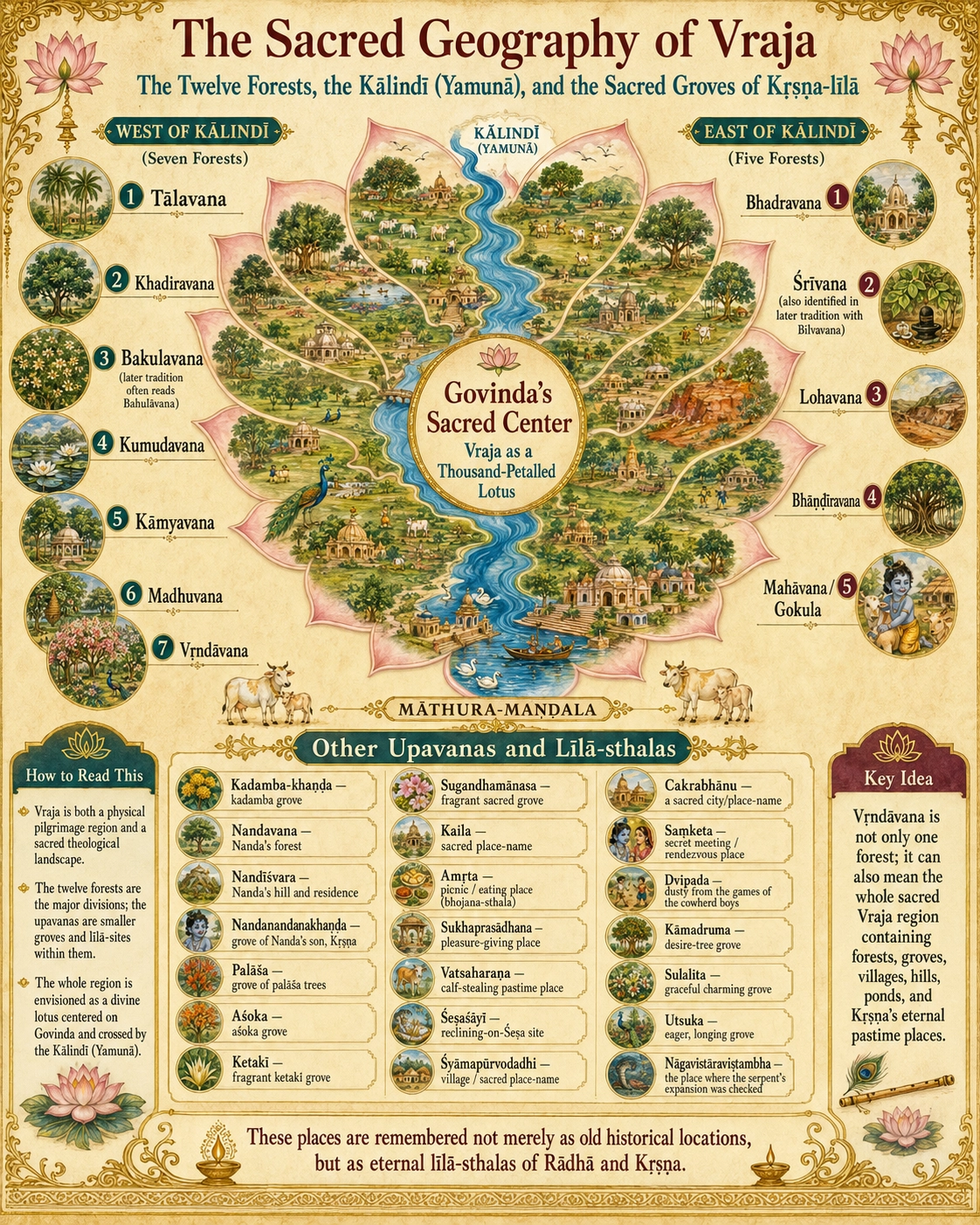
The whole scheme on one sheet: seven forests west of the Kālindī and five to the east, the thousand-petalled lotus centred on Govinda, and the smaller upavanas and līlā-sthalas named in the same passage.
So Vraja is three things at once:
- a real pilgrimage landscape around Mathurā and the Yamunā;
- a network of places tied to particular episodes of Kṛṣṇa’s manifest līlā;
- an eternal transcendental dhāma whose earthly manifestation is understood to be non-different from Kṛṣṇa’s own abode.
This vision appears with particular clarity in the Padma Purāṇa, Pātāla-khaṇḍa, chapter 69, and was afterwards transmitted and interpreted within Gauḍīya Vaiṣṇava literature.
Pārvatī Asks Śiva to Reveal the Secret Abode
The setting matters. Pārvatī asks Śiva to reveal the most intimate and beloved abode of Kṛṣṇa — the place beyond which there is nothing dearer to him. Śiva replies that the subject is:
गुह्याद् गुह्यतरं गुह्यम्
guhyād guhyataraṁ guhyam
“A secret more secret than the secret.”
He describes eternal Vṛndāvana as situated beyond ordinary material existence, and says that its manifestation upon earth is not merely a copy of some higher reality: the terrestrial dhāma participates in the reality of the eternal Vṛndāvana. Then he introduces the image that governs everything after it:
सहस्रपत्रकमलाकारं माथुरमण्डलम् ।
sahasra-patra-kamalākāraṁ māthura-maṇḍalam
“Māthura-maṇḍala is in the form of a thousand-petalled lotus.”
Vraja as a Thousand-Petalled Lotus
The sacred region is not described like a modern map with rigid administrative boundaries. The Padma Purāṇa returns again and again to the lotus. It first calls Māthura-maṇḍala a thousand-petalled lotus; later the great realm called Gokula is itself described the same way:
सहस्रपत्रकमलं गोकुलाख्यं महत्पदम् ।
sahasra-patra-kamalaṁ gokulākhyaṁ mahat-padam
And deeper within that mystical geography lies Vṛndāvana, associated with the innermost structure of the lotus. So the terminology deliberately overlaps. Māthura-maṇḍala → Gokula → Vṛndāvana does not behave like country → province → town. The same divine landscape is being contemplated at different levels of intimacy, and the whole realm can be envisioned as a lotus while its innermost region contains another lotus-like arrangement. At the centre — the karṇikā, the pericarp — is the supreme place of Govinda.
The Twelve Principal Forests
भद्र श्री लोह भाण्डीर महा ताल खदीरकाः ।
बकुलं कुमुदं काम्यं मधु वृन्दावनं तथा ॥
bhadra śrī loha bhāṇḍīra mahā tāla khadīrakāḥ
bakulaṁ kumudaṁ kāmyaṁ madhu vṛndāvanaṁ tathā
These are the dvādaśa-vanas, the twelve principal forests. The following verse divides them:
कालिन्द्याः सप्त पश्चिमे ।
पूर्वे पञ्चवनं प्रोक्तम् ॥
kālindyāḥ sapta paścime
pūrve pañca-vanaṁ proktam
Seven lie west of the Kālindī, the Yamunā, and five to the east.
Five to the east
Seven to the west
The Caitanya-caritāmṛta preserves this same five-east, seven-west classification.
Śrīvana and Bilvavana are the same forest
One apparent discrepancy resolves easily. The Padma Purāṇa reads Śrīvana where the standard Gauḍīya list usually says Bilvavana. They are two names for one forest. When Mahāprabhu toured Vraja, the Caitanya-caritāmṛta records:
‘শ্রীবন’ দেখি’ পুনঃ গেলা ‘লোহ-বন’ ।
‘মহাবন’ গিয়া কৈলা জন্মস্থান-দরশন ॥
‘śrīvana’ dekhi’ punaḥ gelā ‘loha-vana’
‘mahāvana’ giyā kailā janma-sthāna-daraśana
“After seeing Śrīvana he went on to Lohavana; and going to Mahāvana he saw the place of Kṛṣṇa’s birth and childhood.”
The traditional commentary identifies Śrīvana with Bilvavana explicitly, and the two names simply express different aspects of the place — bilva, the trees that grow there, and śrī, Lakṣmī-devī, whom later Vraja tradition remembers performing austerities in this region, desiring entrance into the intimacy of Kṛṣṇa’s Vraja-līlā.
Bakulavana or Bahulāvana?
This variation is harder, and more interesting. The Sanskrit recension of the Padma Purāṇa genuinely reads bakula, not bahulā — and not as a one-off, since later in the same chapter it again refers to bakulāraṇyam, the Bakula forest. Even the Sādhanadīpikā, reproducing the passage, preserves bakulaṁ kumudaṁ kāmyaṁ.
Yet elsewhere in the same Gauḍīya textual tradition the forest appears as Bahulāvana, which is the familiar name in later Vraja pilgrimage geography. The Sādhanadīpikā is itself revealing: having quoted the Purāṇa with bakula, it later gives its own list with bahulā.
This looks like a genuine textual and traditional variation rather than a spelling error, and both readings are worth keeping: Bakula in this Padma Purāṇa recension, Bahulā in the established later Gauḍīya and Vraja tradition.
Mahāvana and Gokula
Another pair needs nuance. The Padma Purāṇa includes Mahāvana among the twelve and then speaks separately of the great secret region called Gokula. Later Vraja tradition closely identifies the two:
শ্রী-গোকুল, মহাবন—দুই ‘এক’ হয়
śrī-gokula, mahāvana—dui ‘eka’ haya
“Śrī Gokula and Mahāvana are one.”
Bhakti-ratnākara
Mahāvana and Gokula belong to the earliest līlās — Nanda and Yaśodā, Pūtanā, Dāmodara, the breaking of the twin yamala-arjuna trees, Kṛṣṇa’s infancy, the first cowherd settlement. The Padma Purāṇa itself places his bāla-krīḍā there and mentions Pūtanā and the arjuna trees by name.
So rather than flatly saying “Mahāvana is Gokula,” the more precise formulation is that the two are distinguished in some textual descriptions but become virtually identified in later Vraja sacred geography.
Beyond the Twelve: the Upavanas
Having listed the twelve, the text immediately warns that its map is far more detailed:
अन्यच्चोपवनं प्रोक्तं कृष्णक्रीडारसस्थलम् ।
anyac copavanaṁ proktaṁ kṛṣṇa-krīḍā-rasa-sthalam
“There are also other subsidiary groves — places of Kṛṣṇa’s playful, rasa-filled pastimes.”
This matters. What follows is not a competing list of major forests but a more intimate scale of sacred geography: smaller groves, forest tracts, villages, hills, picnic places, meeting places, and sites identified by the līlā performed there.
कदम्बखण्डनं नन्दवनं नन्दीश्वरं तथा ।
नन्दनन्दनखण्डं च पलाशाशोककेतकी ॥
kadamba-khaṇḍanaṁ nanda-vanaṁ nandīśvaraṁ tathā
nanda-nandana-khaṇḍaṁ ca palāśāśoka-ketakī
One transcriptional point: Kadamba-khaṇḍana is a single compound, not a separate “Kadamba” and “Khaṇḍana.”
Several of these identifications remain uncertain, and that uncertainty is worth preserving rather than disguising.
A correction: Dadhigrāma, not “Śyāmapūrvodadhi”
श्यामपूर्वो दधिग्रामश्चक्रभानुपुरं तथा ।
śyāma-pūrvo dadhi-grāmaś cakra-bhānu-puraṁ tathā
An older English segmentation can produce the misleading form Śyāmapūrvodadhi, which should not be treated as a securely established place-name. What the passage clearly contains is Dadhigrāma and Cakrabhānu-pura. The precise grammatical role of śyāma-pūrvaḥ deserves textual and commentarial study, and should not be “solved” by inventing a new geographical name.
The chart accompanying this article still follows the older segmentation at two points: it lists Śyāmapūrvodadhi as a village or place-name, and glosses Dvipada as “dusty from the games of the cowherd boys” — a phrase which belongs, as below, to bāla-krīḍana-dhūsaram rather than to Dvipada. Where the chart and this text differ, the readings given here are the ones argued for.
“Dusty from the play of children”
बालक्रीडनधूसरम्
bāla-krīḍana-dhūsaram
“Made grey with dust by the play of children.”
This is not another place-name — and the image is important. Vraja is not imagined as a sterile celestial palace. Its holiness appears through dusty village roads, barefoot cowherd boys, running and wrestling, calves, trees, picnic grounds, laughter and children covered in dust. That is characteristic of Vraja-mādhurya: divinity concealed within extreme intimacy and apparent ordinariness. The dust itself becomes sacred because it has touched Kṛṣṇa’s feet.
Saṃketa: a geography of secret meeting
The word saṃketa can mean an agreed sign, an appointment, a convention, an appointed meeting-place, a rendezvous. The text later places Saṃketa within one of the petals of the sacred lotus and adds a detail:
संकेतं द्विपदं चैव कुटीद्वौ तत्कुले स्थितौ ।
saṁketaṁ dvipadaṁ caiva kuṭī-dvau tat-kule sthitau
There were two huts there.
This fits the later Vraja understanding of Saṃketa as a confidential meeting-place between Rādhā’s side of Vraja and Kṛṣṇa’s. The place-name itself tells you what the place is for — sacred geography becoming a language of rasa.
Nāgavistāra-viṣṭambha
The compound breaks down as nāga, serpent; vistāra, expansion or spreading; viṣṭambha, obstruction or checking — the checking of the serpent’s expansion. It is tempting to identify this directly with Kālīya, and that is certainly possible.
But the text does not say Kālīya here, and a little later it explicitly names Kālī-hrada, Kālīya’s pool, as a separate site. The responsible formulation is that Nāgavistāra-viṣṭambha probably preserves the memory of a serpent-subduing līlā, and that an association with Kālīya is plausible but not certain.
The Inner Eight-Petalled Map
The text then zooms further in, describing eight directional petals around the central karṇikā.
The lotus is effectively a narrative map: each direction opens onto a different Kṛṣṇa-līlā.
At the conclusion of this eight-petalled description appears Gopīśvara Śiva, placed within the sacred Vṛndāvana landscape itself. This is the theological background for the enduring Vraja tradition in which Śiva is honoured as guardian of the intimate dhāma and as one who desires participation in the gopīs’ devotion. It is not an accidental Śaiva element imported into a Vaiṣṇava geography — Śiva is woven directly into the structure of Vṛndāvana.
The Outer Sixteen-Petalled Landscape
A wider sixteen-petalled circuit then surrounds the inner Vṛndāvana. Among the places explicitly associated with this larger lotus are Govardhana, described as an eternal abode of rasa; Nandīśvara, where Nanda’s house is remembered; Nandavana; Bakulāraṇya; Tālavana with Dhenuka; Kumudavana; Kāmyavana; Bhāṇḍīravana, where Kṛṣṇa plays surrounded by Śrīdāma and the cowherd boys; Bhadravana; Śrīvana; Lohavana; and Mahāvana.
The transmitted numbering is not equally transparent at every point, so it is better not to force every modern geographical identification into an artificially precise numbered diagram. The unmistakable fact is that the major forests themselves become petals of a larger sacred lotus.
Mahāvana, the petal of childhood
The Padma Purāṇa is particularly explicit about Mahāvana, describing Kṛṣṇa there absorbed in bāla-krīḍā, surrounded by the calf-herding boys, and naming the killing of Pūtanā and the breaking of the yamala-arjuna trees. The presiding form is Bāla-Gopāla, also described as Dāmodara.
So the sacred geography carries an implicit chronology: different parts of Vraja become associated with different ages, moods and relationships of Kṛṣṇa. Mahāvana is especially the landscape of the little child of Nanda and Yaśodā.
Vṛndāvana Can Mean Two Different Things
Both usages are legitimate. Similarly, “Gokula” can denote a particular settlement, while in theological texts it expands into a name for the eternal divine realm itself. Sacred terminology contracts and expands according to context, and much apparent confusion comes from expecting it not to.
Not Merely Where Kṛṣṇa Once Lived
The deepest part of the chapter comes after the geography, when Śiva tells Pārvatī what kind of reality Vṛndāvana actually is:
गुणातीतं महद्धाम पूर्णप्रेमस्वरूपकम् ।
guṇātītaṁ mahad-dhāma pūrṇa-prema-svarūpakam
“The great abode beyond the material guṇas, whose very nature is complete divine love.”
That is much stronger than saying Vṛndāvana is holy. The text even describes the trees as displaying the symptoms of prema — standing with their hairs erect, shedding tears of ecstatic love — so that the distinction between animate and inanimate sacred landscape begins to dissolve. And then the theological climax:
गोविन्ददेहतोऽभिन्नं पूर्णब्रह्मसुखाश्रयम् ।
govinda-dehato ’bhinnaṁ pūrṇa-brahma-sukhāśrayam
“It is non-different from the body of Govinda, and is the abode of the bliss of the complete Absolute.”
This explains the entire sacred geography. Vṛndāvana is not merely the place where Kṛṣṇa performed pastimes thousands of years ago. Kṛṣṇa, his dhāma, his associates and his līlā belong to one eternal spiritual reality, so a līlā-sthala does not function like the historical site of a past event: it is a place in which the eternal līlā is understood to remain ontologically present. Which is why Vraja pilgrimage involves more than historical curiosity. It is an attempt to enter the geography of relationship with Kṛṣṇa.
From Geography to Rasa
Māthura-maṇḍala
 └─ the thousand-petalled lotus
     └─ twelve forests (dvādaśa-vana)
         └─ subsidiary groves (upavanas)
             └─ villages, hills, ponds, līlā-sthalas
                 └─ the directional petals
                     └─ the inner Vṛndāvana
                         └─ the karṇikā
                             └─ Govinda
At the highest level the scheme turns back on itself, because the dhāma is govinda-dehato ’bhinnam — non-different from Govinda himself. So the twelve forests are not merely twelve woods around an ancient Indian city. They are an early sacred-geographical blueprint of the Vraja-līlā.
The large forests give the broad divisions; the upavanas bring us closer; Saṃketa, Nandīśvara, Vatsaharaṇa, Śeṣaśāyī, Kālī-hrada and the rest lead into increasingly specific pastimes. Eventually the geography becomes theology, and every tree, pond, hill and dusty path participates in the eternal relationship between Kṛṣṇa and his devotees.
Which is why the text can describe Vṛndāvana not simply as beautiful, or ancient, or sacred, but as pūrṇa-prema-svarūpakam — the very embodiment of complete divine love.