

Make Your Whole World Kṛṣṇa’s
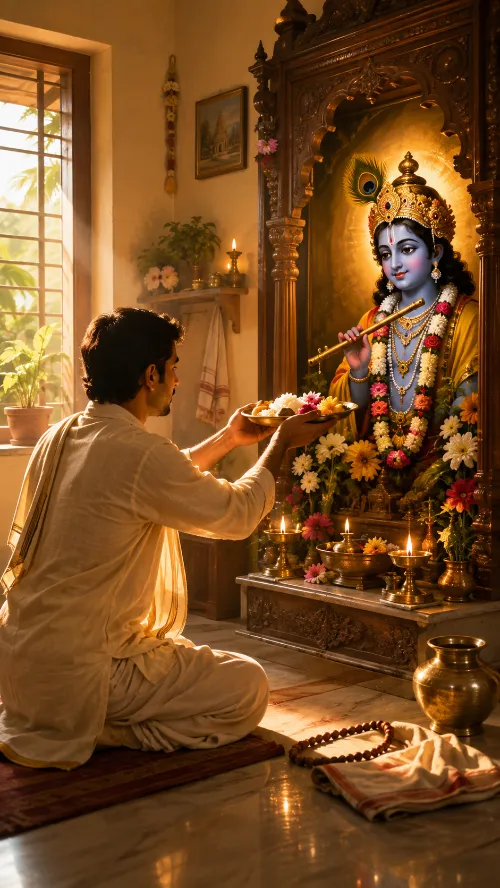
Bhaktivinoda Ṭhākura on Household Life, Compassion, and the Holy Name
Two lines of Bengali that quietly refuse the choice most spiritual advice insists on. Bhaktivinoda Ṭhākura does not tell the householder to abandon the household. He tells him to make it Kṛṣṇa’s — and that one difference carries the entire teaching.
কৃষ্ণের সংসার কর ছাড়ি’ অনাচার ।
জীবে দয়া, কৃষ্ণনাম—সর্বধর্মসার ॥
“Make your saṁsāra Kṛṣṇa’s, abandoning improper conduct; show compassion to the living beings and take shelter of Kṛṣṇa’s holy name—this is the essence of all dharma.”
Bhaktivinoda Ṭhākura, Gītāvalī, Śrī Nagara-kīrtana 1 (Ājñā-Ṭahāla)
“Give up improper conduct and make your household life Kṛṣṇa-centered. Show compassion to all living beings and chant Kṛṣṇa’s holy name—this is the essence of all dharma.”
The line is sometimes paraphrased as simply “do everything for Kṛṣṇa,” which captures part of the devotional idea and loses most of the precision. The Bengali does not say abandon household life. It says make your household Kṛṣṇa’s.
Nityānanda’s Marketplace of the Holy Name
The couplet belongs to a song, and the song opens with one of Bhaktivinoda’s most memorable images:
নদীয়া-গোদ্রুমে নিত্যানন্দ মহাজন ।
পাতিয়াছে নাম-হট্ট জীবের কারণ ॥
“In Nadīyā, on the island of Godruma, the great personality Nityānanda has opened the marketplace of the Holy Name for the sake of the jīvas.”
“the marketplace of the Holy Name.”
— but a very strange marketplace. The commodity is priceless, and instead of demanding payment the merchant begs people to accept it:
প্রভুর আজ্ঞায় ভাই, মাগি এই ভিক্ষা ।
বল ‘কৃষ্ণ’, ভজ কৃষ্ণ, কর কৃষ্ণ-শিক্ষা ॥
“O brothers, by the Lord’s order I beg this charity from you: say ‘Kṛṣṇa,’ worship Kṛṣṇa, and follow Kṛṣṇa’s teachings.”
Nityānanda is imagined begging from the very people to whom He is giving spiritual wealth. He asks for no money, no prestige, no allegiance — only that they speak Kṛṣṇa’s name, worship Kṛṣṇa, and learn to live by Kṛṣṇa’s teaching. The nāma-haṭṭa is an inverted market: the distributor pleads with the recipient to take the treasure.
And before the household changes, identity changes. The next stanza establishes what has to shift first:
অপরাধ-শূন্য হয়ে লহ কৃষ্ণনাম ।
কৃষ্ণ মাতা, কৃষ্ণ পিতা, কৃষ্ণ ধন-প্রাণ ॥
“Being free from offenses, take shelter of Kṛṣṇa’s holy name. Kṛṣṇa is your mother, Kṛṣṇa is your father, Kṛṣṇa is your wealth and your very life.”
Only after that does Bhaktivinoda say kṛṣṇera saṁsāra kara. Household transformation begins with a prior question — who is at the center of my identity? — because once Kṛṣṇa is mother, father, wealth and life, then home, family, work, possessions and relationships can no longer stay spiritually disconnected from Him.
Kṛṣṇera Saṁsāra Kara: Make Ordinary Life His
কৃষ্ণের সংসার
kṛṣṇera saṁsāra
“Kṛṣṇa’s saṁsāra.”
Saṁsāra is famous in Sanskrit for meaning the cycle of conditioned existence — birth, death, rebirth. But Bengali also uses it in the plain domestic sense: household, family life, worldly responsibilities, the sphere of daily existence. That is the operative sense here, and it changes everything.
The decisive grammatical detail is what Bhaktivinoda does not tell the householder to abandon. He does not say:
“Give up household life.”
He says:
“Give up improper conduct.”
The household may remain. What must change is its center and its conduct. And the Gītā states the same principle directly:
यत्करोषि यदश्नासि
यज्जुहोषि ददासि यत् ।
यत्तपस्यसि कौन्तेय
तत्कुरुष्व मदर्पणम् ॥
“Whatever you do, whatever you eat, whatever you offer in sacrifice, whatever you give, and whatever austerity you perform—do that as an offering to Me.”
Bhagavad-gītā 9.27
Kṛṣṇa does not say “stop acting, stop eating, stop giving.” He says yat karoṣi — whatever you do — and then tat kuruṣva mad-arpaṇam, make it an offering to Me. The external form of life may remain; its orientation changes. Which is the clearest Sanskrit parallel to kṛṣṇera saṁsāra kara available. Near the end of the same text, work itself becomes the instrument:
यतः प्रवृत्तिर्भूतानां
येन सर्वमिदं ततम् ।
स्वकर्मणा तमभ्यर्च्य
सिद्धिं विन्दति मानवः ॥
“By worshiping through one’s own work Him from whom all beings arise and by whom the whole universe is pervaded, a human being attains perfection.”
Bhagavad-gītā 18.46
स्वकर्मणा तमभ्यर्च्य
sva-karmaṇā tam abhyarcya
“worshiping Him through one’s own work.”
So work need not stand outside spiritual life at all. It can be one of the fields in which devotion is expressed.
The Test: Hari-toṣaṇam
The Bhāgavatam supplies a remarkably compact criterion for whether duty has reached its spiritual purpose:
अतः पुम्भिर्द्विजश्रेष्ठा
वर्णाश्रमविभागशः ।
स्वनुष्ठितस्य धर्मस्य
संसिद्धिर्हरितोषणम् ॥
“The perfection of properly performed duty is the satisfaction of Hari.”
Śrīmad-Bhāgavatam 1.2.13
हरितोषणम्
hari-toṣaṇam
“the satisfaction of Hari.”
So kṛṣṇera saṁsāra does not mean merely running a well-ordered religious household. It means a household whose activity actually satisfies Hari. And the Bhāgavatam states the converse just as bluntly:
धर्मः स्वनुष्ठितः पुंसां
विष्वक्सेनकथासु यः ।
नोत्पादयेद्यदि रतिं
श्रम एव हि केवलम् ॥
“If the proper performance of one’s dharma does not awaken attraction for hearing about Viṣvaksena, it is ultimately only labor.”
Śrīmad-Bhāgavatam 1.2.8
A home may be orderly, financially successful, hard-working, socially respected and morally conventional, and still not be kṛṣṇera saṁsāra if Kṛṣṇa remains peripheral to it. The transformation being asked for is not disorder into order. It is self-centered order into Kṛṣṇa-centered order.
यज्ञार्थात्कर्मणोऽन्यत्र
लोकोऽयं कर्मबन्धनः ।
तदर्थं कर्म कौन्तेय
मुक्तसङ्गः समाचर ॥
“Action performed for anything other than yajña causes bondage in this world. Therefore, O Kaunteya, perform action for that purpose, free from attachment.”
Bhagavad-gītā 3.9
Two households can look identical from outside while differing completely in structure:
Ordinary egoistic consciousness keeps saying my home, my spouse, my children, my income, my career, my achievements. Bhaktivinoda introduces a different grammar — Kṛṣṇa’s — which does not extinguish healthy affection but does challenge the claim of absolute proprietorship. Ownership becomes stewardship: the home, the wealth, and parenthood all become entrusted responsibility, and the spouse stops being an object of possession and becomes another jīva related to Kṛṣṇa. You belong to me becomes we both belong to Kṛṣṇa.
The Women of Vraja: Affection Is Not the Problem
This is why Śrīla Prabhupāda cites Bhaktivinoda’s line while commenting on a passage about the women of Vraja:
पयांसि यासामपिबत्
पुत्रस्नेहस्नुतान्यलम् ।
भगवान् देवकीपुत्रः
कैवल्याद्यखिलप्रदः ॥
“The Supreme Lord, Devakī’s son, who bestows liberation and every other perfection, drank abundantly the milk of those women, flowing from their maternal affection.”
तासामविरतं कृष्णे
कुर्वतीनां सुतेक्षणम् ।
न पुनः कल्पते राजन्
संसारोऽज्ञानसम्भवः ॥
“O King, because those women constantly regarded Kṛṣṇa with the affection they bore toward their own sons, the saṁsāra arising from ignorance could no longer exist for them.”
Śrīmad-Bhāgavatam 10.6.39–40
They possessed homes, children, family affection and maternal relationships, and their affection was not condemned for taking family form. What transformed it was that Kṛṣṇa became its center. The lesson is not that family affection must be given up but that family affection can be spiritualized. Relationship itself is not the enemy; the question is what the relationship is centered upon. Caitanya Mahāprabhu’s instruction to Kūrma runs in exactly the same direction:
গৃহে রহি’ কৃষ্ণনাম নিরন্তর লইবা
gṛhe rahi’ kṛṣṇa-nāma nirantara laiba
“Remain at home and constantly chant Kṛṣṇa’s name.”
Śrī Caitanya-caritāmṛta, Madhya 7.127
Chāḍi’ Anācāra: What Actually Gets Renounced
Bhaktivinoda does demand renunciation. The question is of what:
অনাচার
anācāra
The word is built from an-, contrary or improper, and ācāra, conduct or proper practice. Rendering it “illicit sex” is not exactly wrong, but modern English makes it far narrower than the Bengali, which covers a much wider moral field — dishonesty, intoxication, exploitation, cruelty, sexual misconduct, neglect of genuine responsibilities, offensive behavior, and habits fundamentally opposed to Vaiṣṇava life. So the instruction is not “keep everything as it is and add Kṛṣṇa.” It is “because this life now belongs to Kṛṣṇa, remove what contradicts that relationship.”
Which means a household does not become kṛṣṇera saṁsāra by acquiring pictures of Kṛṣṇa, incense, ritual objects, devotional music or occasional ceremonies. If the home stays governed by abuse, dishonesty, greed, egoism, neglect or exploitation, the devotional decoration has not fulfilled the instruction. That is precisely why chāḍi’ anācāra sits immediately beside kṛṣṇera saṁsāra kara — Kṛṣṇa-centeredness has to transform conduct.
Put positively, and without reducing it to a checklist: food prepared with gratitude and offered as prasāda; money treated as a responsibility rather than an absolute possession; marriage as mutual support in dharma, character and bhakti; children regarded as individual jīvas entrusted temporarily to parental care rather than extensions of parental ambition; speech making room for truthfulness, gratitude, Kṛṣṇa-kathā and encouragement; time containing regular space for nāma, śāstra, worship and service; hospitality becoming sevā. The house remains a house. Its inner purpose changes.
Jīve Dayā: The Clause That Keeps It Honest
জীবে দয়া
jīve dayā
“compassion toward the jīvas.”
This clause is indispensable, and it functions as a check on everything before it. A household may chant Kṛṣṇa’s name, perform worship and speak about bhakti — but if the practice produces harshness, self-righteousness, cruelty or indifference toward others, the program has not been understood. Kṛṣṇa-centered life is supposed to expand the heart. Kapiladeva’s description of saintly persons supplies the Bhāgavata foundation:
तितिक्षवः कारुणिकाः
सुहृदः सर्वदेहिनाम् ।
अजातशत्रवः शान्ताः
साधवः साधुभूषणाः ॥
“The sādhus are tolerant, compassionate, well-wishers of all embodied beings, inimical to none, peaceful, and adorned with saintly qualities.”
Śrīmad-Bhāgavatam 3.25.21
— of which two expressions carry the weight here: kāruṇikāḥ, merciful, and suhṛdaḥ sarva-dehinām, well-wishers of all embodied beings. And the Bhāgavatam refuses to let mercy stay a feeling:
एतावज्जन्मसाफल्यं
देहिनामिह देहिषु ।
प्राणैरर्थैर्धिया वाचा
श्रेयआचरणं सदा ॥
“The perfection of embodied life is to act continually for the genuine welfare of other embodied beings with one’s life, resources, intelligence, and words.”
Śrīmad-Bhāgavatam 10.22.35
So dayā is more than feeling sorry for someone. It is participation in another being’s genuine welfare.
Bhaktivinoda gives the term a specifically Gauḍīya depth without setting the two kinds of mercy against each other. The conditioned jīva suffers materially through hunger, illness, fear, poverty, violence and loneliness — and also through a deeper condition, forgetfulness of its relationship with Kṛṣṇa. It would be too narrow to say only spiritual mercy counts. A hungry person may need food, a grieving person kindness, a confused person wisdom, and the conditioned jīva ultimately needs remembrance of Kṛṣṇa. These need not compete.
And the two halves of the second line belong together for a reason: one of the highest forms of mercy is helping another jīva encounter the Name. The nāma-haṭṭa itself exists jīvera kāraṇa, for the sake of the living beings — Nityānanda’s compassion takes the form of distributing the Name.
Kṛṣṇa-nāma: The Center, Not an Accessory
কৃষ্ণনাম
kṛṣṇa-nāma
“Kṛṣṇa’s holy name.”
The whole song revolves around nāma — first the marketplace of the Name, then bala kṛṣṇa, speak Kṛṣṇa, then laha kṛṣṇa-nāma, take the Name, and finally kṛṣṇa-nāma sarva-dharma-sāra. The Holy Name is not a decorative practice attached to an otherwise independent household philosophy. It is the devotional center of the entire song, and it stands inside the wider Bhāgavata emphasis, as Śukadeva Gosvāmī tells Parīkṣit:
कलेर्दोषनिधे राजन्
अस्ति ह्येको महान् गुणः ।
कीर्तनादेव कृष्णस्य
मुक्तसङ्गः परं व्रजेत् ॥
“O King, although Kali-yuga is an ocean of faults, it possesses one great quality: simply through the kīrtana of Kṛṣṇa one becomes free from material bondage and attains the supreme destination.”
Śrīmad-Bhāgavatam 12.3.51
সর্বধর্মসার
sarva-dharma-sāra
“the essence of all dharma.”
So the couplet is not household advice with a devotional flourish. It distills an entire orientation, in four movements:
Renunciation Without Leaving Home
What Bhaktivinoda offers is a distinctly Gauḍīya form of renunciation: one may remain a parent, a spouse, a professional, a neighbor and a citizen while practicing something profound. The central renunciation is not house into no house but my house into Kṛṣṇa’s house; not relationship into no relationship but you belong to me into we both belong to Kṛṣṇa; not activity into inactivity but ordinary activity into sevā.
This is not an easy compromise between material and spiritual life — which is how it is often heard. It is a demand that the entire structure of ordinary life be reinterpreted through relationship with Kṛṣṇa, which is a good deal harder than leaving.
Nor does the resulting household close in on itself. The nāma-haṭṭa was established jīvera kāraṇa, and a Kṛṣṇa-centered home can become a source of prasāda, hospitality, Kṛṣṇa-kathā, nāma, wisdom and mercy — one of the places from which Mahāprabhu’s culture of devotion moves outward. Which is what makes the marketplace image so exact: an ordinary market supplies what people already know they want, while the nāma-haṭṭa offers what the conditioned jīva has forgotten to desire. The jīva thinks it needs wealth and shelter; Nityānanda offers the Name, and Bhaktivinoda answers that Kṛṣṇa is mother, father, wealth and life. Only then does kṛṣṇera saṁsāra kara make sense as an instruction rather than a slogan.
For publication, precision is worth preserving. A close rendering keeps the striking Bengali kṛṣṇera saṁsāra intact; a smoother version explains its practical meaning; and a theological paraphrase along the lines of “do everything for Kṛṣṇa” can communicate the devotional idea, especially in light of Vraja — but it should be identified as interpretation rather than translation.
“Make your saṁsāra Kṛṣṇa’s, abandoning improper conduct; show compassion to the living beings and take shelter of Kṛṣṇa’s holy name—this is the essence of all dharma.”
The couplet does not say abandon your household; it says make your household Kṛṣṇa’s. It does not say merely live respectably; it says abandon anācāra because this life now belongs to Kṛṣṇa. It does not let devotion stay private and self-contained; it says jīve dayā. And it does not leave the matter at ethical improvement; it puts the Holy Name at the center. The house may remain, the family may remain, work and responsibility and affection may all remain — while “mine” becomes “His,” possession becomes stewardship, activity becomes service, affection becomes less possessive and more sacred, compassion widens the boundaries of the home, and nāma keeps returning consciousness to the Person the whole transformation exists for. Bhaktivinoda’s deepest renunciation is the renunciation of a false center. The spiritual solution is not always to flee the structure of ordinary life. Sometimes the harder task is to consecrate it.
কৃষ্ণের সংসার কর ছাড়ি’ অনাচার ।
জীবে দয়া, কৃষ্ণনাম—সর্বধর্মসার ॥
“Make your saṁsāra Kṛṣṇa’s, abandoning improper conduct; show compassion to the living beings and take shelter of Kṛṣṇa’s holy name—this is the essence of all dharma.”
Gītāvalī, Śrī Nagara-kīrtana 1