

The Mode of Manifestation Decides the Name
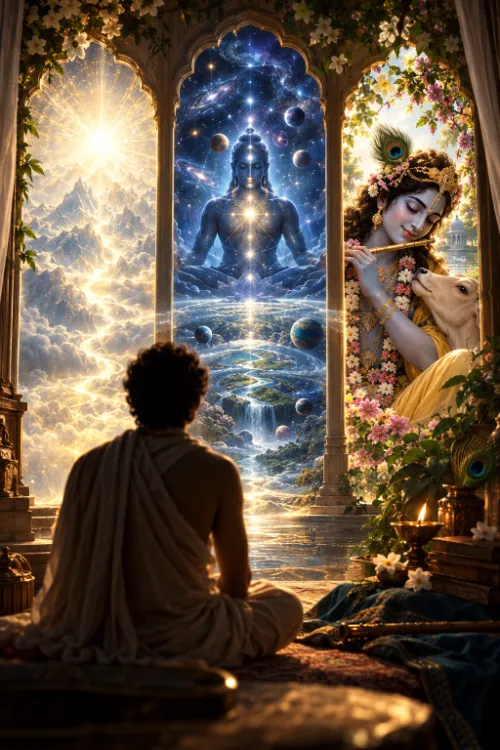
Brahman, Paramātmā and Bhagavān as Three Modes of One Reality
One of the most compact statements of Gauḍīya Vaiṣṇava theology appears in a single Bengali couplet of the Caitanya-caritāmṛta. In two lines, Kṛṣṇadāsa Kavirāja explains how one nondual Absolute Reality can be known as Brahman, Paramātmā, and Bhagavān without becoming three different Absolutes.
প্রকাশবিশেষে তেঁহ ধরে তিন নাম ।
ব্রহ্ম, পরমাত্মা আর স্বয়ং-ভগবান্ ॥
prakāśa-viśeṣe teṅha dhare tina nāma
brahma, paramātmā āra svayaṁ-bhagavān
“According to the particular manner of His manifestation, He bears three names: Brahman, Paramātmā, and Svayaṁ Bhagavān.”
Caitanya-caritāmṛta, Ādi 2.10
The familiar translation—“In terms of His various manifestations, He is known in three features”—is accurate. But the Bengali contains several theological clues that deserve careful attention.
The first is teṅha: “He.” Kṛṣṇadāsa does not say that three independent realities exist. One “He” bears three names. The second is prakāśa-viśeṣe: “according to the particular manifestation,” or “according to the specific mode of revelation.”
And the third is svayaṁ-bhagavān. Kṛṣṇadāsa does not merely write Bhagavān. He deliberately says Svayaṁ Bhagavān—Bhagavān Himself, preparing the ground for his central argument that the fullest manifestation of the Absolute is Śrī Kṛṣṇa.
The verse therefore contains an entire metaphysics in miniature: one Absolute Reality, differently manifested and differently realized, culminating in Svayaṁ Bhagavān.
The Sanskrit foundation: one nondual Reality
Kṛṣṇadāsa immediately supplies the scriptural foundation for his statement by quoting one of the most important verses in the Śrīmad-Bhāgavatam.
वदन्ति तत्तत्त्वविदस्तत्त्वं यज्ज्ञानमद्वयम् ।
ब्रह्मेति परमात्मेति भगवानिति शब्द्यते ॥
vadanti tat tattva-vidas
tattvaṁ yaj jñānam advayam
brahmeti paramātmeti
bhagavān iti śabdyate
“Those who know Reality declare that the Absolute Truth is nondual consciousness. It is spoken of as Brahman, Paramātmā, and Bhagavān.”
Śrīmad-Bhāgavatam 1.2.11
This verse establishes the controlling principle for everything that follows:
Jñānam advayam — nondual conscious Reality
The Absolute is not divided into three competing divine substances. It is advaya—without a second. Brahman is not one Absolute, Paramātmā another, and Bhagavān a third. They are names applied to the same tattva according to the manner in which that tattva becomes manifest and is realized.
This is why the verse begins with the singular: tattvam yaj jñānam advayam “that Reality which is nondual consciousness” and only afterward gives the three designations: brahma iti, paramātmā iti, bhagavān iti.
For Gauḍīya theologians, especially Jīva Gosvāmī, this verse became one of the fundamental keys for understanding the entire Bhāgavata Purāṇa. Jīva develops its implications throughout his Ṣaṭ-sandarbha: the Absolute is one and indivisible, yet it is apprehended as unqualified Brahman, immanent Paramātmā, and fully self-revealed Bhagavān.
This is not a movement from falsehood to truth. Brahman and Paramātmā are not illusions. It is a movement from less differentiated revelation toward greater fullness of revelation.
What does prakāśa-viśeṣe actually mean?
The expression deserves special attention. Prakāśa means manifestation, appearance, disclosure, illumination or revelation. Viśeṣa means distinction, specificity or particularity.
Thus prakāśa-viśeṣe suggests: “according to the particular way in which the one Absolute manifests Himself.” This is more sophisticated than saying that different religious people merely imagine God differently.
Kṛṣṇadāsa is making both an ontological and an epistemological statement. The Absolute actually possesses different modes of manifestation; at the same time, different spiritual disciplines encounter Him according to the manner in which He is revealed through them.
Kṛṣṇadāsa later explains:
জ্ঞানযোগমার্গে তাঁরে ভজে যেই সব ।
ব্রহ্ম-আত্মারূপে তাঁরে করে অনুভব ॥
jñāna-yoga-mārge tāṅre bhaje yei saba
brahma-ātma-rūpe tāṅre kare anubhava
“Those who approach Him through the paths of knowledge and yoga perceive that same Lord in the forms of Brahman and Paramātmā.”
Caitanya-caritāmṛta, Ādi 2.26
Again the key word is tāṅre—“Him.” The jñānī, yogī and bhakta are not necessarily approaching three unrelated objects. They encounter the one Absolute according to different modes of revelation.
In broad Gauḍīya terms, jñāna tends toward realization of Brahman, contemplative yoga toward realization of Paramātmā, and bhakti toward direct realization of Bhagavān. But Bhagavān is not thereby merely a third item sitting beside the other two.
He is understood as the fullest manifestation of the Reality already encountered as Brahman and Paramātmā.
Brahman: the Absolute experienced without personal differentiation
Immediately after quoting Śrīmad-Bhāgavatam 1.2.11, Kṛṣṇadāsa explains what he means by Brahman.
তাঁহার অঙ্গের শুদ্ধ কিরণ-মণ্ডল ।
উপনিষৎ কহে তাঁরে ব্রহ্ম সুনির্মল ॥
tāṅhāra aṅgera śuddha kiraṇa-maṇḍala
upaniṣat kahe tāṅre brahma sunirmala
“The Upaniṣads call the pure transcendental realm of rays emanating from Him the spotless Brahman.”
Caitanya-caritāmṛta, Ādi 2.12
This makes the Gauḍīya position unusually explicit. Brahman is not a second Reality existing independently of Bhagavān. It is the unlimited spiritual radiance of the Supreme Reality apprehended without the full revelation of personal form, qualities, relationships and līlā.
Kṛṣṇadāsa strengthens this interpretation by invoking the Brahma-saṁhitā.
यस्य प्रभा प्रभवतो जगदण्डकोटि-
कोटीष्वशेषवसुधादिविभूतिभिन्नम् ।
तद्ब्रह्म निष्कलमनन्तमशेषभूतं
गोविन्दमादिपुरुषं तमहं भजामि ॥
yasya prabhā prabhavato jagad-aṇḍa-koṭi-
koṭīṣv aśeṣa-vasudhādi-vibhūti-bhinnam
tad brahma niṣkalam anantam aśeṣa-bhūtaṁ
govindam ādi-puruṣaṁ tam ahaṁ bhajāmi
“I worship Govinda, the original Person, whose radiance is that unlimited, indivisible Brahman, extending beyond innumerable universes with their countless manifestations.”
Brahma-saṁhitā 5.40
The crucial expression is: yasya prabhā … tad brahma “Whose radiance … is that Brahman.” The relationship is therefore analogous to that between the sun and sunlight.
Sunlight is real. It is not separate from the sun in origin or nature. Yet experiencing sunlight is not identical with entering into the fullest possible encounter with its source.
Kṛṣṇadāsa himself summarizes this immediately afterward: the immeasurable Brahman spreading through countless universes is Govinda’s effulgence.
Bhagavad-gītā: Brahman rests upon Kṛṣṇa
A particularly important text for the Gauḍīya interpretation occurs near the end of the fourteenth chapter of the Bhagavad-gītā.
ब्रह्मणो हि प्रतिष्ठाहममृतस्याव्ययस्य च ।
शाश्वतस्य च धर्मस्य सुखस्यैकान्तिकस्य च ॥
brahmaṇo hi pratiṣṭhāham
amṛtasyāvyayasya ca
śāśvatasya ca dharmasya
sukhasyaikāntikasya ca
“For I am indeed the foundation of Brahman—the immortal and imperishable reality, the eternal dharma, and ultimate happiness.”
Bhagavad-gītā 14.27
The striking expression is: brahmaṇaḥ pratiṣṭhā aham “I am the foundation of Brahman.” For Gauḍīya Vaiṣṇavas, this is incompatible with the idea that Kṛṣṇa is merely a temporary personal appearance arising from an ontologically higher impersonal Brahman.
The direction is reversed. Brahman rests upon Him. This is one reason Gauḍīya Vedānta can affirm the infinitude of Brahman while still holding Bhagavān to be the more complete disclosure of the Absolute.
“Impersonal” does not mean unconscious
The English word impersonal can easily create confusion. Brahman is not regarded as dead energy, cosmic matter, unconscious light or metaphysical nothingness. The Bhāgavata describes the Absolute itself as: jñānam advayam “nondual consciousness.”
Thus the term “impersonal Brahman” means that personal differentiation is not manifest in that realization. The experiencer encounters unlimited spiritual being and consciousness, but does not yet encounter the full particularity of Bhagavān’s name, form, qualities, relationships and līlā.
The Upaniṣads famously describe the Absolute as the luminosity behind every other luminosity.
न तत्र सूर्यो भाति न चन्द्रतारकं
नेमा विद्युतो भान्ति कुतोऽयमग्निः ।
तमेव भान्तमनुभाति सर्वं
तस्य भासा सर्वमिदं विभाति ॥
na tatra sūryo bhāti na candra-tārakaṁ
nemā vidyuto bhānti kuto ’yam agniḥ
tam eva bhāntam anubhāti sarvaṁ
tasya bhāsā sarvam idaṁ vibhāti
“There the sun does not shine, nor the moon and stars; lightning does not illumine it—what then of ordinary fire? Everything shines because that Reality shines; by its light all this is illuminated.”
Muṇḍaka Upaniṣad 2.2.10
Kṛṣṇadāsa explicitly connects this Upaniṣadic language of transcendental luminosity with Brahman. But his argument goes further: the luminosity has a source.
Paramātmā: the Absolute as the indwelling Supreme Self
The second manifestation is Paramātmā. Parama means “supreme,” and ātman means “self.” Paramātmā is therefore the Supreme Self, particularly the Lord manifested within the cosmos and within the hearts of living beings.
Kṛṣṇadāsa writes:
আত্মান্তর্যামী যাঁরে যোগশাস্ত্রে কয় ।
সেহ গোবিন্দের অংশ বিভূতি যে হয় ॥
ātmāntaryāmī yāṅre yoga-śāstre kaya
seha govindera aṁśa vibhūti ye haya
“He whom the yoga scriptures describe as the indwelling Supreme Self is a plenary manifestation of Govinda.”
Caitanya-caritāmṛta, Ādi 2.18
Another crucial term appears here: antaryāmī — the inner ruler or indwelling controller. Paramātmā is not simply a vague universal spirit. He is the conscious divine presence within living beings, witnessing, accompanying and governing the workings of material existence.
The Bhagavad-gītā states this directly.
ईश्वरः सर्वभूतानां हृद्देशेऽर्जुन तिष्ठति ।
भ्रामयन्सर्वभूतानि यन्त्रारूढानि मायया ॥
īśvaraḥ sarva-bhūtānāṁ
hṛd-deśe ’rjuna tiṣṭhati
bhrāmayan sarva-bhūtāni
yantrārūḍhāni māyayā
“The Supreme Lord resides in the heart of every living being, O Arjuna, directing the wanderings of beings who are mounted upon the machine of material nature.”
Bhagavad-gītā 18.61
And elsewhere Kṛṣṇa says:
सर्वस्य चाहं हृदि सन्निविष्टो
मत्तः स्मृतिर्ज्ञानमपोहनं च ।
sarvasya cāhaṁ hṛdi sanniviṣṭo
mattaḥ smṛtir jñānam apohanaṁ ca
“I am situated in everyone’s heart; from Me arise remembrance, knowledge and forgetfulness.”
Bhagavad-gītā 15.15
Paramātmā is therefore not merely “God spread everywhere.” It is God personally present everywhere.
“Localized Paramātmā” does not mean a spatially limited God
The expression “localized Paramātmā” can also mislead. It does not mean that God becomes compressed into tiny physical locations. Kṛṣṇadāsa gives a precise analogy.
অনন্ত স্ফটিকে যৈছে এক সূর্য ভাসে ।
তৈছে জীবে গোবিন্দের অংশ প্রকাশে ॥
ananta sphaṭike yaiche eka sūrya bhāse
taiche jīve govindera aṁśa prakāśe
“As one sun appears reflected in innumerable crystals, so Govinda manifests His expansion within innumerable living beings.”
Caitanya-caritāmṛta, Ādi 2.19
The point is not that God breaks Himself into billions of fragments. The point is almost the opposite. The one Supreme can be fully present to innumerable beings without ceasing to be one.
Kṛṣṇadāsa reinforces this with Bhīṣma’s realization at the end of his life.
तमिममहमजं शरीरभाजां
हृदि हृदि धिष्ठितमात्मकल्पितानाम् ।
प्रतिदृशमिव नैकधार्कमेकं
समधिगतोऽस्मि विधूतभेदमोहः ॥
tam imam aham ajaṁ śarīra-bhājāṁ
hṛdi hṛdi dhiṣṭhitam ātma-kalpitānām
pratidṛśam iva naikadhārkam ekaṁ
samadhigato ’smi vidhūta-bheda-mohaḥ
“I now realize that one unborn Lord who is situated heart after heart among embodied beings. Although He appears differently to different observers, He is one—just as the one sun appears before many.”
Śrīmad-Bhāgavatam 1.9.42
The beautiful phrase is: hṛdi hṛdi — “heart after heart.” One Lord. Countless hearts.
The jīva and Paramātmā are not the same individual self
Vaiṣṇava Vedānta distinguishes the individual conscious being, the jīvātmā, from the indwelling Supreme, Paramātmā. One of the oldest and most famous Upaniṣadic images expresses this distinction through two birds sitting upon the same tree.
द्वा सुपर्णा सयुजा सखाया
समानं वृक्षं परिषस्वजाते ।
तयोरन्यः पिप्पलं स्वाद्वत्त्य्
अनश्नन्नन्यो अभिचाकशीति ॥
dvā suparṇā sayujā sakhāyā
samānaṁ vṛkṣaṁ pariṣasvajāte
tayor anyaḥ pippalaṁ svādv atty
anaśnann anyo ’bhicākaśīti
“Two beautiful birds, inseparable companions, sit upon the same tree. One eats the fruit of the tree; the other does not eat but watches.”
Muṇḍaka Upaniṣad 3.1.1; Śvetāśvatara Upaniṣad 4.6
In the Vaiṣṇava reading, the bird eating the fruits is the jīva, experiencing the consequences of karma. The witnessing bird is the Supreme Self. Thus liberation is not understood simply as the finite individual discovering that he was secretly the omniscient cosmic controller all along. Rather, the jīva awakens to his relationship with the Supreme companion who has accompanied him throughout material existence.
Bhagavān: when the Absolute is revealed as Someone
With Bhagavān the theological perspective changes dramatically. The Absolute is no longer encountered merely as limitless spiritual existence or as the indwelling witness.
The Absolute is revealed as the Supreme Person. This does not mean that an infinite Brahman somehow becomes finite by acquiring a body. That would indeed be a reduction. Gauḍīya theology instead argues that Bhagavān possesses an intrinsic transcendental form—svarūpa—which is categorically different from a material body.
The Brahma-saṁhitā states:
ईश्वरः परमः कृष्णः
सच्चिदानन्दविग्रहः ।
अनादिरादिर्गोविन्दः
सर्वकारणकारणम् ॥
īśvaraḥ paramaḥ kṛṣṇaḥ
sac-cid-ānanda-vigrahaḥ
anādir ādir govindaḥ
sarva-kāraṇa-kāraṇam
“Kṛṣṇa is the Supreme Lord. His form is eternal being, consciousness and bliss. He is beginningless, yet the origin of all; Govinda is the cause of all causes.”
Brahma-saṁhitā 5.1
The remarkable expression is: sac-cid-ānanda-vigrahaḥ His vigraha, His form, consists of:
- sat — eternal being
- cit — consciousness
- ānanda — bliss.
Thus divine form does not mean material limitation.
Within Gauḍīya ontology, formlessness denies material form; it does not deny the possibility of transcendental form. Likewise, transcendence of material qualities does not require the Absolute to lack all qualities whatsoever.
Bhagavān possesses qualities, but they do not arise from the three material guṇas. He possesses form, but His form is not a temporary organism. He possesses personality, but His personality is not produced by psychology, matter or ego.
Why Bhagavān is considered the fullest revelation
The three terms Brahman, Paramātmā and Bhagavān should therefore not be imagined as three equal boxes. Nor should they be imagined quantitatively: Brahman is not “one-third God,” Paramātmā “two-thirds God,” and Bhagavān “the whole God.”
The Absolute is always indivisible. The difference concerns manifest fullness. Brahman reveals the Absolute’s unlimited spiritual existence and consciousness. Paramātmā reveals the same Reality as the immanent Supreme Self and cosmic governor.
Bhagavān reveals that same Absolute together with form, attributes, energies, will, beauty, relationships and līlā. One useful shorthand is: Brahman: the Absolute is. Paramātmā: the Absolute is present.
Bhagavān: the Absolute is Someone. And Gauḍīya bhakti goes further still: That Someone can be known, served, loved, and can reciprocate love. This is why Jīva Gosvāmī regards Bhagavān as the most complete manifestation of advaya-jñāna-tattva.
Bhagavān includes everything that is true of Brahman and Paramātmā, while Brahman realization does not disclose everything that is manifest in Bhagavān.
Why Kṛṣṇadāsa says Svayaṁ Bhagavān
Here we reach one of the most important details in Ādi 2.10. Śrīmad-Bhāgavatam 1.2.11 says: brahmeti paramātmeti bhagavān iti śabdyate “Brahman, Paramātmā and Bhagavān.” But Kṛṣṇadāsa writes: brahma, paramātmā āra svayaṁ-bhagavān He deliberately adds svayam.
Why? Because another foundational verse of the Bhāgavata identifies Kṛṣṇa in exactly those terms.
एते चांशकलाः पुंसः कृष्णस्तु भगवान् स्वयम् ।
इन्द्रारिव्याकुलं लोकं मृडयन्ति युगे युगे ॥
ete cāṁśa-kalāḥ puṁsaḥ
kṛṣṇas tu bhagavān svayam
indrāri-vyākulaṁ lokaṁ
mṛḍayanti yuge yuge
“These are portions or portions of portions of the Supreme Person, but Kṛṣṇa is Bhagavān Himself. They appear age after age to protect the world when it is troubled by hostile forces.”
Śrīmad-Bhāgavatam 1.3.28
The decisive phrase is: kṛṣṇas tu bhagavān svayam “Kṛṣṇa, however, is Bhagavān Himself.” That little word tu—“but,” “however”—is enormously important in Gauḍīya theology.
The text has just enumerated numerous divine descents. Then it distinguishes Kṛṣṇa. For Kṛṣṇadāsa Kavirāja and Jīva Gosvāmī this becomes the scriptural foundation for the doctrine that Kṛṣṇa is not merely one avatāra among many.
He is Svayaṁ Bhagavān—the original personal form from whom other divine manifestations proceed. This proposition becomes the central subject of Jīva Gosvāmī’s Kṛṣṇa-sandarbha.
The sun analogy ties everything together
Kṛṣṇadāsa repeatedly uses the sun because it provides a remarkably effective way of explaining unity together with differentiated manifestation. The analogy can be summarized like this.
Brahman is comparable to sunlight. One encounters the sun through its boundless radiance. Paramātmā is comparable to one sun reflected in innumerable jewels or bodies of water.
One source appears simultaneously in countless locations. Bhagavān is comparable to encountering the luminous source itself. The analogy should not be pressed too literally. The spiritual Absolute is not physically separated from Brahman in the way a material solar globe is separated from rays extending through space.
Nevertheless, the analogy communicates Kṛṣṇadāsa’s central point: the rays, reflections and source are intimately related, but they do not disclose the source with equal completeness.
Why bhakti reveals what speculation alone cannot
Kṛṣṇadāsa connects these distinctions directly with spiritual practice.
ভক্তিযোগে ভক্ত পায় যাঁহার দর্শন ।
সূর্য যেন সবিগ্রহ দেখে দেবগণ ॥
bhakti-yoge bhakta pāya yāṅhāra darśana
sūrya yena savigraha dekhe deva-gaṇa
“Through bhakti-yoga the devotee obtains His direct vision, just as the celestial beings behold the sun together with its personal form.”
Caitanya-caritāmṛta, Ādi 2.25
The crucial theological point is that Bhagavān is not manufactured by devotion. Bhakti does not anthropomorphize an originally impersonal Reality. Rather, according to the Gauḍīya understanding, bhakti is the means by which the personal fullness already inherent in the Absolute becomes revealed.
This distinction changes the entire debate. The question is no longer: “Does the devotee project personality onto the Absolute?” The Gauḍīya answer is: “No. Personality belongs eternally to the Absolute; realization may simply fail to disclose its fullness.”
Thus Brahman realization is true, but incomplete in terms of revealed particularity.
Form does not necessarily mean limitation
Much confusion arises because human experience associates form with limitation. A material body necessarily occupies one location rather than another. It is composed of parts, ages, changes and eventually dies.
Therefore one may reason: “If the Absolute has form, the Absolute must be limited.” Gauḍīya Vedānta rejects the assumption behind the argument. It distinguishes material form from spiritual svarūpa.
Material form is imposed upon the living being through material nature. Bhagavān’s form is intrinsic to Bhagavān. It is not something He acquires. It is not produced. It is not composed of dead matter.
It is not subject to decay. Hence sac-cid-ānanda-vigrahaḥ: divine form is identified with eternal being, consciousness and bliss itself. This also explains why descriptions such as nirguṇa or “without qualities” need not mean “devoid of all attributes” in Vaiṣṇava interpretation.
They may instead indicate freedom from material guṇas and material limitation. The transcendent can therefore be beyond material qualities while possessing unlimited spiritual qualities.
The most important distinction: nondual does not mean featureless
The verse jñānam advayam is sometimes assumed to imply that all differentiation must ultimately disappear. But Gauḍīya theology makes a different philosophical move. It argues that nonduality does not require featurelessness.
If form, qualities, energies and relationships belong intrinsically to the Absolute rather than arising from some second independent substance, their existence does not violate nonduality.
Bhagavān and His intrinsic potency do not create two competing Absolutes. Similarly, the Lord’s form and the Lord Himself are not regarded as two separate material entities.
Thus divine variety can exist within nondual Reality. This principle is fundamental for understanding why Gauḍīya theology can speak simultaneously of: absolute unity, infinite variety, divine personality, innumerable manifestations, and eternal loving relationships.
The Absolute is one, but oneness does not require emptiness of distinction.
Why Bhagavān matters especially for bhakti
The transition from Brahman to Bhagavān is not merely an abstract metaphysical refinement. It changes the very meaning of spiritual life. Brahman may be realized. Paramātmā may be contemplated and perceived as the indwelling Lord.
But Bhagavān can become the object of reciprocal relationship. Once the Absolute is understood as personal, entirely new spiritual categories become possible: service, surrender, friendship, affection, intimacy, remembrance, separation, reunion, beauty, līlā and prema.
This is where Gauḍīya theology ultimately wants to go. Its highest question is not simply: “What is the Absolute?” It becomes: “What relationship can exist between the individual conscious being and the infinite conscious Absolute?”
The answer is bhakti. And the culmination of bhakti is prema—divine love. That is why Bhagavān is not merely a philosophical conclusion. For Gauḍīyas, Bhagavān is the necessary foundation of an eternal loving relationship between God and the jīva.
From Bhagavān to Kṛṣṇa—and from Kṛṣṇa to Caitanya
This finally reveals why Ādi-līlā 2.10 occurs exactly where it does. Kṛṣṇadāsa Kavirāja is not writing an abstract textbook on comparative Vedānta. His immediate purpose in the second chapter of the Caitanya-caritāmṛta is to establish the identity of Śrī Caitanya Mahāprabhu.
His argument develops in stages. The Absolute Reality is one. That one Reality is known as Brahman, Paramātmā and Bhagavān. Brahman is Govinda’s spiritual radiance. Paramātmā is Govinda’s indwelling expansion.
The fullest manifestation is Bhagavān. The Bhāgavata identifies Kṛṣṇa as Bhagavān svayam. Then Kṛṣṇadāsa makes his decisive move.
সেইত’ গোবিন্দ সাক্ষাচ্চৈতন্য গোসাঞি ।
জীব নিস্তারিতে ঐছে দয়ালু আর নাই ॥
seita govinda sākṣāc caitanya gosāñi
jīva nistārite aiche dayālu āra nāi
“That very Govinda has personally appeared as Caitanya Gosāñi. No one is so merciful in delivering the living beings.”
Caitanya-caritāmṛta, Ādi 2.22
This is the destination toward which the entire discussion has been moving. Brahman → Paramātmā → Bhagavān → Svayaṁ Bhagavān Kṛṣṇa → Śrī Caitanya. The chapter’s ontology therefore serves its Christological-like—or more properly, Caitanya-theological—purpose: identifying who Caitanya is.
Kṛṣṇadāsa’s claim is not merely that Caitanya is a saint who teaches devotion to God. His claim is far more radical: the very Govinda who is the source of Brahman and the source of Paramātmā has appeared as Śrī Caitanya in the mood and role of His own devotee.
Caitanya-caritāmṛta Ādi 2.10 is therefore much more than a classification of three theological concepts. It presents a distinctive vision of reality. Brahman is true. Paramātmā is true.
Bhagavān is true. They do not represent three independent Absolutes. Nor does Gauḍīya theology treat them as three entirely equivalent descriptions that reveal exactly the same content.
The controlling principle is: advaya-jñāna-tattva—one nondual conscious Reality. But that Reality manifests with differing degrees of disclosed particularity. As Brahman, the Absolute is realized as unlimited spiritual being and consciousness.
As Paramātmā, that Reality is revealed as the immanent Supreme Self, accompanying every jīva and governing cosmic existence. As Bhagavān, the same Absolute is revealed in His fullness as the transcendent Person possessing eternal form, qualities, energies, beauty, will, relationships and līlā.
And according to the distinctively Gauḍīya reading of the Bhāgavata: kṛṣṇas tu bhagavān svayam “Kṛṣṇa is Bhagavān Himself.” That is why Kṛṣṇadāsa’s apparently simple expression— prakāśa-viśeṣe “according to the particular manifestation”— is so profound.
It allows him to preserve absolute unity without abolishing divine variety. The deepest formula of the passage could therefore be expressed as:
- One tattva.
- Three primary modes of revelation.
- Increasing fullness of disclosed personality.
- The culmination: Svayaṁ Bhagavān Śrī Kṛṣṇa.
And the next step in the Caitanya-caritāmṛta is even more astonishing: That very Kṛṣṇa has appeared as Śrī Caitanya.