

The Secret of Kṛṣṇa’s Appearance
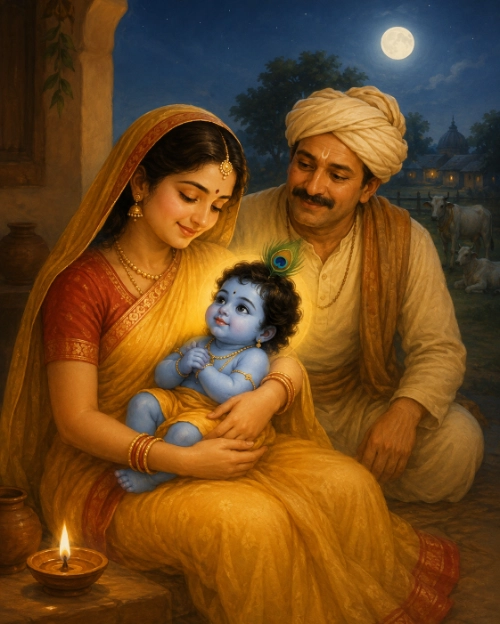
The Secret of Kṛṣṇa's Appearance: Janma-tattva, the Descent into Vraja, and Why Kṛṣṇa Appears
The question this lecture asks is not when or where Kṛṣṇa was born, but what the tattva of his janma is — and the answer it builds towards is a distinction most retellings never draw: that the child who appears before Devakī in the Mathurā prison and the child born from Yaśodā in Vraja are not, in the Gauḍīya reading, simply the same event told twice.
Why Hearing Kṛṣṇa-kathā Matters
The external reason, and the internal one
The lecture opens by separating two dimensions of avatāra. The external reasons are the familiar ones Kṛṣṇa states himself — yadā yadā hi dharmasya glānir bhavati bhārata, and then:
paritrāṇāya sādhūnāṁ
vināśāya ca duṣkṛtām
dharma-saṁsthāpanārthāya
sambhavāmi yuge yuge
Protecting the devotees, destroying what is destructive, and re-establishing dharma.
But the speaker’s subject is the hidden internal reason: Kṛṣṇa’s own desire to taste particular dimensions of rasa. Everything in the talk works towards that.
What kathā is actually for
Kṛṣṇa performs beautiful līlās so that people may hear about him and become attached to him. Career, wealth, friendship, marriage, children, grandchildren — none of these finally removes bewilderment. The lecturer recalls Radhanath Swami’s answer to the question what is guaranteed in the material world?
— bewilderment. One must therefore become attached to the one who is himself full of bliss. The sequence is: hearing → attachment → love of Kṛṣṇa.
Kathā as a detergent
śṛṇvatāṁ sva-kathāḥ kṛṣṇaḥ
puṇya-śravaṇa-kīrtanaḥ
hṛdy antaḥ-stho hy abhadrāṇi
vidhunoti suhṛt satām
Śrīmad-Bhāgavatam 1.2.17
The image offered is a powerful detergent: even deeply set stains come out of cloth, and accumulated impurity is washed from the heart the same way, by hearing.
A digression on Bhādra
Abhadrāṇi prompts a cluster of associations, since bhadra means auspicious and Bhādra is the month:
- Rādhāṣṭamī falls in Bhādra;
- Śukadeva’s seven-day recitation to Parīkṣit is said to have begun on Rādhāṣṭamī;
- the seventh day culminated at Bhādra Pūrṇimā;
- Bhādra Pūrṇimā is specially associated with gifting the Śrīmad-Bhāgavatam;
- Śrīla Prabhupāda accepted sannyāsa on Bhādra Pūrṇimā.
And so back to abhadrāṇi: kathā removes everything a-bhadra, everything inauspicious, from the heart.
Hear, sing, remember, enact
From Kṛṣṇa’s instructions to Uddhava — śraddhālur mat-kathāḥ śṛṇvan — the lecturer draws a sequence of devotional engagement:
Devotional theatre, on this reading, is not merely entertainment but a scripturally sanctioned extension of remembering the līlā. One’s dharma, artha and kāma should likewise be directed towards Kṛṣṇa, and the practical benchmark the speaker associates with Śrīla Prabhupāda is simply: will this activity take someone closer to Kṛṣṇa? The result is labhate niścalāṁ bhaktiṁ mayi — steady bhakti that does not disappear.
Hari-līlā is inexhaustible
The Bhāgavatam returns endlessly to one subject, hari-līlā-kathā, and calls it amṛta — nectar producing continuing bliss. A person who genuinely develops rasa for kathā, kīrtana and remembrance does not want to leave the source of it.
Why Gauḍīyas Approach Kṛṣṇa Through Gaura
Before entering the birth-līlā at all, the lecturer invokes Prabodhānanda Sarasvatī:
yathā yathā gaura-padāravinde
vindeta bhaktiṁ kṛta-puṇya-rāśiḥ
tathā tathotsarpati hṛdy akasmād
rādhā-padāmbhoja-sudhāmbu-rāśiḥ
The more attachment develops for Gaura’s lotus feet, the more spontaneously the ocean of nectar of Śrī Rādhā’s lotus feet rises within the heart.
Caitanya-candrāmṛta
Hence the insistence that for Gauḍīya Vaiṣṇavas, Kṛṣṇa-līlā is not to be separated from Gaura-līlā — which is why the next quarter of the lecture is about how Mahāprabhu himself kept Janmāṣṭamī.
How Caitanya Mahāprabhu Kept Janmāṣṭamī
Nanda-mahotsava at Jagannātha Purī
During Cāturmāsya the devotees from Bengal stayed with Mahāprabhu at Purī and kept the festivals together. Kṛṣṇadāsa Kavirāja describes the Janmāṣṭamī celebration:
kṛṣṇa-janma-yātrā-dine nanda-mahotsava
gopa-veśa haila prabhu lañā bhakta-saba
On the day of the festival of Kṛṣṇa’s birth, at the Nanda-mahotsava, the Lord and all his devotees dressed as cowherds.
They wore turbans and bandī or bagalbandī garments, cowherd-style clothing, with the women dressed as gopīs. The bandī adjusts by tying — which the speaker connects, drily, with a diet of milk, yogurt, butter and ghee. The devotees carried vessels of milk and yogurt on their shoulders — dadhi dugdha bhara sabe nija-skandhe kari — and entered chanting Hari! Hari!
Who played Nanda and Yaśodā
The lecturer mentions that according to some sources Yaśodā was about 84 when Kṛṣṇa appeared and Nanda about 120, and explains the figures against the much longer lifespans attributed to the previous yugas.
King Pratāparudra was present, with Kāśī Miśra, Sārvabhauma and Tulasī Paḍichā Pātra. They danced and chanted while splashing one another with milk, yogurt and turmeric water until the white cloth was stained golden-yellow.
Advaita Ācārya’s challenge, and the laguḍa
In the middle of the festival Advaita Ācārya challenges Mahāprabhu directly:
laguḍa phirāite pāra tabe jāni gopa
“If You can properly wield this cowherd staff, then I shall accept that You are truly a gopa.”
The laguḍa is distinguished from the other cowherd sticks — there are three kinds associated with the gopas, as there are seven kinds of flute. It stands roughly the height of a grown man, five and a half to six feet; it is used against wild animals and to control strong bulls, and individual cowherds carry their own characteristic staffs.
Mahāprabhu accepts. He twirls the staff, throws it high and catches it, spins it above his head, behind his back, in front, on both sides, and passes it between his legs, until the crowd is astonished:
alāta-cakrera prāya laguḍa phirāya
He whirled the staff like an alāta-cakra — the circle of fire that appears when a firebrand is spun rapidly.
It seemed, the speaker says, to become Sudarśana-cakra itself, even throwing sparks. Nityānanda Prabhu then performs his own extraordinary staff-play, and Kṛṣṇadāsa Kavirāja simply asks ke bujhibe tāhāra duṅhāra gopa-bhāva gūḍha — who can understand the profound cowherd mood of these two?
Nityānanda’s unrestricted mercy
The lecturer connects Nityānanda’s wild spontaneity to his identity as Balarāma and as an avadhūta, illustrating it through the preaching he did with Haridāsa Ṭhākura under Mahāprabhu’s command — prati ghare giyā… bolo kṛṣṇa, bhajo kṛṣṇa, koro kṛṣṇa-śikṣā, go to every house: speak of Kṛṣṇa, worship Kṛṣṇa, teach his instructions.
- Jumping into the Gaṅgā, imagining it to be the Yamunā;
- approaching crocodiles and inviting them into Kṛṣṇa-bhakti;
- fearlessly approaching people convention would have told him to avoid;
- entering drinking places and telling the drinkers he possessed the best drink of all — the holy name.
The theological point is unrestricted mercy: Nityānanda does not first calculate who is respectable or qualified.
The mahā-vastra
King Pratāparudra arranged for a cloth previously worn by Lord Jagannātha to be brought. It was honoured by being placed upon the head rather than worn casually — deity clothing is prasāda and is treated as such. At the end Mahāprabhu looked upon those dressed as Nanda and Yaśodā and offered obeisances to them in the mood of seeing his own parents, then returned to the Gambhīrā.
So Mahāprabhu kept Janmāṣṭamī not by discussing Kṛṣṇa but by dressing as a Vrajavāsī, dancing, chanting, enacting the Vraja-līlā and entering gopa-bhāva.
The External Reason for the Descent
Bhūmi-devī overburdened
The Earth suffers because oppressive rulers exploit her and her resources — Kaṁsa, Dantavakra, Śiśupāla, Śālva, of whom Śālva is given as an example of extraordinary extraction of precious materials from deep within her.
Bhū-devī is herself a consort of the Lord. When Varāhadeva lifted the Earth on his tusk and rescued her, she desired him as her husband; and so South Indian Viṣṇu temples commonly show Nārāyaṇa accompanied by both Śrī-Lakṣmī and Bhū-devī.
The devas petition, and how the answer comes
Bhū-devī approaches Brahmā; Brahmā, Śiva and the devas proceed to Kṣīra-sāgara and pray to Kṣīrodakaśāyī Viṣṇu. The lecturer makes a practical point here that is easy to miss: Brahmā does not necessarily receive a visible personal audience — he hears the response. Devotees should likewise not expect every prayer to produce an overt supernatural answer. Kṛṣṇa may reply through devotees, through guru, through unexpected guidance, through circumstances. The skill to be learned is recognising reciprocation.
The hierarchy of expansions
Kṛṣṇa
 └─ Balarāma
     └─ Mūla-Saṅkarṣaṇa
         └─ Mahā-Saṅkarṣaṇa
             └─ Mahā-Viṣṇu
                 └─ Garbhodakaśāyī Viṣṇu
                     └─ Kṣīrodakaśāyī Viṣṇu
The message Brahmā receives is that the original source will himself descend, and that the devas and their consorts should appear on Earth before him, together with personalities descending from Vaikuṇṭha.
Rādhā sends the dhāma ahead
Drawing on the Garga-saṁhitā tradition, the lecturer relates that when Kṛṣṇa asks Rādhā to descend, she answers that she will not be attracted to a place that has neither Govardhana nor the Yamunā. The order of descent therefore runs:
The meaning is that the earthly līlā does not begin in an empty landscape. The eternal dhāma and its associates come down with him.
When Does Svayaṁ Bhagavān Appear?
Once in a day of Brahmā — placed here in the first day of Brahmā’s fifty-first year, in the twenty-eighth catur-yuga, towards the end of Dvāpara and immediately before Kali.
A slip in the recording. At one point the speaker says a day of Brahmā contains 72 catur-yugas, and shortly afterwards states correctly that it contains 1,000. The figure of 72 is evidently an oral slip; the later calculations use 1,000.
The Kakudmī and Revatī calculation
To show how the twenty-eighth catur-yuga is derived from the Bhāgavatam itself, the lecturer turns to King Kakudmī, who goes to Brahmaloka to ask who would suit his daughter Revatī. Brahmā is listening to celestial music, so Kakudmī waits; and by the time the performance ends, the men he had in mind, their sons, their grandchildren and their whole lineages have gone. The verse gives the reason — kālo ’bhiyātaḥ… tri-nava-catur-yugā — which the lecturer reads as tri-nava, three times nine: twenty-seven catur-yugas have passed while he waited. Brahmā then tells him to give Revatī to baladevo mahā-balaḥ, Balarāma. Balarāma’s appearance — and so Kṛṣṇa’s — therefore falls in the twenty-eighth.
Time on Brahmaloka
- One day of Brahmā = 1,000 catur-yugas;
- one catur-yuga = 12,000 deva-years;
- one second of Brahmā ≈ 100,000 human years, by the speaker’s reckoning;
- Kali-yuga’s 432,000 years would then pass in about 4.32 seconds;
- Kakudmī’s wait of 27 catur-yugas ≈ 19 minutes 44 seconds of Brahmā’s experience.
The point is not the arithmetic but the gap between human and Brahmic scales of time.
The Internal Reasons
janma karma ca me divyam
evaṁ yo vetti tattvataḥ
tyaktvā dehaṁ punar janma
naiti mām eti so ’rjuna
Bhagavad-gītā 4.9
Kṛṣṇa’s birth and activities are divya, transcendental — and liberation does not follow from knowing the outward narrative. One must understand tattvataḥ, in truth. The same chapter gives the method: tad viddhi praṇipātena paripraśnena sevayā, upadekṣyanti te jñānaṁ jñāninas tattva-darśinaḥ. One learns janma-tattva from those who have seen the truth — here principally Kavi Karṇapūra and Jīva Gosvāmī.
Kavi Karṇapūra gives the deepest answer: Kṛṣṇa appears in the twenty-eighth catur-yuga for his own pleasure. Two internal reasons follow.
First: mādhurya with full separation
Kṛṣṇa wishes to experience mādhurya-rasa with Śrī Rādhā including its dimensions of separation — so the earthly descent creates modes of loving experience not manifested in exactly the same way in eternal Goloka.
Second: Yaśodā’s expanded vātsalya
Yaśodā’s love is fully eternal in Goloka, but the earthly līlā permits additional vyabhicāri-bhāvas, the transitory intensifying emotions — of which the Bhakti-rasāmṛta-sindhu enumerates thirty-three. The example given is anxiety. In Goloka Yaśodā may worry whether Kṛṣṇa will finish his plate; in Bhauma Vṛndāvana she can say please don’t go to the forest — what if a demon attacks you? Please come back safely.
Because Kṛṣṇa appears genuinely vulnerable inside a human-like līlā, maternal love acquires dramatic intensities it could not otherwise have.
The Family Background of Nanda and Vasudeva
Following Jīva Gosvāmī’s Gopāla-campū, the lineage runs:
Yadu → Yādava lineage → Devamīḍha
   ├─ Kṣatriya wife → Śūrasena → Vasudeva
   └─ Vaiśya wife  → Parjanya → the Vraja cowherd line
Parjanya has five sons — Upananda, Abhinanda, Nanda, Sananda and Nandana — Nanda being the middle one. Their settlement is described as Bṛhadvana, Mahāvana and Gokula, treated here as names for the same general place, where roughly a thousand gopa families lived.
Why the middle son becomes king
When Parjanya retires he first offers the leadership to Upananda, the eldest, who declines: of all the brothers it is Nanda who gives the greatest happiness to the cowherds, so Nanda should lead Vraja. Upananda observes that although he is older, his own name carries upa — secondary — and that he can serve as Nanda’s adviser. Nanda marries Yaśodā, daughter of a gopa named Sumukha; yaśas is fame or glory and dā is giver, so Yaśodā is she who distributes glory.
Nanda as “Vasudeva,” Yaśodā as “Kīrtidā” and “Devakī”
Here comes a distinctive Gauḍīya interpretive point. The lecturer notes that the Harivaṁśa gives Vasudeva as another name of Nanda — vasu, wealth, and deva, lord: the lord of wealth, wealthiest of the gopas. And for Yaśodā:
His summary is blunt: For us, Devakī is Yaśodā; Vasudeva is also Nanda.
He immediately acknowledges that the Vasudeva and Devakī of Mathurā are also distinct personalities in their own right. The identification is a devotional reading, not a denial of them.
Nanda and Yaśodā Desire a Child
The couple remain childless, and the Vrajavāsīs long for an heir. Sacrifices are performed, including putreṣṭi-yajña, and no son appears. Jīva Gosvāmī’s explanation, as presented here, is lovely: a mundane ritual can produce only a mundane child, and Nanda and Yaśodā are not destined to receive an ordinary son. They desire the one more beautiful than Nārāyaṇa himself.
Then Nanda dreams of an extraordinarily beautiful bluish boy. The child appears within Nanda’s heart and passes from his heart into Yaśodā’s. He wakes and goes to tell her — and before he can speak she tells him she has had exactly the same dream.
They then perform a year-long vow associated with Ekādaśī and Dvādaśī: beginning on an Ekādaśī, observing regulated Ekādaśī eating throughout the cycle, continuing a full year and completing it on the Dvādaśī when the corresponding Ekādaśī returns — comparable to the vow of Ambarīṣa Mahārāja. At its completion Nārāyaṇa appears to Nanda in a dream and promises that his wife shall very soon conceive.
Paurṇamāsī and Madhumaṅgala Arrive
Immediately after that dream an effulgent female ascetic arrives and introduces herself as Paurṇamāsī. She has come from Ujjayinī, possesses astrological knowledge of past, present and future, and predicts that Yaśodā will soon bear a beautiful child. The Vrajavāsīs are so delighted that they build her a cottage on the bank of the Yamunā.
The little boy with her is Madhumaṅgala — son of Sāndīpani Muni of Ujjain, the guru with whom Kṛṣṇa and Balarāma will later study. The boy has been entrusted to Paurṇamāsī and stays in Vraja with her. So Madhumaṅgala is already present before Kṛṣṇa appears.
As the lecturer puts it: Yogamāyā makes all the arrangements; Balarāma creates the environment.
Rohiṇī and Balarāma
On the same day Paurṇamāsī arrives, Rohiṇī — Vasudeva’s wife, described as about three months pregnant — comes to Vraja. Vasudeva, imprisoned with Devakī, has sent her to Nanda for safety.
Four months later, on Mārgaśīrṣa, Kṛṣṇa-pakṣa, the first lunar day, Yaśodā feels movement within her womb: she is now pregnant with the Lord. Meanwhile Devakī appears to miscarry her seventh child. The secret is that Yogamāyā transfers that child into Rohiṇī’s womb — and because he is drawn from one womb to another, Balarāma is called Saṅkarṣaṇa, from the sense of drawing or attracting together.
An ambiguity in the recording. The lecturer had already described Rohiṇī as pregnant with Balarāma before this transfer, and then says Devakī’s seventh child is subsequently transferred into her womb. The talk does not pause to reconcile the two descriptions, and it is left here exactly as given rather than repaired from outside.
Yaśodā’s Pregnancy
An unresolved thread. Nanda’s dream contained a further detail — the bluish boy is covered or enveloped by a golden girl — and the lecturer says we’ll see who this golden girl is; the truth will be revealed.
In the recording he never returns to identify her.
From the Gopāla-campū come intimate details of the pregnancy. Yaśodā’s recurring craving is for a sweet rice preparation of milk, rice, sugar candy and ghee, with a little camphor, Tulasī, and first offered to the Lord — a preparation the lecturer says became traditionally associated with Janmāṣṭamī.
As Yaśodā tastes these things, Kṛṣṇa within her womb tastes them with her, and mother and son come to share identical preferences. The sweetness of it is that Kṛṣṇa’s future love of milk, butter, yogurt and sweetness is already being nourished through Yaśodā before he is born.
Two Manifestations of Kṛṣṇa
This is the doctrinal centre of the lecture. It begins from a testimony in the Harivaṁśa:
garbha-kāle tv asampūrṇe aṣṭame māsi te striyau
devakī ca yaśodā ca suṣuvāte samaṁ tadā
Both women, Devakī and Yaśodā, delivered at the same time, in the incomplete eighth month.
Harivaṁśa 2.4.11
Following Śrīmad-Bhāgavatam 10.3, Devakī does not undergo an ordinary labour. The Lord manifests before her in a four-armed Viṣṇu form bearing śaṅkha, cakra, gadā and padma — the twenty-four principal forms of Viṣṇu differing according to how these four are arranged. Devakī, afraid that Kaṁsa will recognise him, asks him to become an ordinary little child, and the four-armed Lord assumes a baby form. The lecturer calls this child Vāsudeva Kṛṣṇa of Mathurā.
Meanwhile — and this is the secret being argued for — another Kṛṣṇa has appeared in Vraja. From Yaśodā’s womb comes a beautiful bluish boy, Svayaṁ Bhagavān, followed by a twin sister identified here with Mahāmāyā.
Vasudeva Crosses the Yamunā
At the Lord’s instruction the shackles fall open, the prison doors open, the guards are overcome, and Vasudeva carries the Mathurā child towards Gokula with the instruction to exchange him for Nanda’s daughter.
Why is the moon full on aṣṭamī?
Janmāṣṭamī falls on the eighth lunar day, when the moon should not be full — yet the līlā describes it as full. The explanation, attributed to Jīva Gosvāmī and Viśvanātha Cakravartī, is a rasa explanation rather than an astronomical one: the moon became so ecstatic at Kṛṣṇa’s birth that it could not restrain itself and manifested fullness in spite of the tithi.
The female fox, and the waves
The Yamunā is greatly swollen and Vasudeva hesitates. A female fox crosses the river ahead of him — identified here as Mahāmāyā, giving him confidence and showing the way — and he follows. The waters part.
Her great waves rise repeatedly towards the child, and not to harm him: a tiny toe protrudes from the basket, and the Yamunā is reaching for it. What looks externally like danger is the river’s devotional eagerness for Kṛṣṇa’s touch.
The Exchange
At Nanda’s home everyone is asleep under Yogamāyā’s influence. Vasudeva enters the sūtikā-gṛha, the maternity chamber — and although the Vraja Kṛṣṇa has already been born there, he sees only the baby girl, because Yogamāyā conceals the boy from him. (The lecturer also mentions, with amusement, a non-Gauḍīya ācārya’s explanation that tiny Kṛṣṇa simply hid beneath Yaśodā’s sari.)
Vasudeva lays the Mathurā baby beside Yaśodā and carries the girl away — and at that moment the Mathurā manifestation becomes united with the original Vraja Kṛṣṇa.
The analogy offered is two flames. If one candle lights another, the flames can be distinguished, yet both are fire; and brought together they appear as one flame. The lecturer uses the word merge
only reluctantly, stressing that it must not be understood as impersonal dissolution. One divine manifestation is absorbed into another: Vāsudeva Kṛṣṇa into Svayaṁ Bhagavān, the Vraja Kṛṣṇa.
He calls the Mathurā manifestation a kind of prakāśa-aṁśa — one lamp lighting another, the same in nature yet distinguishable as manifestations.
He notes that the precise Gauḍīya categories — prakāśa, aṁśa, svāṁśa, vaibhava-prakāśa — require finer distinctions than he has time to develop, so the taxonomy is left sketched rather than worked out.
The girl then differentiates into two aspects: Yogamāyā, who continues as Paurṇamāsī arranging the Vraja-līlā, and Mahāmāyā, who travels back with Vasudeva to Mathurā. Vasudeva returns to the prison, the doors close, the shackles return, everything externally appears normal — and then the baby girl cries.
How Baby Kṛṣṇa Cries
From the Gopāla-campū comes a charming detail. Ordinary babies cry with ordinary infant sounds; but little Kṛṣṇa cries Om! Om!
The sages hear it and think that Oṁkāra itself has become incarnate. And there is a pun in it, a śleṣa: om can also function as an affirmative, a yes. So his first crying can be heard as Yes! Yes! I am here!
— the Lord announcing his own arrival.
Kaṁsa and the Goddess
The girl’s crying wakes Kaṁsa, who rushes in thinking my death has arrived — and I will kill my death.
He is confused to find the eighth child is a girl, but attempts to kill her as he killed the others. She escapes his hands and manifests in the sky as an eight-armed goddess, telling him that the one who will destroy him has already appeared.
Kaṁsa is himself a worshipper of Durgā and offers obeisance at once — and then distorts her warning completely. Where it means stop your wickedness; your fate is sealed,
he hears I have been looking in the wrong place; the child must be outside the prison; I should search all the villages.
The lecturer draws a general lesson from this: a deeply conditioned person can receive entirely correct advice and still translate it through his conditioning into the opposite conclusion.
The Textual Case for Yaśodā-nandana
The final movement of the lecture assembles the textual clues for the claim that the original Kṛṣṇa is actually born in Vraja, from Yaśodā.
The argument closes with the Śikṣāṣṭaka, where Mahāprabhu himself addresses Kṛṣṇa as nanda-tanuja — tanu, body, and ja, born: one born from Nanda.
ayi nanda-tanuja kiṅkaraṁ
patitaṁ māṁ viṣame bhavāmbudhau
kṛpayā tava pāda-paṅkaja-
sthita-dhūlī-sadṛśaṁ vicintaya
“O son of Nanda, I am your servant, yet I have fallen into this terrible ocean of material duality. By your mercy, please consider me a single particle of dust resting at your lotus feet.”
Śikṣāṣṭaka 5
The lecturer recommends this verse as the Janmāṣṭamī meditation, and notes what the aspiration in it is not. It is not give me mastery.
It is let me become dust at the lotus feet of Nanda’s son.
Kṛṣṇa is eternally Nanda-nandana and Yaśodā-nandana.
Tattva and Rasa
The talk returns at the end to a theme from the previous one. A tattva-darśī is not merely someone who can classify theology intellectually: darśī means one who sees.
This is why the ācāryas can discuss extremely technical ontology and, in the same breath, the sound of a baby’s crying. For them theology is not abstract taxonomy; it has become experienced reality. The lecturer sums the spirit of the literature with madhurādhipater akhilaṁ madhuram — everything about the Lord of sweetness is sweet. Not only Govardhana and the destruction of Kaṁsa and the cosmic theology, but also Yaśodā’s pregnancy cravings, Kṛṣṇa’s cry, his tiny toe, a mother’s worry, and the Yamunā reaching for him. That attention to apparently insignificant intimate detail is itself what rasika revelation means.
Further Details from the Talk
A few points sit outside the central argument but are worth keeping.
The horoscope was prepared but not delivered. The lecturer had a chart of Kṛṣṇa’s birth, attributed to materials from Bhaktivinoda Ṭhākura, Jīva Gosvāmī and Rūpa Gosvāmī, and mentions only fragments: the Moon associated with the ascendant in Taurus; the Moon indicating beauty; Ketu associated with dark complexion; Rāhu in a marriage-related position read as multiple relationships; the Sun read as indicating the killing of his maternal uncle. He explicitly skips the full explanation, so this remains a sketch rather than an argument.
The Chronology in Twenty Steps
The talk finally distinguishes three ways of understanding Janmāṣṭamī. At the level of history, a divine child appears, Vasudeva crosses the Yamunā, and Kaṁsa fails to kill the goddess. At the level of tattva, there is a distinction between Vāsudeva Kṛṣṇa of Mathurā and Svayaṁ Bhagavān, the Yaśodā-nandana of Vraja — and on the Gauḍīya reading presented here, the first is finally absorbed into the second.
At the level of rasa comes the question the whole lecture exists to answer: why does the original Lord descend at all? Not because demons are too powerful for Viṣṇu to handle. He descends because he wishes to taste love — Rādhā’s love intensified through separation, Yaśodā’s maternal love intensified through fear and anxiety and apparent danger, and the unrestrained intimacy of Vraja. Destroying demons and restoring dharma are real, but they are the external reasons. The internal reason is rasa.
Which is also what the festival is for. We do not hear about Kṛṣṇa’s birth merely to learn what happened. We hear until janma becomes tattva; tattva becomes darśana; darśana becomes rasa; rasa becomes attachment; and attachment becomes bhakti. That is the arc of the whole talk.