

Kṛṣṇa’s Bālya, Paugaṇḍa and Kaiśora Līlās
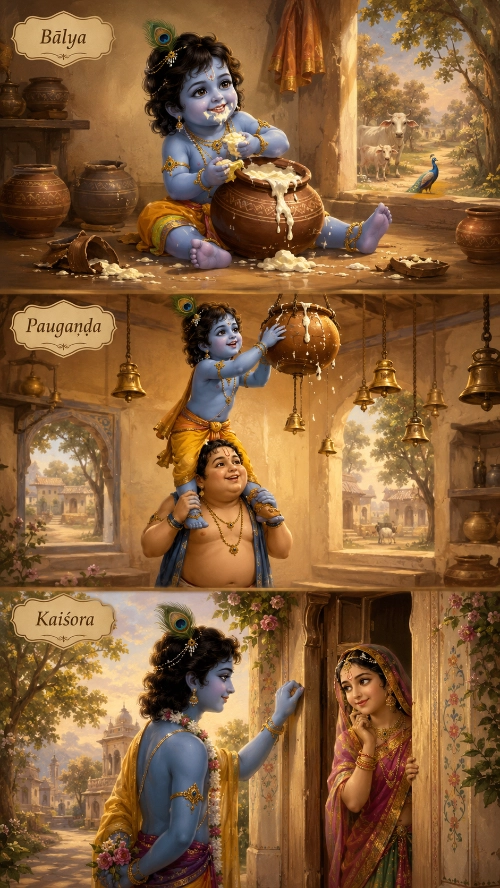
Kṛṣṇa's Bālya, Paugaṇḍa and Kaiśora Līlās
A lecture given on Janmāṣṭamī has to do two things at once: establish who Kṛṣṇa is, and show what he does. Kartik Chandra Das takes the second question seriously enough to date it — walking through the three ages of Kṛṣṇa’s Vraja childhood, the villages he lived in at each, and the līlās that belong to each — and then closes by arguing that the theology and the stories were never two subjects at all.
The verse the lecture is built on concerns two interlocking classifications: avatāras as aṁśa and śaktyāveśa, and Kṛṣṇa’s own manifestations in bālya and paugaṇḍa. Prabhupāda’s purport states that the childhood and boyhood are special features, while the permanent, eternal form is that of an adolescent youth.
The lecturer pauses on a remark of Prabhupāda’s before going further — My purports are my devotional ecstasies
— and takes it to mean that the purports are not intellectual commentary with feeling added afterwards. The realisation is carried in the individual words.
The Age of Kṛṣṇa
Four classical stages
For the division of human age the lecturer cites Śrīdhara Svāmī’s commentary on Śrīmad-Bhāgavatam 10.12.37. The four pādas name four successive stages:
kaumāraṁ pañcābdhāntam |
paugaṇḍaṁ daśamāvadhi |
kaiśoram āpañcadaśāt |
yauvanaṁ ca tataḥ param ||
“Kaumāra to the end of the fifth year; paugaṇḍa as far as the tenth; kaiśora up to the fifteenth; and after that, yauvana.”
This particular formula treats everything after fifteen as yauvana. Other traditional schemes distinguish the later stages of life separately; the verse is not attempting a complete account of a human lifespan.
The eternal ages of Rādhā and Kṛṣṇa
Chronological age during the earthly (bhauma) līlā is one thing; eternal spiritual age and appearance are another. For the second the lecturer turns to Dhyānacandra Gosvāmī’s Bṛhad-Govindārcana-smaraṇa-paddhati, which quotes the Bṛhat Gautamīya Tantra, and the figures given are startlingly exact.
So the familiar statement that Kṛṣṇa is eternally sixteen
turns out to be shorthand. More precisely, he is eternally almost sixteen — poised at the point just before youth completes itself. The lecturer notes that there is a further science behind the exact figures, but does not open it here.
How can an eight-year-old perform the rāsa-līlā?
This produces a genuine chronological problem, and the lecture does not dodge it. Kṛṣṇa lifted Govardhana Hill at seven. The rāsa-līlā follows in the next year, when he is roughly eight. Yet the rāsa-līlā belongs to the nava-yauvana Kṛṣṇa, the fresh youth, and seems to require a far more mature form than an eight-year-old body.
Viśvanātha Cakravartī Ṭhākura and Jīva Gosvāmī resolve it in connection with Śrīmad-Bhāgavatam 10.45.3. Jīva Gosvāmī is quoted approximately as:
saptamārambhe kaiśora-praveśaḥ
“At the beginning of the seventh year, the entry into kaiśora.”
Chronologically Kṛṣṇa is seven or eight. Bodily, he is already manifesting the features and maturity of kaiśora. The principle the lecture draws out of this is worth stating plainly, because everything after it depends on the distinction: chronological age does not necessarily determine manifested transcendental bodily age. The eight-year-old of the earthly chronology can carry the adolescent beauty the rāsa-līlā requires.
Kṛṣṇa’s Movement Through Vraja
A chronological geography
One of the most useful things in the lecture is that it puts the childhood on a map as well as a calendar. Conventionally Kṛṣṇa appears at Mathurā and is carried across the Yamunā that night; the lecturer adds that another theological description has Kṛṣṇa appearing simultaneously in Mathurā and in Gokula-Mahāvana.
Upananda’s council, Brahmagiri and Nandīśvara
Nanda Mahārāja has five brothers, of whom Upananda is the eldest, and it is Upananda who presides over the council of cowherds that decides to leave Vṛndāvana. Their case is straightforward: Kāliya is in the waters, demons come by air, and demons come by land. The region they choose is described as being simultaneously blessed for devotees and cursed for demons.
Two sacred hills mark it. Brahmagiri represents Brahmā and is described as possessing four heads; this becomes associated with Varṣāṇā, and it is there that Vṛṣabhānu Mahārāja, the father of Śrīmatī Rādhārāṇī, settles. Nandīśvara Parvata represents Śiva, and it is there that Nanda Mahārāja settles — the place that becomes Nandagrāma, Nandgaon.
Mathurā → Gokula-Mahāvana → Vṛndāvana → Nandagrāma
                                  Vṛṣabhānu → Varṣāṇā (Brahmagiri)
Bālya-līlā — The Thief
What bālya means
The lecturer gives an explanatory derivation beginning balati mastakaṁ rakṣati saṁvṛṇoti iti, connecting bālya with a child’s developing strength and body. For Kṛṣṇa it is the age of early mischief, and the mischief has one governing theme: butter.
The butter thief
The central passage is Śrīmad-Bhāgavatam 10.8.29, which the lecture takes up from vatsān muñcan kvacid asamaye. The Dāmodara-līlā age is given as roughly two years and two months. Kṛṣṇa can barely walk properly — and is already an accomplished thief.
The name itself is made to carry the point. Harati iti hariḥ — “one who takes away is Hari.” What Kṛṣṇa steals is not finally butter. He steals the hearts of his devotees, and the childish theft is the visible form of that power of attraction.
The strategy: release the calves
To rob a house, Kṛṣṇa first has to empty it, and his method is precise. He waits for asamaya — an inappropriate hour, the middle of the day. Normally a calf is allowed to drink briefly from its mother to start the milk flowing, after which the cow is milked. Kṛṣṇa simply releases the calves at the wrong time. They rush to their mothers, the cows become excited, and the cowherds run outside to regain control of the herd. The house is now empty, and Kṛṣṇa walks in and takes the yogurt, milk and butter.
The scale is worth registering. The smallest ordinary gopa herd was around three hundred cows, and Nanda Mahārāja is said to have possessed some nine hundred thousand. Loosing one household’s calves at midday is not a small disturbance.
The smile that ends the argument
The gopīs return and catch him drinking. They are angry — and Kṛṣṇa looks at them and smiles. The sweetness of it overwhelms the anger completely; they simply stand and watch while he finishes and walks calmly out. This is the actual rasa of the butter-theft narratives, and it is why they are not stories about crime: the anger is real and is defeated by affection every time.
Why steal, when Nanda’s house has everything?
The gopīs make the obvious objection. Kṛṣṇa has no material need whatsoever — Nanda’s wealth in cows, milk, yogurt and butter is enormous. Yet what is stolen is what he prefers, and the lecture takes up steyaṁ svādu: what is obtained by stealing somehow tastes sweeter to him.
When Yaśodā suggests the simple solution — let the gopīs invite him in and feed him as much as he likes — they answer that he would refuse. The theft is not the means. It is the point.
Steya-yoga
Out of which comes the lecture’s best joke, and one of its better pieces of theology. We know karma-yoga, jñāna-yoga, dhyāna-yoga and bhakti-yoga. In Vraja, says the lecturer, Kṛṣṇa has invented one more: steya-yoga, the yoga of stealing. Yoga is what connects; steya is theft; therefore through stealing Kṛṣṇa manufactures intimate connections with his devotees that a formal invitation could never produce.
The lecturer also suggests an etymological link between Sanskrit steya and English “steal.” This is best kept as a speaker’s aside rather than treated as an established historical-linguistic conclusion.
An army of monkeys
Sometimes Kṛṣṇa has eaten so much already that he cannot manage any more, so he brings help. Their leader is Dadhi-lobha — dadhi, yogurt, and lobha, greed; Mr Greedy-for-Yogurt. The troop that can accompany him runs, in the telling, to some twelve thousand monkeys, and among them Kṛṣṇa distributes the stolen butter, yogurt and milk. Vibhajati — he distributes.
Why the monkeys eat first
Then comes the deeper reading. Kṛṣṇa remembers his previous līlā as Rāmacandra. Sītā is described poetically as the personification of Rāma’s heart; Rāvaṇa stole that heart, and it was the monkeys who proved indispensable in finding and recovering her. So Kṛṣṇa tells them, in effect, that he remains eternally in their debt — and since everything belonging to Kṛṣṇa belongs equally to those who served him that intimately, the stolen butter, milk and ghee are theirs by right.
The spiritual world reverses the protocol
The lecturer connects this to the inverted tree of Bhagavad-gītā 15, ūrdhva-mūlam adhaḥ-śākham: the material world is the reflection, the spiritual world the original. Here we offer food to Kṛṣṇa and then eat the prasāda. In Vraja his intimate cowherd friends taste their own food first, decide it is good, and put it into his mouth. In the same way Kṛṣṇa feeds the monkeys before considering whether to eat himself. Intimate Vraja-bhakti does not always look like formal ritual worship, and is not meant to.
And if there is nothing to steal
If he enters a gopī’s house and finds no milk, butter or yogurt at all, the mischief only escalates. He becomes angry and threatens to burn the house down next time, with instructions to have butter and yogurt ready — and on the way out he may scratch or disturb the babies so that they start crying. This is the wildness of the bālya-līlā, before, as the lecture puts it, he becomes a seasoned thief.
Paugaṇḍa-līlā — The Conspirator
Why “paugaṇḍa”
Paugaṇḍa runs from roughly five to ten. The lecturer associates gaṇḍa with the cheeks: it is the age at which a child’s cheeks are still conspicuously round, soft and eminently pullable, before the harder jawline of adolescence arrives.
Bilvamaṅgala Ṭhākura and the Kṛṣṇa-karṇāmṛta
Caitanya Mahāprabhu listened to the Kṛṣṇa-karṇāmṛta every day. Composed by Bilvamaṅgala Ṭhākura, it contains some of the most intimate descriptions of Kṛṣṇa in the tradition, and the paugaṇḍa story that follows is attributed to it.
Madhumaṅgala
Kṛṣṇa’s comic brāhmaṇa companion Madhumaṅgala is called Mansukha in Braj usage — mana, mind, and sukha, happiness: he gives happiness to Kṛṣṇa’s mind. His other name divides as madhu, sweet, and maṅgala, auspicious, and as a brāhmaṇa boy his company is itself regarded as auspicious. He is quite sure, and says so often, that Kṛṣṇa’s ability to kill demons derives entirely from his brāhmaṇical blessings — the evidence being that he is always present whenever Kṛṣṇa does anything heroic.
The pot surrounded by bells
One gopī is known to have particularly delicious milk, and she knows perfectly well that her house is next. So she builds an alarm: the milk pot is hung from the ceiling, bells are hung all around it, she pretends to sleep in another room, and she keeps a daṇḍa within reach. Kṛṣṇa arrives anyway, with Madhumaṅgala.
Through the window
The door is locked, so Kṛṣṇa sends the brāhmaṇa in first. Madhumaṅgala is a large boy and barely fits through the window, and he points out the flaw in the plan: after drinking all that milk and yogurt he will be larger still, and will not get out again. Kṛṣṇa reassures him. They set up a stool; Madhumaṅgala sits on it; Kṛṣṇa climbs onto his shoulders and reaches the suspended pot. Madhumaṅgala remains privately certain that everyone else will escape and he will be the one beaten by the gopī.
The demigod of bells
As the pot moves, the bells are about to sound. Kṛṣṇa declares that he is Lord of the universe and that every bell in it is therefore obliged to obey him; he summons the presiding deity of bells and issues the order that no bell anywhere is to make a sound. The deity agrees. The bells swing as the pot comes free, and stay silent.
Madhumaṅgala drinks first
Kṛṣṇa tilts the pot and the milk begins to flow. Madhumaṅgala cups his hands beneath it and drinks first, and Kṛṣṇa congratulates him: he had been told to meditate on milk, and here the meditation has borne fruit and produced actual milk. Only when Madhumaṅgala has had his fill does Kṛṣṇa begin to drink.
Every bell in Vraja
The instant the first drop touches Kṛṣṇa’s lips, every bell begins to ring — not only the ones around the pot but bells throughout the neighbourhood, temple bells, effectively the whole of Vraja at once. Madhumaṅgala panics and accuses Kṛṣṇa of being a fraudulent God, on the reasonable grounds that his divine command has just failed in the most public way imaginable.
The gopī comes in with her stick. Kṛṣṇa announces that his duty is to protect the brāhmaṇa. Both fill their mouths with milk, spray it into her eyes as she reaches them, and while she is blinded he pushes Madhumaṅgala through the window and follows him out.
Why the bell disobeyed
Afterwards Kṛṣṇa angrily summons the bell deity to explain himself, and the explanation is the point of the whole story. When bhoga is offered to the Lord, bells are rung. That is the bell’s nitya-dharma, its eternal and constant duty. The moment Kṛṣṇa tasted the milk, the milk had become an offering being relished by the Lord — and no bell in existence could have stayed silent through it. The deity was in fact so ecstatic that he set every surrounding bell ringing too. Kṛṣṇa hears him out and declares him innocent.
Kṛṣṇa can command the universe. He cannot stop the universe from worshipping him.
Kaiśora-līlā — Defeated at the Door
The character of kaiśora
Kaiśora corresponds to roughly ten to fifteen years, and the lecturer glosses it with kiñcit śūratvaṁ dṛśyate — a little boldness, daring or boisterousness begins to show. The material that follows is associated with Rūpa Gosvāmī, who collected verses by earlier poets, including poets from before his own Vaiṣṇava period.
One of Rādhārāṇī’s twenty-five qualities is an extraordinary skill with words. The two exchanges below exist to demonstrate exactly that.
First duel: who is at the door?
Kṛṣṇa arrives at Rādhā’s door and she asks ko ’yaṁ dvārī — who is at the door? He answers: Hari. But hari carries several senses at once — Kṛṣṇa, a lion, a tawny or yellowish creature, a deer, a monkey. It is the same ambiguity that lets Narahari mean the man-lion, Narasiṁha.
Rādhā selects the least flattering reading available. If he is Hari, then he is a monkey; he should go back to the forest and the branches, and there is no obvious reason for him to be standing at her door.
Kṛṣṇa clarifies: kṛṣṇo ’haṁ dayite — darling, I am Kṛṣṇa. But kṛṣṇa also means black. So he is a black monkey, which is worse. Every clarification hands her another opening.
He tries a third name, ahaṁ madhusūdanaḥ — conventionally the slayer of the demon Madhu. Rādhā reads the components through madhu, honey, and turns Madhusūdana into a creature that sucks honey: a bee. In which case he should take himself off to the flowering creepers of the forest, and again, why is he here?
The dialogue ends with Kṛṣṇa speechless, shy and comprehensively defeated. The prayer attached to the verse asks that this Hari — the one rendered wordless by his beloved — protect the devotees.
Second duel: the same door, more names
A second poem runs the same experiment with a longer list. Kṛṣṇa knocks vigorously on the door with his finger, and Rādhā asks who is knocking.
Kṛṣṇa can only smile, and the poem ends by invoking that smiling Cakrapāṇi as protector.
The lecturer glosses kavāṭa as “door” and suggests a link with English “cupboard.” As with steya and “steal,” this is the speaker’s aside, not established historical linguistics.
What these exchanges demonstrate is a dimension of kaiśora-rasa that is easy to miss. Rādhā is not passively adoring. She can outwit him, tease him, reinterpret his divine names against him, refuse him entrance, and reduce the Supreme Lord to silence. The majesty of God gives way, and what replaces it is intimate reciprocal love.
Questions — Aṁśa and Śaktyāveśa
What “partial incarnation” means
Asked about aṁśa, translated as partial, the lecturer distinguishes two quite different mechanisms.
The distinction matters: a śaktyāveśa personality remains a jīva, not an omniscient or omnipresent Viṣṇu-tattva expansion, however extraordinary the empowerment. For the fuller taxonomy — prakāśa, vilāsa, vaibhava and the classes of incarnation — he recommends Teachings of Lord Caitanya.
Vilāsa, and why God acts at all
He reads vilāsa as essentially pleasure or play: a manifestation undertaken for divine enjoyment. The narrative he tells has Nārāyaṇa desiring vigorous activity, and Jaya and Vijaya offering to take forms in which they can fight him for his pleasure; the curse of the Four Kumāras then supplies the mechanism by which they descend as demonic opponents.
Three expressions carry the metaphysics. Raso vai saḥ, from the Taittirīya Upaniṣad — the Supreme is rasa itself. Ānandamayo ’bhyāsāt, from the Vedānta-sūtra — the Supreme is characterised by bliss. And lokavat tu līlā-kaivalyam, also from the Vedānta-sūtra, which the lecturer reads as placing creation itself under the heading of līlā rather than need. Kṛṣṇa does not act from deficiency. Fullness expresses itself as rasa, bliss and play.
Tattva and Rasa
Are they competing?
The final question asks whether devotees should concentrate on tattva — philosophical truth — or on rasa, devotional relationship and taste. The answer is emphatic: there is ultimately no separation between them. He compares it to light described as particle and as wave. One reality, two aspects, and the choice of description is not a choice of realities.
Bhakti-rasāmṛta-sindhu is both
Is Rūpa Gosvāmī’s Bhakti-rasāmṛta-sindhu a tāttvika śāstra or a rasika one? Both. Tattva categorises and explains the structure of rasa; once the structure is understood, what remains is the lived reality, which is rasa. Tattva gives intelligible structure to rasa, and rasa gives experiential life to tattva.
Do not be lazy about tattva
He invokes jīvasya tattva-jijñāsā, the human duty to inquire into truth, and attributes to Mahāprabhu the teaching that one should show no ālasya, laziness, in philosophical understanding. The reason is practical rather than academic: a sound grasp of tattva is what allows a person to approach rasa systematically and responsibly, instead of inventing a private spirituality.
The danger on both sides
He quotes Prabhupāda: Religion without philosophy is simply sentiment, and philosophy without religion is simply mental speculation.
The danger is symmetrical.
Genuine Vaiṣṇavism is neither emotionalism nor dry intellectualism, and the lecturer has a phrase for what it should produce instead: tāttvika rasikas — devotees who are philosophically grounded and spiritually relishing at the same time.
The cake
The closing analogy is the best thing in the lecture. Is a cake its recipe, or its taste? It is both. Without the recipe there is no cake at all; but without the taste, what was the cake for? Tattva is the recipe and rasa is the taste, and they describe different dimensions of one thing. He goes further: although Prabhupāda often appears to be speaking principally about tattva, one could argue with equal force that he was always speaking rasa — precisely because the two cannot finally be pulled apart.
Tattva tells us who Kṛṣṇa is: the original Personality of Godhead, whose expansions may be aṁśa and whose power may work through śaktyāveśa. Chronology tells us how he manifests: an earthly līlā passing through childhood, boyhood and apparent adolescence, while the eternal form remains the ever-fresh adolescent Kṛṣṇa.
Then the three ages show what intimacy costs him, stage by stage. In bālya he is the thief — of butter, and in truth of hearts. In paugaṇḍa he schemes with Madhumaṅgala, commands the cosmic powers, steals the milk, and is defeated by nothing more than the eternal duty of a bell to ring when the Lord accepts an offering. In kaiśora Rādhā’s love permits her not merely to worship him but to tease, embarrass, outargue and silence him.
Which is why the theology is not an alternative to the stories. It is the only thing that explains how events this human, this mischievous and this funny can simultaneously be manifestations of the Absolute. One needs tattva in order to understand rasa properly — and the entire purpose of tattva is to enter rasa more deeply. That is what it means to become a tāttvika rasika.
Sources Cited in the Lecture
- Caitanya-caritāmṛta, Ādi-līlā 2.98;
- Śrīmad-Bhāgavatam 10.12.37, with Śrīdhara Svāmī’s commentary;
- Śrīmad-Bhāgavatam 10.45.3, with the discussions associated with Jīva Gosvāmī and Viśvanātha Cakravartī Ṭhākura;
- Śrīmad-Bhāgavatam 10.8.29;
- Prabhupāda’s Kṛṣṇa Book, particularly the chronology around Govardhana and the rāsa-līlā;
- Dhyānacandra Gosvāmī, Bṛhad-Govindārcana-smaraṇa-paddhati;
- Bṛhat Gautamīya Tantra;
- Bilvamaṅgala Ṭhākura, Kṛṣṇa-karṇāmṛta;
- Collected verses of Rūpa Gosvāmī, and Bhakti-rasāmṛta-sindhu;
- Bhagavad-gītā, chapter 15;
- Taittirīya Upaniṣad — raso vai saḥ;
- Vedānta-sūtra — ānandamayo ’bhyāsāt and lokavat tu līlā-kaivalyam;
- Prabhupāda, Teachings of Lord Caitanya.
This is a summary of the lecture’s substance, following its order. Logistical remarks, repetitions and closing announcements are not included; the recording above is the primary source.