

Lalita-mādhava
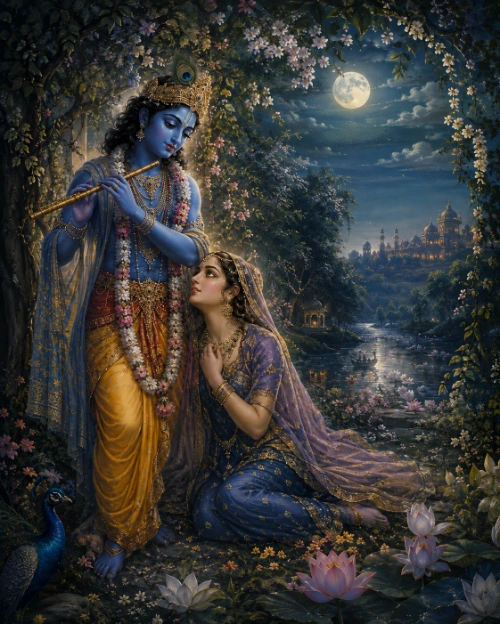
Lalita-mādhava: Rūpa Gosvāmī’s Drama of Separation, Identity, and the Supremacy of Vraja-prema
Lalita-mādhava is the second of Śrī Rūpa Gosvāmī’s two great Sanskrit dramas, and it asks a far more painful question than its companion. Vidagdha-mādhava remains within Vṛndāvana, presenting Rādhā and Kṛṣṇa’s youthful love through flute music, secret meetings, sakhī mediation, jealousy, māna and reconciliation. Lalita-mādhava asks instead: what happens to Vraja-prema when Kṛṣṇa appears to leave Vṛndāvana?
Its ten acts move through separation, divine madness, apparent loss, Mathurā and Dvārakā identities, recognition, the reconstruction of Vṛndāvana in Nava-Vṛndāvana, and finally the restoration of the underlying truth of Vraja. The drama is therefore not a sequel to Vidagdha-mādhava but a theological meditation in dramatic form on whether Vraja-prema can ever truly be displaced. Rūpa’s answer is no. Dvārakā may display divine majesty, queenship and royal splendour, but the most intimate truth of Kṛṣṇa remains his relationship with the Vrajavāsīs, and above all with Śrī Rādhā.
What Does the Title Mean?
Mādhava is a name of Kṛṣṇa. The adjective lalita can mean graceful, charming, playful, delicate, elegant, beautifully refined, or accomplished in the arts of love. The title may thus be rendered “The Graceful Mādhava,” or more fully, “Mādhava in his refined, graceful, love-playful aspect.” But there is a more precise way to understand the word, because Rūpa defines the dhīra-lalita hero in his own aesthetic theology:
विदग्धो नवतारुण्यः परिहासविशारदः ।
निश्चिन्तो धीरललितः स्यात् प्रायः प्रेयसीवशः ॥
vidagdho nava-tāruṇyaḥ parihāsa-viśāradaḥ |
niścinto dhīra-lalitaḥ syāt prāyaḥ preyasī-vaśaḥ ||
“A dhīra-lalita hero is refined and artful, possessed of fresh youth, expert in joking, carefree, and generally under the sway of his beloved.” — Bhakti-rasāmṛta-sindhu 2.1.230
This makes the title much richer. The lalita Mādhava is not merely handsome but young, witty, playful, artistically refined, expert in romantic exchange — and capable of being controlled by his beloved. That final element, preyasī-vaśa, “under the sway of the beloved,” is especially significant in the theology of Rādhā and Kṛṣṇa.
The resemblance between lalita and the name of Lalitā-devī, one of Rādhā’s principal sakhīs, naturally invites the thought that the title refers to her — and she is indeed central to the drama, with Act Six named for her recovery. Grammatically, however, Lalita-mādhava most naturally means “Mādhava who is lalita.” Any echo of Lalitā-sakhī is best treated as poetic resonance rather than the primary derivation.
The Ten Acts
The Sanskrit act titles already reveal the dramatic progression.
सायमुत्सवः ।
शङ्खचूडवधः ।
उन्मत्तराधिकः ।
श्रीराधाभिसारः ।
श्रीचन्द्रावलीलाभः ।
श्रीललितोपलब्धिः ।
नववृन्दावनसङ्गमः ।
नववृन्दावनविहारः ।
चित्रदर्शनः ।
पूर्णमनोरथः ॥
sāyam-utsavaḥ |
śaṅkhacūḍa-vadhaḥ |
unmatta-rādhikaḥ |
śrī-rādhābhisāraḥ |
śrī-candrāvalī-lābhaḥ |
śrī-lalitopalabdhiḥ |
nava-vṛndāvana-saṅgamaḥ |
nava-vṛndāvana-vihāraḥ |
citra-darśanaḥ |
pūrṇa-manorathaḥ ||
The ten acts of the drama, in order.
It is therefore too simple to describe the play as “Rādhā and Kṛṣṇa in Mathurā and Dvārakā.” It begins in Vraja, with the wound of separation, and its real movement runs:
Vraja
 └─ separation and emotional catastrophe
     └─ apparent loss and transformation
         └─ Mathurā–Dvārakā identities
             └─ recollection of Vraja
                 └─ Nava-Vṛndāvana
                     └─ recognition
                         └─ restoration
                             └─ pūrṇa-manoratha — fulfilment
The central theological question is therefore not “what new life does Kṛṣṇa begin after Vṛndāvana?” but “can anything that happens outside Vṛndāvana ever erase the truth of Vṛndāvana?” The whole drama argues that it cannot.
The Opening Benediction
The very beginning establishes that this is devotional drama, not secular romance. Rūpa invokes the glory of Mukunda:
सुररिपुसुदृशामुरोजकोकान्
मुखकमलानि च खेदयन्नखण्डः ।
चिरमखिलसुहृच्चकोरनन्दी
दिशतु मुकुन्दयशःशशी मुदं वः ॥
sura-ripu-sudṛśām uroja-kokān
mukha-kamalāni ca khedayann akhaṇḍaḥ |
ciram akhila-suhṛc-cakora-nandī
diśatu mukunda-yaśaḥ-śaśī mudaṁ vaḥ ||
“May the undiminished moon of Mukunda’s glory, which causes distress to the lotus-like faces of his enemies’ beloveds yet delights his devotee-friends like cakora birds, bestow joy upon you.” — Lalita-mādhava 1.1
The imagery is entirely classical Sanskrit kāvya: Mukunda’s fame is the moon, and the devotees are cakora birds nourished by moonlight. Then, as in Vidagdha-mādhava, Rūpa invokes Śrī Caitanya inside the drama itself:
निजप्रणयितां सुधामुदयमाप्नुवन् यः क्षितौ
किरत्यलमुरीकृतद्विजकुलाधिराजस्थितिः ।
स लुञ्चिततमस्ततिर्मम शचीसुताख्यः शशी
वशीकृतजगन्मनाः किमपि शर्म विन्यस्यतु ॥
nija-praṇayitāṁ sudhām udayam āpnuvan yaḥ kṣitau
kiraty alam urī-kṛta-dvija-kulādhirāja-sthitiḥ |
sa luñcita-tamas-tatir mama śacī-sutākhyaḥ śaśī
vaśī-kṛta-jagan-manāḥ kim api śarma vinyasyatu ||
“May that moon named the son of Śacī, who arose upon the earth and profusely distributes the nectar of his own devotional love, dispelling darkness and captivating the minds of the world, bestow auspiciousness.” — Lalita-mādhava 1.3
Caitanya tastes and reveals Rādhā-Kṛṣṇa prema
 └─ Rūpa systematises and dramatises it
Why Rūpa Wrote Two Dramas
Rūpa originally intended to include both the Vraja-līlā and the pura-līlā, the Mathurā-Dvārakā city pastimes, within a single dramatic project. Svarūpa Dāmodara explains the original plan in the Caitanya-caritāmṛta:
স্বরূপ কহে,—“কৃষ্ণলীলার নাটক করিতে ।
ব্রজলীলা-পুরলীলা একত্র বর্ণিতে ॥”
svarūpa kahe—“kṛṣṇa-līlāra nāṭaka karite
vraja-līlā-pura-līlā ekatra varṇite”
“He intended to compose a drama of Kṛṣṇa-līlā, describing the Vraja pastimes and the city pastimes together.” — Caitanya-caritāmṛta, Antya 1.124
দুই ‘নান্দী’ ‘প্রস্তাবনা’, দুই ‘সংঘটনা’ ।
পৃথক্ করিয়া লিখি করিয়া ভাবনা ॥
dui nāndī prastāvanā, dui saṅghaṭanā
pṛthak kariyā likhi kariyā bhāvanā
“He conceived two separate benedictions, two introductions and two distinct dramatic developments.” — Caitanya-caritāmṛta, Antya 1.71
আরম্ভিয়াছিলা, এবে প্রভু-আজ্ঞা পাঞা ।
দুই নাটক করিতেছে বিভাগ করিয়া ॥
ārambhiyāchilā, ebe prabhu-ājñā pāñā
dui nāṭaka kariteche vibhāga kariyā
“He had begun the work, but now, having received the Lord’s instruction, he divided it into two dramas.” — Caitanya-caritāmṛta, Antya 1.125
There is also a famous devotional explanation. While travelling through Odisha, Rūpa stayed at a place called Satyabhāmā-pura, where a beautiful divine woman appeared to him in a dream and instructed him to compose her drama separately. He understood her to be Satyabhāmā — an episode especially fitting, since Satyabhāmā becomes central to the theological structure of this very play.
Kṛṣṇa Never Truly Leaves Vṛndāvana
Behind both dramas stands a Gauḍīya principle that this play exists to dramatise:
कृष्णोऽन्यो यदुसम्भूतो यः पूर्णः सोऽस्त्यतः परः ।
वृन्दावनं परित्यज्य स क्वचिन्नैव गच्छति ॥
kṛṣṇo ‘nyo yadu-sambhūto yaḥ pūrṇaḥ so ‘sty ataḥ paraḥ |
vṛndāvanaṁ parityajya sa kvacin naiva gacchati ||
“The Kṛṣṇa appearing in the Yadu dynasty is one manifestation, while beyond him is the complete Kṛṣṇa, who never leaves Vṛndāvana.” — Laghu-bhāgavatāmṛta, quoted in Caitanya-caritāmṛta, Antya 1.67
This is not a denial of the Bhāgavata Purāṇa’s narrative in which Kṛṣṇa visibly goes to Mathurā. Vrajendra-nandana Kṛṣṇa, the eternally youthful son of Nanda and beloved of the gopīs, never ceases to exist in Vṛndāvana; the princely and royal manifestations in Mathurā and Dvārakā are other manifestations of the same divine person. This is precisely the paradox Lalita-mādhava must solve. Kṛṣṇa is in Dvārakā, and yet the deepest Kṛṣṇa remains inseparable from Vṛndāvana.
Separation Reorganises the Entire Drama
In Vidagdha-mādhava, separation occurs within an intact Vraja world. Rādhā and Kṛṣṇa may fail to meet, she may become angry, he may have to appease her — but Vṛndāvana remains around them. Lalita-mādhava raises the stakes enormously, because Kṛṣṇa appears to have left the entire world of Vraja. The resulting separation is no longer “where is my beloved tonight?” but “what happens to my very identity if the beloved who gives existence its meaning has left my world?” That is why the play is so much darker.
Its central category is vipralambha, love in separation, as against sambhoga, love in union. Within Gauḍīya aesthetics separation is not simply an unfortunate interruption of union; it can intensify love, and sambhoga when it comes is the deeper for it. In separation memory becomes all-consuming, every sound recalls the beloved, every tree becomes a witness, every place is charged with remembrance. The absent beloved may dominate consciousness even more completely than the present one. The drama therefore explores what prema becomes when possession becomes impossible.
Rādhā’s Divine Madness
Act Three bears the striking title Unmatta-rādhikā, “Rādhā in divine madness.” Unmatta normally means mad, intoxicated, deranged, beside oneself — but in rasa literature the language is not a psychiatric diagnosis. It describes an ecstatic state in which prema exceeds ordinary cognitive categories, and in which distinctions begin to collapse: presence and absence, memory and perception, self and beloved, hope and despair, life and death. The emotional world begins to resemble what later Gauḍīya literature describes of Śrī Caitanya’s final years at the Gambhīrā in Jagannātha Purī.
The drama even includes episodes of apparent death or deathlike transformation caused by separation. This is not theatrical melodrama but a radical theological proposition: for the Vraja gopīs, Kṛṣṇa is not one meaningful part of life — their very capacity to live is structured by love for him. Separation therefore becomes existential, and the extremity of viraha reveals how total Vraja-prema is.
Rādhā and Satyabhāmā
One of the most famous and difficult features of the drama is the relationship between Śrī Rādhā and Satyabhāmā, Kṛṣṇa’s queen in Dvārakā. It must not be reduced to “Rādhā simply turns into Satyabhāmā,” nor understood as ordinary reincarnation. Gauḍīya theology uses instead the language of prakāśa, manifestation:
श्रीव्रजेन्द्रनन्दनस्य यथा श्रीवसुदेवनन्दनः प्रकाशस् तथा श्रीराधिकादीनां सत्यभामाद्याः प्रकाशरूपाः ।
śrī-vrajendra-nandanasya yathā śrī-vasudeva-nandanaḥ prakāśas
tathā śrī-rādhikādīnāṁ satyabhāmādyāḥ prakāśa-rūpāḥ |
“Just as the son of Vasudeva is a manifestation of Vrajendra-nandana Kṛṣṇa, so Satyabhāmā and the other queens are manifestation-forms of Śrī Rādhikā and the other Vraja heroines.”
This gives the theological key: Vraja identity is primary, and the Dvārakā personalities do not erase it but reveal related manifestations of that deeper eternal identity. The same structural principle appears in the pairing of Candrāvalī with Rukmiṇī, and the drama lets Lalitā voice the shock directly:
प्रियसखी चन्द्रावली एव किं खलु रुक्मिणीति श्रूयते ?
priya-sakhī candrāvalī eva kiṁ khalu rukmiṇīti śrūyate?
“Is it really said that my dear friend Candrāvalī is Rukmiṇī?”
The question’s shock is deliberate. What appears to be an entirely new Dvārakā social world may contain hidden continuities with Vraja.
These identity transformations are not random fantasy; they are dramatic solutions to genuine Gauḍīya metaphysical problems. If the Vraja associates are eternal, how can they simply disappear from Kṛṣṇa’s later līlā? If Vraja-prema is supreme, how can Dvārakā replace it? If Kṛṣṇa in his fullest identity never leaves Vṛndāvana, what exactly are we seeing when he appears as the king of Dvārakā? The drama answers through manifestation, recognition, hidden identity, memory and restoration.
Lalitā and the Necessity of the Sakhīs
Although lalita in the title primarily describes Mādhava, Lalitā-devī herself is indispensable, and Act Six is named for her recovery. She is described as rādhikāyāḥ prāṇa-sakhī, “Rādhikā’s life-friend” — not merely someone Rādhā likes, but one who belongs to the very structure of Rādhā’s emotional life. The recovery of Lalitā is therefore part of the restoration of Vraja itself.
This is central to Gauḍīya devotion. Rādhā and Kṛṣṇa’s love is not an isolated two-person romance: the sakhīs carry messages, create meetings, interpret emotions, protect Rādhā, tease Kṛṣṇa, console the lovers, reconstruct lost circumstances and increase their happiness. Prema becomes sevā. The sakhī does not compete with Rādhā; she finds her fulfilment in increasing Rādhā and Kṛṣṇa’s joy. In Act Four, Lalitā presents Kṛṣṇa before Rādhā:
जङ्घाधस्तटसङ्गिदक्षिणपदं किञ्चिद्विभुग्नत्रिकं
साचिस्तम्भितकन्धरं सखि तिरःसञ्चारिनेत्राञ्चलम् ।
वंशीं कुट्मलिते दधानमधरे लोलाङ्गुलीसङ्गतां
रिङ्गद्भ्रूभ्रमरं वराङ्गि परमानन्दं पुरः स्वीकुरु ॥
jaṅghādhas-taṭa-saṅgi-dakṣiṇa-padaṁ kiñcid vibhugna-trikaṁ
sāci-stambhita-kandharaṁ sakhi tiraḥ-sañcāri-netrāñcalam |
vaṁśīṁ kuṭmalite dadhānam adhare lolāṅgulī-saṅgatāṁ
riṅgad-bhrū-bhramaraṁ varāṅgi paramānandaṁ puraḥ svīkuru ||
“O beautiful friend, accept before you this embodiment of supreme bliss: his right foot rests beside the lower part of his other leg, his waist bends gracefully, his neck inclines to the side, his sidelong glance moves restlessly, and he holds the flute against his budding lips while his fingers dance upon it and his brows move like bees.” — Lalita-mādhava 4.27
The verse is a reminder that beneath all the drama’s suffering lies the irresistible mādhurya of Vraja-Kṛṣṇa.
Nava-Vṛndāvana
Acts Seven and Eight introduce one of the deepest concepts in the drama: Nava-Vṛndāvana, a Vṛndāvana-like environment constructed within the Dvārakā world, recreating groves, flowers, forest paths, trees, kuñjas and the whole atmosphere of Vraja. The theological question is immediate. Can Vṛndāvana actually be recreated outside Vṛndāvana? The answer is both yes and no: the external environment can be imitated, but Vraja-bhāva cannot be manufactured by reproducing trees and flowers. Nava-Vṛndāvana therefore becomes a dramatic testing ground — can royal Kṛṣṇa enter again into the emotional truth of Vraja?
It works because places themselves function as emotional stimuli. In Sanskrit aesthetics these are uddīpana-vibhāva, objects or environments that intensify an established emotional state. A forest path can awaken remembrance; a flute can awaken longing; a painted image can awaken an entire lost world. A grove resembling Vṛndāvana can force Dvārakā-Kṛṣṇa to remember who he is in Vraja. Geography becomes theology.
Kṛṣṇa Encounters His Own Sweetness
Perhaps the most astonishing verse in the entire drama occurs in Act Eight, when Kṛṣṇa sees his own reflection:
अपरिकलितपूर्वः कश्चमत्कारकारी
स्फुरति मम गरीयानेष माधुर्यपूरः ।
अयमहमपि हन्त प्रेक्ष्य यं लुब्धचेताः
सरभसमुपभोक्तुं कामये राधिकेव ॥
aparikalita-pūrvaḥ kaś camatkāra-kārī
sphurati mama garīyān eṣa mādhurya-pūraḥ |
ayam aham api hanta prekṣya yaṁ lubdha-cetāḥ
sa-rabhasam upabhoktuṁ kāmaye rādhikeva ||
“What astonishing abundance of sweetness is this, never before experienced! Seeing this form, even I become greedy to enjoy it intensely, just as Rādhikā does.” — Lalita-mādhava 8.34
Normally Rādhā experiences Kṛṣṇa. Here Kṛṣṇa encounters his own sweetness almost from outside himself, and realises that Rādhā experiences something in him that he does not experience in the same way. This raises an extraordinary question: what is it like to experience Kṛṣṇa through Rādhā’s consciousness? Gauḍīya texts explain Caitanya’s descent partly through exactly this desire:
The reflection verse contains the seed of precisely this problem. Rādhā is therefore not merely the supreme lover because she loves Kṛṣṇa most; her love reveals dimensions of Kṛṣṇa even to Kṛṣṇa himself.
Citra-darśana — Images as Portals of Memory
Act Nine, “Viewing the Pictures,” may sound like a minor episode. It is in fact profoundly sophisticated. The characters view representations connected with Vraja, and these pictures collapse the distance between past and present, Vraja and Dvārakā, memory and perception. A picture becomes an uddīpana that reactivates the emotional reality of the world it depicts, so that Rūpa is using art within drama to investigate how representation makes the absent beloved psychologically present.
Several levels operate at once: the audience watches a play; the characters look at images; the images depict another world; that world awakens memory; and memory becomes emotionally more powerful than the characters’ immediate surroundings. The drama continually asks which is more real — the place physically before us, or the Vṛndāvana remembered through prema? Rūpa consistently privileges the reality revealed by love.
The tenth act, Pūrṇa-manoratha, then resolves contradictions the preceding nine have made to seem impossible: Rādhā and Kṛṣṇa separated, Vraja apparently lost, companions seemingly dead or transformed, Dvārakā apparently replacing the pastoral world, old identities fragmented. The final fulfilment is not simply that everyone is happy again. It is the restoration of the deepest ontological truth beneath all apparent separation.
Poetic Truth and Historical Sequence
This is essential for reading the play correctly. Lalita-mādhava is not a literal dramatisation of the Tenth Canto of the Bhāgavata Purāṇa; many of its events and identity relationships are poetic constructions. Rūpa was deeply learned in Sanskrit dramaturgy — he wrote his own manual, the Nāṭaka-candrikā — and explicitly accepted poetic invention within dramatic literature. Classical theory distinguishes three kinds of plot:
When Rūpa creates a scene we should not assume he claims that the Bhāgavata records this exact event in this sequence. His dramatic question is rather: what arrangement of characters, places and events will most perfectly reveal the truth of Vraja-prema? Poetry serves theology. Later Gauḍīya readers found the departures from familiar Purāṇic chronology obvious, and traditional commentaries sometimes explain that the drama may depict another manifestation of Kṛṣṇa-līlā in another kalpa. Whether one takes that literally or as theological harmonisation, it shows that the tradition itself recognised the play is not a historical transcript.
Is Dvārakā Inferior to Vṛndāvana?
This requires nuance. Dvārakā is not mundane; it is a divine realm of Kṛṣṇa. The difference is one of rasa.
The Gauḍīya hierarchy is therefore not that Dvārakā is false and Vṛndāvana true. Both are divine; Vṛndāvana reveals the most intimate mode of relationship with Kṛṣṇa. Dvārakā supplies the outer royal structure, Vṛndāvana the deepest emotional identity, and the drama gradually peels away the outer structure until the Vraja truth beneath becomes recognisable again. Nava-Vṛndāvana is thus not nostalgia but a mechanism for revealing ontological memory.
The Two Dramas Compared
Set side by side, the difference between Rūpa’s two plays becomes precise.
A concise distinction: Vidagdha-mādhava is the drama of Vraja-prema unfolding within its natural home; Lalita-mādhava is the drama of Vraja-prema apparently displaced from its home, and of the revelation that it can never actually be displaced.
The Literary Progression
Śrīmad-Bhāgavatam ── Vraja, the gopīs, the flute, rāsa, Mathurā, Dvārakā
 └─ Jayadeva's Gīta-govinda ── Rādhā at the centre of jealousy, separation and reunion
     └─ Vidagdha-mādhava ── the intimate Vraja world, organised by rasa theology
         └─ Lalita-mādhava ── that same prema tested by absence and transformation
This arguably makes Lalita-mādhava the more philosophically daring of the two dramas. The lyrical world it inherits is traced in How to Read the Gīta-govinda.
Why the Drama Matters
At first Lalita-mādhava may seem bewildering: separation, madness, apparent death, identity transformation, queens of Dvārakā, recovered sakhīs, a reconstructed Vṛndāvana, paintings that awaken memory, and a final extraordinary reunion. But these are not random complications. Every device addresses one question — can the truth of Rādhā and Kṛṣṇa’s Vṛndāvana love be destroyed by separation, geography, chronology or outward identity? Rūpa’s answer is no. Vṛndāvana may appear lost, Rādhā may appear hidden beneath another manifestation, Kṛṣṇa may sit in Dvārakā as a royal prince, the gopīs may appear separated from him; and yet the drama gradually exposes Vraja-prema as the hidden reality beneath everything else. It is therefore not a drama about what happened after Kṛṣṇa left Vṛndāvana. It is a drama about the impossibility of truly leaving Vṛndāvana at all — and in its most astonishing verse the whole mystery turns inward, when Kṛṣṇa sees his own sweetness and becomes greedy to taste it as Rādhikā does. From that moment the question is no longer how deeply Rādhā loves Kṛṣṇa, but what Rādhā experiences in Kṛṣṇa that even Kṛṣṇa desires to taste — and from that question the path leads directly to Śrī Caitanya Mahāprabhu.
Primary Sources
Four cautions are worth preserving. The title is best understood primarily as “the graceful Mādhava”; its resemblance to Lalitā-sakhī’s name may carry poetic resonance but should not be asserted as its principal derivation. The pairings Rādhā–Satyabhāmā and Candrāvalī–Rukmiṇī should be explained through prakāśa, manifestation, rather than as reincarnation or replacement. The drama should not be read as a literal chronological dramatisation of the Bhāgavata Purāṇa, since Rūpa consciously uses poetic invention to express theological truth. And saying Vṛndāvana is higher than Dvārakā does not make Dvārakā mundane: both are divine, and the distinction concerns the greater intimacy of Vraja-bhāva. Texts consulted in digital form: the Bhaktivedanta Vedabase for the Caitanya-caritāmṛta passages quoting the drama; the IGNCA Sanskrit repository and GRETIL for Gauḍīya Sanskrit texts; published Sanskrit editions of the play for the act titles; and academic studies of Rūpa’s dramaturgy and the Nāṭaka-candrikā.