

How to Read the Gīta-govinda
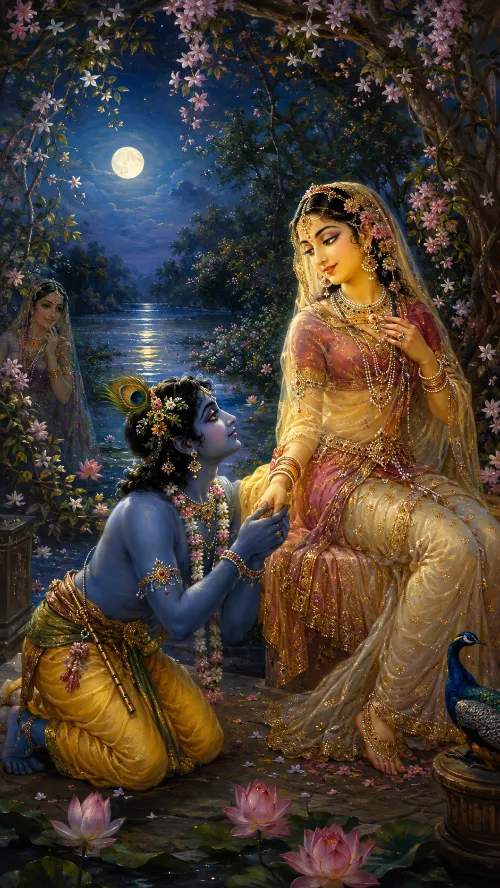
How to Read the Gīta-govinda: Rādhā, Kṛṣṇa, Separation, and the Triumph of Divine Love
Jayadeva’s Gīta-govinda, composed in Sanskrit in the twelfth century, is one of the most influential works ever written about the love of Rādhā and Kṛṣṇa. It is at once poetry, song, dramatic narration, devotional meditation and an exploration of the psychology of divine love — and beneath its concentrated plot Jayadeva constructs a deliberate theological paradox: the Kṛṣṇa who rules the universe is conquered by Rādhā’s love.
The story itself is compact. Kṛṣṇa enjoys the springtime forest of Vṛndāvana with the gopīs. Rādhā, wounded by his attention to others, withdraws. Separation follows, and both lovers suffer. An intimate sakhī moves between them, carrying messages and preparing their reconciliation. Rādhā must overcome wounded pride; Kṛṣṇa must submit himself before her. They meet at last — and the poem ends not merely in union but with an extraordinary image: Kṛṣṇa personally serving Rādhā and restoring her ornaments. That paradox is one of the principal reasons the work became so important within the devotional world of Śrī Caitanya Mahāprabhu.
What Does Gīta-govinda Mean?
गीतगोविन्द
gīta-govinda
“The Song of Govinda,” or more freely “Songs of Govinda.”
Gīta means “song,” “that which is sung,” or “a sung composition”; Govinda is one of Kṛṣṇa’s most ancient and beloved names. Although the title resembles the Bhagavad-gītā, the two works differ entirely in literary character. The Bhagavad-gītā is primarily a philosophical and theological dialogue spoken on the battlefield of Kurukṣetra. The Gīta-govinda is lyrical, musical, dramatic and intensely emotional.
Jayadeva Tells Us What Kind of Work He Is Writing
Near the very beginning Jayadeva gives what amounts to a poetic manifesto for the whole composition:
यदि हरिस्मरणे सरसं मनो
यदि विलासकलासु कुतूहलम् ।
मधुरकोमलकान्तपदावलीं
शृणु तदा जयदेवसरस्वतीम् ॥
yadi hari-smaraṇe sarasaṁ mano
yadi vilāsa-kalāsu kutūhalam |
madhura-komala-kānta-padāvalīṁ
śṛṇu tadā jayadeva-sarasvatīm ||
“If your heart delights in the remembrance of Hari, and if you are curious about the arts of amorous play, then listen to Jayadeva’s speech, whose succession of words is sweet, tender and beautiful.” — Gīta-govinda 1.3
The verse is crucial for understanding the work, because it deliberately places two things side by side: hari-smaraṇa, remembrance of Hari, and vilāsa-kalā, the arts of amorous play. Jayadeva does not regard devotion and the aesthetics of divine romance as contradictory. The intimate love of Rādhā and Kṛṣṇa becomes itself a medium for contemplating the Divine. He describes the poem in the same terms a verse earlier:
श्रीवासुदेवरतिकेलिकथासमेतम्
एतं करोति जयदेवकविः प्रबन्धम् ॥
śrī-vāsudeva-rati-keli-kathā-sametam
etaṁ karoti jayadeva-kaviḥ prabandham ||
“Poet Jayadeva composes this prabandha, containing the accounts of Śrī Vāsudeva’s amorous play.” — Gīta-govinda 1.2
The erotic language of the poem is therefore not an accidental embellishment added around a religious message. It belongs to Jayadeva’s conception of the work from the outset.
The Poem Actually Begins with Rādhā and Mādhava
It is often said that the Gīta-govinda begins with the Daśāvatāra hymn. That is nearly true of its songs, but not of the text. Before the first lyric, Jayadeva opens with a remarkable verse:
मेघैर्मेदुरमम्बरं वनभुवः श्यामास्तमालद्रुमैः
नक्तं भीरुरयं त्वमेव तदिमं राधे गृहं प्रापय ।
इत्थं नन्दनिदेशितश्चलितयोः प्रत्यध्वकुञ्जद्रुमं
राधामाधवयोर्जयन्ति यमुनाकूले रहःकेलयः ॥
meghair meduram ambaraṁ vana-bhuvaḥ śyāmās tamāla-drumair
naktaṁ bhīrur ayaṁ tvam eva tad imaṁ rādhe gṛhaṁ prāpaya |
itthaṁ nanda-nideśitaś calitayoḥ praty-adhva-kuñja-drumaṁ
rādhā-mādhavayor jayanti yamunā-kūle rahaḥ-kelayaḥ ||
“The sky is heavy with clouds, and the forest ground is dark beneath the tamāla trees. Night has fallen. ‘Rādhā, this boy is timid; you yourself take him home.’ Thus instructed by Nanda, the two set out, and along every path beneath the bowers on the bank of the Yamunā, the secret pastimes of Rādhā and Mādhava triumph.” — Gīta-govinda 1.1
This is an astonishing opening. Jayadeva does not introduce Rādhā and Kṛṣṇa through philosophical definitions. He places the reader immediately on the Yamunā bank at night, beneath forest bowers, with Rādhā and Mādhava alone together. Their hidden love itself becomes the auspicious gateway into the poem.
Then Comes the Cosmic Kṛṣṇa: the Daśāvatāra Hymn
Only after these introductory verses does the first song arrive — Jayadeva’s celebrated Daśāvatāra hymn:
प्रलयपयोधिजले धृतवानसि वेदं
विहितवहित्रचरित्रमखेदम् ।
केशव धृतमीनशरीर जय जगदीश हरे ॥
pralaya-payodhi-jale dhṛtavān asi vedaṁ
vihita-vahitra-caritram akhedam |
keśava dhṛta-mīna-śarīra jaya jagadīśa hare ||
“In the waters of the cosmic dissolution you upheld the Veda, assuming without difficulty the role of a saving vessel. O Keśava, who assumed the form of the Fish — victory to you, O Lord of the universe, Hari!” — Gīta-govinda, Aṣṭapadī 1
The hymn proceeds through Matsya, Kūrma, Varāha, Narasiṁha, Vāmana, Paraśurāma, Rāma, Balarāma, Buddha and Kalki, its refrain addressing Kṛṣṇa each time as jaya jagadīśa hare, “victory to Hari, Lord of the universe.” This provides an important theological frame. Jayadeva first establishes the majestic, cosmic identity of the Lord whose avatāras rescue worlds, restore dharma and defeat demons. Only then does the poem lead us into another dimension of Kṛṣṇa — the youthful lover of Vṛndāvana. The contrast is deliberate: the Jagadīśa will eventually become the lover who begs Rādhā to place her foot upon his head.
The Emotional Architecture of the Poem
Kṛṣṇa sports with the gopīs
 └─ Rādhā feels her unique position violated
     └─ she withdraws
         └─ separation intensifies her remembrance
             └─ Kṛṣṇa too becomes afflicted by separation
                 └─ the sakhī moves between the lovers
                     └─ Rādhā waits; Kṛṣṇa disappoints her
                         └─ Rādhā angrily rejects him
                             └─ Kṛṣṇa humbles himself
                                 └─ her māna softens
                                     └─ Rādhā and Kṛṣṇa unite
                                         └─ Kṛṣṇa serves Rādhā
This movement from separation toward union is usually described through the two divisions of śṛṅgāra-rasa, the aesthetic mood of love:
But Jayadeva’s psychology is subtler than a simple movement from sadness to happiness. Separation generates an entire world of heightened consciousness — memory, imagination, jealousy, expectation, hallucination, sleeplessness, impatience, physical weakness, intense longing. The absent beloved becomes inwardly almost more present precisely because he is outwardly absent.
Why Does Rādhā Leave Kṛṣṇa?
Jayadeva’s account is more sophisticated than saying that Rādhā sees Kṛṣṇa with other gopīs and becomes jealous:
विहरति वने राधा साधारणप्रणये हरौ
विगलितनिजोत्कर्षादीर्ष्यावशेन गतान्यतः ।
क्वचिदपि लताकुञ्जे गुञ्जन्मधुव्रतमण्डली-
मुखरशिखरे लीना दीनाप्युवाच रहः सखीम् ॥
viharati vane rādhā sādhāraṇa-praṇaye harau
vigalita-nijotkarṣād īrṣyā-vaśena gatānyataḥ |
kvacid api latā-kuñje guñjan-madhuvrata-maṇḍalī-
mukhara-śikhare līnā dīnāpy uvāca rahaḥ sakhīm ||
“When Hari sported in the forest with his love made common, Rādhā, feeling deprived of her own special eminence and overcome by jealousy, went elsewhere. Hidden miserably within a vine-bower alive with the humming of bees, she spoke privately to her friend.” — Gīta-govinda 2.1
The crucial expression is sādhāraṇa-praṇaye — roughly, “when love had become common,” or shared. Rādhā’s pain therefore arises from something deeper than ordinary jealousy: she cannot accept being merely one beloved among many. Her love makes an absolute claim upon Kṛṣṇa, and the rest of the poem gradually demonstrates that Kṛṣṇa recognises the uniqueness of that claim.
Anger Does Not Destroy Rādhā’s Love
One of Jayadeva’s most perceptive observations is that Rādhā’s anger never eliminates her attraction. She withdraws from Kṛṣṇa, complains about him and is jealous of him — and her mind cannot stop returning to him:
रासे हरिमिह विहितविलासं
स्मरति मनो मम कृतपरिहासम् ॥
rāse harim iha vihita-vilāsaṁ
smarati mano mama kṛta-parihāsam ||
“My mind remembers Hari, who sported here in the rāsa and playfully delighted with me.” — Gīta-govinda, Aṣṭapadī 2
This is the paradox of māna, loving offended pride: Rādhā pushes Kṛṣṇa away precisely because her attachment to him is so intense. Her apparent rejection is itself a transformation of love.
Spring Is Not Mere Scenery
The forests of the Gīta-govinda are full of flowering creepers, mango blossoms, bees, cuckoos, fragrant winds, moonlight, Yamunā banks and forest bowers — but nature is never merely decorative. In Sanskrit love poetry the external world functions as uddīpana, a stimulus that awakens or intensifies an existing emotional state. Spring becomes almost another participant in the drama: flowers remind the lovers of intimacy, the breeze becomes unbearable to the separated Rādhā, moonlight that ordinarily cools becomes torment, and the humming of bees intensifies longing. Vṛndāvana itself seems to conspire in their love.
The Sakhī, Hidden Architect of the Reunion
Although Rādhā and Kṛṣṇa are the two poles of the poem, the drama would scarcely move without a third participant: the sakhī. Jayadeva never gives her a personal name, yet she understands both lovers. She hears Rādhā’s complaints, describes Rādhā’s suffering to Kṛṣṇa and Kṛṣṇa’s condition to Rādhā, interprets each to the other, and arranges the possibility of reunion. At the opening of the sixth canto:
अथ तां गन्तुमशक्तां चिरमनुरक्तां लतागृहे दृष्ट्वा ।
तच्चरितं गोविन्दे मनसिजमन्दे सखी प्राह ॥
atha tāṁ gantum aśaktāṁ ciram anuraktāṁ latā-gṛhe dṛṣṭvā |
tac-caritaṁ govinde manasija-mande sakhī prāha ||
“Then, seeing her unable to go and remaining longingly within the vine-bower, the sakhī told Govinda — himself weakened by Love — of her condition.” — Gīta-govinda 6.1
Notice what this implies. Both Rādhā and Kṛṣṇa are suffering, and the sakhī knows it while the separated lovers do not fully know one another’s inner condition. She therefore holds a privileged perspective — a feature that would become extraordinarily important in later Rādhā-Kṛṣṇa devotion, particularly in Gauḍīya understandings of sakhī-bhāva and intimate service to the Divine Couple.
It is worth distinguishing the historical stages. Jayadeva poetically dramatises the mediating sakhī; later Gauḍīya theologians develop that into a systematic devotional theology.
Rādhā Is Not a Passive Heroine
One of the most striking features of Jayadeva’s Rādhā is her authority. When Kṛṣṇa finally appears before her, having disappointed her expectations, she reads in him the signs of a night spent with another woman and refuses his excuses:
हरि हरि याहि माधव याहि केशव
मा वद कैतववादम् ।
तामनुसर सरसीरुहलोचन
या तव हरति विषादम् ॥
hari hari yāhi mādhava yāhi keśava
mā vada kaitava-vādam |
tām anusara sarasīruha-locana
yā tava harati viṣādam ||
“Go, Mādhava! Go, Keśava! Do not speak deceptive words. Follow that lotus-eyed woman — the one who removes your sorrow.” — Gīta-govinda, Aṣṭapadī 17
The theological reversal has already begun. Kṛṣṇa has come to Rādhā; Kṛṣṇa is apologising; Rādhā dismisses him. The all-attractive Kṛṣṇa must now struggle to regain the favour of the woman whose love he has wounded.
Kṛṣṇa Becomes the Supplicant
The reversal reaches its most celebrated expression in the tenth canto:
त्वमसि मम भूषणं त्वमसि मम जीवनं
त्वमसि भवजलधिरत्नम् ।
tvam asi mama bhūṣaṇaṁ tvam asi mama jīvanaṁ
tvam asi bhava-jaladhi-ratnam |
“You are my ornament. You are my life. You are the jewel in the ocean of existence.” — Gīta-govinda, Aṣṭapadī 19
Then comes perhaps the most famous verse of the entire poem:
स्मरगरलखण्डनं मम शिरसि मण्डनं
देहि पदपल्लवमुदारम् ।
ज्वलति मयि दारुणो मदनकदनानलो
हरतु तदुपाहितविकारम् ॥
smara-garala-khaṇḍanaṁ mama śirasi maṇḍanaṁ
dehi pada-pallavam udāram |
jvalati mayi dāruṇo madana-kadanānalo
haratu tad-upāhita-vikāram ||
“Place your generous tender foot upon my head — an antidote to the poison of Love and an ornament upon my head. The terrible fire of Love burns within me; may your foot remove the torment it has produced.” — Gīta-govinda, Aṣṭapadī 19
The image is deliberately startling. The same Kṛṣṇa hailed in the first song as jagadīśa, Lord of the universe, now asks mama śirasi… dehi pada-pallavam — “place your tender foot upon my head.” Jayadeva has moved from cosmic sovereignty to intimate surrender.
Does This Mean Rādhā Is Greater Than Kṛṣṇa?
Jayadeva himself does not present a systematic theological argument in the later terminology of Gauḍīya Vedānta, so it is better to distinguish two levels:
The characteristically Gauḍīya formulation — Kṛṣṇa conquers everyone, but Rādhā’s prema conquers Kṛṣṇa — is not stated by Jayadeva in those scholastic terms. What the Gīta-govinda provides is one of its most powerful poetic precedents.
The Ending Is More Than “They Reunite”
The final canto is often summarised by saying that Rādhā and Kṛṣṇa are reunited. True — but that misses Jayadeva’s most significant closing gesture. After their union, Rādhā asks Kṛṣṇa to restore the ornaments and decorations that have become disarranged:
कुरु यदुनन्दन चन्दनशिशिरतरेण करेण पयोधरे
मृगमदपत्रकमत्र मनोभवमङ्गलकलशसहोदरे ।
kuru yadunandana candana-śiśiratareṇa kareṇa payodhare
mṛgamada-patrakam atra manobhava-maṅgala-kalaśa-sahodare |
“O Yadunandana, with your hand cooler than sandalwood, paint musk-leaf designs upon my breast…” — Gīta-govinda, Aṣṭapadī 24
She continues, asking him to restore her collyrium, earrings, hair, flowers, girdle and ornaments — and Jayadeva then makes the conclusion explicit:
रचय कुचयोः पत्रं चित्रं कुरुष्व कपोलयोः
घटय जघने काञ्चीमञ्च स्रजं कबरीभरे ।
कलय वलयश्रेणीं पाणौ पदे कुरु नूपुरौ
इति निगदितः प्रीतः पीताम्बरोऽपि तथाकरोत् ॥
racaya kucayoḥ patraṁ citraṁ kuruṣva kapolayoḥ
ghaṭaya jaghane kāñcīm añca srajaṁ kabarī-bhare |
kalaya valaya-śreṇīṁ pāṇau pade kuru nūpurau
iti nigaditaḥ prītaḥ pītāmbaro ‘pi tathākarot ||
“Decorate my breasts; make designs upon my cheeks. Fasten the girdle around my hips and arrange the garland in my hair. Place the bracelets upon my hands and the anklets upon my feet.” Thus instructed, Pītāmbara — Kṛṣṇa — gladly did exactly as she asked. — Gīta-govinda 12.9
This is where the entire dramatic movement arrives. At the beginning Rādhā suffers because Kṛṣṇa appears to distribute his affection among many women. At the end he is entirely attentive to her: he adorns her, he serves her, he follows her instructions with delight. This is why Rādhā at the culmination of the poem can be understood through the classical category svādhīna-bhartṛkā — the heroine whose beloved is completely subject to her influence.
Why Rādhā’s Role Here Is Historically Important
Jayadeva did not invent Rādhā; traditions and literary references associating a Rādhā with Kṛṣṇa existed before him. Nevertheless the Gīta-govinda marks an enormously important stage in the history of Rādhā devotion, because here she becomes a fully developed central heroine of Sanskrit devotional literature.
The contrast with the Bhāgavata Purāṇa is instructive. The Bhāgavata’s rāsa narrative contains the famous episode of one especially favoured gopī who goes alone with Kṛṣṇa, but the Sanskrit text does not explicitly name her Rādhā. In Jayadeva there is no such ambiguity. The poem revolves around Rādhā’s jealousy, her memories, her longing, her māna, her suffering, her journey, her reconciliation — and Kṛṣṇa’s submission before her. Kṛṣṇa remains the divine centre of the Vaiṣṇava universe; yet emotionally, Rādhā becomes the centre of Kṛṣṇa’s universe.
Poetry, Music and Performance
The Gīta-govinda contains twelve sargas, or cantos, and twenty-four prabandhas, or lyrical songs, conventionally known as aṣṭapadīs. The word suggests something “eight-footed,” or consisting of eight sections; in actual textual and performance traditions, refrains and additional verses mean the visible stanza structure is not always best understood through a rigid modern formula.
What matters is that Jayadeva designed these portions as songs, not as passages for silent reading. The work continually moves from narrative verse to emotional situation to song to transition to a new emotional condition, and traditional manuscripts and performance lineages associate the songs with rāgas and rhythmic patterns. This explains the poem’s extraordinary afterlife in Indian classical and regional music, temple performance, Odissi and other dance traditions, manuscript painting, religious recitation and dramatic interpretation. Reading only the semantic meaning of the Sanskrit reveals just one dimension of what Jayadeva made.
Why the Gīta-govinda Mattered So Much to Śrī Caitanya
The connection with Śrī Caitanya Mahāprabhu is not a later speculation. The Caitanya-caritāmṛta explicitly places Jayadeva among the poets Mahāprabhu repeatedly heard and relished:
চণ্ডীদাস, বিদ্যাপতি, রায়ের নাটক-গীতি,
কর্ণামৃত, শ্রীগীতগোবিন্দ ।
স্বরূপ-রামানন্দ-সনে, মহাপ্রভু রাত্রি-দিনে,
গায়, শুনে—পরম আনন্দ ॥
caṇḍīdāsa, vidyāpati, rāyera nāṭaka-gīti,
karṇāmṛta, śrī-gīta-govinda |
svarūpa-rāmānanda-sane, mahāprabhu rātri-dine,
gāya, śune—parama ānanda ||
“Together with Svarūpa and Rāmānanda, Mahāprabhu day and night sang and heard Caṇḍīdāsa, Vidyāpati, Rāmānanda Rāya’s dramatic songs, the Kṛṣṇa-karṇāmṛta and the Śrī Gīta-govinda, experiencing supreme bliss.” — Caitanya-caritāmṛta, Madhya 2.77
বিদ্যাপতি, চণ্ডীদাস, শ্রীগীতগোবিন্দ ।
এই তিন গীতে করা’ন প্রভুর আনন্দ ॥
vidyāpati, caṇḍīdāsa, śrī-gīta-govinda
ei tina gīte karā’na prabhura ānanda ||
“Through the songs of Vidyāpati, Caṇḍīdāsa and the Śrī Gīta-govinda, Svarūpa Dāmodara gave the Lord great joy.” — Caitanya-caritāmṛta, Madhya 10.115
This places the Gīta-govinda inside the intimate devotional culture surrounding Caitanya during his years in Jagannātha Purī. For Mahāprabhu these were not simply beautiful old poems: they provided a language through which the extreme states of Kṛṣṇa-prema, longing and separation could be tasted and expressed.
From Jayadeva to Rūpa Gosvāmī
Jayadeva lived centuries before the principal Gauḍīya Gosvāmīs, and the literary sequence is worth stating plainly:
Jayadeva ── Gīta-govinda, 12th century
 └─ Śrī Caitanya Mahāprabhu, 1486–1534
     │   personally relishes and repeatedly hears it
     └─ Rūpa Gosvāmī
         ├─ Vidagdha-mādhava ── Rādhā and Kṛṣṇa in Vṛndāvana
         └─ Lalita-mādhava ── separation, and the Vraja–Mathurā–Dvārakā world
Rūpa Gosvāmī should not be treated simply as continuing Jayadeva’s narrative. He does something more systematic: the emotional universe that Jayadeva renders through poetry and song becomes, in the Gauḍīya tradition, part of an elaborate theology and aesthetics of bhakti-rasa. That longer chain of transmission — through gurus, households, books and Deities — is traced in Networks of Transmission in Early Gauḍīya Vaiṣṇavism.
From Aiśvarya to Mādhurya
One of the most illuminating ways to read the Gīta-govinda is as a movement between two dimensions of divinity.
The cosmic Lord has not ceased to be God. Jayadeva reveals another kind of supremacy: the greatness of a God capable of becoming vulnerable to love. This movement from aiśvarya to mādhurya would later become especially significant in Gauḍīya Vaiṣṇava theology.
On the surface the Gīta-govinda tells an intimate story of lovers: Rādhā wants Kṛṣṇa exclusively, he wounds her, she leaves, each longs for the other, a friend brings them together, Rādhā refuses him, Kṛṣṇa humbles himself, her anger melts, they unite, and Kṛṣṇa serves her. Beneath that narrative lies a much larger proposition. Jayadeva begins by presenting Kṛṣṇa as the cosmic Lord whose avatāras save the universe, then takes us progressively deeper into the hidden world of Vṛndāvana, where divine power operates by an entirely different law. Here sovereignty does not mean remaining untouched, and the highest achievement is not domination: the highest power belongs to prema. The Lord who conquers demons is himself conquered; the one who is worshipped becomes the supplicant; the one whose feet are worshipped throughout the universe asks for Rādhā’s foot upon his head; and at the conclusion the Lord of the universe happily becomes her attendant. That is the extraordinary theological movement at the heart of the poem — Kṛṣṇa is supreme, yet Rādhā’s love is so complete that the Supreme willingly places himself under its dominion. For later Gauḍīya Vaiṣṇavas this would become one of the deepest mysteries of Rādhā-Kṛṣṇa theology, and it is the principal reason the Gīta-govinda remains far more than a masterpiece of medieval Sanskrit poetry. It is a poetic exploration of a radical devotional idea: that the ultimate expression of divine power is God’s willingness to be conquered by love.
Primary Texts Cited
Texts consulted in digital form: Sanskrit Documents, for the Sanskrit and Roman-transliterated text of the Gīta-govinda; the Indira Gandhi National Centre for the Arts (IGNCA) Gīta-govinda project, for text, structure, music, dance and performance traditions; and the Vedabase, for the Sanskrit and Bengali text and translations of the Caitanya-caritāmṛta passages.